WAREHOUSING
MANAGEMENT
Gaurav Narkhede | Josue Servalis | Mike Macas |
Praneetha Boda
• Part of firms logistics system that stores
products at and between point of origin and
point of consumption.
• Term “Warehousing” is referred as
transportation at zero miles per hour
• Warehousing provides time and place utility for
raw materials, industrial goods, and finished
products, allowing firms to use customer service
as a dynamic value-adding competitive tool.
THE ROLE OF THE WAREHOUSE IN
THE LOGISTICS SYSTEM
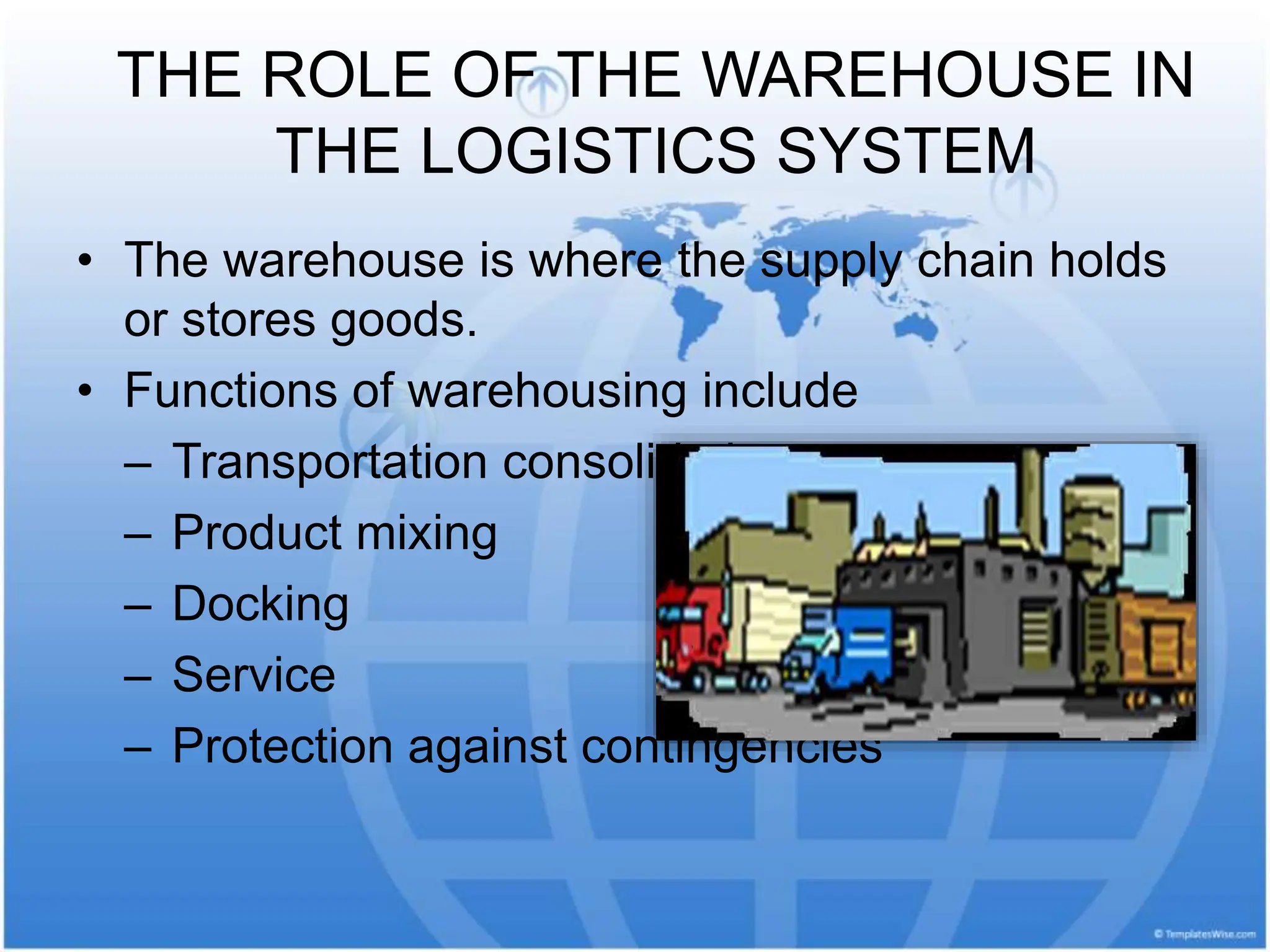
• The warehouse is where the supply chain holds
or stores goods.
• Functions of warehousing include
– Transportation consolidation
– Product mixing
– Docking
– Service
– Protection against contingencies
TYPE OF WAREHOUSING
• Public Warehousing
• Private Warehousing
• Contract Warehousing
• Multi-client Warehousing
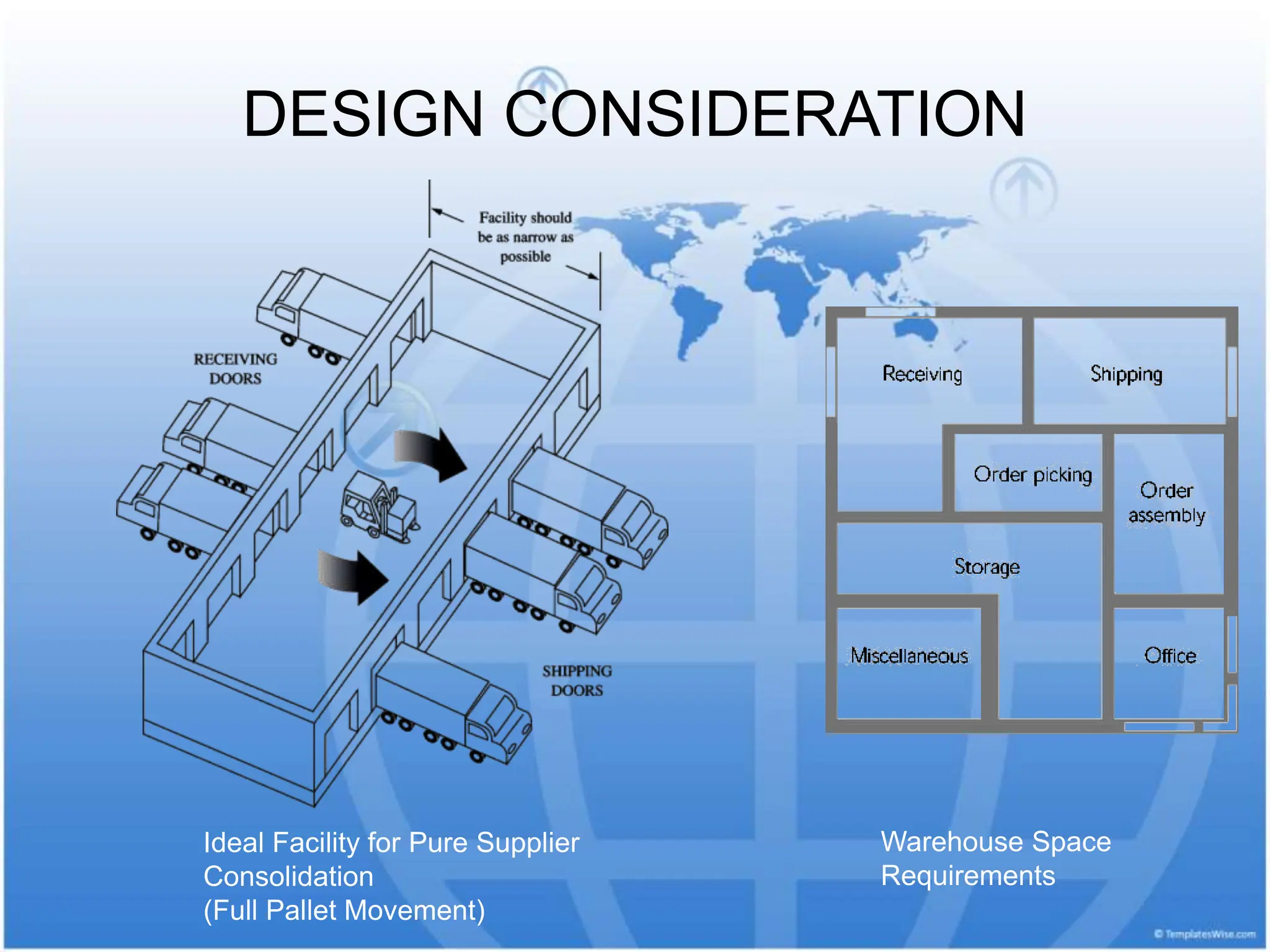
DESIGN CONSIDERATION
Ideal Facility for Pure Supplier
Consolidation
(Full Pallet Movement)
Warehouse Space
Requirements
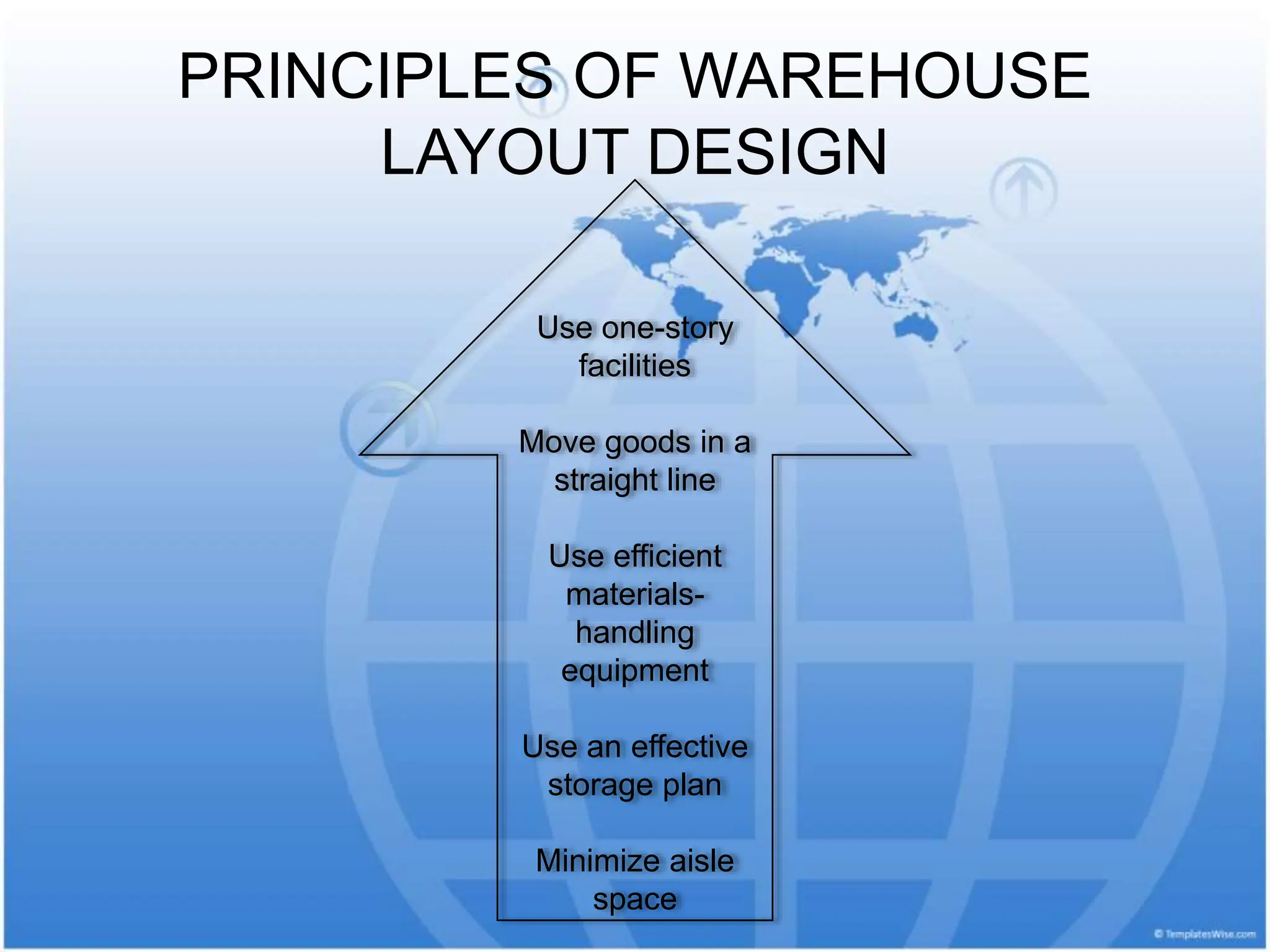
PRINCIPLES OF WAREHOUSE
LAYOUT DESIGN
Use one-story
facilities
Move goods in a
straight line
Use efficient
materials-
handling
equipment
Use an effective
storage plan
Minimize aisle
space
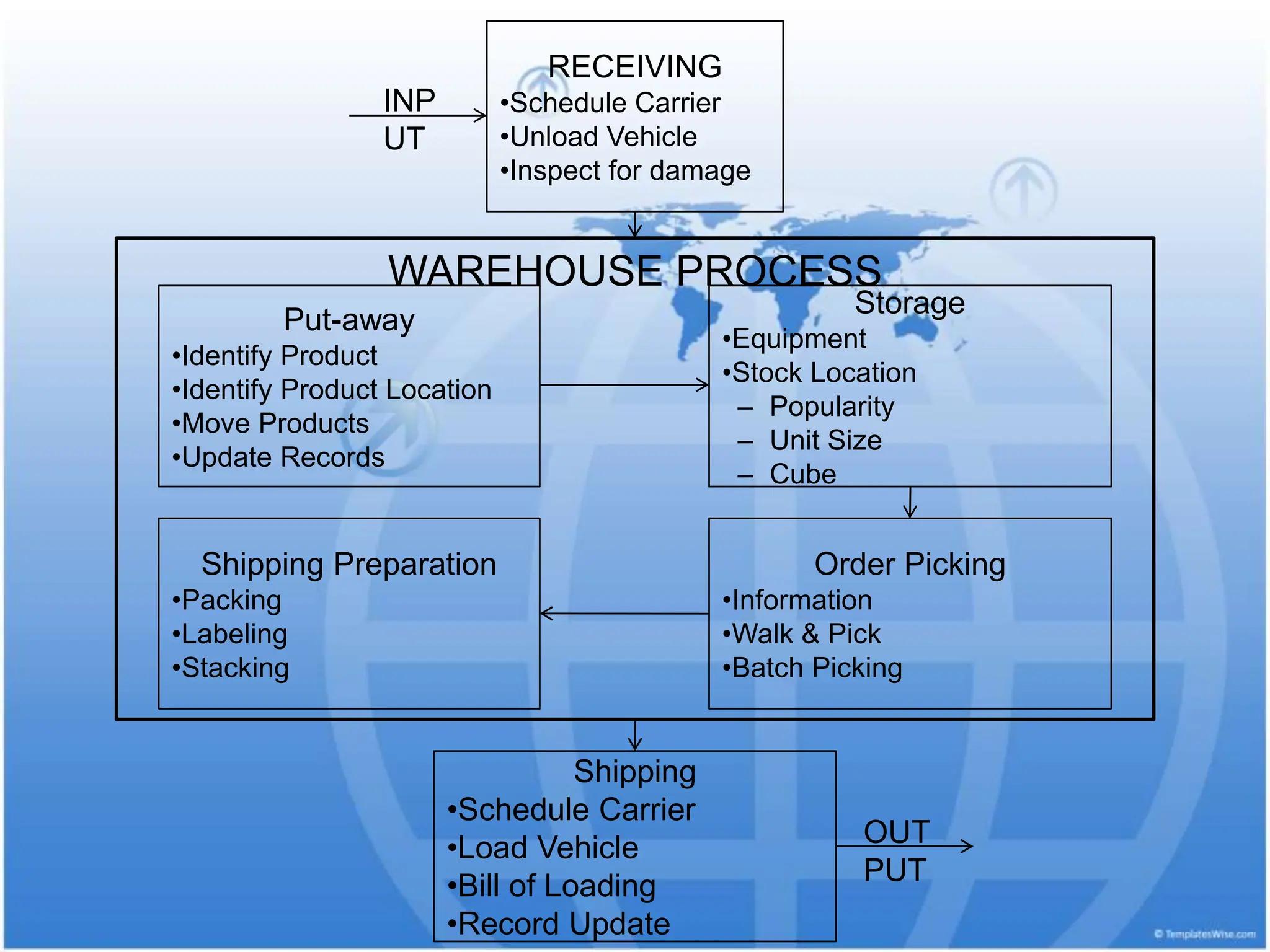
WAREHOUSE PROCESS
Put-away
•Identify Product
•Identify Product Location
•Move Products
•Update Records
Storage
•Equipment
•Stock Location
– Popularity
– Unit Size
– Cube
Shipping Preparation
•Packing
•Labeling
•Stacking
Order Picking
•Information
•Walk & Pick
•Batch Picking
Shipping
•Schedule Carrier
•Load Vehicle
•Bill of Loading
•Record Update
RECEIVING
•Schedule Carrier
•Unload Vehicle
•Inspect for damage
INP
UT
OUT
PUT
OBJECTIVES OF EFFICIENT
WAREHOUSE OPERATIONS
• Provide timely customer service.
• Keep track of items so they can be found readily &
correctly.
• Minimize the total physical effort & thus the cost of
moving goods into & out of storage.
• Provide communication links with customers
• Benefits of Warehouse Management
– Provide a place to store & protect inventory
– Reduce transportation costs
– Improve customer service levels
• Complexity of warehouse operation depends on the
number of SKUs handled & the number of orders
received & filled.
• Most activity in a warehouse is material handling.
• Capital costs
— Costs of space & materials handling
equipment
• Operating costs
— Cost of labor
— Measure of labor productivity is the number of
units that an operator can move in a day
COSTS OF OPERATING A WAREHOUSE
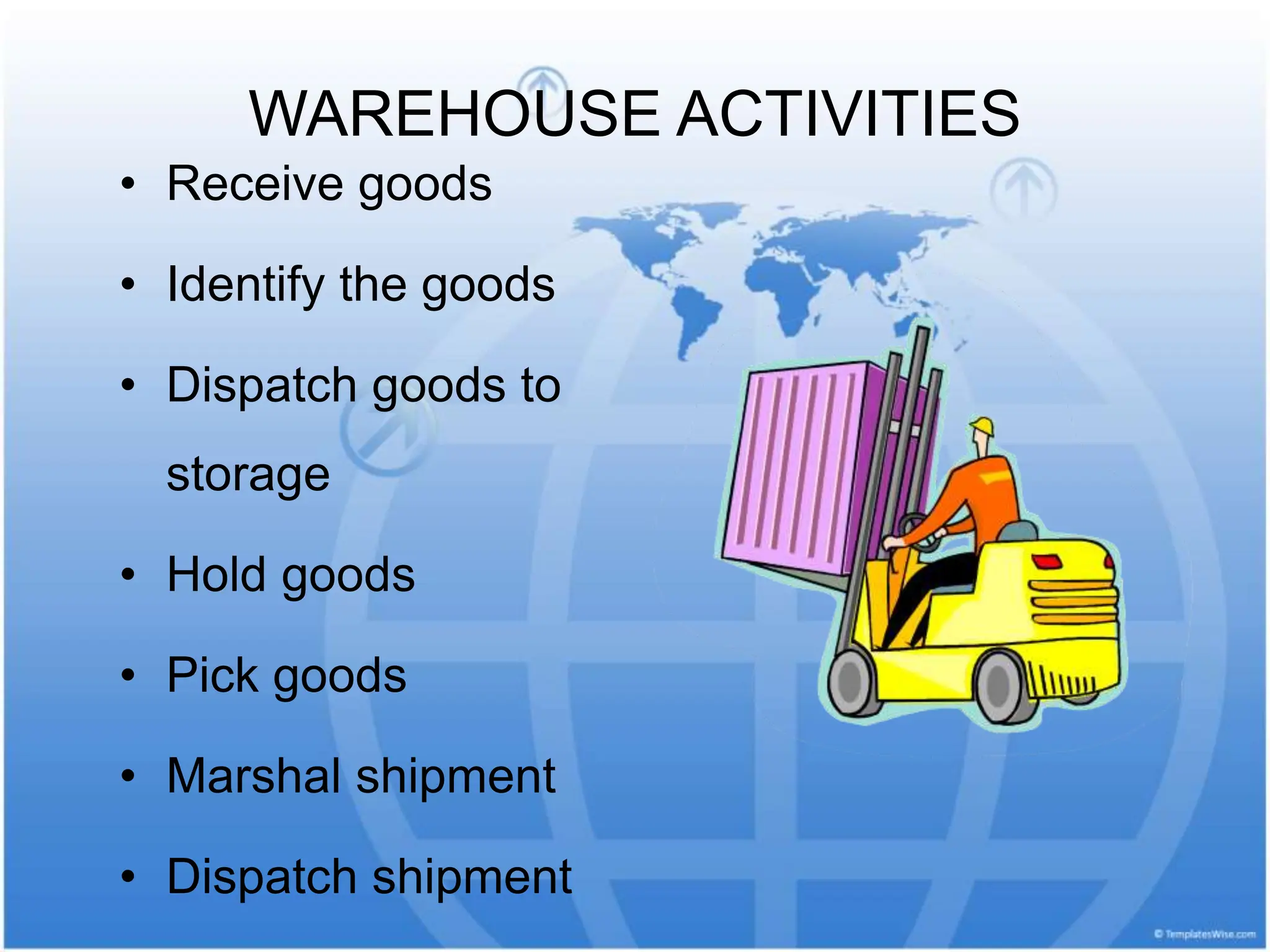
WAREHOUSE ACTIVITIES
• Receive goods
• Identify the goods
• Dispatch goods to
storage
• Hold goods
• Pick goods
• Marshal shipment
• Dispatch shipment
• Accepts goods from
‒ Outside transportation or attached factory &
accepts responsibility
• Check the goods against an order & the bill of
loading
• Check the quantities
• Check for damage & fill out damage reports if
necessary
• Inspect goods if required
Receive goods
‒ items are identified with the appropriate stock-
keeping unit (SKU) number (part number) &
the quantity received recorded
Identify the goods
Dispatch goods to storage
‒ goods are sorted & put away
Hold goods
‒ goods are kept in storage & under proper
protection until needed
Pick goods
‒ items required from stock must be selected
from storage & brought to a marshalling area
Marshal the shipment
‒ goods making up a single order are brought
together & checked for omissions or errors; order
records are updated
Dispatch the shipment
‒ orders are packaged, shipping documents are
prepared, & goods loaded on the vehicle
Operate an information system
‒ a record must be maintained for each item in
stock showing the quantity on hand, quantity
received, quantity issued, & location in the
warehouse
Maximize productivity & minimize
cost, warehouse management must
work with the following
• Maximize use of space
– space is the largest capital cost
• Effective use of labor & equipment
– labor is the largest operating cost
– material handling equipment is the second
largest capital cost
FACTORS INFLUENCING EFFECTIVE
USE OF WAREHOUSES
• Cube utilization and accessibility
• Stock location
• Order picking and assembly
• Physical Control & Security - Elements
Cube utilization and
accessibility
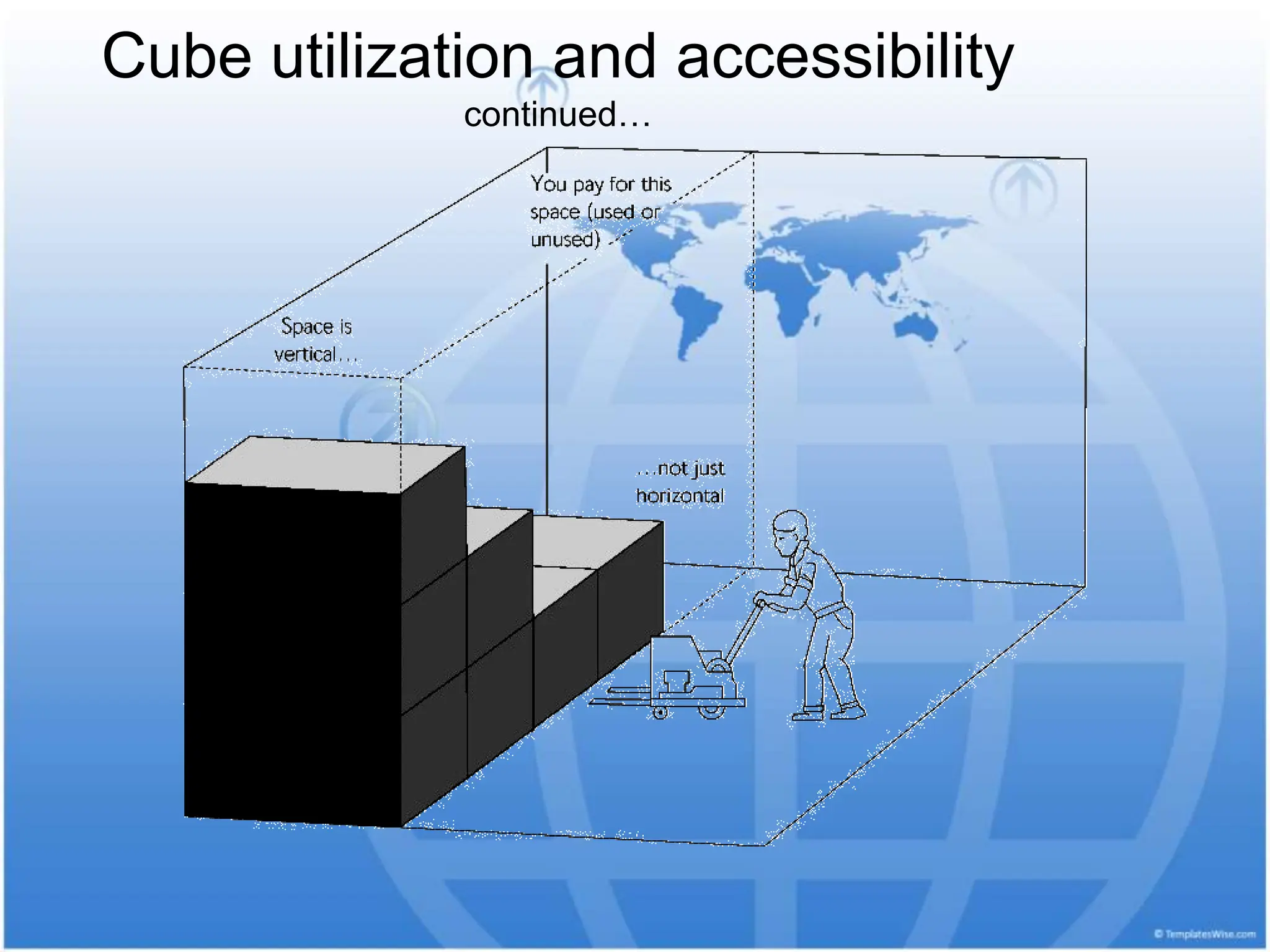
‒ Goods stored not just on the floor, but in the
cubic space of the warehouse; warehouse
capacity depends on how high goods can be
stored
‒ Accessibility means being able to get at the
goods wanted with a minimum amount of
work
Cube utilization and accessibility
continued…
Stock Location
• Objectives
– To provide the required customer
service
– To keep track of where items are stored
– To minimize effort to receive, put away,
and retrieve items
• Basic Stock Locating Systems
– Group functionally related items
together
• Fixed Location
– SKU assigned a permanent location, & no other
items are stored there
– Fixed-location systems usually have poor cube
utilization
– Usually used in small warehouses; throughput is
small, & there are few SKUs
• Floating (Random) Location
– Goods stored wherever there is appropriate
space
– Advantage is improved cube utilization
Stock Location
continued…
Stock Location
continued…
• Two other systems sometimes used are
– Point-of-use storage
• Inventory stored close to where it will be
needed
• Used in repetitive manufacturing & JIT
systems
– Central storage
• Contains all inventory in one central location
• Advantages of Point-of-use Storage
– Materials are readily accessible to users
– Material handling is reduced or eliminated
– Central storage costs are reduced
– Material is accessible all the time
Stock Location
continued…
• Advantages of Central Storage
– Ease of control
– Inventory record accuracy is easier to
maintain
– Specialized storage can be used
– Reduced safety stock, since users do not
need to carry their own safety stock
Stock Location
continued…
Order Picking and
Assembly
• When an order is received, items must
be obtained from the warehouse,
grouped, & prepared for shipment,
systems used
– Area system
– Zone system
– Multi-order system
• Area system
– Order picker circulates throughout
warehouse selecting items on an order --
order is ready to ship when order picker is
finished
• Zone system
– Warehouse is divided into zones, & each
picker works only in an assigned zone --
Order Picking and
Assembly continued…
• Multi-order system
– Same as the zone system, except that
each picker collects items for a number of
orders at the same time
Order Picking and
Assembly continued…
PHYSICAL CONTROL & SECURITY -
ELEMENTS
• Good part numbering system
• Simple, well-documented transaction system
– Identify the item
– Verify the quantity
– Record the transaction
– Physically execute the transaction
• Limited access
– Inventory must be kept in a safe, secure
(locked) place with limited general access
• Well-trained workforce
VIDEO
http://www.youtube.com/watch?v=
Cbj2d_0w24E
Questio
ns ?
THANK
YOU

WAREHOUSING MANAGEMENT file in belize org

  • 1.
    WAREHOUSING MANAGEMENT Gaurav Narkhede |Josue Servalis | Mike Macas | Praneetha Boda
  • 2.
    • Part offirms logistics system that stores products at and between point of origin and point of consumption. • Term “Warehousing” is referred as transportation at zero miles per hour • Warehousing provides time and place utility for raw materials, industrial goods, and finished products, allowing firms to use customer service as a dynamic value-adding competitive tool.
  • 3.
    THE ROLE OFTHE WAREHOUSE IN THE LOGISTICS SYSTEM • The warehouse is where the supply chain holds or stores goods. • Functions of warehousing include – Transportation consolidation – Product mixing – Docking – Service – Protection against contingencies
  • 4.
    TYPE OF WAREHOUSING •Public Warehousing • Private Warehousing • Contract Warehousing • Multi-client Warehousing
  • 5.
    DESIGN CONSIDERATION Ideal Facilityfor Pure Supplier Consolidation (Full Pallet Movement) Warehouse Space Requirements
  • 6.
    PRINCIPLES OF WAREHOUSE LAYOUTDESIGN Use one-story facilities Move goods in a straight line Use efficient materials- handling equipment Use an effective storage plan Minimize aisle space
  • 7.
    WAREHOUSE PROCESS Put-away •Identify Product •IdentifyProduct Location •Move Products •Update Records Storage •Equipment •Stock Location – Popularity – Unit Size – Cube Shipping Preparation •Packing •Labeling •Stacking Order Picking •Information •Walk & Pick •Batch Picking Shipping •Schedule Carrier •Load Vehicle •Bill of Loading •Record Update RECEIVING •Schedule Carrier •Unload Vehicle •Inspect for damage INP UT OUT PUT
  • 8.
    OBJECTIVES OF EFFICIENT WAREHOUSEOPERATIONS • Provide timely customer service. • Keep track of items so they can be found readily & correctly. • Minimize the total physical effort & thus the cost of moving goods into & out of storage. • Provide communication links with customers
  • 9.
    • Benefits ofWarehouse Management – Provide a place to store & protect inventory – Reduce transportation costs – Improve customer service levels • Complexity of warehouse operation depends on the number of SKUs handled & the number of orders received & filled. • Most activity in a warehouse is material handling.
  • 10.
    • Capital costs —Costs of space & materials handling equipment • Operating costs — Cost of labor — Measure of labor productivity is the number of units that an operator can move in a day COSTS OF OPERATING A WAREHOUSE
  • 11.
    WAREHOUSE ACTIVITIES • Receivegoods • Identify the goods • Dispatch goods to storage • Hold goods • Pick goods • Marshal shipment • Dispatch shipment
  • 12.
    • Accepts goodsfrom ‒ Outside transportation or attached factory & accepts responsibility • Check the goods against an order & the bill of loading • Check the quantities • Check for damage & fill out damage reports if necessary • Inspect goods if required Receive goods
  • 13.
    ‒ items areidentified with the appropriate stock- keeping unit (SKU) number (part number) & the quantity received recorded Identify the goods Dispatch goods to storage ‒ goods are sorted & put away Hold goods ‒ goods are kept in storage & under proper protection until needed
  • 14.
    Pick goods ‒ itemsrequired from stock must be selected from storage & brought to a marshalling area Marshal the shipment ‒ goods making up a single order are brought together & checked for omissions or errors; order records are updated
  • 15.
    Dispatch the shipment ‒orders are packaged, shipping documents are prepared, & goods loaded on the vehicle Operate an information system ‒ a record must be maintained for each item in stock showing the quantity on hand, quantity received, quantity issued, & location in the warehouse
  • 16.
    Maximize productivity &minimize cost, warehouse management must work with the following • Maximize use of space – space is the largest capital cost • Effective use of labor & equipment – labor is the largest operating cost – material handling equipment is the second largest capital cost
  • 17.
    FACTORS INFLUENCING EFFECTIVE USEOF WAREHOUSES • Cube utilization and accessibility • Stock location • Order picking and assembly • Physical Control & Security - Elements
  • 18.
    Cube utilization and accessibility ‒Goods stored not just on the floor, but in the cubic space of the warehouse; warehouse capacity depends on how high goods can be stored ‒ Accessibility means being able to get at the goods wanted with a minimum amount of work
  • 19.
    Cube utilization andaccessibility continued…
  • 20.
    Stock Location • Objectives –To provide the required customer service – To keep track of where items are stored – To minimize effort to receive, put away, and retrieve items • Basic Stock Locating Systems – Group functionally related items together
  • 21.
    • Fixed Location –SKU assigned a permanent location, & no other items are stored there – Fixed-location systems usually have poor cube utilization – Usually used in small warehouses; throughput is small, & there are few SKUs • Floating (Random) Location – Goods stored wherever there is appropriate space – Advantage is improved cube utilization Stock Location continued…
  • 22.
    Stock Location continued… • Twoother systems sometimes used are – Point-of-use storage • Inventory stored close to where it will be needed • Used in repetitive manufacturing & JIT systems – Central storage • Contains all inventory in one central location
  • 23.
    • Advantages ofPoint-of-use Storage – Materials are readily accessible to users – Material handling is reduced or eliminated – Central storage costs are reduced – Material is accessible all the time Stock Location continued…
  • 24.
    • Advantages ofCentral Storage – Ease of control – Inventory record accuracy is easier to maintain – Specialized storage can be used – Reduced safety stock, since users do not need to carry their own safety stock Stock Location continued…
  • 25.
    Order Picking and Assembly •When an order is received, items must be obtained from the warehouse, grouped, & prepared for shipment, systems used – Area system – Zone system – Multi-order system
  • 26.
    • Area system –Order picker circulates throughout warehouse selecting items on an order -- order is ready to ship when order picker is finished • Zone system – Warehouse is divided into zones, & each picker works only in an assigned zone -- Order Picking and Assembly continued…
  • 27.
    • Multi-order system –Same as the zone system, except that each picker collects items for a number of orders at the same time Order Picking and Assembly continued…
  • 28.
    PHYSICAL CONTROL &SECURITY - ELEMENTS • Good part numbering system • Simple, well-documented transaction system – Identify the item – Verify the quantity – Record the transaction – Physically execute the transaction • Limited access – Inventory must be kept in a safe, secure (locked) place with limited general access • Well-trained workforce
  • 29.
  • 30.
  • 31.