The Keys to Successful
Communication:
Purpose, Audience, and Tone
Chapter 1
Chapter 1 Learning Objectives
 In this chapter, you will learn how to:
 Determine your purpose for writing
 Identify your intended audience
 Perform productive prewriting activities
 Complete revision-ready first drafts
 Rewrite effectively to achieve appropriate tone
Determine Your Purpose
for Writing
 Three purposes of workplace writing:
 Create a record
 Request or provide information
 Persuade
 Identify which purpose applies
Purpose, continued
 Prewriting: Decide what you are trying to say by focusing on
the “Five W’s”
 Who?
 What?
 When?
 Where?
 Why?
Identify Your Intended Audience
 Tailor communications to intended audience
 Ask yourself:
 Am I writing to one person or more than one?
 What are their job titles and/or areas of responsibility?
 What do they already know about the specific situation?
 Why do they need this information?
 What do I want them to do as a result of receiving it?
 What factors might influence their response?
Audience, continued
 Classify audience by level
 Layperson—no significant prior knowledge of the field
 Expert—prior knowledge of the field
 Executive—decision-making power and expertise
Audience, continued
 Communications fall into four broad categories:
 Upward: Intended for those above you (e.g., supervisor)
 Lateral: Intended for those at your own level (e.g., co-worker)
 Downward: Intended for those below you (e.g., intern)
 Outward: Intended for those outside your workplace (e.g., client)
Audience, continued
 Global audiences demand special considerations:
 Distinguish high-context from low-context cultures
 Avoid idioms, slang, abbreviations, and acronyms that may lead to
miscommunication
 Rely on commonplace vocabulary and direct sentence structure
 Avoid culture-specific references
 Avoid attempts at humor
Perform Productive
Prewriting Activities
 Prewriting
 Identify purpose and intended audience
 Decide what needs to be said
 Choose appropriate format
Complete Revision-Ready First Drafts
 Drafting
 Concentrate on content rather than fine points of editing
Rewrite Effectively to
Achieve Appropriate Tone
 Rewriting
 Check for accuracy, completeness, ethics
 Consider organization
 Fine-tune style
 Adjust tone
 Check and edit mechanics
Tone, continued
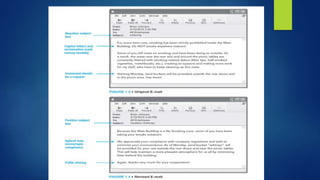
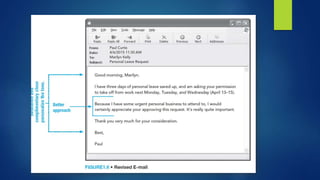
 Remember the hierarchical relationship to your reader
 Appeal to reader’s sense of fairness and cooperation vs.
sounding tough or demanding
 Emphasize the reader’s point of view by using a reader-
centered perspective (also known as the “you” approach)
 Use polite terms such as please, thank you, etc.
Tone, continued
 Avoid excessively conversational style—remember
“business is business”
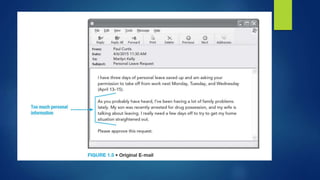
 Never allow personal matters to appear in workplace
correspondence
 A courteous, positive, reader-centered, and ethical
approach gets the best results
Review Question 1
1. Which of the following is part of the prewriting
stage?
a. Checking the organization of the content
b. Choosing the most appropriate format
c. Creating a first draft that focuses on content
d. Revising style for conciseness and simplicity
Review Question 2
2. Which of the following questions is a good way to
identify your purpose?
a. “What is the best format for this communication?
b. “Who will read what I have written?”
c. “Summarized in one sentence, what am I trying to say?”
d. “How much background knowledge does my intended reader
have?”
Review Question 3
3. Which of the following formats was traditionally the
preferred written medium for in-house
communications?
a. Business letter
b. Memo
c. Fax
Review Question 4
4. Which of the following is recommended for the
drafting stage (as opposed to the prewriting or
rewriting stage)?
a. Analyze your hierarchical relationship with the intended
audience.
b. Check that the sentences in each paragraph are presented
in the best possible order.
c. Adjust the tone to suit the audience.
d. Concentrate on content rather than fine points of
mechanics, style, and tone.
Review Question 5
5. Which of the following is an example of writer-
centered prose?
a. “We accept most credit cards and PayPal.”
b. “Your order will be shipped as soon as you specify the
desired size and color.”
c. “You may reach us by telephone until 3:00 p.m. on
Fridays.”
d. “Thank you for your order.”

Workplace Writing Chapter 1

  • 1.
    The Keys toSuccessful Communication: Purpose, Audience, and Tone Chapter 1
  • 2.
    Chapter 1 LearningObjectives  In this chapter, you will learn how to:  Determine your purpose for writing  Identify your intended audience  Perform productive prewriting activities  Complete revision-ready first drafts  Rewrite effectively to achieve appropriate tone
  • 3.
    Determine Your Purpose forWriting  Three purposes of workplace writing:  Create a record  Request or provide information  Persuade  Identify which purpose applies
  • 4.
    Purpose, continued  Prewriting:Decide what you are trying to say by focusing on the “Five W’s”  Who?  What?  When?  Where?  Why?
  • 5.
    Identify Your IntendedAudience  Tailor communications to intended audience  Ask yourself:  Am I writing to one person or more than one?  What are their job titles and/or areas of responsibility?  What do they already know about the specific situation?  Why do they need this information?  What do I want them to do as a result of receiving it?  What factors might influence their response?
  • 6.
    Audience, continued  Classifyaudience by level  Layperson—no significant prior knowledge of the field  Expert—prior knowledge of the field  Executive—decision-making power and expertise
  • 7.
    Audience, continued  Communicationsfall into four broad categories:  Upward: Intended for those above you (e.g., supervisor)  Lateral: Intended for those at your own level (e.g., co-worker)  Downward: Intended for those below you (e.g., intern)  Outward: Intended for those outside your workplace (e.g., client)
  • 8.
    Audience, continued  Globalaudiences demand special considerations:  Distinguish high-context from low-context cultures  Avoid idioms, slang, abbreviations, and acronyms that may lead to miscommunication  Rely on commonplace vocabulary and direct sentence structure  Avoid culture-specific references  Avoid attempts at humor
  • 9.
    Perform Productive Prewriting Activities Prewriting  Identify purpose and intended audience  Decide what needs to be said  Choose appropriate format
  • 10.
    Complete Revision-Ready FirstDrafts  Drafting  Concentrate on content rather than fine points of editing
  • 11.
    Rewrite Effectively to AchieveAppropriate Tone  Rewriting  Check for accuracy, completeness, ethics  Consider organization  Fine-tune style  Adjust tone  Check and edit mechanics
  • 12.
    Tone, continued  Rememberthe hierarchical relationship to your reader  Appeal to reader’s sense of fairness and cooperation vs. sounding tough or demanding  Emphasize the reader’s point of view by using a reader- centered perspective (also known as the “you” approach)  Use polite terms such as please, thank you, etc.
  • 13.
    Tone, continued  Avoidexcessively conversational style—remember “business is business”  Never allow personal matters to appear in workplace correspondence  A courteous, positive, reader-centered, and ethical approach gets the best results
  • 17.
    Review Question 1 1.Which of the following is part of the prewriting stage? a. Checking the organization of the content b. Choosing the most appropriate format c. Creating a first draft that focuses on content d. Revising style for conciseness and simplicity
  • 18.
    Review Question 2 2.Which of the following questions is a good way to identify your purpose? a. “What is the best format for this communication? b. “Who will read what I have written?” c. “Summarized in one sentence, what am I trying to say?” d. “How much background knowledge does my intended reader have?”
  • 19.
    Review Question 3 3.Which of the following formats was traditionally the preferred written medium for in-house communications? a. Business letter b. Memo c. Fax
  • 20.
    Review Question 4 4.Which of the following is recommended for the drafting stage (as opposed to the prewriting or rewriting stage)? a. Analyze your hierarchical relationship with the intended audience. b. Check that the sentences in each paragraph are presented in the best possible order. c. Adjust the tone to suit the audience. d. Concentrate on content rather than fine points of mechanics, style, and tone.
  • 21.
    Review Question 5 5.Which of the following is an example of writer- centered prose? a. “We accept most credit cards and PayPal.” b. “Your order will be shipped as soon as you specify the desired size and color.” c. “You may reach us by telephone until 3:00 p.m. on Fridays.” d. “Thank you for your order.”

Editor's Notes

  • #4 Students whose previous writing has been limited mainly to academic writing on pre-set or suggested topics may not be used to thinking in terms of the purposes of workplace writing. You may want to ask students to reflect on writing they have done in the workplace or in volunteer/student organization work. Then ask them to categorize specific instances of writing as one of these three purposes. Students may note that some writing has multiple purposes. For example, a brochure may be designed to both inform and persuade. In such cases, students should try to identify the primary purpose, or perhaps assign different purposes to different sections of the document.
  • #6 Again, workplace writing opens up a new set of considerations about audience. Students who are used to writing primarily to faculty members (who generally have more knowledge than the student about the subject matter being written about) need to learn to think in different ways about workplace audiences. If you have asked students to reflect on workplace or organizational writing that they have done, you may want to have them return to those examples and classify the audiences to whom they were writing.
  • #8 It is common for workplace writing to have not just a primary audience but also a secondary audience. Ask students to think about any features of workplace writing they have seen that are designed to accommodate multiple audiences. (Examples might include appendix materials in a report; glossaries; the “cc” feature on e-mails and memos.)
  • #9 It is common for workplace writing to have not just a primary audience but also a secondary audience. Ask students to think about any features of workplace writing they have seen that are designed to accommodate multiple audiences. (Examples might include appendix materials in a report; glossaries; the “cc” feature on e-mails and memos.)
  • #11 The main point for students to realize about the drafting stage is that the goal is to get ideas down—not necessarily in their final order or form.
  • #12 Students may enjoy bringing in examples of e-mails, memos, or other types of workplace writing that illustrate successful and unsuccessful tone.