AUGMENTED REALITY AND
VIRTUAL REALITY
AUGMENTED REALITY - ReInvented
 Technology is improving at a rapid pace, as many things are
possible today that were not possible 10 years ago even if we tried
our best to make it happen. Today, some of the impossible things
are rising to the occasion in the form of Augmented Reality and
Virtual Reality. But what are they exactly? Let's find out.
 Back in the 1990s, virtual reality was on the lips of everyone as
multiple companies tried and failed to make it happen. The most
notable device back then was the Nintendo Virtual Boy, though
it failed miserably, and was discontinued a year after going on
sale. Since then, Nintendo has never attempted improve on the
technology, which could set the company behind its competition
as virtual reality is slowly creeping back into our lives.
Contents
 Introduction
 Augmented Reality
 Augmented Reality System
 Augmenting World Tour
 Examples
 Implementation
 Component of AR system
 Head Mounted Display ( HDR )
 Tracking & orientation
 Using Augmented reality
 Limitations
Introduction
 Augmented Reality is a field of computer research
which deals with combination of reality with computer
generated data.
 It is still in an early stage of research and development,
possibly by the end of this decade we will see the first
mass-marketed AR system.
Implementation
 To implement there are four things that we require to do
 First, find users location
 Second, find users orientation
 Third, Generating information
 Fourth, Augmenting the information to users view.
Types of VR System
 Windows on World(WoW)
 Also called Desktop VR.
 Using a conventional computer monitor to
display the 3D virtual world.
 Immersive VR
 Completely immerse the user's personal viewpoint inside
the virtual 3D world.
 The user has no visual contact with the physical word.
 Often equipped with a Head Mounted Display (HMD).
Types of VR System(Cont’d)
 Mixed Reality(Augmented Reality)
 The seamless merging of real space and virtual space.
 Integrate the computer-generated virtual objects into the
physical world which become in a sense an equal part of
our natural environment.
Distributed VR
 A simulated world runs on several computers which are
connected over network and the people are able to interact
in real time, sharing the same virtual world.
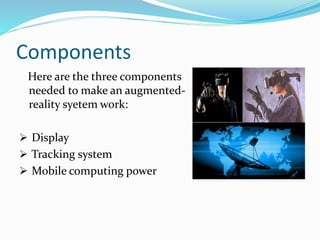
Components
Here are the three components
needed to make an augmented-
reality syetem work:
 Display
 Tracking system
 Mobile computing power
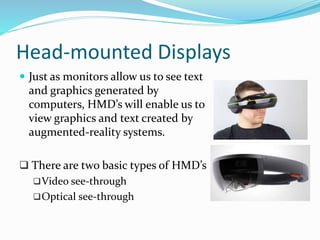
Head-mounted Displays
 Just as monitors allow us to see text
and graphics generated by
computers, HMD’s will enable us to
view graphics and text created by
augmented-reality systems.
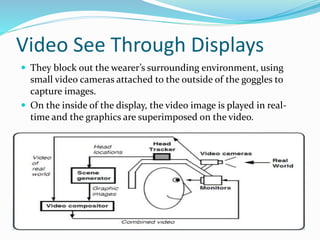
 There are two basic types of HMD’s
Video see-through
Optical see-through
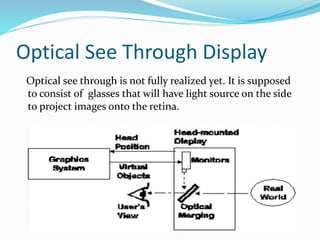
Video See Through Displays
 They block out the wearer’s surrounding environment, using
small video cameras attached to the outside of the goggles to
capture images.
 On the inside of the display, the video image is played in real-
time and the graphics are superimposed on the video.
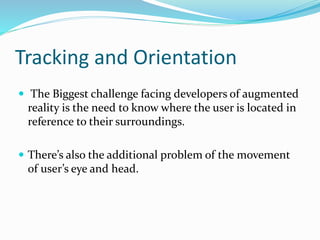
Optical See Through Display
Optical see through is not fully realized yet. It is supposed
to consist of glasses that will have light source on the side
to project images onto the retina.
Tracking and Orientation
 The Biggest challenge facing developers of augmented
reality is the need to know where the user is located in
reference to their surroundings.
 There’s also the additional problem of the movement
of user’s eye and head.
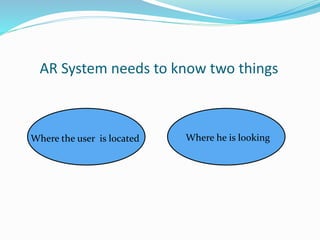
AR System needs to know two things
Where the user is located Where he is looking
GPS – Tracking Technology
 Currently, the best tracking technology available for
large open areas is the GLOBAL POSITIONING
SYSTEM.
 However, GPS receivers have an accuracy to about 10-
30 meters, which is not bad in the ground scheme of
things, but isn’t good enough for AR, which needs
accuracy measured on a much smaller scale.
 Real Time Differential GPS may be used for better
accuracy.
Mobile Computing Power
Wearable computers
 Mobile computing can be accomplished with help of
wearable computers
 A wearable computer is a battery powered computer
system worn on the user’s body.
 It is designed for mobile and predominantly hands free
operations often incorporating head mounted display
and speech input.
Using Augmented Reality
 Education, Medical science, Medical surgeries,
Military Operation, Touring, Gaming, etc.
 Education : History for example can be taught with virtual 3D
visuals.
 Medical : In Teaching students without requiring real human
organs, Surgeons can operate patient from a distant location.
 Military : Help military in trainings and identifying enemy
location and building maps.
 Touring : Live information access at new places.
 Gaming: offering a complete gaming studio environment at
home.
Casino and Virtual Reality
 In partnership with Google, Infinity Augmented Reality Inc. will soon be
changing how casino games are played online. By using augmented eyewear
and a 360 degree camera that can pan the entire casino, players will step into
the action and enjoy gambling like never before. There are some huge
challenges ahead for these companies and it will be necessary to create brand
new software and hardware to deliver this gambling experience to players.
 Despite the fact that the Oculus Rift headset is unlikely to become
commercially available at least until Q1 of 2016, online gambling
company SlotsMillion has spent the past seven months rendering its online
casino experience in VR.
The result is a casino lobby in the clouds, on the 80th floor of a skyscraper in a
futuristic cityscape. Here, you can prop up the bar, choose to play any number
of immersive 3D slots games, interact with other players, and experience very
real vertigo when you lean against the windows and look down.
Limitations
 Accurate Tracking and Orientation.
 Costly Hardware and not yet available for commercial
use.
 Device capability in terms of computing power and
device size.
Major players in Virtual Reality
 Oculus Rift, Oculus VR and Facebook : Perhaps the largest
silhouette on the Virtual Reality horizon is cast by Oculus VR, the
makers of the Oculus Rift headsets. FB baught Oculus in 2014 and
more recent acquisition of Surrwal Vision is a great step in future
offering users to feel telepresence.
 Microsoft Hololens : Microsoft HoloLens is shaping up to be
another formidable competitor in the Virtual Reality market. Unlike
the Oculus Rift, Microsoft’s ambitious research teams are basing their
display on holographic technology. While this lends itself to
Augmented Reality (or, as Microsoft prefers to call it, “mixed reality”)
more than VR, it’s clear that the display technology alone is meant to
be a jumping-off point for virtual experiences to come.
Major players in Virtual Reality (Cont’d)
 Sony’s project Morpheus : Sony’s entry into the
market, Project Morpheus. attempts to streamline what Oculus
offers, with integration into the already-successful PlayStation
game systems. Like the Oculus Rift, the Morpheus headset is
scheduled for early 2016.
 Samsung Gear VR & Google cardboard : Instead of
dedicated display technology, lenses allow the phone’s screen to
act as a stereoscopic display.
References
 http://venturebeat.com/2015/11/13/gambling-on-
virtual-reality-the-online-casinos-of-the-future/
 http://www.augmented-reality-games.com/online-
casino.php
 http://www.marxentlabs.com/what-is-virtual-reality-
definition-and-examples/
 http://www.marxentlabs.com/top-virtual-reality-
augmented-reality-trends-2015/
THANK
YOU

AR/VR basics

  • 1.
  • 2.
    AUGMENTED REALITY -ReInvented  Technology is improving at a rapid pace, as many things are possible today that were not possible 10 years ago even if we tried our best to make it happen. Today, some of the impossible things are rising to the occasion in the form of Augmented Reality and Virtual Reality. But what are they exactly? Let's find out.  Back in the 1990s, virtual reality was on the lips of everyone as multiple companies tried and failed to make it happen. The most notable device back then was the Nintendo Virtual Boy, though it failed miserably, and was discontinued a year after going on sale. Since then, Nintendo has never attempted improve on the technology, which could set the company behind its competition as virtual reality is slowly creeping back into our lives.
  • 3.
    Contents  Introduction  AugmentedReality  Augmented Reality System  Augmenting World Tour  Examples  Implementation  Component of AR system  Head Mounted Display ( HDR )  Tracking & orientation  Using Augmented reality  Limitations
  • 4.
    Introduction  Augmented Realityis a field of computer research which deals with combination of reality with computer generated data.  It is still in an early stage of research and development, possibly by the end of this decade we will see the first mass-marketed AR system.
  • 5.
    Implementation  To implementthere are four things that we require to do  First, find users location  Second, find users orientation  Third, Generating information  Fourth, Augmenting the information to users view.
  • 6.
    Types of VRSystem  Windows on World(WoW)  Also called Desktop VR.  Using a conventional computer monitor to display the 3D virtual world.  Immersive VR  Completely immerse the user's personal viewpoint inside the virtual 3D world.  The user has no visual contact with the physical word.  Often equipped with a Head Mounted Display (HMD).
  • 7.
    Types of VRSystem(Cont’d)  Mixed Reality(Augmented Reality)  The seamless merging of real space and virtual space.  Integrate the computer-generated virtual objects into the physical world which become in a sense an equal part of our natural environment. Distributed VR  A simulated world runs on several computers which are connected over network and the people are able to interact in real time, sharing the same virtual world.
  • 8.
    Components Here are thethree components needed to make an augmented- reality syetem work:  Display  Tracking system  Mobile computing power
  • 9.
    Head-mounted Displays  Justas monitors allow us to see text and graphics generated by computers, HMD’s will enable us to view graphics and text created by augmented-reality systems.  There are two basic types of HMD’s Video see-through Optical see-through
  • 10.
    Video See ThroughDisplays  They block out the wearer’s surrounding environment, using small video cameras attached to the outside of the goggles to capture images.  On the inside of the display, the video image is played in real- time and the graphics are superimposed on the video.
  • 11.
    Optical See ThroughDisplay Optical see through is not fully realized yet. It is supposed to consist of glasses that will have light source on the side to project images onto the retina.
  • 12.
    Tracking and Orientation The Biggest challenge facing developers of augmented reality is the need to know where the user is located in reference to their surroundings.  There’s also the additional problem of the movement of user’s eye and head.
  • 13.
    AR System needsto know two things Where the user is located Where he is looking
  • 14.
    GPS – TrackingTechnology  Currently, the best tracking technology available for large open areas is the GLOBAL POSITIONING SYSTEM.  However, GPS receivers have an accuracy to about 10- 30 meters, which is not bad in the ground scheme of things, but isn’t good enough for AR, which needs accuracy measured on a much smaller scale.  Real Time Differential GPS may be used for better accuracy.
  • 15.
    Mobile Computing Power Wearablecomputers  Mobile computing can be accomplished with help of wearable computers  A wearable computer is a battery powered computer system worn on the user’s body.  It is designed for mobile and predominantly hands free operations often incorporating head mounted display and speech input.
  • 16.
    Using Augmented Reality Education, Medical science, Medical surgeries, Military Operation, Touring, Gaming, etc.  Education : History for example can be taught with virtual 3D visuals.  Medical : In Teaching students without requiring real human organs, Surgeons can operate patient from a distant location.  Military : Help military in trainings and identifying enemy location and building maps.  Touring : Live information access at new places.  Gaming: offering a complete gaming studio environment at home.
  • 17.
    Casino and VirtualReality  In partnership with Google, Infinity Augmented Reality Inc. will soon be changing how casino games are played online. By using augmented eyewear and a 360 degree camera that can pan the entire casino, players will step into the action and enjoy gambling like never before. There are some huge challenges ahead for these companies and it will be necessary to create brand new software and hardware to deliver this gambling experience to players.  Despite the fact that the Oculus Rift headset is unlikely to become commercially available at least until Q1 of 2016, online gambling company SlotsMillion has spent the past seven months rendering its online casino experience in VR. The result is a casino lobby in the clouds, on the 80th floor of a skyscraper in a futuristic cityscape. Here, you can prop up the bar, choose to play any number of immersive 3D slots games, interact with other players, and experience very real vertigo when you lean against the windows and look down.
  • 18.
    Limitations  Accurate Trackingand Orientation.  Costly Hardware and not yet available for commercial use.  Device capability in terms of computing power and device size.
  • 19.
    Major players inVirtual Reality  Oculus Rift, Oculus VR and Facebook : Perhaps the largest silhouette on the Virtual Reality horizon is cast by Oculus VR, the makers of the Oculus Rift headsets. FB baught Oculus in 2014 and more recent acquisition of Surrwal Vision is a great step in future offering users to feel telepresence.  Microsoft Hololens : Microsoft HoloLens is shaping up to be another formidable competitor in the Virtual Reality market. Unlike the Oculus Rift, Microsoft’s ambitious research teams are basing their display on holographic technology. While this lends itself to Augmented Reality (or, as Microsoft prefers to call it, “mixed reality”) more than VR, it’s clear that the display technology alone is meant to be a jumping-off point for virtual experiences to come.
  • 20.
    Major players inVirtual Reality (Cont’d)  Sony’s project Morpheus : Sony’s entry into the market, Project Morpheus. attempts to streamline what Oculus offers, with integration into the already-successful PlayStation game systems. Like the Oculus Rift, the Morpheus headset is scheduled for early 2016.  Samsung Gear VR & Google cardboard : Instead of dedicated display technology, lenses allow the phone’s screen to act as a stereoscopic display.
  • 21.
    References  http://venturebeat.com/2015/11/13/gambling-on- virtual-reality-the-online-casinos-of-the-future/  http://www.augmented-reality-games.com/online- casino.php http://www.marxentlabs.com/what-is-virtual-reality- definition-and-examples/  http://www.marxentlabs.com/top-virtual-reality- augmented-reality-trends-2015/
  • 22.