Augmented Reality
&
Virtual Reality
Reality?
❏ The state of things as they actually exist
❏ A thing that is actually experienced or
seen, especially when this is unpleasant.
"we want to make the dream to reality"
REALITY
Augmented Reality (AR)
1. Augmented Reality (AR) is an interactive experience of
a real-world environment whereby the objects that
reside in the real-world are "augmented" by
computer-generated perceptual information
1. Augmented reality is that it brings components of the
digital world into a person's perception of the real
world
1. Augmented reality is used to enhance natural
environments or situations and offer perceptually
enriched experiences.
How It Works?
❖ Augmented Reality (AR) refers to deploying virtual
image over real-world objects.
❖ The overlay is executed simultaneously with the input
received from a camera or another input device like
smart glasses.
❖ This superimposition of virtual images over real-world
objects creates an illusion that can effectively engage
users in a virtual world.
The Development
There are 3 main categories of AR tools:
Augmented Reality 3D viewers -:allow users to place life-size 3D
models in your surrounding with or without the use of trackers.
Augmented Reality browsers - enrich your camera display with
contextual data. You can literally point your smartphone at a
house or building to estimate its value or to display its history.
Augmented Reality gaming - imagine shooting zombies while
walking in your own bedroom! Thus, the biggest use of AR gaming
to-date is definitely Pokémon Go, allowing users to catch virtual
Pokémon creatures that are hidden throughout a map of the real
environment.
Augmented Reality Devices
Mobile devices
● Through mobile devices like smartphones (tablets also), AR
acts like a magic window
PC and connected TV players
● Augmented Reality also works through a webcam and
broadcast through the screen
Head mounted displays, glasses and lenses
● AR becomes a part of your entire field of view, preparing for
more life-like AR experiences - almost feels like Ironman with
the help of the intelligent system Jarvis
APPLICATIONS
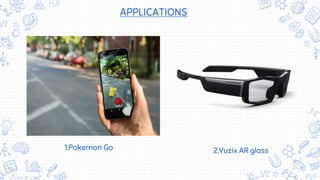
1.Pokemon Go 2.Vuzix AR glass
virtual reality (VR)
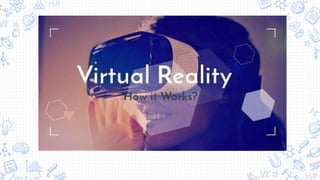
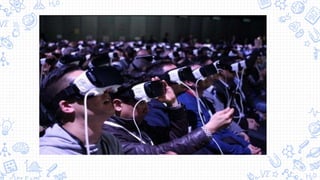
❏ Virtual reality is a way to create a computer-
generated environment that immerses the user into a
virtual world. When we put on a VR headset it takes us
to a simulated set-up making us completely aloof
from the actual surroundings
❏ The technology behind virtual reality and the basic
terminology surrounding the development of a
simulated ecosystem for a head-mounted display (VR
headset).
How It Works?
❏ The primary subject of virtual reality is simulating the vision. Every
headset aims to perfect their approach to creating an immersive 3D
environment. Each VR headset puts up a screen (or two - one for each
eye) in front of eyes thus, eliminating any interaction with the real
world. Two autofocus lenses are generally placed between the screen
and the eyes that adjust based on individual eye movement1 and
positioning. The visuals on the screen are rendered either by using a
mobile phone or PC.
❏ To create a truly immersive virtual reality there are certain
prerequisites - a frame rate of minimum 60fps, an equally competent
refresh rate and minimum 100-degree field of view (FOV) (though 180
degrees is ideal). The frame rate is the rate at which the GPU can
process the images per second
To create an complete VR experience it has
❏ The Impact of Sound:Sound effects, when synced with the visuals, can
create very engaging effects. By using a headphone and 3D sound effects the user’s
belief in the virtual environment can be reassured. While crafting sound effects due
care needs to be taken about the consistency between the graphics and the sound. If
you start playing horror music in the background of a fairy tale movie it will just put
the user off.
❏ Eye and Head Tracking:Eye and head tracking can be ensured using
laser pointers, led lights or mobile sensors. In mobile, we use the accelerometer to
detect three-dimensional movement, gyroscope for angular movement and
magnetometer to identify the position relative to the Earth. If we need to achieve a
very high accuracy then cameras and sensors can be installed in the room where you
would use the headset. Although this is a much costlier setup as compared to using
basic phone sensors.
Applications
❏ Field Training Without The Field
❏ Information Overlays And Virtual Object Manipulation
❏ For Surgical Training
❏ Cooking
❏ Educational purposes
Difference Between
Augmented reality (AR)
adds digital elements to
a live view often by
using the camera on a
smartphone. Examples
of augmented reality
experiences include
Snapchat lenses and
the game Pokemon Go.
Virtual reality (VR)
implies a complete
immersion experience
that shuts out the
physical world. Using VR
devices such as HTC
Vive, Oculus Rift or
Google Cardboard,
users can be
transported into a
number of real-world
and imagined
environments such as
the middle of a
squawking penguin
colony or even the back
of a dragon.
mixed reality (MR)
experience, which
combines elements of
both AR and VR, real-
world and digital objects
interact. Mixed reality
technology is just now
starting to take off with
Microsoft’s HoloLens one
of the most notable
early mixed reality
apparatuses.
By:
Sooriya.G
Cse-department
2nd year

Augmented reality & virtual reality

  • 1.
  • 2.
    Reality? ❏ The stateof things as they actually exist ❏ A thing that is actually experienced or seen, especially when this is unpleasant. "we want to make the dream to reality"
  • 3.
  • 4.
    Augmented Reality (AR) 1.Augmented Reality (AR) is an interactive experience of a real-world environment whereby the objects that reside in the real-world are "augmented" by computer-generated perceptual information 1. Augmented reality is that it brings components of the digital world into a person's perception of the real world 1. Augmented reality is used to enhance natural environments or situations and offer perceptually enriched experiences.
  • 5.
    How It Works? ❖Augmented Reality (AR) refers to deploying virtual image over real-world objects. ❖ The overlay is executed simultaneously with the input received from a camera or another input device like smart glasses. ❖ This superimposition of virtual images over real-world objects creates an illusion that can effectively engage users in a virtual world.
  • 6.
  • 7.
    There are 3main categories of AR tools: Augmented Reality 3D viewers -:allow users to place life-size 3D models in your surrounding with or without the use of trackers. Augmented Reality browsers - enrich your camera display with contextual data. You can literally point your smartphone at a house or building to estimate its value or to display its history. Augmented Reality gaming - imagine shooting zombies while walking in your own bedroom! Thus, the biggest use of AR gaming to-date is definitely Pokémon Go, allowing users to catch virtual Pokémon creatures that are hidden throughout a map of the real environment.
  • 8.
    Augmented Reality Devices Mobiledevices ● Through mobile devices like smartphones (tablets also), AR acts like a magic window PC and connected TV players ● Augmented Reality also works through a webcam and broadcast through the screen Head mounted displays, glasses and lenses ● AR becomes a part of your entire field of view, preparing for more life-like AR experiences - almost feels like Ironman with the help of the intelligent system Jarvis
  • 9.
  • 10.
    virtual reality (VR) ❏Virtual reality is a way to create a computer- generated environment that immerses the user into a virtual world. When we put on a VR headset it takes us to a simulated set-up making us completely aloof from the actual surroundings ❏ The technology behind virtual reality and the basic terminology surrounding the development of a simulated ecosystem for a head-mounted display (VR headset).
  • 12.
    How It Works? ❏The primary subject of virtual reality is simulating the vision. Every headset aims to perfect their approach to creating an immersive 3D environment. Each VR headset puts up a screen (or two - one for each eye) in front of eyes thus, eliminating any interaction with the real world. Two autofocus lenses are generally placed between the screen and the eyes that adjust based on individual eye movement1 and positioning. The visuals on the screen are rendered either by using a mobile phone or PC. ❏ To create a truly immersive virtual reality there are certain prerequisites - a frame rate of minimum 60fps, an equally competent refresh rate and minimum 100-degree field of view (FOV) (though 180 degrees is ideal). The frame rate is the rate at which the GPU can process the images per second
  • 14.
    To create ancomplete VR experience it has ❏ The Impact of Sound:Sound effects, when synced with the visuals, can create very engaging effects. By using a headphone and 3D sound effects the user’s belief in the virtual environment can be reassured. While crafting sound effects due care needs to be taken about the consistency between the graphics and the sound. If you start playing horror music in the background of a fairy tale movie it will just put the user off. ❏ Eye and Head Tracking:Eye and head tracking can be ensured using laser pointers, led lights or mobile sensors. In mobile, we use the accelerometer to detect three-dimensional movement, gyroscope for angular movement and magnetometer to identify the position relative to the Earth. If we need to achieve a very high accuracy then cameras and sensors can be installed in the room where you would use the headset. Although this is a much costlier setup as compared to using basic phone sensors.
  • 15.
    Applications ❏ Field TrainingWithout The Field ❏ Information Overlays And Virtual Object Manipulation ❏ For Surgical Training ❏ Cooking ❏ Educational purposes
  • 16.
    Difference Between Augmented reality(AR) adds digital elements to a live view often by using the camera on a smartphone. Examples of augmented reality experiences include Snapchat lenses and the game Pokemon Go. Virtual reality (VR) implies a complete immersion experience that shuts out the physical world. Using VR devices such as HTC Vive, Oculus Rift or Google Cardboard, users can be transported into a number of real-world and imagined environments such as the middle of a squawking penguin colony or even the back of a dragon. mixed reality (MR) experience, which combines elements of both AR and VR, real- world and digital objects interact. Mixed reality technology is just now starting to take off with Microsoft’s HoloLens one of the most notable early mixed reality apparatuses.
  • 18.