1
CHAPTER 5
Augmented
Reality
(AR)
2
Outline
•Overview of AR
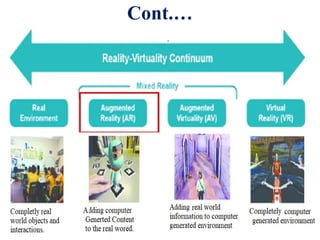
•AR, VR and MR
•Architecture of AR Systems
•Applications of AR
3
What is Augmented Reality?
• AR refers to a technology that combines the view of
real environment with virtual content that is
presented through computer graphics to enhance the
user's perception of reality.
• AR is achieved by ensuring that the virtual content is
aligned and registered with the real objects.

It overlays virtual elements onto the physical
environment, allowing users to interact with both real
and virtual objects simultaneously.
4
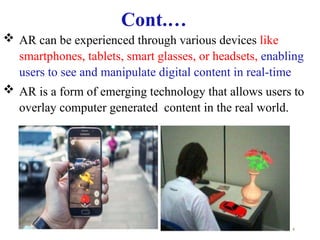
 AR can be experienced through various devices like
smartphones, tablets, smart glasses, or headsets, enabling
users to see and manipulate digital content in real-time
 AR is a form of emerging technology that allows users to
overlay computer generated content in the real world.
Cont.…
5
AR, VR and MR
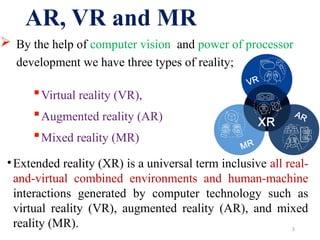
•Extended reality (XR) is a universal term inclusive all real-
and-virtual combined environments and human-machine
interactions generated by computer technology such as
virtual reality (VR), augmented reality (AR), and mixed
reality (MR).
 By the help of computer vision and power of processor
development we have three types of reality;
Virtual reality (VR),
Augmented reality (AR)
Mixed reality (MR)
6
Virtual Reality (VR)
VR is a technology that creates virtual environment
This environment is perceived through a device known as a
virtual reality headset or helmet
It is computer -generated simulation of an environment or a
3-dimentioal image making the user feel they are immersed
in their surrounding.
VR is fully immersive, which tricks your senses into
thinking you’re in a different environment or world apart
from the real world
It is called a computer-simulated reality
7
Cont.…
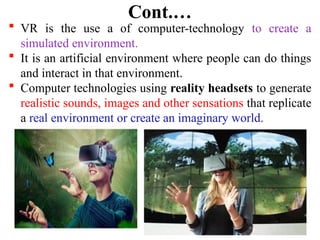
 VR is the use a of computer-technology to create a
simulated environment.
 It is an artificial environment where people can do things
and interact in that environment.
 Computer technologies using reality headsets to generate
realistic sounds, images and other sensations that replicate
a real environment or create an imaginary world.
8
Augmented Reality
• Advanced version of VR
• An enhanced version of the real physical world that is achieved through
the use of digital visual elements, sound, or other sensory stimuli
delivered via technology.
• Add vertiual things in a real world
Users can see and interact with the real world while digital content is
added to it:
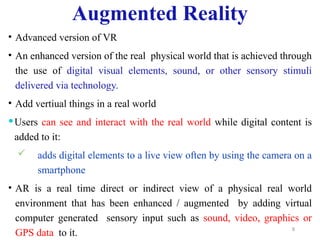
 adds digital elements to a live view often by using the camera on a
smartphone
• AR is a real time direct or indirect view of a physical real world
environment that has been enhanced / augmented by adding virtual
computer generated sensory input such as sound, video, graphics or
GPS data to it.
9
Examples of AR
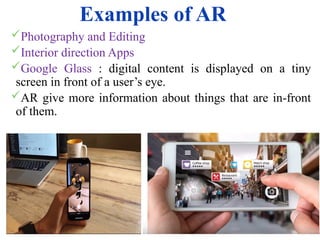
Photography and Editing
Interior direction Apps
Google Glass : digital content is displayed on a tiny
screen in front of a user’s eye.
AR give more information about things that are in-front
of them.
10
Mixed Reality (MR)
Sometimes referred to as hybrid reality
It is the merging of real and virtual worlds to produce new
environments and visualizations where physical & digital
objects co-exist & interact in real-time.
play a virtual video game, grab your real-world water
bottle, and smack an imaginary character from the game
with the bottle.
11
Cont.…
In MR users can interact with and manipulate both
physical and virtual items and environments using next
generation sensing and imagination technology..
The key character of MR is that the artificial content
and the real world content are able to react to each other
in real time.
• M.R Provides the ability one foot (or hand) in the real
world, and the other in an imaginary place.
• Breaking down basic concepts between real &
imaginary
12
Cont.…
13
AR vs VR vs MR
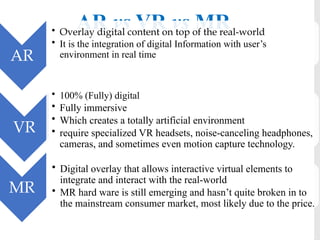
AR
• Overlay digital content on top of the real-world
• It is the integration of digital Information with user’s
environment in real time
VR
• 100% (Fully) digital
• Fully immersive
• Which creates a totally artificial environment
• require specialized VR headsets, noise-canceling headphones,
cameras, and sometimes even motion capture technology.
MR
• Digital overlay that allows interactive virtual elements to
integrate and interact with the real-world
• MR hard ware is still emerging and hasn’t quite broken in to
the mainstream consumer market, most likely due to the price.
14
Architecture of AR Systems
• The first AR systems were usually designed with a bases on
three main blocks:
• Infrastructure Tracker Unit
• Processing Unit
• Visual Unit
• The Infrastructure Tracker Unit was responsible for
collecting data from the real world, sending them to the
Processing Unit
• Processor unit mixes the virtual content with the real content
and send the result to the Video Out module of the Visual Unit
15
Cont.…
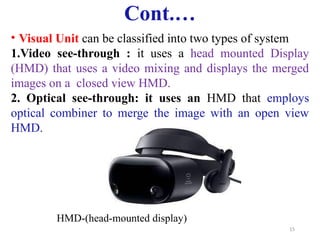
• Visual Unit can be classified into two types of system
1.Video see-through : it uses a head mounted Display
(HMD) that uses a video mixing and displays the merged
images on a closed view HMD.
2. Optical see-through: it uses an HMD that employs
optical combiner to merge the image with an open view
HMD.
HMD-(head-mounted display)
16
Architecture of AR Systems
17
VR Vs AR
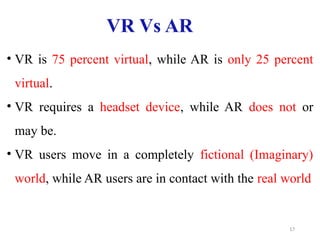
• VR is 75 percent virtual, while AR is only 25 percent
virtual.
• VR requires a headset device, while AR does not or
may be.
• VR users move in a completely fictional (Imaginary)
world, while AR users are in contact with the real world
Applications of AR Systems
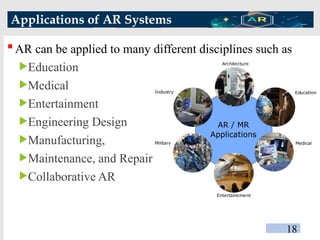
AR can be applied to many different disciplines such as
Education
Medical
Entertainment
Engineering Design
Manufacturing,
Maintenance, and Repair
Collaborative AR
18
Applications of AR: Education
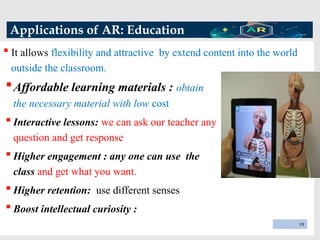
 It allows flexibility and attractive by extend content into the world
outside the classroom.
19
Affordable learning materials : obtain
the necessary material with low cost
 Interactive lessons: we can ask our teacher any
question and get response
 Higher engagement : any one can use the
class and get what you want.
 Higher retention: use different senses
 Boost intellectual curiosity :
20
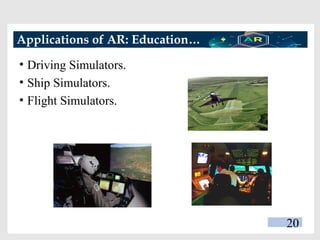
• Driving Simulators.
• Ship Simulators.
• Flight Simulators.
Applications of AR: Education…
Applications of AR: Medicine
21
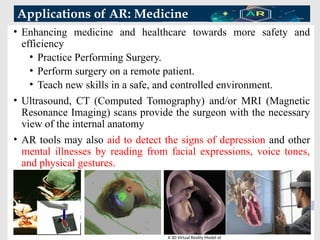
• Enhancing medicine and healthcare towards more safety and
efficiency
• Practice Performing Surgery.
• Perform surgery on a remote patient.
• Teach new skills in a safe, and controlled environment.
• Ultrasound, CT (Computed Tomography) and/or MRI (Magnetic
Resonance Imaging) scans provide the surgeon with the necessary
view of the internal anatomy
• AR tools may also aid to detect the signs of depression and other
mental illnesses by reading from facial expressions, voice tones,
and physical gestures.
A 3D Virtual Reality Model of
Applications of AR: Medicine…
22
3D ultrasound scan is registered with a pregnant woman’s
body- Looking into the Inner part of the body
Describing symptoms: accurate diagnosis
Nursing care: successful finding of the vein (Accuvien)
Surgery: Three-dimensional reconstructions of organs
(Agumedics)
Diabetes Management : real-time tracking of blood sugar levels
Navigation: the nearest hospitals
Applications of AR: Entertainment
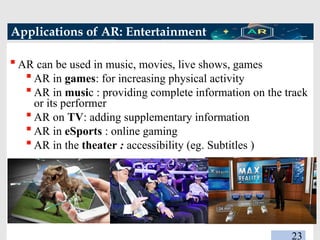
 AR can be used in music, movies, live shows, games
 AR in games: for increasing physical activity
 AR in music : providing complete information on the track
or its performer
 AR on TV: adding supplementary information
 AR in eSports : online gaming
 AR in the theater : accessibility (eg. Subtitles )
23
Applications of AR
Engineering Design
24
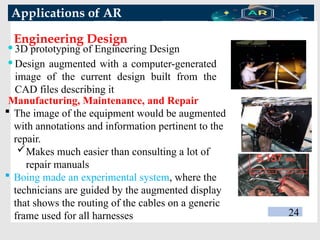
 3D prototyping of Engineering Design
 Design augmented with a computer-generated
image of the current design built from the
CAD files describing it
 The image of the equipment would be augmented
with annotations and information pertinent to the
repair.
Makes much easier than consulting a lot of
repair manuals
 Boing made an experimental system, where the
technicians are guided by the augmented display
that shows the routing of the cables on a generic
frame used for all harnesses
Manufacturing, Maintenance, and Repair
25
END

2015 Chapter 5 Emerging technology . pptx

  • 1.
  • 2.
    2 Outline •Overview of AR •AR,VR and MR •Architecture of AR Systems •Applications of AR
  • 3.
    3 What is AugmentedReality? • AR refers to a technology that combines the view of real environment with virtual content that is presented through computer graphics to enhance the user's perception of reality. • AR is achieved by ensuring that the virtual content is aligned and registered with the real objects.  It overlays virtual elements onto the physical environment, allowing users to interact with both real and virtual objects simultaneously.
  • 4.
    4  AR canbe experienced through various devices like smartphones, tablets, smart glasses, or headsets, enabling users to see and manipulate digital content in real-time  AR is a form of emerging technology that allows users to overlay computer generated content in the real world. Cont.…
  • 5.
    5 AR, VR andMR •Extended reality (XR) is a universal term inclusive all real- and-virtual combined environments and human-machine interactions generated by computer technology such as virtual reality (VR), augmented reality (AR), and mixed reality (MR).  By the help of computer vision and power of processor development we have three types of reality; Virtual reality (VR), Augmented reality (AR) Mixed reality (MR)
  • 6.
    6 Virtual Reality (VR) VRis a technology that creates virtual environment This environment is perceived through a device known as a virtual reality headset or helmet It is computer -generated simulation of an environment or a 3-dimentioal image making the user feel they are immersed in their surrounding. VR is fully immersive, which tricks your senses into thinking you’re in a different environment or world apart from the real world It is called a computer-simulated reality
  • 7.
    7 Cont.…  VR isthe use a of computer-technology to create a simulated environment.  It is an artificial environment where people can do things and interact in that environment.  Computer technologies using reality headsets to generate realistic sounds, images and other sensations that replicate a real environment or create an imaginary world.
  • 8.
    8 Augmented Reality • Advancedversion of VR • An enhanced version of the real physical world that is achieved through the use of digital visual elements, sound, or other sensory stimuli delivered via technology. • Add vertiual things in a real world Users can see and interact with the real world while digital content is added to it:  adds digital elements to a live view often by using the camera on a smartphone • AR is a real time direct or indirect view of a physical real world environment that has been enhanced / augmented by adding virtual computer generated sensory input such as sound, video, graphics or GPS data to it.
  • 9.
    9 Examples of AR Photographyand Editing Interior direction Apps Google Glass : digital content is displayed on a tiny screen in front of a user’s eye. AR give more information about things that are in-front of them.
  • 10.
    10 Mixed Reality (MR) Sometimesreferred to as hybrid reality It is the merging of real and virtual worlds to produce new environments and visualizations where physical & digital objects co-exist & interact in real-time. play a virtual video game, grab your real-world water bottle, and smack an imaginary character from the game with the bottle.
  • 11.
    11 Cont.… In MR userscan interact with and manipulate both physical and virtual items and environments using next generation sensing and imagination technology.. The key character of MR is that the artificial content and the real world content are able to react to each other in real time. • M.R Provides the ability one foot (or hand) in the real world, and the other in an imaginary place. • Breaking down basic concepts between real & imaginary
  • 12.
  • 13.
    13 AR vs VRvs MR AR • Overlay digital content on top of the real-world • It is the integration of digital Information with user’s environment in real time VR • 100% (Fully) digital • Fully immersive • Which creates a totally artificial environment • require specialized VR headsets, noise-canceling headphones, cameras, and sometimes even motion capture technology. MR • Digital overlay that allows interactive virtual elements to integrate and interact with the real-world • MR hard ware is still emerging and hasn’t quite broken in to the mainstream consumer market, most likely due to the price.
  • 14.
    14 Architecture of ARSystems • The first AR systems were usually designed with a bases on three main blocks: • Infrastructure Tracker Unit • Processing Unit • Visual Unit • The Infrastructure Tracker Unit was responsible for collecting data from the real world, sending them to the Processing Unit • Processor unit mixes the virtual content with the real content and send the result to the Video Out module of the Visual Unit
  • 15.
    15 Cont.… • Visual Unitcan be classified into two types of system 1.Video see-through : it uses a head mounted Display (HMD) that uses a video mixing and displays the merged images on a closed view HMD. 2. Optical see-through: it uses an HMD that employs optical combiner to merge the image with an open view HMD. HMD-(head-mounted display)
  • 16.
  • 17.
    17 VR Vs AR •VR is 75 percent virtual, while AR is only 25 percent virtual. • VR requires a headset device, while AR does not or may be. • VR users move in a completely fictional (Imaginary) world, while AR users are in contact with the real world
  • 18.
    Applications of ARSystems AR can be applied to many different disciplines such as Education Medical Entertainment Engineering Design Manufacturing, Maintenance, and Repair Collaborative AR 18
  • 19.
    Applications of AR:Education  It allows flexibility and attractive by extend content into the world outside the classroom. 19 Affordable learning materials : obtain the necessary material with low cost  Interactive lessons: we can ask our teacher any question and get response  Higher engagement : any one can use the class and get what you want.  Higher retention: use different senses  Boost intellectual curiosity :
  • 20.
    20 • Driving Simulators. •Ship Simulators. • Flight Simulators. Applications of AR: Education…
  • 21.
    Applications of AR:Medicine 21 • Enhancing medicine and healthcare towards more safety and efficiency • Practice Performing Surgery. • Perform surgery on a remote patient. • Teach new skills in a safe, and controlled environment. • Ultrasound, CT (Computed Tomography) and/or MRI (Magnetic Resonance Imaging) scans provide the surgeon with the necessary view of the internal anatomy • AR tools may also aid to detect the signs of depression and other mental illnesses by reading from facial expressions, voice tones, and physical gestures. A 3D Virtual Reality Model of
  • 22.
    Applications of AR:Medicine… 22 3D ultrasound scan is registered with a pregnant woman’s body- Looking into the Inner part of the body Describing symptoms: accurate diagnosis Nursing care: successful finding of the vein (Accuvien) Surgery: Three-dimensional reconstructions of organs (Agumedics) Diabetes Management : real-time tracking of blood sugar levels Navigation: the nearest hospitals
  • 23.
    Applications of AR:Entertainment  AR can be used in music, movies, live shows, games  AR in games: for increasing physical activity  AR in music : providing complete information on the track or its performer  AR on TV: adding supplementary information  AR in eSports : online gaming  AR in the theater : accessibility (eg. Subtitles ) 23
  • 24.
    Applications of AR EngineeringDesign 24  3D prototyping of Engineering Design  Design augmented with a computer-generated image of the current design built from the CAD files describing it  The image of the equipment would be augmented with annotations and information pertinent to the repair. Makes much easier than consulting a lot of repair manuals  Boing made an experimental system, where the technicians are guided by the augmented display that shows the routing of the cables on a generic frame used for all harnesses Manufacturing, Maintenance, and Repair
  • 25.