Simple 
Arlene R. Del Rosario 
Jacquilyn Javier 
IV – BSEd Social Studies 
Dr. Renato E. Salcedo 
Subject Instructor
What is a 
Simple True or False? 
 Alternative choice test in which the 
student or examinee indicates 
whether each of several statements is 
true or false. 
 Binomial – choice tests and tests that 
have only (2) options.
There are three forms 
of true and false: 
Simple - two choices only 
 Complex - more than two choices 
 Compound - two choices plus 
conditional completion response.
Guidelines in Using 
Simple True or False 
 Write items that test significant material, not 
trivial details. 
 The correct answer should require the specialized 
knowledge being tested, not common sense. 
 Focus each item on a single idea so that students 
do not have to deal with the possible truth or 
falsity of two or more propositions at once. 
 Compound statements can sometimes be divided 
into two separate items. 
 Express each item in simple and clear language.
Advantages of True-False Items 
Versatility -- True-false items are adaptable to the 
measurement of a wide variety of learning outcomes. 
Scoring accuracy and economy -- Scoring keys can be 
economically applied by machine or clerical assistants. 
Reliability -- True-false tests that are highly reliable can 
be constructed. 
Amenable to item analysis -- Item difficulty (the 
percentage of students who select the correct response) 
and item discrimination (a correlation coefficient that 
indicates how well the item separates students who 
know the material well from those who do not) can be 
used to improve true-false items and inform instruction.
Disadvantages of 
True-False Items 
True-false items are especially subject to guessing. 
Half the items would be expected to be correct by 
chance. (But the likelihood of obtaining a 
substantially higher score by guessing alone is very 
small).
In general, individual true-false items are less 
discriminating than individual multiple-choice 
items. 
There is a tendency to write trivial true-false 
items, which lead students to verbatim 
memorization. 
No diagnostic information is available from 
incorrect responses to true-false items. 
True-false items are not amenable to questions 
that cannot be formulated as propositions.
Do’s 
Appropriate for all levels of cognitive ability 
Objective 
Efficient in testing recall and 
comprehension of a broader content area 
relative to other testing strategies 
Well suited to test recall, comprehension of 
simple logic or understanding, as with "if-then" 
"causal/because" statements 
Not appropriate to test the ability to read 
or interpret complex sentences or 
understand complex thoughts
Sufficiently reliable and valid instrument: 
 Its ability to include the most test items in a time 
frame increases its reliability. 
True false tests are less reliable than multiple 
choice tests unless relatively more test items are 
used 
Useful for automated scoring 
Useful for item analysis, internal and over time
Dont’s 
1. Unfamiliar vocabulary and concepts 
2. Long strings of statements 
3. Ambiguous statements and generalizations 
that are open to interpretation 
4. Indefinite or subjective terms
5. Negative words and phrases: they can be 
confusing 
6. Relative and qualifying words restrict or 
open up general statements. 
7. Absolute words restrict possibilities 
8. Pay close attention to 
negatives, qualifiers, absolutes, and long 
strings of statements
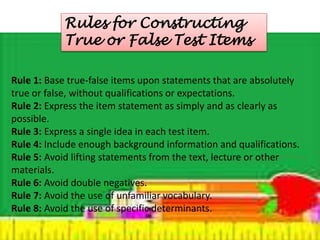
Rules for Constructing 
True or False Test Items 
Rule 1: Base true-false items upon statements that are absolutely 
true or false, without qualifications or expectations. 
Rule 2: Express the item statement as simply and as clearly as 
possible. 
Rule 3: Express a single idea in each test item. 
Rule 4: Include enough background information and qualifications. 
Rule 5: Avoid lifting statements from the text, lecture or other 
materials. 
Rule 6: Avoid double negatives. 
Rule 7: Avoid the use of unfamiliar vocabulary. 
Rule 8: Avoid the use of specific determinants.

Simple true or false

  • 2.
    Simple Arlene R.Del Rosario Jacquilyn Javier IV – BSEd Social Studies Dr. Renato E. Salcedo Subject Instructor
  • 3.
    What is a Simple True or False?  Alternative choice test in which the student or examinee indicates whether each of several statements is true or false.  Binomial – choice tests and tests that have only (2) options.
  • 4.
    There are threeforms of true and false: Simple - two choices only  Complex - more than two choices  Compound - two choices plus conditional completion response.
  • 5.
    Guidelines in Using Simple True or False  Write items that test significant material, not trivial details.  The correct answer should require the specialized knowledge being tested, not common sense.  Focus each item on a single idea so that students do not have to deal with the possible truth or falsity of two or more propositions at once.  Compound statements can sometimes be divided into two separate items.  Express each item in simple and clear language.
  • 6.
    Advantages of True-FalseItems Versatility -- True-false items are adaptable to the measurement of a wide variety of learning outcomes. Scoring accuracy and economy -- Scoring keys can be economically applied by machine or clerical assistants. Reliability -- True-false tests that are highly reliable can be constructed. Amenable to item analysis -- Item difficulty (the percentage of students who select the correct response) and item discrimination (a correlation coefficient that indicates how well the item separates students who know the material well from those who do not) can be used to improve true-false items and inform instruction.
  • 7.
    Disadvantages of True-FalseItems True-false items are especially subject to guessing. Half the items would be expected to be correct by chance. (But the likelihood of obtaining a substantially higher score by guessing alone is very small).
  • 8.
    In general, individualtrue-false items are less discriminating than individual multiple-choice items. There is a tendency to write trivial true-false items, which lead students to verbatim memorization. No diagnostic information is available from incorrect responses to true-false items. True-false items are not amenable to questions that cannot be formulated as propositions.
  • 9.
    Do’s Appropriate forall levels of cognitive ability Objective Efficient in testing recall and comprehension of a broader content area relative to other testing strategies Well suited to test recall, comprehension of simple logic or understanding, as with "if-then" "causal/because" statements Not appropriate to test the ability to read or interpret complex sentences or understand complex thoughts
  • 10.
    Sufficiently reliable andvalid instrument:  Its ability to include the most test items in a time frame increases its reliability. True false tests are less reliable than multiple choice tests unless relatively more test items are used Useful for automated scoring Useful for item analysis, internal and over time
  • 11.
    Dont’s 1. Unfamiliarvocabulary and concepts 2. Long strings of statements 3. Ambiguous statements and generalizations that are open to interpretation 4. Indefinite or subjective terms
  • 12.
    5. Negative wordsand phrases: they can be confusing 6. Relative and qualifying words restrict or open up general statements. 7. Absolute words restrict possibilities 8. Pay close attention to negatives, qualifiers, absolutes, and long strings of statements
  • 13.
    Rules for Constructing True or False Test Items Rule 1: Base true-false items upon statements that are absolutely true or false, without qualifications or expectations. Rule 2: Express the item statement as simply and as clearly as possible. Rule 3: Express a single idea in each test item. Rule 4: Include enough background information and qualifications. Rule 5: Avoid lifting statements from the text, lecture or other materials. Rule 6: Avoid double negatives. Rule 7: Avoid the use of unfamiliar vocabulary. Rule 8: Avoid the use of specific determinants.