UNIVERSITY OF THE ARMED FORCES "ESPE"
ENGLISH METHODOLOGY TO TEACH
ASSESSMENT AND EVALUATION
Group 7
Names of the members
Diana Guamangate
Domenica Herrera
Heydi Guaman
Melissa Herrera
Sabrina Guaman
According to Brown, assessment is a
series of measures used to determine a
complex attribute of an individual or group.
ASSESSMENT
Are a type of assessment method that
tells the teachers about students’
abilities and knowledge.
TEST
Involves gathering and
interpreting information
series of actions taken by
the teacher to measure
students’ responses, actions,
First and foremost,
assessment is important
because it drives students
learning (Brown 1990)
includes a set of techniques
must be explicit and well-
structured
IS A METHOD
Tests can provide results of students’
progress about a general ability or
about specific skills or
competences.
MUST MEASURE
ASSESSMENT
AND
TESTING
A well-constructed test is a useful
instrument that provides
accurate measurement of the test-
taker’s ability within a particular
domain.
S S
E S M
A E
S N T and testing
Results
Process of quantifying
individual achievements. Set of activities that serve to give
a judgment, to make an
assessment, to measure
"something".
M E
M
E
R
U
S
A
E T
N
and Evaluation
Measurement
Two terms
Quantitative and qualitative
descriptions
Qualitative descriptions give
teachers opportunities to
provide individual feedback or
comments on learners’ work
Contributes to compare one
learner with the other in terms
of scores
EVALUATION
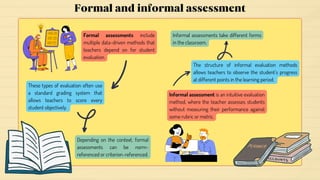
Formal and informal assessment
Formal assessments include
multiple data-driven methods that
teachers depend on for student
evaluation.
These types of evaluation often use
a standard grading system that
allows teachers to score every
student objectively.
Depending on the context, formal
assessments can be norm-
referenced or criterion-referenced.
Informal assessment is an intuitive evaluation
method, where the teacher assesses students
without measuring their performance against
some rubric or metric.
The structure of informal evaluation methods
allows teachers to observe the student’s progress
at different points in the learning period.
Informal assessments take different forms
in the classroom.
The goal of summative assessment
is to evaluate student learning at the
end of an instructional unit by
comparing it against some standard
or benchmark
Summative and formative assessment
The purpose of formative
assessment is to monitor student
learning and provide ongoing
feedback to staff and students. It is
assessment for learning
It can be tutor-led, peer-to-peer or
self-assessment, it is assessment
for learning and has low stakes and
generally does not award any
grades.
Summative assessments often have
high stakes and are treated by the
students as the priority over
formative assessments.
TYPES OF
ASSESSMENTS
OBJECTIVE EVALUATION SKILLS DURATION
ACHIEVEMENT
TESTS
Measure your
students' ability within
a lesson, a unit, or an
entire program.
Formative (feedback).
Summative
(Administered at the
end of a unit).
Skills and knowledge
learned at a given level,
usually through planned
instruction.
Last between five
minutes and three
hours.
DIAGNOSTIC
TESTS
Determine which skills
should be developed
and included.
Are conducted before
the beginning of the
lesson or unit.
Skills such as speaking,
reading, writing,
listening, and language
use.
Last between an hour
and an hour and a
half.
PLACEMENT
TEST
Placing the student at
the appropriate level of
the program or
curriculum.
Summative
test
They
They assess productive
and receptive skills have
open-ended or limited-
response questions
The typical college
placement test consists
of 60 multiple-choice
questions that must be
completed in 90
minutes.
Types and purposes of assessment
TYPES OF
ASSESSMENTS
OBJECTIVE EVALUATION SKILLS DURATION
PROFICIENCY
TESTS
They assess the
general competence of
the students.
The Test of English as
a Foreign Language
(TOEFL)
International English
Language Testing
System (IELTS)
There are four main
skills that are tested:
reading, writing,
listening, and speaking
The TOEFL iBT is a
long and rigorous test
(3 hours)
IELTS Academic: 2
hours and 45 minutes.
APTITUDE
TESTS
It measures a person's
ability to learn a
language before taking
a course.
The Modern Language
Aptitude test (MLAT)
and the Pimsleur
Language Aptitude
battery (PLAB) are two
examples of
standardized aptitude
tests taken in the USA.
Logical reasoning and
thinking skills.
The estimated time of
the evaluation will be
60 minutes, for people
with disabilities the
time allotted will be 90
minutes.
Reliability
It includes the conduct, administration
and scoring of a test. Also the cost, time
and results.
Principles of language assessment
Practicality
According about Brown &
Douglas administrative process
involving the evaluation of an
instrument.
It does not surpass the budget limits
It is taken within the given time
It has clear instructions
It used human and material resources
appropriately
According to Brown
and Douglas the
main qualities of a
practical test are:
It refers to the consistency
of test results.
Among the terms
related to reliability, it is
important to consider
the following:
Learner-Related reliability
Inter-rater reliability
Test administration reliability
Test reliability
Content-related validity Criterion-related validity Construct-related validity
Validity Validity is a measure of learning ability or what has been learnt in class.
example: writing lesson (it measures the structure of sentences.)
It refers to the measurement of
all important sections, covering
most of the content covered.
It refers to a standard, is to say,
an external criterion, the
measurement must match this
standard so that it is valid.
This construct validity is used to
measure the content of a course,
subject, skills, topics that
educators measure.
Autheticity
A task or test is said to be authentic when it is designed to apply
knowledge in new situations or is based on real-life situations.
Example of authentic assessment: Problem-solving exercises
(requiring justification of answers).
Washback
effect
This effect exists when a test has a strong influence on the
way a teacher teaches. This test offers the possibility for
students to get to know the format beforehand.
Thank you

Assesment and Testing

  • 1.
    UNIVERSITY OF THEARMED FORCES "ESPE" ENGLISH METHODOLOGY TO TEACH ASSESSMENT AND EVALUATION Group 7 Names of the members Diana Guamangate Domenica Herrera Heydi Guaman Melissa Herrera Sabrina Guaman
  • 2.
    According to Brown,assessment is a series of measures used to determine a complex attribute of an individual or group. ASSESSMENT Are a type of assessment method that tells the teachers about students’ abilities and knowledge. TEST Involves gathering and interpreting information series of actions taken by the teacher to measure students’ responses, actions, First and foremost, assessment is important because it drives students learning (Brown 1990) includes a set of techniques must be explicit and well- structured IS A METHOD Tests can provide results of students’ progress about a general ability or about specific skills or competences. MUST MEASURE ASSESSMENT AND TESTING A well-constructed test is a useful instrument that provides accurate measurement of the test- taker’s ability within a particular domain. S S E S M A E S N T and testing Results
  • 3.
    Process of quantifying individualachievements. Set of activities that serve to give a judgment, to make an assessment, to measure "something". M E M E R U S A E T N and Evaluation Measurement Two terms Quantitative and qualitative descriptions Qualitative descriptions give teachers opportunities to provide individual feedback or comments on learners’ work Contributes to compare one learner with the other in terms of scores EVALUATION
  • 4.
    Formal and informalassessment Formal assessments include multiple data-driven methods that teachers depend on for student evaluation. These types of evaluation often use a standard grading system that allows teachers to score every student objectively. Depending on the context, formal assessments can be norm- referenced or criterion-referenced. Informal assessment is an intuitive evaluation method, where the teacher assesses students without measuring their performance against some rubric or metric. The structure of informal evaluation methods allows teachers to observe the student’s progress at different points in the learning period. Informal assessments take different forms in the classroom.
  • 5.
    The goal ofsummative assessment is to evaluate student learning at the end of an instructional unit by comparing it against some standard or benchmark Summative and formative assessment The purpose of formative assessment is to monitor student learning and provide ongoing feedback to staff and students. It is assessment for learning It can be tutor-led, peer-to-peer or self-assessment, it is assessment for learning and has low stakes and generally does not award any grades. Summative assessments often have high stakes and are treated by the students as the priority over formative assessments.
  • 6.
    TYPES OF ASSESSMENTS OBJECTIVE EVALUATIONSKILLS DURATION ACHIEVEMENT TESTS Measure your students' ability within a lesson, a unit, or an entire program. Formative (feedback). Summative (Administered at the end of a unit). Skills and knowledge learned at a given level, usually through planned instruction. Last between five minutes and three hours. DIAGNOSTIC TESTS Determine which skills should be developed and included. Are conducted before the beginning of the lesson or unit. Skills such as speaking, reading, writing, listening, and language use. Last between an hour and an hour and a half. PLACEMENT TEST Placing the student at the appropriate level of the program or curriculum. Summative test They They assess productive and receptive skills have open-ended or limited- response questions The typical college placement test consists of 60 multiple-choice questions that must be completed in 90 minutes. Types and purposes of assessment
  • 7.
    TYPES OF ASSESSMENTS OBJECTIVE EVALUATIONSKILLS DURATION PROFICIENCY TESTS They assess the general competence of the students. The Test of English as a Foreign Language (TOEFL) International English Language Testing System (IELTS) There are four main skills that are tested: reading, writing, listening, and speaking The TOEFL iBT is a long and rigorous test (3 hours) IELTS Academic: 2 hours and 45 minutes. APTITUDE TESTS It measures a person's ability to learn a language before taking a course. The Modern Language Aptitude test (MLAT) and the Pimsleur Language Aptitude battery (PLAB) are two examples of standardized aptitude tests taken in the USA. Logical reasoning and thinking skills. The estimated time of the evaluation will be 60 minutes, for people with disabilities the time allotted will be 90 minutes.
  • 8.
    Reliability It includes theconduct, administration and scoring of a test. Also the cost, time and results. Principles of language assessment Practicality According about Brown & Douglas administrative process involving the evaluation of an instrument. It does not surpass the budget limits It is taken within the given time It has clear instructions It used human and material resources appropriately According to Brown and Douglas the main qualities of a practical test are: It refers to the consistency of test results. Among the terms related to reliability, it is important to consider the following: Learner-Related reliability Inter-rater reliability Test administration reliability Test reliability
  • 9.
    Content-related validity Criterion-relatedvalidity Construct-related validity Validity Validity is a measure of learning ability or what has been learnt in class. example: writing lesson (it measures the structure of sentences.) It refers to the measurement of all important sections, covering most of the content covered. It refers to a standard, is to say, an external criterion, the measurement must match this standard so that it is valid. This construct validity is used to measure the content of a course, subject, skills, topics that educators measure. Autheticity A task or test is said to be authentic when it is designed to apply knowledge in new situations or is based on real-life situations. Example of authentic assessment: Problem-solving exercises (requiring justification of answers). Washback effect This effect exists when a test has a strong influence on the way a teacher teaches. This test offers the possibility for students to get to know the format beforehand.
  • 10.