Principles of Language Assessment
Created by Jonathan Dominguez
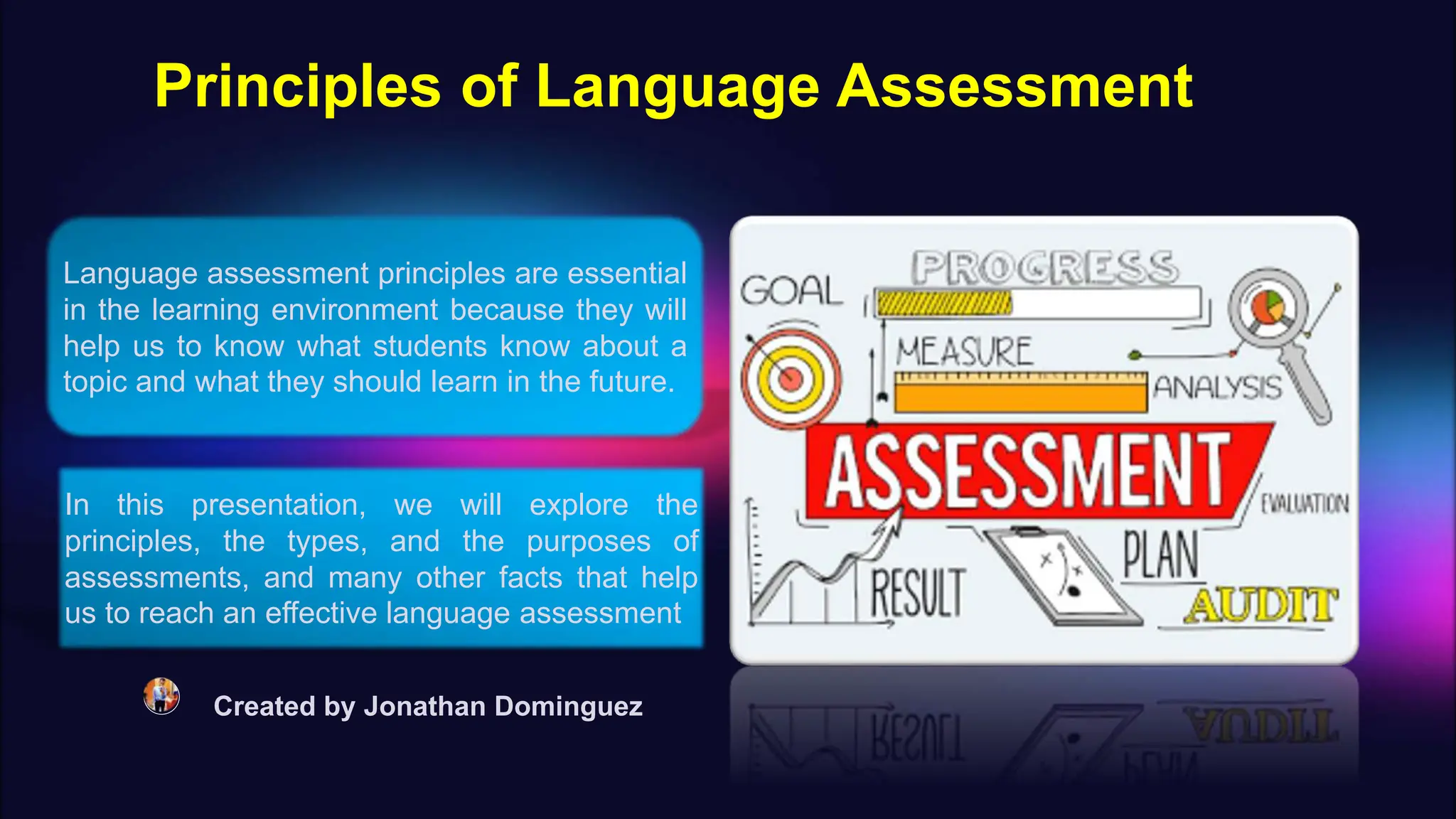
Language assessment principles are essential
in the learning environment because they will
help us to know what students know about a
topic and what they should learn in the future.
In this presentation, we will explore the
principles, the types, and the purposes of
assessments, and many other facts that help
us to reach an effective language assessment
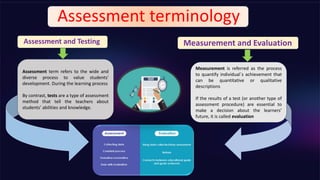
Measurement is referred as the process
to quantify individual´s achievement that
can be quantitative or qualitative
descriptions
If the results of a test (or another type of
assessment procedure) are essential to
make a decision about the learners’
future, it is called evaluation
Assessment term refers to the wide and
diverse process to value students’
development. During the learning process
By contrast, tests are a type of assessment
method that tell the teachers about
students’ abilities and knowledge.
Assessment and Testing Measurement and Evaluation
Assessment terminology
It refers to an individual and spontaneous
form to measure students’ progress
without any grading criteria. The purpose
of informal assessment is to identify the
difficulties and challenges that learner
may face. For example, saying: “good job”,
“well done”
It gives teachers specific and clear
information about how much individuals
have learned during a period or cycle.
Some examples of formal assessment are
tests, quizzes and questionnaires
FORMAL ASSESSMENT INFORMAL ASSESSMENT
Formal and Informal Assessment
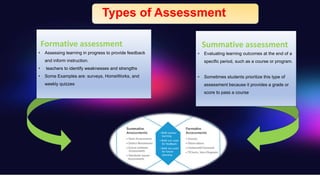
Summative
Assessment
Formative
Assessment
Summative assessment
• Evaluating learning outcomes at the end of a
specific period, such as a course or program.
• Sometimes students prioritize this type of
assessment because it provides a grade or
score to pass a course
Formative assessment
• Assessing learning in progress to provide feedback
and inform instruction.
• teachers to identify weaknesses and strengths
• Some Examples are: surveys, HomeWorks, and
weekly quizzes
Types of Assessment
3. Placement test
• The principal purpose of a placement
test is to place a learner on the right
level of the program or curriculum. A
placement test is composed by sample
materials which will be covered in a
particular area.
• These tests assess productive and
receptive skills, have open-ended or
limited response questions (gap filling,
multiple choice, etc)
1. Achievement tests
Teachers use mostly a test to measure their
students´ ability within a lesson, unit or a
complete program. An achievement test is
intended to measure just a specific part of a
program. These tests are administered at the end
of a lesson, unit, or course. Achievement tests
also help teachers to diagnose their students.
2. Diagnostic tests
A diagnostic test is administered at the beginning
of a program to determine what skills need to be
developed and included. Diagnostic tests give the
teacher or administrator a clear picture on what
aspects of the language need to be covered in a
course.
Types and purposes of assessment
4.- Proficency tests
Proficiency tests evaluate students` general
competence. They do not focus on one specific
skill, but on the overall. The Test of English as a
Foreign Language (TOEFL) is one example of a
commercialized proficiency test
5.- Aptitud tests
An aptitude test measures the ability a person
has to learn a language, specially a foreign or
second language before taking a course. These
tests can predict the success a learner may have
during the taking of a course.
Types and purposes of assessment
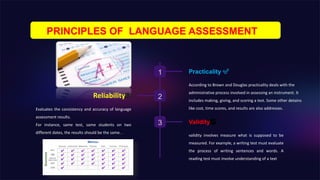
1 Practicality ✅
According to Brown and Douglas practicality deals with the
administrative process involved in assessing an instrument. It
includes making, giving, and scoring a test. Some other detains
like cost, time scores, and results are also addresses.
2
Reliability📊
Evaluates the consistency and accuracy of language
assessment results.
For instance, same test, same students on two
different dates, the results should be the same. .
3 Validity📈
validity involves measure what is supposed to be
measured. For example, a writing test must evaluate
the process of writing sentences and words. A
reading test must involve understanding of a text
PRINCIPLES OF LANGUAGE ASSESSMENT
4
AUTHETICITY ✅
Grant Wiggins (1998) states that an assignment is authentic if it is
realistic, replicates situations of real workplaces and personal life.
Problem solving exercises are examples of authentic evaluation.
In these exercises students need to justify their responses
2
WASHBACK EFFECT 📊
Washback has great effect of tests on teaching
and learning. Washback offers learners the
chance to know the test format in advance,
consequently, students prepare themselves
sufficiently. Washback is helpful for students
because they get feedback before exam date
and that promotes language improvement.
+
Principles of Language Assessment
Language assessment is a vital tool to promote accurate measurement, fair evaluation, and improved language
learning outcomes. Therefore, Validity ensures that the assessment measures what it intends to measure, while
reliability ensures consistency and dependability of results. Practicality emphasizes the feasibility and efficiency
of the assessment process. Overall, adherence to these principles contributes to the development of effective
language assessments that facilitate meaningful insights into language competence and support informed
decision-making in educational and professional settings
CONCLUSION

Principles of language assessment

  • 1.
    Principles of LanguageAssessment Created by Jonathan Dominguez Language assessment principles are essential in the learning environment because they will help us to know what students know about a topic and what they should learn in the future. In this presentation, we will explore the principles, the types, and the purposes of assessments, and many other facts that help us to reach an effective language assessment
  • 2.
    Measurement is referredas the process to quantify individual´s achievement that can be quantitative or qualitative descriptions If the results of a test (or another type of assessment procedure) are essential to make a decision about the learners’ future, it is called evaluation Assessment term refers to the wide and diverse process to value students’ development. During the learning process By contrast, tests are a type of assessment method that tell the teachers about students’ abilities and knowledge. Assessment and Testing Measurement and Evaluation Assessment terminology
  • 3.
    It refers toan individual and spontaneous form to measure students’ progress without any grading criteria. The purpose of informal assessment is to identify the difficulties and challenges that learner may face. For example, saying: “good job”, “well done” It gives teachers specific and clear information about how much individuals have learned during a period or cycle. Some examples of formal assessment are tests, quizzes and questionnaires FORMAL ASSESSMENT INFORMAL ASSESSMENT Formal and Informal Assessment
  • 4.
    Summative Assessment Formative Assessment Summative assessment • Evaluatinglearning outcomes at the end of a specific period, such as a course or program. • Sometimes students prioritize this type of assessment because it provides a grade or score to pass a course Formative assessment • Assessing learning in progress to provide feedback and inform instruction. • teachers to identify weaknesses and strengths • Some Examples are: surveys, HomeWorks, and weekly quizzes Types of Assessment
  • 5.
    3. Placement test •The principal purpose of a placement test is to place a learner on the right level of the program or curriculum. A placement test is composed by sample materials which will be covered in a particular area. • These tests assess productive and receptive skills, have open-ended or limited response questions (gap filling, multiple choice, etc) 1. Achievement tests Teachers use mostly a test to measure their students´ ability within a lesson, unit or a complete program. An achievement test is intended to measure just a specific part of a program. These tests are administered at the end of a lesson, unit, or course. Achievement tests also help teachers to diagnose their students. 2. Diagnostic tests A diagnostic test is administered at the beginning of a program to determine what skills need to be developed and included. Diagnostic tests give the teacher or administrator a clear picture on what aspects of the language need to be covered in a course. Types and purposes of assessment
  • 6.
    4.- Proficency tests Proficiencytests evaluate students` general competence. They do not focus on one specific skill, but on the overall. The Test of English as a Foreign Language (TOEFL) is one example of a commercialized proficiency test 5.- Aptitud tests An aptitude test measures the ability a person has to learn a language, specially a foreign or second language before taking a course. These tests can predict the success a learner may have during the taking of a course. Types and purposes of assessment
  • 7.
    1 Practicality ✅ Accordingto Brown and Douglas practicality deals with the administrative process involved in assessing an instrument. It includes making, giving, and scoring a test. Some other detains like cost, time scores, and results are also addresses. 2 Reliability📊 Evaluates the consistency and accuracy of language assessment results. For instance, same test, same students on two different dates, the results should be the same. . 3 Validity📈 validity involves measure what is supposed to be measured. For example, a writing test must evaluate the process of writing sentences and words. A reading test must involve understanding of a text PRINCIPLES OF LANGUAGE ASSESSMENT
  • 8.
    4 AUTHETICITY ✅ Grant Wiggins(1998) states that an assignment is authentic if it is realistic, replicates situations of real workplaces and personal life. Problem solving exercises are examples of authentic evaluation. In these exercises students need to justify their responses 2 WASHBACK EFFECT 📊 Washback has great effect of tests on teaching and learning. Washback offers learners the chance to know the test format in advance, consequently, students prepare themselves sufficiently. Washback is helpful for students because they get feedback before exam date and that promotes language improvement. + Principles of Language Assessment
  • 9.
    Language assessment isa vital tool to promote accurate measurement, fair evaluation, and improved language learning outcomes. Therefore, Validity ensures that the assessment measures what it intends to measure, while reliability ensures consistency and dependability of results. Practicality emphasizes the feasibility and efficiency of the assessment process. Overall, adherence to these principles contributes to the development of effective language assessments that facilitate meaningful insights into language competence and support informed decision-making in educational and professional settings CONCLUSION