Chapter 1 - Part 1:
Testing, Assessing and Teaching
EII604
• Day-to-day work of teachers is multifaceted.
• No responsibility is more important than assessing
student performance.
• Teachers must be able to communicate academic and
social performance and progress to a variety of audiences
(including students, parents, administrators, the general
public, etc.).
• Assessments and evaluative judgments must be accurate
in order to prevent communication of misinformation to
audiences.
INTRODUCTION
• Assessment system: All systematic methods and
procedures used to obtain information about students;
basis for decisions.
• Evaluation: Use of assessment information to make
judgments.
• Measure: Process involving a structured situation where
specific characteristics are sampled; results in a numerical
or narrative score (also known as assessment method).
• Test: Formal set of questions or tasks that address
particular cognitive capabilities learned in specific subject
areas.
SOME BASIC DEFINITIONS
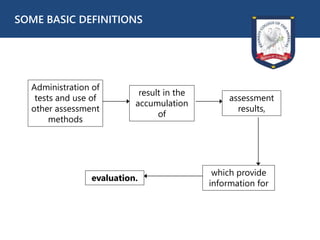
Administration of
tests and use of
other assessment
methods
result in the
accumulation
of
assessment
results,
which provide
information for
evaluation.
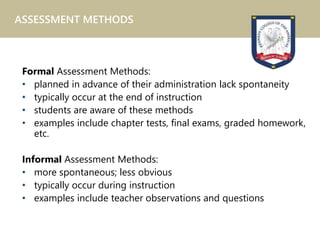
Formal Assessment Methods:
• planned in advance of their administration lack spontaneity
• typically occur at the end of instruction
• students are aware of these methods
• examples include chapter tests, final exams, graded homework,
etc.
Informal Assessment Methods:
• more spontaneous; less obvious
• typically occur during instruction
• examples include teacher observations and questions
ASSESSMENT METHODS
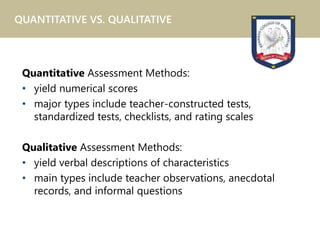
Quantitative Assessment Methods:
• yield numerical scores
• major types include teacher-constructed tests,
standardized tests, checklists, and rating scales
Qualitative Assessment Methods:
• yield verbal descriptions of characteristics
• main types include teacher observations, anecdotal
records, and informal questions
QUANTITATIVE VS. QUALITATIVE
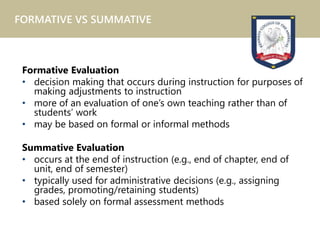
Formative Evaluation
• decision making that occurs during instruction for purposes of
making adjustments to instruction
• more of an evaluation of one’s own teaching rather than of
students’ work
• may be based on formal or informal methods
Summative Evaluation
• occurs at the end of instruction (e.g., end of chapter, end of
unit, end of semester)
• typically used for administrative decisions (e.g., assigning
grades, promoting/retaining students)
• based solely on formal assessment methods
FORMATIVE VS SUMMATIVE
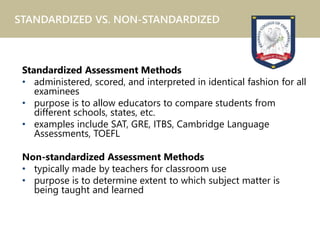
Standardized Assessment Methods
• administered, scored, and interpreted in identical fashion for all
examinees
• purpose is to allow educators to compare students from
different schools, states, etc.
• examples include SAT, GRE, ITBS, Cambridge Language
Assessments, TOEFL
Non-standardized Assessment Methods
• typically made by teachers for classroom use
• purpose is to determine extent to which subject matter is
being taught and learned
STANDARDIZED VS. NON-STANDARDIZED
Norm-Referenced Assessment Methods
• show where an individual student’s performance lies in relation to
other students
• standardized tests are usually norm-referenced
• results are quantitative
• student performance is compared to norm group
Criterion-Referenced Assessment Methods
• compare student performance to preestablished criteria or objectives
• results are quantitative, qualitative, or both
• also known as mastery, objectives-referenced, or competency tests
NORMED REFERENCED VS. CRITERION REFERENCED
Traditional Assessment Methods
• procedures such as pencil-and-paper tests and quizzes
• only one correct response to each test item
• easily and efficiently assess many students simultaneously
• encourage memorization of facts, etc.
Alternative Assessment Methods
• more appropriate for hands-on, experiential learning
• include authentic assessment (involve real application of
skills beyond instructional context)
TRADITIONAL VS. ALTERNATIVE
Objective Assessment Methods
• “objective” refers to method of scoring (no judgments)
• contain only one correct answer
• examples: multiple-choice, true-false, matching items
• also known as structured-response, selected-response, teacher-
supplied items
Subjective Assessment Methods
• scoring involves teachers’ subjective judgments
• several possible correct responses or single correct response with
several ways to arrive at that answer
• examples: short-answer and essay items
• also known as open-ended, constructed-response, supply-type items
OBJECTIVE VS. SUBJECTIVE

Chapter 1 basic definitions

  • 1.
    Chapter 1 -Part 1: Testing, Assessing and Teaching EII604
  • 2.
    • Day-to-day workof teachers is multifaceted. • No responsibility is more important than assessing student performance. • Teachers must be able to communicate academic and social performance and progress to a variety of audiences (including students, parents, administrators, the general public, etc.). • Assessments and evaluative judgments must be accurate in order to prevent communication of misinformation to audiences. INTRODUCTION
  • 3.
    • Assessment system:All systematic methods and procedures used to obtain information about students; basis for decisions. • Evaluation: Use of assessment information to make judgments. • Measure: Process involving a structured situation where specific characteristics are sampled; results in a numerical or narrative score (also known as assessment method). • Test: Formal set of questions or tasks that address particular cognitive capabilities learned in specific subject areas. SOME BASIC DEFINITIONS
  • 4.
    SOME BASIC DEFINITIONS Administrationof tests and use of other assessment methods result in the accumulation of assessment results, which provide information for evaluation.
  • 5.
    Formal Assessment Methods: •planned in advance of their administration lack spontaneity • typically occur at the end of instruction • students are aware of these methods • examples include chapter tests, final exams, graded homework, etc. Informal Assessment Methods: • more spontaneous; less obvious • typically occur during instruction • examples include teacher observations and questions ASSESSMENT METHODS
  • 6.
    Quantitative Assessment Methods: •yield numerical scores • major types include teacher-constructed tests, standardized tests, checklists, and rating scales Qualitative Assessment Methods: • yield verbal descriptions of characteristics • main types include teacher observations, anecdotal records, and informal questions QUANTITATIVE VS. QUALITATIVE
  • 7.
    Formative Evaluation • decisionmaking that occurs during instruction for purposes of making adjustments to instruction • more of an evaluation of one’s own teaching rather than of students’ work • may be based on formal or informal methods Summative Evaluation • occurs at the end of instruction (e.g., end of chapter, end of unit, end of semester) • typically used for administrative decisions (e.g., assigning grades, promoting/retaining students) • based solely on formal assessment methods FORMATIVE VS SUMMATIVE
  • 8.
    Standardized Assessment Methods •administered, scored, and interpreted in identical fashion for all examinees • purpose is to allow educators to compare students from different schools, states, etc. • examples include SAT, GRE, ITBS, Cambridge Language Assessments, TOEFL Non-standardized Assessment Methods • typically made by teachers for classroom use • purpose is to determine extent to which subject matter is being taught and learned STANDARDIZED VS. NON-STANDARDIZED
  • 9.
    Norm-Referenced Assessment Methods •show where an individual student’s performance lies in relation to other students • standardized tests are usually norm-referenced • results are quantitative • student performance is compared to norm group Criterion-Referenced Assessment Methods • compare student performance to preestablished criteria or objectives • results are quantitative, qualitative, or both • also known as mastery, objectives-referenced, or competency tests NORMED REFERENCED VS. CRITERION REFERENCED
  • 10.
    Traditional Assessment Methods •procedures such as pencil-and-paper tests and quizzes • only one correct response to each test item • easily and efficiently assess many students simultaneously • encourage memorization of facts, etc. Alternative Assessment Methods • more appropriate for hands-on, experiential learning • include authentic assessment (involve real application of skills beyond instructional context) TRADITIONAL VS. ALTERNATIVE
  • 11.
    Objective Assessment Methods •“objective” refers to method of scoring (no judgments) • contain only one correct answer • examples: multiple-choice, true-false, matching items • also known as structured-response, selected-response, teacher- supplied items Subjective Assessment Methods • scoring involves teachers’ subjective judgments • several possible correct responses or single correct response with several ways to arrive at that answer • examples: short-answer and essay items • also known as open-ended, constructed-response, supply-type items OBJECTIVE VS. SUBJECTIVE