A S S E S S M E N T A N D
E V A L U A T I O N N R C 1 8 2 3 4
Name: Alejandro Henry Moncayo Triviño
PRINCIPLES OF
LANGUAGE
ASSESSMENT
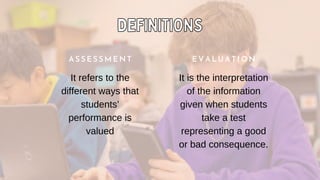
It refers to the
different ways that
students’
performance is
valued
A S S E S S M E N T E V A L U A T I O N
DEFINITIONS
DEFINITIONS
It is the interpretation
of the information
given when students
take a test
representing a good
or bad consequence.
I N F O R M A L
A S S E S S M E N T
F O R M A L
A S S E S S M E N T
Identifies difficulties and
challenges for students. Can
be used to motivate students
to improve their learning.
Evaluates students’ performance
giving information on how much
they have learned during a
period of time.
F O R M A T I V E
A S S E S S M E N T
S U M M A T I V E
A S S E S S M E N T
It helps to identify weaknesses and
strengths, to monitor students
´progress and to adapt or modify the
teaching along the learning process.
In a formal way, it evaluates students
performance at the end of a term, a
lesson or a unit. It covered complete
chapters or contents.
TYPES AND PURPOSES OF
ASSESSMENT
ASSESSMENT
Achievement test: to assess a specific part
of a program. It is applied at the end of a
lesson, unit or course.
Diagnostic test: It is applied at the beginning
of a course. It helps teachers to identifies
topics to be covered during the course.
Placement test: it is used to place a students
in the correct level of a program.
Proficiency test: it evaluate students’
competence according to a standard. Various
skills are assessed
Aptitude test: It measure the ability to learn a
language.
AUTHENTICITY: IT IS BASED ON
REAL WORLD STITUATIONS.
RELIABILITY: IF THE TEST IS
APPLIED IN DIFFERENT CONTEXT,
IT SHOULD HAVE SIMILAR
RESULTS.
WASHBACK EFFECT: IT ALLOW
STUDENTS TO KNOW THE TEST FORMAT
IN ADVANCED AND PREPARE WELL.
VALIDITY: THE TEST MEASURES
WHAT IT IS INTENDED TO ASSESS
PRACTICALITY: IT DEALS WITH
THE PROCESS OF APPLYING A
TEST
PRINCIPLES OF LANGUAGE ASSESSMENT
Kizlik, B. (2012). Measurement, assessment, and evaluation in education.
Retrieved from https://www.academia.edu/download/43362488/DrJJ-
Measure-assess-evaluate-ADPRIMA-n-more-17052012.pdf
Dante D. Dixson & Frank C. Worrell (2016) Formative and Summative
Assessment in the Classroom, Theory Into Practice, 55:2, 153-159, DOI:
10.1080/00405841.2016.1148989
Hughes, A. (2003). Testing for language teachers. Second edition. The
UK. Cambridge University press.
BIBLIOGRAPHY
BIBLIOGRAPHY
THANK
THANK
YOU
YOU

Learning_activity1_Moncayo_Alejandro_NRC18234.pdf

  • 1.
    A S SE S S M E N T A N D E V A L U A T I O N N R C 1 8 2 3 4 Name: Alejandro Henry Moncayo Triviño PRINCIPLES OF LANGUAGE ASSESSMENT
  • 2.
    It refers tothe different ways that students’ performance is valued A S S E S S M E N T E V A L U A T I O N DEFINITIONS DEFINITIONS It is the interpretation of the information given when students take a test representing a good or bad consequence.
  • 3.
    I N FO R M A L A S S E S S M E N T F O R M A L A S S E S S M E N T Identifies difficulties and challenges for students. Can be used to motivate students to improve their learning. Evaluates students’ performance giving information on how much they have learned during a period of time.
  • 4.
    F O RM A T I V E A S S E S S M E N T S U M M A T I V E A S S E S S M E N T It helps to identify weaknesses and strengths, to monitor students ´progress and to adapt or modify the teaching along the learning process. In a formal way, it evaluates students performance at the end of a term, a lesson or a unit. It covered complete chapters or contents.
  • 5.
    TYPES AND PURPOSESOF TYPES AND PURPOSES OF ASSESSMENT ASSESSMENT Achievement test: to assess a specific part of a program. It is applied at the end of a lesson, unit or course. Diagnostic test: It is applied at the beginning of a course. It helps teachers to identifies topics to be covered during the course. Placement test: it is used to place a students in the correct level of a program. Proficiency test: it evaluate students’ competence according to a standard. Various skills are assessed Aptitude test: It measure the ability to learn a language.
  • 6.
    AUTHENTICITY: IT ISBASED ON REAL WORLD STITUATIONS. RELIABILITY: IF THE TEST IS APPLIED IN DIFFERENT CONTEXT, IT SHOULD HAVE SIMILAR RESULTS. WASHBACK EFFECT: IT ALLOW STUDENTS TO KNOW THE TEST FORMAT IN ADVANCED AND PREPARE WELL. VALIDITY: THE TEST MEASURES WHAT IT IS INTENDED TO ASSESS PRACTICALITY: IT DEALS WITH THE PROCESS OF APPLYING A TEST PRINCIPLES OF LANGUAGE ASSESSMENT PRINCIPLES OF LANGUAGE ASSESSMENT
  • 7.
    Kizlik, B. (2012).Measurement, assessment, and evaluation in education. Retrieved from https://www.academia.edu/download/43362488/DrJJ- Measure-assess-evaluate-ADPRIMA-n-more-17052012.pdf Dante D. Dixson & Frank C. Worrell (2016) Formative and Summative Assessment in the Classroom, Theory Into Practice, 55:2, 153-159, DOI: 10.1080/00405841.2016.1148989 Hughes, A. (2003). Testing for language teachers. Second edition. The UK. Cambridge University press. BIBLIOGRAPHY BIBLIOGRAPHY
  • 8.