Introduction to PublicAdministration
PAD 201
Decision Making
&
Communication
HMY
17 Oct, 2024
2.
Decision Making
• Aproblem-solving action or a strategy
• A decision needs to be implementable to achieve goals.
• Decision-making should have a rationale/justification.
3.
Stages in DecisionMaking Process
• Identify the Problem
• Gather information
• Make/prepare options or alternatives
• Select the best Alternative
• Apply them/implementation
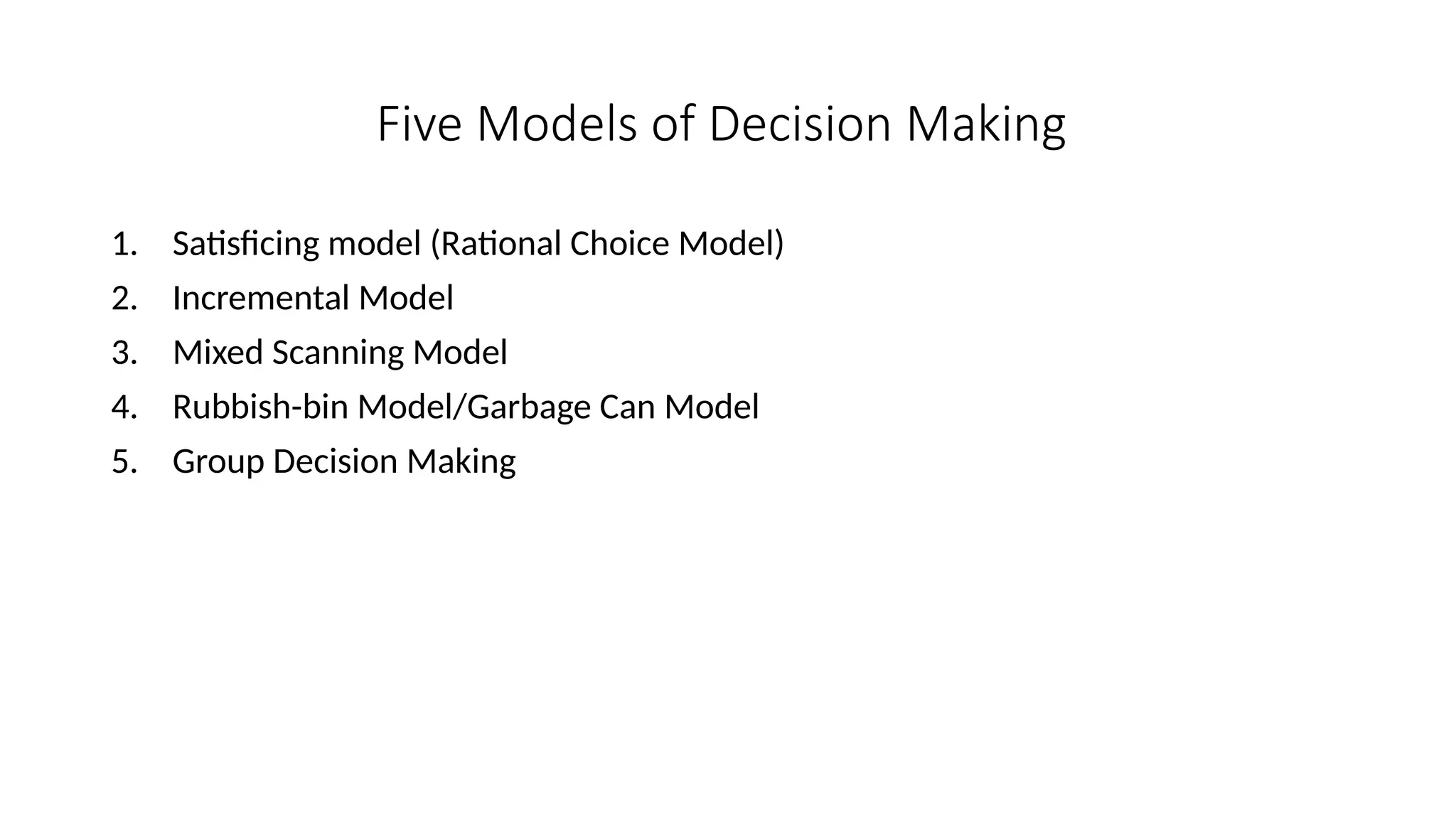
Five Models ofDecision Making
1. Satisficing model (Rational Choice Model)
2. Incremental Model
3. Mixed Scanning Model
4. Rubbish-bin Model/Garbage Can Model
5. Group Decision Making
6.
Rational Decision Making
•Rational decision-making is the opposite of intuitive decision-making.
• It is a strict procedure utilizing objective knowledge and logic.
• It involves identifying the problem to solve, gathering facts, identifying options and
outcomes, analyzing them, considering all the relationships, and selecting the decision.
Frédéric Adam, Dorota Kuchta, Stanisław Stanek (eds.), 2022, Rational Decisions in Organisations
Theoretical and Practical Aspects, CRC Press
7.
Rational Choice Model
Findingthe best solutions to given problems
• A decision maker considers a finite set of alternatives, ascribes consequences
to them.
• Prioritises these consequences according to their importance and value
• A decision maker makes an optimal choice among available alternatives.
• A decision maker is supposed to know all available alternatives.
• A decision maker chooses the best alternative based on expectations and
future consequences or outcomes.
8.
Main Elements ofRational Choice Model
It requires a great deal of time.
It requires a great deal of information.
It assumes rational, measurable criteria are available and agreed
upon.
It assumes accurate, stable and complete knowledge of all
alternatives, preferences, goals and consequences are easy to find.
It assumes a rational, reasonable, non-political world.
9.
Rational Decision MakingModel
Assumptions
• An individual has full and perfect information on which to base a
choice.
• Measure criteria exist for which data can be collected and analysed.
• An individual has the cognitive ability, time and resources to evaluate
each alternative against the others
10.
Limitations of RCT
Assumptionsof rationality are problematic.
WHY?
The decision-makers make unrealistic assumptions about individual behavior as well
as the structure of the situation.
The rational decision-making model does not consider factors that can’t be
quantifiable, such as ethical concerns or the value of altruism.
It can’t leave out consideration of personal feeling, loyalties, or sense of obligation.
Its objectivity creates a bias toward the preference of facts, data and analysis over
intuition or desires
They are always influenced by self-interest.
They are constrained by institutions, cultural influences, and psychological limitations.
11.
Limitations of RationalDecision Making
• Limited information: Rational decision making assumes that all relevant information is available, but in reality, there
may be gaps in knowledge or incomplete data, which can affect the decision-making process.
• Biases: Individuals may have personal biases that can affect their decision-making process. For example, they may
favor certain options or have a preference for a particular outcome.
• Emotions: Rational decision making assumes that decisions are made based on logic, but emotions can also play a
significant role in the decision-making process, and can lead to irrational choices.
• Time constraints: In some cases, there may be time constraints that prevent a thorough analysis of all options,
which can lead to suboptimal decisions.
• Uncertainty: Sometimes, there is uncertainty about the outcomes of different options, which can make it difficult to
make a rational decision.
• Cost-benefit analysis limitations: While cost-benefit analysis is a common tool used in rational decision making, it
can be challenging to assign monetary values to certain outcomes or benefits, making it difficult to compare options.
12.
Satisficing Model (HerbertSimon)
What is Bounded Rationality?
• It means that managers’ ability to be perfectly rational is limited because of
cognitive capacity and time constraints.
Bounded rationality is a human decision-making process in which we attempt to
satisfice, rather than optimize.
• Bounded rationality as a framework to understand actual managerial decision
making (Bazzerman, 1986).
• Bounded rationality occurs when we make decisions based on limited information.
It may lead to suboptimal decisions as it only considers some available options.
• It suggests that people don’t always make perfectly rational decisions. Instead, use
simplified decision-making forms. This means that we often make suboptimal
choices.
13.
Satisficing Models
Factors thataffect managers’ rational decisions.
• Decision makers may have inadequate information about the nature of the problem
• Time and cost factors limit the amount of information gathered.
• Decision makers perceptions about relative importance of various pieces of
data/information.
• The part of human memory used in making decisions retains only a relatively small amount
of information at a time.
• The calculating capacities associated with intelligence limit the scope for optimal decision
making.
• When people are unable to collect all relevant information due to time pressure or other
constraints
• When people are making decisions based on inaccurate or incomplete information
• When a person is influenced by emotions or other prejudices that distort judgment
Menghan Jin, Lingling Ji, and Huamao Peng (2019), The Relationship Between Cognitive Abilities and the Decision-Making Process: The Moderating Role of Self-Relevance. The Frontiers in Phycology, Volume 10 - 2019
14.
Incremental Decision
• Theincremental decision making is a process to make decisions in step-by-step.
• The incremental decision making approach is often used in government settings, such
as defining public policy. It can help to ensure that all options have been considered
and that the final decision is made in the best interest of the public.
• Managers make smallest possible response to solve a problem (Huber, 1980, Etzoini,
1967).
Incrementalism is a short-term approach.
• Incrementalism does not require managers to process a lot of information to take
actions
15.
Features of IncrementalModel
• Political - Budgeting is a political process. An allocation cannot be made rationality on the
basis of the public interest.
• Complexity - It is the most serious problem in policy-making. Decision-making has to
simplify to go on at all.
• Budget Base - Many activities in previous and current years are either mandatory or
fundamental to the purpose of meeting organizational goals. In consequence, it is
necessary to concentrate only on the changes from the previous or current year in setting
up the budget.
• Roles - Spending departments act as “advocate” and argue for better service and more
expenditure in their area of responsibility, while the treasury department act as“Guardians”
and its task is to ensure that available resources are not exceeded.
• Stability - Incremental budgeting pays little attention to any environmental influences. It
argues that the previous year’s budget appropriation is the most influential factor for this
year’s budget outcome.
16.
Limitations of IncrementalModel
• Overlooks opportunities for significant innovations
• Ignores the empirical fact that incremental decisions are often, in effect, made
within the context of established decisions.
• It helps reduce/avoid risks:
• It allows you to change your mind
• It helps gather more information
Common criticism is:
It’s time consuming
17.
Mixed Scanning Model
•The mixed scanning model (Etzioni (1967, 1986) synthesizes the rationalistic
and incremental approach by combining the high order, fundamental policy
making processes.
• This model considers long term scanning, and incremental processes which
is related to fundamental decisions which can be considered as short-term
scanning.
• The scanning process provides a strategy for evaluation and flexibility to scan
different level of situations makes it useful tool for decision making in
different levels of environmental stability.
18.
Garbage Can Model
•The rubbish-bin model holds that managers behave randomly in making the non-programmed decision.
• Decision outcomes occur by chance, depending on those who happen to be involved.
• Favourite solutions available for a problem to solve.
• This model works when decision-makers have no goal preferences or are dictated by organisational
strategic goals.
• It happens when decision-makers change their roles frequently.
• It happens in the absence of any strategic direction of a company.
• Decision makers often operate in an irrational environment with a lot of uncertainty.
• They make decisions without following the rational approach of gathering facts and weighing the
evidence thoughtfully.
• Garbage can decision-making doesn't go looking for the perfect solution.
• Instead, it mixes and matches the elements the organization has already piled into the can.
Cohen, March and Olsen (1972), Garbage Can Model of Organizational Choice, Administrative Science Quarterly 17(1):1-25
19.
Group Decision Making
•Major decision in organisations are made by more than one person
• Team based participatory approach.
• Each team (workgroup) makes most decisions involving its work
area (Fowler, 1988).
• This model helps managing diversity of ideas.
• Facilitates dialectical inquiry.
20.
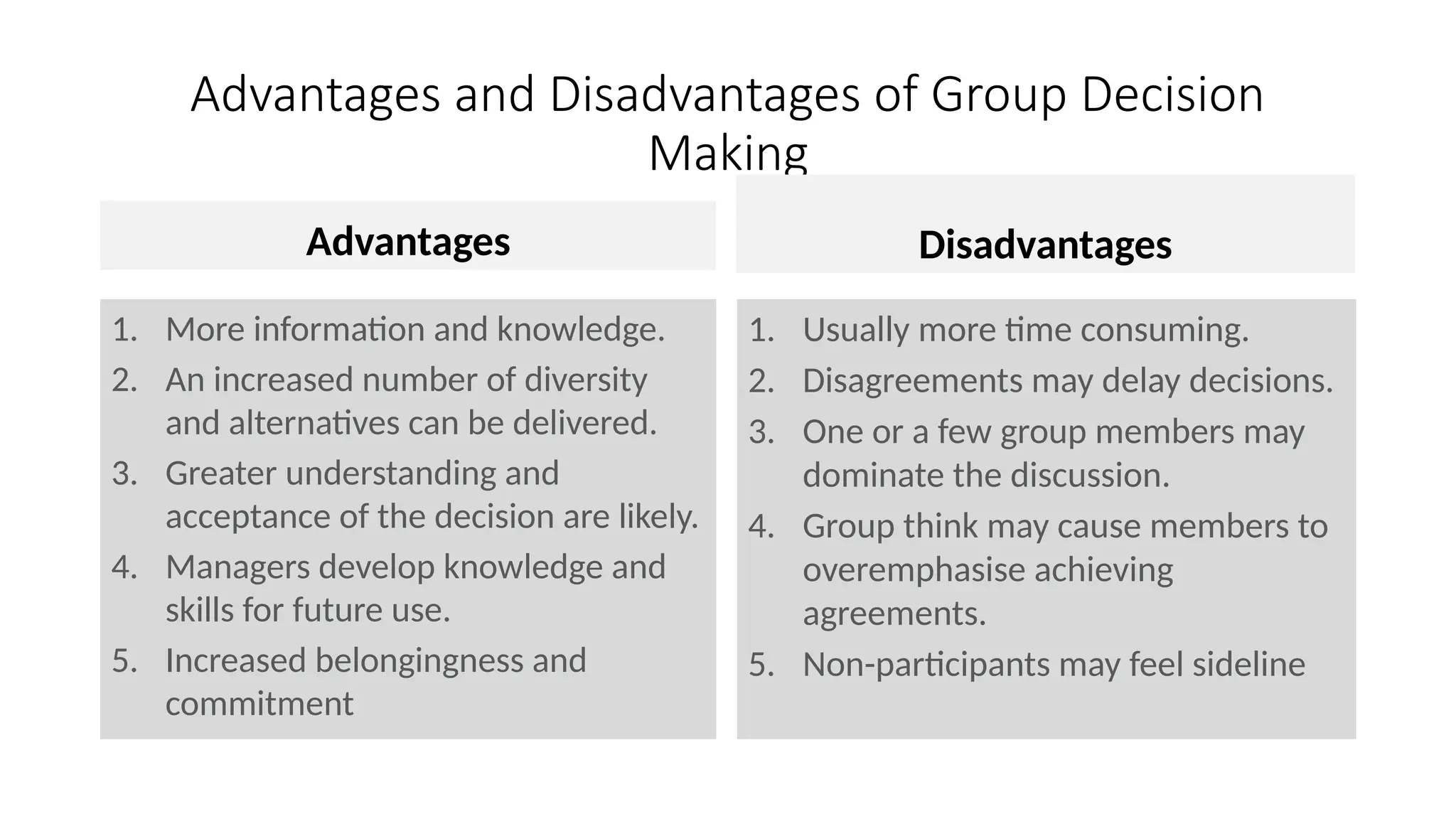
Advantages and Disadvantagesof Group Decision
Making
Advantages
1. More information and knowledge.
2. An increased number of diversity
and alternatives can be delivered.
3. Greater understanding and
acceptance of the decision are likely.
4. Managers develop knowledge and
skills for future use.
5. Increased belongingness and
commitment
Disadvantages
1. Usually more time consuming.
2. Disagreements may delay decisions.
3. One or a few group members may
dominate the discussion.
4. Group think may cause members to
overemphasise achieving
agreements.
5. Non-participants may feel sideline
21.
Communication
Communication isa two-way process which involves
transferring of information or messages from one
person or group to another.
It includes a minimum of one sender and receiver to
pass on the messages.
These messages can either be any ideas, imagination,
emotions, or thoughts.
22.
Communication Style
o PassiveCommunication often looks like not communicating at all for fear of speaking
up. This can lead to misunderstandings.
o Aggressive Communication tends to be driven by anger and judgment and can also
result in inflexibility. This can create a hostile environment.
o Passive-Aggressive Communication might mean you don’t directly communicate your
feelings, but you hold on to negative emotions and let those affect your actions. This
can cause confusion and resentment.
o Assertive Communication is confident but also respectful of others' thoughts and
feelings. Assertive communication creates space for honest conversations and
promotes healthy connections between individuals.
23.
Importance of communication
Goodcommunication encourages motivational skills.
Effective mode of transfering information in the decision-making process.
Communication assists both formal and informal relationship within or outside
the organisational structure.
Helps maintaining chain of command in the organization
It helps in controlling the process. Employees have to follow the organisation
rule, code of conduct and other company policies
Editor's Notes
#4 Intuitive decision making is the way people make decisions naturally, without the use of formal tools and procedures.
The dependent decision-making style can be regarded as requiring support, advice, and guidance from others when making decisions.
Avoidant DMS is the opposite of a rational approach. According to Scott & Bruce (1995), it involves indecision, postponing, avoiding and delaying the decision and keeping oneself away from making a decision. Avoidant DMS is unproductive and is attributed to a lack of self and environmental awareness.
Spontaneous decision making style means that your decisions are likely to be quick, rapid, impulsive, and you are prone to make snap judgements. This is the result of a strong feeling of immediacy and desire to come through the process of decision making as fast as possible.
#13 Bounded Rationality has been found to occur in a variety of situations, including:
When people are facing complex problems, they need to consider many factors
When people are unable to collect all relevant information due to time pressure or other constraints
When people are making decisions based on inaccurate or incomplete information
When a person is influenced by emotions or other prejudices that distort judgment