Chapter 4 - Communication  
Introduction interprocess communication is at the heart of all distributed systems communication in distributed systems is based on message passing as offered by the underlying network as opposed to using shared memory modern distributed systems consist of thousands of processes scattered across an unreliable network such as the Internet unless the primitive communication facilities of the network are replaced by more advanced ones, development of large scale Distributed Systems becomes extremely difficult
Objectives of the Chapter review of how processes communicate in a network (the rules or the protocols) and their structures introduce the four widely used communication models for distributed systems: Remote Procedure Call (RPC) Message-Oriented Middleware (MOM) Stream-Oriented Communication Multicast Communication
4.1 Network Protocols and Standards a  protocol  is a set of rules that governs data communications a protocol defines  what  is communicated,  how  it is communicated, and  when  it is communicated for instance, for one computer to send a message to another computer, the first computer must perform the following general steps  break the data into small sections called  packets   add addressing information to the packets identifying the source and destination computers deliver the data to the network interface card for transmission over the network
the receiving computer must perform the same steps, but in reverse order accept the data from the NIC remove transmitting information that was added by the transmitting computer reassemble the packets of data into the original message the key elements of a protocol are syntax, semantics, and timing syntax : refers to the structure or format of the data semantics : refers to the meaning of each section of bits timing : refers to when data should be sent and how fast they can be sent functions of protocols  each device must perform the same steps the same way so that the data will arrive and reassemble properly; if one device uses a protocol with different steps, the two devices will not be able to communicate with each other
Protocols in a layered architecture  protocols that work together to provide a layer or layers of the model are known as a  protocol   stack  or  protocol   suite,  e.g. TCP/IP each layer handles a different part of the communications process and has its own protocol Data Communication Standards standards are essential for  interoperability data communication standards fall into two categories De   facto   standards : that have not been approved by an organized body; mostly set by manufacturers De   jure   standards : those legislated by an officially recognized body such as ISO, ITU, ANSI, IEEE
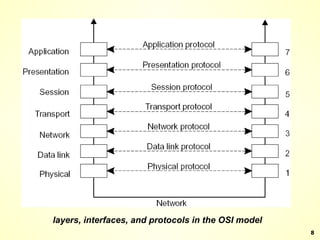
Network (Reference) Models   Layers and Services within a single machine, each layer uses the services immediately below it and provides services for the layer immediately above it between machines, layer x on one machine communicates with layer x on another machine Two important network models or architectures The ISO OSI (Open Systems Interconnection) Reference Model The TCP/IP Reference Model a. The OSI Reference Model consists of 7 layers was never fully implemented as a protocol stack, but a good theoretical model Open  – to connect open systems or systems that are open for communication with other systems
layers, interfaces, and protocols in the OSI model
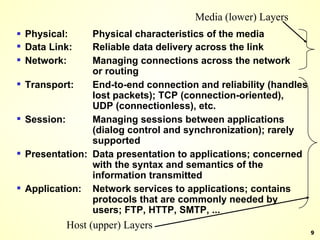
Physical: Physical characteristics of the media Host (upper) Layers Media (lower) Layers Data Link:  Reliable data delivery across the link Network: Managing connections across the network  or routing Transport: End-to-end connection and reliability (handles lost packets); TCP (connection-oriented), UDP (connectionless), etc.  Session: Managing sessions between applications (dialog control and synchronization); rarely supported Presentation: Data presentation to applications; concerned with the syntax and semantics of the information transmitted Application: Network services to applications; contains protocols that are commonly needed by users; FTP, HTTP, SMTP, ...
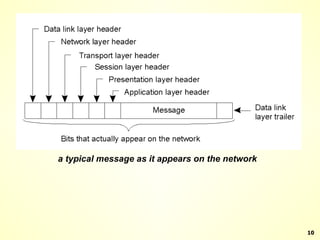
a typical message as it appears on the network
b. The TCP/IP Reference Model TCP/IP - Transmission Control Protocol/Internet Protocol used by ARPANET and its successor the Internet design goals the ability to connect multiple networks (internetworking) in a seamless way the network should be able to survive loss of subnet hardware, i.e., the connection must remain intact as long as the source and destination machines are properly functioning flexible architecture to accommodate requirements of different applications - ranging from transferring files to real-time speech transmission these requirements led to the choice of a packet-switching network based on a connectionless internetwork layer has 4 (or 5 depending on how you see it) layers: Application, Transport, Internet (Internetwork), Host-to-network (some split it into Physical and Data Link)
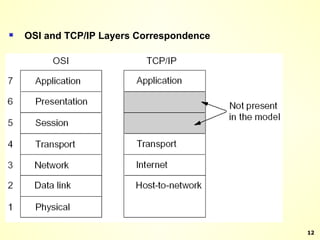
OSI and TCP/IP Layers Correspondence
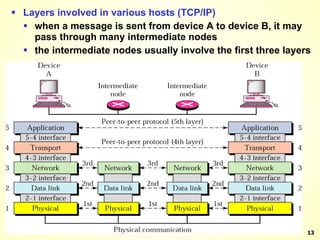
Layers involved in various hosts (TCP/IP) when a message is sent from device A to device B, it may pass through many intermediate nodes the intermediate nodes usually involve the first three layers
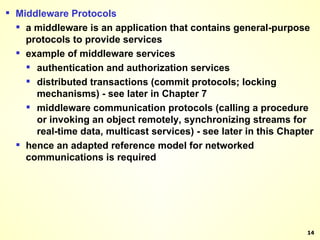
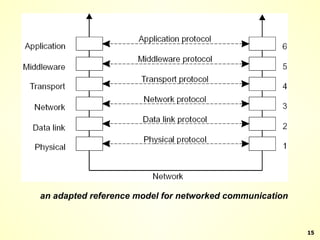
Middleware Protocols a middleware is an application that contains general-purpose protocols to provide services example of middleware services authentication and authorization services distributed transactions (commit protocols; locking mechanisms) - see later in Chapter 7 middleware communication protocols (calling a procedure or invoking an object remotely, synchronizing streams for real-time data, multicast services) - see later in this Chapter hence an adapted reference model for networked communications is required
an adapted reference model for networked communication
4.2 Remote Procedure Call the first distributed systems were based on explicit message exchange between processes through the use of explicit  send  and  receive  procedures; but do not allow access transparency in 1984, Birrel and Nelson introduced a different way of handling communication: RPC it allows a program to call a procedure located on another machine simple and elegant, but there are implementation problems the calling and called procedures run in different address spaces parameters and results have to be exchanged; what if the machines are not identical? what happens if both machines crash?
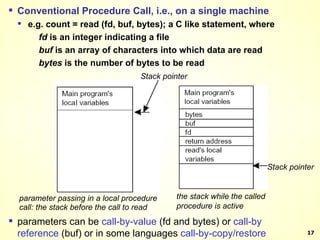
parameter passing in a local procedure call: the stack before the call to read Conventional Procedure Call, i.e., on a single machine e.g. count = read (fd, buf, bytes); a C like statement, where fd  is an integer indicating a file buf  is an array of characters into which data are read bytes  is the number of bytes to be read the stack while the called procedure is active Stack pointer parameters can be  call-by-value  (fd and bytes) or  call-by reference  (buf) or in some languages  call-by-copy/restore Stack pointer
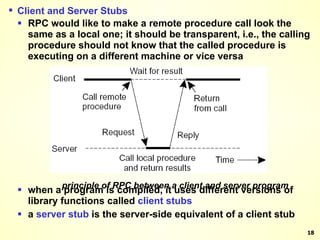
principle of RPC between a client and server program Client and Server Stubs RPC would like to make a remote procedure call look the same as a local one; it should be transparent, i.e., the calling procedure should not know that the called procedure is executing on a different machine or vice versa when a program is compiled, it uses different versions of library functions called  client stubs a  server   stub  is the server-side equivalent of a client   stub
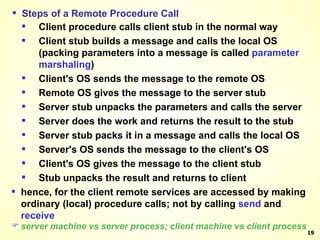
Steps of a Remote Procedure Call Client procedure calls client stub in the normal way Client stub builds a message and calls the local OS (packing parameters into a message is called  parameter marshaling ) Client's OS sends the message to the remote OS Remote OS gives the message to the server stub Server stub unpacks the parameters and calls the server Server does the work and returns the result to the stub Server stub packs it in a message and calls the local OS Server's OS sends the message to the client's OS Client's OS gives the message to the client stub Stub unpacks the result and returns to client hence, for the client remote services are accessed by making ordinary (local) procedure calls; not by calling  send  and  receive server machine vs server process; client machine vs client process
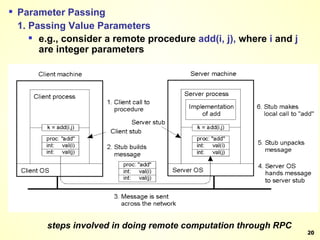
steps involved in doing remote computation through RPC Parameter Passing 1. Passing Value Parameters e.g., consider a remote procedure  add(i, j),  where  i  and  j  are integer parameters
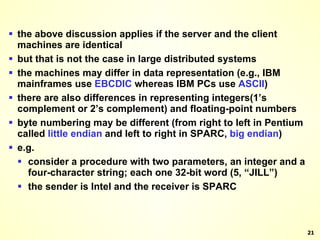
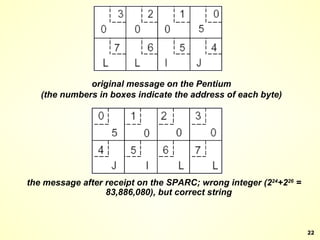
the above discussion applies if the server and the client machines are identical but that is not the case in large distributed systems the machines may differ in data representation (e.g., IBM mainframes use  EBCDIC  whereas IBM PCs use  ASCII ) there are also differences in representing integers(1’s complement or 2’s complement) and floating-point numbers byte numbering may be different (from right to left in Pentium called  little endian  and left to right in SPARC,  big   endian ) e.g. consider a procedure with two parameters, an integer and a four-character string; each one 32-bit word (5, “JILL”) the sender is Intel and the receiver is SPARC
original message on the Pentium (the numbers in boxes indicate the address of each byte) the message after receipt on the SPARC; wrong integer (2 24 +2 26  = 83,886,080), but correct string
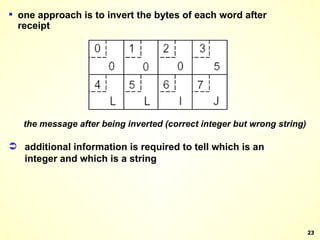
the message after being inverted (correct integer but wrong string) one approach is to invert the bytes of each word after receipt additional information is required to tell which is an integer and which is a string
2. Passing Reference Parameters assume the parameter is a pointer to an array copy the array into the message and send it to the server the server stub can then call the server with a pointer to this array the server then makes any changes to the array and sends it back to the client stub which copies it to the client this is in effect call-by-copy/restore optimization of the method one of the copy operations can be eliminated if the stub knows whether the parameter is input or output to the server if it is an input to the server (e.g., in a call to  write ), it need not be copied back if it is an output, it need not be sent over in the first place; only send the size the above procedure can handle pointers to simple arrays and structures, but difficult to generalize it to an arbitrary data structure
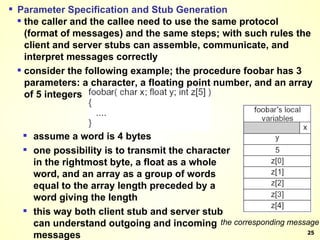
the corresponding message Parameter Specification and Stub Generation assume a word is 4 bytes one possibility is to transmit the character in the rightmost byte, a float as a whole word, and an array as a group of words equal to the array length preceded by a word giving the length this way both client stub and server stub can understand outgoing and incoming messages the caller and the callee need to use the same protocol (format of messages) and the same steps; with such rules the client and server stubs can assemble, communicate, and interpret messages correctly consider the following example; the procedure foobar has 3 parameters: a character, a floating point number, and an array of 5 integers
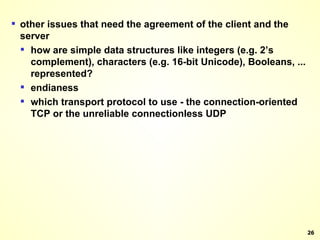
other issues that need the agreement of the client and the server how are simple data structures like integers (e.g. 2’s complement), characters (e.g. 16-bit Unicode), Booleans, ... represented? endianess which transport protocol to use - the connection-oriented TCP or the unreliable connectionless UDP
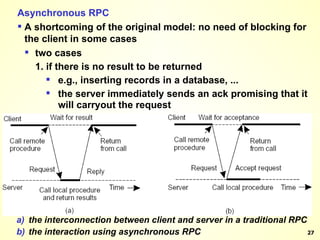
Asynchronous RPC A shortcoming of the original model: no need of blocking for the client in some cases two cases 1. if there is no result to be returned e.g., inserting records in a database, ... the server immediately sends an ack promising that it will carryout the request the client can now proceed without blocking the interconnection between client and server in a traditional RPC the interaction using asynchronous RPC
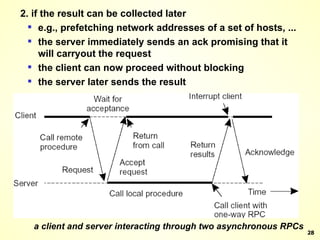
2. if the result can be collected later e.g., prefetching network addresses of a set of hosts, ... the server immediately sends an ack promising that it will carryout the request the client can now proceed without blocking the server later sends the result a client and server interacting through two asynchronous RPCs
the above method combines two asynchronous RPCs and is sometimes called  deferred synchronous RPC variants of asynchronous RPC let the client continue without waiting even for an ack, called  one-way RPC problem: if reliability of communication is not guaranteed
DCE (Distributed Computing Environment) RPC a middleware and an example RPC system developed by OSF (Open Software Foundation), now The Open Group it is designed to execute as a layer of abstraction between existing OSs and distributed applications The Open Group sells the source code and vendors integrate it into their systems it uses the client-server programming model and communication is by means of RPCs services distributed file service : a worldwide file system that provides a transparent way of accessing files directory   service : to keep track of the location of all resources in the system (machines, printers, data, servers, ...); a process can ask for a resource without knowing its location security   service : for protecting resources; access is only through authorization
distributed   time   service : to maintain clocks on different machines synchronized (clock synchronization is covered in Chapter 6) Steps in writing a Client and a Server in DCE RPC the system consists of languages, libraries, daemons, utility programs, ... for writing clients and servers IDL  (Interface Definition Language) is the interface language - the glue that holds everything together it contains type definitions, constant declarations and what the procedures do (only their syntax)
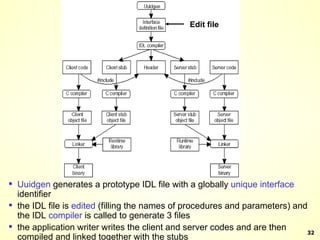
Uuidgen  generates a prototype IDL file with a globally  unique   interface  identifier the IDL file is  edited  (filling the names of procedures and parameters) and the IDL  compiler  is called to generate 3 files the application writer writes the client and server codes and are then compiled and linked together with the stubs Edit file
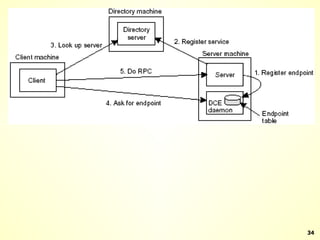
Binding a Client to a Server in DCE RPC for a client to call a server, the server must be registered (1 & 2 in the following figure) the registration allows the client to locate the server and bind to it the DCE daemon maintains a table (server, endpoint) and the protocols the server uses the directory server maintains the locations of all resources in the system (machines, servers, data,, ...) two steps for server location locate the server’s machine (3) locate the server process on that machine (which has what is called an  endpoint  or  port ) (4)
 
RPCs are not adequate for all distributed system applications the provision of access transparency may be good but they have semantics that is not adequate for all applications example problems they assume that the receiving side is running at the time of communication a client is blocked until its request has been processed 4.3 Message-Oriented Communication
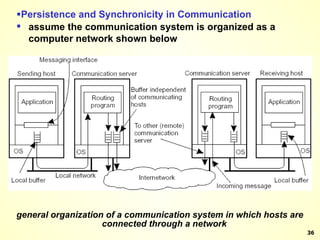
Persistence and Synchronicity in Communication general organization of a communication system in which hosts are connected through a network assume the communication system is organized as a computer network shown below
communication can be persistent or transient asynchronous or synchronous persistent : a message that has been submitted for transmission is stored by the communication system as long as it takes to deliver it to the receiver e.g., email delivery, snail mail delivery transient : a message that has been submitted for transmission is stored by the communication system only as long as the sending and receiving applications are executing asynchronous : a sender continues immediately after it has submitted its message for transmission synchronous : the sender is blocked until its message is stored in a local buffer at the receiving host or delivered to the receiver
Message-Oriented Transient Communication many applications are built on top of the simple message-oriented model offered by the transport layer standardizing the interface of the transport layer by providing a set of primitives allows programmers to use messaging protocols they also allow porting applications 1. Berkley Sockets an example is the  socket interface  as used in Berkley UNIX a socket is a communication endpoint to which an application can write data that are to be sent over the network, and from which incoming data can be read
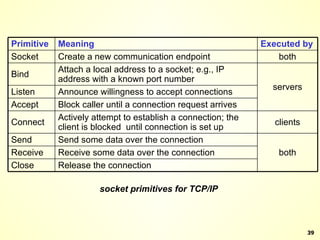
socket primitives for TCP/IP both clients servers both Executed   by Release the connection Close Receive some data over the connection Receive Send some data over the connection Send Actively attempt to establish a connection; the client is blocked  until connection is set up Connect Block caller until a connection request arrives Accept Announce willingness to accept connections Listen Attach a local address to a socket; e.g., IP address with a known port number Bind Create a new communication endpoint Socket Meaning Primitive
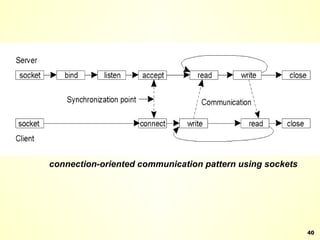
connection-oriented communication pattern using sockets
2. The Message-Passing Interface (MPI) sockets were designed to communicate across networks using general-purpose protocol stacks such as TCP/IP they were not designed for proprietary protocols developed for high-speed interconnection networks; of course portability will suffer MPI is designed for parallel applications and tailored for transient communication MPI assumes communication takes place within a known group of processes, where each group is assigned an identifier (groupID)  each process within a group is also assigned an identifier (processID) a (groupID, processID) identifies the source or destination of a message, and is used instead of a transport-level address
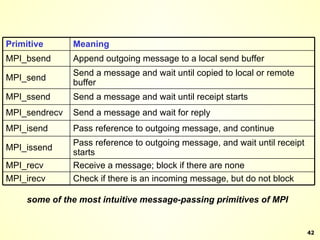
some of the most intuitive message-passing primitives of MPI Check if there is an incoming message, but do not block MPI_irecv Receive a message; block if there are none MPI_recv Pass reference to outgoing message, and wait until receipt starts MPI_issend Pass reference to outgoing message, and continue MPI_isend Send a message and wait for reply MPI_sendrecv Send a message and wait until receipt starts MPI_ssend  Send a message and wait until copied to local or remote buffer MPI_send Append outgoing message to a local send buffer MPI_bsend Meaning Primitive
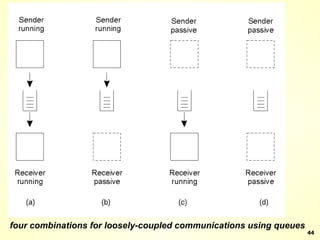
Message-Oriented Persistent Communication there are message-oriented middleware services, called  Message-Queuing   Systems  or  Message-Oriented   Middleware  ( MOM ) they support persistent asynchronous communication they have intermediate-term storage capacity for messages, without requiring the sender or the receiver to be active during message transmission unlike Berkley sockets and MPI, message transfer may take minutes instead of seconds or milliseconds Message-Queuing   Model applications communicate by inserting messages in specific queues it permits loosely-coupled communication the sender may or may not be running; similarly the receiver may or may not be running, giving four possible combinations
four combinations for loosely-coupled communications using queues
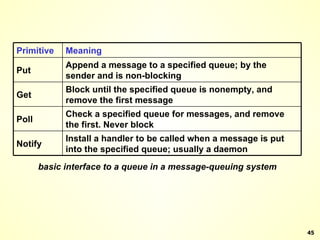
basic interface to a queue in a message-queuing system Install a handler to be called when a message is put into the specified queue; usually a daemon Notify Check a specified queue for messages, and remove the first. Never block Poll Block until the specified queue is nonempty, and remove the first message Get Append a message to a specified queue; by the sender and is non-blocking Put Meaning Primitive
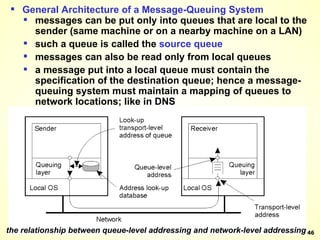
the relationship between queue-level addressing and network-level addressing General Architecture of a Message-Queuing System messages can be put only into queues that are local to the sender (same machine or on a nearby machine on a LAN) such a queue is called the  source   queue messages can also be read only from local queues a message put into a local queue must contain the specification of the destination queue; hence a message-queuing system must maintain a mapping of queues to network locations; like in DNS
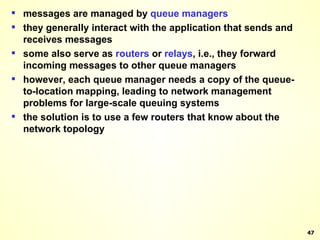
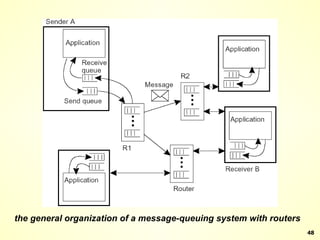
messages are managed by  queue   managers they generally interact with the application that sends and receives messages some also serve as  routers  or  relays , i.e., they forward incoming messages to other queue managers however, each queue manager needs a copy of the queue-to-location mapping, leading to network management problems for large-scale queuing systems the solution is to use a few routers that know about the network topology
the general organization of a message-queuing system with routers
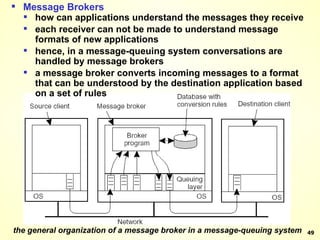
the general organization of a message broker in a message-queuing system Message   Brokers how can applications understand the messages they receive each receiver can not be made to understand message formats of new applications hence, in a message-queuing system conversations are handled by message brokers a message broker converts incoming messages to a format that can be understood by the destination application based on a set of rules
as an example, read about IBM’s WebSphere Message-Queuing System; pages 152-157
until now, we focused on exchanging independent and complete units of information time has no effect on correctness; a system can be slow or fast however, there are communications where time has a critical role Multimedia  media  storage, transmission, interchange, presentation, representation and perception of different data types:  text, graphics, images, voice, audio, video, animation, ... movie: video + audio + …  multimedia: handling of a variety of representation media  end user pull  information overload and starvation  technology push  emerging technology to integrate media  4.4 Stream-Oriented Communication
The Challenge  new applications  multimedia will be pervasive in few years (as graphics)  storage and transmission  e.g., 2 hours uncompressed HDTV (1920×1080) movie: 1.12 TB (1920×1080x3x25x60x60x2) videos are extremely large, even after compressed (actually encoded) continuous delivery  e.g., 30 frames/s (NTSC), 25 frames/s (PAL) for video  guaranteed Quality of Service  admission control  search  can we look at 100… videos to find the proper one?
Types of Media two types discrete media : text, executable code, graphics, images; temporal relationships between data items are  not  fundamental to correctly interpret the data continuous media : video, audio, animation; temporal relationships between data items are fundamental to correctly interpret the data a  data   stream  is a sequence of data units and can be applied to discrete as well as continuous media stream-oriented communication  provides facilities for the exchange of  time-dependent information  (continuous media) such as audio and video streams
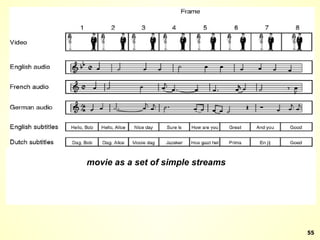
timing in transmission modes asynchronous transmission mode : data items are transmitted one after the other, but no timing constraints; e.g. text transfer synchronous transmission mode : a maximum end-to-end delay defined for each data unit; it is possible that data can be transmitted faster than the maximum delay, but not slower isochronous transmission mode : maximum and minimum end-to-end delay are defined; also called  bounded   delay jitter ; applicable for distributed multimedia systems a continuous data stream can be simple or complex simple stream : consists of a single sequence of data; e.g., mono audio, video only (only visual frames) complex stream : consists of several related simple streams, called  substreams ,  that must be  synchronized ; e.g., stereo audio, video consisting of audio and video (may also contain subtitles, translation to other languages, ...)
movie as a set of simple streams
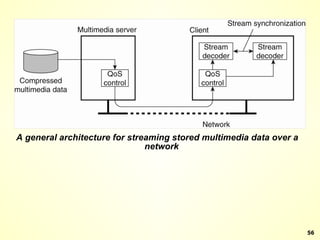
A general architecture for streaming stored multimedia data over a network
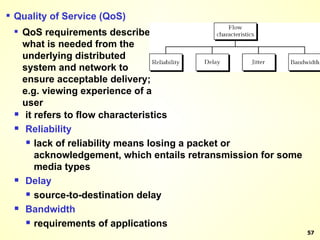
Quality of Service (QoS) QoS requirements describe what is needed from the underlying distributed system and network to ensure acceptable delivery; e.g. viewing experience of a user it refers to flow characteristics Reliability lack of reliability means losing a packet or acknowledgement, which entails retransmission for some media types Delay source-to-destination delay Bandwidth requirements of applications
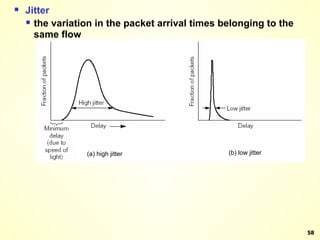
Jitter the variation in the packet arrival times belonging to the same flow
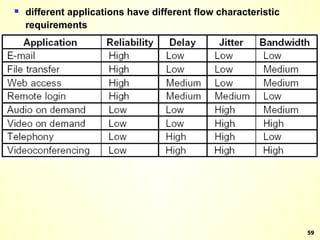
different applications have different flow characteristic requirements
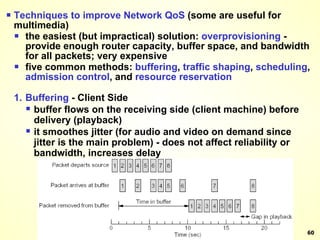
Techniques to improve Network QoS  (some are useful for multimedia) the easiest (but impractical) solution:  overprovisioning  - provide enough router capacity, buffer space, and bandwidth for all packets; very expensive five common methods:  buffering ,  traffic   shaping ,  scheduling ,  admission   control , and  resource   reservation 1. Buffering  - Client Side buffer flows on the receiving side (client machine) before delivery (playback) it smoothes jitter (for audio and video on demand since jitter is the main problem) - does not affect reliability or bandwidth, increases delay
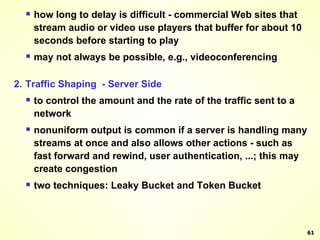
how long to delay is difficult - commercial Web sites that stream audio or video use players that buffer for about 10 seconds before starting to play may not always be possible, e.g., videoconferencing 2. Traffic Shaping  - Server Side to control the amount and the rate of the traffic sent to a network nonuniform output is common if a server is handling many streams at once and also allows other actions - such as fast forward and rewind, user authentication, ...; this may create congestion two techniques: Leaky Bucket and Token Bucket
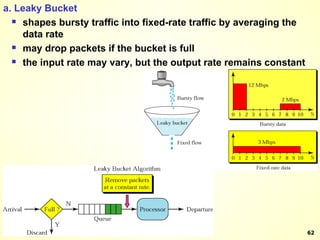
a. Leaky Bucket shapes bursty traffic into fixed-rate traffic by averaging the data rate may drop packets if the bucket is full the input rate may vary, but the output rate remains constant
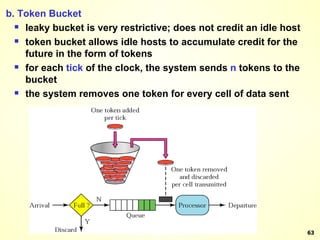
b. Token Bucket leaky bucket is very restrictive; does not credit an idle host token bucket allows idle hosts to accumulate credit for the future in the form of tokens for each  tick  of the clock, the system sends  n  tokens to the bucket the system removes one token for every cell of data sent
e.g., if  n  = 100 and the host is idle for 100 ticks, the bucket collects 10,000 tokens; now the host can consume all these tokens in one tick with 10,000 cells, or the host takes 1000 ticks with 10 cells per tick that means the host can send bursty data as long as the bucket is not empty token bucket allows bursty traffic at a regulated maximum rate
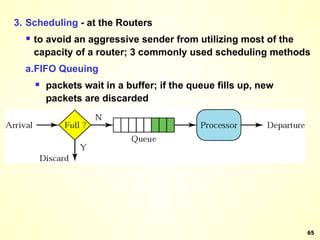
3. Scheduling  - at the Routers to avoid an aggressive sender from utilizing most of the capacity of a router; 3 commonly used scheduling methods a. FIFO Queuing packets wait in a buffer; if the queue fills up, new packets are discarded
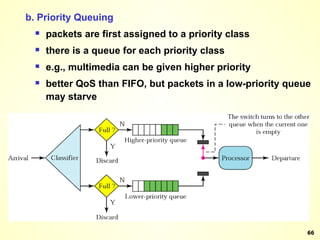
b. Priority Queuing packets are first assigned to a priority class there is a queue for each priority class e.g., multimedia can be given higher priority better QoS than FIFO, but packets in a low-priority queue may starve
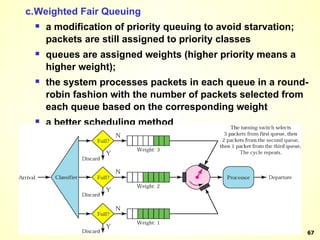
c. Weighted Fair Queuing a modification of priority queuing to avoid starvation; packets are still assigned to priority classes queues are assigned weights (higher priority means a higher weight); the system processes packets in each queue in a round-robin fashion with the number of packets selected from each queue based on the corresponding weight a better scheduling method
4. Resource Reservation Qos is improved if resources (buffer, bandwidth, CPU time, ...) are reserved along the path before hand there is a specific route for a flow Read about the following - QoS approaches by IETF Integrated Services (IntServ) - a flow-based QoS model designed for IP Differentiated Services (DS or DiffServ) - a class-based QoS model designed for IP 5. Admission Control a mechanism used by a router to accept or reject a flow based on predefined parameters called flow specifications before it accepts a flow, it checks the flow specification to see if its capacity (buffer size, bandwidth, CPU speed, ...) and its previous commitments to other flows can handle the new flow
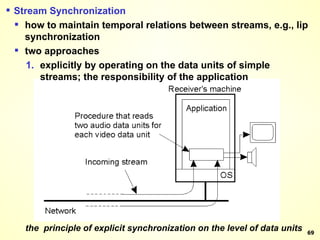
the  principle of explicit synchronization on the level of data units Stream Synchronization how to maintain temporal relations between streams, e.g., lip synchronization two approaches explicitly by operating on the data units of simple streams; the responsibility of the application
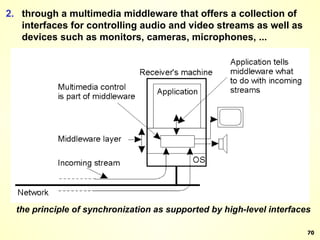
the principle of synchronization as supported by high-level interfaces 2. through a multimedia middleware that offers a collection of interfaces for controlling audio and video streams as well as devices such as monitors, cameras, microphones, ...
multicasting: delivery of data from one host to many destinations; for instance for multimedia applications a one-to-many relationship 1. Application-Level Multicasting nodes are organized into an overlay network and information is disseminated to its members (routers are not involved as in network-level routing) how to construct the overlay network nodes organize themselves as a tree with a unique path between two pairs of nodes or nodes organize into a mesh network and there will be multiple paths between two nodes; adv: robust 2. Gossip-Based Data Transmission use epidemic protocols where information is propagated among a collection of nodes without a coordinator for details read pages 166-174 4.5 Multicast Communication

Chapter 4 communication2

  • 1.
    Chapter 4 -Communication  
  • 2.
    Introduction interprocess communicationis at the heart of all distributed systems communication in distributed systems is based on message passing as offered by the underlying network as opposed to using shared memory modern distributed systems consist of thousands of processes scattered across an unreliable network such as the Internet unless the primitive communication facilities of the network are replaced by more advanced ones, development of large scale Distributed Systems becomes extremely difficult
  • 3.
    Objectives of theChapter review of how processes communicate in a network (the rules or the protocols) and their structures introduce the four widely used communication models for distributed systems: Remote Procedure Call (RPC) Message-Oriented Middleware (MOM) Stream-Oriented Communication Multicast Communication
  • 4.
    4.1 Network Protocolsand Standards a protocol is a set of rules that governs data communications a protocol defines what is communicated, how it is communicated, and when it is communicated for instance, for one computer to send a message to another computer, the first computer must perform the following general steps break the data into small sections called packets add addressing information to the packets identifying the source and destination computers deliver the data to the network interface card for transmission over the network
  • 5.
    the receiving computermust perform the same steps, but in reverse order accept the data from the NIC remove transmitting information that was added by the transmitting computer reassemble the packets of data into the original message the key elements of a protocol are syntax, semantics, and timing syntax : refers to the structure or format of the data semantics : refers to the meaning of each section of bits timing : refers to when data should be sent and how fast they can be sent functions of protocols each device must perform the same steps the same way so that the data will arrive and reassemble properly; if one device uses a protocol with different steps, the two devices will not be able to communicate with each other
  • 6.
    Protocols in alayered architecture protocols that work together to provide a layer or layers of the model are known as a protocol stack or protocol suite, e.g. TCP/IP each layer handles a different part of the communications process and has its own protocol Data Communication Standards standards are essential for interoperability data communication standards fall into two categories De facto standards : that have not been approved by an organized body; mostly set by manufacturers De jure standards : those legislated by an officially recognized body such as ISO, ITU, ANSI, IEEE
  • 7.
    Network (Reference) Models Layers and Services within a single machine, each layer uses the services immediately below it and provides services for the layer immediately above it between machines, layer x on one machine communicates with layer x on another machine Two important network models or architectures The ISO OSI (Open Systems Interconnection) Reference Model The TCP/IP Reference Model a. The OSI Reference Model consists of 7 layers was never fully implemented as a protocol stack, but a good theoretical model Open – to connect open systems or systems that are open for communication with other systems
  • 8.
    layers, interfaces, andprotocols in the OSI model
  • 9.
    Physical: Physical characteristicsof the media Host (upper) Layers Media (lower) Layers Data Link: Reliable data delivery across the link Network: Managing connections across the network or routing Transport: End-to-end connection and reliability (handles lost packets); TCP (connection-oriented), UDP (connectionless), etc. Session: Managing sessions between applications (dialog control and synchronization); rarely supported Presentation: Data presentation to applications; concerned with the syntax and semantics of the information transmitted Application: Network services to applications; contains protocols that are commonly needed by users; FTP, HTTP, SMTP, ...
  • 10.
    a typical messageas it appears on the network
  • 11.
    b. The TCP/IPReference Model TCP/IP - Transmission Control Protocol/Internet Protocol used by ARPANET and its successor the Internet design goals the ability to connect multiple networks (internetworking) in a seamless way the network should be able to survive loss of subnet hardware, i.e., the connection must remain intact as long as the source and destination machines are properly functioning flexible architecture to accommodate requirements of different applications - ranging from transferring files to real-time speech transmission these requirements led to the choice of a packet-switching network based on a connectionless internetwork layer has 4 (or 5 depending on how you see it) layers: Application, Transport, Internet (Internetwork), Host-to-network (some split it into Physical and Data Link)
  • 12.
    OSI and TCP/IPLayers Correspondence
  • 13.
    Layers involved invarious hosts (TCP/IP) when a message is sent from device A to device B, it may pass through many intermediate nodes the intermediate nodes usually involve the first three layers
  • 14.
    Middleware Protocols amiddleware is an application that contains general-purpose protocols to provide services example of middleware services authentication and authorization services distributed transactions (commit protocols; locking mechanisms) - see later in Chapter 7 middleware communication protocols (calling a procedure or invoking an object remotely, synchronizing streams for real-time data, multicast services) - see later in this Chapter hence an adapted reference model for networked communications is required
  • 15.
    an adapted referencemodel for networked communication
  • 16.
    4.2 Remote ProcedureCall the first distributed systems were based on explicit message exchange between processes through the use of explicit send and receive procedures; but do not allow access transparency in 1984, Birrel and Nelson introduced a different way of handling communication: RPC it allows a program to call a procedure located on another machine simple and elegant, but there are implementation problems the calling and called procedures run in different address spaces parameters and results have to be exchanged; what if the machines are not identical? what happens if both machines crash?
  • 17.
    parameter passing ina local procedure call: the stack before the call to read Conventional Procedure Call, i.e., on a single machine e.g. count = read (fd, buf, bytes); a C like statement, where fd is an integer indicating a file buf is an array of characters into which data are read bytes is the number of bytes to be read the stack while the called procedure is active Stack pointer parameters can be call-by-value (fd and bytes) or call-by reference (buf) or in some languages call-by-copy/restore Stack pointer
  • 18.
    principle of RPCbetween a client and server program Client and Server Stubs RPC would like to make a remote procedure call look the same as a local one; it should be transparent, i.e., the calling procedure should not know that the called procedure is executing on a different machine or vice versa when a program is compiled, it uses different versions of library functions called client stubs a server stub is the server-side equivalent of a client stub
  • 19.
    Steps of aRemote Procedure Call Client procedure calls client stub in the normal way Client stub builds a message and calls the local OS (packing parameters into a message is called parameter marshaling ) Client's OS sends the message to the remote OS Remote OS gives the message to the server stub Server stub unpacks the parameters and calls the server Server does the work and returns the result to the stub Server stub packs it in a message and calls the local OS Server's OS sends the message to the client's OS Client's OS gives the message to the client stub Stub unpacks the result and returns to client hence, for the client remote services are accessed by making ordinary (local) procedure calls; not by calling send and receive server machine vs server process; client machine vs client process
  • 20.
    steps involved indoing remote computation through RPC Parameter Passing 1. Passing Value Parameters e.g., consider a remote procedure add(i, j), where i and j are integer parameters
  • 21.
    the above discussionapplies if the server and the client machines are identical but that is not the case in large distributed systems the machines may differ in data representation (e.g., IBM mainframes use EBCDIC whereas IBM PCs use ASCII ) there are also differences in representing integers(1’s complement or 2’s complement) and floating-point numbers byte numbering may be different (from right to left in Pentium called little endian and left to right in SPARC, big endian ) e.g. consider a procedure with two parameters, an integer and a four-character string; each one 32-bit word (5, “JILL”) the sender is Intel and the receiver is SPARC
  • 22.
    original message onthe Pentium (the numbers in boxes indicate the address of each byte) the message after receipt on the SPARC; wrong integer (2 24 +2 26 = 83,886,080), but correct string
  • 23.
    the message afterbeing inverted (correct integer but wrong string) one approach is to invert the bytes of each word after receipt additional information is required to tell which is an integer and which is a string
  • 24.
    2. Passing ReferenceParameters assume the parameter is a pointer to an array copy the array into the message and send it to the server the server stub can then call the server with a pointer to this array the server then makes any changes to the array and sends it back to the client stub which copies it to the client this is in effect call-by-copy/restore optimization of the method one of the copy operations can be eliminated if the stub knows whether the parameter is input or output to the server if it is an input to the server (e.g., in a call to write ), it need not be copied back if it is an output, it need not be sent over in the first place; only send the size the above procedure can handle pointers to simple arrays and structures, but difficult to generalize it to an arbitrary data structure
  • 25.
    the corresponding messageParameter Specification and Stub Generation assume a word is 4 bytes one possibility is to transmit the character in the rightmost byte, a float as a whole word, and an array as a group of words equal to the array length preceded by a word giving the length this way both client stub and server stub can understand outgoing and incoming messages the caller and the callee need to use the same protocol (format of messages) and the same steps; with such rules the client and server stubs can assemble, communicate, and interpret messages correctly consider the following example; the procedure foobar has 3 parameters: a character, a floating point number, and an array of 5 integers
  • 26.
    other issues thatneed the agreement of the client and the server how are simple data structures like integers (e.g. 2’s complement), characters (e.g. 16-bit Unicode), Booleans, ... represented? endianess which transport protocol to use - the connection-oriented TCP or the unreliable connectionless UDP
  • 27.
    Asynchronous RPC Ashortcoming of the original model: no need of blocking for the client in some cases two cases 1. if there is no result to be returned e.g., inserting records in a database, ... the server immediately sends an ack promising that it will carryout the request the client can now proceed without blocking the interconnection between client and server in a traditional RPC the interaction using asynchronous RPC
  • 28.
    2. if theresult can be collected later e.g., prefetching network addresses of a set of hosts, ... the server immediately sends an ack promising that it will carryout the request the client can now proceed without blocking the server later sends the result a client and server interacting through two asynchronous RPCs
  • 29.
    the above methodcombines two asynchronous RPCs and is sometimes called deferred synchronous RPC variants of asynchronous RPC let the client continue without waiting even for an ack, called one-way RPC problem: if reliability of communication is not guaranteed
  • 30.
    DCE (Distributed ComputingEnvironment) RPC a middleware and an example RPC system developed by OSF (Open Software Foundation), now The Open Group it is designed to execute as a layer of abstraction between existing OSs and distributed applications The Open Group sells the source code and vendors integrate it into their systems it uses the client-server programming model and communication is by means of RPCs services distributed file service : a worldwide file system that provides a transparent way of accessing files directory service : to keep track of the location of all resources in the system (machines, printers, data, servers, ...); a process can ask for a resource without knowing its location security service : for protecting resources; access is only through authorization
  • 31.
    distributed time service : to maintain clocks on different machines synchronized (clock synchronization is covered in Chapter 6) Steps in writing a Client and a Server in DCE RPC the system consists of languages, libraries, daemons, utility programs, ... for writing clients and servers IDL (Interface Definition Language) is the interface language - the glue that holds everything together it contains type definitions, constant declarations and what the procedures do (only their syntax)
  • 32.
    Uuidgen generatesa prototype IDL file with a globally unique interface identifier the IDL file is edited (filling the names of procedures and parameters) and the IDL compiler is called to generate 3 files the application writer writes the client and server codes and are then compiled and linked together with the stubs Edit file
  • 33.
    Binding a Clientto a Server in DCE RPC for a client to call a server, the server must be registered (1 & 2 in the following figure) the registration allows the client to locate the server and bind to it the DCE daemon maintains a table (server, endpoint) and the protocols the server uses the directory server maintains the locations of all resources in the system (machines, servers, data,, ...) two steps for server location locate the server’s machine (3) locate the server process on that machine (which has what is called an endpoint or port ) (4)
  • 34.
  • 35.
    RPCs are notadequate for all distributed system applications the provision of access transparency may be good but they have semantics that is not adequate for all applications example problems they assume that the receiving side is running at the time of communication a client is blocked until its request has been processed 4.3 Message-Oriented Communication
  • 36.
    Persistence and Synchronicityin Communication general organization of a communication system in which hosts are connected through a network assume the communication system is organized as a computer network shown below
  • 37.
    communication can bepersistent or transient asynchronous or synchronous persistent : a message that has been submitted for transmission is stored by the communication system as long as it takes to deliver it to the receiver e.g., email delivery, snail mail delivery transient : a message that has been submitted for transmission is stored by the communication system only as long as the sending and receiving applications are executing asynchronous : a sender continues immediately after it has submitted its message for transmission synchronous : the sender is blocked until its message is stored in a local buffer at the receiving host or delivered to the receiver
  • 38.
    Message-Oriented Transient Communicationmany applications are built on top of the simple message-oriented model offered by the transport layer standardizing the interface of the transport layer by providing a set of primitives allows programmers to use messaging protocols they also allow porting applications 1. Berkley Sockets an example is the socket interface as used in Berkley UNIX a socket is a communication endpoint to which an application can write data that are to be sent over the network, and from which incoming data can be read
  • 39.
    socket primitives forTCP/IP both clients servers both Executed by Release the connection Close Receive some data over the connection Receive Send some data over the connection Send Actively attempt to establish a connection; the client is blocked until connection is set up Connect Block caller until a connection request arrives Accept Announce willingness to accept connections Listen Attach a local address to a socket; e.g., IP address with a known port number Bind Create a new communication endpoint Socket Meaning Primitive
  • 40.
  • 41.
    2. The Message-PassingInterface (MPI) sockets were designed to communicate across networks using general-purpose protocol stacks such as TCP/IP they were not designed for proprietary protocols developed for high-speed interconnection networks; of course portability will suffer MPI is designed for parallel applications and tailored for transient communication MPI assumes communication takes place within a known group of processes, where each group is assigned an identifier (groupID) each process within a group is also assigned an identifier (processID) a (groupID, processID) identifies the source or destination of a message, and is used instead of a transport-level address
  • 42.
    some of themost intuitive message-passing primitives of MPI Check if there is an incoming message, but do not block MPI_irecv Receive a message; block if there are none MPI_recv Pass reference to outgoing message, and wait until receipt starts MPI_issend Pass reference to outgoing message, and continue MPI_isend Send a message and wait for reply MPI_sendrecv Send a message and wait until receipt starts MPI_ssend Send a message and wait until copied to local or remote buffer MPI_send Append outgoing message to a local send buffer MPI_bsend Meaning Primitive
  • 43.
    Message-Oriented Persistent Communicationthere are message-oriented middleware services, called Message-Queuing Systems or Message-Oriented Middleware ( MOM ) they support persistent asynchronous communication they have intermediate-term storage capacity for messages, without requiring the sender or the receiver to be active during message transmission unlike Berkley sockets and MPI, message transfer may take minutes instead of seconds or milliseconds Message-Queuing Model applications communicate by inserting messages in specific queues it permits loosely-coupled communication the sender may or may not be running; similarly the receiver may or may not be running, giving four possible combinations
  • 44.
    four combinations forloosely-coupled communications using queues
  • 45.
    basic interface toa queue in a message-queuing system Install a handler to be called when a message is put into the specified queue; usually a daemon Notify Check a specified queue for messages, and remove the first. Never block Poll Block until the specified queue is nonempty, and remove the first message Get Append a message to a specified queue; by the sender and is non-blocking Put Meaning Primitive
  • 46.
    the relationship betweenqueue-level addressing and network-level addressing General Architecture of a Message-Queuing System messages can be put only into queues that are local to the sender (same machine or on a nearby machine on a LAN) such a queue is called the source queue messages can also be read only from local queues a message put into a local queue must contain the specification of the destination queue; hence a message-queuing system must maintain a mapping of queues to network locations; like in DNS
  • 47.
    messages are managedby queue managers they generally interact with the application that sends and receives messages some also serve as routers or relays , i.e., they forward incoming messages to other queue managers however, each queue manager needs a copy of the queue-to-location mapping, leading to network management problems for large-scale queuing systems the solution is to use a few routers that know about the network topology
  • 48.
    the general organizationof a message-queuing system with routers
  • 49.
    the general organizationof a message broker in a message-queuing system Message Brokers how can applications understand the messages they receive each receiver can not be made to understand message formats of new applications hence, in a message-queuing system conversations are handled by message brokers a message broker converts incoming messages to a format that can be understood by the destination application based on a set of rules
  • 50.
    as an example,read about IBM’s WebSphere Message-Queuing System; pages 152-157
  • 51.
    until now, wefocused on exchanging independent and complete units of information time has no effect on correctness; a system can be slow or fast however, there are communications where time has a critical role Multimedia media storage, transmission, interchange, presentation, representation and perception of different data types: text, graphics, images, voice, audio, video, animation, ... movie: video + audio + … multimedia: handling of a variety of representation media end user pull information overload and starvation technology push emerging technology to integrate media 4.4 Stream-Oriented Communication
  • 52.
    The Challenge new applications multimedia will be pervasive in few years (as graphics) storage and transmission e.g., 2 hours uncompressed HDTV (1920×1080) movie: 1.12 TB (1920×1080x3x25x60x60x2) videos are extremely large, even after compressed (actually encoded) continuous delivery e.g., 30 frames/s (NTSC), 25 frames/s (PAL) for video guaranteed Quality of Service admission control search can we look at 100… videos to find the proper one?
  • 53.
    Types of Mediatwo types discrete media : text, executable code, graphics, images; temporal relationships between data items are not fundamental to correctly interpret the data continuous media : video, audio, animation; temporal relationships between data items are fundamental to correctly interpret the data a data stream is a sequence of data units and can be applied to discrete as well as continuous media stream-oriented communication provides facilities for the exchange of time-dependent information (continuous media) such as audio and video streams
  • 54.
    timing in transmissionmodes asynchronous transmission mode : data items are transmitted one after the other, but no timing constraints; e.g. text transfer synchronous transmission mode : a maximum end-to-end delay defined for each data unit; it is possible that data can be transmitted faster than the maximum delay, but not slower isochronous transmission mode : maximum and minimum end-to-end delay are defined; also called bounded delay jitter ; applicable for distributed multimedia systems a continuous data stream can be simple or complex simple stream : consists of a single sequence of data; e.g., mono audio, video only (only visual frames) complex stream : consists of several related simple streams, called substreams , that must be synchronized ; e.g., stereo audio, video consisting of audio and video (may also contain subtitles, translation to other languages, ...)
  • 55.
    movie as aset of simple streams
  • 56.
    A general architecturefor streaming stored multimedia data over a network
  • 57.
    Quality of Service(QoS) QoS requirements describe what is needed from the underlying distributed system and network to ensure acceptable delivery; e.g. viewing experience of a user it refers to flow characteristics Reliability lack of reliability means losing a packet or acknowledgement, which entails retransmission for some media types Delay source-to-destination delay Bandwidth requirements of applications
  • 58.
    Jitter the variationin the packet arrival times belonging to the same flow
  • 59.
    different applications havedifferent flow characteristic requirements
  • 60.
    Techniques to improveNetwork QoS (some are useful for multimedia) the easiest (but impractical) solution: overprovisioning - provide enough router capacity, buffer space, and bandwidth for all packets; very expensive five common methods: buffering , traffic shaping , scheduling , admission control , and resource reservation 1. Buffering - Client Side buffer flows on the receiving side (client machine) before delivery (playback) it smoothes jitter (for audio and video on demand since jitter is the main problem) - does not affect reliability or bandwidth, increases delay
  • 61.
    how long todelay is difficult - commercial Web sites that stream audio or video use players that buffer for about 10 seconds before starting to play may not always be possible, e.g., videoconferencing 2. Traffic Shaping - Server Side to control the amount and the rate of the traffic sent to a network nonuniform output is common if a server is handling many streams at once and also allows other actions - such as fast forward and rewind, user authentication, ...; this may create congestion two techniques: Leaky Bucket and Token Bucket
  • 62.
    a. Leaky Bucketshapes bursty traffic into fixed-rate traffic by averaging the data rate may drop packets if the bucket is full the input rate may vary, but the output rate remains constant
  • 63.
    b. Token Bucketleaky bucket is very restrictive; does not credit an idle host token bucket allows idle hosts to accumulate credit for the future in the form of tokens for each tick of the clock, the system sends n tokens to the bucket the system removes one token for every cell of data sent
  • 64.
    e.g., if n = 100 and the host is idle for 100 ticks, the bucket collects 10,000 tokens; now the host can consume all these tokens in one tick with 10,000 cells, or the host takes 1000 ticks with 10 cells per tick that means the host can send bursty data as long as the bucket is not empty token bucket allows bursty traffic at a regulated maximum rate
  • 65.
    3. Scheduling - at the Routers to avoid an aggressive sender from utilizing most of the capacity of a router; 3 commonly used scheduling methods a. FIFO Queuing packets wait in a buffer; if the queue fills up, new packets are discarded
  • 66.
    b. Priority Queuingpackets are first assigned to a priority class there is a queue for each priority class e.g., multimedia can be given higher priority better QoS than FIFO, but packets in a low-priority queue may starve
  • 67.
    c. Weighted FairQueuing a modification of priority queuing to avoid starvation; packets are still assigned to priority classes queues are assigned weights (higher priority means a higher weight); the system processes packets in each queue in a round-robin fashion with the number of packets selected from each queue based on the corresponding weight a better scheduling method
  • 68.
    4. Resource ReservationQos is improved if resources (buffer, bandwidth, CPU time, ...) are reserved along the path before hand there is a specific route for a flow Read about the following - QoS approaches by IETF Integrated Services (IntServ) - a flow-based QoS model designed for IP Differentiated Services (DS or DiffServ) - a class-based QoS model designed for IP 5. Admission Control a mechanism used by a router to accept or reject a flow based on predefined parameters called flow specifications before it accepts a flow, it checks the flow specification to see if its capacity (buffer size, bandwidth, CPU speed, ...) and its previous commitments to other flows can handle the new flow
  • 69.
    the principleof explicit synchronization on the level of data units Stream Synchronization how to maintain temporal relations between streams, e.g., lip synchronization two approaches explicitly by operating on the data units of simple streams; the responsibility of the application
  • 70.
    the principle ofsynchronization as supported by high-level interfaces 2. through a multimedia middleware that offers a collection of interfaces for controlling audio and video streams as well as devices such as monitors, cameras, microphones, ...
  • 71.
    multicasting: delivery ofdata from one host to many destinations; for instance for multimedia applications a one-to-many relationship 1. Application-Level Multicasting nodes are organized into an overlay network and information is disseminated to its members (routers are not involved as in network-level routing) how to construct the overlay network nodes organize themselves as a tree with a unique path between two pairs of nodes or nodes organize into a mesh network and there will be multiple paths between two nodes; adv: robust 2. Gossip-Based Data Transmission use epidemic protocols where information is propagated among a collection of nodes without a coordinator for details read pages 166-174 4.5 Multicast Communication