Chapter 3   Resource Description Framework
Introduction
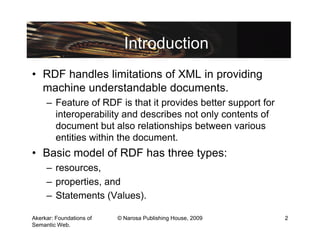
• RDF handles limitations of XML in providing
  machine understandable documents.
     – Feature of RDF is that it provides better support for
       interoperability and describes not only contents of
       document but also relationships between various
       entities within the document.
• Basic model of RDF has three types:
     – resources,
     – properties, and
     – Statements (Values).

Akerkar: Foundations of   © Narosa Publishing House, 2009      2
Semantic Web.
Introduction
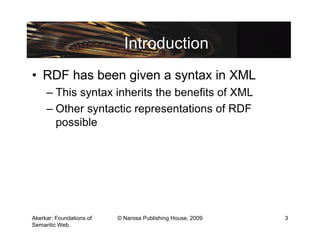
• RDF has been given a syntax in XML
     – This syntax inherits the benefits of XML
     – Other syntactic representations of RDF
       possible


Akerkar: Foundations of   © Narosa Publishing House, 2009   3
Semantic Web.
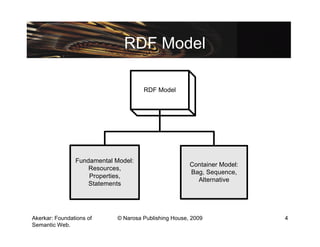
RDF Model

                                      RDF Model


                Fundamental Model:
                                                       Container Model:
                    Resources,
                                                       Bag, Sequence,
                    Properties,
                                                         Alternative
                    Statements


Akerkar: Foundations of      © Narosa Publishing House, 2009              4
Semantic Web.
Introduction
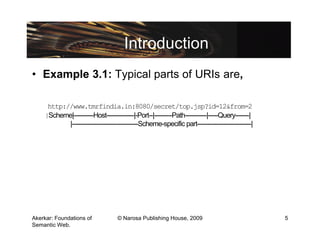
• Example 3.1: Typical parts of URIs are,

     http://www.tmrfindia.in:8080/secret/top.jsp?id=12&from=2
    |Scheme|----------Host--------------|-Port--|---------Path-----------|-----Query-------|
           |---------------------------------Scheme-specific part---------------------------|


Akerkar: Foundations of            © Narosa Publishing House, 2009                              5
Semantic Web.
Introduction
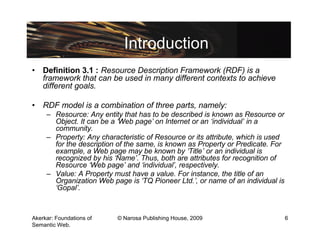
• Definition 3.1 : Resource Description Framework (RDF) is a
  framework that can be used in many different contexts to achieve
  different goals.

• RDF model is a combination of three parts, namely:
     – Resource: Any entity that has to be described is known as Resource or
       Object. It can be a ‘Web page’ on Internet or an ‘individual’ in a
       community.
     – Property: Any characteristic of Resource or its attribute, which is used
       for the description of the same, is known as Property or Predicate. For
       example, a Web page may be known by ‘Title’ or an individual is
       recognized by his ‘Name’. Thus, both are attributes for recognition of
       Resource ‘Web page’ and ‘individual’, respectively.
     – Value: A Property must have a value. For instance, the title of an
       Organization Web page is ‘TQ Pioneer Ltd.’, or name of an individual is
       ‘Gopal’.


Akerkar: Foundations of    © Narosa Publishing House, 2009                        6
Semantic Web.
Example 3.2
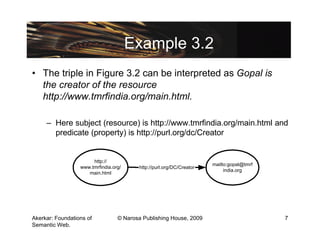
• The triple in Figure 3.2 can be interpreted as Gopal is
  the creator of the resource
  http://www.tmrfindia.org/main.html.

     – Here subject (resource) is http://www.tmrfindia.org/main.html and
       predicate (property) is http://purl.org/dc/Creator


                       http://
                                                                      mailto:gopal@tmrf
                  www.tmrfindia.org/     http://purl.org/DC/Creator
                                                                           india.org
                     main.html


Akerkar: Foundations of           © Narosa Publishing House, 2009                         7
Semantic Web.
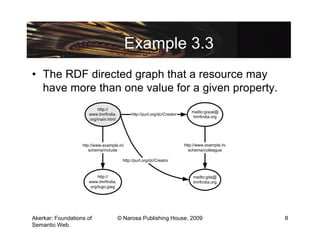
Example 3.3
• The RDF directed graph that a resource may
  have more than one value for a given property.
                          http://
                                                                            mailto:gopal@
                      www.tmrfindia.        http://purl.org/dc/Creator
                                                                            tmrfindia.org
                      org/main.html


                   http://www.example.in/                                http://www.example.in/
                       schema/include                                      schema/colleague

                                        http://purl.org/dc/Creator


                           http://                                           mailto:gita@
                      www.tmrfindia.                                         tmrfindia.org
                       org/logo.jpeg


Akerkar: Foundations of                © Narosa Publishing House, 2009                            8
Semantic Web.
Vocabulary
• A vocabulary is a list of predefined values.
• rdf:Resource
     – It is an attribute of a property element.
• rdf:Property
     – The properties are special type of resources
       used as predicate of triples; the semantics of
       a triple clearly depends on the property used
       as predicate.

Akerkar: Foundations of   © Narosa Publishing House, 2009   9
Semantic Web.
Vocabulary
• rdf:Statement
     – A statement is a resource reifying a triple. It
       emphasizes the properties of resources
• rdfs:subPropertyOf
     – Any property denotes a relation between resources.
       rdfs:subPropertyOf applies to properties
• rdfs:Class, rdf:type and rdfs:subClassOf
     – Classes are resources denoting a set of resources, by
       the mean of the property rdf:type (instances have
       property rdf:type valued by the class). All properties
       have rdf:type valued by rdf:Property.

Akerkar: Foundations of   © Narosa Publishing House, 2009   10
Semantic Web.
Vocabulary
• rdfs:domain and rdfs:range
     – rdfs:domain is a property used to indicate
       that a particular property applies to a
       designated class (i.e. domain of the property).
     – rdfs:range is a property used to indicate that
       the values of a particular property are
       instances of designated class.


Akerkar: Foundations of   © Narosa Publishing House, 2009   11
Semantic Web.
Vocabulary
• rdfs:Literal
     – rdfs:Literal, denoting the set of literals, is
      declared as a class. Its intended use is to be
      the range of properties.
• rdfs:Container
     – Containers are collections of resources.


Akerkar: Foundations of   © Narosa Publishing House, 2009   12
Semantic Web.
Example 3.8
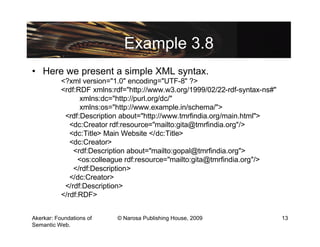
• Here we present a simple XML syntax.
           <?xml version="1.0" encoding="UTF-8" ?>
           <rdf:RDF xmlns:rdf="http://www.w3.org/1999/02/22-rdf-syntax-ns#"
                 xmlns:dc="http://purl.org/dc/"
                 xmlns:os="http://www.example.in/schema/">
            <rdf:Description about="http://www.tmrfindia.org/main.html">
              <dc:Creator rdf:resource="mailto:gita@tmrfindia.org"/>
              <dc:Title> Main Website </dc:Title>
              <dc:Creator>
               <rdf:Description about="mailto:gopal@tmrfindia.org">
                 <os:colleague rdf:resource="mailto:gita@tmrfindia.org"/>
               </rdf:Description>
              </dc:Creator>
            </rdf:Description>
           </rdf:RDF>


Akerkar: Foundations of    © Narosa Publishing House, 2009                    13
Semantic Web.
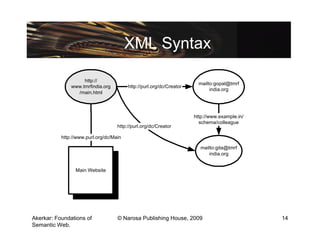
XML Syntax

                    http://
                                                                        mailto:gopal@tmrf
               www.tmrfindia.org         http://purl.org/dc/Creator
                                                                             india.org
                 /main.html


                                                                      http://www.example.in/
                                                                        schema/colleague
                                    http://purl.org/dc/Creator

           http://www.purl.org/dc/Main

                                                                        mailto:gita@tmrf
                                                                            india.org


                 Main Website


Akerkar: Foundations of             © Narosa Publishing House, 2009                            14
Semantic Web.
Example 3.10
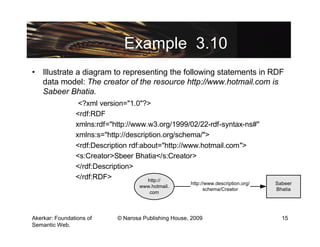
• Illustrate a diagram to representing the following statements in RDF
  data model: The creator of the resource http://www.hotmail.com is
  Sabeer Bhatia.
                 <?xml version="1.0"?>
                <rdf:RDF
                xmlns:rdf="http://www.w3.org/1999/02/22-rdf-syntax-ns#"
                xmlns:s="http://description.org/schema/">
                <rdf:Description rdf:about="http://www.hotmail.com">
                <s:Creator>Sbeer Bhatia</s:Creator>
                </rdf:Description>
                </rdf:RDF>             http://
                                                      http://www.description.org/   Sabeer
                                   www.hotmail.
                                                            schema/Creator          Bhatia
                                      com


Akerkar: Foundations of     © Narosa Publishing House, 2009                           15
Semantic Web.
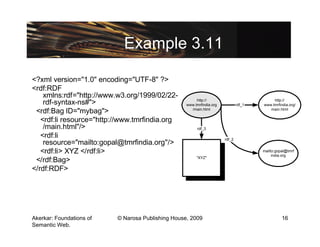
Example 3.11

<?xml version="1.0" encoding="UTF-8" ?>
<rdf:RDF
    xmlns:rdf="http://www.w3.org/1999/02/22-
                                                        http://                             http://
    rdf-syntax-ns#">                               www.tmrfindia.org           rdf_1   www.tmrfindia.org/
                                                     /main.html                           main.html
 <rdf:Bag ID="mybag">
   <rdf:li resource="http://www.tmrfindia.org
    /main.html"/>                                        rdf_3

   <rdf:li                                                             rdf_2
    resource="mailto:gopal@tmrfindia.org"/>
   <rdf:li> XYZ </rdf:li>                                                              mailto:gopal@tmrf
                                                                                            india.org
                                                        "XYZ"
 </rdf:Bag>
</rdf:RDF>


Akerkar: Foundations of   © Narosa Publishing House, 2009                                        16
Semantic Web.
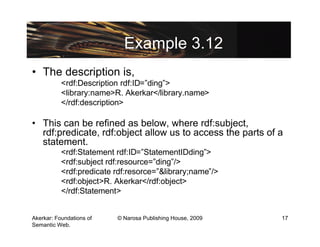
Example 3.12
• The description is,
           <rdf:Description rdf:ID=”ding”>
           <library:name>R. Akerkar</library.name>
           </rdf:description>

• This can be refined as below, where rdf:subject,
  rdf:predicate, rdf:object allow us to access the parts of a
  statement.
           <rdf:Statement rdf:ID=”StatementIDding”>
           <rdf:subject rdf:resource=”ding”/>
           <rdf:predicate rdf:resorce=”&library;name”/>
           <rdf:object>R. Akerkar</rdf:object>
           </rdf:Statement>


Akerkar: Foundations of   © Narosa Publishing House, 2009   17
Semantic Web.
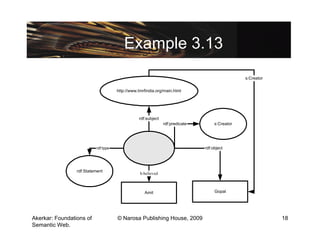
Example 3.13
                                                                                               s:Creator

                                     http://www.tmrfindia.org/main.html


                                                rdf:subject
                                                              rdf:predicate        s:Creator


                          rdf:type                                            rdf:object


                 rdf:Statement
                                                 b:believed


                                                   Amit                            Gopal


Akerkar: Foundations of              © Narosa Publishing House, 2009                                       18
Semantic Web.
RDF Schema
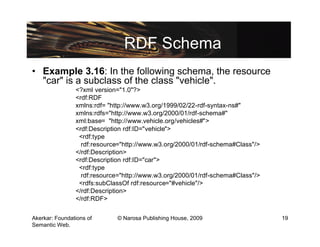
• Example 3.16: In the following schema, the resource
  "car" is a subclass of the class "vehicle".
                <?xml version="1.0"?>
                <rdf:RDF
                xmlns:rdf= "http://www.w3.org/1999/02/22-rdf-syntax-ns#"
                xmlns:rdfs="http://www.w3.org/2000/01/rdf-schema#"
                xml:base= "http://www.vehicle.org/vehicles#">
                <rdf:Description rdf:ID="vehicle">
                 <rdf:type
                  rdf:resource="http://www.w3.org/2000/01/rdf-schema#Class"/>
                </rdf:Description>
                <rdf:Description rdf:ID="car">
                 <rdf:type
                  rdf:resource="http://www.w3.org/2000/01/rdf-schema#Class"/>
                 <rdfs:subClassOf rdf:resource="#vehicle"/>
                </rdf:Description>
                </rdf:RDF>


Akerkar: Foundations of      © Narosa Publishing House, 2009                    19
Semantic Web.
RDF Schema
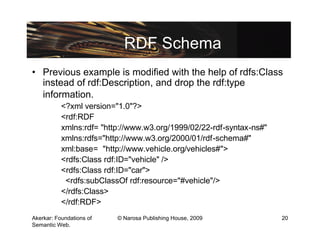
• Previous example is modified with the help of rdfs:Class
  instead of rdf:Description, and drop the rdf:type
  information.
           <?xml version="1.0"?>
           <rdf:RDF
           xmlns:rdf= "http://www.w3.org/1999/02/22-rdf-syntax-ns#"
           xmlns:rdfs="http://www.w3.org/2000/01/rdf-schema#"
           xml:base= "http://www.vehicle.org/vehicles#">
           <rdfs:Class rdf:ID="vehicle" />
           <rdfs:Class rdf:ID="car">
            <rdfs:subClassOf rdf:resource="#vehicle"/>
           </rdfs:Class>
           </rdf:RDF>
Akerkar: Foundations of   © Narosa Publishing House, 2009             20
Semantic Web.
Query Languages
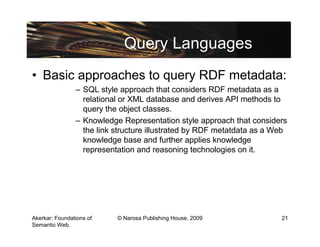
• Basic approaches to query RDF metadata:
                – SQL style approach that considers RDF metadata as a
                  relational or XML database and derives API methods to
                  query the object classes.
                – Knowledge Representation style approach that considers
                  the link structure illustrated by RDF metatdata as a Web
                  knowledge base and further applies knowledge
                  representation and reasoning technologies on it.


Akerkar: Foundations of    © Narosa Publishing House, 2009              21
Semantic Web.
Query Languages
     – RQL
     – SeRQL
     – Triple
     – RDQL
     – Rule ML


Akerkar: Foundations of   © Narosa Publishing House, 2009   22
Semantic Web.
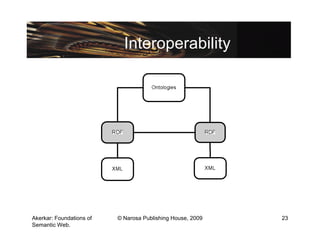
Interoperability


Akerkar: Foundations of   © Narosa Publishing House, 2009   23
Semantic Web.
RDF Disadvantages
     – The RDF format restricts you on how you
       design your XML.

     – RDF uses namespaces to uniquely identify
       types (classes), properties, and resources.

     – In order to use the RDF format, you have to
       learn the extensive RDF vocabulary.


Akerkar: Foundations of   © Narosa Publishing House, 2009   24
Semantic Web.
Suggested Readings
     1.     R. Akerkar and P. Lingras. Building an Intelligent Web: Theory
            & Practice, Johns & Bartlett, 2007.
     2.     T. Berners-Lee, R. Fielding, U.C. Irvine, and L. Masinter.
            Uniform Resource Identifiers (URI): Generic Syntax.
            urn:ietf:rfc:2396, 1998.
     3.     D. Brickley and R.V. Guha. Resource Description Framework
            (RDF) Schema Specification, W3C proposed
            recommendation, 1999.
     4.     R. Fikes and D. L McGuinness. An Axiomatic Semantics for
            RDF, RDF Schema, and DAML-ONT. KS Lab, Stanford
            University, 2001.
     5.     O. Lassila and R. R. Swick. Resource Description Framework
            (RDF) Model and Syntax Specification, W3C recommendation,
            1999.


Akerkar: Foundations of   © Narosa Publishing House, 2009               25
Semantic Web.

Chapter 3 semantic web

  • 1.
    Chapter 3 Resource Description Framework
  • 2.
    Introduction • RDF handleslimitations of XML in providing machine understandable documents. – Feature of RDF is that it provides better support for interoperability and describes not only contents of document but also relationships between various entities within the document. • Basic model of RDF has three types: – resources, – properties, and – Statements (Values). Akerkar: Foundations of © Narosa Publishing House, 2009 2 Semantic Web.
  • 3.
    Introduction • RDF hasbeen given a syntax in XML – This syntax inherits the benefits of XML – Other syntactic representations of RDF possible Akerkar: Foundations of © Narosa Publishing House, 2009 3 Semantic Web.
  • 4.
    RDF Model RDF Model Fundamental Model: Container Model: Resources, Bag, Sequence, Properties, Alternative Statements Akerkar: Foundations of © Narosa Publishing House, 2009 4 Semantic Web.
  • 5.
    Introduction • Example 3.1:Typical parts of URIs are, http://www.tmrfindia.in:8080/secret/top.jsp?id=12&from=2 |Scheme|----------Host--------------|-Port--|---------Path-----------|-----Query-------| |---------------------------------Scheme-specific part---------------------------| Akerkar: Foundations of © Narosa Publishing House, 2009 5 Semantic Web.
  • 6.
    Introduction • Definition 3.1: Resource Description Framework (RDF) is a framework that can be used in many different contexts to achieve different goals. • RDF model is a combination of three parts, namely: – Resource: Any entity that has to be described is known as Resource or Object. It can be a ‘Web page’ on Internet or an ‘individual’ in a community. – Property: Any characteristic of Resource or its attribute, which is used for the description of the same, is known as Property or Predicate. For example, a Web page may be known by ‘Title’ or an individual is recognized by his ‘Name’. Thus, both are attributes for recognition of Resource ‘Web page’ and ‘individual’, respectively. – Value: A Property must have a value. For instance, the title of an Organization Web page is ‘TQ Pioneer Ltd.’, or name of an individual is ‘Gopal’. Akerkar: Foundations of © Narosa Publishing House, 2009 6 Semantic Web.
  • 7.
    Example 3.2 • Thetriple in Figure 3.2 can be interpreted as Gopal is the creator of the resource http://www.tmrfindia.org/main.html. – Here subject (resource) is http://www.tmrfindia.org/main.html and predicate (property) is http://purl.org/dc/Creator http:// mailto:gopal@tmrf www.tmrfindia.org/ http://purl.org/DC/Creator india.org main.html Akerkar: Foundations of © Narosa Publishing House, 2009 7 Semantic Web.
  • 8.
    Example 3.3 • TheRDF directed graph that a resource may have more than one value for a given property. http:// mailto:gopal@ www.tmrfindia. http://purl.org/dc/Creator tmrfindia.org org/main.html http://www.example.in/ http://www.example.in/ schema/include schema/colleague http://purl.org/dc/Creator http:// mailto:gita@ www.tmrfindia. tmrfindia.org org/logo.jpeg Akerkar: Foundations of © Narosa Publishing House, 2009 8 Semantic Web.
  • 9.
    Vocabulary • A vocabularyis a list of predefined values. • rdf:Resource – It is an attribute of a property element. • rdf:Property – The properties are special type of resources used as predicate of triples; the semantics of a triple clearly depends on the property used as predicate. Akerkar: Foundations of © Narosa Publishing House, 2009 9 Semantic Web.
  • 10.
    Vocabulary • rdf:Statement – A statement is a resource reifying a triple. It emphasizes the properties of resources • rdfs:subPropertyOf – Any property denotes a relation between resources. rdfs:subPropertyOf applies to properties • rdfs:Class, rdf:type and rdfs:subClassOf – Classes are resources denoting a set of resources, by the mean of the property rdf:type (instances have property rdf:type valued by the class). All properties have rdf:type valued by rdf:Property. Akerkar: Foundations of © Narosa Publishing House, 2009 10 Semantic Web.
  • 11.
    Vocabulary • rdfs:domain andrdfs:range – rdfs:domain is a property used to indicate that a particular property applies to a designated class (i.e. domain of the property). – rdfs:range is a property used to indicate that the values of a particular property are instances of designated class. Akerkar: Foundations of © Narosa Publishing House, 2009 11 Semantic Web.
  • 12.
    Vocabulary • rdfs:Literal – rdfs:Literal, denoting the set of literals, is declared as a class. Its intended use is to be the range of properties. • rdfs:Container – Containers are collections of resources. Akerkar: Foundations of © Narosa Publishing House, 2009 12 Semantic Web.
  • 13.
    Example 3.8 • Herewe present a simple XML syntax. <?xml version="1.0" encoding="UTF-8" ?> <rdf:RDF xmlns:rdf="http://www.w3.org/1999/02/22-rdf-syntax-ns#" xmlns:dc="http://purl.org/dc/" xmlns:os="http://www.example.in/schema/"> <rdf:Description about="http://www.tmrfindia.org/main.html"> <dc:Creator rdf:resource="mailto:gita@tmrfindia.org"/> <dc:Title> Main Website </dc:Title> <dc:Creator> <rdf:Description about="mailto:gopal@tmrfindia.org"> <os:colleague rdf:resource="mailto:gita@tmrfindia.org"/> </rdf:Description> </dc:Creator> </rdf:Description> </rdf:RDF> Akerkar: Foundations of © Narosa Publishing House, 2009 13 Semantic Web.
  • 14.
    XML Syntax http:// mailto:gopal@tmrf www.tmrfindia.org http://purl.org/dc/Creator india.org /main.html http://www.example.in/ schema/colleague http://purl.org/dc/Creator http://www.purl.org/dc/Main mailto:gita@tmrf india.org Main Website Akerkar: Foundations of © Narosa Publishing House, 2009 14 Semantic Web.
  • 15.
    Example 3.10 • Illustratea diagram to representing the following statements in RDF data model: The creator of the resource http://www.hotmail.com is Sabeer Bhatia. <?xml version="1.0"?> <rdf:RDF xmlns:rdf="http://www.w3.org/1999/02/22-rdf-syntax-ns#" xmlns:s="http://description.org/schema/"> <rdf:Description rdf:about="http://www.hotmail.com"> <s:Creator>Sbeer Bhatia</s:Creator> </rdf:Description> </rdf:RDF> http:// http://www.description.org/ Sabeer www.hotmail. schema/Creator Bhatia com Akerkar: Foundations of © Narosa Publishing House, 2009 15 Semantic Web.
  • 16.
    Example 3.11 <?xml version="1.0"encoding="UTF-8" ?> <rdf:RDF xmlns:rdf="http://www.w3.org/1999/02/22- http:// http:// rdf-syntax-ns#"> www.tmrfindia.org rdf_1 www.tmrfindia.org/ /main.html main.html <rdf:Bag ID="mybag"> <rdf:li resource="http://www.tmrfindia.org /main.html"/> rdf_3 <rdf:li rdf_2 resource="mailto:gopal@tmrfindia.org"/> <rdf:li> XYZ </rdf:li> mailto:gopal@tmrf india.org "XYZ" </rdf:Bag> </rdf:RDF> Akerkar: Foundations of © Narosa Publishing House, 2009 16 Semantic Web.
  • 17.
    Example 3.12 • Thedescription is, <rdf:Description rdf:ID=”ding”> <library:name>R. Akerkar</library.name> </rdf:description> • This can be refined as below, where rdf:subject, rdf:predicate, rdf:object allow us to access the parts of a statement. <rdf:Statement rdf:ID=”StatementIDding”> <rdf:subject rdf:resource=”ding”/> <rdf:predicate rdf:resorce=”&library;name”/> <rdf:object>R. Akerkar</rdf:object> </rdf:Statement> Akerkar: Foundations of © Narosa Publishing House, 2009 17 Semantic Web.
  • 18.
    Example 3.13 s:Creator http://www.tmrfindia.org/main.html rdf:subject rdf:predicate s:Creator rdf:type rdf:object rdf:Statement b:believed Amit Gopal Akerkar: Foundations of © Narosa Publishing House, 2009 18 Semantic Web.
  • 19.
    RDF Schema • Example3.16: In the following schema, the resource "car" is a subclass of the class "vehicle". <?xml version="1.0"?> <rdf:RDF xmlns:rdf= "http://www.w3.org/1999/02/22-rdf-syntax-ns#" xmlns:rdfs="http://www.w3.org/2000/01/rdf-schema#" xml:base= "http://www.vehicle.org/vehicles#"> <rdf:Description rdf:ID="vehicle"> <rdf:type rdf:resource="http://www.w3.org/2000/01/rdf-schema#Class"/> </rdf:Description> <rdf:Description rdf:ID="car"> <rdf:type rdf:resource="http://www.w3.org/2000/01/rdf-schema#Class"/> <rdfs:subClassOf rdf:resource="#vehicle"/> </rdf:Description> </rdf:RDF> Akerkar: Foundations of © Narosa Publishing House, 2009 19 Semantic Web.
  • 20.
    RDF Schema • Previousexample is modified with the help of rdfs:Class instead of rdf:Description, and drop the rdf:type information. <?xml version="1.0"?> <rdf:RDF xmlns:rdf= "http://www.w3.org/1999/02/22-rdf-syntax-ns#" xmlns:rdfs="http://www.w3.org/2000/01/rdf-schema#" xml:base= "http://www.vehicle.org/vehicles#"> <rdfs:Class rdf:ID="vehicle" /> <rdfs:Class rdf:ID="car"> <rdfs:subClassOf rdf:resource="#vehicle"/> </rdfs:Class> </rdf:RDF> Akerkar: Foundations of © Narosa Publishing House, 2009 20 Semantic Web.
  • 21.
    Query Languages • Basicapproaches to query RDF metadata: – SQL style approach that considers RDF metadata as a relational or XML database and derives API methods to query the object classes. – Knowledge Representation style approach that considers the link structure illustrated by RDF metatdata as a Web knowledge base and further applies knowledge representation and reasoning technologies on it. Akerkar: Foundations of © Narosa Publishing House, 2009 21 Semantic Web.
  • 22.
    Query Languages – RQL – SeRQL – Triple – RDQL – Rule ML Akerkar: Foundations of © Narosa Publishing House, 2009 22 Semantic Web.
  • 23.
    Interoperability Akerkar: Foundations of © Narosa Publishing House, 2009 23 Semantic Web.
  • 24.
    RDF Disadvantages – The RDF format restricts you on how you design your XML. – RDF uses namespaces to uniquely identify types (classes), properties, and resources. – In order to use the RDF format, you have to learn the extensive RDF vocabulary. Akerkar: Foundations of © Narosa Publishing House, 2009 24 Semantic Web.
  • 25.
    Suggested Readings 1. R. Akerkar and P. Lingras. Building an Intelligent Web: Theory & Practice, Johns & Bartlett, 2007. 2. T. Berners-Lee, R. Fielding, U.C. Irvine, and L. Masinter. Uniform Resource Identifiers (URI): Generic Syntax. urn:ietf:rfc:2396, 1998. 3. D. Brickley and R.V. Guha. Resource Description Framework (RDF) Schema Specification, W3C proposed recommendation, 1999. 4. R. Fikes and D. L McGuinness. An Axiomatic Semantics for RDF, RDF Schema, and DAML-ONT. KS Lab, Stanford University, 2001. 5. O. Lassila and R. R. Swick. Resource Description Framework (RDF) Model and Syntax Specification, W3C recommendation, 1999. Akerkar: Foundations of © Narosa Publishing House, 2009 25 Semantic Web.