Hypertext and
  Hypermedia
        PRAKASH KHAIRE
B V PATEL INSTITUTE OF BMC & IT
384


                  Hypertext
•   Text augmented with links

    •   Link: pointer to another piece of text in
        same or different document

    •   Navigational metaphor

        •   User follows a link from its source to its
            destination, usually by clicking on source
            with the mouse

    •   Use browser to view and navigate hypertext
Non-linearity
•   Hypertext not usually read linearly (from start
    to finish)

•   Links encourage branching off

    •   History and back button permit backtracking

•   Not an innovation, but the immediacy of
    following links by clicking creates a different
    experience from traditional non-linearity (e.g.
    cross-references in encyclopedia)
Links
•   Simple unidirectional links

    •   Connect single point on one page with a point on
        another page (e.g. WWW)

•   Extended links

    •   Regional links (ends may be regions within a
        page)

    •   Bidirectional links (may be followed in both
        directions)

    •   Multilinks (may have more than two ends)
Browsing & Searching
•   Browsing – retrieve information by association

    •   Follow links, backtrack

    •   Maintain history, bookmarks

•   Searching – retrieve information by content

    •   Construct indexes of URLs

    •   Search by keyword/description of page
392–393


                Web Indexes
•   Manual (Yahoo!, Open Directory Project,…)

    •   Classify sites on basis of human evaluation of
        their content

    •   Navigate hierarchy, or search entries by
        keyword

•   Automatic (Google, AltaVista,…)

    •   Spider/robot 'crawls' Web, collecting URLs and
        keywords extracted from pages

    •   Highly efficient search engine processes queries
Automatic Indexing
•   Must extract keywords automatically from pages

    •   Apply heuristics to identify meaningful words
        within text

    •   Use metadata added by page's author

        •   <meta name="keywords" content="…">

        •   <meta name="description" content="…">

•   Google applies weighting based on number of
    links pointing to a page
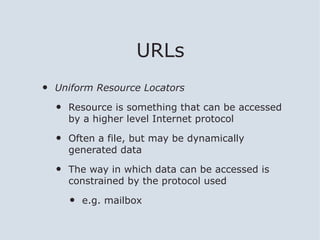
URLs
•   Uniform Resource Locators

    •   Resource is something that can be accessed
        by a higher level Internet protocol

    •   Often a file, but may be dynamically
        generated data

    •   The way in which data can be accessed is
        constrained by the protocol used

        •   e.g. mailbox
395–396


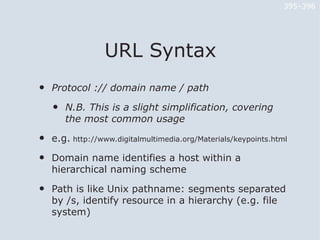
                 URL Syntax
•   Protocol :// domain name / path

    •   N.B. This is a slight simplification, covering
        the most common usage

•   e.g. http://www.digitalmultimedia.org/Materials/keypoints.html

•   Domain name identifies a host within a
    hierarchical naming scheme

•   Path is like Unix pathname: segments separated
    by /s, identify resource in a hierarchy (e.g. file
    system)
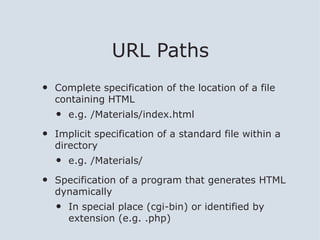
URL Paths
•   Complete specification of the location of a file
    containing HTML
    •   e.g. /Materials/index.html

•   Implicit specification of a standard file within a
    directory
    •   e.g. /Materials/

•   Specification of a program that generates HTML
    dynamically
    •   In special place (cgi-bin) or identified by
        extension (e.g. .php)
398


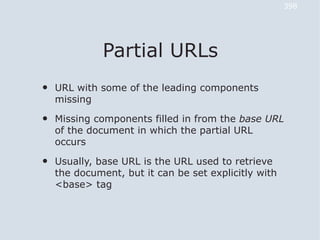
              Partial URLs
•   URL with some of the leading components
    missing

•   Missing components filled in from the base URL
    of the document in which the partial URL
    occurs

•   Usually, base URL is the URL used to retrieve
    the document, but it can be set explicitly with
    <base> tag
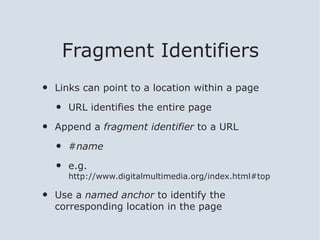
Fragment Identifiers
•   Links can point to a location within a page

    •   URL identifies the entire page

•   Append a fragment identifier to a URL

    •   #name

    •   e.g.
        http://www.digitalmultimedia.org/index.html#top

•   Use a named anchor to identify the
    corresponding location in the page
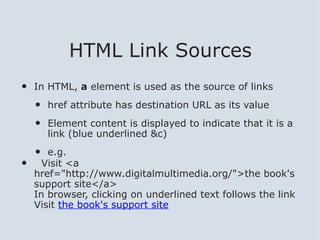
HTML Link Sources
•   In HTML, a element is used as the source of links

    •   href attribute has destination URL as its value

    •   Element content is displayed to indicate that it is a
        link (blue underlined &c)

    •  e.g.
•     Visit <a
    href="http://www.digitalmultimedia.org/">the book's
    support site</a>
    In browser, clicking on underlined text follows the link
    Visit the book's support site
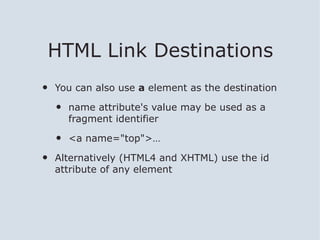
HTML Link Destinations
•   You can also use a element as the destination

    •   name attribute's value may be used as a
        fragment identifier

    •   <a name="top">…

•   Alternatively (HTML4 and XHTML) use the id
    attribute of any element
400


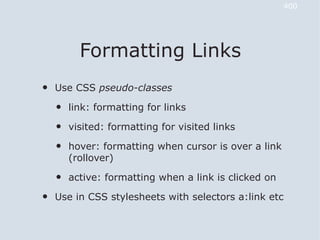
          Formatting Links
•   Use CSS pseudo-classes

    •   link: formatting for links

    •   visited: formatting for visited links

    •   hover: formatting when cursor is over a link
        (rollover)

    •   active: formatting when a link is clicked on

•   Use in CSS stylesheets with selectors a:link etc
HTML & Hypermedia
•   href of an a element might not point to an
    HTML file
•   Server response will include MIME type when
    resource is retrieved (deduced from extension)
•   Browser will either
    •   Deal with data itself
    •   Call on a helper application to display the
        retrieved resource externally
    •   Use a plug-in to display it in browser window
Hypermedia Markup
•   If non-textual data is rendered within the browser,
    can integrate images, video, etc within Web page

•   img element is established way of embedding
    bitmapped images (GIF, JPEG, PNG)

•   object element can be used for any type of
    embedded data

•   embed element not standard, but widely
    supported for embedding video, audio and applets
Links and Images
•   An image may appear in the content of an a
    element, to serve as a clickable link

    •   e.g. thumbnail image linked to bigger
        version

•   An image map can contain several hot spots,
    each linked to a URL

•   usemap attribute of img designates map
    element, which contains area elements
    specifying shape and position of hot spots and
    their associated URLs

Hypertextandhypermedia 120320065133-phpapp01

  • 1.
    Hypertext and Hypermedia PRAKASH KHAIRE B V PATEL INSTITUTE OF BMC & IT
  • 2.
    384 Hypertext • Text augmented with links • Link: pointer to another piece of text in same or different document • Navigational metaphor • User follows a link from its source to its destination, usually by clicking on source with the mouse • Use browser to view and navigate hypertext
  • 3.
    Non-linearity • Hypertext not usually read linearly (from start to finish) • Links encourage branching off • History and back button permit backtracking • Not an innovation, but the immediacy of following links by clicking creates a different experience from traditional non-linearity (e.g. cross-references in encyclopedia)
  • 4.
    Links • Simple unidirectional links • Connect single point on one page with a point on another page (e.g. WWW) • Extended links • Regional links (ends may be regions within a page) • Bidirectional links (may be followed in both directions) • Multilinks (may have more than two ends)
  • 5.
    Browsing & Searching • Browsing – retrieve information by association • Follow links, backtrack • Maintain history, bookmarks • Searching – retrieve information by content • Construct indexes of URLs • Search by keyword/description of page
  • 6.
    392–393 Web Indexes • Manual (Yahoo!, Open Directory Project,…) • Classify sites on basis of human evaluation of their content • Navigate hierarchy, or search entries by keyword • Automatic (Google, AltaVista,…) • Spider/robot 'crawls' Web, collecting URLs and keywords extracted from pages • Highly efficient search engine processes queries
  • 7.
    Automatic Indexing • Must extract keywords automatically from pages • Apply heuristics to identify meaningful words within text • Use metadata added by page's author • <meta name="keywords" content="…"> • <meta name="description" content="…"> • Google applies weighting based on number of links pointing to a page
  • 8.
    URLs • Uniform Resource Locators • Resource is something that can be accessed by a higher level Internet protocol • Often a file, but may be dynamically generated data • The way in which data can be accessed is constrained by the protocol used • e.g. mailbox
  • 9.
    395–396 URL Syntax • Protocol :// domain name / path • N.B. This is a slight simplification, covering the most common usage • e.g. http://www.digitalmultimedia.org/Materials/keypoints.html • Domain name identifies a host within a hierarchical naming scheme • Path is like Unix pathname: segments separated by /s, identify resource in a hierarchy (e.g. file system)
  • 10.
    URL Paths • Complete specification of the location of a file containing HTML • e.g. /Materials/index.html • Implicit specification of a standard file within a directory • e.g. /Materials/ • Specification of a program that generates HTML dynamically • In special place (cgi-bin) or identified by extension (e.g. .php)
  • 11.
    398 Partial URLs • URL with some of the leading components missing • Missing components filled in from the base URL of the document in which the partial URL occurs • Usually, base URL is the URL used to retrieve the document, but it can be set explicitly with <base> tag
  • 12.
    Fragment Identifiers • Links can point to a location within a page • URL identifies the entire page • Append a fragment identifier to a URL • #name • e.g. http://www.digitalmultimedia.org/index.html#top • Use a named anchor to identify the corresponding location in the page
  • 13.
    HTML Link Sources • In HTML, a element is used as the source of links • href attribute has destination URL as its value • Element content is displayed to indicate that it is a link (blue underlined &c) • e.g. • Visit <a href="http://www.digitalmultimedia.org/">the book's support site</a> In browser, clicking on underlined text follows the link Visit the book's support site
  • 14.
    HTML Link Destinations • You can also use a element as the destination • name attribute's value may be used as a fragment identifier • <a name="top">… • Alternatively (HTML4 and XHTML) use the id attribute of any element
  • 15.
    400 Formatting Links • Use CSS pseudo-classes • link: formatting for links • visited: formatting for visited links • hover: formatting when cursor is over a link (rollover) • active: formatting when a link is clicked on • Use in CSS stylesheets with selectors a:link etc
  • 16.
    HTML & Hypermedia • href of an a element might not point to an HTML file • Server response will include MIME type when resource is retrieved (deduced from extension) • Browser will either • Deal with data itself • Call on a helper application to display the retrieved resource externally • Use a plug-in to display it in browser window
  • 17.
    Hypermedia Markup • If non-textual data is rendered within the browser, can integrate images, video, etc within Web page • img element is established way of embedding bitmapped images (GIF, JPEG, PNG) • object element can be used for any type of embedded data • embed element not standard, but widely supported for embedding video, audio and applets
  • 18.
    Links and Images • An image may appear in the content of an a element, to serve as a clickable link • e.g. thumbnail image linked to bigger version • An image map can contain several hot spots, each linked to a URL • usemap attribute of img designates map element, which contains area elements specifying shape and position of hot spots and their associated URLs