CHAPTER - 3
PUBLIC, PRIVATE
AND
GLOBAL ENTERPRISES
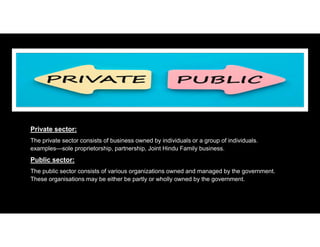
Private sector:
The private sector consists of business owned by individuals or a group of individuals.
examples—sole proprietorship, partnership, Joint Hindu Family business.
Public sector:
The public sector consists of various organizations owned and managed by the government.
These organisations may be either be partly or wholly owned by the government.
PRIVATE COMPANY:
A Private company means a company which
• restricts the right of members to transfer its shares.
• has a minimum of 2 and a maximum of 50 members.
• does not invite public to subscribe to its share capital.
• must have a minimum paid up capital of Rs. 1 lakh.
• It is necessary for a private company to use the word private
limited after its name.
The following are some of the privileges of a private limited company as
against a public limited company:
A private company can be formed by only two members whereas seven people are needed to
form a public company.
There is no need to issue a prospectus as public is not invited to subscribe to the shares of a
private company.
Allotment of shares can be done without receiving he minimum subscription.
A private company can start business as soon as it receives the certificate of incorporation. The
public company on the other hand, must wait for the receipt of certificate of commencement
before it can start a business.
A private company need to have only two directors as against the minimum of three directors in
the case of a public company.
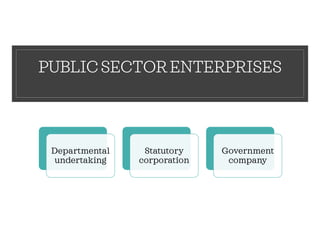
PUBLICSECTORENTERPRISES
Departmental
undertaking
Statutory
corporation
Government
company
Departmental Undertakings
This is the oldest and most traditional form of organising public
enterprises.
These enterprises are established as departments of the ministry
and are considered part or an extension of the ministry itself.
Examples of departmental undertakings are Indian Railways,
Post and Telegraph etc
FEATURES:
Part of government: The ultimate authority lies with the concerned minister
who is responsible to the parliament or state legislature.
Government financing: The funding of these enterprises comes directly
from the government treasury and revenue earned by these is also paid into
the treasury.
Accounting and Audit: The undertaking is subject to the normal budgeting,
accounting and audit.
Civil Service code: The enterprise is managed by civil servants whose
methods of recruitment and service conditions are the same as for other civil
servants of the government.
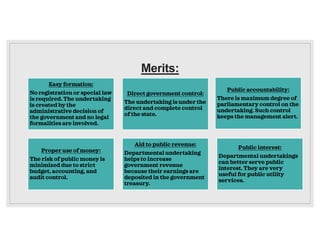
Merits:
Easy formation:
No registration or special law
is required. The undertaking
is created by the
administrative decision of
the government and no legal
formalities are involved.
Direct government control:
The undertaking is under the
direct and complete control
of the state.
Public accountability:
There is maximum degree of
parliamentary control on the
undertaking. Such control
keeps the management alert.
Proper use of money:
The risk of public money is
minimized due to strict
budget, accounting, and
audit control.
Aid to public revenue:
Departmental undertaking
helps to increase
government revenue
because their earnings are
deposited in the government
treasury.
Public interest:
Departmental undertakings
can better serve public
interest. They are very
useful for public utility
services.
Limitations:
 Lack of flexibility
 Lack of motivation
 Red tapism– excessive formality and
routine required before official action can
be taken or strict adherence to official
formalities.
 Inefficient management
 Insensitive to needs of consumers
STATUTORY
CORPORATIONS
Statutory Corporations are public enterprises
brought into existence by a special act of
parliament.
The act defines its powers and functions,rules
and regulation governing its employees and its
relationshipwith government department.
Examples are Airport Authority of India, National
Highways Authority of India, Central
Warehousing Corporation,LIC of India, RBI, ICAI
(Institute of Chartered Accountants of India)
FEATURES
Generally financed by the central or state government.
May borrow fund from the public and government
organization.
They have separate legal entity.
They have to frame their own policies and procedures
within the scope of state legislature.
Providing better services to public and make adequate
profit
They can recruit and appoint their employee with their
service condition, since they are corporate body.
There is less government interference in matters of the
corporation
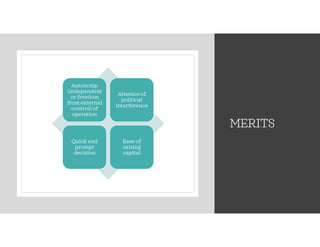
MERITS
Autonomy
(independent
or freedom
from external
control) of
operation
Absence of
political
interference
Quick and
prompt
decision
Ease of
raising
capital
DEMERITS
No flexibility in operation
Misuse of powers
Lack of efficiency
Political interference could be
there
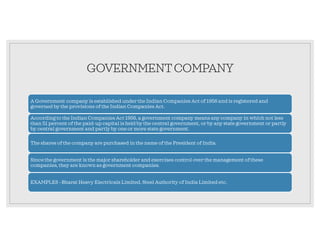
GOVERNMENTCOMPANY
A Government company is established under the Indian Companies Act of 1956 and is registered and
governed by the provisions of the Indian Companies Act.
According to the Indian Companies Act 1956, a government company means any company in which not less
than 51 percent of the paid-up capital is held by the central government, or by any state government or partly
by central government and partly by one or more state government.
The shares of the company are purchased in the name of the President of India.
Since the government is the major shareholder and exercises control over the management of these
companies, they are known as government companies.
EXAMPLES –Bharat Heavy Electricals Limited, Steel Authority of India Limited etc.
FEATURES
It is an organisation created by the Indian Companies
Act, 1956.
The company can file a suit in a court of law against any
third party and be sued.
The company can enter into a contract and can acquire
propertyin its own name.
The Managementof the company is regulatedby the
provisions of the companies Act, like any other public
limited company.
The employees of the company are appointed according
to their own rules and regulations as contained in the
Memorandum and Articles of Associations.
These companies are exempted from the accounting and
audit rules and procedures.
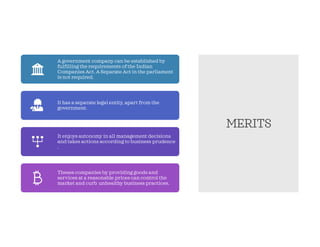
MERITS
A government company can be established by
fulfilling the requirements of the Indian
Companies Act. A Separate Act in the parliament
is not required.
It has a separate legal entity, apart from the
government.
It enjoys autonomy in all management decisions
and takes actions according to business prudence
.
Theses companies by providing goods and
services at a reasonable prices can control the
market and curb unhealthy business practices.
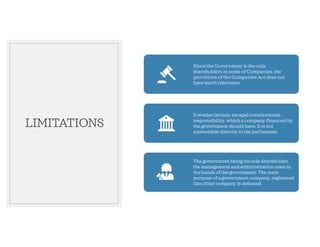
LIMITATIONS
Since the Government is the only
shareholders in some of Companies, the
provisions of the Companies Act does not
have much relevance.
It evades (avoids, escape) constitutional
responsibility, which a company financed by
the government should have. It is not
answerable directly to the parliament.
The government being the sole shareholder,
the management and administration rests in
the hands of the government. The main
purpose of a government company, registered
like other company is defeated.
GLOBAL
ENTERPRISES
Global enterprises are the companies which
functions all around the world.
They are characterized by their huge size,
large number of products, advance
technology, marketing strategies and network
of operations all over the world.
Global enterprises thus are huge industrial
organizations which extend their industrial
and marketing operations through a network
of their branches in several countries.
Example: McDonalds, Bata, Amul, Pizza Hut.
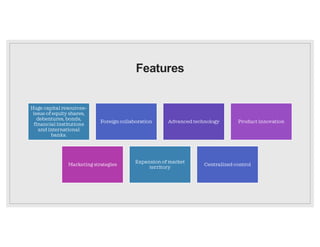
Features
Huge capital resources–
issue of equity shares,
debentures, bonds,
financial institutions
and international
banks.
Foreign collaboration Advanced technology Product innovation
Marketing strategies
Expansion of market
territory
Centralized control
JOINTVENTURES
A joint venture is a project or enterprise in which multiple companies or
individuals invest.
A joint venture is the pooling of resources and expertise by two or more businesses,
to achieve a goal.
The risk and rewards of the business are also shared.
The reason behind the joint venture often include business expansion, development
of new products or moving into new markets, particularly in another company.
Example: Sony-Ericsson, Bharti Airtel, Maruti Suzuki.
Benefitsof
JointVentures
Increased resources and capacity
Access to new markets and distribution
networks
Access to technology
Innovation
Low cost of production
Established brand name
CANGINGROLEOF
PUBLICSECTOR
Following points highlight the changing role
of public sector:
Development of infrastructure
Regional balance
Check over concentration of economic
power
Import substitution: Its government trade
and economic policy which advocates
replacing imports with domestic production.
Example replacement of some agricultural
or industrial imports to encourage local
production for local consumption.
Governmentpolicytowardsthepublicsector
since1991
Reduction in the number of industries reserved for the public sector from 17 to 8 (and then to 3):
In 2001, only three industries were reserved for the public sector. These are atomic energy, arms, and rail
transport.
This meant that the private sector could enter all areas (except the three) and the public sector would have to
compete with them.
Disinvestment of shares of a select set public sector enterprises:
Disinvestment involves the sale of the equity shares to the private sector and the public.
The government had taken a decision to withdraw from the industrial sector and reduce its equity in all
undertakings.
Policy regarding sick units to be the same as that for the private sector:
All public sector units were referred to the Board of Industrial and Financial Reconstruction to decide whether a
sick unit was to be restructured or closed down
Governmentpolicytowardsthepublicsector
since1991
Memorandum of understanding:
Improvement of performance trough a MoU system by which management are to be granted greater autonomy but
held accountable for specified result.
Under this system, public sector units were given clear targets and operational autonomy for achieving those
targets.

Private, public & global enterprises

  • 1.
    CHAPTER - 3 PUBLIC,PRIVATE AND GLOBAL ENTERPRISES
  • 2.
    Private sector: The privatesector consists of business owned by individuals or a group of individuals. examples—sole proprietorship, partnership, Joint Hindu Family business. Public sector: The public sector consists of various organizations owned and managed by the government. These organisations may be either be partly or wholly owned by the government.
  • 3.
    PRIVATE COMPANY: A Privatecompany means a company which • restricts the right of members to transfer its shares. • has a minimum of 2 and a maximum of 50 members. • does not invite public to subscribe to its share capital. • must have a minimum paid up capital of Rs. 1 lakh. • It is necessary for a private company to use the word private limited after its name.
  • 4.
    The following aresome of the privileges of a private limited company as against a public limited company: A private company can be formed by only two members whereas seven people are needed to form a public company. There is no need to issue a prospectus as public is not invited to subscribe to the shares of a private company. Allotment of shares can be done without receiving he minimum subscription. A private company can start business as soon as it receives the certificate of incorporation. The public company on the other hand, must wait for the receipt of certificate of commencement before it can start a business. A private company need to have only two directors as against the minimum of three directors in the case of a public company.
  • 5.
  • 6.
    Departmental Undertakings This isthe oldest and most traditional form of organising public enterprises. These enterprises are established as departments of the ministry and are considered part or an extension of the ministry itself. Examples of departmental undertakings are Indian Railways, Post and Telegraph etc
  • 7.
    FEATURES: Part of government:The ultimate authority lies with the concerned minister who is responsible to the parliament or state legislature. Government financing: The funding of these enterprises comes directly from the government treasury and revenue earned by these is also paid into the treasury. Accounting and Audit: The undertaking is subject to the normal budgeting, accounting and audit. Civil Service code: The enterprise is managed by civil servants whose methods of recruitment and service conditions are the same as for other civil servants of the government.
  • 8.
    Merits: Easy formation: No registrationor special law is required. The undertaking is created by the administrative decision of the government and no legal formalities are involved. Direct government control: The undertaking is under the direct and complete control of the state. Public accountability: There is maximum degree of parliamentary control on the undertaking. Such control keeps the management alert. Proper use of money: The risk of public money is minimized due to strict budget, accounting, and audit control. Aid to public revenue: Departmental undertaking helps to increase government revenue because their earnings are deposited in the government treasury. Public interest: Departmental undertakings can better serve public interest. They are very useful for public utility services.
  • 9.
    Limitations:  Lack offlexibility  Lack of motivation  Red tapism– excessive formality and routine required before official action can be taken or strict adherence to official formalities.  Inefficient management  Insensitive to needs of consumers
  • 10.
    STATUTORY CORPORATIONS Statutory Corporations arepublic enterprises brought into existence by a special act of parliament. The act defines its powers and functions,rules and regulation governing its employees and its relationshipwith government department. Examples are Airport Authority of India, National Highways Authority of India, Central Warehousing Corporation,LIC of India, RBI, ICAI (Institute of Chartered Accountants of India)
  • 11.
    FEATURES Generally financed bythe central or state government. May borrow fund from the public and government organization. They have separate legal entity. They have to frame their own policies and procedures within the scope of state legislature. Providing better services to public and make adequate profit They can recruit and appoint their employee with their service condition, since they are corporate body. There is less government interference in matters of the corporation
  • 12.
    MERITS Autonomy (independent or freedom from external control)of operation Absence of political interference Quick and prompt decision Ease of raising capital
  • 13.
    DEMERITS No flexibility inoperation Misuse of powers Lack of efficiency Political interference could be there
  • 14.
    GOVERNMENTCOMPANY A Government companyis established under the Indian Companies Act of 1956 and is registered and governed by the provisions of the Indian Companies Act. According to the Indian Companies Act 1956, a government company means any company in which not less than 51 percent of the paid-up capital is held by the central government, or by any state government or partly by central government and partly by one or more state government. The shares of the company are purchased in the name of the President of India. Since the government is the major shareholder and exercises control over the management of these companies, they are known as government companies. EXAMPLES –Bharat Heavy Electricals Limited, Steel Authority of India Limited etc.
  • 15.
    FEATURES It is anorganisation created by the Indian Companies Act, 1956. The company can file a suit in a court of law against any third party and be sued. The company can enter into a contract and can acquire propertyin its own name. The Managementof the company is regulatedby the provisions of the companies Act, like any other public limited company. The employees of the company are appointed according to their own rules and regulations as contained in the Memorandum and Articles of Associations. These companies are exempted from the accounting and audit rules and procedures.
  • 16.
    MERITS A government companycan be established by fulfilling the requirements of the Indian Companies Act. A Separate Act in the parliament is not required. It has a separate legal entity, apart from the government. It enjoys autonomy in all management decisions and takes actions according to business prudence . Theses companies by providing goods and services at a reasonable prices can control the market and curb unhealthy business practices.
  • 17.
    LIMITATIONS Since the Governmentis the only shareholders in some of Companies, the provisions of the Companies Act does not have much relevance. It evades (avoids, escape) constitutional responsibility, which a company financed by the government should have. It is not answerable directly to the parliament. The government being the sole shareholder, the management and administration rests in the hands of the government. The main purpose of a government company, registered like other company is defeated.
  • 18.
    GLOBAL ENTERPRISES Global enterprises arethe companies which functions all around the world. They are characterized by their huge size, large number of products, advance technology, marketing strategies and network of operations all over the world. Global enterprises thus are huge industrial organizations which extend their industrial and marketing operations through a network of their branches in several countries. Example: McDonalds, Bata, Amul, Pizza Hut.
  • 19.
    Features Huge capital resources– issueof equity shares, debentures, bonds, financial institutions and international banks. Foreign collaboration Advanced technology Product innovation Marketing strategies Expansion of market territory Centralized control
  • 20.
    JOINTVENTURES A joint ventureis a project or enterprise in which multiple companies or individuals invest. A joint venture is the pooling of resources and expertise by two or more businesses, to achieve a goal. The risk and rewards of the business are also shared. The reason behind the joint venture often include business expansion, development of new products or moving into new markets, particularly in another company. Example: Sony-Ericsson, Bharti Airtel, Maruti Suzuki.
  • 21.
    Benefitsof JointVentures Increased resources andcapacity Access to new markets and distribution networks Access to technology Innovation Low cost of production Established brand name
  • 22.
    CANGINGROLEOF PUBLICSECTOR Following points highlightthe changing role of public sector: Development of infrastructure Regional balance Check over concentration of economic power Import substitution: Its government trade and economic policy which advocates replacing imports with domestic production. Example replacement of some agricultural or industrial imports to encourage local production for local consumption.
  • 23.
    Governmentpolicytowardsthepublicsector since1991 Reduction in thenumber of industries reserved for the public sector from 17 to 8 (and then to 3): In 2001, only three industries were reserved for the public sector. These are atomic energy, arms, and rail transport. This meant that the private sector could enter all areas (except the three) and the public sector would have to compete with them. Disinvestment of shares of a select set public sector enterprises: Disinvestment involves the sale of the equity shares to the private sector and the public. The government had taken a decision to withdraw from the industrial sector and reduce its equity in all undertakings. Policy regarding sick units to be the same as that for the private sector: All public sector units were referred to the Board of Industrial and Financial Reconstruction to decide whether a sick unit was to be restructured or closed down
  • 24.
    Governmentpolicytowardsthepublicsector since1991 Memorandum of understanding: Improvementof performance trough a MoU system by which management are to be granted greater autonomy but held accountable for specified result. Under this system, public sector units were given clear targets and operational autonomy for achieving those targets.