Class 11 Business Studies
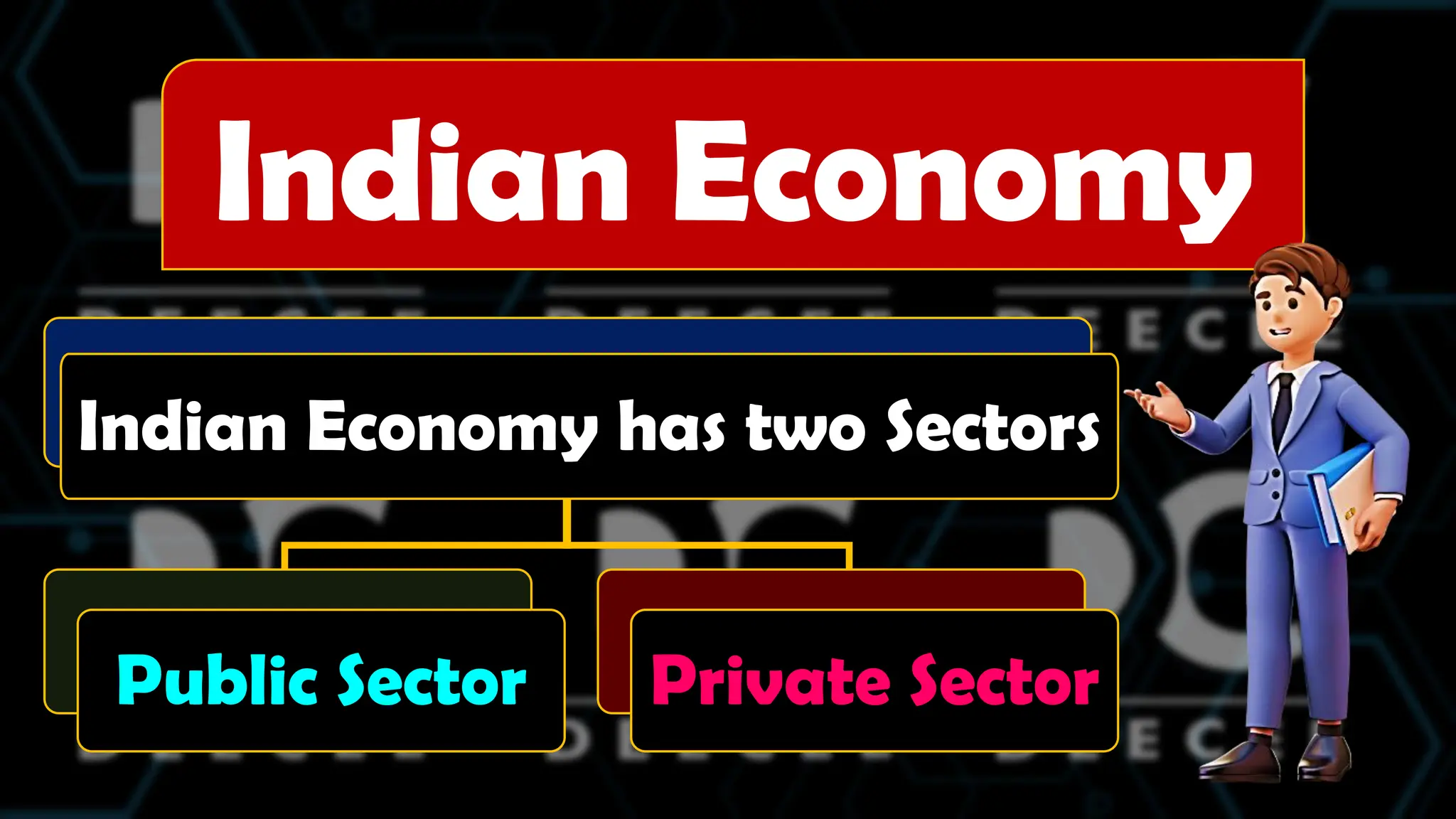
Indian Economy
Indian Economy has two Sectors
Public Sector Private Sector
Private
Sector
 Business enterprises which are
owned and managed by
individuals or a group of
individuals are called private
sector enterprises.
 Various form of organization are
sole proprietorship, partnership,
joint Hindu family, cooperative,
company and multinational
corporations.
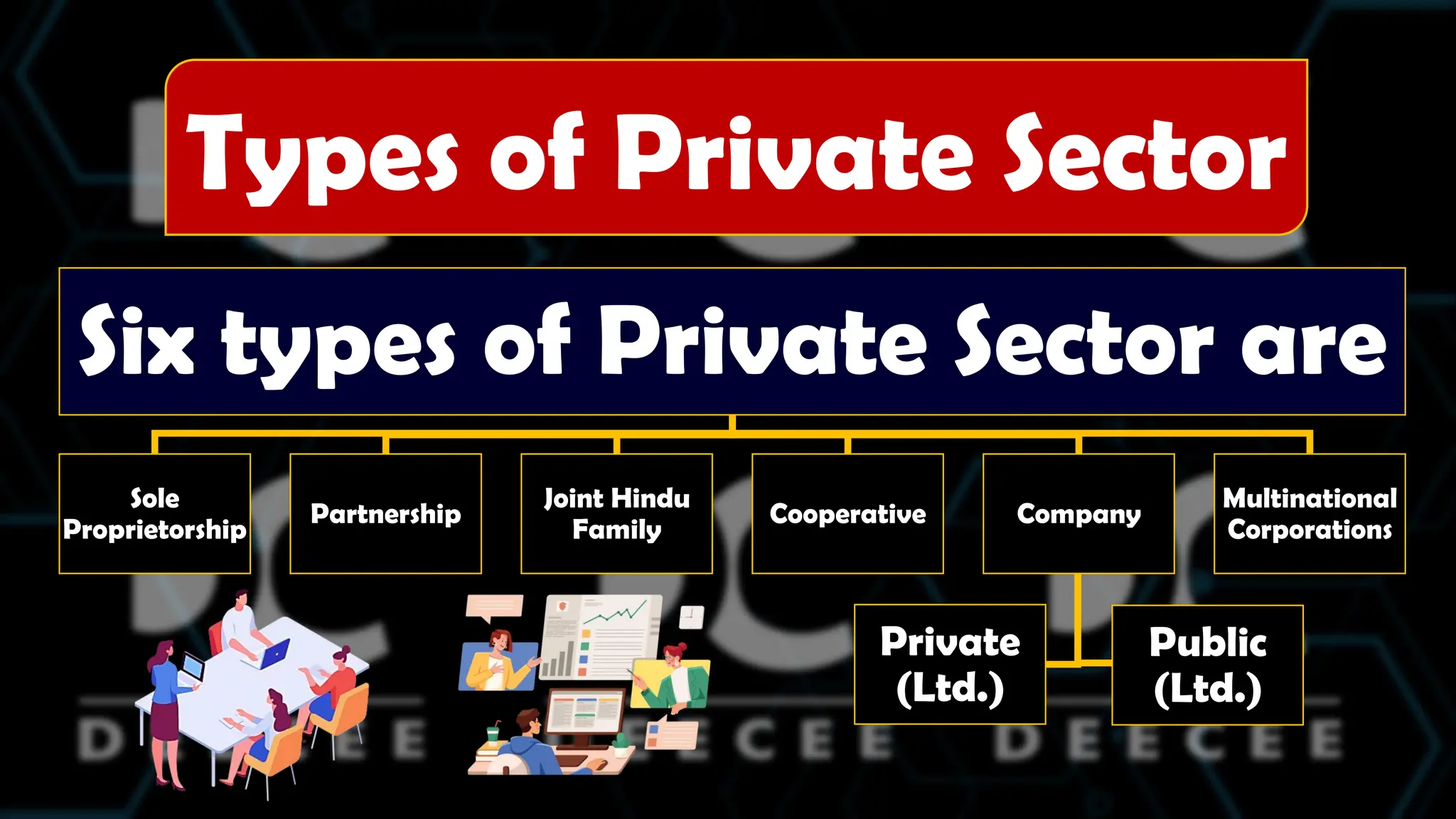
Six types of Private Sector are
Sole
Proprietorship
Partnership
Joint Hindu
Family
Cooperative Company
Private
(Ltd.)
Public
(Ltd.)
Multinational
Corporations
Types of Private Sector
Public
Sector
 Business enterprises which are
managed and owned by the
government. These organizations may
either be partly or wholly owned by
the central or state government.
 The forms of organization which a
public enterprise may take are
departmental undertaking, statutory
corporation and government
company etc.
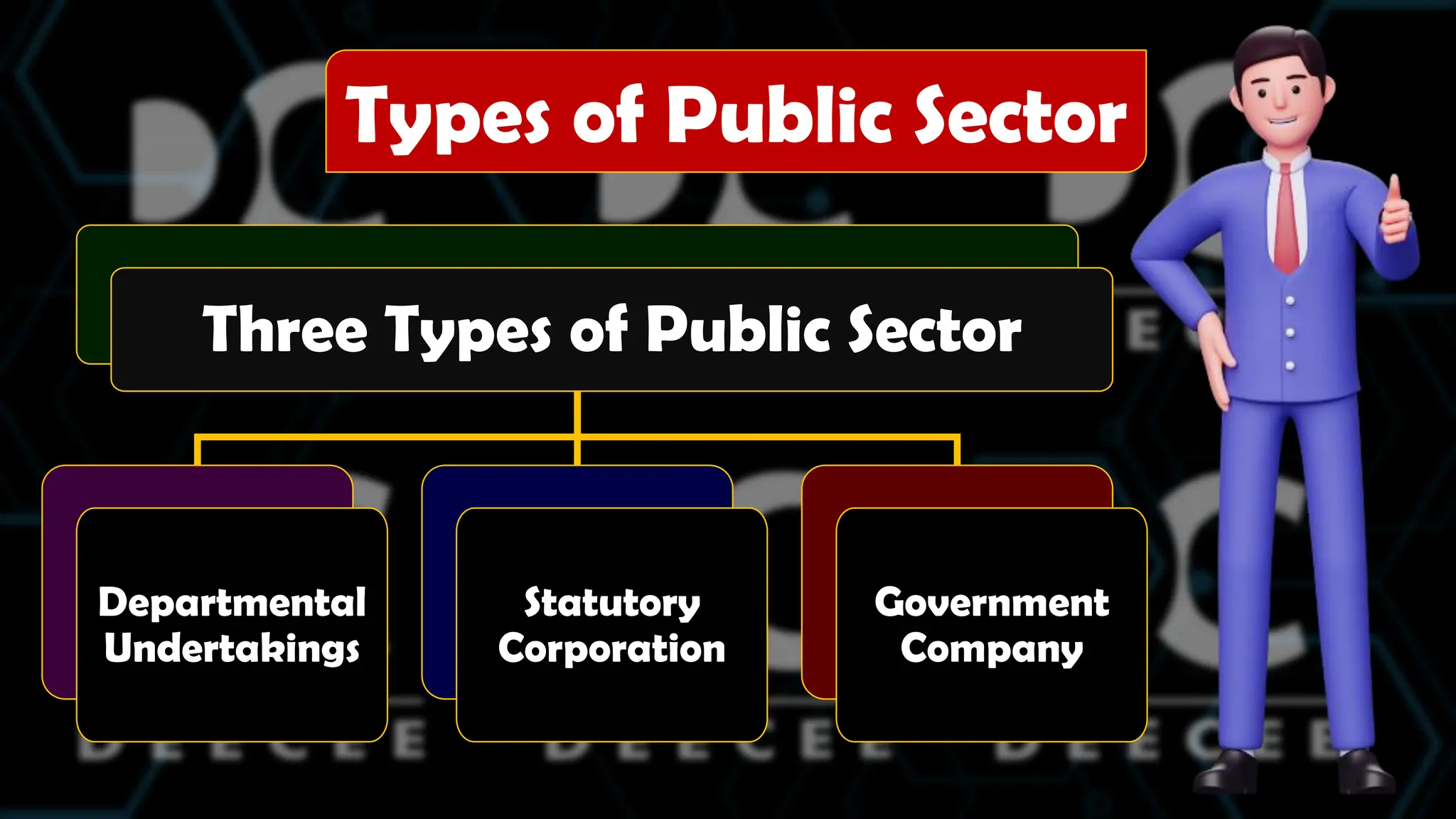
Three Types of Public Sector
Departmental
Undertakings
Statutory
Corporation
Government
Company
Types of Public Sector
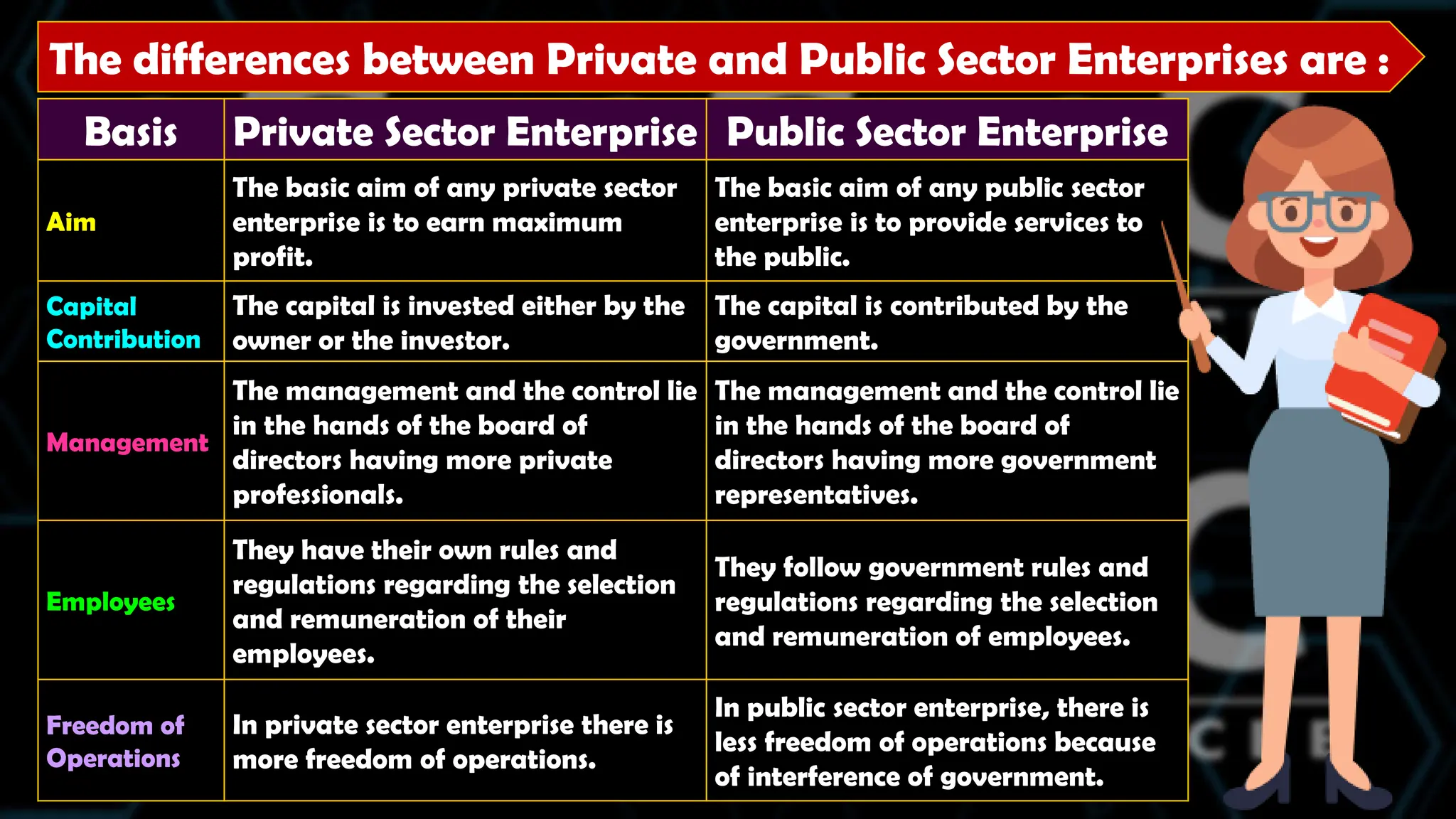
The differences between Private and Public Sector Enterprises are :
Basis Private Sector Enterprise Public Sector Enterprise
Aim
The basic aim of any private sector
enterprise is to earn maximum
profit.
The basic aim of any public sector
enterprise is to provide services to
the public.
Capital
Contribution
The capital is invested either by the
owner or the investor.
The capital is contributed by the
government.
Management
The management and the control lie
in the hands of the board of
directors having more private
professionals.
The management and the control lie
in the hands of the board of
directors having more government
representatives.
Employees
They have their own rules and
regulations regarding the selection
and remuneration of their
employees.
They follow government rules and
regulations regarding the selection
and remuneration of employees.
Freedom of
Operations
In private sector enterprise there is
more freedom of operations.
In public sector enterprise, there is
less freedom of operations because
of interference of government.
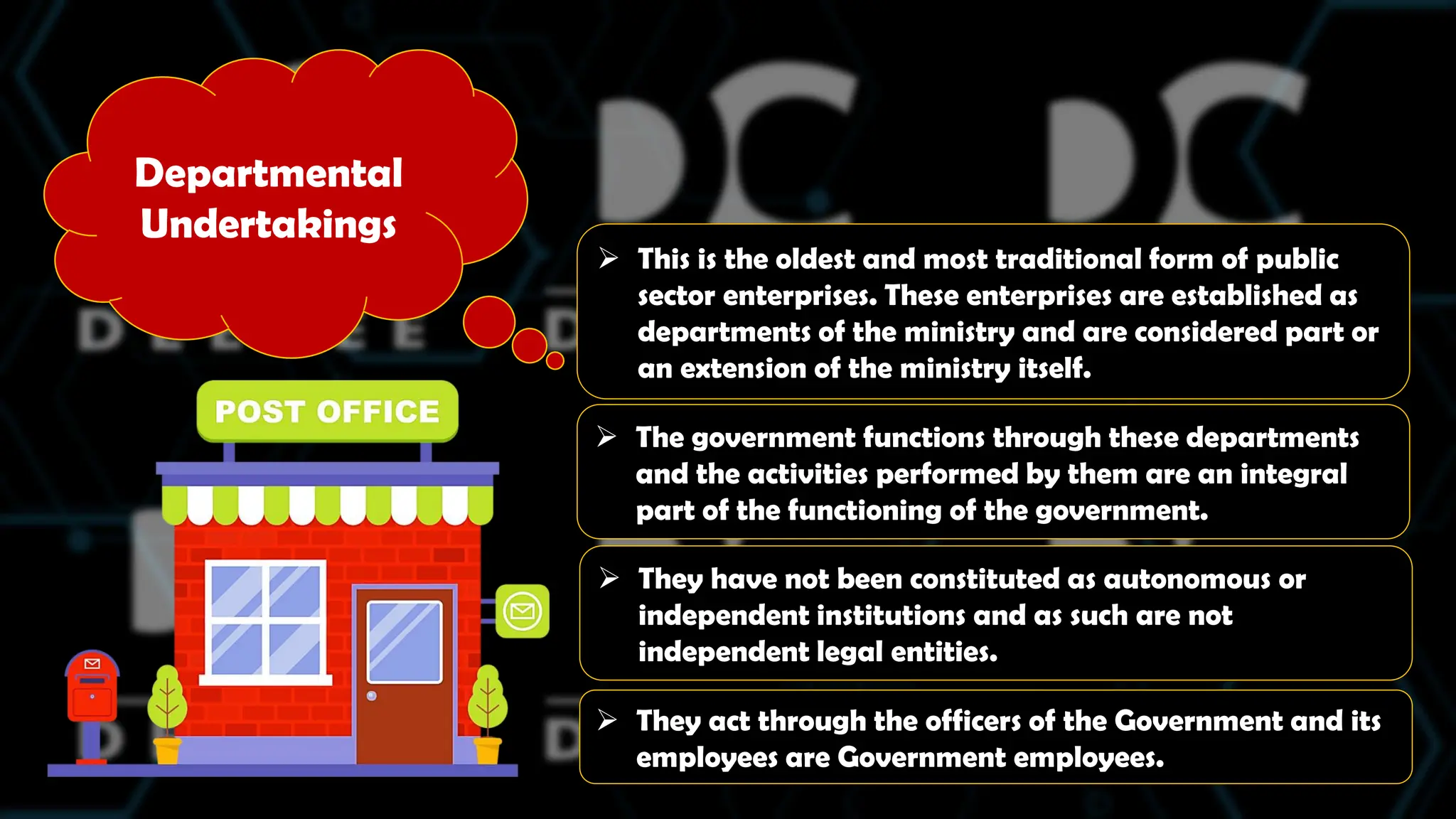
Departmental
Undertakings
 This is the oldest and most traditional form of public
sector enterprises. These enterprises are established as
departments of the ministry and are considered part or
an extension of the ministry itself.
 The government functions through these departments
and the activities performed by them are an integral
part of the functioning of the government.
 They have not been constituted as autonomous or
independent institutions and as such are not
independent legal entities.
 They act through the officers of the Government and its
employees are Government employees.
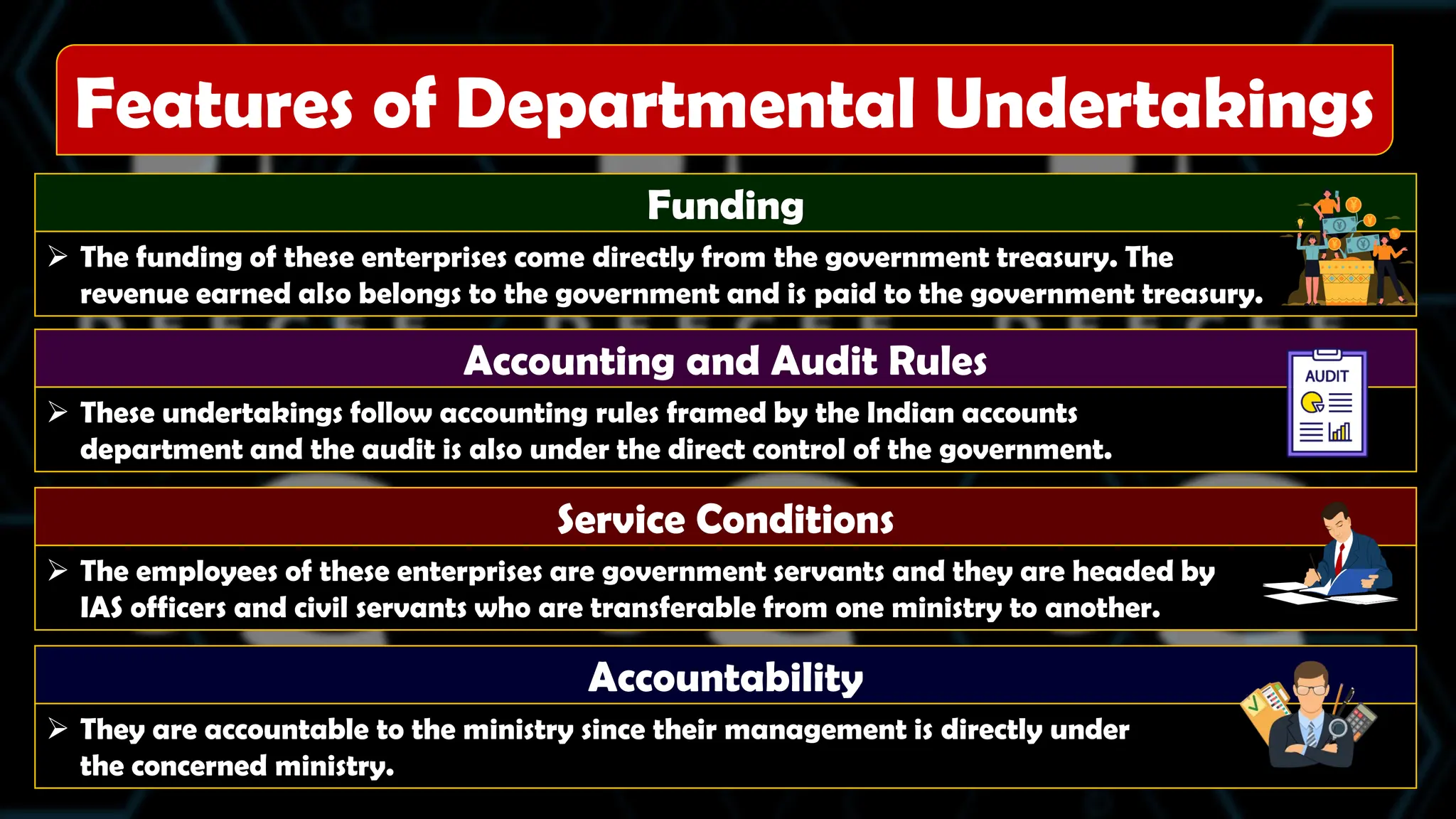
Funding
 The funding of these enterprises come directly from the government treasury. The
revenue earned also belongs to the government and is paid to the government treasury.
Accounting and Audit Rules
 These undertakings follow accounting rules framed by the Indian accounts
department and the audit is also under the direct control of the government.
Service Conditions
 The employees of these enterprises are government servants and they are headed by
IAS officers and civil servants who are transferable from one ministry to another.
Features of Departmental Undertakings
Accountability
 They are accountable to the ministry since their management is directly under
the concerned ministry.
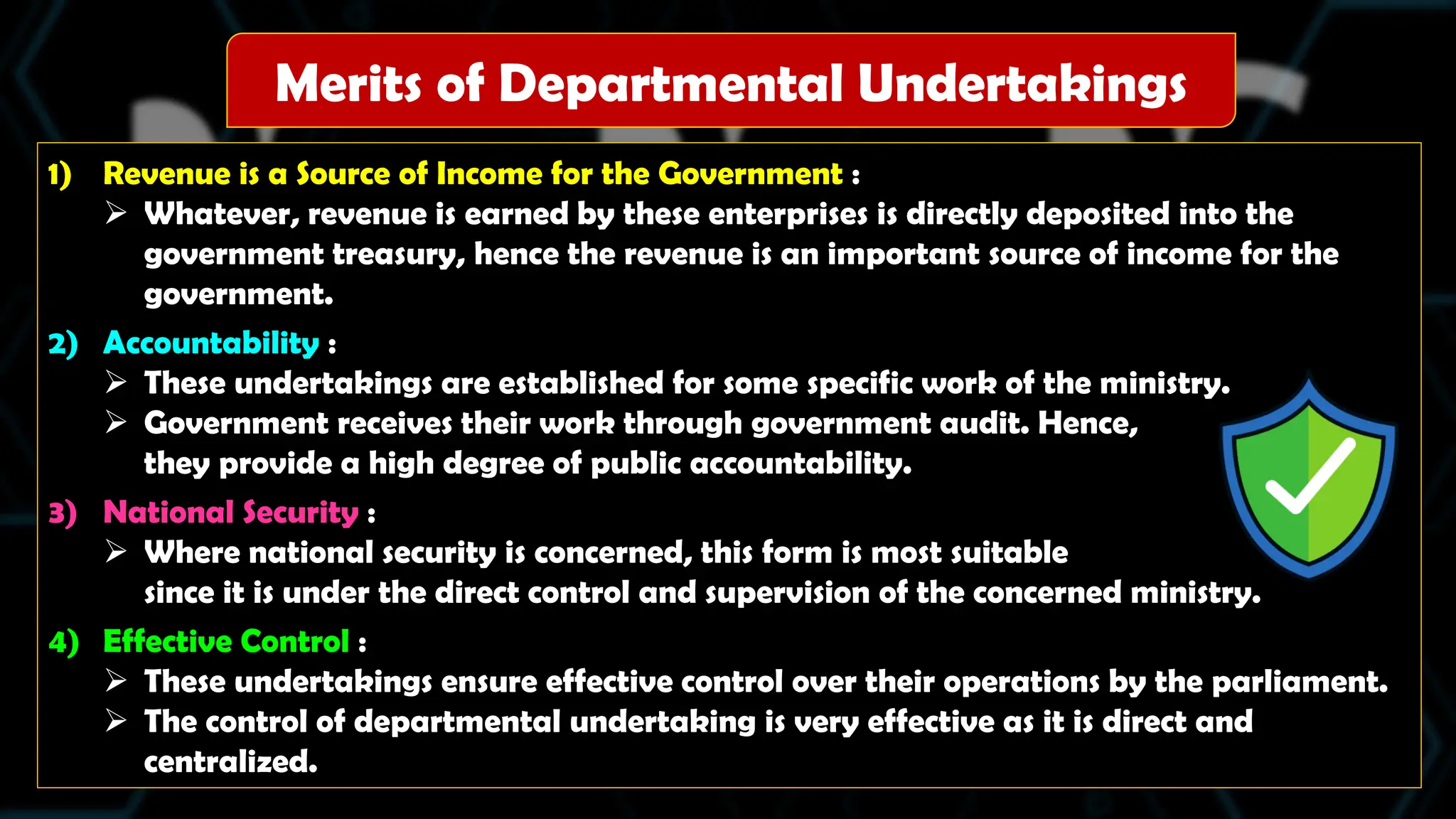
1) Revenue is a Source of Income for the Government :
 Whatever, revenue is earned by these enterprises is directly deposited into the
government treasury, hence the revenue is an important source of income for the
government.
2) Accountability :
 These undertakings are established for some specific work of the ministry.
 Government receives their work through government audit. Hence,
they provide a high degree of public accountability.
3) National Security :
 Where national security is concerned, this form is most suitable
since it is under the direct control and supervision of the concerned ministry.
4) Effective Control :
 These undertakings ensure effective control over their operations by the parliament.
 The control of departmental undertaking is very effective as it is direct and
centralized.
Merits of Departmental Undertakings
1) Lack of Flexibility :
 Departmental undertakings fail to provide flexibility, which is essential for the smooth
operation of business.
2) Delay in Decision-making :
 These enterprises failed to make quick decisions because for every decision they have to
obtain approval from the concerned ministry.
3) Political Interference :
 Political interference hinders the efficient working of these undertakings.
 Most of the time is elapsed in attending a political meeting and
implementing their recommendations.
4) Red Tapism :
 Departmental undertaking suffers from red tapism in its day-to-day working.
 Actions can be taken only after following the proper channels of the authority.
5) Bureaucracy :
 These enterprises are not able to take full benefits of business opportunities.
 Bureaucratic and conservative approach of the concern ministry hinders their initiative.
Demerits of Departmental Undertakings
Statutory
Corporations
 Statutory corporations are public enterprises
brought into existence by a special act of the
Parliament. The act defines its powers and
functions, rules and regulations governing its
employees and its relationship with government
departments.
 It is a corporate body created by the legislature with
defined powers and functions and is financially
independent with a clear control over a specified
area or a particular type of commercial activity.
 For e.g. : Indian Airlines, Air India, State Bank of
India, (LIC) Life Insurance Corporation of India etc.
Formation
 Statutory Corporations are set up under an Act of Parliament. The Act defines the
objects, powers and privileges of a statutory corporation.
A Body Corporate
 It has a separate legal entity, distinct from its members. Therefore, it can sell or
purchase property, enter into contracts, can sue and be sued.
Independently
Financed
 Usually, these enterprises are independently financed by borrowings
from the government or from the public or through revenue.
 They earn from the sales of goods and services. These enterprises
have the authority to use their revenues.
Features of Statutory Corporations
Own Service
Conditions
 The employees of these enterprises are not government employees.
 The conditions of recruitment and service of the employees are laid down by the
legislation that creates them.
Independence from
Government
Accounting
 Unlike government departments, enterprises are not bound to adopt government
accounting or audit procedures.
 Even they are not dependent on the central budget of the government.
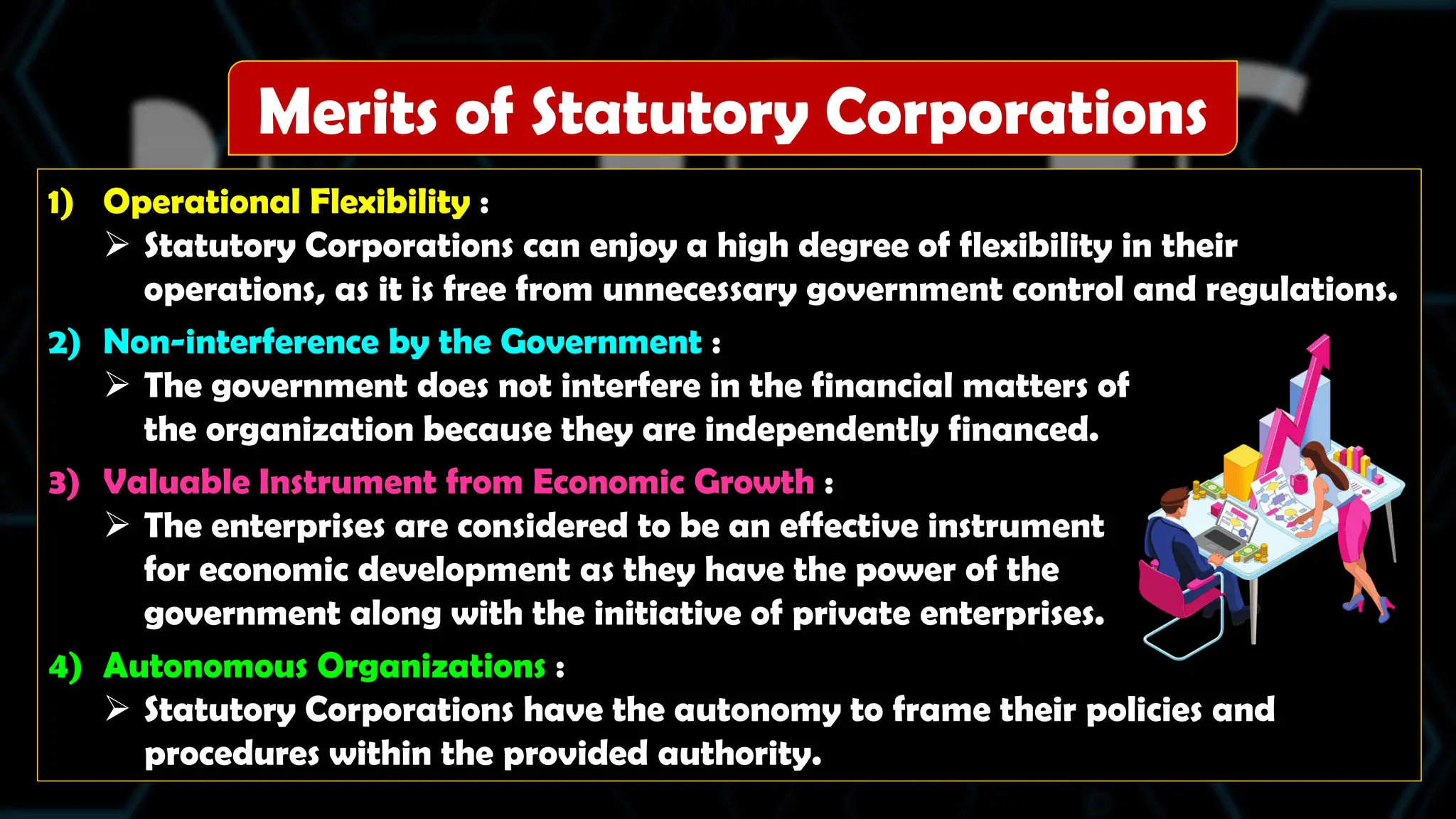
1) Operational Flexibility :
 Statutory Corporations can enjoy a high degree of flexibility in their
operations, as it is free from unnecessary government control and regulations.
2) Non-interference by the Government :
 The government does not interfere in the financial matters of
the organization because they are independently financed.
3) Valuable Instrument from Economic Growth :
 The enterprises are considered to be an effective instrument
for economic development as they have the power of the
government along with the initiative of private enterprises.
4) Autonomous Organizations :
 Statutory Corporations have the autonomy to frame their policies and
procedures within the provided authority.
Merits of Statutory Corporations
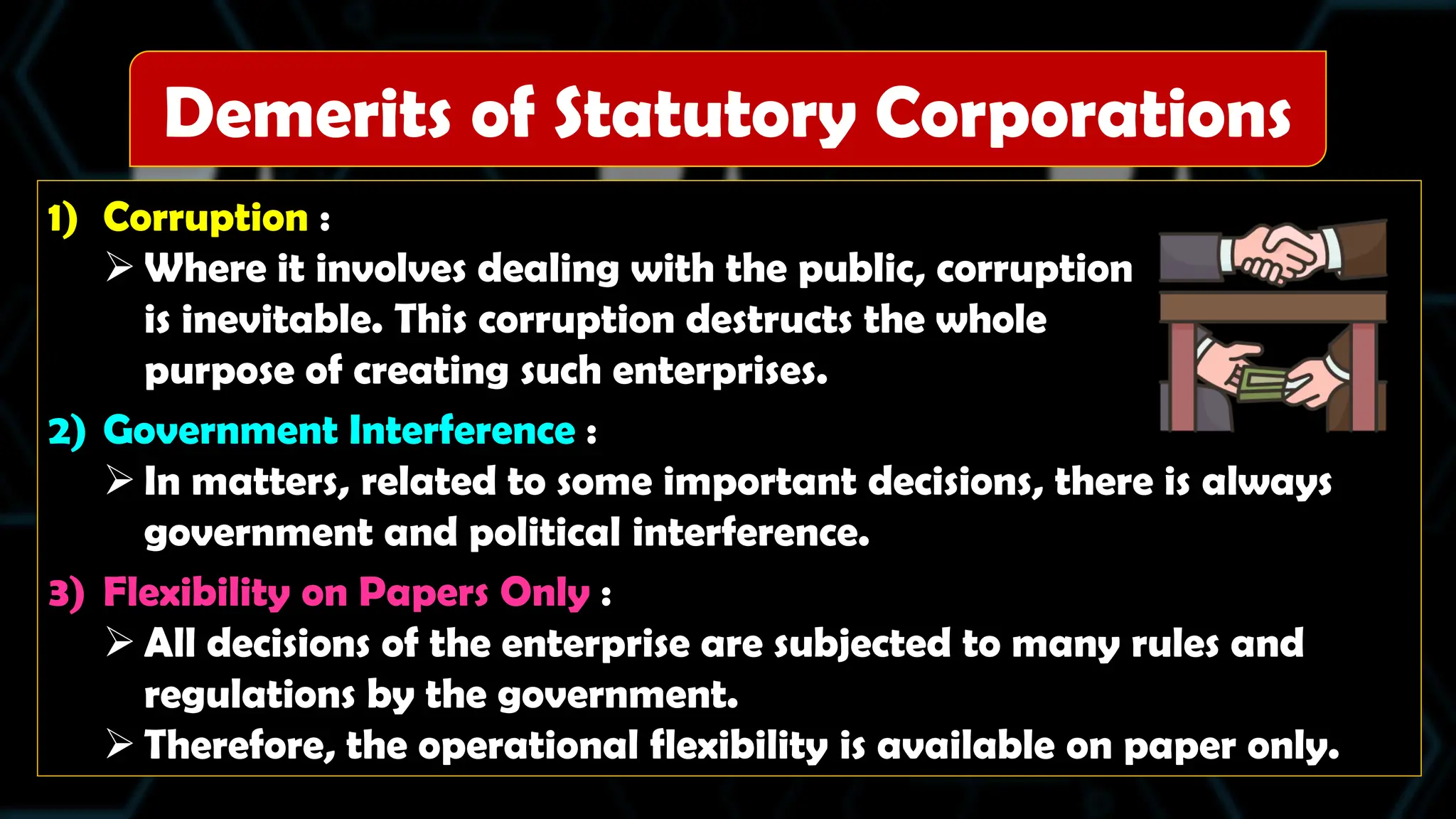
1) Corruption :
 Where it involves dealing with the public, corruption
is inevitable. This corruption destructs the whole
purpose of creating such enterprises.
2) Government Interference :
 In matters, related to some important decisions, there is always
government and political interference.
3) Flexibility on Papers Only :
 All decisions of the enterprise are subjected to many rules and
regulations by the government.
 Therefore, the operational flexibility is available on paper only.
Demerits of Statutory Corporations
 According to the Companies Act 2013, a
government company means any company
in which at least 51 per cent of the paid-up
share capital is held by the central or state
government or partly by the central
government and partly by one or more state
governments and includes a company which
is a subsidiary of a government company.
 For e.g. : Steel Authority of India, State
Trading Corporation, and Hindustan Machine
Tools.
Government
Company
 The memorandum and article of association lay down the rules and regulations for appointing
the employees of the company.
 Audit of accounts is conducted by an auditor appointed by the central government.
 Its annual report is also laid on both houses of the parliament.
 The company has the authority to sell and purchase the property and to enter into contracts in its
name.
 Being a separate legal entity, a government company can sue and be sued by a third party.
 It is an organization created under the Companies Act, of 2013 or any
other previous company law.
Created by Companies Act
File a Suit
Enter into a Contract
Features of Government Company
Audit by Central Government
The Rules Contained in MOA and AOA
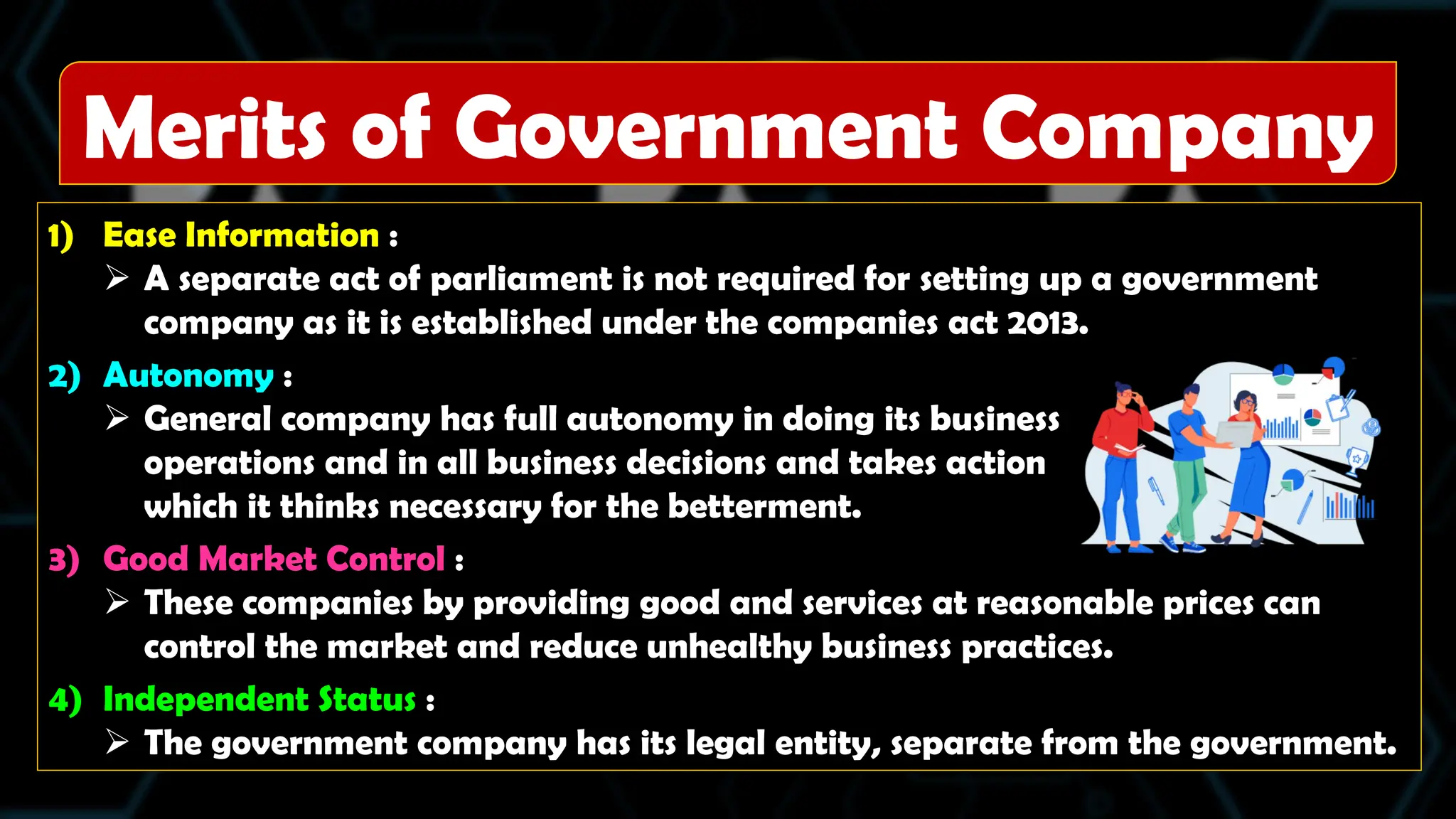
1) Ease Information :
 A separate act of parliament is not required for setting up a government
company as it is established under the companies act 2013.
2) Autonomy :
 General company has full autonomy in doing its business
operations and in all business decisions and takes action
which it thinks necessary for the betterment.
3) Good Market Control :
 These companies by providing good and services at reasonable prices can
control the market and reduce unhealthy business practices.
4) Independent Status :
 The government company has its legal entity, separate from the government.
Merits of Government Company
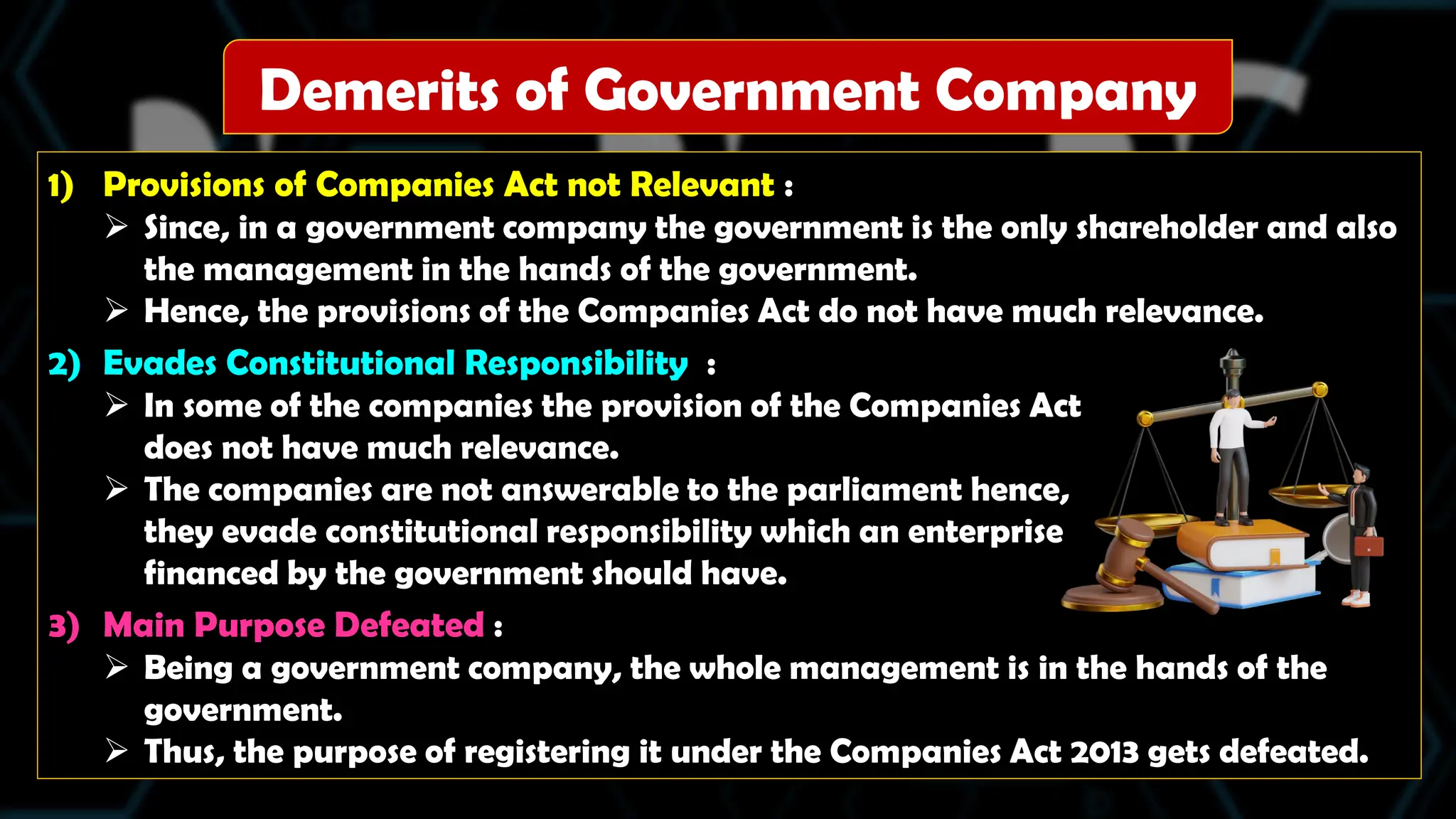
1) Provisions of Companies Act not Relevant :
 Since, in a government company the government is the only shareholder and also
the management in the hands of the government.
 Hence, the provisions of the Companies Act do not have much relevance.
2) Evades Constitutional Responsibility :
 In some of the companies the provision of the Companies Act
does not have much relevance.
 The companies are not answerable to the parliament hence,
they evade constitutional responsibility which an enterprise
financed by the government should have.
3) Main Purpose Defeated :
 Being a government company, the whole management is in the hands of the
government.
 Thus, the purpose of registering it under the Companies Act 2013 gets defeated.
Demerits of Government Company
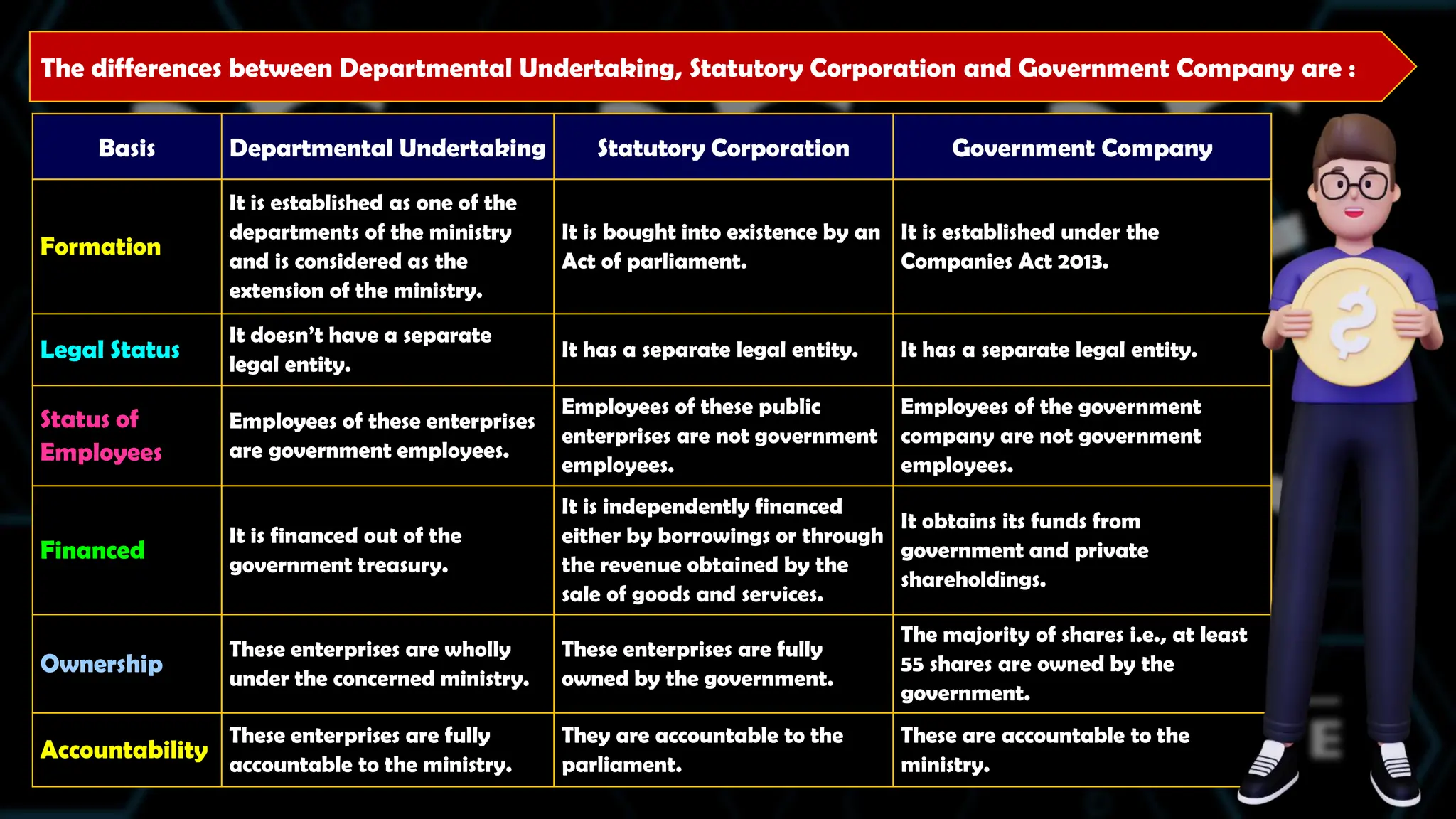
The differences between Departmental Undertaking, Statutory Corporation and Government Company are :
Basis Departmental Undertaking Statutory Corporation Government Company
Formation
It is established as one of the
departments of the ministry
and is considered as the
extension of the ministry.
It is bought into existence by an
Act of parliament.
It is established under the
Companies Act 2013.
Legal Status
It doesn’t have a separate
legal entity.
It has a separate legal entity. It has a separate legal entity.
Status of
Employees
Employees of these enterprises
are government employees.
Employees of these public
enterprises are not government
employees.
Employees of the government
company are not government
employees.
Financed
It is financed out of the
government treasury.
It is independently financed
either by borrowings or through
the revenue obtained by the
sale of goods and services.
It obtains its funds from
government and private
shareholdings.
Ownership
These enterprises are wholly
under the concerned ministry.
These enterprises are fully
owned by the government.
The majority of shares i.e., at least
55 shares are owned by the
government.
Accountability
These enterprises are fully
accountable to the ministry.
They are accountable to the
parliament.
These are accountable to the
ministry.
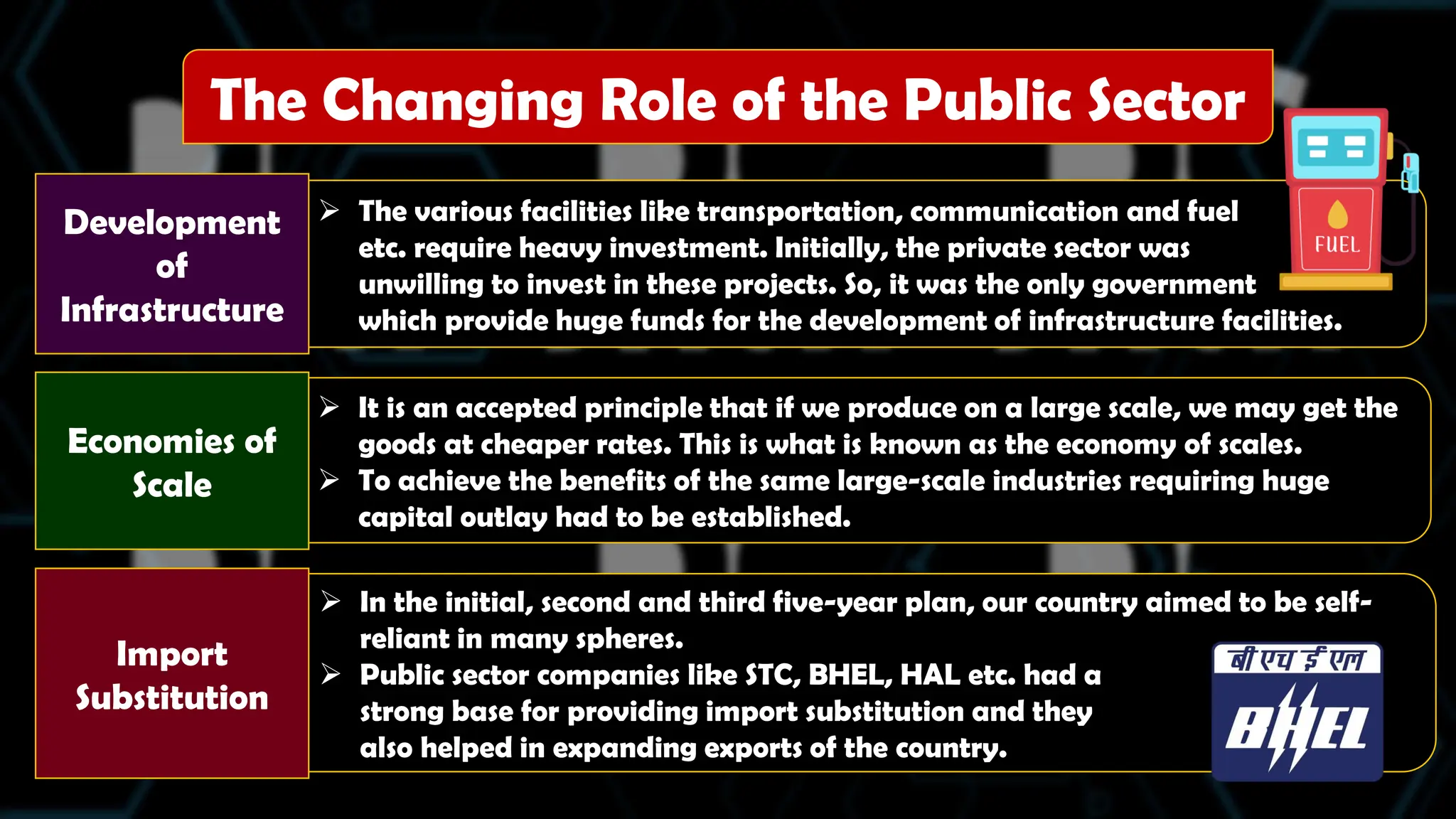
 In the initial, second and third five-year plan, our country aimed to be self-
reliant in many spheres.
 Public sector companies like STC, BHEL, HAL etc. had a
strong base for providing import substitution and they
also helped in expanding exports of the country.
 It is an accepted principle that if we produce on a large scale, we may get the
goods at cheaper rates. This is what is known as the economy of scales.
 To achieve the benefits of the same large-scale industries requiring huge
capital outlay had to be established.
 The various facilities like transportation, communication and fuel
etc. require heavy investment. Initially, the private sector was
unwilling to invest in these projects. So, it was the only government
which provide huge funds for the development of infrastructure facilities.
Development
of
Infrastructure
Import
Substitution
Economies of
Scale
The Changing Role of the Public Sector
 In its industrial policy resolutions, the government defines the area of activities in
which the private and the public sector are allowed to work. This resolution gave
more importance to the public sector.
 The major developments regarding the role given to public sector enterprises are
as under :
a) Reduction in the number of industries reserved for the public reserved.
b) Disinvestment of shares.
c) Policy regarding sick units to be the same as that of private sector.
d) Memorandum of understanding.
 Concentration of economic power means accumulation of wealth into the hands of
a few. This leads to economic inequalities which are determined for any society.
 The basic role of public sector enterprises was to check the concentration of
economic power and monopolistic practices in the private sector.
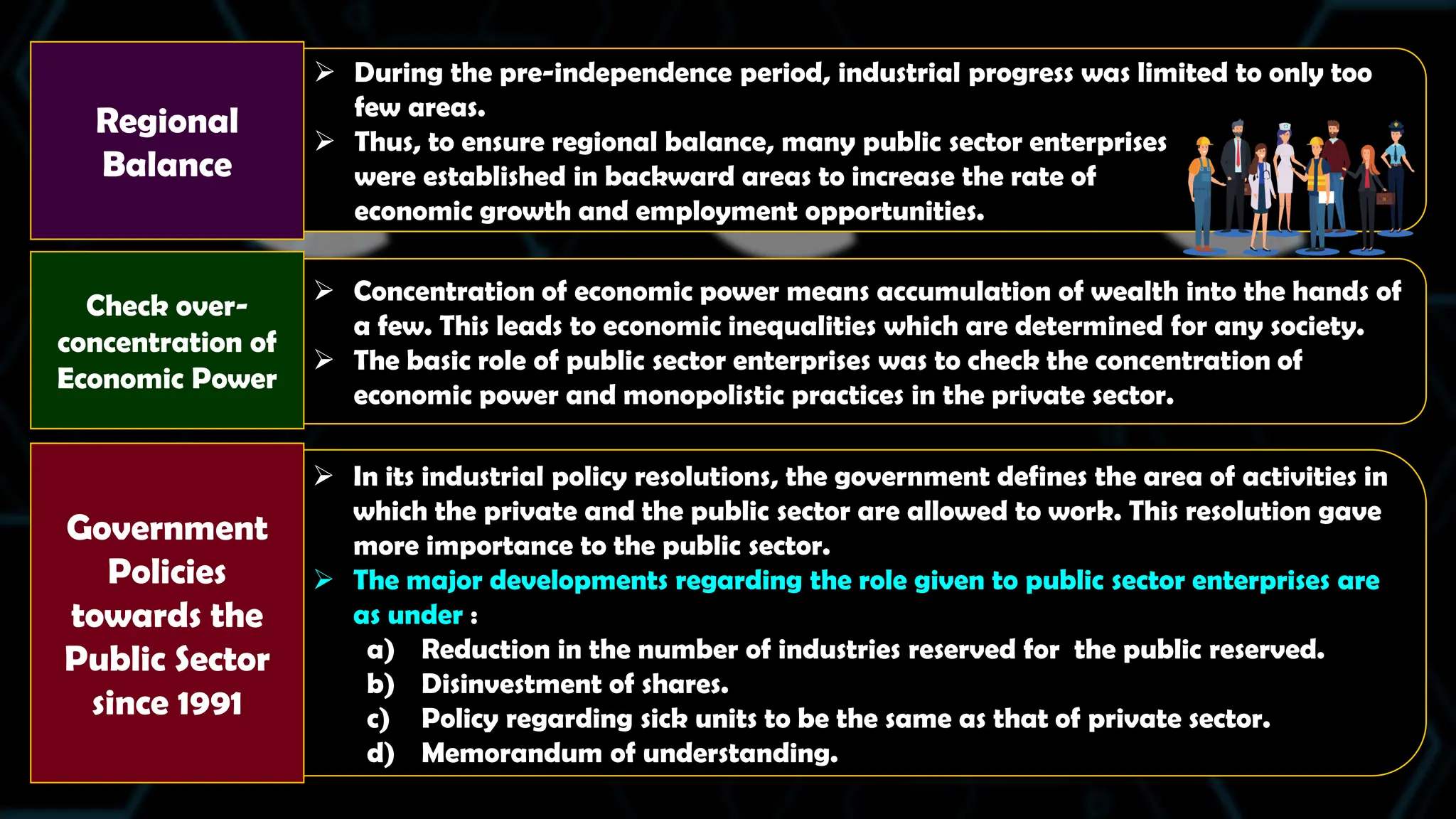
 During the pre-independence period, industrial progress was limited to only too
few areas.
 Thus, to ensure regional balance, many public sector enterprises
were established in backward areas to increase the rate of
economic growth and employment opportunities.
Regional
Balance
Government
Policies
towards the
Public Sector
since 1991
Check over-
concentration of
Economic Power
Global
Enterprises
(Multinational
Corporations)
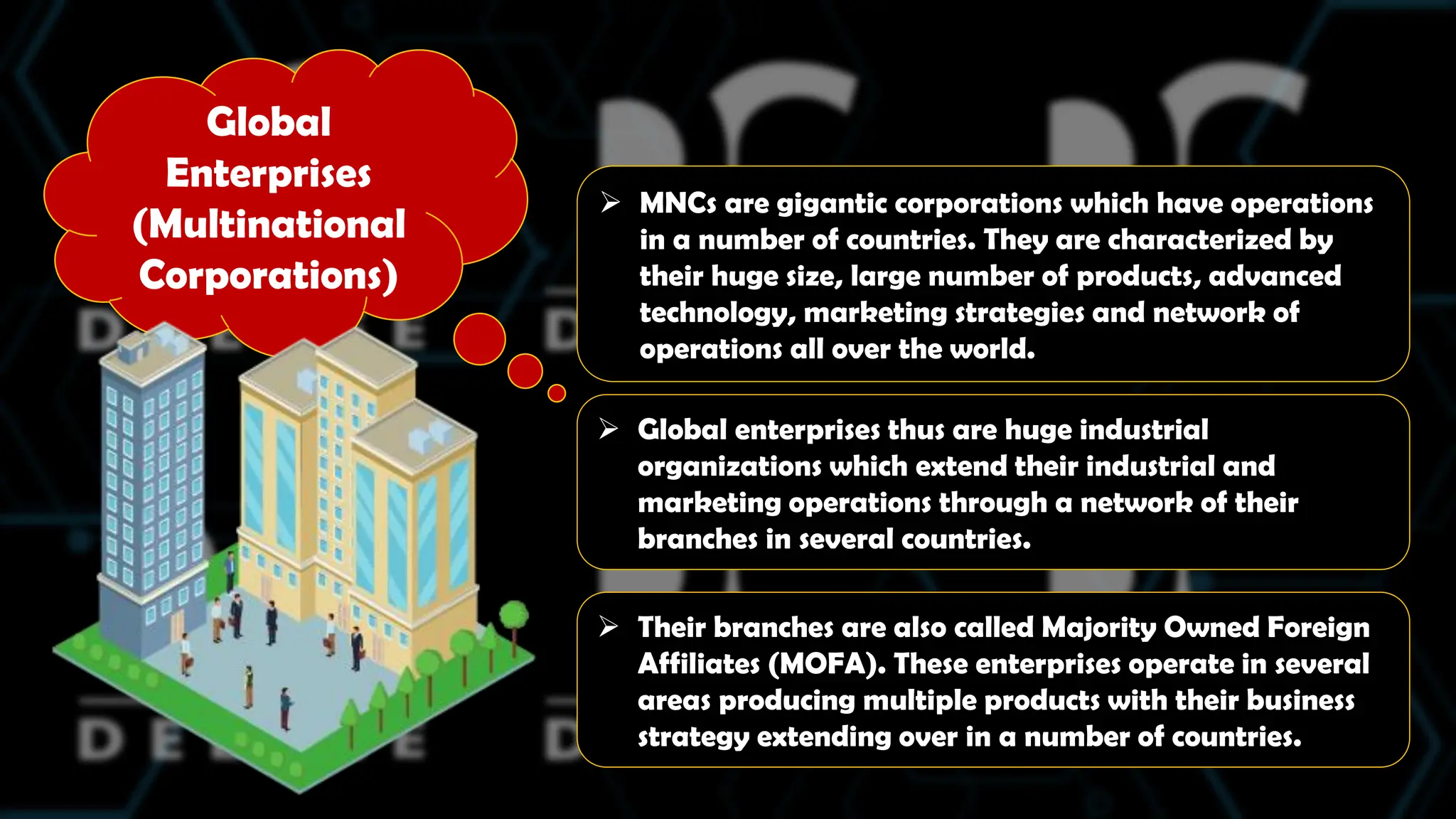
 MNCs are gigantic corporations which have operations
in a number of countries. They are characterized by
their huge size, large number of products, advanced
technology, marketing strategies and network of
operations all over the world.
 Global enterprises thus are huge industrial
organizations which extend their industrial and
marketing operations through a network of their
branches in several countries.
 Their branches are also called Majority Owned Foreign
Affiliates (MOFA). These enterprises operate in several
areas producing multiple products with their business
strategy extending over in a number of countries.
 These enterprises have huge financial resources and also possess
the ability to raise funds from different sources.
 They can raise funds by issuing equity shares, debentures or bonds to
the public or by borrowing from financial institutions, international banks etc.
Huge Capital Resources
 Usually, these enterprises agree with the companies of the host country.
 The agreement may be in respect of the sale of technology,
production of goods, resources, use of brand name etc.
 These enterprises have up-to-date advanced technology for production.
 Hence, goods and services produced by MNCs conform to international standards
and quality specifications.
Features of Multinational Company (MNC)
Advanced Technology
Foreign Collaboration
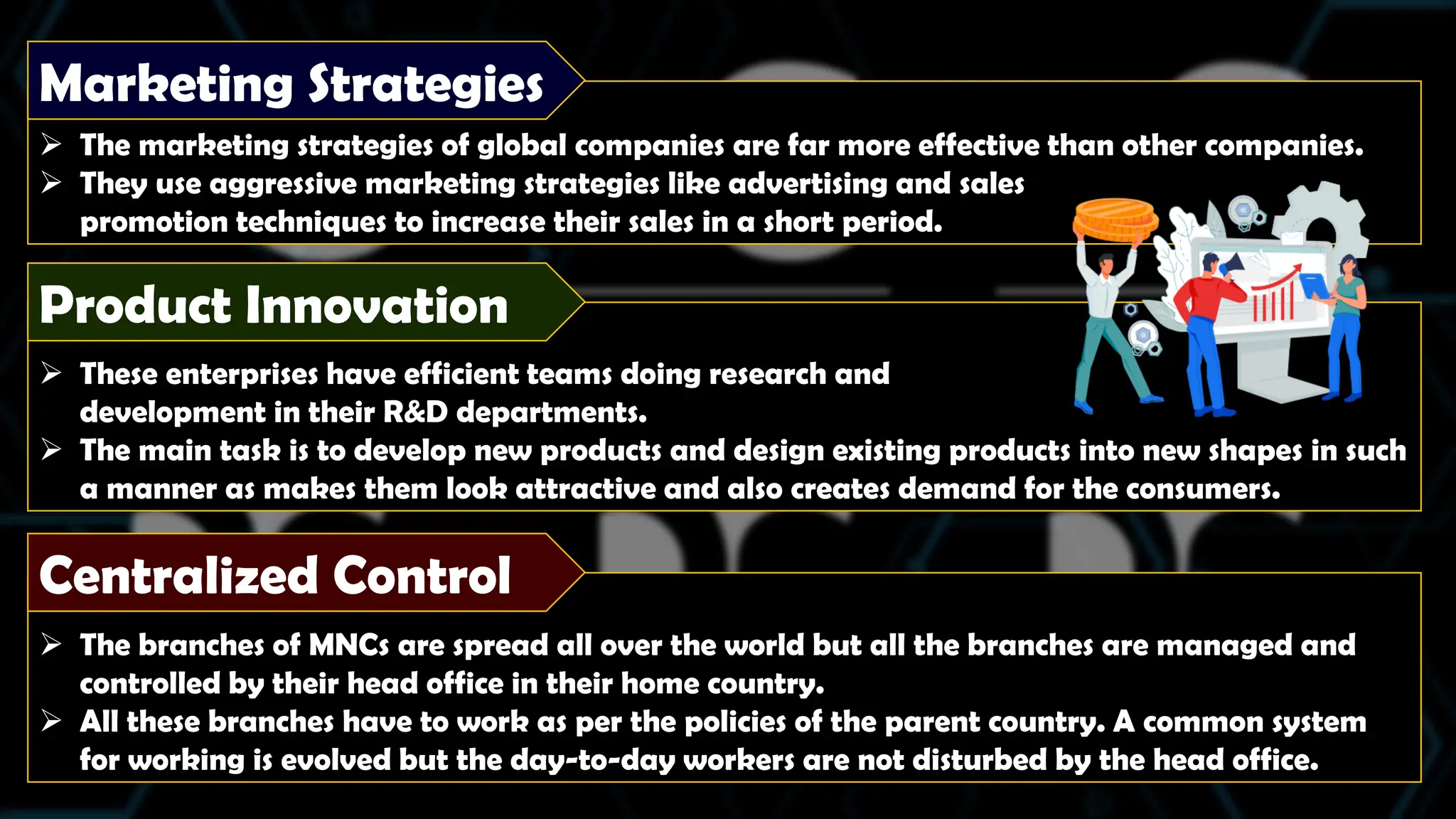
 These enterprises have efficient teams doing research and
development in their R&D departments.
 The main task is to develop new products and design existing products into new shapes in such
a manner as makes them look attractive and also creates demand for the consumers.
 The marketing strategies of global companies are far more effective than other companies.
 They use aggressive marketing strategies like advertising and sales
promotion techniques to increase their sales in a short period.
Marketing Strategies
Product Innovation
 The branches of MNCs are spread all over the world but all the branches are managed and
controlled by their head office in their home country.
 All these branches have to work as per the policies of the parent country. A common system
for working is evolved but the day-to-day workers are not disturbed by the head office.
Centralized Control
Joint
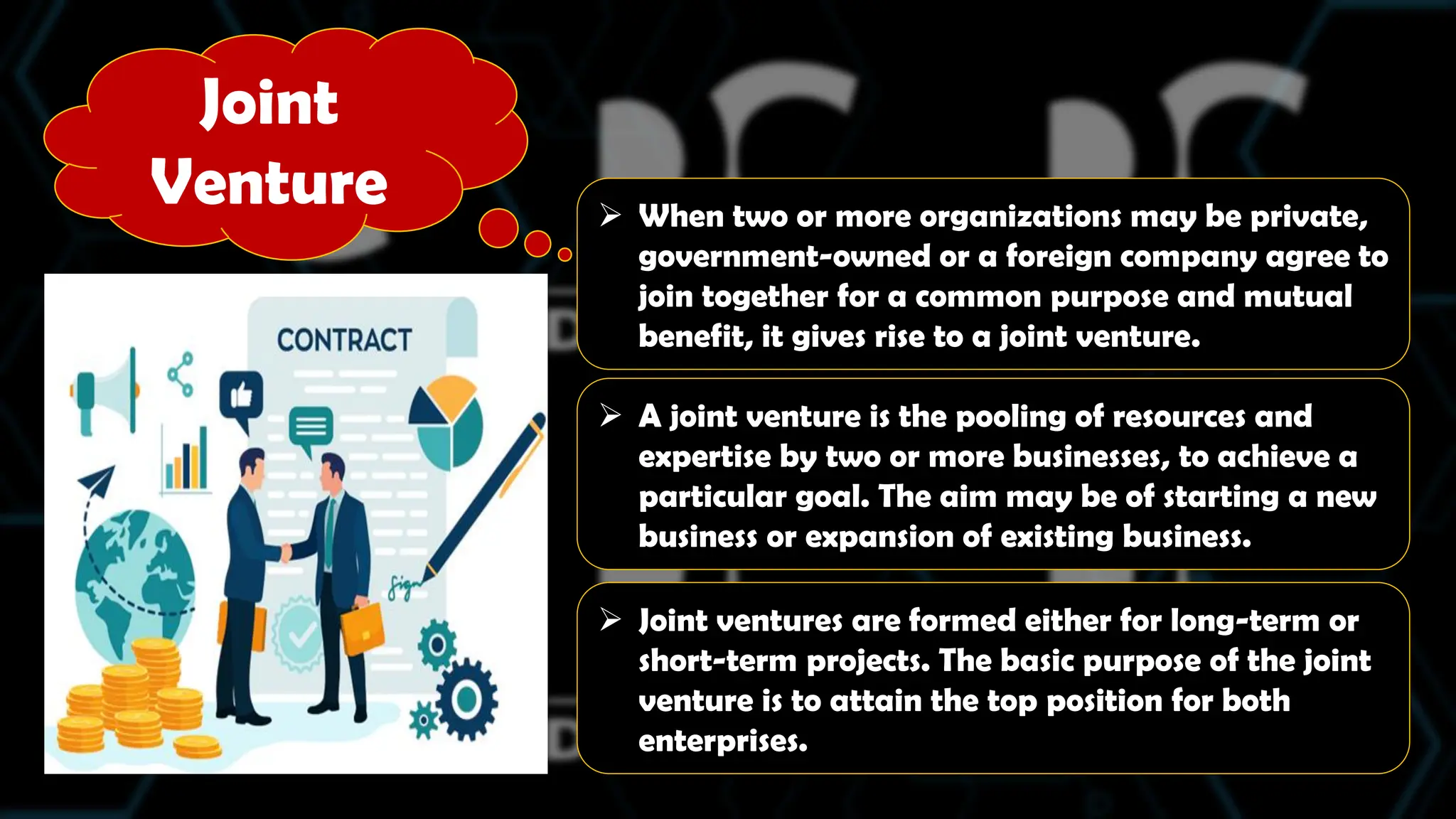
Venture  When two or more organizations may be private,
government-owned or a foreign company agree to
join together for a common purpose and mutual
benefit, it gives rise to a joint venture.
 A joint venture is the pooling of resources and
expertise by two or more businesses, to achieve a
particular goal. The aim may be of starting a new
business or expansion of existing business.
 Joint ventures are formed either for long-term or
short-term projects. The basic purpose of the joint
venture is to attain the top position for both
enterprises.
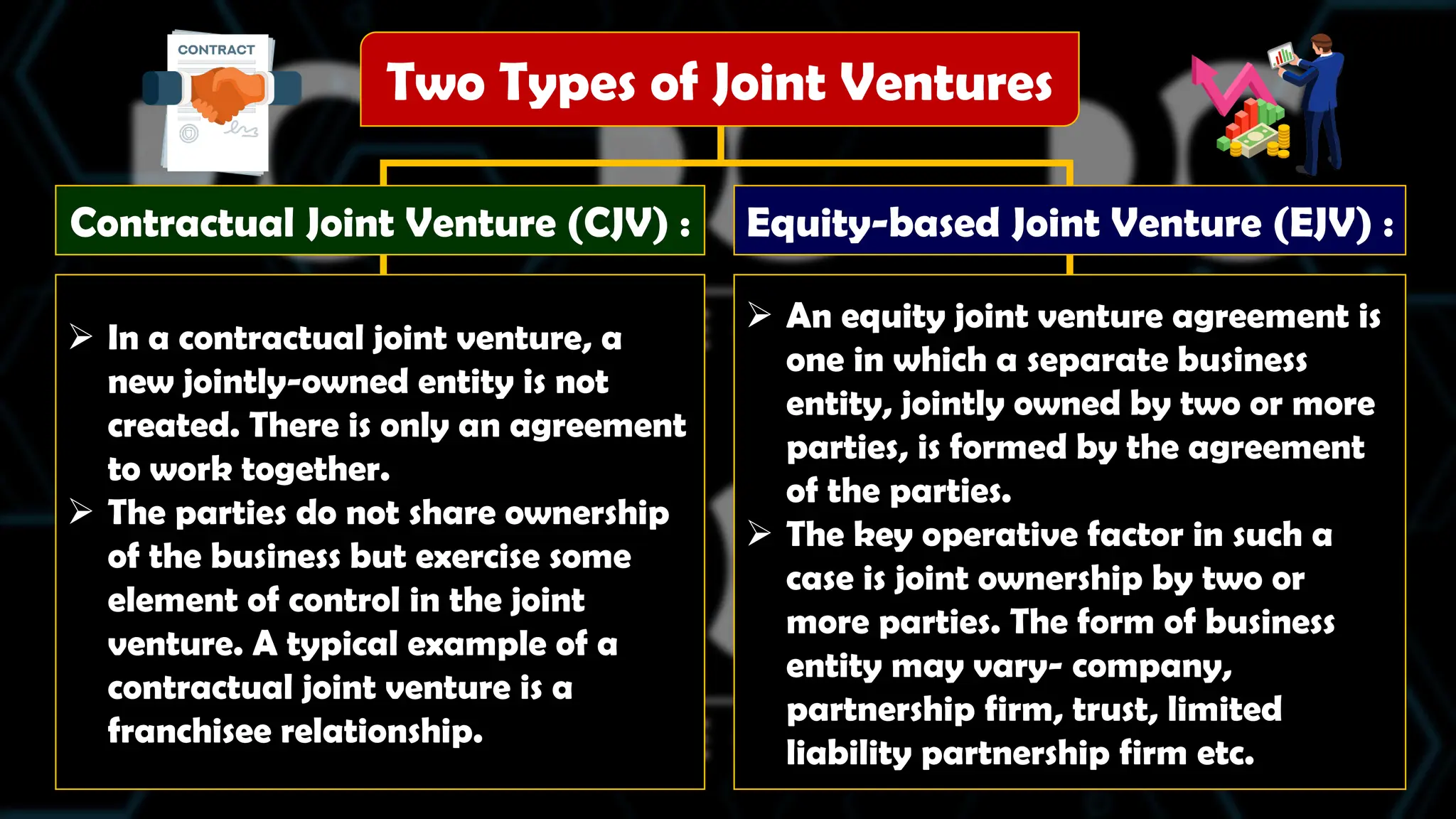
Two Types of Joint Ventures
Contractual Joint Venture (CJV) :
 In a contractual joint venture, a
new jointly-owned entity is not
created. There is only an agreement
to work together.
 The parties do not share ownership
of the business but exercise some
element of control in the joint
venture. A typical example of a
contractual joint venture is a
franchisee relationship.
Equity-based Joint Venture (EJV) :
 An equity joint venture agreement is
one in which a separate business
entity, jointly owned by two or more
parties, is formed by the agreement
of the parties.
 The key operative factor in such a
case is joint ownership by two or
more parties. The form of business
entity may vary- company,
partnership firm, trust, limited
liability partnership firm etc.
Benefits of Joint Ventures
1) Increased Resources and Capacity :
 A joint venture involves the pooling of human and financial resources.
 Thus, a joint venture enterprise can easily face market challenges and take the advantage of new growth
opportunities.
2) Access to Technology :
 Joint venture helps to use the latest and advanced technology of the world.
 Advanced technology helps in improving the quality of the products, saving the time,
cost, energy and money to be spent in developing own technologies.
3) Low cost of Production :
 Joint venture helps in reducing the cost.
 Joining hands with others, especially with foreign companies helps in reducing the cost of production because of
their good system, knowing how qualified workforce and management professionals etc.
4) Established Brand Name :
 Joint ventures may prove very beneficial in developing and branding the name of the enterprises.
 This is possible when two enterprises either into a joint venture both are benefited from each other’s name, fame,
reputation and goodwill etc. already established in the market.
5) Innovation :
 Joint ventures enable business enterprises to come up with new ideas for products and services that help them to
meet the market demand. The joint venture also helps to create and tap demand for their new products.
Public Private
Partnership
(PPP)  PPP is defined as a relationship
between public and private entities in
the context of infrastructure and other
services.
 The cooperative venture between the
public and private sectors built on the
expertise of each, through the
allocation of resources, risks and
returns jointly.
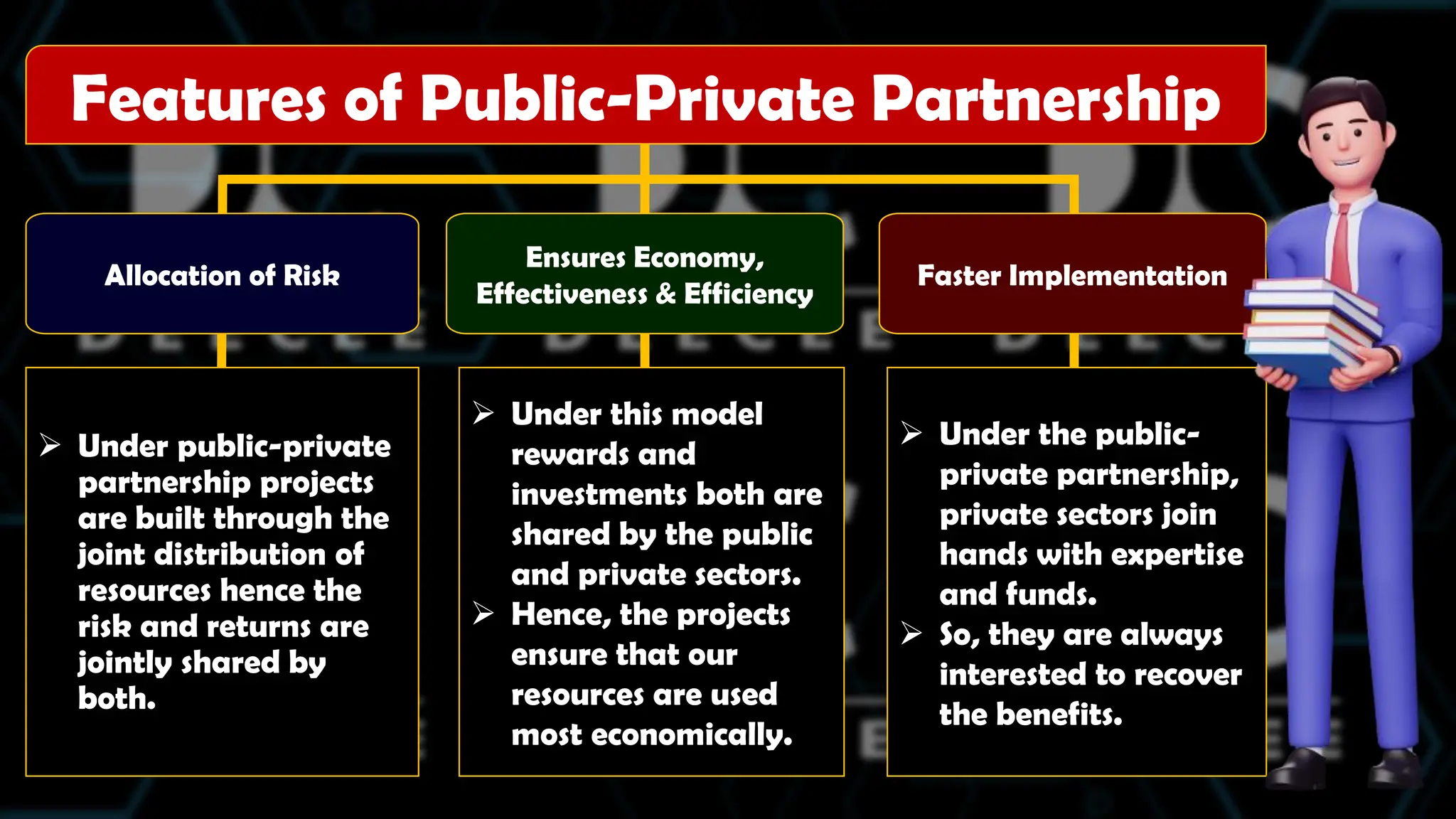
Allocation of Risk
Ensures Economy,
Effectiveness & Efficiency
Faster Implementation
Features of Public-Private Partnership
 Under public-private
partnership projects
are built through the
joint distribution of
resources hence the
risk and returns are
jointly shared by
both.
 Under this model
rewards and
investments both are
shared by the public
and private sectors.
 Hence, the projects
ensure that our
resources are used
most economically.
 Under the public-
private partnership,
private sectors join
hands with expertise
and funds.
 So, they are always
interested to recover
the benefits.
BST CHAP 3 PPT_a11fc6b0-0404-4c4c-9375-30284a2b4a3b.pdf

  • 1.
  • 2.
    Indian Economy Indian Economyhas two Sectors Public Sector Private Sector
  • 3.
    Private Sector  Business enterpriseswhich are owned and managed by individuals or a group of individuals are called private sector enterprises.  Various form of organization are sole proprietorship, partnership, joint Hindu family, cooperative, company and multinational corporations.
  • 4.
    Six types ofPrivate Sector are Sole Proprietorship Partnership Joint Hindu Family Cooperative Company Private (Ltd.) Public (Ltd.) Multinational Corporations Types of Private Sector
  • 5.
    Public Sector  Business enterpriseswhich are managed and owned by the government. These organizations may either be partly or wholly owned by the central or state government.  The forms of organization which a public enterprise may take are departmental undertaking, statutory corporation and government company etc.
  • 6.
    Three Types ofPublic Sector Departmental Undertakings Statutory Corporation Government Company Types of Public Sector
  • 7.
    The differences betweenPrivate and Public Sector Enterprises are : Basis Private Sector Enterprise Public Sector Enterprise Aim The basic aim of any private sector enterprise is to earn maximum profit. The basic aim of any public sector enterprise is to provide services to the public. Capital Contribution The capital is invested either by the owner or the investor. The capital is contributed by the government. Management The management and the control lie in the hands of the board of directors having more private professionals. The management and the control lie in the hands of the board of directors having more government representatives. Employees They have their own rules and regulations regarding the selection and remuneration of their employees. They follow government rules and regulations regarding the selection and remuneration of employees. Freedom of Operations In private sector enterprise there is more freedom of operations. In public sector enterprise, there is less freedom of operations because of interference of government.
  • 8.
    Departmental Undertakings  This isthe oldest and most traditional form of public sector enterprises. These enterprises are established as departments of the ministry and are considered part or an extension of the ministry itself.  The government functions through these departments and the activities performed by them are an integral part of the functioning of the government.  They have not been constituted as autonomous or independent institutions and as such are not independent legal entities.  They act through the officers of the Government and its employees are Government employees.
  • 9.
    Funding  The fundingof these enterprises come directly from the government treasury. The revenue earned also belongs to the government and is paid to the government treasury. Accounting and Audit Rules  These undertakings follow accounting rules framed by the Indian accounts department and the audit is also under the direct control of the government. Service Conditions  The employees of these enterprises are government servants and they are headed by IAS officers and civil servants who are transferable from one ministry to another. Features of Departmental Undertakings Accountability  They are accountable to the ministry since their management is directly under the concerned ministry.
  • 10.
    1) Revenue isa Source of Income for the Government :  Whatever, revenue is earned by these enterprises is directly deposited into the government treasury, hence the revenue is an important source of income for the government. 2) Accountability :  These undertakings are established for some specific work of the ministry.  Government receives their work through government audit. Hence, they provide a high degree of public accountability. 3) National Security :  Where national security is concerned, this form is most suitable since it is under the direct control and supervision of the concerned ministry. 4) Effective Control :  These undertakings ensure effective control over their operations by the parliament.  The control of departmental undertaking is very effective as it is direct and centralized. Merits of Departmental Undertakings
  • 11.
    1) Lack ofFlexibility :  Departmental undertakings fail to provide flexibility, which is essential for the smooth operation of business. 2) Delay in Decision-making :  These enterprises failed to make quick decisions because for every decision they have to obtain approval from the concerned ministry. 3) Political Interference :  Political interference hinders the efficient working of these undertakings.  Most of the time is elapsed in attending a political meeting and implementing their recommendations. 4) Red Tapism :  Departmental undertaking suffers from red tapism in its day-to-day working.  Actions can be taken only after following the proper channels of the authority. 5) Bureaucracy :  These enterprises are not able to take full benefits of business opportunities.  Bureaucratic and conservative approach of the concern ministry hinders their initiative. Demerits of Departmental Undertakings
  • 12.
    Statutory Corporations  Statutory corporationsare public enterprises brought into existence by a special act of the Parliament. The act defines its powers and functions, rules and regulations governing its employees and its relationship with government departments.  It is a corporate body created by the legislature with defined powers and functions and is financially independent with a clear control over a specified area or a particular type of commercial activity.  For e.g. : Indian Airlines, Air India, State Bank of India, (LIC) Life Insurance Corporation of India etc.
  • 13.
    Formation  Statutory Corporationsare set up under an Act of Parliament. The Act defines the objects, powers and privileges of a statutory corporation. A Body Corporate  It has a separate legal entity, distinct from its members. Therefore, it can sell or purchase property, enter into contracts, can sue and be sued. Independently Financed  Usually, these enterprises are independently financed by borrowings from the government or from the public or through revenue.  They earn from the sales of goods and services. These enterprises have the authority to use their revenues. Features of Statutory Corporations Own Service Conditions  The employees of these enterprises are not government employees.  The conditions of recruitment and service of the employees are laid down by the legislation that creates them. Independence from Government Accounting  Unlike government departments, enterprises are not bound to adopt government accounting or audit procedures.  Even they are not dependent on the central budget of the government.
  • 14.
    1) Operational Flexibility:  Statutory Corporations can enjoy a high degree of flexibility in their operations, as it is free from unnecessary government control and regulations. 2) Non-interference by the Government :  The government does not interfere in the financial matters of the organization because they are independently financed. 3) Valuable Instrument from Economic Growth :  The enterprises are considered to be an effective instrument for economic development as they have the power of the government along with the initiative of private enterprises. 4) Autonomous Organizations :  Statutory Corporations have the autonomy to frame their policies and procedures within the provided authority. Merits of Statutory Corporations
  • 15.
    1) Corruption : Where it involves dealing with the public, corruption is inevitable. This corruption destructs the whole purpose of creating such enterprises. 2) Government Interference :  In matters, related to some important decisions, there is always government and political interference. 3) Flexibility on Papers Only :  All decisions of the enterprise are subjected to many rules and regulations by the government.  Therefore, the operational flexibility is available on paper only. Demerits of Statutory Corporations
  • 16.
     According tothe Companies Act 2013, a government company means any company in which at least 51 per cent of the paid-up share capital is held by the central or state government or partly by the central government and partly by one or more state governments and includes a company which is a subsidiary of a government company.  For e.g. : Steel Authority of India, State Trading Corporation, and Hindustan Machine Tools. Government Company
  • 17.
     The memorandumand article of association lay down the rules and regulations for appointing the employees of the company.  Audit of accounts is conducted by an auditor appointed by the central government.  Its annual report is also laid on both houses of the parliament.  The company has the authority to sell and purchase the property and to enter into contracts in its name.  Being a separate legal entity, a government company can sue and be sued by a third party.  It is an organization created under the Companies Act, of 2013 or any other previous company law. Created by Companies Act File a Suit Enter into a Contract Features of Government Company Audit by Central Government The Rules Contained in MOA and AOA
  • 18.
    1) Ease Information:  A separate act of parliament is not required for setting up a government company as it is established under the companies act 2013. 2) Autonomy :  General company has full autonomy in doing its business operations and in all business decisions and takes action which it thinks necessary for the betterment. 3) Good Market Control :  These companies by providing good and services at reasonable prices can control the market and reduce unhealthy business practices. 4) Independent Status :  The government company has its legal entity, separate from the government. Merits of Government Company
  • 19.
    1) Provisions ofCompanies Act not Relevant :  Since, in a government company the government is the only shareholder and also the management in the hands of the government.  Hence, the provisions of the Companies Act do not have much relevance. 2) Evades Constitutional Responsibility :  In some of the companies the provision of the Companies Act does not have much relevance.  The companies are not answerable to the parliament hence, they evade constitutional responsibility which an enterprise financed by the government should have. 3) Main Purpose Defeated :  Being a government company, the whole management is in the hands of the government.  Thus, the purpose of registering it under the Companies Act 2013 gets defeated. Demerits of Government Company
  • 20.
    The differences betweenDepartmental Undertaking, Statutory Corporation and Government Company are : Basis Departmental Undertaking Statutory Corporation Government Company Formation It is established as one of the departments of the ministry and is considered as the extension of the ministry. It is bought into existence by an Act of parliament. It is established under the Companies Act 2013. Legal Status It doesn’t have a separate legal entity. It has a separate legal entity. It has a separate legal entity. Status of Employees Employees of these enterprises are government employees. Employees of these public enterprises are not government employees. Employees of the government company are not government employees. Financed It is financed out of the government treasury. It is independently financed either by borrowings or through the revenue obtained by the sale of goods and services. It obtains its funds from government and private shareholdings. Ownership These enterprises are wholly under the concerned ministry. These enterprises are fully owned by the government. The majority of shares i.e., at least 55 shares are owned by the government. Accountability These enterprises are fully accountable to the ministry. They are accountable to the parliament. These are accountable to the ministry.
  • 21.
     In theinitial, second and third five-year plan, our country aimed to be self- reliant in many spheres.  Public sector companies like STC, BHEL, HAL etc. had a strong base for providing import substitution and they also helped in expanding exports of the country.  It is an accepted principle that if we produce on a large scale, we may get the goods at cheaper rates. This is what is known as the economy of scales.  To achieve the benefits of the same large-scale industries requiring huge capital outlay had to be established.  The various facilities like transportation, communication and fuel etc. require heavy investment. Initially, the private sector was unwilling to invest in these projects. So, it was the only government which provide huge funds for the development of infrastructure facilities. Development of Infrastructure Import Substitution Economies of Scale The Changing Role of the Public Sector
  • 22.
     In itsindustrial policy resolutions, the government defines the area of activities in which the private and the public sector are allowed to work. This resolution gave more importance to the public sector.  The major developments regarding the role given to public sector enterprises are as under : a) Reduction in the number of industries reserved for the public reserved. b) Disinvestment of shares. c) Policy regarding sick units to be the same as that of private sector. d) Memorandum of understanding.  Concentration of economic power means accumulation of wealth into the hands of a few. This leads to economic inequalities which are determined for any society.  The basic role of public sector enterprises was to check the concentration of economic power and monopolistic practices in the private sector.  During the pre-independence period, industrial progress was limited to only too few areas.  Thus, to ensure regional balance, many public sector enterprises were established in backward areas to increase the rate of economic growth and employment opportunities. Regional Balance Government Policies towards the Public Sector since 1991 Check over- concentration of Economic Power
  • 23.
    Global Enterprises (Multinational Corporations)  MNCs aregigantic corporations which have operations in a number of countries. They are characterized by their huge size, large number of products, advanced technology, marketing strategies and network of operations all over the world.  Global enterprises thus are huge industrial organizations which extend their industrial and marketing operations through a network of their branches in several countries.  Their branches are also called Majority Owned Foreign Affiliates (MOFA). These enterprises operate in several areas producing multiple products with their business strategy extending over in a number of countries.
  • 24.
     These enterpriseshave huge financial resources and also possess the ability to raise funds from different sources.  They can raise funds by issuing equity shares, debentures or bonds to the public or by borrowing from financial institutions, international banks etc. Huge Capital Resources  Usually, these enterprises agree with the companies of the host country.  The agreement may be in respect of the sale of technology, production of goods, resources, use of brand name etc.  These enterprises have up-to-date advanced technology for production.  Hence, goods and services produced by MNCs conform to international standards and quality specifications. Features of Multinational Company (MNC) Advanced Technology Foreign Collaboration
  • 25.
     These enterpriseshave efficient teams doing research and development in their R&D departments.  The main task is to develop new products and design existing products into new shapes in such a manner as makes them look attractive and also creates demand for the consumers.  The marketing strategies of global companies are far more effective than other companies.  They use aggressive marketing strategies like advertising and sales promotion techniques to increase their sales in a short period. Marketing Strategies Product Innovation  The branches of MNCs are spread all over the world but all the branches are managed and controlled by their head office in their home country.  All these branches have to work as per the policies of the parent country. A common system for working is evolved but the day-to-day workers are not disturbed by the head office. Centralized Control
  • 26.
    Joint Venture  Whentwo or more organizations may be private, government-owned or a foreign company agree to join together for a common purpose and mutual benefit, it gives rise to a joint venture.  A joint venture is the pooling of resources and expertise by two or more businesses, to achieve a particular goal. The aim may be of starting a new business or expansion of existing business.  Joint ventures are formed either for long-term or short-term projects. The basic purpose of the joint venture is to attain the top position for both enterprises.
  • 27.
    Two Types ofJoint Ventures Contractual Joint Venture (CJV) :  In a contractual joint venture, a new jointly-owned entity is not created. There is only an agreement to work together.  The parties do not share ownership of the business but exercise some element of control in the joint venture. A typical example of a contractual joint venture is a franchisee relationship. Equity-based Joint Venture (EJV) :  An equity joint venture agreement is one in which a separate business entity, jointly owned by two or more parties, is formed by the agreement of the parties.  The key operative factor in such a case is joint ownership by two or more parties. The form of business entity may vary- company, partnership firm, trust, limited liability partnership firm etc.
  • 28.
    Benefits of JointVentures 1) Increased Resources and Capacity :  A joint venture involves the pooling of human and financial resources.  Thus, a joint venture enterprise can easily face market challenges and take the advantage of new growth opportunities. 2) Access to Technology :  Joint venture helps to use the latest and advanced technology of the world.  Advanced technology helps in improving the quality of the products, saving the time, cost, energy and money to be spent in developing own technologies. 3) Low cost of Production :  Joint venture helps in reducing the cost.  Joining hands with others, especially with foreign companies helps in reducing the cost of production because of their good system, knowing how qualified workforce and management professionals etc. 4) Established Brand Name :  Joint ventures may prove very beneficial in developing and branding the name of the enterprises.  This is possible when two enterprises either into a joint venture both are benefited from each other’s name, fame, reputation and goodwill etc. already established in the market. 5) Innovation :  Joint ventures enable business enterprises to come up with new ideas for products and services that help them to meet the market demand. The joint venture also helps to create and tap demand for their new products.
  • 29.
    Public Private Partnership (PPP) PPP is defined as a relationship between public and private entities in the context of infrastructure and other services.  The cooperative venture between the public and private sectors built on the expertise of each, through the allocation of resources, risks and returns jointly.
  • 30.
    Allocation of Risk EnsuresEconomy, Effectiveness & Efficiency Faster Implementation Features of Public-Private Partnership  Under public-private partnership projects are built through the joint distribution of resources hence the risk and returns are jointly shared by both.  Under this model rewards and investments both are shared by the public and private sectors.  Hence, the projects ensure that our resources are used most economically.  Under the public- private partnership, private sectors join hands with expertise and funds.  So, they are always interested to recover the benefits.