Introduction
Characteristics
Advantages
Disadvantages
Categories
Role of PSUs
Disinvestment
Recommendations
Overview Of The Presentation!!!
WHAT IS PSU ?
Central and state Public Sector Undertakings (PSUs)
play a prominent role in India’s industrialization and
economic development. Since independence, various
socio-economic problems needed to be dealt with in a
planned and systematic manner. A predominantly
agrarian economy, a weak industrial base, low
savings, inadequate investments and lack of industrial
facilities called for state intervention to use the public
sector as an instrument to steer the country’s
underlying potential towards self reliant economic
growth.
Why PSU in INDIA
Public sector enterprises in India have grown
from only five enterprises post independence and
with an investment of ` 0.3 bn in the year 1951 to
249 enterprises as on Mar 31, 2010. Aggregate
investment in Central PSUs has been increasing
over the years. Total investment, including equity
plus long-term loans of Central PSUs went up
from ` 5,135.32 bn in FY09 to ` 5799.20 bn in FY10,
growing 12.93%.
Evolution of Public Sector
Enterprises in India
1. State Ownership:
Public undertakings are fully owned by the
Government or some public authority. For
example, Reserve Bank of India is owned by the
Central Govern-ment while Delhi Transport
Corporation is owned by the Government of Delhi
State.
2. Government Control:
The ultimate control of a public sector undertaking
lies with the Government.
CHARACTERISTICS OF PSU’S
3. Service Motive: The primary objective of a public
sector undertaking is to render service to the
public at large. In order to serve the public, it may
even incur loss. For example, the Food
Corporation of India provides food grains to the
public at subsidised prices.
4. State Financing: The Government provides the
capital and funds through appropria-tions from its
budget. The government may also provide loans
from time to time from the State exchequer.
5. Public Accountability: Public sector undertakings are
accountable to the public at large for their performance
and results. The annual audit of these undertakings is
con-ducted by the Comptroller and Auditor General of
India. Moreover, their annual reports are subject to
discussion in the Parliament or the State legislature.
6. Bureaucratic Management: The management of
public sector undertakings is bureau-cratic in the sense
that their operations are governed by certain rules and
regulations prescribed by the Government.
1. Balanced growth
2. Long period planning
3. Facilities for economic development
4. Greater public welfare
5. Equal distribution of wealth
6. Abolition of monopoly
7. Better relation with labour force
8. Achievement of self-reliance
9. Utilization of local resources
ADVANTAGES OF PSU
1. Lack of initiation and efficiency
2 Lack of selection of goods
3. Political interference
4. Slow growth
5. Poor management
6. Lack of flexibility
Limitations: PSU
Maharatna
Navaratna
Miniratna
Categories
Allows the PSU’s to raise its Investment Ceiling from Rs.1000
to Rs.5000 cr.
Criteria
1) Granted to Navaratna companies
2) Listed in Stock Exchange
3) turnover more than Rs.25000 crore.
4) Net profit Rs.5000 crore
Maharatna
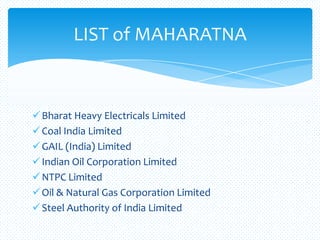
Bharat Heavy Electricals Limited
Coal India Limited
GAIL (India) Limited
Indian Oil Corporation Limited
NTPC Limited
Oil & Natural Gas Corporation Limited
Steel Authority of India Limited
LIST of MAHARATNA
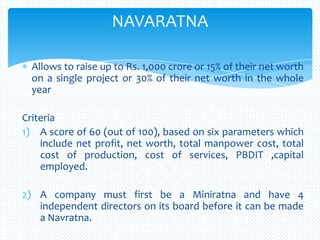
Allows to raise up to Rs. 1,000 crore or 15% of their net worth
on a single project or 30% of their net worth in the whole
year
Criteria
1) A score of 60 (out of 100), based on six parameters which
include net profit, net worth, total manpower cost, total
cost of production, cost of services, PBDIT ,capital
employed.
2) A company must first be a Miniratna and have 4
independent directors on its board before it can be made
a Navratna.
NAVARATNA
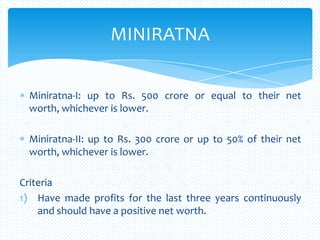
Miniratna-I: up to Rs. 500 crore or equal to their net
worth, whichever is lower.
Miniratna-II: up to Rs. 300 crore or up to 50% of their net
worth, whichever is lower.
Criteria
1) Have made profits for the last three years continuously
and should have a positive net worth.
MINIRATNA
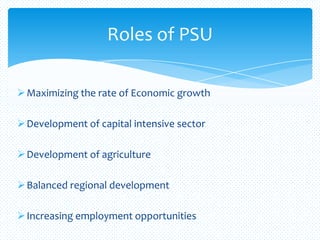
Maximizing the rate of Economic growth
Development of capital intensive sector
Development of agriculture
Balanced regional development
Increasing employment opportunities
Roles of PSU
Preventing private monopoly
Export promotion & Import substitution
Research & Development
Mobilization of resources
Establishment of socialist pattern
Selling or liquidating an asset or subsidiary.
Disinvestment is the withdrawal of capital from a country or
corporation.
Disinvestment
SALIENT FEATURES
Sale of only part of equity holdings held by the government
to private investors.
Leads only to dilution of ownership and not transfer of full
ownership.
Privatization refers to the transfer of ownership from
government to private investors.
Disinvestment is called as Partial Privatization.
 Releasing large amount of public resources
 Reducing the public debt
 Transfer of Commercial Risk
 Expose the privatised companies to market discipline
 Wider distribution of wealth
 Effect on the Capital Market
 Increase in Economic Activity
OBJECTIVES OF DISINVESTMENT
 Social security for Employees
 Choosing out area for disinvestment
 Threat to national security
 No transparency
 Failure to attract foreign buyers
Challenges in Disinvestment
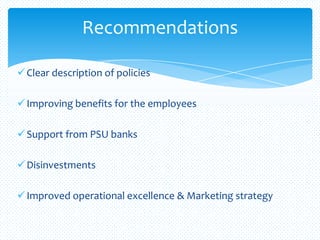
Clear description of policies
Improving benefits for the employees
Support from PSU banks
Disinvestments
Improved operational excellence & Marketing strategy
Recommendations
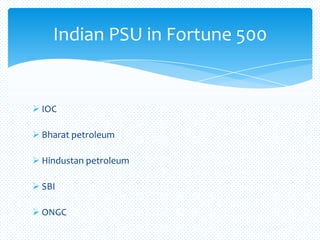
 IOC
 Bharat petroleum
 Hindustan petroleum
 SBI
 ONGC
Indian PSU in Fortune 500
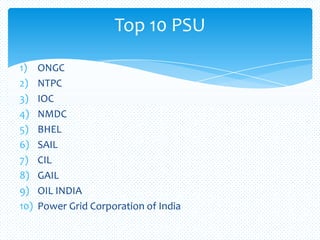
1) ONGC
2) NTPC
3) IOC
4) NMDC
5) BHEL
6) SAIL
7) CIL
8) GAIL
9) OIL INDIA
10) Power Grid Corporation of India
Top 10 PSU

Public Sector Undertakings in India

  • 2.
  • 3.
  • 4.
    Central and statePublic Sector Undertakings (PSUs) play a prominent role in India’s industrialization and economic development. Since independence, various socio-economic problems needed to be dealt with in a planned and systematic manner. A predominantly agrarian economy, a weak industrial base, low savings, inadequate investments and lack of industrial facilities called for state intervention to use the public sector as an instrument to steer the country’s underlying potential towards self reliant economic growth. Why PSU in INDIA
  • 5.
    Public sector enterprisesin India have grown from only five enterprises post independence and with an investment of ` 0.3 bn in the year 1951 to 249 enterprises as on Mar 31, 2010. Aggregate investment in Central PSUs has been increasing over the years. Total investment, including equity plus long-term loans of Central PSUs went up from ` 5,135.32 bn in FY09 to ` 5799.20 bn in FY10, growing 12.93%. Evolution of Public Sector Enterprises in India
  • 6.
    1. State Ownership: Publicundertakings are fully owned by the Government or some public authority. For example, Reserve Bank of India is owned by the Central Govern-ment while Delhi Transport Corporation is owned by the Government of Delhi State. 2. Government Control: The ultimate control of a public sector undertaking lies with the Government. CHARACTERISTICS OF PSU’S
  • 7.
    3. Service Motive:The primary objective of a public sector undertaking is to render service to the public at large. In order to serve the public, it may even incur loss. For example, the Food Corporation of India provides food grains to the public at subsidised prices. 4. State Financing: The Government provides the capital and funds through appropria-tions from its budget. The government may also provide loans from time to time from the State exchequer.
  • 8.
    5. Public Accountability:Public sector undertakings are accountable to the public at large for their performance and results. The annual audit of these undertakings is con-ducted by the Comptroller and Auditor General of India. Moreover, their annual reports are subject to discussion in the Parliament or the State legislature. 6. Bureaucratic Management: The management of public sector undertakings is bureau-cratic in the sense that their operations are governed by certain rules and regulations prescribed by the Government.
  • 9.
    1. Balanced growth 2.Long period planning 3. Facilities for economic development 4. Greater public welfare 5. Equal distribution of wealth 6. Abolition of monopoly 7. Better relation with labour force 8. Achievement of self-reliance 9. Utilization of local resources ADVANTAGES OF PSU
  • 10.
    1. Lack ofinitiation and efficiency 2 Lack of selection of goods 3. Political interference 4. Slow growth 5. Poor management 6. Lack of flexibility Limitations: PSU
  • 11.
  • 12.
    Allows the PSU’sto raise its Investment Ceiling from Rs.1000 to Rs.5000 cr. Criteria 1) Granted to Navaratna companies 2) Listed in Stock Exchange 3) turnover more than Rs.25000 crore. 4) Net profit Rs.5000 crore Maharatna
  • 13.
    Bharat Heavy ElectricalsLimited Coal India Limited GAIL (India) Limited Indian Oil Corporation Limited NTPC Limited Oil & Natural Gas Corporation Limited Steel Authority of India Limited LIST of MAHARATNA
  • 14.
    Allows to raiseup to Rs. 1,000 crore or 15% of their net worth on a single project or 30% of their net worth in the whole year Criteria 1) A score of 60 (out of 100), based on six parameters which include net profit, net worth, total manpower cost, total cost of production, cost of services, PBDIT ,capital employed. 2) A company must first be a Miniratna and have 4 independent directors on its board before it can be made a Navratna. NAVARATNA
  • 15.
    Miniratna-I: up toRs. 500 crore or equal to their net worth, whichever is lower. Miniratna-II: up to Rs. 300 crore or up to 50% of their net worth, whichever is lower. Criteria 1) Have made profits for the last three years continuously and should have a positive net worth. MINIRATNA
  • 16.
    Maximizing the rateof Economic growth Development of capital intensive sector Development of agriculture Balanced regional development Increasing employment opportunities Roles of PSU
  • 17.
    Preventing private monopoly Exportpromotion & Import substitution Research & Development Mobilization of resources Establishment of socialist pattern
  • 18.
    Selling or liquidatingan asset or subsidiary. Disinvestment is the withdrawal of capital from a country or corporation. Disinvestment
  • 19.
    SALIENT FEATURES Sale ofonly part of equity holdings held by the government to private investors. Leads only to dilution of ownership and not transfer of full ownership. Privatization refers to the transfer of ownership from government to private investors. Disinvestment is called as Partial Privatization.
  • 20.
     Releasing largeamount of public resources  Reducing the public debt  Transfer of Commercial Risk  Expose the privatised companies to market discipline  Wider distribution of wealth  Effect on the Capital Market  Increase in Economic Activity OBJECTIVES OF DISINVESTMENT
  • 21.
     Social securityfor Employees  Choosing out area for disinvestment  Threat to national security  No transparency  Failure to attract foreign buyers Challenges in Disinvestment
  • 22.
    Clear description ofpolicies Improving benefits for the employees Support from PSU banks Disinvestments Improved operational excellence & Marketing strategy Recommendations
  • 23.
     IOC  Bharatpetroleum  Hindustan petroleum  SBI  ONGC Indian PSU in Fortune 500
  • 24.
    1) ONGC 2) NTPC 3)IOC 4) NMDC 5) BHEL 6) SAIL 7) CIL 8) GAIL 9) OIL INDIA 10) Power Grid Corporation of India Top 10 PSU