
PRIVATE PUBLIC
AND
GLOBAL ENTERPRISES
*CONTENTS*
1. THE CONCEPT & CHARACTERISTIC OF
ENTERPRISES
2. FEATURES OF DIFFERENT FORM OF
ENTERPRISES
3. GLOBAL ENTERPRISES
4. JOINT VENTURE
5. PRIVATE PUBLIC PARTNERSHIP
6. CHANGING ROLE OF THE PUBLIC SECTOR
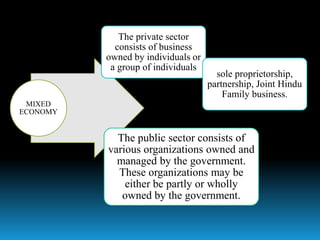
MIXED
ECONOMY
The private sector
consists of business
owned by individuals or
a group of individuals
sole proprietorship,
partnership, Joint Hindu
Family business.
The public sector consists of
various organizations owned and
managed by the government.
These organizations may be
either be partly or wholly
owned by the government.
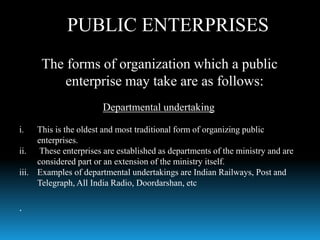
The forms of organization which a public
enterprise may take are as follows:
Departmental undertaking
i. This is the oldest and most traditional form of organizing public
enterprises.
ii. These enterprises are established as departments of the ministry and are
considered part or an extension of the ministry itself.
iii. Examples of departmental undertakings are Indian Railways, Post and
Telegraph, All India Radio, Doordarshan, etc
.
PUBLIC ENTERPRISES
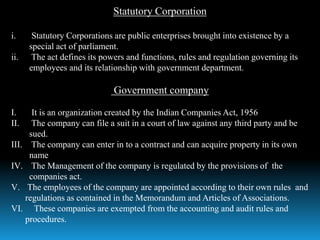
Statutory Corporation
i. Statutory Corporations are public enterprises brought into existence by a
special act of parliament.
ii. The act defines its powers and functions, rules and regulation governing its
employees and its relationship with government department.
Government company
I. It is an organization created by the Indian Companies Act, 1956
II. The company can file a suit in a court of law against any third party and be
sued.
III. The company can enter in to a contract and can acquire property in its own
name
IV. The Management of the company is regulated by the provisions of the
companies act.
V. The employees of the company are appointed according to their own rules and
regulations as contained in the Memorandum and Articles of Associations.
VI. These companies are exempted from the accounting and audit rules and
procedures.
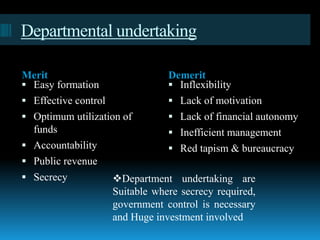
Departmental undertaking
Merit Demerit
 Easy formation
 Effective control
 Optimum utilization of
funds
 Accountability
 Public revenue
 Secrecy
 Inflexibility
 Lack of motivation
 Lack of financial autonomy
 Inefficient management
 Red tapism & bureaucracy
Department undertaking are
Suitable where secrecy required,
government control is necessary
and Huge investment involved
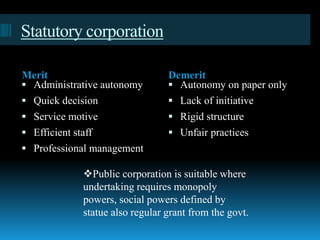
Statutory corporation
Merit Demerit
 Administrative autonomy
 Quick decision
 Service motive
 Efficient staff
 Professional management
 Autonomy on paper only
 Lack of initiative
 Rigid structure
 Unfair practices
Public corporation is suitable where
undertaking requires monopoly
powers, social powers defined by
statue also regular grant from the govt.
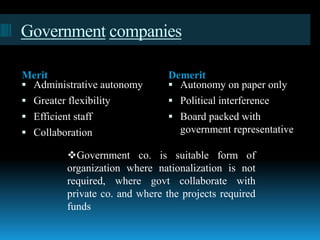
Government companies
Merit Demerit
 Administrative autonomy
 Greater flexibility
 Efficient staff
 Collaboration
 Autonomy on paper only
 Political interference
 Board packed with
government representative
Government co. is suitable form of
organization where nationalization is not
required, where govt collaborate with
private co. and where the projects required
funds
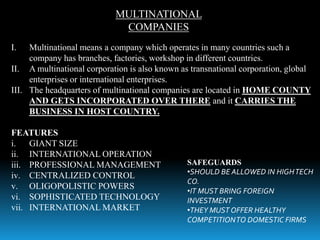
MULTINATIONAL
COMPANIES
I. Multinational means a company which operates in many countries such a
company has branches, factories, workshop in different countries.
II. A multinational corporation is also known as transnational corporation, global
enterprises or international enterprises.
III. The headquarters of multinational companies are located in HOME COUNTY
AND GETS INCORPORATED OVER THERE and it CARRIES THE
BUSINESS IN HOST COUNTRY.
FEATURES
i. GIANT SIZE
ii. INTERNATIONAL OPERATION
iii. PROFESSIONAL MANAGEMENT
iv. CENTRALIZED CONTROL
v. OLIGOPOLISTIC POWERS
vi. SOPHISTICATED TECHNOLOGY
vii. INTERNATIONAL MARKET
SAFEGUARDS
•SHOULD BE ALLOWED IN HIGHTECH
CO.
•IT MUST BRING FOREIGN
INVESTMENT
•THEY MUST OFFER HEALTHY
COMPETITIONTO DOMESTIC FIRMS
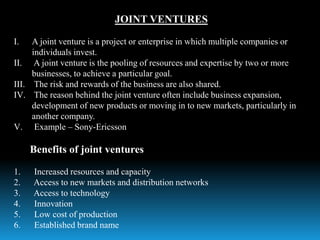
JOINT VENTURES
I. A joint venture is a project or enterprise in which multiple companies or
individuals invest.
II. A joint venture is the pooling of resources and expertise by two or more
businesses, to achieve a particular goal.
III. The risk and rewards of the business are also shared.
IV. The reason behind the joint venture often include business expansion,
development of new products or moving in to new markets, particularly in
another company.
V. Example – Sony-Ericsson
Benefits of joint ventures
1. Increased resources and capacity
2. Access to new markets and distribution networks
3. Access to technology
4. Innovation
5. Low cost of production
6. Established brand name
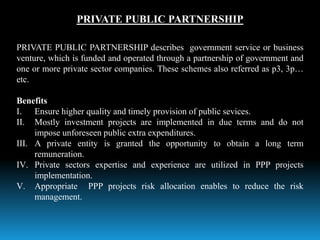
PRIVATE PUBLIC PARTNERSHIP
PRIVATE PUBLIC PARTNERSHIP describes government service or business
venture, which is funded and operated through a partnership of government and
one or more private sector companies. These schemes also referred as p3, 3p…
etc.
Benefits
I. Ensure higher quality and timely provision of public sevices.
II. Mostly investment projects are implemented in due terms and do not
impose unforeseen public extra expenditures.
III. A private entity is granted the opportunity to obtain a long term
remuneration.
IV. Private sectors expertise and experience are utilized in PPP projects
implementation.
V. Appropriate PPP projects risk allocation enables to reduce the risk
management.
CHANGING ROLE OF PUBLIC SECTOR
A. GOVERNMENT POLICY TOWARDS PUBLIC SECTOR
1991. GOVERNMENT of INDIA has introduced 4 major
reforms in public sector in its NEW ECONOMIC POLICY OF
1991.
THESE ARE:
A. RESTRUCTURE AND REVIVE POTENTIALLY VIABLE
PSU`S
B. CLOSE DOWN THE PSU WHICH CANNOT BE REVIVED.
C. BRING DOWN THE GOVERNMENT EQUITY IN ALL
NON-STRATEGIC PSU TO 26% OR LOWER IF
NECESSARY.
D. FULLY PROTECT THE INTEREST OF WORKERS.
5. Government policy towards the public sector since1991:_
a) Reduction in the number of industries reserved for the public
sector from 17 to 8 (and then to 3):-
---In 2001, only three industries were reserved for the public
sector. These are atomic energy, arms, and rail transport.
---- This meant that the private sector could enter all areas
(except the three) and the public sector would have to
compete with them.
b) Disinvestment of shares of a select set public sector
enterprises:-
---Disinvestment involves the sale of the equity shares to the
private sector and the public.
---- The government had taken a decision to withdraw from the
industrial sector and reduce its equity in all undertakings.
c) Policy regarding sick units to be the same as that for the
private sector:-
----- All public sector units were referred to the Board of Industrial
and Financial Reconstruction to decide whether a sick unit was to
be restructured or closed down.
d) Memorandum of understanding:-
---- Improvement of performance trough a MoU system by which
management are to be granted greater autonomy but held
accountable for specified result.
---- Under this system, public sector units were given clear targets
and operational autonomy for achieving those targets.
Thank you!!
Anjali Kumbhar
XI- C

Private public & global environment

  • 1.
  • 2.
    *CONTENTS* 1. THE CONCEPT& CHARACTERISTIC OF ENTERPRISES 2. FEATURES OF DIFFERENT FORM OF ENTERPRISES 3. GLOBAL ENTERPRISES 4. JOINT VENTURE 5. PRIVATE PUBLIC PARTNERSHIP 6. CHANGING ROLE OF THE PUBLIC SECTOR
  • 3.
    MIXED ECONOMY The private sector consistsof business owned by individuals or a group of individuals sole proprietorship, partnership, Joint Hindu Family business. The public sector consists of various organizations owned and managed by the government. These organizations may be either be partly or wholly owned by the government.
  • 4.
    The forms oforganization which a public enterprise may take are as follows: Departmental undertaking i. This is the oldest and most traditional form of organizing public enterprises. ii. These enterprises are established as departments of the ministry and are considered part or an extension of the ministry itself. iii. Examples of departmental undertakings are Indian Railways, Post and Telegraph, All India Radio, Doordarshan, etc . PUBLIC ENTERPRISES
  • 5.
    Statutory Corporation i. StatutoryCorporations are public enterprises brought into existence by a special act of parliament. ii. The act defines its powers and functions, rules and regulation governing its employees and its relationship with government department. Government company I. It is an organization created by the Indian Companies Act, 1956 II. The company can file a suit in a court of law against any third party and be sued. III. The company can enter in to a contract and can acquire property in its own name IV. The Management of the company is regulated by the provisions of the companies act. V. The employees of the company are appointed according to their own rules and regulations as contained in the Memorandum and Articles of Associations. VI. These companies are exempted from the accounting and audit rules and procedures.
  • 6.
    Departmental undertaking Merit Demerit Easy formation  Effective control  Optimum utilization of funds  Accountability  Public revenue  Secrecy  Inflexibility  Lack of motivation  Lack of financial autonomy  Inefficient management  Red tapism & bureaucracy Department undertaking are Suitable where secrecy required, government control is necessary and Huge investment involved
  • 7.
    Statutory corporation Merit Demerit Administrative autonomy  Quick decision  Service motive  Efficient staff  Professional management  Autonomy on paper only  Lack of initiative  Rigid structure  Unfair practices Public corporation is suitable where undertaking requires monopoly powers, social powers defined by statue also regular grant from the govt.
  • 8.
    Government companies Merit Demerit Administrative autonomy  Greater flexibility  Efficient staff  Collaboration  Autonomy on paper only  Political interference  Board packed with government representative Government co. is suitable form of organization where nationalization is not required, where govt collaborate with private co. and where the projects required funds
  • 9.
    MULTINATIONAL COMPANIES I. Multinational meansa company which operates in many countries such a company has branches, factories, workshop in different countries. II. A multinational corporation is also known as transnational corporation, global enterprises or international enterprises. III. The headquarters of multinational companies are located in HOME COUNTY AND GETS INCORPORATED OVER THERE and it CARRIES THE BUSINESS IN HOST COUNTRY. FEATURES i. GIANT SIZE ii. INTERNATIONAL OPERATION iii. PROFESSIONAL MANAGEMENT iv. CENTRALIZED CONTROL v. OLIGOPOLISTIC POWERS vi. SOPHISTICATED TECHNOLOGY vii. INTERNATIONAL MARKET SAFEGUARDS •SHOULD BE ALLOWED IN HIGHTECH CO. •IT MUST BRING FOREIGN INVESTMENT •THEY MUST OFFER HEALTHY COMPETITIONTO DOMESTIC FIRMS
  • 10.
    JOINT VENTURES I. Ajoint venture is a project or enterprise in which multiple companies or individuals invest. II. A joint venture is the pooling of resources and expertise by two or more businesses, to achieve a particular goal. III. The risk and rewards of the business are also shared. IV. The reason behind the joint venture often include business expansion, development of new products or moving in to new markets, particularly in another company. V. Example – Sony-Ericsson Benefits of joint ventures 1. Increased resources and capacity 2. Access to new markets and distribution networks 3. Access to technology 4. Innovation 5. Low cost of production 6. Established brand name
  • 11.
    PRIVATE PUBLIC PARTNERSHIP PRIVATEPUBLIC PARTNERSHIP describes government service or business venture, which is funded and operated through a partnership of government and one or more private sector companies. These schemes also referred as p3, 3p… etc. Benefits I. Ensure higher quality and timely provision of public sevices. II. Mostly investment projects are implemented in due terms and do not impose unforeseen public extra expenditures. III. A private entity is granted the opportunity to obtain a long term remuneration. IV. Private sectors expertise and experience are utilized in PPP projects implementation. V. Appropriate PPP projects risk allocation enables to reduce the risk management.
  • 12.
    CHANGING ROLE OFPUBLIC SECTOR A. GOVERNMENT POLICY TOWARDS PUBLIC SECTOR 1991. GOVERNMENT of INDIA has introduced 4 major reforms in public sector in its NEW ECONOMIC POLICY OF 1991. THESE ARE: A. RESTRUCTURE AND REVIVE POTENTIALLY VIABLE PSU`S B. CLOSE DOWN THE PSU WHICH CANNOT BE REVIVED. C. BRING DOWN THE GOVERNMENT EQUITY IN ALL NON-STRATEGIC PSU TO 26% OR LOWER IF NECESSARY. D. FULLY PROTECT THE INTEREST OF WORKERS.
  • 13.
    5. Government policytowards the public sector since1991:_ a) Reduction in the number of industries reserved for the public sector from 17 to 8 (and then to 3):- ---In 2001, only three industries were reserved for the public sector. These are atomic energy, arms, and rail transport. ---- This meant that the private sector could enter all areas (except the three) and the public sector would have to compete with them. b) Disinvestment of shares of a select set public sector enterprises:- ---Disinvestment involves the sale of the equity shares to the private sector and the public. ---- The government had taken a decision to withdraw from the industrial sector and reduce its equity in all undertakings.
  • 14.
    c) Policy regardingsick units to be the same as that for the private sector:- ----- All public sector units were referred to the Board of Industrial and Financial Reconstruction to decide whether a sick unit was to be restructured or closed down. d) Memorandum of understanding:- ---- Improvement of performance trough a MoU system by which management are to be granted greater autonomy but held accountable for specified result. ---- Under this system, public sector units were given clear targets and operational autonomy for achieving those targets.
  • 15.