Gauss-Seidal (G-S) Method of Power Flow
Younus
B. Tech (EEE)
Amity University
Table of Contents
Gauss Seidal Method
Application of G-S Method in Power Flow
Example
Advantages and Disadvantages
Table of Contents
Gauss Seidal Method
Application of G-S Method in Power Flow
Example
Advantages and Disadvantages
Introduction
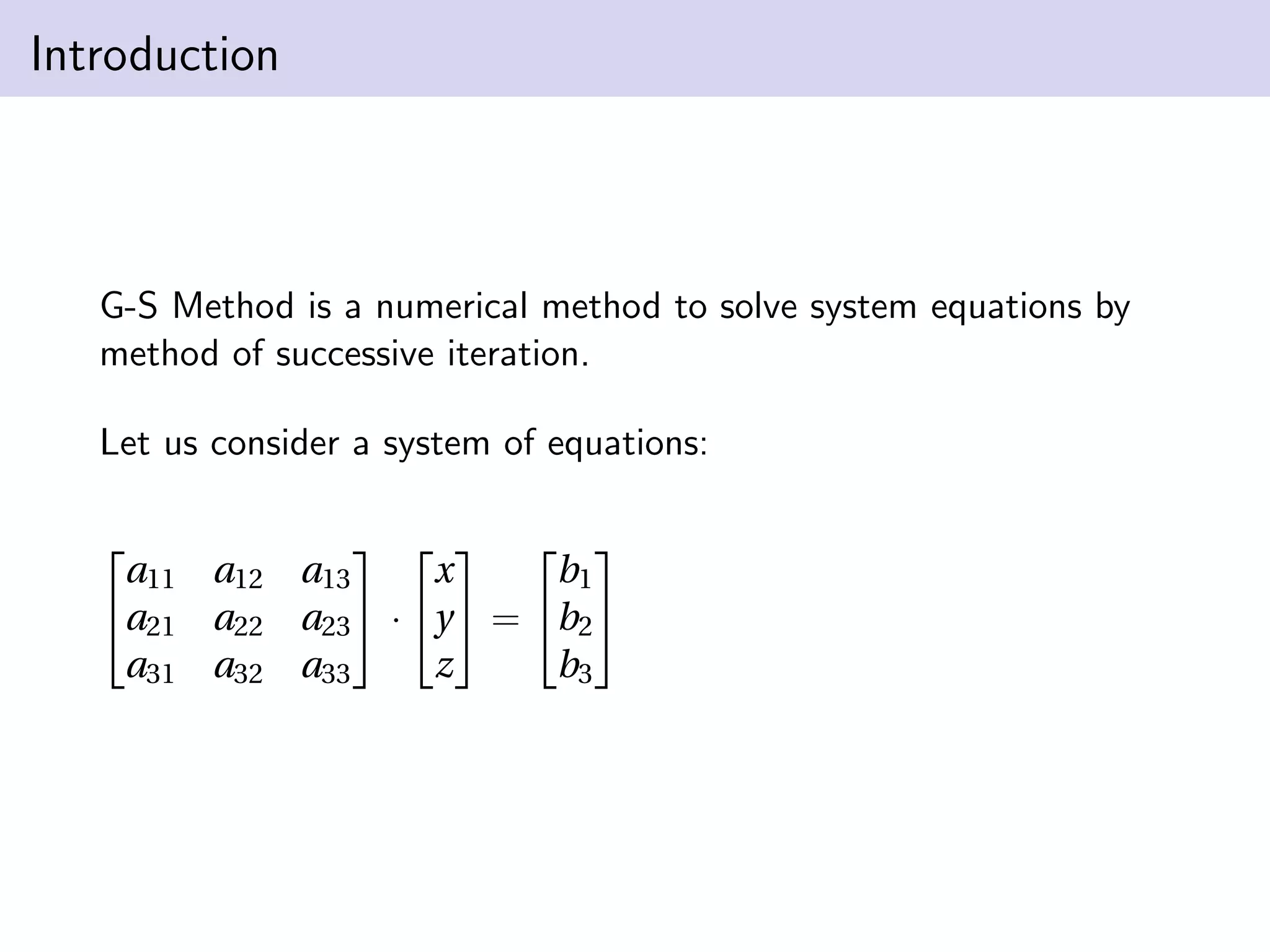
G-S Method is a numerical method to solve system equations by
method of successive iteration.
Let us consider a system of equations:


a11 a12 a13
a21 a22 a23
a31 a32 a33

 ·


x
y
z

 =


b1
b2
b3


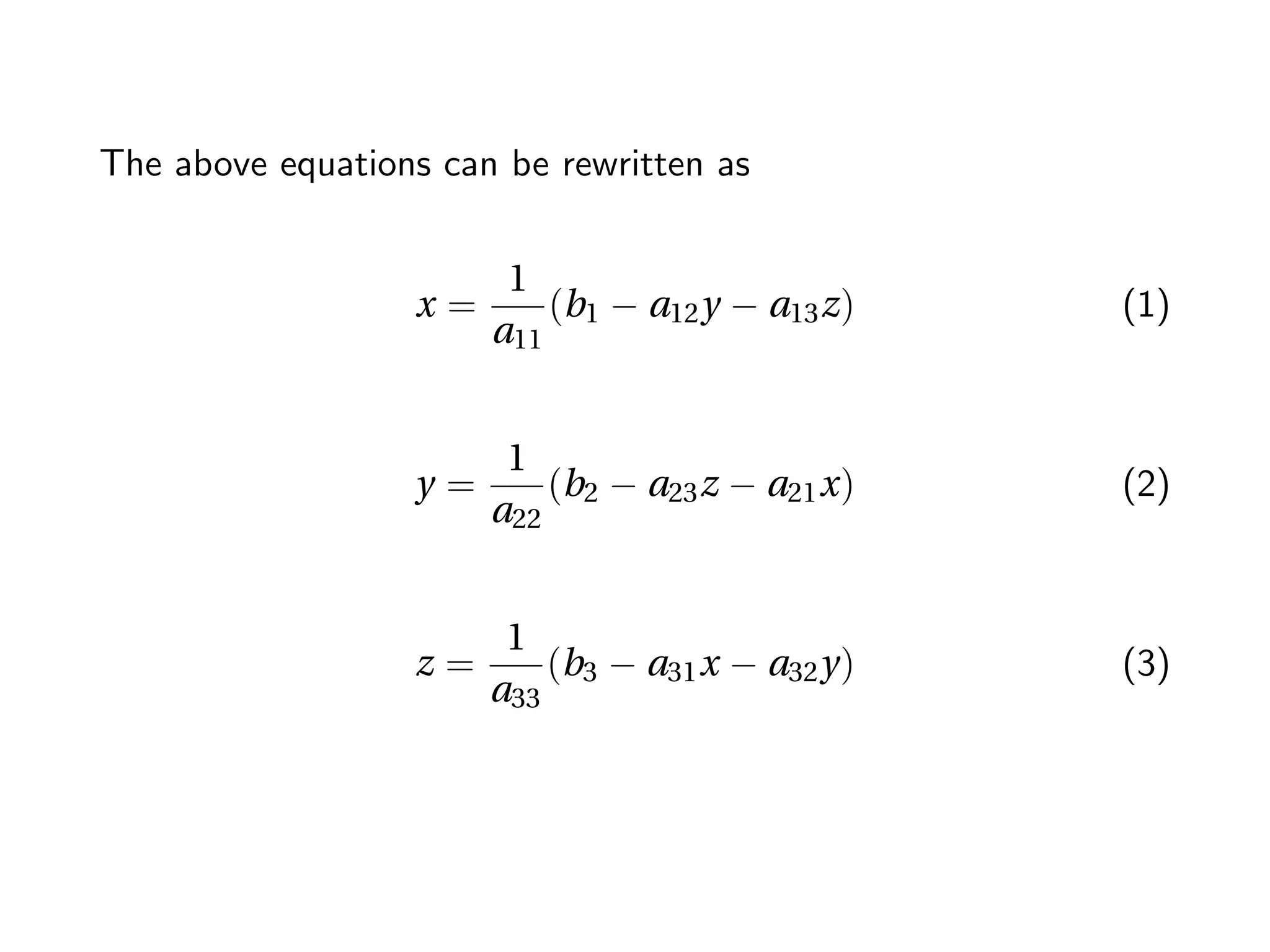
The above equations can be rewritten as
x =
1
a11
(b1 − a12y − a13z) (1)
y =
1
a22
(b2 − a23z − a21x) (2)
z =
1
a33
(b3 − a31x − a32y) (3)
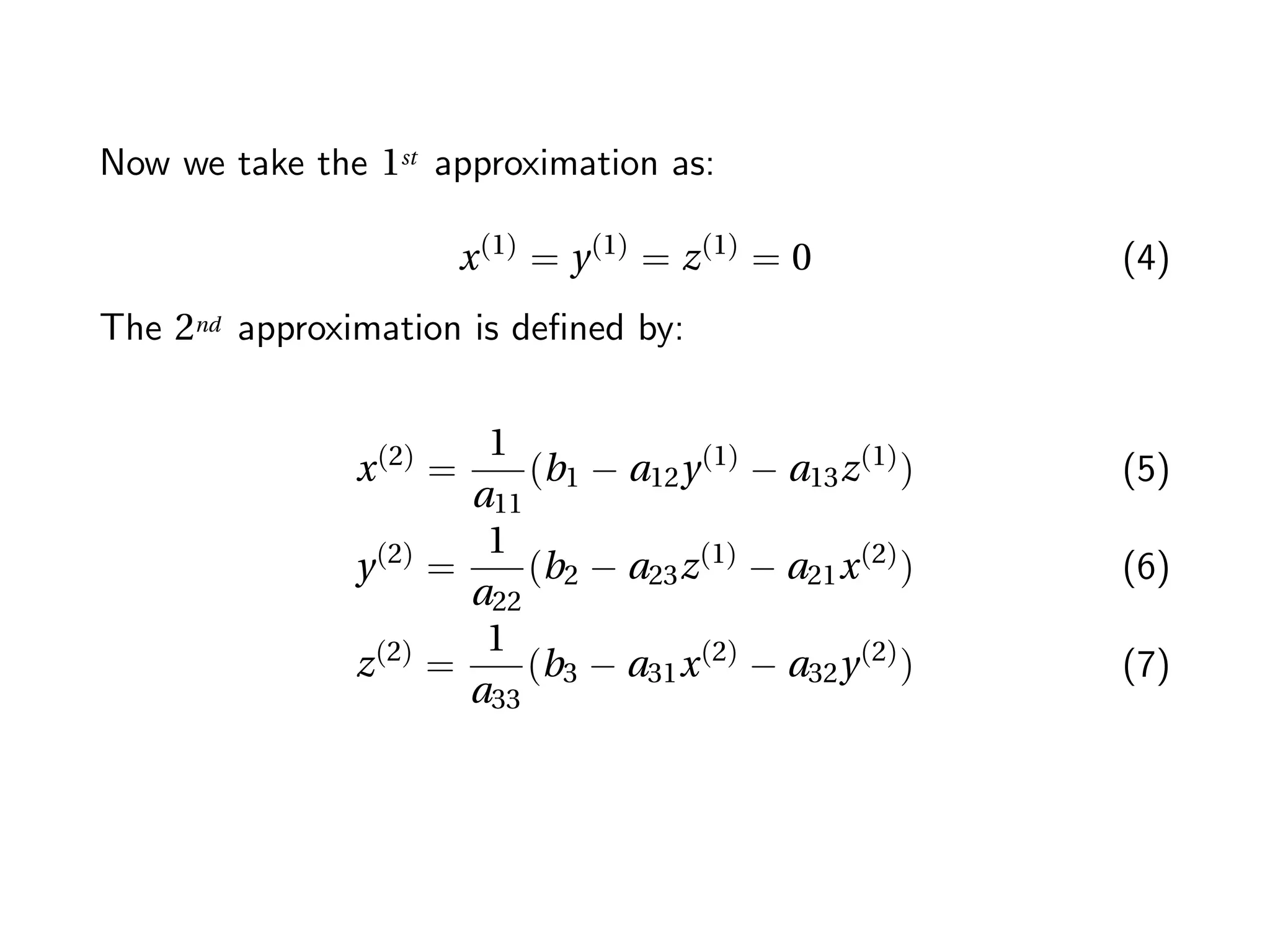
Now we take the 1st approximation as:
x(1)
= y(1)
= z(1)
= 0 (4)
The 2nd approximation is defined by:
x(2)
=
1
a11
(b1 − a12y(1)
− a13z(1)
) (5)
y(2)
=
1
a22
(b2 − a23z(1)
− a21x(2)
) (6)
z(2)
=
1
a33
(b3 − a31x(2)
− a32y(2)
) (7)
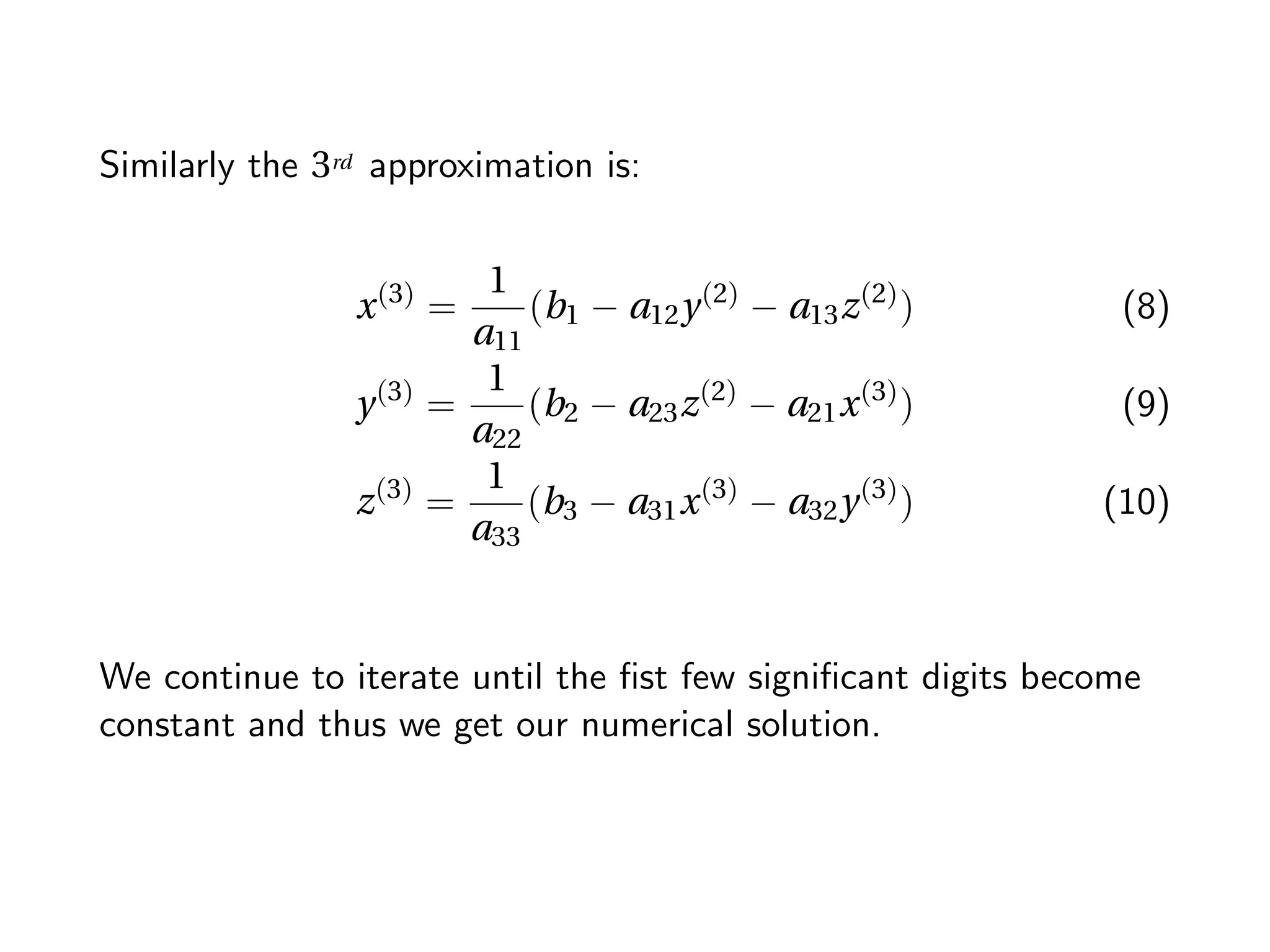
Similarly the 3rd approximation is:
x(3)
=
1
a11
(b1 − a12y(2)
− a13z(2)
) (8)
y(3)
=
1
a22
(b2 − a23z(2)
− a21x(3)
) (9)
z(3)
=
1
a33
(b3 − a31x(3)
− a32y(3)
) (10)
We continue to iterate until the fist few significant digits become
constant and thus we get our numerical solution.
Table of Contents
Gauss Seidal Method
Application of G-S Method in Power Flow
Example
Advantages and Disadvantages
Numerical Solution of Power Flow
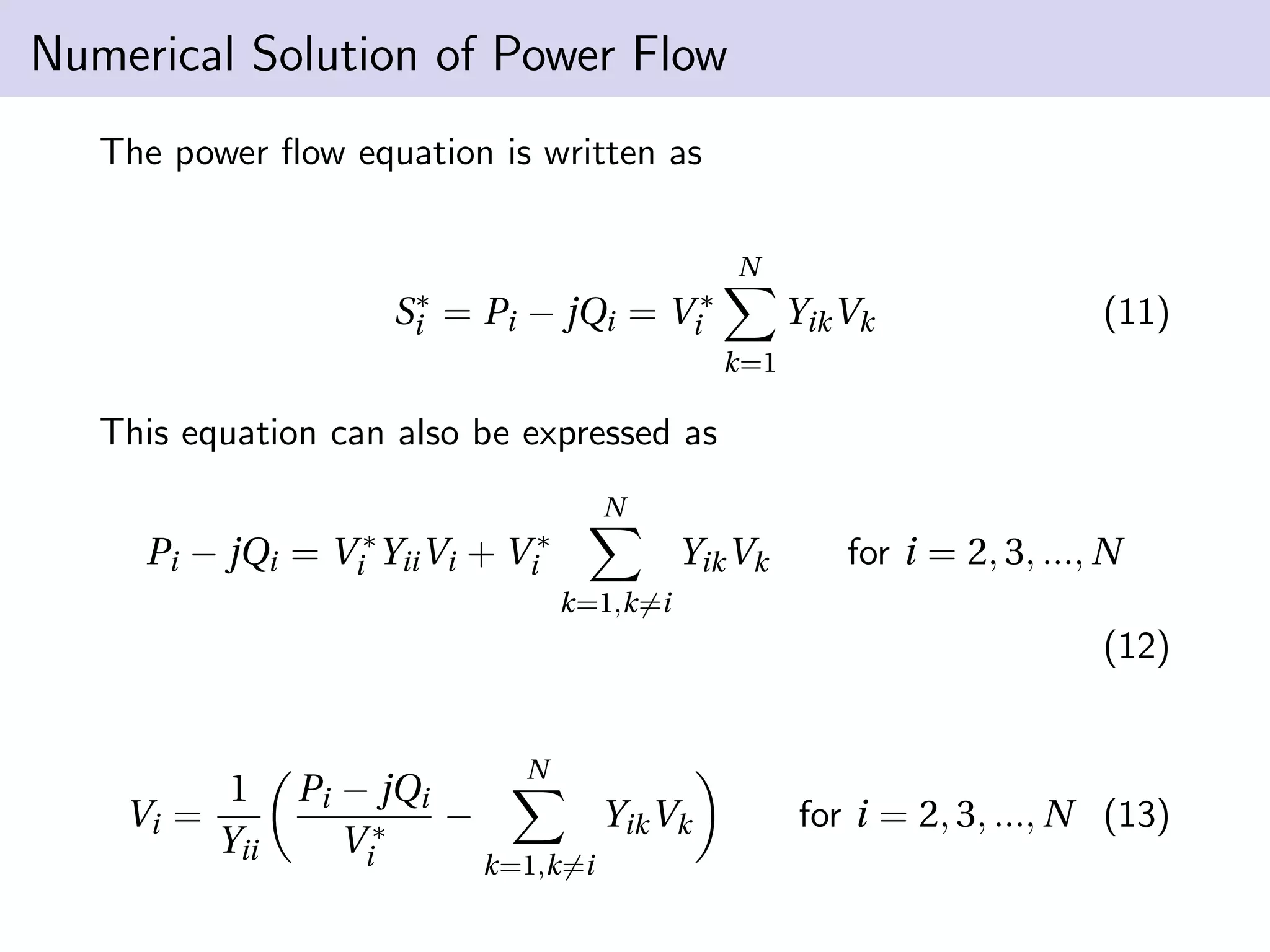
The power flow equation is written as
S∗
i = Pi − jQi = V ∗
i
N
k=1
YikVk (11)
This equation can also be expressed as
Pi − jQi = V ∗
i YiiVi + V ∗
i
N
k=1,k=i
YikVk for i = 2, 3, ..., N
(12)
Vi =
1
Yii
Pi − jQi
V ∗
i
−
N
k=1,k=i
YikVk for i = 2, 3, ..., N (13)
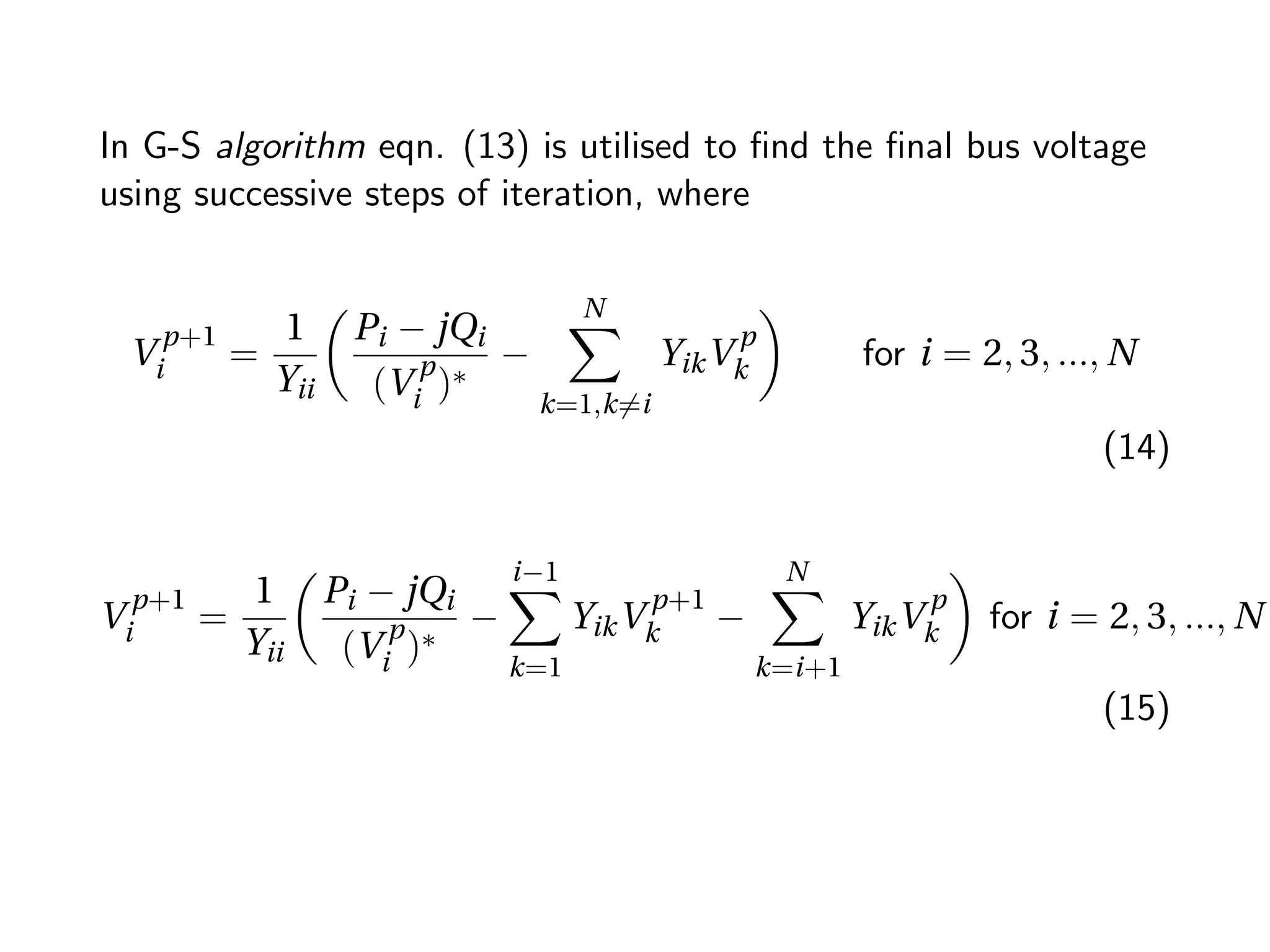
In G-S algorithm eqn. (13) is utilised to find the final bus voltage
using successive steps of iteration, where
V
p+1
i =
1
Yii
Pi − jQi
(V
p
i )∗
−
N
k=1,k=i
YikV
p
k for i = 2, 3, ..., N
(14)
V
p+1
i =
1
Yii
Pi − jQi
(V
p
i )∗
−
i−1
k=1
YikV
p+1
k −
N
k=i+1
YikV
p
k for i = 2, 3, ..., N
(15)
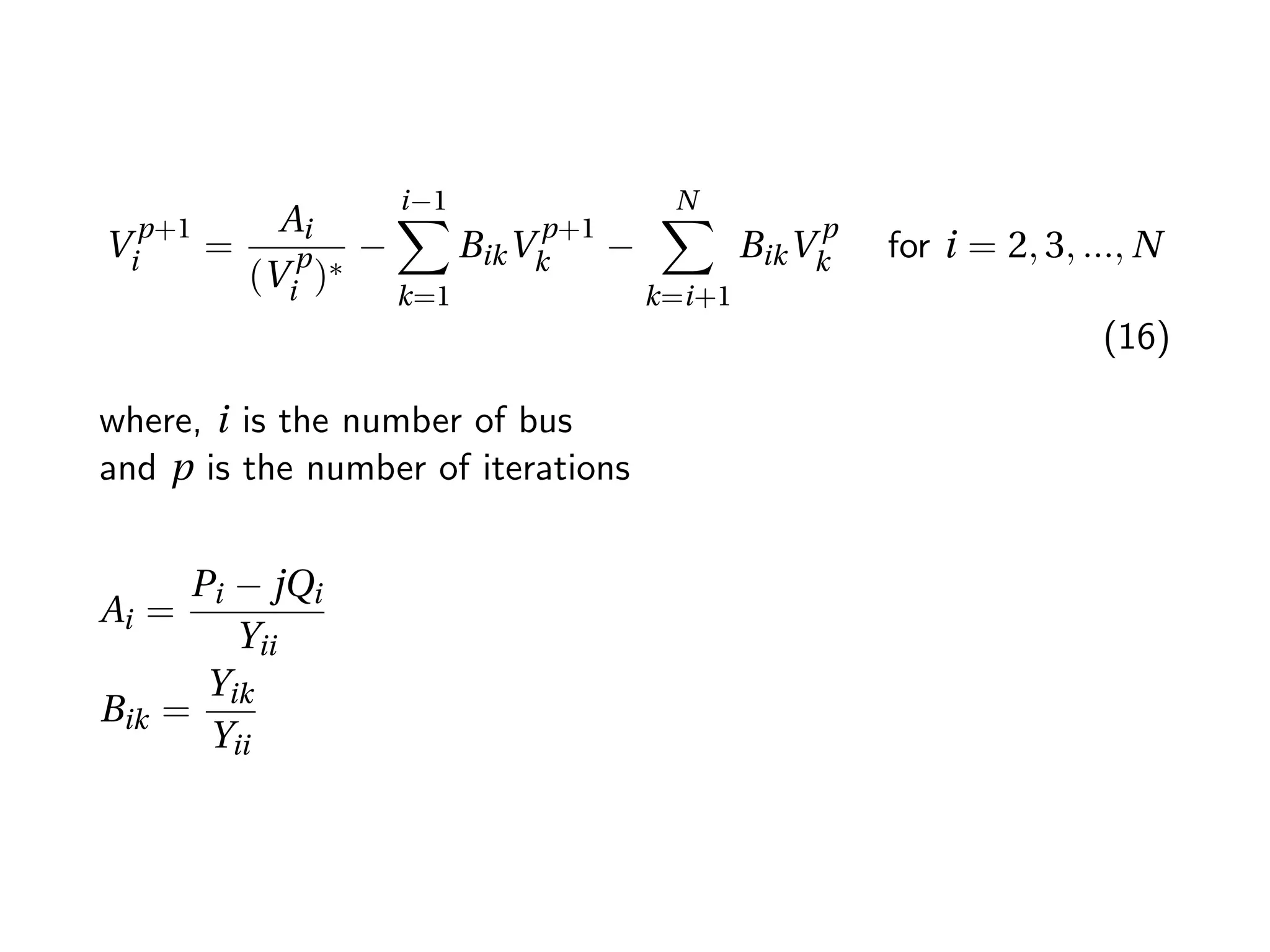
V
p+1
i =
Ai
(V
p
i )∗
−
i−1
k=1
BikV
p+1
k −
N
k=i+1
BikV
p
k for i = 2, 3, ..., N
(16)
where, i is the number of bus
and p is the number of iterations
Ai =
Pi − jQi
Yii
Bik =
Yik
Yii
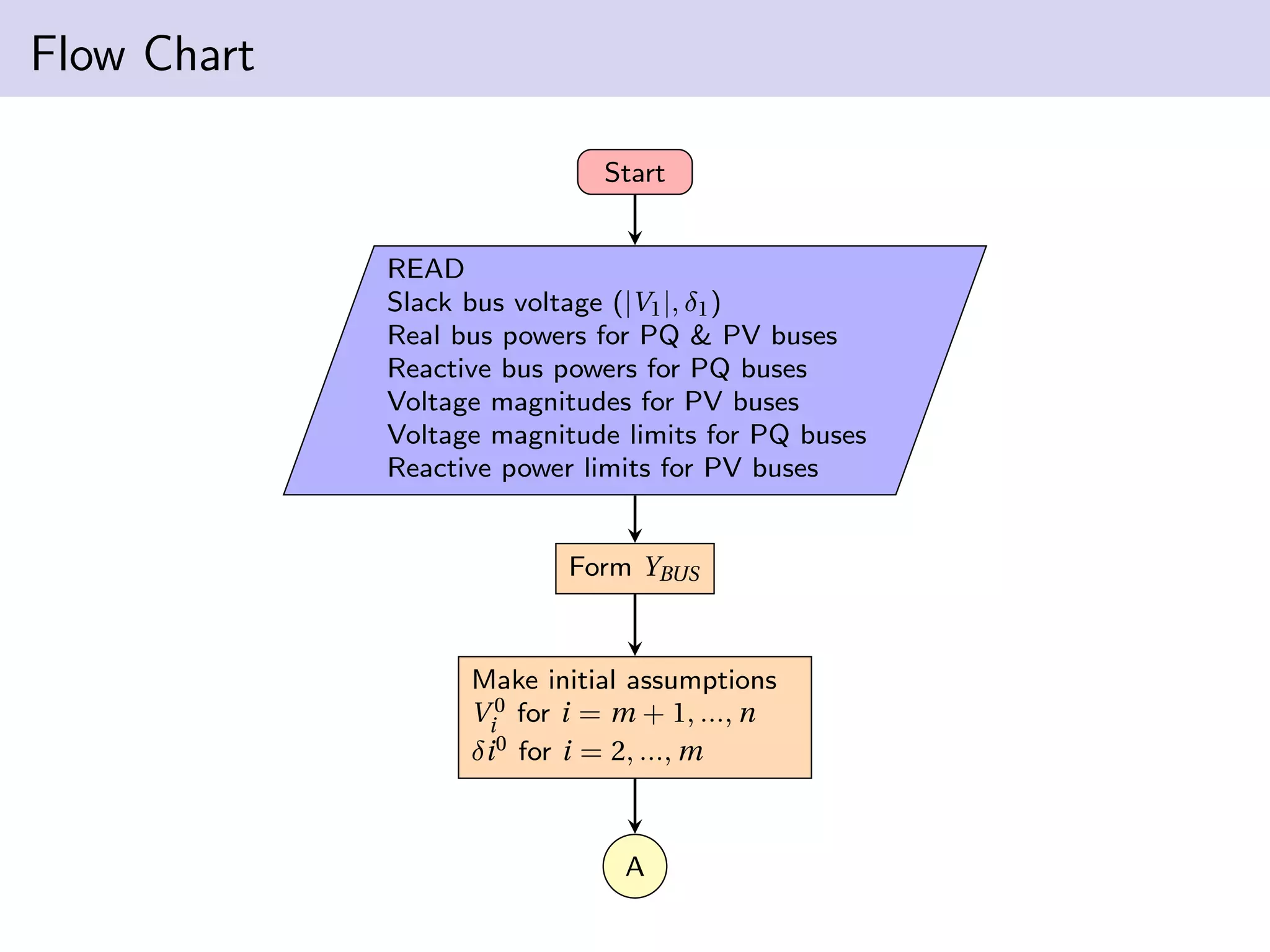
Flow Chart
Start
READ
Slack bus voltage (|V1|, δ1)
Real bus powers for PQ & PV buses
Reactive bus powers for PQ buses
Voltage magnitudes for PV buses
Voltage magnitude limits for PQ buses
Reactive power limits for PV buses
Form YBUS
Make initial assumptions
V 0
i for i = m + 1, ..., n
δi0 for i = 2, ..., m
A
A
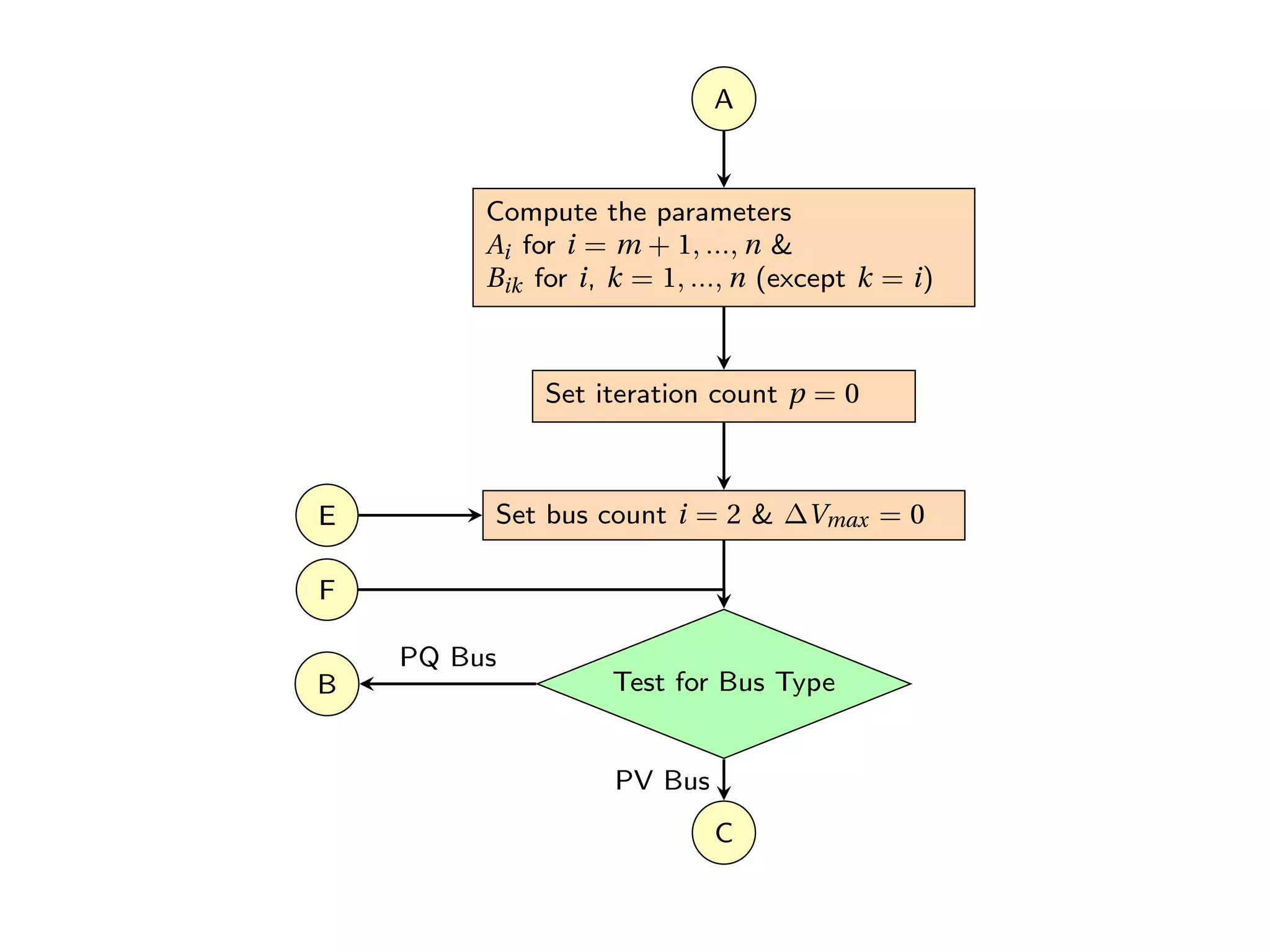
Compute the parameters
Ai for i = m + 1, ..., n &
Bik for i, k = 1, ..., n (except k = i)
Set iteration count p = 0
Set bus count i = 2 & ∆Vmax = 0
Test for Bus TypeB
C
E
F
PQ Bus
PV Bus
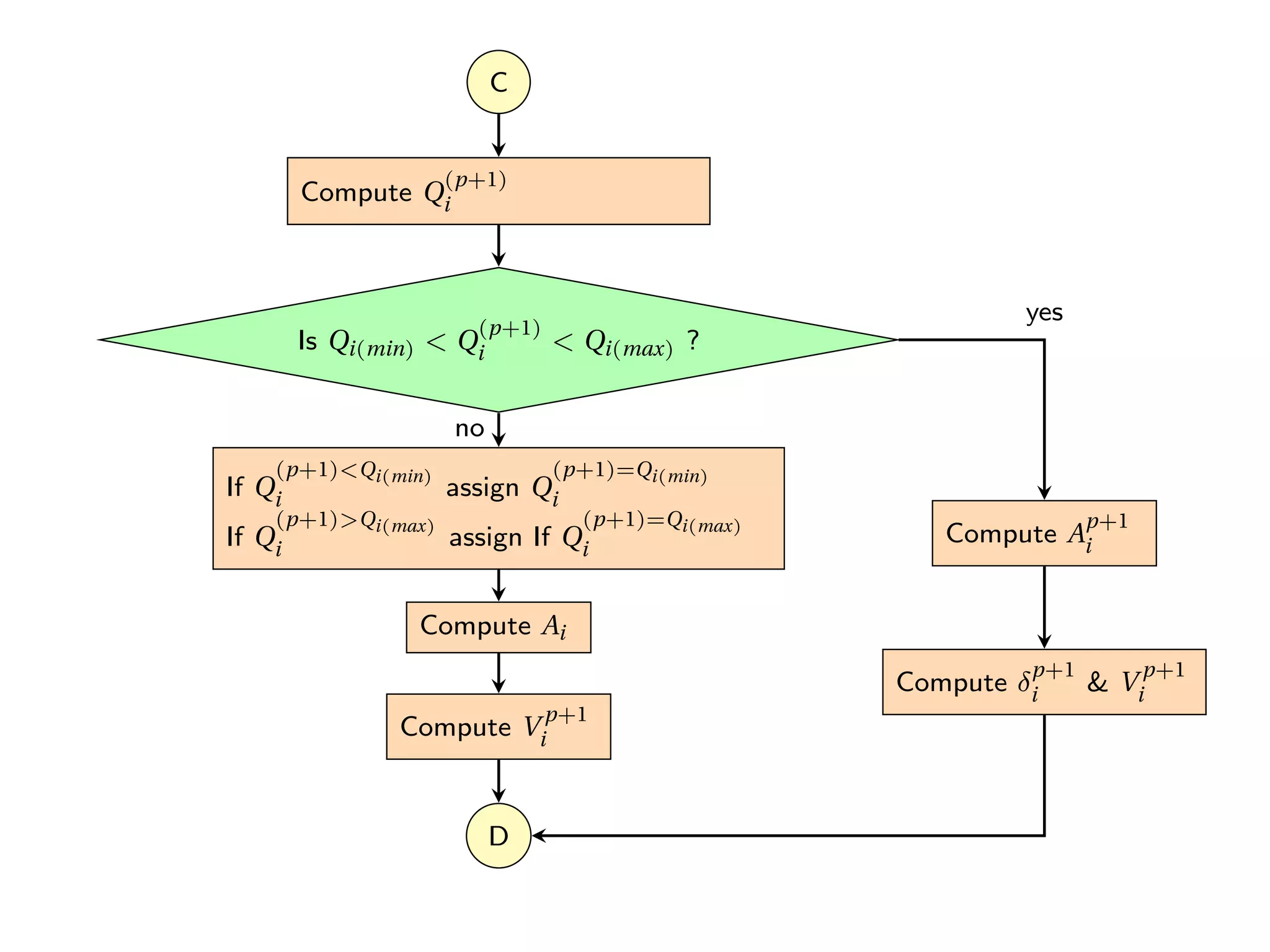
C
Compute Q
(p+1)
i
Is Qi(min) < Q
(p+1)
i < Qi(max) ?
If Q
(p+1)<Qi(min)
i assign Q
(p+1)=Qi(min)
i
If Q
(p+1)>Qi(max)
i assign If Q
(p+1)=Qi(max)
i
Compute A
p+1
i
Compute Ai
Compute V
p+1
i
Compute δ
p+1
i & V
p+1
i
D
no
yes
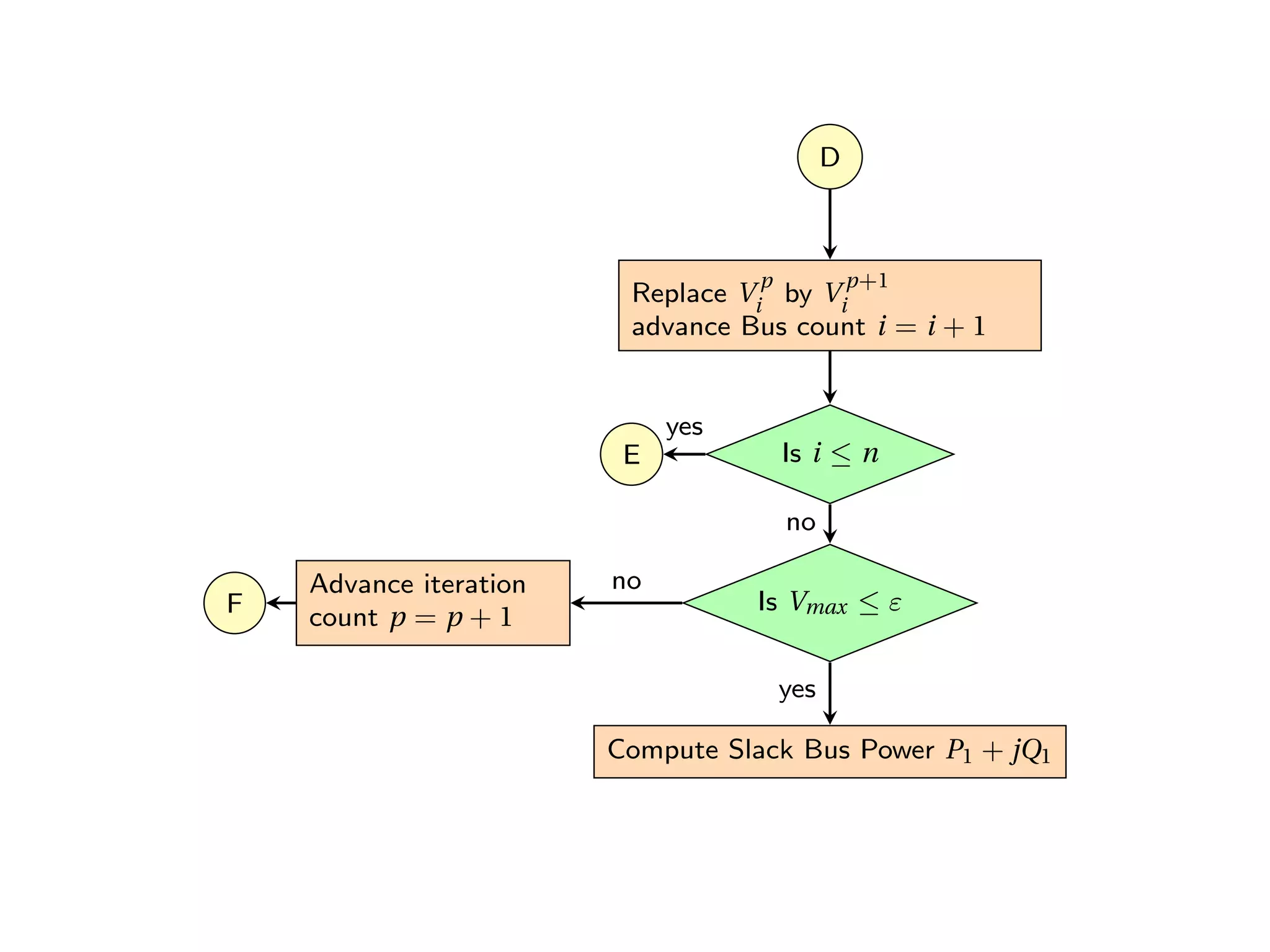
D
Replace V
p
i by V
p+1
i
advance Bus count i = i + 1
Is i ≤ n
Is Vmax ≤ ε
Advance iteration
count p = p + 1
Compute Slack Bus Power P1 + jQ1
E
F
yes
no
yes
no
Table of Contents
Gauss Seidal Method
Application of G-S Method in Power Flow
Example
Advantages and Disadvantages
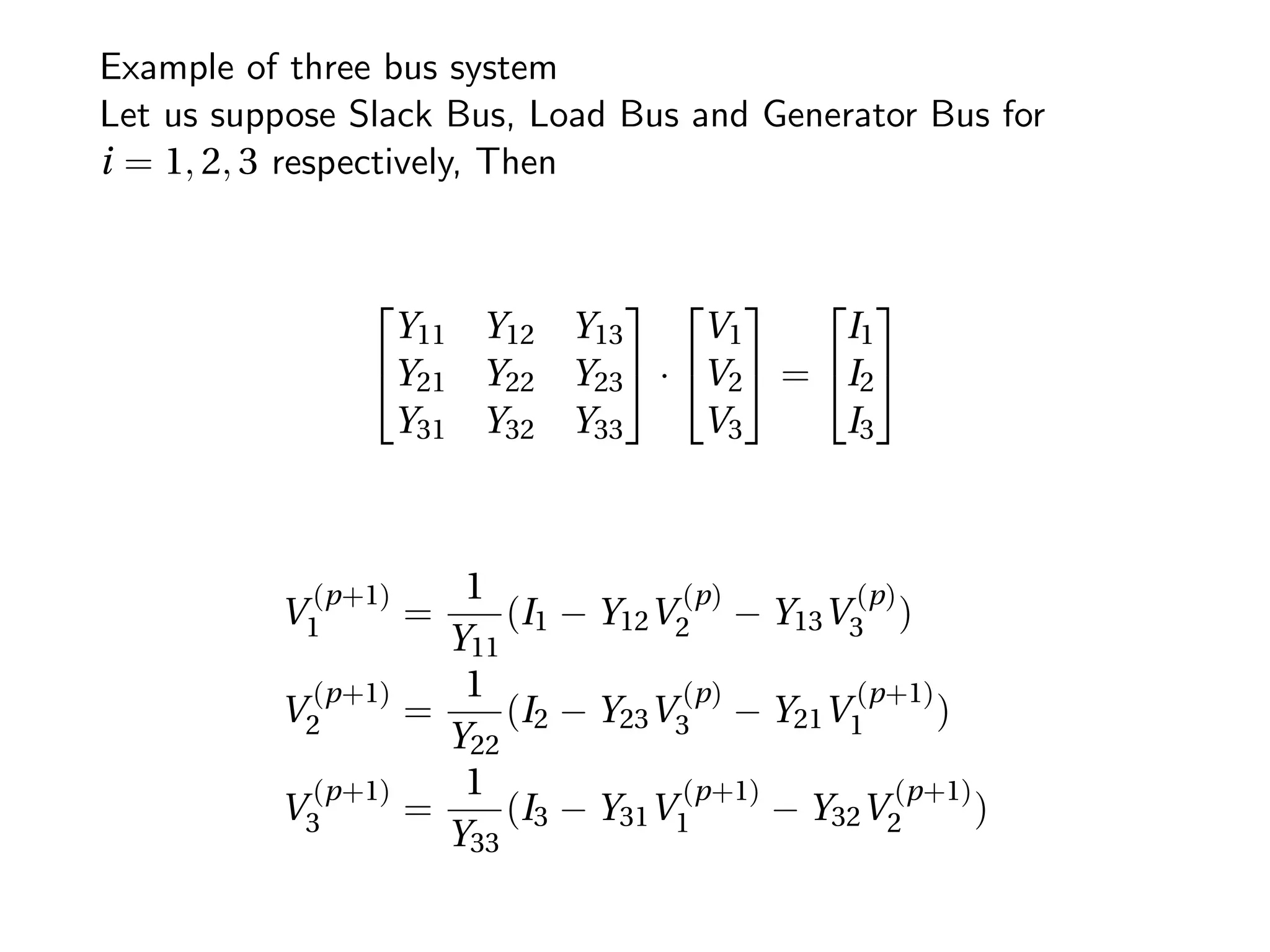
Example of three bus system
Let us suppose Slack Bus, Load Bus and Generator Bus for
i = 1, 2, 3 respectively, Then


Y11 Y12 Y13
Y21 Y22 Y23
Y31 Y32 Y33

 ·


V1
V2
V3

 =


I1
I2
I3


V
(p+1)
1 =
1
Y11
(I1 − Y12V
(p)
2 − Y13V
(p)
3 )
V
(p+1)
2 =
1
Y22
(I2 − Y23V
(p)
3 − Y21V
(p+1)
1 )
V
(p+1)
3 =
1
Y33
(I3 − Y31V
(p+1)
1 − Y32V
(p+1)
2 )
V1 = 1 + j0
V
(p+1)
2 = 1
Y22
P2−jQ2
(V
p
2 )∗ − Y23V
(p)
3 − Y21V
(p+1)
1
Q
(p+1)
3 = − N
k=1 YikViVk = −(Y31V3V1 +Y32V3V
p+1
2 +Y33V3V3)
V
(p+1)
3 = 1
Y33
P3−jQ3
(V
p
3 )∗ − Y31V
(p+1)
1 − Y32V
(p+1)
2
Table of Contents
Gauss Seidal Method
Application of G-S Method in Power Flow
Example
Advantages and Disadvantages
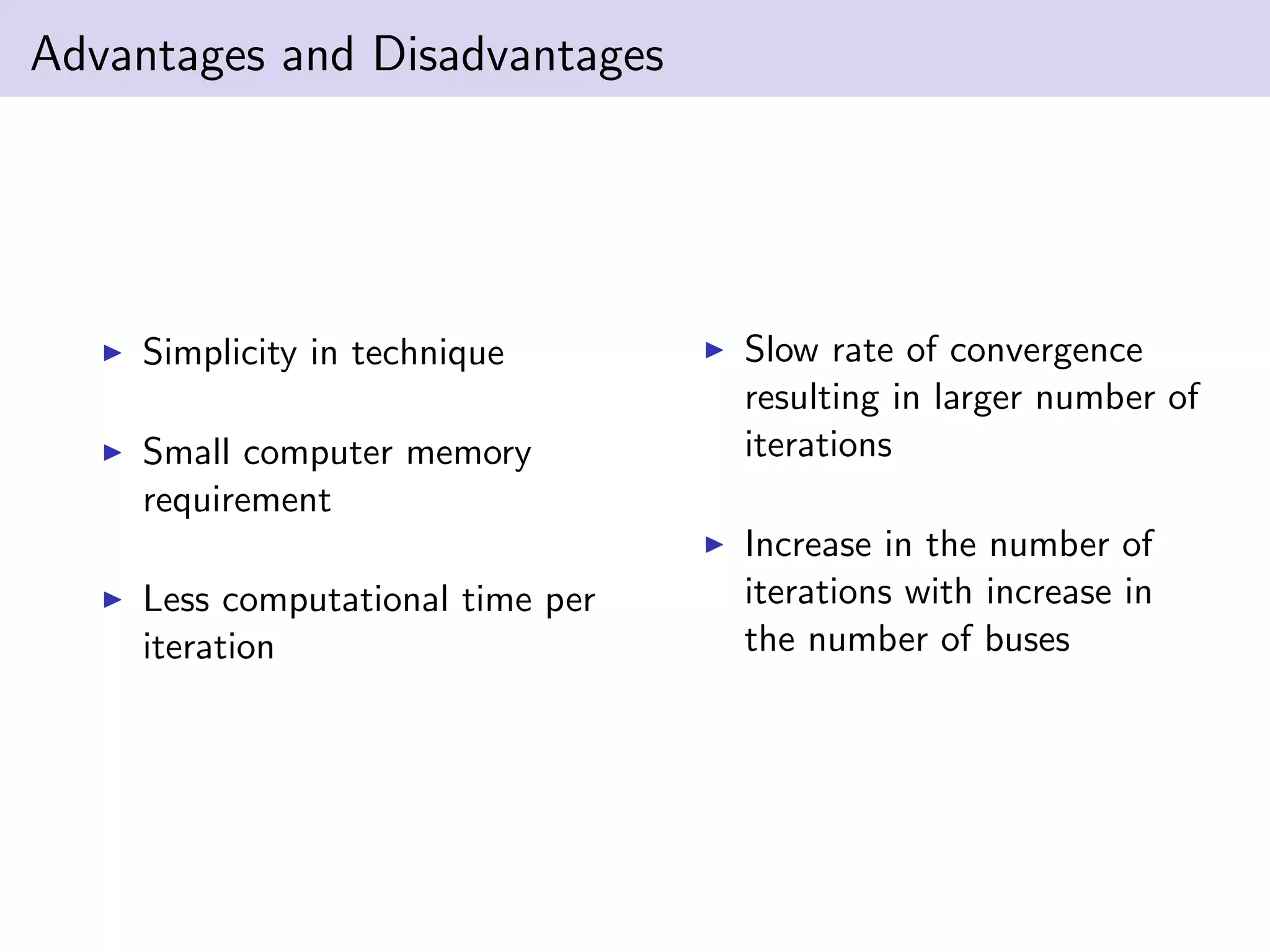
Simplicity in technique
Small computer memory
requirement
Less computational time per
iteration
Slow rate of convergence
resulting in larger number of
iterations
Increase in the number of
iterations with increase in
the number of buses
Thank You

Gauss Seidel Method of Power Flow

  • 1.
    Gauss-Seidal (G-S) Methodof Power Flow Younus B. Tech (EEE) Amity University
  • 2.
    Table of Contents GaussSeidal Method Application of G-S Method in Power Flow Example Advantages and Disadvantages
  • 3.
    Table of Contents GaussSeidal Method Application of G-S Method in Power Flow Example Advantages and Disadvantages
  • 4.
    Introduction G-S Method isa numerical method to solve system equations by method of successive iteration. Let us consider a system of equations:   a11 a12 a13 a21 a22 a23 a31 a32 a33   ·   x y z   =   b1 b2 b3  
  • 5.
    The above equationscan be rewritten as x = 1 a11 (b1 − a12y − a13z) (1) y = 1 a22 (b2 − a23z − a21x) (2) z = 1 a33 (b3 − a31x − a32y) (3)
  • 6.
    Now we takethe 1st approximation as: x(1) = y(1) = z(1) = 0 (4) The 2nd approximation is defined by: x(2) = 1 a11 (b1 − a12y(1) − a13z(1) ) (5) y(2) = 1 a22 (b2 − a23z(1) − a21x(2) ) (6) z(2) = 1 a33 (b3 − a31x(2) − a32y(2) ) (7)
  • 7.
    Similarly the 3rdapproximation is: x(3) = 1 a11 (b1 − a12y(2) − a13z(2) ) (8) y(3) = 1 a22 (b2 − a23z(2) − a21x(3) ) (9) z(3) = 1 a33 (b3 − a31x(3) − a32y(3) ) (10) We continue to iterate until the fist few significant digits become constant and thus we get our numerical solution.
  • 8.
    Table of Contents GaussSeidal Method Application of G-S Method in Power Flow Example Advantages and Disadvantages
  • 9.
    Numerical Solution ofPower Flow The power flow equation is written as S∗ i = Pi − jQi = V ∗ i N k=1 YikVk (11) This equation can also be expressed as Pi − jQi = V ∗ i YiiVi + V ∗ i N k=1,k=i YikVk for i = 2, 3, ..., N (12) Vi = 1 Yii Pi − jQi V ∗ i − N k=1,k=i YikVk for i = 2, 3, ..., N (13)
  • 10.
    In G-S algorithmeqn. (13) is utilised to find the final bus voltage using successive steps of iteration, where V p+1 i = 1 Yii Pi − jQi (V p i )∗ − N k=1,k=i YikV p k for i = 2, 3, ..., N (14) V p+1 i = 1 Yii Pi − jQi (V p i )∗ − i−1 k=1 YikV p+1 k − N k=i+1 YikV p k for i = 2, 3, ..., N (15)
  • 11.
    V p+1 i = Ai (V p i )∗ − i−1 k=1 BikV p+1 k− N k=i+1 BikV p k for i = 2, 3, ..., N (16) where, i is the number of bus and p is the number of iterations Ai = Pi − jQi Yii Bik = Yik Yii
  • 12.
    Flow Chart Start READ Slack busvoltage (|V1|, δ1) Real bus powers for PQ & PV buses Reactive bus powers for PQ buses Voltage magnitudes for PV buses Voltage magnitude limits for PQ buses Reactive power limits for PV buses Form YBUS Make initial assumptions V 0 i for i = m + 1, ..., n δi0 for i = 2, ..., m A
  • 13.
    A Compute the parameters Aifor i = m + 1, ..., n & Bik for i, k = 1, ..., n (except k = i) Set iteration count p = 0 Set bus count i = 2 & ∆Vmax = 0 Test for Bus TypeB C E F PQ Bus PV Bus
  • 14.
    C Compute Q (p+1) i Is Qi(min)< Q (p+1) i < Qi(max) ? If Q (p+1)<Qi(min) i assign Q (p+1)=Qi(min) i If Q (p+1)>Qi(max) i assign If Q (p+1)=Qi(max) i Compute A p+1 i Compute Ai Compute V p+1 i Compute δ p+1 i & V p+1 i D no yes
  • 15.
    D Replace V p i byV p+1 i advance Bus count i = i + 1 Is i ≤ n Is Vmax ≤ ε Advance iteration count p = p + 1 Compute Slack Bus Power P1 + jQ1 E F yes no yes no
  • 16.
    Table of Contents GaussSeidal Method Application of G-S Method in Power Flow Example Advantages and Disadvantages
  • 17.
    Example of threebus system Let us suppose Slack Bus, Load Bus and Generator Bus for i = 1, 2, 3 respectively, Then   Y11 Y12 Y13 Y21 Y22 Y23 Y31 Y32 Y33   ·   V1 V2 V3   =   I1 I2 I3   V (p+1) 1 = 1 Y11 (I1 − Y12V (p) 2 − Y13V (p) 3 ) V (p+1) 2 = 1 Y22 (I2 − Y23V (p) 3 − Y21V (p+1) 1 ) V (p+1) 3 = 1 Y33 (I3 − Y31V (p+1) 1 − Y32V (p+1) 2 )
  • 18.
    V1 = 1+ j0 V (p+1) 2 = 1 Y22 P2−jQ2 (V p 2 )∗ − Y23V (p) 3 − Y21V (p+1) 1 Q (p+1) 3 = − N k=1 YikViVk = −(Y31V3V1 +Y32V3V p+1 2 +Y33V3V3) V (p+1) 3 = 1 Y33 P3−jQ3 (V p 3 )∗ − Y31V (p+1) 1 − Y32V (p+1) 2
  • 19.
    Table of Contents GaussSeidal Method Application of G-S Method in Power Flow Example Advantages and Disadvantages
  • 20.
    Advantages and Disadvantages Simplicityin technique Small computer memory requirement Less computational time per iteration Slow rate of convergence resulting in larger number of iterations Increase in the number of iterations with increase in the number of buses
  • 21.