Consumer Behavior
• It is broadly the study of individuals, or organizations and the processes
consumers use to search, select, use and dispose of products, services,
experience, or ideas to satisfy needs and study of its impact on the consumer
and society.
• It is best understood in three distinct steps
• 1. Consumer Preferences
• 2. Budget Constraint
• 3. Consumer Choices
1. Consumer Preferences
• It is the judgements and evaluations that consumers make about the
products and services available to them, based on factors such as
quality, price, convenience, and personal tastes.
Basic Assumptions about Preferences
• 1. Completeness
• 2. Transitivity
• 3. More is better than less
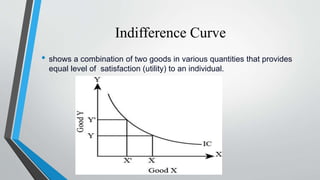
Indifference Curve
• shows a combination of two goods in various quantities that provides
equal level of satisfaction (utility) to an individual.
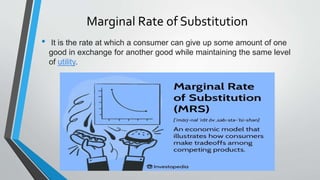
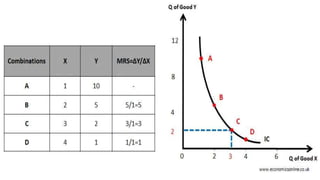
Marginal Rate of Substitution
• It is the rate at which a consumer can give up some amount of one
good in exchange for another good while maintaining the same level
of utility.
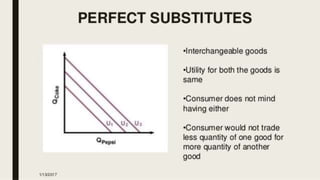
Perfect Substitutes
• We say that two goods are Perfect Substitutes when the Marginal Rate of
Substitution of one for another is a constant.
• Indifference curve describing the trade-off between the consumption of the
goods are straight line.
• The slope of indifference curve need not be -1 in the case of Perfect
Substitutes.
• Elasticity of substitution between them is infinite.
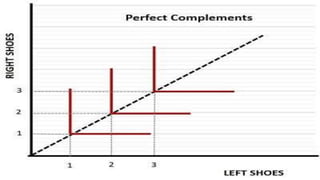
Perfect Complements
• Perfect complements are two goods or services that are
consumed together and are considered inseparable.
• That means they are consumed in fixed proportions.
• Demand for one good is directly linked to the demand for the
other.
• They are the exact opposite of perfect substitutes.
Utility
• Utility is the level of satisfaction a person derives from consuming a
good or service.
• Utility theory explains individuals choices and measures their level of
satisfaction from consuming a good or service.
• The level of satisfaction is measured in unit is called Utils.
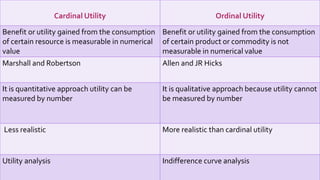
Cardinal Utility Ordinal Utility
Benefit or utility gained from the consumption
of certain resource is measurable in numerical
value
Benefit or utility gained from the consumption
of certain product or commodity is not
measurable in numerical value
Marshall and Robertson Allen and JR Hicks
It is quantitative approach utility can be
measured by number
It is qualitative approach because utility cannot
be measured by number
Less realistic More realistic than cardinal utility
Utility analysis Indifference curve analysis
2. Budget Constraints
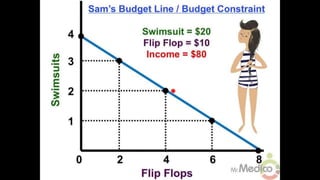
• Budget constraint is the total amount of items you can afford within a
current budget.
• It illustrates the range of choices available within that budget.
• Budget constraint also known as the Budget line.
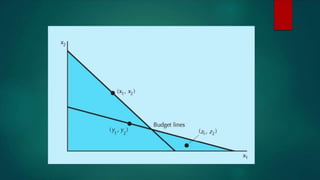
• It is the graphical representation of all possible combinations of two
goods which can be purchased with given income and prices, such
that the cost of each of these combinations is equal to the money
income of the consumer.
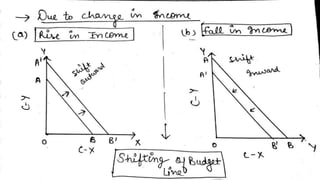
Effects on Budget line when changes in income
• An increase in income will increase the vertical intercept and not affect the slope of
the line.
• Thus an increase in income will result in a parallel shift outward of the budget line.
• Similarly, a decrease in income will cause a parallel shift inward of the Budget line.
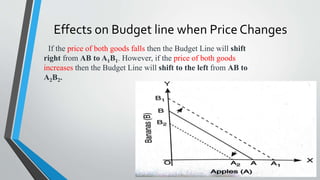
Effects on Budget line when Price Changes
If the price of both goods falls then the Budget Line will shift
right from AB to A1B1. However, if the price of both goods
increases then the Budget Line will shift to the left from AB to
A2B2.
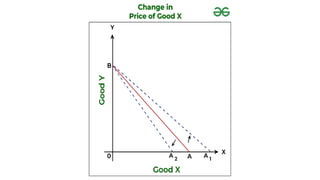
Change in the Price of Commodity on the X-axis
(Good X)
• When the price of Good X falls, then the budget line will rotate to the right
from AB to A1B.
• It means that the new budget line will meet the Y-axis at the same point “B”
because the price of Good Y has not changed.
• however, it will touch the X-axis at point A1, because the consumer can now
buy more units of Good X with his same income level
• Similarly, if the price of Good X rises, then the budget line will rotate to the
left from AB to A2B.
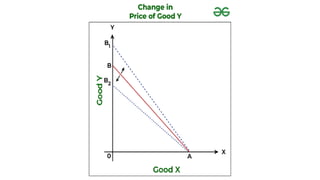
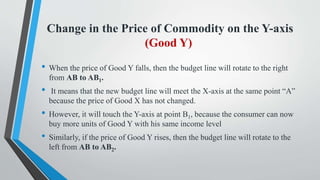
Change in the Price of Commodity on the Y-axis
(Good Y)
• When the price of Good Y falls, then the budget line will rotate to the right
from AB to AB1.
• It means that the new budget line will meet the X-axis at the same point “A”
because the price of Good X has not changed.
• However, it will touch the Y-axis at point B1, because the consumer can now
buy more units of Good Y with his same income level
• Similarly, if the price of Good Y rises, then the budget line will rotate to the
left from AB to AB2.
3. Consumer Choice
• Consumer make this choice in a rational way that they choose goods to
maximize the satisfaction then they can achieve given the limited budget
available to them.
• Maximizing the bundle of goods must satisfy two conditions
1. It must be located on the budget line.
2. It must give the consumer the most preferred combination and services.
REVEALED PREFERENCE
• Introduced by the American economist Paul Samuelson in 1938.
• Consumers' preferences can be revealed by what they purchase
under different circumstances, particularly under different income
and price circumstances.
• It is the direct test of the utility model of preferences.
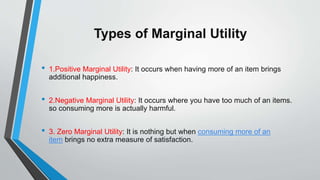
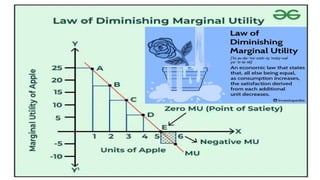
Types of Marginal Utility
• 1.Positive Marginal Utility: It occurs when having more of an item brings
additional happiness.
• 2.Negative Marginal Utility: It occurs where you have too much of an items.
so consuming more is actually harmful.
• 3. Zero Marginal Utility: It is nothing but when consuming more of an
item brings no extra measure of satisfaction.
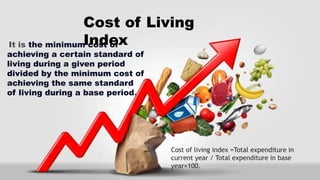
It is the minimum cost of
achieving a certain standard of
living during a given period
divided by the minimum cost of
achieving the same standard
of living during a base period.
Cost of Living
Index
Cost of living index =Total expenditure in
current year / Total expenditure in base
year×100.
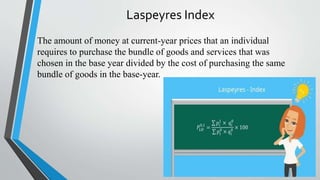
Laspeyres Index
The amount of money at current-year prices that an individual
requires to purchase the bundle of goods and services that was
chosen in the base year divided by the cost of purchasing the same
bundle of goods in the base-year.
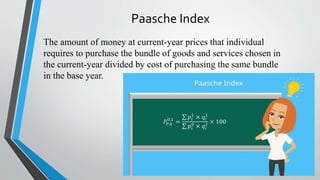
Paasche Index
The amount of money at current-year prices that individual
requires to purchase the bundle of goods and services chosen in
the current-year divided by cost of purchasing the same bundle
in the base year.
Consumer Behavior in agricultural consumption.pptx

Consumer Behavior in agricultural consumption.pptx

  • 2.
    Consumer Behavior • Itis broadly the study of individuals, or organizations and the processes consumers use to search, select, use and dispose of products, services, experience, or ideas to satisfy needs and study of its impact on the consumer and society. • It is best understood in three distinct steps • 1. Consumer Preferences • 2. Budget Constraint • 3. Consumer Choices
  • 3.
    1. Consumer Preferences •It is the judgements and evaluations that consumers make about the products and services available to them, based on factors such as quality, price, convenience, and personal tastes. Basic Assumptions about Preferences • 1. Completeness • 2. Transitivity • 3. More is better than less
  • 4.
    Indifference Curve • showsa combination of two goods in various quantities that provides equal level of satisfaction (utility) to an individual.
  • 6.
    Marginal Rate ofSubstitution • It is the rate at which a consumer can give up some amount of one good in exchange for another good while maintaining the same level of utility.
  • 8.
    Perfect Substitutes • Wesay that two goods are Perfect Substitutes when the Marginal Rate of Substitution of one for another is a constant. • Indifference curve describing the trade-off between the consumption of the goods are straight line. • The slope of indifference curve need not be -1 in the case of Perfect Substitutes. • Elasticity of substitution between them is infinite.
  • 10.
    Perfect Complements • Perfectcomplements are two goods or services that are consumed together and are considered inseparable. • That means they are consumed in fixed proportions. • Demand for one good is directly linked to the demand for the other. • They are the exact opposite of perfect substitutes.
  • 12.
    Utility • Utility isthe level of satisfaction a person derives from consuming a good or service. • Utility theory explains individuals choices and measures their level of satisfaction from consuming a good or service. • The level of satisfaction is measured in unit is called Utils.
  • 13.
    Cardinal Utility OrdinalUtility Benefit or utility gained from the consumption of certain resource is measurable in numerical value Benefit or utility gained from the consumption of certain product or commodity is not measurable in numerical value Marshall and Robertson Allen and JR Hicks It is quantitative approach utility can be measured by number It is qualitative approach because utility cannot be measured by number Less realistic More realistic than cardinal utility Utility analysis Indifference curve analysis
  • 14.
    2. Budget Constraints •Budget constraint is the total amount of items you can afford within a current budget. • It illustrates the range of choices available within that budget. • Budget constraint also known as the Budget line. • It is the graphical representation of all possible combinations of two goods which can be purchased with given income and prices, such that the cost of each of these combinations is equal to the money income of the consumer.
  • 16.
    Effects on Budgetline when changes in income • An increase in income will increase the vertical intercept and not affect the slope of the line. • Thus an increase in income will result in a parallel shift outward of the budget line. • Similarly, a decrease in income will cause a parallel shift inward of the Budget line.
  • 18.
    Effects on Budgetline when Price Changes If the price of both goods falls then the Budget Line will shift right from AB to A1B1. However, if the price of both goods increases then the Budget Line will shift to the left from AB to A2B2.
  • 19.
    Change in thePrice of Commodity on the X-axis (Good X) • When the price of Good X falls, then the budget line will rotate to the right from AB to A1B. • It means that the new budget line will meet the Y-axis at the same point “B” because the price of Good Y has not changed. • however, it will touch the X-axis at point A1, because the consumer can now buy more units of Good X with his same income level • Similarly, if the price of Good X rises, then the budget line will rotate to the left from AB to A2B.
  • 21.
    Change in thePrice of Commodity on the Y-axis (Good Y) • When the price of Good Y falls, then the budget line will rotate to the right from AB to AB1. • It means that the new budget line will meet the X-axis at the same point “A” because the price of Good X has not changed. • However, it will touch the Y-axis at point B1, because the consumer can now buy more units of Good Y with his same income level • Similarly, if the price of Good Y rises, then the budget line will rotate to the left from AB to AB2.
  • 23.
    3. Consumer Choice •Consumer make this choice in a rational way that they choose goods to maximize the satisfaction then they can achieve given the limited budget available to them. • Maximizing the bundle of goods must satisfy two conditions 1. It must be located on the budget line. 2. It must give the consumer the most preferred combination and services.
  • 24.
    REVEALED PREFERENCE • Introducedby the American economist Paul Samuelson in 1938. • Consumers' preferences can be revealed by what they purchase under different circumstances, particularly under different income and price circumstances. • It is the direct test of the utility model of preferences.
  • 27.
    Types of MarginalUtility • 1.Positive Marginal Utility: It occurs when having more of an item brings additional happiness. • 2.Negative Marginal Utility: It occurs where you have too much of an items. so consuming more is actually harmful. • 3. Zero Marginal Utility: It is nothing but when consuming more of an item brings no extra measure of satisfaction.
  • 29.
    It is theminimum cost of achieving a certain standard of living during a given period divided by the minimum cost of achieving the same standard of living during a base period. Cost of Living Index Cost of living index =Total expenditure in current year / Total expenditure in base year×100.
  • 30.
    Laspeyres Index The amountof money at current-year prices that an individual requires to purchase the bundle of goods and services that was chosen in the base year divided by the cost of purchasing the same bundle of goods in the base-year.
  • 31.
    Paasche Index The amountof money at current-year prices that individual requires to purchase the bundle of goods and services chosen in the current-year divided by cost of purchasing the same bundle in the base year.