Consumer Behavior
Consumer Preferences, Budget Constraints, Consumer Choice,
Revealed Preference, Marginal Utility
HSS-01: Economics Lesson: 02
Shopping Time
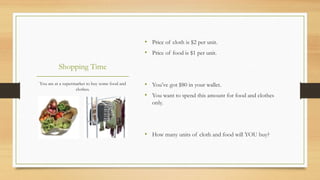
You are at a supermarket to buy some food and
clothes.
• Price of cloth is $2 per unit.
• Price of food is $1 per unit.
• You’ve got $80 in your wallet.
• You want to spend this amount for food and clothes
only.
• How many units of cloth and food will YOU buy?
Shopping Time
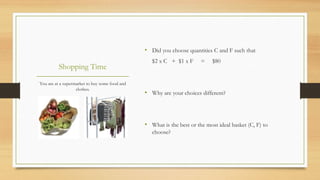
You are at a supermarket to buy some food and
clothes.
• Did you choose quantities C and F such that
$2 x C + $1 x F = $80
• Why are your choices different?
• What is the best or the most ideal basket (C, F) to
choose?
Theory of Consumer Behavior
Description of how consumers allocate incomes among different goods
and services to maximize their wellbeing.
Rational models
More realistic models – behavioral economics
3.1. CONSUMER PREFERENCES
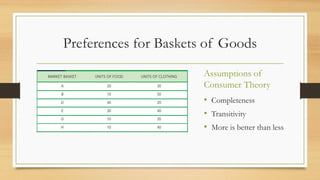
Preferences for Baskets of Goods
Assumptions of
Consumer Theory
• Completeness
• Transitivity
• More is better than less
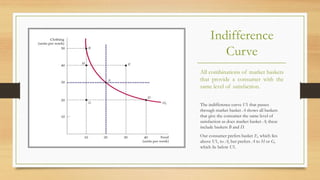
Indifference
Curve
All combinations of market baskets
that provide a consumer with the
same level of satisfaction.
The indifference curve U1 that passes
through market basket A shows all baskets
that give the consumer the same level of
satisfaction as does market basket A; these
include baskets B and D.
Our consumer prefers basket E, which lies
above U1, to A, but prefers A to H or G,
which lie below U1.
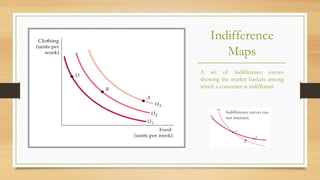
Indifference
Maps
A set of indifference curves
showing the market baskets among
which a consumer is indifferent.
Indifference curves can
not intersect.
Shape of Indifference Curves
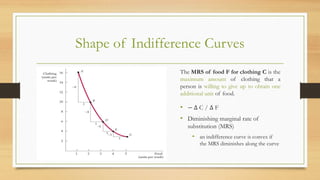
The MRS of food F for clothing C is the
maximum amount of clothing that a
person is willing to give up to obtain one
additional unit of food.
• − ∆ C / ∆ F
• Diminishing marginal rate of
substitution (MRS)
• an indifference curve is convex if
the MRS diminishes along the curve
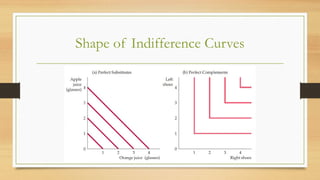
Shape of Indifference Curves
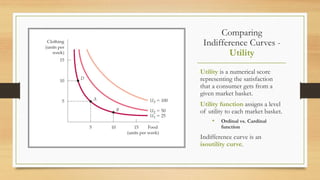
Comparing
Indifference Curves -
Utility
Utility is a numerical score
representing the satisfaction
that a consumer gets from a
given market basket.
Utility function assigns a level
of utility to each market basket.
• Ordinal vs. Cardinal
function
Indifference curve is an
isoutility curve.
3.2. BUDGET CONSTRAINTS
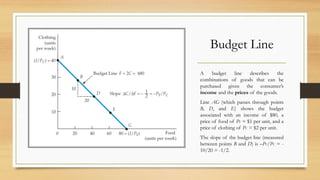
Budget Line
A budget line describes the
combinations of goods that can be
purchased given the consumer’s
income and the prices of the goods.
Line AG (which passes through points
B, D, and E) shows the budget
associated with an income of $80, a
price of food of PF = $1 per unit, and a
price of clothing of PC = $2 per unit.
The slope of the budget line (measured
between points B and D) is –PF/PC = -
10/20 = -1/2.
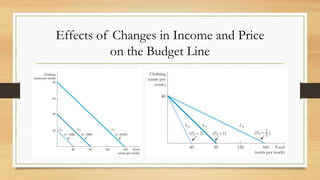
Effects of Changes in Income and Price
on the Budget Line
3.3. CONSUMER CHOICE
How do (rational) consumers choose
a market basket?
Consumers see goods in the market, and have money in the pocket.
A particular consumer therefore chooses a basket
 located on the budget line
 with the highest preference (highest utility)
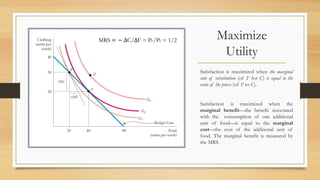
Maximize
Utility
A consumer maximizes satisfaction by
choosing market basket A.
At this point, the budget line and
indifference curve U2 are tangent, and no
higher level of satisfaction (e.g., market
basket D) can be attained.
At A, the point of maximization, the MRS
between the two goods equals the price ratio.
At B, however, because the MRS [-(-10/10)
= 1] is greater than the price ratio (1/2),
satisfaction is not maximized.
MRS = − ∆C/∆F = PF/PC = 1/2
Maximize
Utility
Satisfaction is maximized when the marginal
rate of substitution (of F for C) is equal to the
ratio of the prices (of F to C).
Satisfaction is maximized when the
marginal benefit—the benefit associated
with the consumption of one additional
unit of food—is equal to the marginal
cost—the cost of the additional unit of
food. The marginal benefit is measured by
the MRS.
MRS = − ∆C/∆F = PF/PC = 1/2
Maximize
Utility
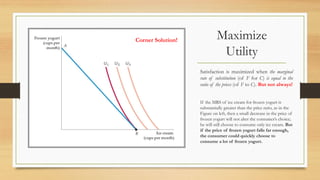
Satisfaction is maximized when the marginal
rate of substitution (of F for C) is equal to the
ratio of the prices (of F to C). But not always!
If the MRS of ice cream for frozen yogurt is
substantially greater than the price ratio, as in the
Figure on left, then a small decrease in the price of
frozen yogurt will not alter the consumer’s choice;
he will still choose to consume only ice cream. But
if the price of frozen yogurt falls far enough,
the consumer could quickly choose to
consume a lot of frozen yogurt.
Corner Solution!
3.4. REVEALED PREFERENCE
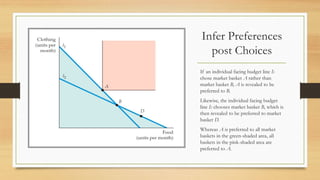
Infer Preferences
post Choices
If an individual facing budget line I1
chose market basket A rather than
market basket B, A is revealed to be
preferred to B.
Likewise, the individual facing budget
line I2 chooses market basket B, which is
then revealed to be preferred to market
basket D.
Whereas A is preferred to all market
baskets in the green-shaded area, all
baskets in the pink-shaded area are
preferred to A.
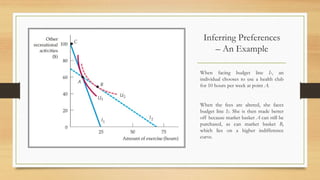
Inferring Preferences
– An Example
When facing budget line I1, an
individual chooses to use a health club
for 10 hours per week at point A.
When the fees are altered, she faces
budget line I2. She is then made better
off because market basket A can still be
purchased, as can market basket B,
which lies on a higher indifference
curve.
3.5. MARGINAL UTILITY
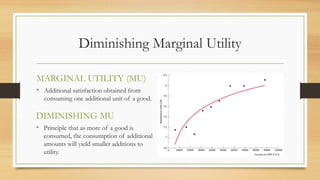
Diminishing Marginal Utility
DIMINISHING MU
• Principle that as more of a good is
consumed, the consumption of additional
amounts will yield smaller additions to
utility.
MARGINAL UTILITY (MU)
• Additional satisfaction obtained from
consuming one additional unit of a good.
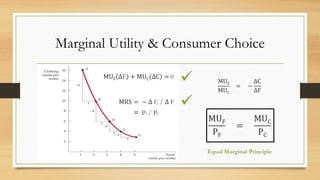
Marginal Utility & Consumer Choice
MRS = − ∆ C / ∆ F
= PF / PC

MUF ∆F + MUC(∆C) = 0
 MUF
MUC
= −
∆C
∆F
MUF
PF
=
MUC
PC
Equal Marginal Principle
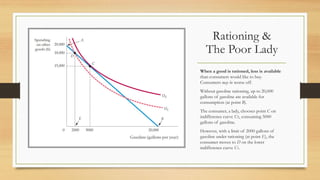
Rationing &
The Poor Lady
When a good is rationed, less is available
than consumers would like to buy.
Consumers may be worse off.
Without gasoline rationing, up to 20,000
gallons of gasoline are available for
consumption (at point B).
The consumer, a lady, chooses point C on
indifference curve U2, consuming 5000
gallons of gasoline.
However, with a limit of 2000 gallons of
gasoline under rationing (at point E), the
consumer moves to D on the lower
indifference curve U1.
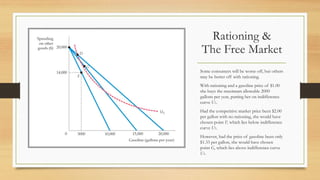
Rationing &
The Free Market
Some consumers will be worse off, but others
may be better off with rationing.
With rationing and a gasoline price of $1.00
she buys the maximum allowable 2000
gallons per year, putting her on indifference
curve U1.
Had the competitive market price been $2.00
per gallon with no rationing, she would have
chosen point F, which lies below indifference
curve U1.
However, had the price of gasoline been only
$1.33 per gallon, she would have chosen
point G, which lies above indifference curve
U1.

LESSON_02_consumer-beh.pdf

  • 1.
    Consumer Behavior Consumer Preferences,Budget Constraints, Consumer Choice, Revealed Preference, Marginal Utility HSS-01: Economics Lesson: 02
  • 2.
    Shopping Time You areat a supermarket to buy some food and clothes. • Price of cloth is $2 per unit. • Price of food is $1 per unit. • You’ve got $80 in your wallet. • You want to spend this amount for food and clothes only. • How many units of cloth and food will YOU buy?
  • 3.
    Shopping Time You areat a supermarket to buy some food and clothes. • Did you choose quantities C and F such that $2 x C + $1 x F = $80 • Why are your choices different? • What is the best or the most ideal basket (C, F) to choose?
  • 4.
    Theory of ConsumerBehavior Description of how consumers allocate incomes among different goods and services to maximize their wellbeing. Rational models More realistic models – behavioral economics
  • 5.
  • 6.
    Preferences for Basketsof Goods Assumptions of Consumer Theory • Completeness • Transitivity • More is better than less
  • 7.
    Indifference Curve All combinations ofmarket baskets that provide a consumer with the same level of satisfaction. The indifference curve U1 that passes through market basket A shows all baskets that give the consumer the same level of satisfaction as does market basket A; these include baskets B and D. Our consumer prefers basket E, which lies above U1, to A, but prefers A to H or G, which lie below U1.
  • 8.
    Indifference Maps A set ofindifference curves showing the market baskets among which a consumer is indifferent. Indifference curves can not intersect.
  • 9.
    Shape of IndifferenceCurves The MRS of food F for clothing C is the maximum amount of clothing that a person is willing to give up to obtain one additional unit of food. • − ∆ C / ∆ F • Diminishing marginal rate of substitution (MRS) • an indifference curve is convex if the MRS diminishes along the curve
  • 10.
  • 11.
    Comparing Indifference Curves - Utility Utilityis a numerical score representing the satisfaction that a consumer gets from a given market basket. Utility function assigns a level of utility to each market basket. • Ordinal vs. Cardinal function Indifference curve is an isoutility curve.
  • 12.
  • 13.
    Budget Line A budgetline describes the combinations of goods that can be purchased given the consumer’s income and the prices of the goods. Line AG (which passes through points B, D, and E) shows the budget associated with an income of $80, a price of food of PF = $1 per unit, and a price of clothing of PC = $2 per unit. The slope of the budget line (measured between points B and D) is –PF/PC = - 10/20 = -1/2.
  • 14.
    Effects of Changesin Income and Price on the Budget Line
  • 15.
  • 16.
    How do (rational)consumers choose a market basket? Consumers see goods in the market, and have money in the pocket. A particular consumer therefore chooses a basket  located on the budget line  with the highest preference (highest utility)
  • 17.
    Maximize Utility A consumer maximizessatisfaction by choosing market basket A. At this point, the budget line and indifference curve U2 are tangent, and no higher level of satisfaction (e.g., market basket D) can be attained. At A, the point of maximization, the MRS between the two goods equals the price ratio. At B, however, because the MRS [-(-10/10) = 1] is greater than the price ratio (1/2), satisfaction is not maximized. MRS = − ∆C/∆F = PF/PC = 1/2
  • 18.
    Maximize Utility Satisfaction is maximizedwhen the marginal rate of substitution (of F for C) is equal to the ratio of the prices (of F to C). Satisfaction is maximized when the marginal benefit—the benefit associated with the consumption of one additional unit of food—is equal to the marginal cost—the cost of the additional unit of food. The marginal benefit is measured by the MRS. MRS = − ∆C/∆F = PF/PC = 1/2
  • 19.
    Maximize Utility Satisfaction is maximizedwhen the marginal rate of substitution (of F for C) is equal to the ratio of the prices (of F to C). But not always! If the MRS of ice cream for frozen yogurt is substantially greater than the price ratio, as in the Figure on left, then a small decrease in the price of frozen yogurt will not alter the consumer’s choice; he will still choose to consume only ice cream. But if the price of frozen yogurt falls far enough, the consumer could quickly choose to consume a lot of frozen yogurt. Corner Solution!
  • 20.
  • 21.
    Infer Preferences post Choices Ifan individual facing budget line I1 chose market basket A rather than market basket B, A is revealed to be preferred to B. Likewise, the individual facing budget line I2 chooses market basket B, which is then revealed to be preferred to market basket D. Whereas A is preferred to all market baskets in the green-shaded area, all baskets in the pink-shaded area are preferred to A.
  • 22.
    Inferring Preferences – AnExample When facing budget line I1, an individual chooses to use a health club for 10 hours per week at point A. When the fees are altered, she faces budget line I2. She is then made better off because market basket A can still be purchased, as can market basket B, which lies on a higher indifference curve.
  • 23.
  • 24.
    Diminishing Marginal Utility DIMINISHINGMU • Principle that as more of a good is consumed, the consumption of additional amounts will yield smaller additions to utility. MARGINAL UTILITY (MU) • Additional satisfaction obtained from consuming one additional unit of a good.
  • 25.
    Marginal Utility &Consumer Choice MRS = − ∆ C / ∆ F = PF / PC  MUF ∆F + MUC(∆C) = 0  MUF MUC = − ∆C ∆F MUF PF = MUC PC Equal Marginal Principle
  • 26.
    Rationing & The PoorLady When a good is rationed, less is available than consumers would like to buy. Consumers may be worse off. Without gasoline rationing, up to 20,000 gallons of gasoline are available for consumption (at point B). The consumer, a lady, chooses point C on indifference curve U2, consuming 5000 gallons of gasoline. However, with a limit of 2000 gallons of gasoline under rationing (at point E), the consumer moves to D on the lower indifference curve U1.
  • 27.
    Rationing & The FreeMarket Some consumers will be worse off, but others may be better off with rationing. With rationing and a gasoline price of $1.00 she buys the maximum allowable 2000 gallons per year, putting her on indifference curve U1. Had the competitive market price been $2.00 per gallon with no rationing, she would have chosen point F, which lies below indifference curve U1. However, had the price of gasoline been only $1.33 per gallon, she would have chosen point G, which lies above indifference curve U1.