Chapter Three Software: The Essence of Computers“The number one benefit of information technology is that it empowers people to do what they want to do. It lets people be creative. It lets people be productive. It lets people learn things they didn't think they could learn before, and so in a sense it is all about potential.” Steve Ballmer, CEO, Microsoft Corporation
Chapter Three OutlineSoftware
Operating Systems
Customized Software
Software Quality
Word Processing
Electronic Spreadsheet
Database Software
Presentation Graphics
Integrated and Workflow Software
Unleashing Executive BrainpowerPressman:	“Software is (1) instructions (computer programs) that when executed provide desired features, function, and performance; (2) data structures that enable the programs to adequately manipulate information; and (3) documents that describer the operation and use of the programs.”Sommerville:	“Computer programs and associated documentation. Software products may be developed for a particular customer or may be developed for a general market.”What is software?
Software is developed or engineered; it is not manufactured in the classical sense.The cost of developing software is focused in engineering process, so the software project cant be managed as in manufacturing projectSoftware doesn’t “wear out”.
Although the industry is moving toward component-based construction, most software continues to be custombuilt. a software component should be designed and implemented so that it can be reused.Software Characteristic
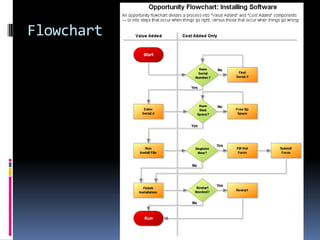
SoftwareSoftware: The computer programs that control the electronic hardware and perform processing tasks for the user.  There are two types of software: operatingsystem, a master control program informing the computer how to function, and application, used for performing general-purpose (e.g., word processing) and industry-specific (e.g., inventory control, accounting, sales and marketing, table management, etc.)  tasks.Programmers: The creators of software who are responsible for designing, coding, debugging, and documenting computer programs. Programming Languages:  Software programs are written or coded using a particular language, such as COBOL, Java, and C++. Flowchart:  A diagram showing how a program works . It also used to understand, evaluate, and design information systems. Click on this Video Link: A demo of  Microsoft Visio 2007 that helps IT and business professionals visualize systems and processes.© 2008 Jupiter Images Corporation
Flowchart
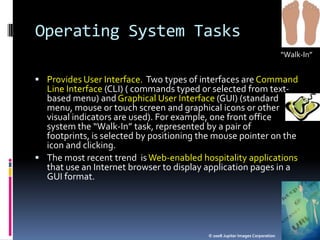
Operating System Tasks“Walk-In”Provides User Interface.  Two types of interfaces are Command Line Interface (CLI) ( commands typed or selected from text-based menu) and Graphical User Interface (GUI) (standard menu, mouse or touch screen and graphical icons or other visual indicators are used). For example, one front office system the “Walk-In” task, represented by a pair of footprints, is selected by positioning the mouse pointer on the icon and clicking. The most recent trend  is Web-enabled hospitality applications that use an Internet browser to display application pages in a GUI format. © 2008 Jupiter Images Corporation
Operating System TasksManages the  File System.  Groups data into logical compartments for storage on the disk, which is filled with directories (file cabinets) and  subdirectories (drawers) where files (folders) are kept.  Files are kept organized by using a consistent naming scheme that is understandable and easily remembered by users (e.g., short, common names) and storing related files in the same directory. Windows Vista offers an “Instant Search Function” within the Explorer window to locate files difficult to find.  This allows users to search for files by extensions (e.g., abc.doc where “doc” is the extension), filenames (abc.doc), or keywords within the documents.© 2008 Jupiter Images Corporation
Operating System Tasks© 2008 Jupiter Images CorporationManages the  Hardware. The operating system acts as the intermediary between the programs and hardware. For example, when a printer (e.g., Hewlett Packard Color Laserjet) is added in Windows, it is automatically accessible in all other programs.
Operating System TasksSupports Other Programs. The operating system acts as the intermediary between the programs and hardware. For example, when a user requests a word processing program to list word processing document files available on the USB flash drive,  it calls on the operating system to perform this task.
Operating SystemsOperating System Types: Although Windows and its predecessor, DOS, have dominated the hospitality computer market, Unix and Linux are gaining in popularity due to their power, flexibility, and portability.  Unlike Windows and DOS, Unix and Linux are based on open standards like the Internet, allowing them to run on virtually any computer.  Click on this Video Link: Dell - Linux 101.
Selecting an Operating System: A key consideration when selecting an operating system is the availability of the application. For example, a restaurant company selected Linux, a free operating system similar to Unix, because the software license fees and the computing costs were lower than other operating systems.   It took the restaurant, however, five years to find a suitable Linux point of sale solution, a key application in any restaurant operation.       Linux  Mascot© 2008 Jupiter Images Corporation
Customized SoftwareSoftware development has not been able to satisfy the demand for custom software. Consequently, most hospitality users rely on prepackaged business applications.Hospitality  vendors are now designing software programs to provide customizable screens, reports, menus, and user interfaces.  Click on this Video Link: A discussion on creating customized solutions for restaurants. In 1920, it was predicted that every man, woman, and child would have to be a telephone operator by 1960 to accommodate people using telephones. Oddly enough, this became a reality because telephones were created that everyone could easily afford, understand, and operate. Likewise, future computer operators will begin to look more and more like programmers equipped with sophisticated tools allowing programs to be expeditiously created and modified with use. Exciting developments are on the horizon where end-users will play an integral role in the reaching the next stage of the software revolution. Example: MARSHA, HOLIDEX, OnQ
Software Quality - FURPS© 2008 Jupiter Images Corporation Functionality – Refers to program capabilities and features. Functional  software  helps employees to do their  jobs quickly and easily and  to provide consistent, responsive, and quality customer service. Click on this Video Link: An Orbitz systems analyst  discussed  the importance of functional Web sites and applications. Usability – Refers to the “user-friendliness” of software. Friendly software is adaptable, understandable, predictable, responsive, self-explanatory, forgiving,  efficient, and flexible.  Due to the high turnover rate there are  many naïve (lacks hospitality and computer experience) and novice  users ( hospitality experience with some computer experience).  This  precludes a direct command system (e.g., select  guest checkout function key F1) and requires  a menu command system where the user is presented with a list  of choices and  prompts.   Some hospitality programs have incorporated both a menu and direct command system to accommodate all users: naïve, novice, and competent/expert users (have solid computer and hospitality experience). Click on this Video Link:  Microsoft founder Bill Gates discusses the importance of usability and  how the human-computer interface has evolved.
Software Quality - FURPSUsability PrinciplesProvides self-explanatory choices.Information is presented in organized fashion allowing the user to quickly spot the appropriate command or choice.Screen layouts are carefully formatted  with appropriate font sizes and colors and not too much information. Task and key descriptions are precisely defined and easily understood.Related tasks are grouped together  Tasks should also be grouped according to their sequence of use, frequency of use, function, and importance.The user always know where he or she is located in the program.The system keeps the user informed of system status and when problems are encountered.The system responds to user requests within 10 seconds.Task  and keyboard/input  definitions are consistent throughout the program.Uses appropriate color combinations.
Software Quality - FURPSReliability – Refers to the number of software defects or errors.  Click on this Video Link: Troubleshooting software errors.  A reliable program produces accurate information and provides the ability to quickly recover from software errors without jeopardizing the integrity of files. Click on this Video Link: Testing for software bugs.
Performance –  Refers to program speed and response time.  A front office program requiring a user to execute eight steps to print a guest folio impedes organizational  efficiency and customer service.
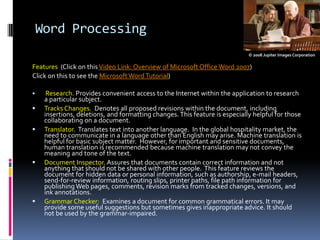
Supportability – Refers to the ability to service and maintain a program. Reputable software vendors have well-trained customer support staffs.Word ProcessingFeatures  (Click on this Video Link: Overview of Microsoft Office Word 2007)Click on this to see the Microsoft Word Tutorial)Research. Provides convenient access to the Internet within the application to research a particular subject.  Tracks Changes.  Denotes all proposed revisions within the document, including insertions, deletions, and formatting changes. This feature is especially helpful for those collaborating on a document.Translator.  Translates text into another language.  In the global hospitality market, the need to communicate in a language other than English may arise. Machine translation is helpful for basic subject matter.  However, for important and sensitive documents, human translation is recommended because machine translation may not convey the meaning and tone of the text. Document Inspector. Assures that documents contain correct information and not anything that should not be shared with other people.  This feature reviews the document for hidden data or personal information, such as authorship, e-mail headers, send-for-review information, routing slips, printer paths, file path information for publishing Web pages, comments, revision marks from tracked changes, versions, and ink annotations. Grammar Checker:  Examines a document for common grammatical errors. It may provide some useful suggestions but sometimes gives inappropriate advice. It should not be used by the grammar-impaired.© 2008 Jupiter Images Corporation
Word ProcessingFeaturesSpell Checker. Identifies misspelled words, typos, repeated words (e.g., from from) and incorrect capitalization (fFrom). Spell checkers contain over 400,000 words and frequently flag correctly spelled words. Dictionaries can be selected based on the target audience (e.g., British). Words not found can be added to the spell checker’s custom dictionary. It is important to remember that spell check does not replace good proofreading.
Auto-Check. Automatically corrects misspelled words.
Aut0-Summarize. Identifies  the key points in a  document and creates a summary for others to read
Style Checker.  Checks a document for readability. For example, a  Hemingway short story is written at a fifth grade level according to one style checker.
Thesaurus. Suggest synonyms for any word. It is best to choose simple words.
Other Features. These programs can create watermarks (e.g., confidential appears in the background on each page), visible and invisible digital signatures, multicolumn documents, and the automatic generation of indexes and tables of content.  They enable the insertion of graphics, video clips, sound files, charts, and illustrations to grab the reader’s attention. They can do equation editing, drawing, and mail merges, the combining of names and addresses with a form letter. Mail merge, for example, can be used to personalize e-mail newsletters by inserting each contact’s first and last name at a designated point in the e-mail.  Word ProcessingFeaturesDesk Top Publishing. Since word processors can merge text and graphics on the same page, they can do basic desk top publishing,  an inexpensive production system for generating typesetting quality text and graphics.  A word processing program can efficiently create a five-page newsletter or a simple brochure with only a few graphics.
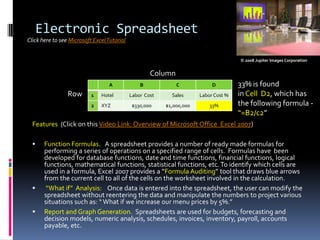
Multiple Views. For example, a document can be viewed in a number of different ways in MS Word 2007. The “Outline View” shows the structure of the document, enabling the user to rearrange content by clicking and dragging content to new locations. To check through a document quickly, the user may either select a “Draft View,” which hides images and graphics, or a “Full Screen Reading View,” which displays two pages of the document at a time. The “Web Layout” view displays the document as if it were an online document.  Electronic SpreadsheetClick here to see Microsoft Excel Tutorial                      RowFeatures  (Click on this Video Link: Overview of Microsoft Office  Excel 2007)Function Formulas.   A spreadsheet provides a number of ready made formulas for performing a series of operations on a specified range of cells.  Formulas have  been developed for database functions, date and time functions, financial functions, logical functions, mathematical functions, statistical functions, etc. To identify which cells are used in a formula, Excel 2007 provides a “Formula Auditing” tool that draws blue arrows from the current cell to all of the cells on the worksheet involved in the calculation.
“What if”  Analysis:    Once data is entered into the spreadsheet, the user can modify the spreadsheet without reentering the data and manipulate the numbers to project various situations such as: “ What if we increase our menu prices by 5%.”
Report and Graph Generation.  Spreadsheets are used for budgets, forecasting and decision models, numeric analysis, schedules, invoices, inventory, payroll, accounts payable, etc. © 2008 Jupiter Images CorporationColumn  33% is foundin Cell  D2, which hasthe following formula -“=B2/c2”
Electronic SpreadsheetFeaturesNaming Function.  This feature enables the user to name  a cell (or range of cells) that can be referenced in a formula (e.g.,  +A1*markup rate).  Referring to a cell by a name, rather than by the cell location, also makes reading, constructing, and debugging formulas far easier.

Chapter 3

  • 1.
    Chapter Three Software:The Essence of Computers“The number one benefit of information technology is that it empowers people to do what they want to do. It lets people be creative. It lets people be productive. It lets people learn things they didn't think they could learn before, and so in a sense it is all about potential.” Steve Ballmer, CEO, Microsoft Corporation
  • 2.
  • 3.
  • 4.
  • 5.
  • 6.
  • 7.
  • 8.
  • 9.
  • 10.
  • 11.
    Unleashing Executive BrainpowerPressman: “Softwareis (1) instructions (computer programs) that when executed provide desired features, function, and performance; (2) data structures that enable the programs to adequately manipulate information; and (3) documents that describer the operation and use of the programs.”Sommerville: “Computer programs and associated documentation. Software products may be developed for a particular customer or may be developed for a general market.”What is software?
  • 12.
    Software is developedor engineered; it is not manufactured in the classical sense.The cost of developing software is focused in engineering process, so the software project cant be managed as in manufacturing projectSoftware doesn’t “wear out”.
  • 13.
    Although the industryis moving toward component-based construction, most software continues to be custombuilt. a software component should be designed and implemented so that it can be reused.Software Characteristic
  • 14.
    SoftwareSoftware: The computerprograms that control the electronic hardware and perform processing tasks for the user. There are two types of software: operatingsystem, a master control program informing the computer how to function, and application, used for performing general-purpose (e.g., word processing) and industry-specific (e.g., inventory control, accounting, sales and marketing, table management, etc.) tasks.Programmers: The creators of software who are responsible for designing, coding, debugging, and documenting computer programs. Programming Languages: Software programs are written or coded using a particular language, such as COBOL, Java, and C++. Flowchart: A diagram showing how a program works . It also used to understand, evaluate, and design information systems. Click on this Video Link: A demo of Microsoft Visio 2007 that helps IT and business professionals visualize systems and processes.© 2008 Jupiter Images Corporation
  • 15.
  • 16.
    Operating System Tasks“Walk-In”ProvidesUser Interface. Two types of interfaces are Command Line Interface (CLI) ( commands typed or selected from text-based menu) and Graphical User Interface (GUI) (standard menu, mouse or touch screen and graphical icons or other visual indicators are used). For example, one front office system the “Walk-In” task, represented by a pair of footprints, is selected by positioning the mouse pointer on the icon and clicking. The most recent trend is Web-enabled hospitality applications that use an Internet browser to display application pages in a GUI format. © 2008 Jupiter Images Corporation
  • 17.
    Operating System TasksManagesthe File System. Groups data into logical compartments for storage on the disk, which is filled with directories (file cabinets) and subdirectories (drawers) where files (folders) are kept. Files are kept organized by using a consistent naming scheme that is understandable and easily remembered by users (e.g., short, common names) and storing related files in the same directory. Windows Vista offers an “Instant Search Function” within the Explorer window to locate files difficult to find. This allows users to search for files by extensions (e.g., abc.doc where “doc” is the extension), filenames (abc.doc), or keywords within the documents.© 2008 Jupiter Images Corporation
  • 18.
    Operating System Tasks©2008 Jupiter Images CorporationManages the Hardware. The operating system acts as the intermediary between the programs and hardware. For example, when a printer (e.g., Hewlett Packard Color Laserjet) is added in Windows, it is automatically accessible in all other programs.
  • 19.
    Operating System TasksSupportsOther Programs. The operating system acts as the intermediary between the programs and hardware. For example, when a user requests a word processing program to list word processing document files available on the USB flash drive, it calls on the operating system to perform this task.
  • 20.
    Operating SystemsOperating SystemTypes: Although Windows and its predecessor, DOS, have dominated the hospitality computer market, Unix and Linux are gaining in popularity due to their power, flexibility, and portability. Unlike Windows and DOS, Unix and Linux are based on open standards like the Internet, allowing them to run on virtually any computer. Click on this Video Link: Dell - Linux 101.
  • 21.
    Selecting an OperatingSystem: A key consideration when selecting an operating system is the availability of the application. For example, a restaurant company selected Linux, a free operating system similar to Unix, because the software license fees and the computing costs were lower than other operating systems. It took the restaurant, however, five years to find a suitable Linux point of sale solution, a key application in any restaurant operation. Linux Mascot© 2008 Jupiter Images Corporation
  • 22.
    Customized SoftwareSoftware developmenthas not been able to satisfy the demand for custom software. Consequently, most hospitality users rely on prepackaged business applications.Hospitality vendors are now designing software programs to provide customizable screens, reports, menus, and user interfaces. Click on this Video Link: A discussion on creating customized solutions for restaurants. In 1920, it was predicted that every man, woman, and child would have to be a telephone operator by 1960 to accommodate people using telephones. Oddly enough, this became a reality because telephones were created that everyone could easily afford, understand, and operate. Likewise, future computer operators will begin to look more and more like programmers equipped with sophisticated tools allowing programs to be expeditiously created and modified with use. Exciting developments are on the horizon where end-users will play an integral role in the reaching the next stage of the software revolution. Example: MARSHA, HOLIDEX, OnQ
  • 23.
    Software Quality -FURPS© 2008 Jupiter Images Corporation Functionality – Refers to program capabilities and features. Functional software helps employees to do their jobs quickly and easily and to provide consistent, responsive, and quality customer service. Click on this Video Link: An Orbitz systems analyst discussed the importance of functional Web sites and applications. Usability – Refers to the “user-friendliness” of software. Friendly software is adaptable, understandable, predictable, responsive, self-explanatory, forgiving, efficient, and flexible. Due to the high turnover rate there are many naïve (lacks hospitality and computer experience) and novice users ( hospitality experience with some computer experience). This precludes a direct command system (e.g., select guest checkout function key F1) and requires a menu command system where the user is presented with a list of choices and prompts. Some hospitality programs have incorporated both a menu and direct command system to accommodate all users: naïve, novice, and competent/expert users (have solid computer and hospitality experience). Click on this Video Link: Microsoft founder Bill Gates discusses the importance of usability and how the human-computer interface has evolved.
  • 24.
    Software Quality -FURPSUsability PrinciplesProvides self-explanatory choices.Information is presented in organized fashion allowing the user to quickly spot the appropriate command or choice.Screen layouts are carefully formatted with appropriate font sizes and colors and not too much information. Task and key descriptions are precisely defined and easily understood.Related tasks are grouped together Tasks should also be grouped according to their sequence of use, frequency of use, function, and importance.The user always know where he or she is located in the program.The system keeps the user informed of system status and when problems are encountered.The system responds to user requests within 10 seconds.Task and keyboard/input definitions are consistent throughout the program.Uses appropriate color combinations.
  • 25.
    Software Quality -FURPSReliability – Refers to the number of software defects or errors. Click on this Video Link: Troubleshooting software errors. A reliable program produces accurate information and provides the ability to quickly recover from software errors without jeopardizing the integrity of files. Click on this Video Link: Testing for software bugs.
  • 26.
    Performance – Refers to program speed and response time. A front office program requiring a user to execute eight steps to print a guest folio impedes organizational efficiency and customer service.
  • 27.
    Supportability – Refersto the ability to service and maintain a program. Reputable software vendors have well-trained customer support staffs.Word ProcessingFeatures (Click on this Video Link: Overview of Microsoft Office Word 2007)Click on this to see the Microsoft Word Tutorial)Research. Provides convenient access to the Internet within the application to research a particular subject. Tracks Changes. Denotes all proposed revisions within the document, including insertions, deletions, and formatting changes. This feature is especially helpful for those collaborating on a document.Translator. Translates text into another language. In the global hospitality market, the need to communicate in a language other than English may arise. Machine translation is helpful for basic subject matter. However, for important and sensitive documents, human translation is recommended because machine translation may not convey the meaning and tone of the text. Document Inspector. Assures that documents contain correct information and not anything that should not be shared with other people. This feature reviews the document for hidden data or personal information, such as authorship, e-mail headers, send-for-review information, routing slips, printer paths, file path information for publishing Web pages, comments, revision marks from tracked changes, versions, and ink annotations. Grammar Checker: Examines a document for common grammatical errors. It may provide some useful suggestions but sometimes gives inappropriate advice. It should not be used by the grammar-impaired.© 2008 Jupiter Images Corporation
  • 28.
    Word ProcessingFeaturesSpell Checker.Identifies misspelled words, typos, repeated words (e.g., from from) and incorrect capitalization (fFrom). Spell checkers contain over 400,000 words and frequently flag correctly spelled words. Dictionaries can be selected based on the target audience (e.g., British). Words not found can be added to the spell checker’s custom dictionary. It is important to remember that spell check does not replace good proofreading.
  • 29.
  • 30.
    Aut0-Summarize. Identifies the key points in a document and creates a summary for others to read
  • 31.
    Style Checker. Checks a document for readability. For example, a Hemingway short story is written at a fifth grade level according to one style checker.
  • 32.
    Thesaurus. Suggest synonymsfor any word. It is best to choose simple words.
  • 33.
    Other Features. Theseprograms can create watermarks (e.g., confidential appears in the background on each page), visible and invisible digital signatures, multicolumn documents, and the automatic generation of indexes and tables of content. They enable the insertion of graphics, video clips, sound files, charts, and illustrations to grab the reader’s attention. They can do equation editing, drawing, and mail merges, the combining of names and addresses with a form letter. Mail merge, for example, can be used to personalize e-mail newsletters by inserting each contact’s first and last name at a designated point in the e-mail. Word ProcessingFeaturesDesk Top Publishing. Since word processors can merge text and graphics on the same page, they can do basic desk top publishing, an inexpensive production system for generating typesetting quality text and graphics. A word processing program can efficiently create a five-page newsletter or a simple brochure with only a few graphics.
  • 34.
    Multiple Views. Forexample, a document can be viewed in a number of different ways in MS Word 2007. The “Outline View” shows the structure of the document, enabling the user to rearrange content by clicking and dragging content to new locations. To check through a document quickly, the user may either select a “Draft View,” which hides images and graphics, or a “Full Screen Reading View,” which displays two pages of the document at a time. The “Web Layout” view displays the document as if it were an online document. Electronic SpreadsheetClick here to see Microsoft Excel Tutorial RowFeatures (Click on this Video Link: Overview of Microsoft Office Excel 2007)Function Formulas. A spreadsheet provides a number of ready made formulas for performing a series of operations on a specified range of cells. Formulas have been developed for database functions, date and time functions, financial functions, logical functions, mathematical functions, statistical functions, etc. To identify which cells are used in a formula, Excel 2007 provides a “Formula Auditing” tool that draws blue arrows from the current cell to all of the cells on the worksheet involved in the calculation.
  • 35.
    “What if” Analysis: Once data is entered into the spreadsheet, the user can modify the spreadsheet without reentering the data and manipulate the numbers to project various situations such as: “ What if we increase our menu prices by 5%.”
  • 36.
    Report and GraphGeneration. Spreadsheets are used for budgets, forecasting and decision models, numeric analysis, schedules, invoices, inventory, payroll, accounts payable, etc. © 2008 Jupiter Images CorporationColumn 33% is foundin Cell D2, which hasthe following formula -“=B2/c2”
  • 37.
    Electronic SpreadsheetFeaturesNaming Function. This feature enables the user to name a cell (or range of cells) that can be referenced in a formula (e.g., +A1*markup rate). Referring to a cell by a name, rather than by the cell location, also makes reading, constructing, and debugging formulas far easier.