Gartner’s Data Analytics
Maturity Model
By: Faizan Irshad
Background
 Gartner's Data Analytics Maturity Model is a framework developed by Gartner, Inc., a
leading research and advisory company specializing in information technology (IT)
and business-related insights.
 This model is one of many frameworks developed by Gartner to help organizations
assess and improve their capabilities in various areas, including data analytics,
business intelligence, and digital transformation.
 It provides a structured approach to understand where an organization stands in terms
of its data analytics capabilities and how it can progress to more advanced stages.
 The model typically consists of several stages or levels, each representing a different
level of maturity in data analytics practices.
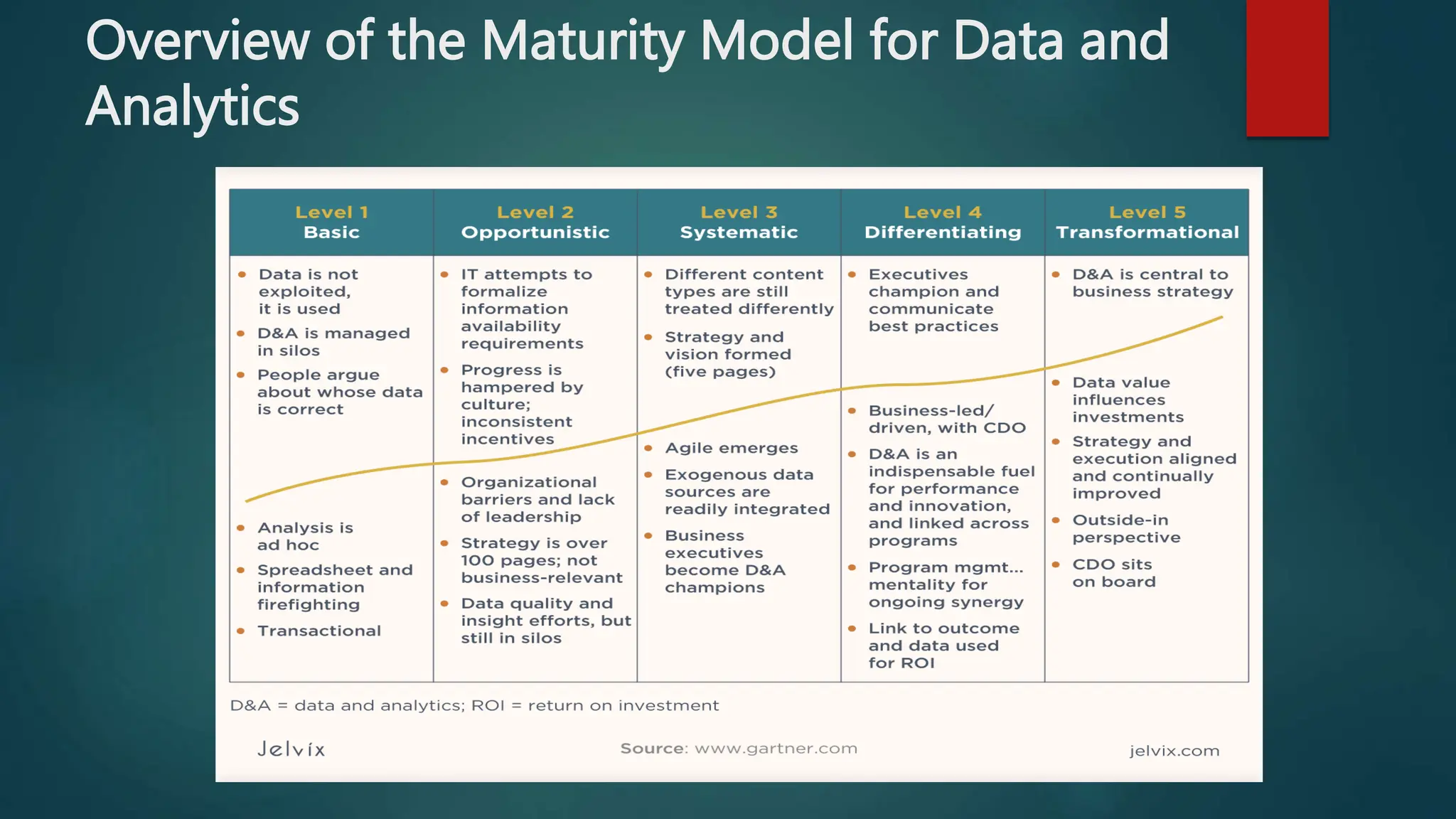
Overview of the Maturity Model for Data and
Analytics
Phases of Gartner’s Data Analytics Maturity
Model
This model consists of the following four phases:
 Descriptive Analytics
 Diagnostic Analytics
 Predictive Analytics
 Prescriptive Analytics
Descriptive Analytics
This is the first phase and addresses the question, “ What happened” in the past using
historical data. For example:
 “How many iPhones did Apple Stores in the city of New York sell last month?”
 “How many customers downloaded the newly launched health app from the play
store yesterday?”
 “How many customers visited the store in the last 3 days of the SALE?”
 “What are the regions which have less than 20% coverage of COVID-19 vaccination
program?
Diagnostic Analytics
This phase is the next advancement in the adoption of Analytics and addresses the question,
“Why did it happen”.
The Diagnostic Analysis focuses on deriving the hidden insights from the data which are not
captured during the Descriptive Analytics phase. You can find answers to the following questions:
 “Is there an impact of gender on the sale of the newly launched iPhone 12?”
 “Does plant operations costs differ across the two locations significantly?”
 “Is there a positive relationship between the age and the sales revenue from the protein
bars?”
 “Which of the following factors are responsible for the increase in the number of COVID-19
fatalities in the state — Age, comorbidity, the number of vaccination doses administered,
gender, and lifestyle?”
 You can also perform various hypothesis tests to prove/disprove your assumptions using
statistical tests such as t-tests, ANOVA, Chi-square tests.
Predictive Analytics
 This is an advanced phase of analytics that focuses on data mining and uses various
advanced analytics techniques such as machine learning, and artificial intelligence to
build models that make predictions by using historical data. This phase addresses the
question, “What will happen in the future”.
 Predictive analytics studies the hidden pattern in the data and establishes the
relationship between the outcome variable and the predictor variables to build a
mathematical/statistical model which can be used to predict the outcome variable for
new data.
 Predictive Analytics helps automate the decision making process using these models
that foresee the future and equip you with the right information to take the right
actions.
Predictive Analytics
In this phase, you will be able to find answers to the following type of questions:
 “How many iPhone 12 smart phones will I be able to sell in the next month?”
 “Will John purchase the new car in next quarter and do I need to follow-up with
him and add him to the list of prospective customers for next month?”
 “What is the probability of students taking admission in college if Data Analytics
course is offered in morning timings?”
 “Is the color of the suit preferred by middle-aged men (35–50 years) in London
dark-grey?”
Prescriptive Analytics
The next advanced level in Analytics is Prescriptive Analytics which addresses the question
“How can I achieve it? — What should be done ?”.
Prescriptive analytics enables you to choose the optimal analytics solution to solve the
business problem by enabling you to evaluate various mathematical models, compare their
performance on the available data for a specific industry, and pick the most optimal
solution.
In this phase of analytics, you can get answers to the following types of questions:
 “How much ground staff will I need to operate the volume of passengers on 25-Dec in
Lahore?”
 “Which are the top 3 combo offers that will boost the staple sales in next month?”
 “In which Cafe-Coffee Day outlets across Pakistan should I open the mini book stores to
do a cross selling?
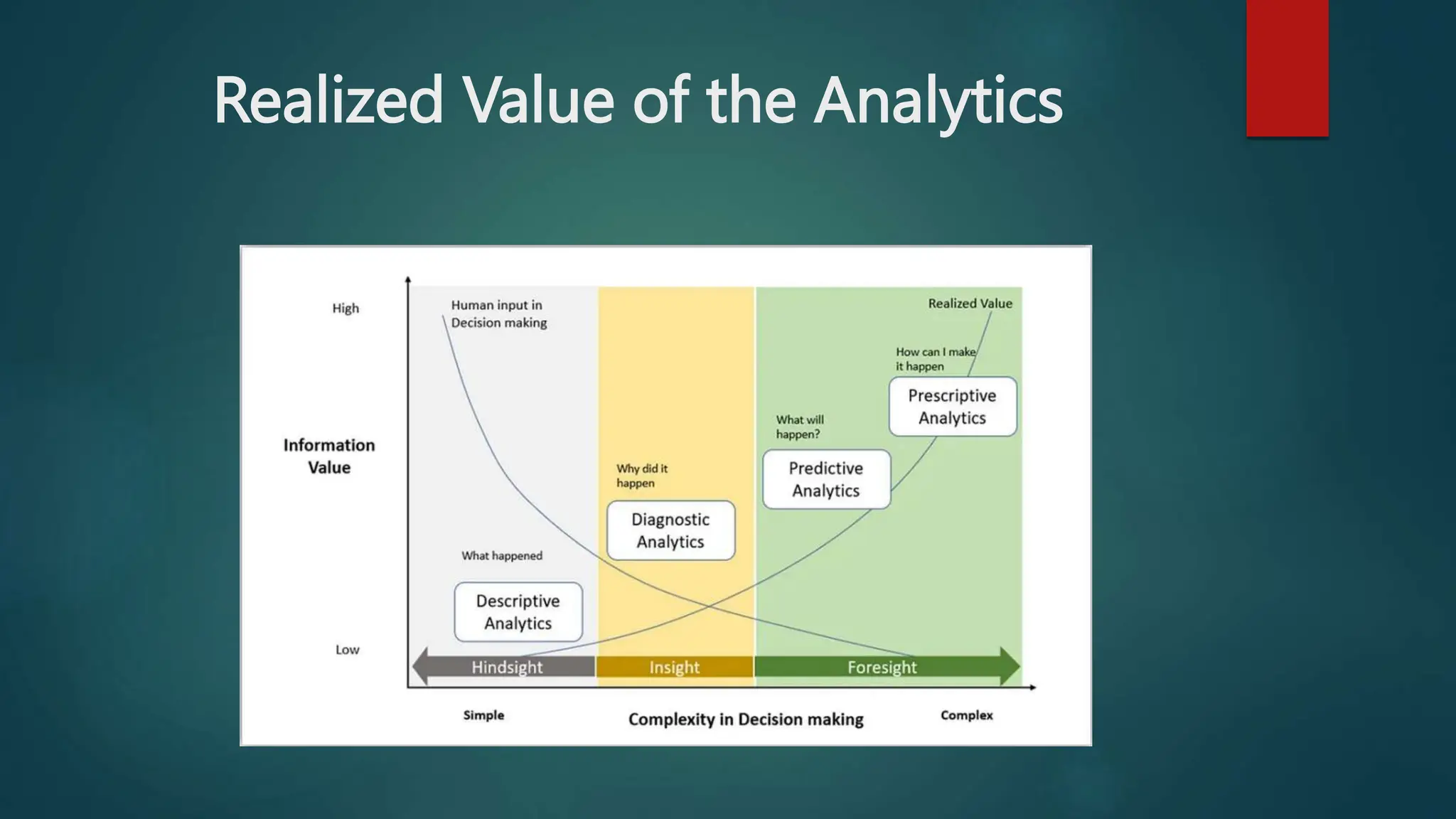
Realized Value of the Analytics
 These four phases represent different maturity levels at which organizations can be
during their adoption journey in analytics.
 The ‘Descriptive Analytics’ looks backward at what has happened in the past
(hindsight), whereas the ‘Diagnostic Analytics’ focuses on gathering insights from
the past data and using it for decision making. The ‘Predictive Analytics’ and
‘Prescriptive Analytics’ predict the future and focus on ‘foresight’.
 The human input in decision-making reduces as you progress from Descriptive
Analytics to Prescriptive Analytics. The decisions are automated in
predictive/prescriptive analytics. The realized value of the analytics is much higher
as you proceed into the advanced phases of the analytics.
Realized Value of the Analytics
Thankyou

Gartner's Data Analytics Maturity Model.pptx

  • 1.
    Gartner’s Data Analytics MaturityModel By: Faizan Irshad
  • 2.
    Background  Gartner's DataAnalytics Maturity Model is a framework developed by Gartner, Inc., a leading research and advisory company specializing in information technology (IT) and business-related insights.  This model is one of many frameworks developed by Gartner to help organizations assess and improve their capabilities in various areas, including data analytics, business intelligence, and digital transformation.  It provides a structured approach to understand where an organization stands in terms of its data analytics capabilities and how it can progress to more advanced stages.  The model typically consists of several stages or levels, each representing a different level of maturity in data analytics practices.
  • 3.
    Overview of theMaturity Model for Data and Analytics
  • 4.
    Phases of Gartner’sData Analytics Maturity Model This model consists of the following four phases:  Descriptive Analytics  Diagnostic Analytics  Predictive Analytics  Prescriptive Analytics
  • 5.
    Descriptive Analytics This isthe first phase and addresses the question, “ What happened” in the past using historical data. For example:  “How many iPhones did Apple Stores in the city of New York sell last month?”  “How many customers downloaded the newly launched health app from the play store yesterday?”  “How many customers visited the store in the last 3 days of the SALE?”  “What are the regions which have less than 20% coverage of COVID-19 vaccination program?
  • 6.
    Diagnostic Analytics This phaseis the next advancement in the adoption of Analytics and addresses the question, “Why did it happen”. The Diagnostic Analysis focuses on deriving the hidden insights from the data which are not captured during the Descriptive Analytics phase. You can find answers to the following questions:  “Is there an impact of gender on the sale of the newly launched iPhone 12?”  “Does plant operations costs differ across the two locations significantly?”  “Is there a positive relationship between the age and the sales revenue from the protein bars?”  “Which of the following factors are responsible for the increase in the number of COVID-19 fatalities in the state — Age, comorbidity, the number of vaccination doses administered, gender, and lifestyle?”  You can also perform various hypothesis tests to prove/disprove your assumptions using statistical tests such as t-tests, ANOVA, Chi-square tests.
  • 7.
    Predictive Analytics  Thisis an advanced phase of analytics that focuses on data mining and uses various advanced analytics techniques such as machine learning, and artificial intelligence to build models that make predictions by using historical data. This phase addresses the question, “What will happen in the future”.  Predictive analytics studies the hidden pattern in the data and establishes the relationship between the outcome variable and the predictor variables to build a mathematical/statistical model which can be used to predict the outcome variable for new data.  Predictive Analytics helps automate the decision making process using these models that foresee the future and equip you with the right information to take the right actions.
  • 8.
    Predictive Analytics In thisphase, you will be able to find answers to the following type of questions:  “How many iPhone 12 smart phones will I be able to sell in the next month?”  “Will John purchase the new car in next quarter and do I need to follow-up with him and add him to the list of prospective customers for next month?”  “What is the probability of students taking admission in college if Data Analytics course is offered in morning timings?”  “Is the color of the suit preferred by middle-aged men (35–50 years) in London dark-grey?”
  • 9.
    Prescriptive Analytics The nextadvanced level in Analytics is Prescriptive Analytics which addresses the question “How can I achieve it? — What should be done ?”. Prescriptive analytics enables you to choose the optimal analytics solution to solve the business problem by enabling you to evaluate various mathematical models, compare their performance on the available data for a specific industry, and pick the most optimal solution. In this phase of analytics, you can get answers to the following types of questions:  “How much ground staff will I need to operate the volume of passengers on 25-Dec in Lahore?”  “Which are the top 3 combo offers that will boost the staple sales in next month?”  “In which Cafe-Coffee Day outlets across Pakistan should I open the mini book stores to do a cross selling?
  • 10.
    Realized Value ofthe Analytics  These four phases represent different maturity levels at which organizations can be during their adoption journey in analytics.  The ‘Descriptive Analytics’ looks backward at what has happened in the past (hindsight), whereas the ‘Diagnostic Analytics’ focuses on gathering insights from the past data and using it for decision making. The ‘Predictive Analytics’ and ‘Prescriptive Analytics’ predict the future and focus on ‘foresight’.  The human input in decision-making reduces as you progress from Descriptive Analytics to Prescriptive Analytics. The decisions are automated in predictive/prescriptive analytics. The realized value of the analytics is much higher as you proceed into the advanced phases of the analytics.
  • 11.
    Realized Value ofthe Analytics
  • 12.