Chapter 7 – Project planning
Topics covered
 Software pricing
 Project scheduling
 Estimation techniques
Project planning
 Project planning involves breaking down the work into
parts and assign these to project team members,
anticipate problems that might arise and prepare
tentative solutions to those problems.
 The project plan, which is created at the start of a
project, is used to communicate how the work will be
done to the project team and customers, and to help
assess progress on the project.
Planning stages
 At the proposal stage, when you are bidding for a
contract to develop or provide a software system.
 During the project startup phase, when you have to plan
who will work on the project, how the project will be
broken down into increments, how resources will be
allocated across your company, etc.
 Periodically throughout the project, when you modify
your plan in the light of experience gained and
information from monitoring the progress of the work.
Proposal planning
 Planning may be necessary with only outline software
requirements.
 The aim of planning at this stage is to provide
information that will be used in setting a price for the
system to customers.
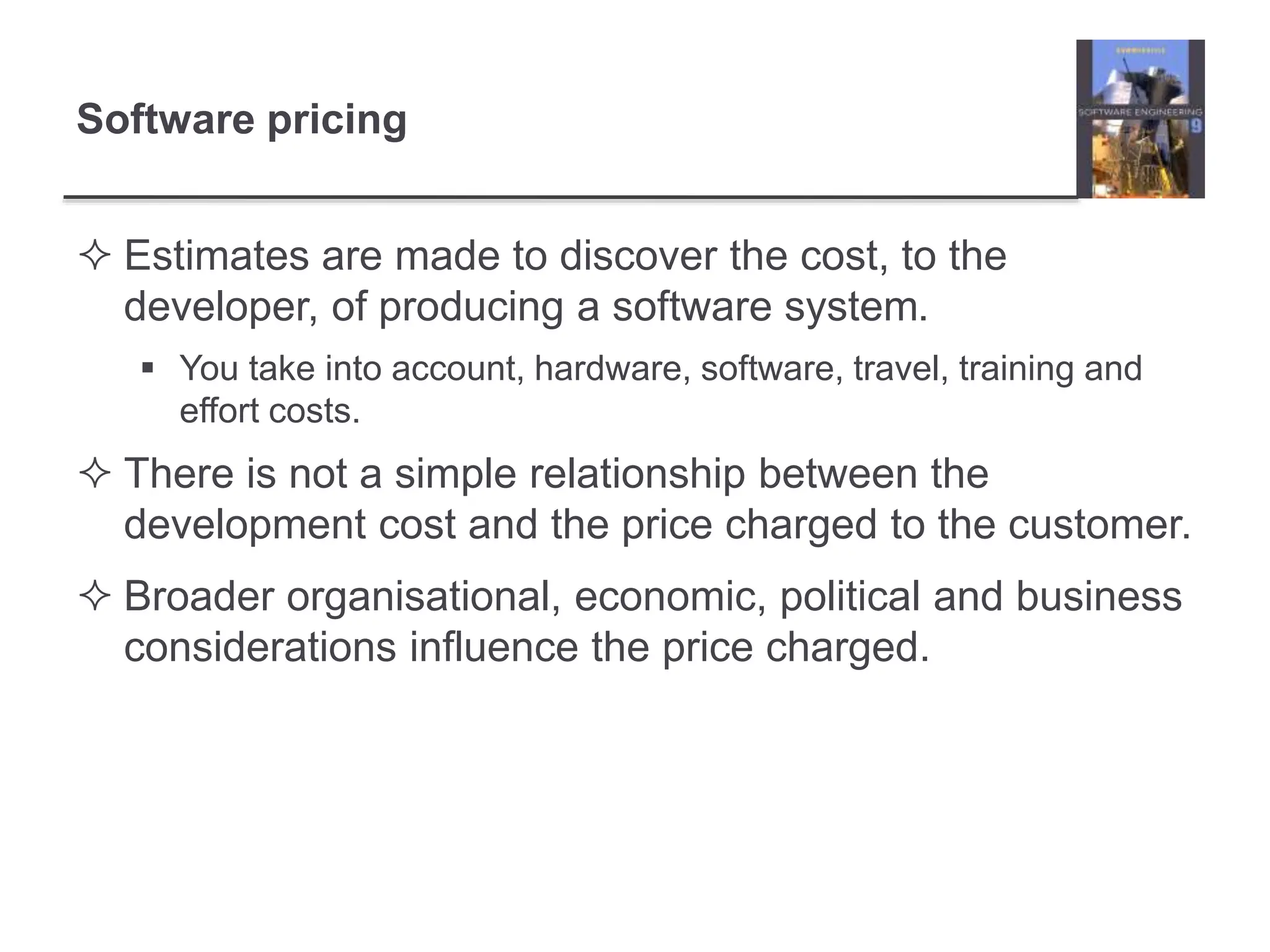
Software pricing
 Estimates are made to discover the cost, to the
developer, of producing a software system.
 You take into account, hardware, software, travel, training and
effort costs.
 There is not a simple relationship between the
development cost and the price charged to the customer.
 Broader organisational, economic, political and business
considerations influence the price charged.
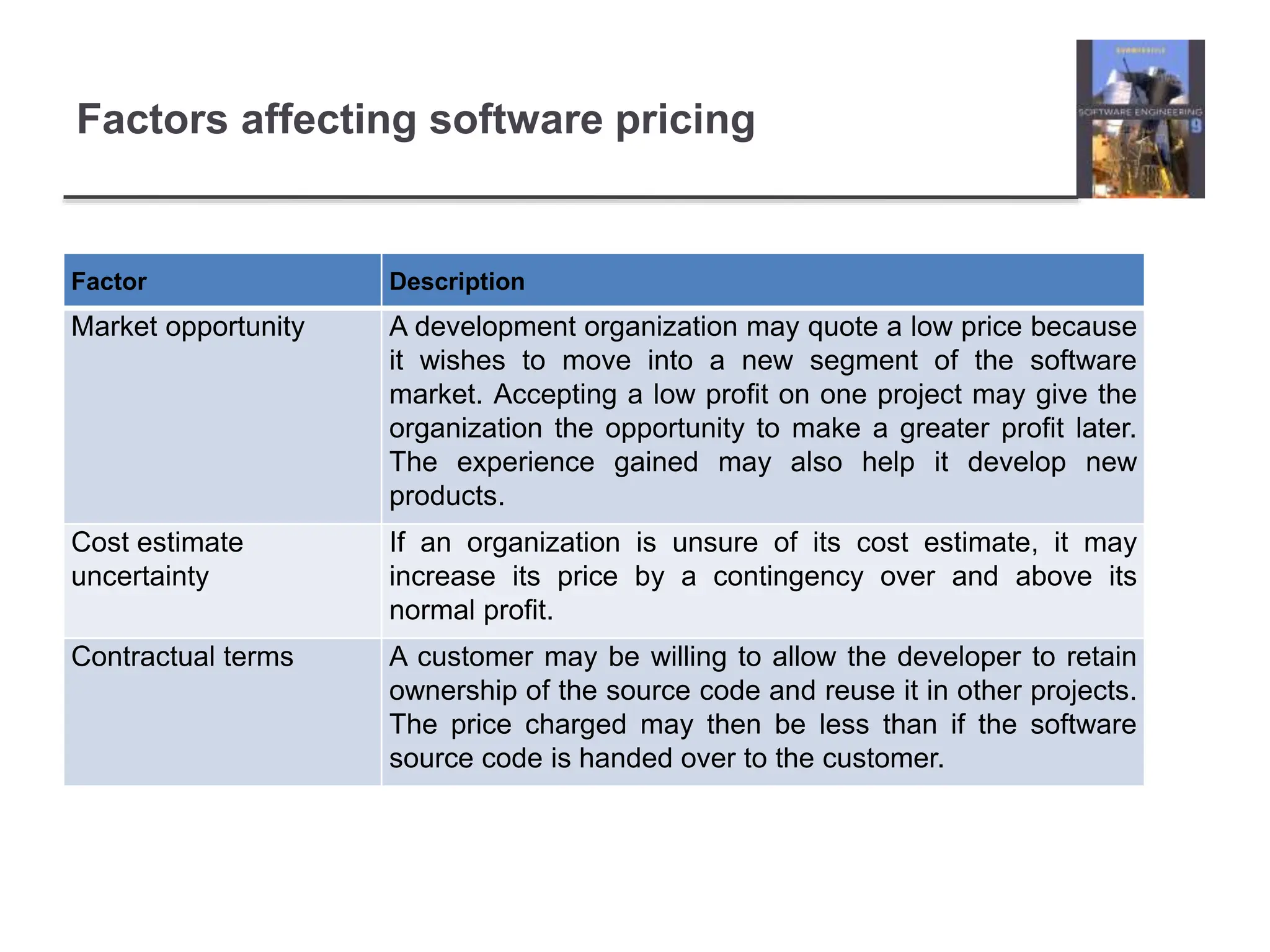
Factors affecting software pricing
Factor Description
Market opportunity A development organization may quote a low price because
it wishes to move into a new segment of the software
market. Accepting a low profit on one project may give the
organization the opportunity to make a greater profit later.
The experience gained may also help it develop new
products.
Cost estimate
uncertainty
If an organization is unsure of its cost estimate, it may
increase its price by a contingency over and above its
normal profit.
Contractual terms A customer may be willing to allow the developer to retain
ownership of the source code and reuse it in other projects.
The price charged may then be less than if the software
source code is handed over to the customer.
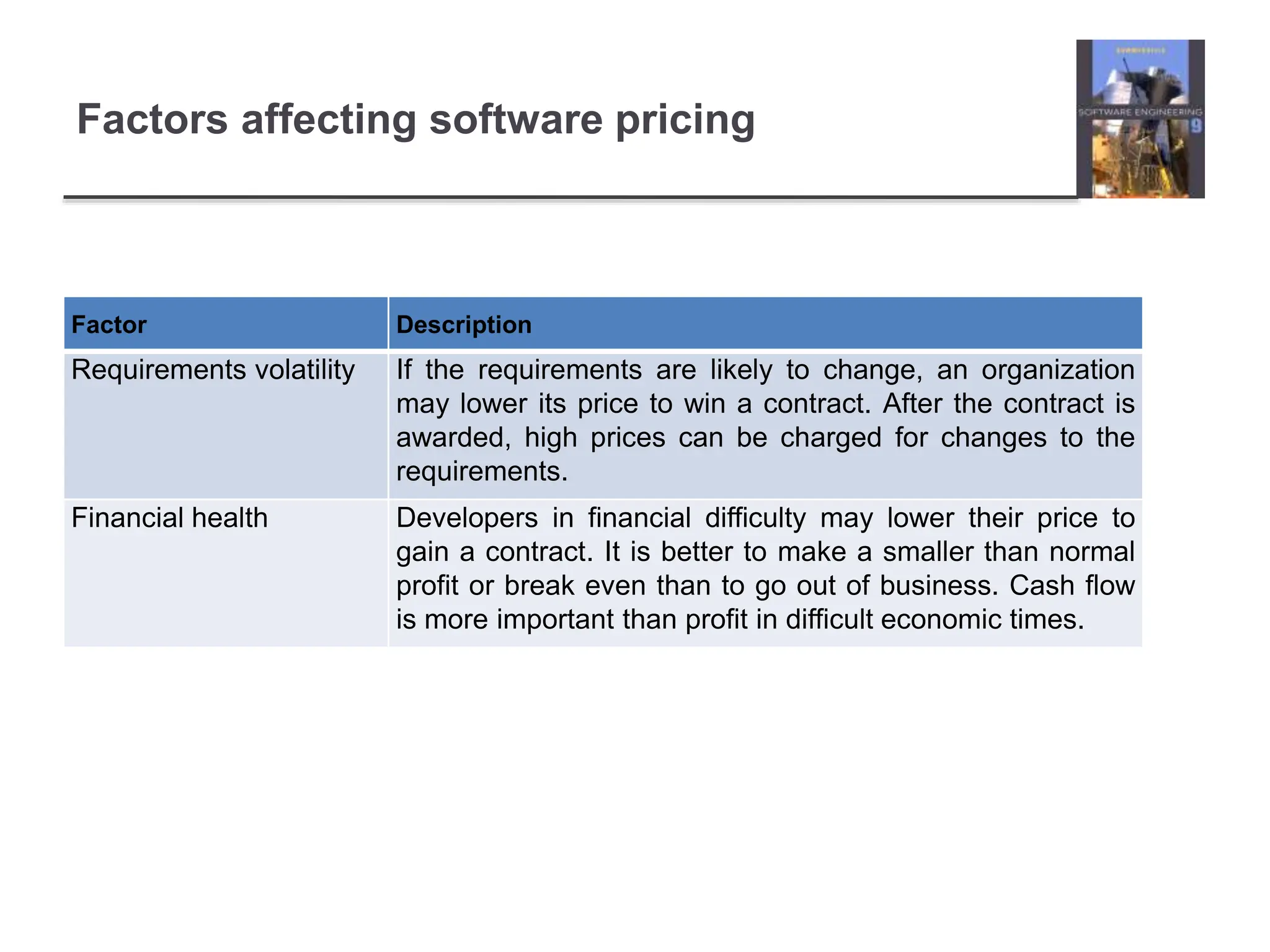
Factors affecting software pricing
Factor Description
Requirements volatility If the requirements are likely to change, an organization
may lower its price to win a contract. After the contract is
awarded, high prices can be charged for changes to the
requirements.
Financial health Developers in financial difficulty may lower their price to
gain a contract. It is better to make a smaller than normal
profit or break even than to go out of business. Cash flow
is more important than profit in difficult economic times.
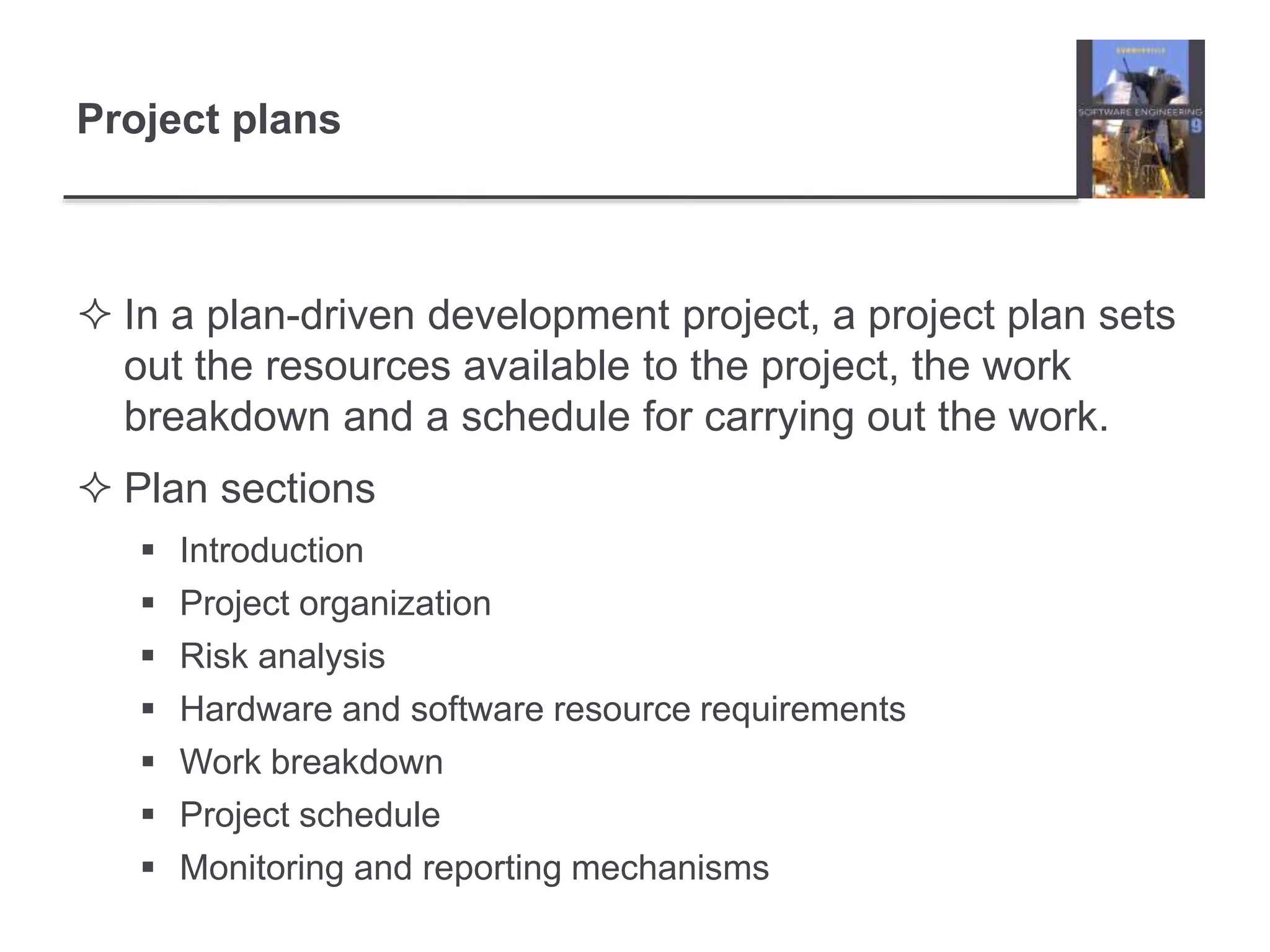
Project plans
 In a plan-driven development project, a project plan sets
out the resources available to the project, the work
breakdown and a schedule for carrying out the work.
 Plan sections
 Introduction
 Project organization
 Risk analysis
 Hardware and software resource requirements
 Work breakdown
 Project schedule
 Monitoring and reporting mechanisms
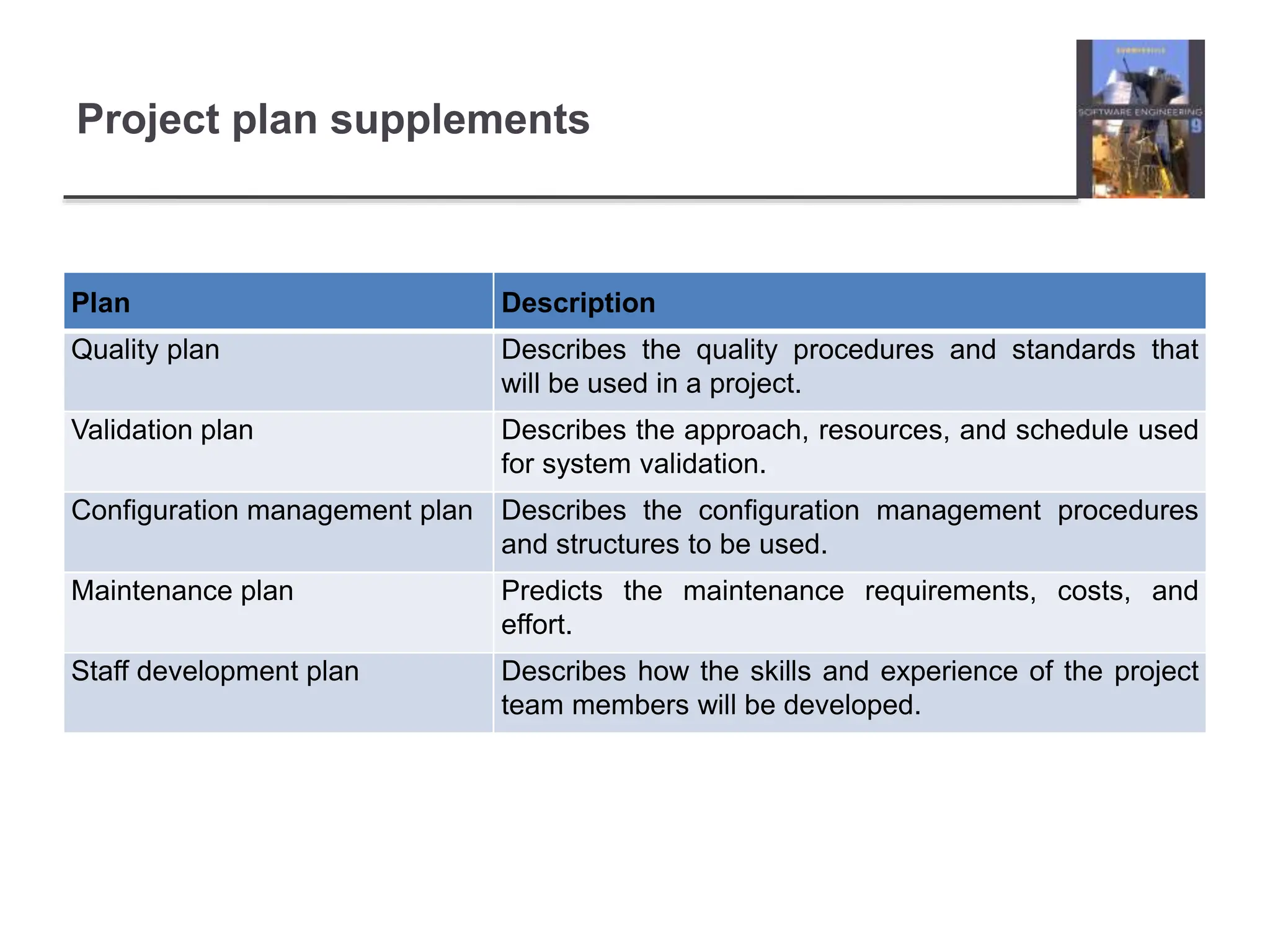
Project plan supplements
Plan Description
Quality plan Describes the quality procedures and standards that
will be used in a project.
Validation plan Describes the approach, resources, and schedule used
for system validation.
Configuration management plan Describes the configuration management procedures
and structures to be used.
Maintenance plan Predicts the maintenance requirements, costs, and
effort.
Staff development plan Describes how the skills and experience of the project
team members will be developed.
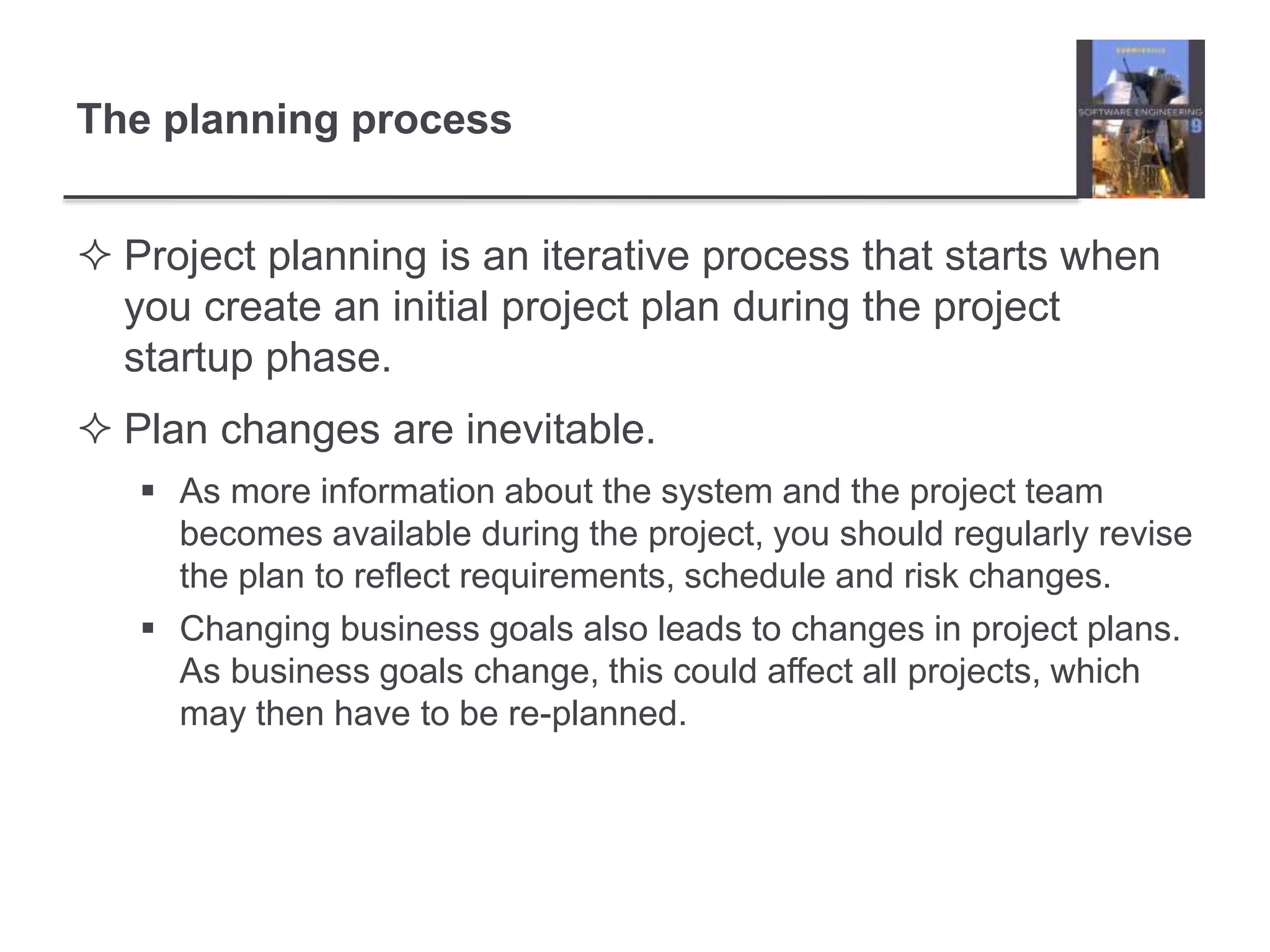
The planning process
 Project planning is an iterative process that starts when
you create an initial project plan during the project
startup phase.
 Plan changes are inevitable.
 As more information about the system and the project team
becomes available during the project, you should regularly revise
the plan to reflect requirements, schedule and risk changes.
 Changing business goals also leads to changes in project plans.
As business goals change, this could affect all projects, which
may then have to be re-planned.
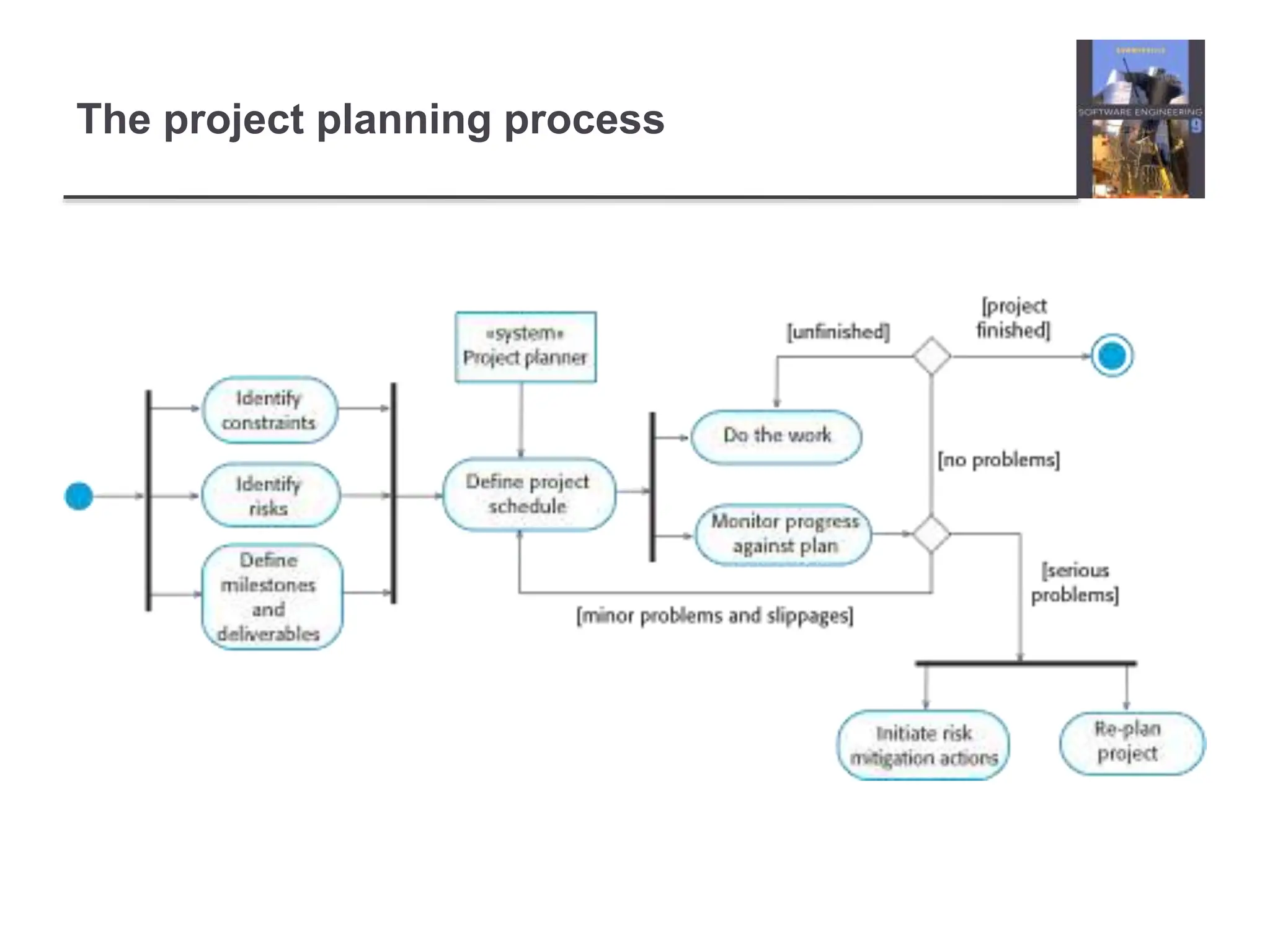
The project planning process
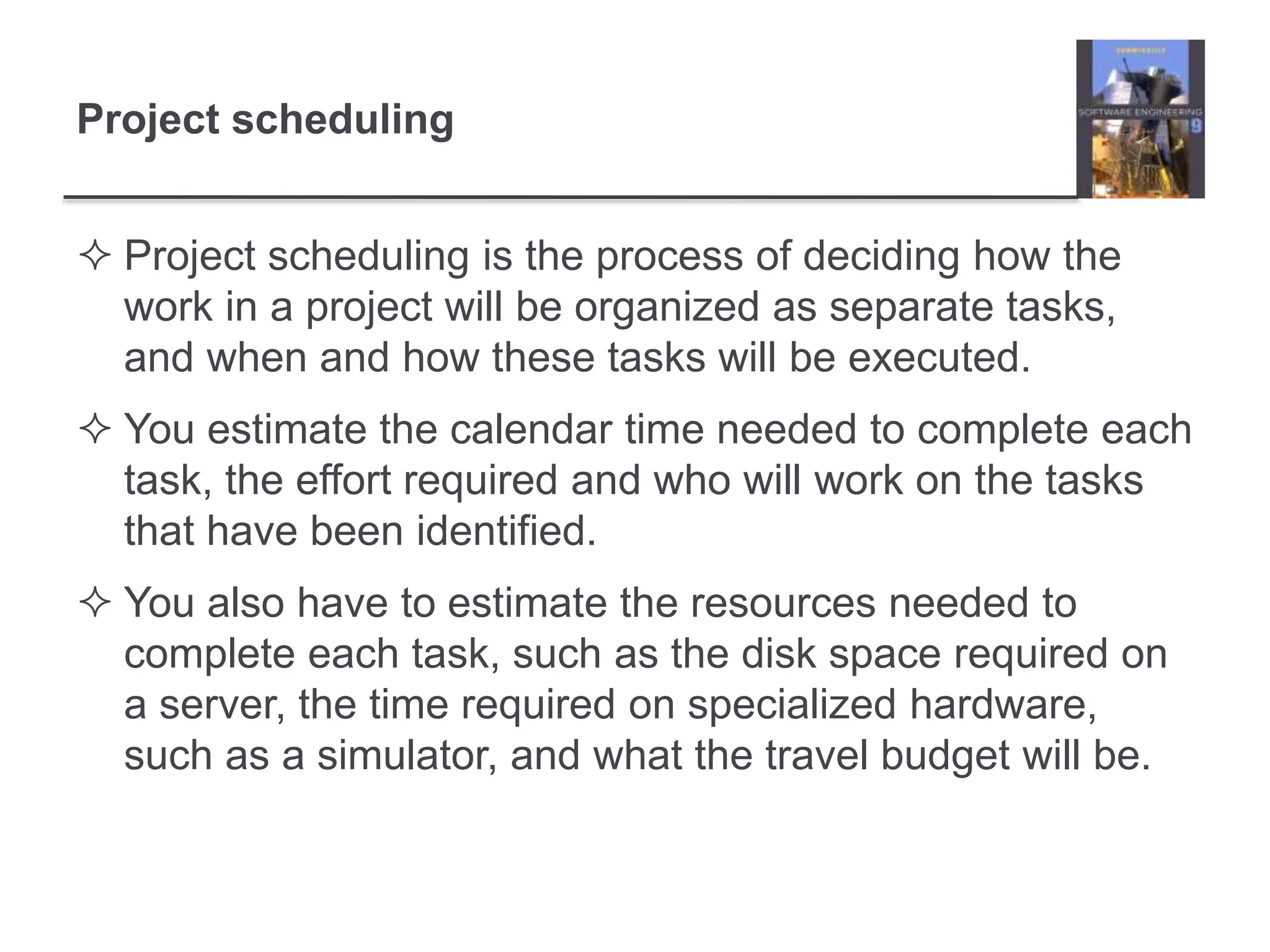
Project scheduling
 Project scheduling is the process of deciding how the
work in a project will be organized as separate tasks,
and when and how these tasks will be executed.
 You estimate the calendar time needed to complete each
task, the effort required and who will work on the tasks
that have been identified.
 You also have to estimate the resources needed to
complete each task, such as the disk space required on
a server, the time required on specialized hardware,
such as a simulator, and what the travel budget will be.
Project scheduling activities
 Split project into tasks and estimate time and resources
required to complete each task.
 Organize tasks concurrently to make optimal
use of workforce.
 Minimize task dependencies to avoid delays
caused by one task waiting for another to complete.
 Dependent on project managers intuition and
experience.
Milestones and deliverables
 Milestones are points in the schedule against which you
can assess progress, for example, the handover of the
system for testing.
 Deliverables are work products that are delivered to the
customer, e.g. a requirements document for the system.
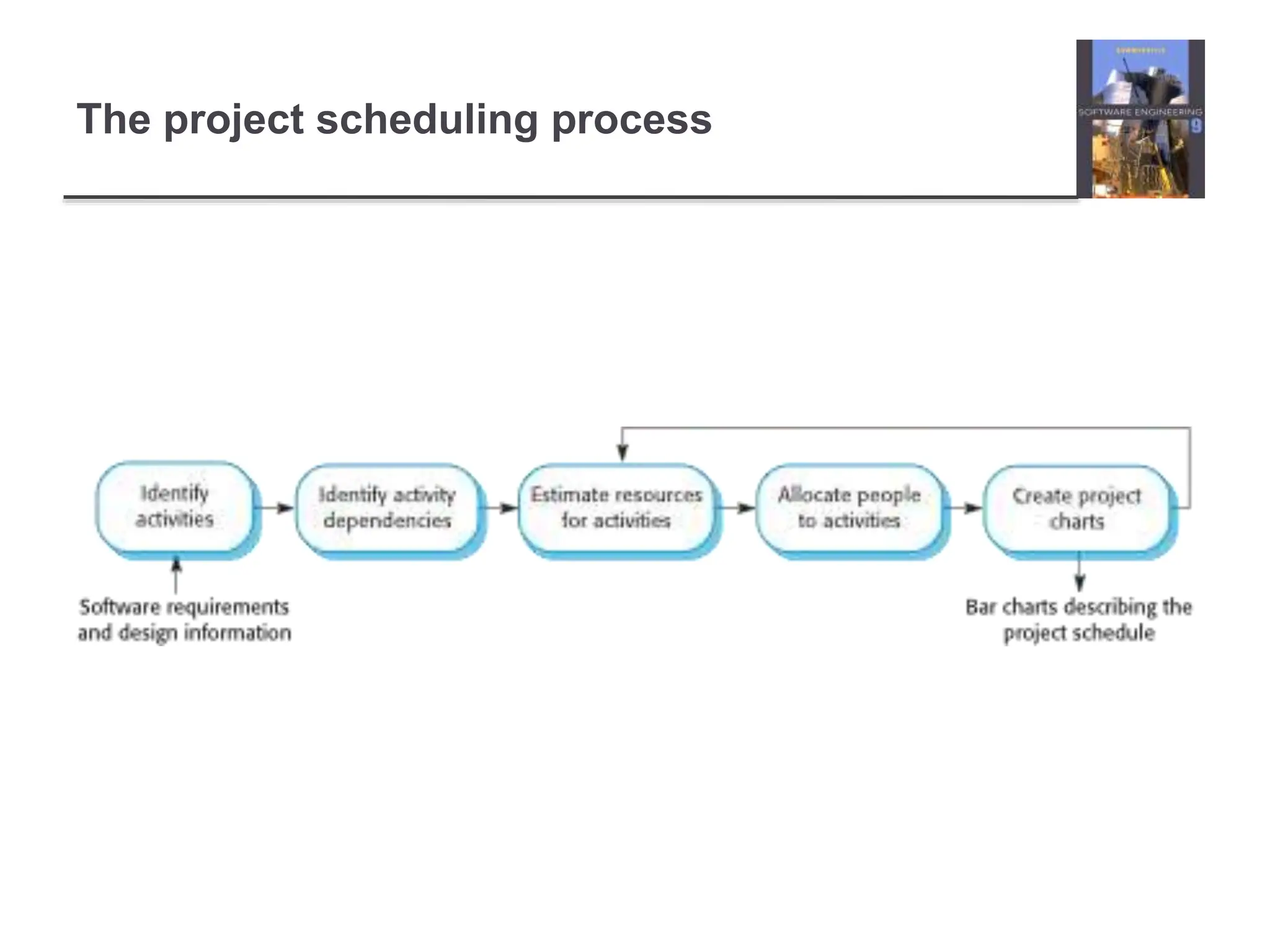
The project scheduling process
Scheduling problems
 Estimating the difficulty of problems and hence the cost
of developing a solution is hard.
 Productivity is not proportional to the number of people
working on a task.
 Adding people to a late project makes it later because of
communication overheads.
 The unexpected always happens. Always allow
contingency in planning.
Schedule representation
 Graphical notations are normally used to illustrate the
project schedule.
 These show the project breakdown into tasks. Tasks
should not be too small. They should take about a week
or two.
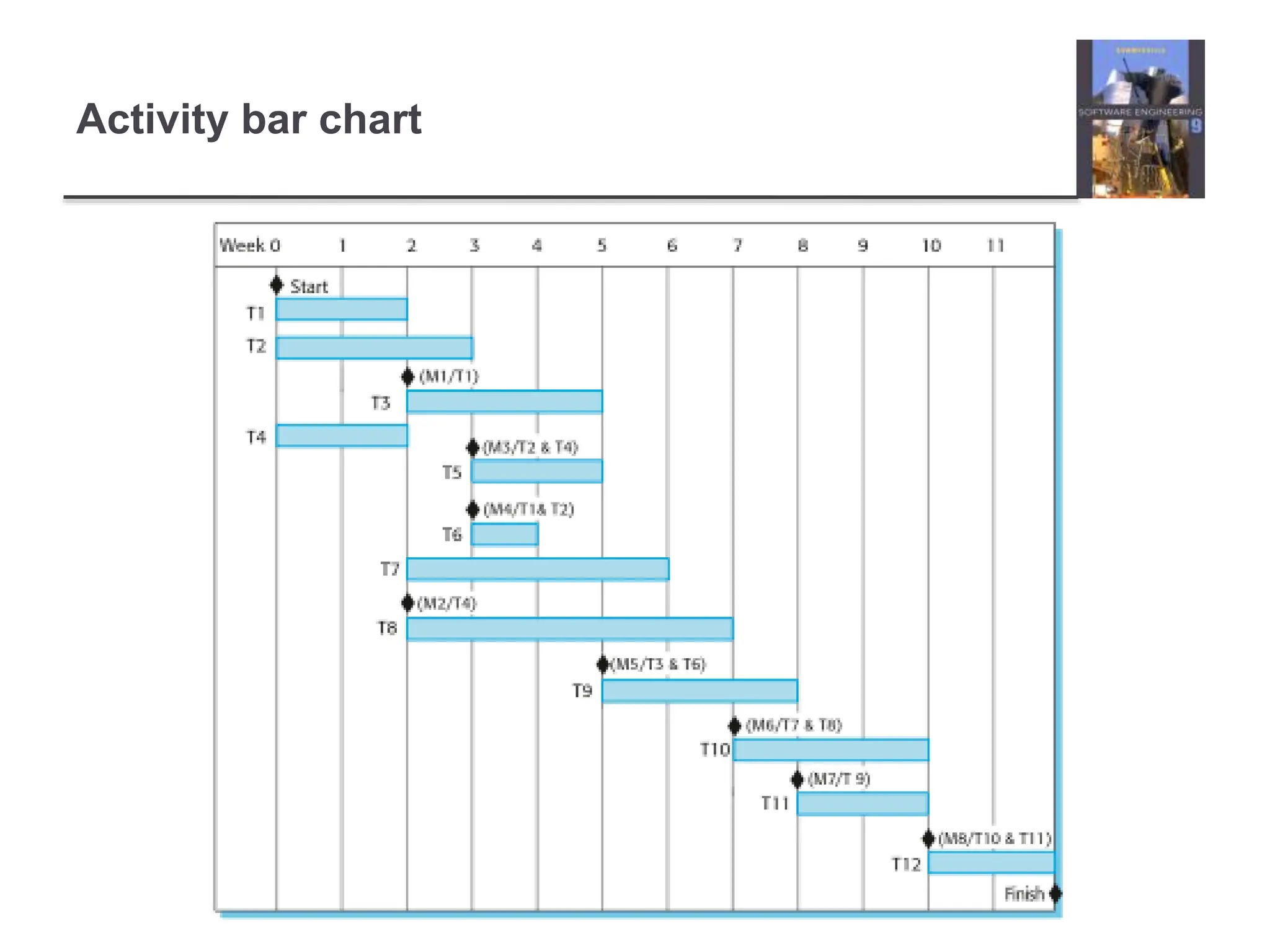
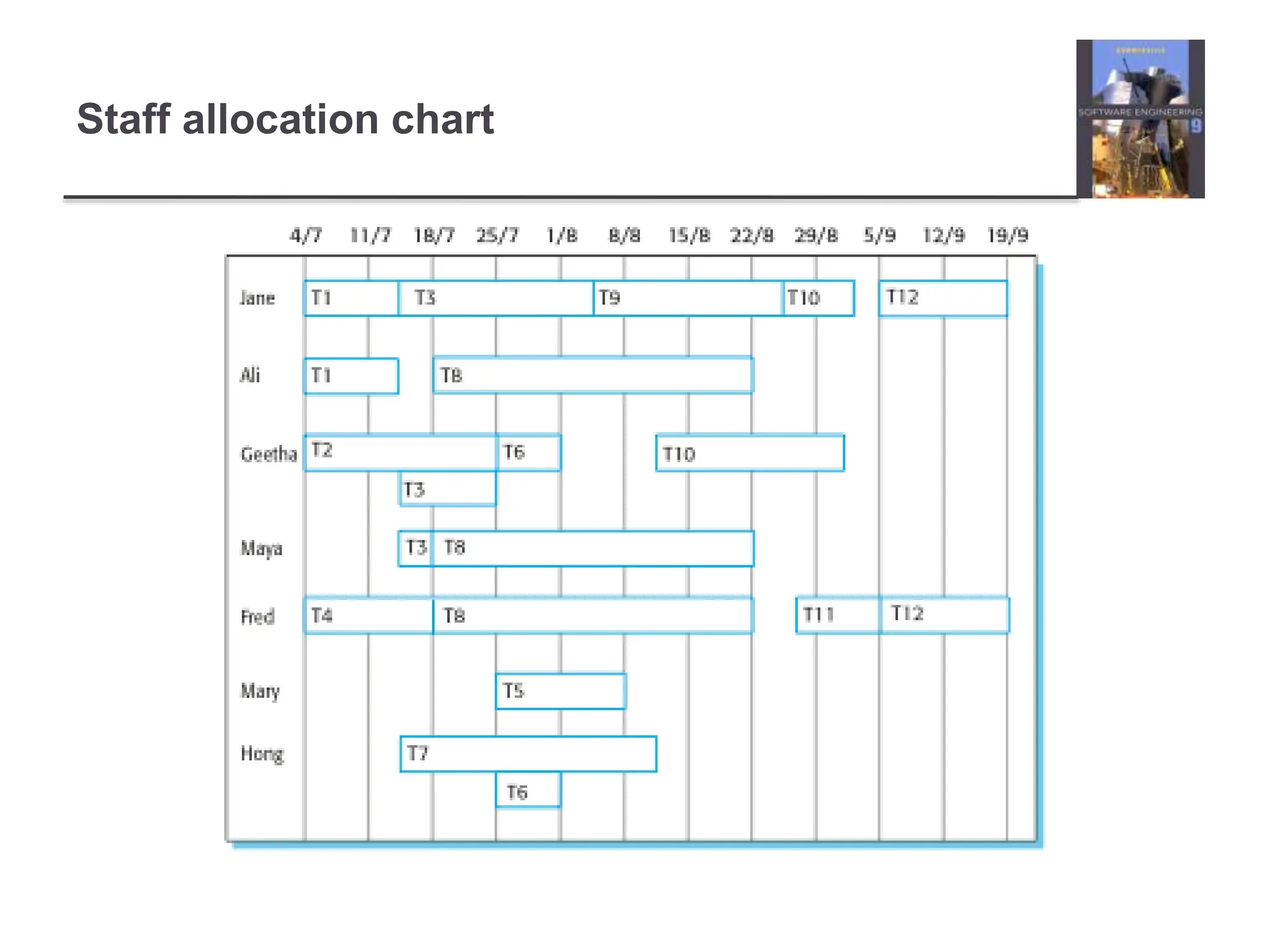
 Bar charts are the most commonly used representation
for project schedules. They show the schedule as
activities or resources against time.
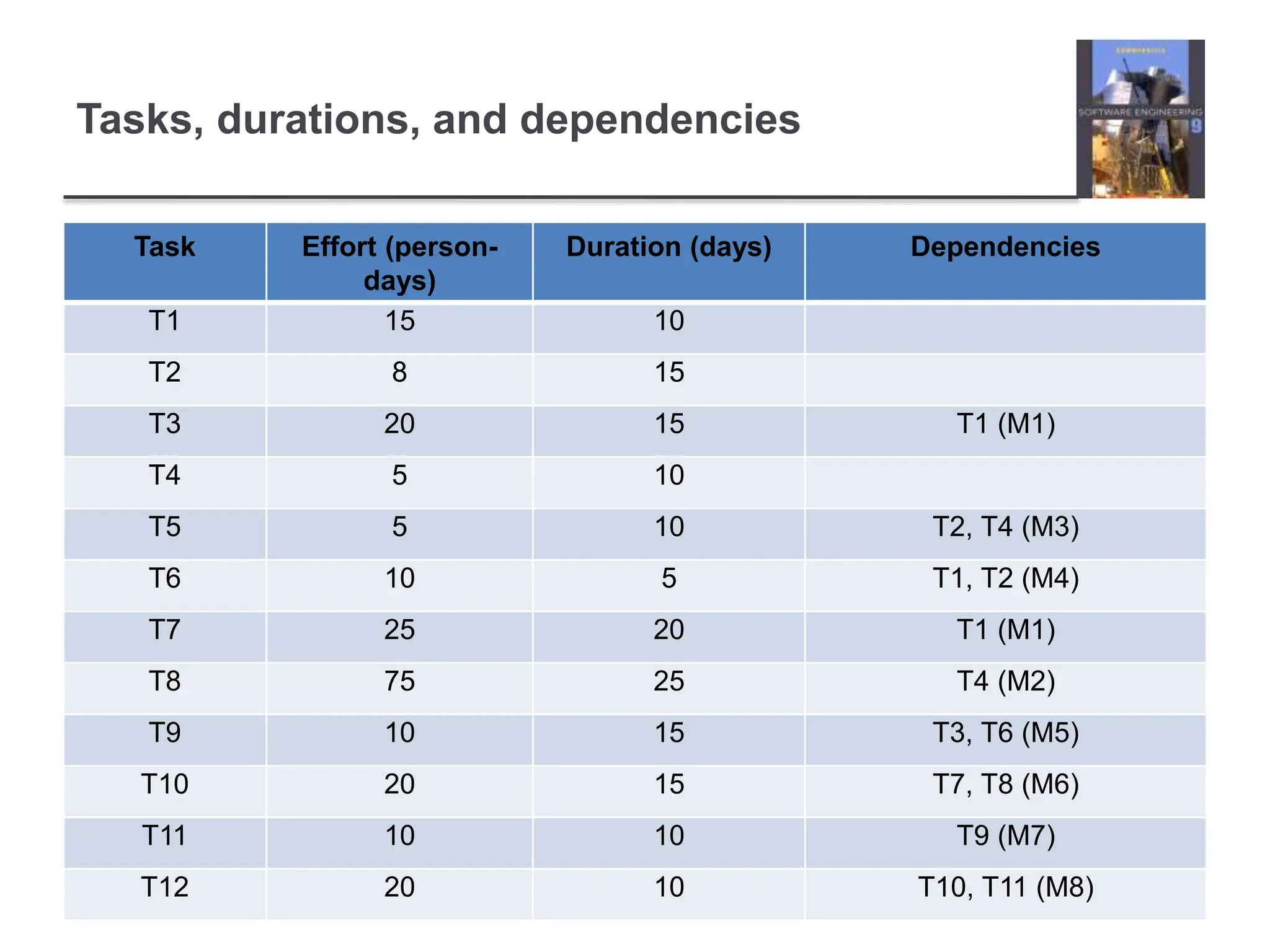
Tasks, durations, and dependencies
Task Effort (person-
days)
Duration (days) Dependencies
T1 15 10
T2 8 15
T3 20 15 T1 (M1)
T4 5 10
T5 5 10 T2, T4 (M3)
T6 10 5 T1, T2 (M4)
T7 25 20 T1 (M1)
T8 75 25 T4 (M2)
T9 10 15 T3, T6 (M5)
T10 20 15 T7, T8 (M6)
T11 10 10 T9 (M7)
T12 20 10 T10, T11 (M8)
Activity bar chart
Staff allocation chart
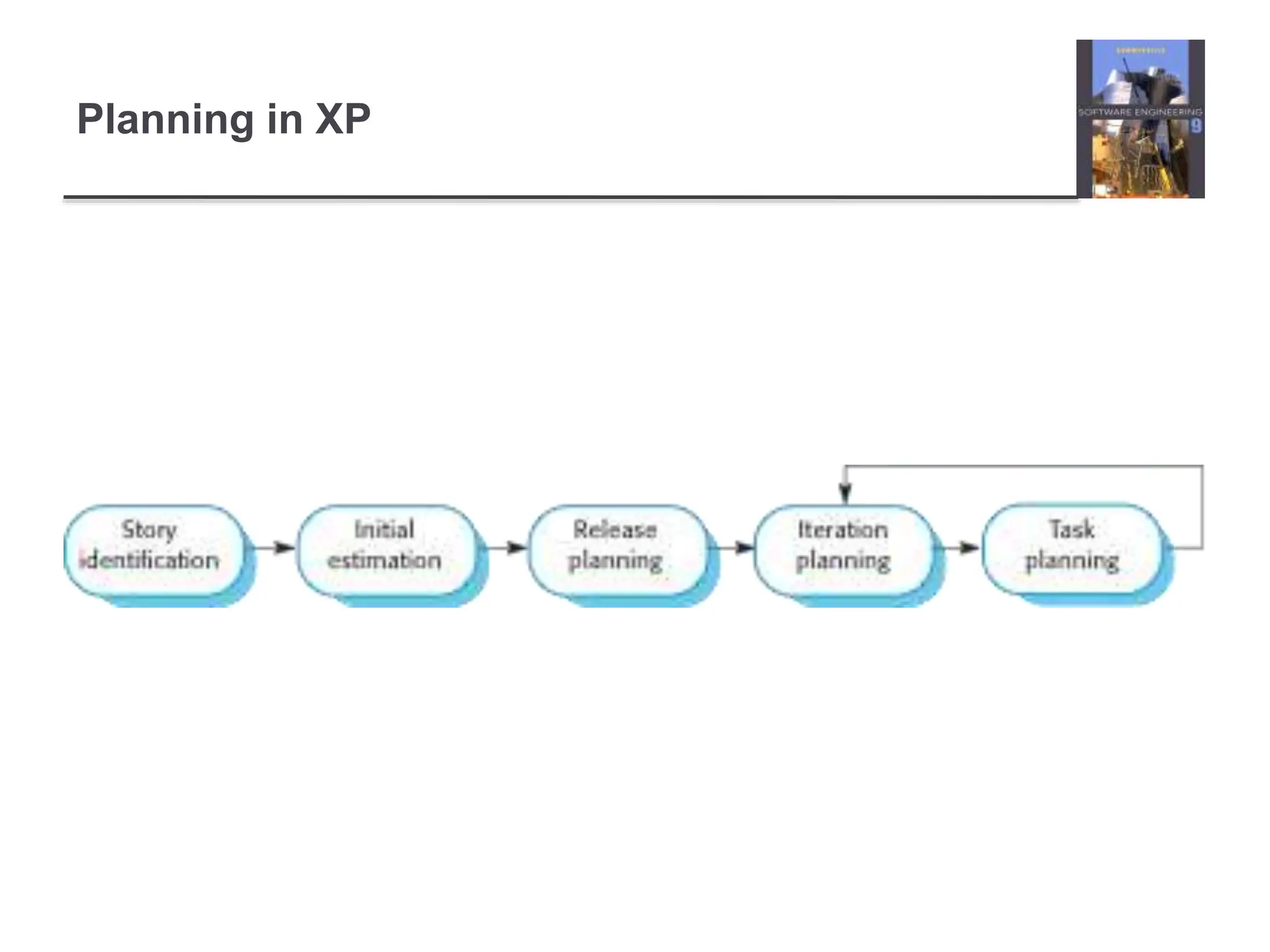
Planning in XP
Story-based planning
 The system specification in XP is based on user stories that reflect
the features that should be included in the system.
 The project team read and discuss the stories and rank them in
order of the amount of time they think it will take to implement the
story.
 Release planning involves selecting and refining the stories that will
reflect the features to be implemented in a release of a system and
the order in which the stories should be implemented.
 Stories to be implemented in each iteration are chosen, with the
number of stories reflecting the time to deliver an iteration (usually 2
or 3 weeks).
Estimation accuracy
 The size of a software system can only be known
accurately when it is finished.
 Several factors influence the final size
 Use of COTS and components;
 Programming language;
 Distribution of system.
 As the development process progresses then the size
estimate becomes more accurate.
 The estimates of the factors contributing to B and M are
subjective and vary according to the judgment of the
estimator.
Staffing requirements
 Staff required can’t be computed by diving the
development time by the required schedule.
 The number of people working on a project varies
depending on the phase of the project.
 The more people who work on the project, the more total
effort is usually required.
 A very rapid build-up of people often correlates with
schedule slippage.
Key points
 Estimation techniques for software may be experience-
based, where managers judge the effort required, or
algorithmic, where the effort required is computed from
other estimated project parameters.
Key points
 The price charged for a system does not just depend on its
estimated development costs; it may be adjusted depending on the
market and organizational priorities.
 Plan-driven development is organized around a complete project
plan that defines the project activities, the planned effort, the activity
schedule and who is responsible for each activity.
 Project scheduling involves the creation of graphical representations
the project plan. Bar charts show the activity duration and staffing
timelines, are the most commonly used schedule representations.
 The XP planning game involves the whole team in project planning.
The plan is developed incrementally and, if problems arise, is
adjusted. Software functionality is reduced instead of delaying
delivery of an increment.

Chapter7 database management system.pptx

  • 1.
    Chapter 7 –Project planning
  • 2.
    Topics covered  Softwarepricing  Project scheduling  Estimation techniques
  • 3.
    Project planning  Projectplanning involves breaking down the work into parts and assign these to project team members, anticipate problems that might arise and prepare tentative solutions to those problems.  The project plan, which is created at the start of a project, is used to communicate how the work will be done to the project team and customers, and to help assess progress on the project.
  • 4.
    Planning stages  Atthe proposal stage, when you are bidding for a contract to develop or provide a software system.  During the project startup phase, when you have to plan who will work on the project, how the project will be broken down into increments, how resources will be allocated across your company, etc.  Periodically throughout the project, when you modify your plan in the light of experience gained and information from monitoring the progress of the work.
  • 5.
    Proposal planning  Planningmay be necessary with only outline software requirements.  The aim of planning at this stage is to provide information that will be used in setting a price for the system to customers.
  • 6.
    Software pricing  Estimatesare made to discover the cost, to the developer, of producing a software system.  You take into account, hardware, software, travel, training and effort costs.  There is not a simple relationship between the development cost and the price charged to the customer.  Broader organisational, economic, political and business considerations influence the price charged.
  • 7.
    Factors affecting softwarepricing Factor Description Market opportunity A development organization may quote a low price because it wishes to move into a new segment of the software market. Accepting a low profit on one project may give the organization the opportunity to make a greater profit later. The experience gained may also help it develop new products. Cost estimate uncertainty If an organization is unsure of its cost estimate, it may increase its price by a contingency over and above its normal profit. Contractual terms A customer may be willing to allow the developer to retain ownership of the source code and reuse it in other projects. The price charged may then be less than if the software source code is handed over to the customer.
  • 8.
    Factors affecting softwarepricing Factor Description Requirements volatility If the requirements are likely to change, an organization may lower its price to win a contract. After the contract is awarded, high prices can be charged for changes to the requirements. Financial health Developers in financial difficulty may lower their price to gain a contract. It is better to make a smaller than normal profit or break even than to go out of business. Cash flow is more important than profit in difficult economic times.
  • 9.
    Project plans  Ina plan-driven development project, a project plan sets out the resources available to the project, the work breakdown and a schedule for carrying out the work.  Plan sections  Introduction  Project organization  Risk analysis  Hardware and software resource requirements  Work breakdown  Project schedule  Monitoring and reporting mechanisms
  • 10.
    Project plan supplements PlanDescription Quality plan Describes the quality procedures and standards that will be used in a project. Validation plan Describes the approach, resources, and schedule used for system validation. Configuration management plan Describes the configuration management procedures and structures to be used. Maintenance plan Predicts the maintenance requirements, costs, and effort. Staff development plan Describes how the skills and experience of the project team members will be developed.
  • 11.
    The planning process Project planning is an iterative process that starts when you create an initial project plan during the project startup phase.  Plan changes are inevitable.  As more information about the system and the project team becomes available during the project, you should regularly revise the plan to reflect requirements, schedule and risk changes.  Changing business goals also leads to changes in project plans. As business goals change, this could affect all projects, which may then have to be re-planned.
  • 12.
  • 13.
    Project scheduling  Projectscheduling is the process of deciding how the work in a project will be organized as separate tasks, and when and how these tasks will be executed.  You estimate the calendar time needed to complete each task, the effort required and who will work on the tasks that have been identified.  You also have to estimate the resources needed to complete each task, such as the disk space required on a server, the time required on specialized hardware, such as a simulator, and what the travel budget will be.
  • 14.
    Project scheduling activities Split project into tasks and estimate time and resources required to complete each task.  Organize tasks concurrently to make optimal use of workforce.  Minimize task dependencies to avoid delays caused by one task waiting for another to complete.  Dependent on project managers intuition and experience.
  • 15.
    Milestones and deliverables Milestones are points in the schedule against which you can assess progress, for example, the handover of the system for testing.  Deliverables are work products that are delivered to the customer, e.g. a requirements document for the system.
  • 16.
  • 17.
    Scheduling problems  Estimatingthe difficulty of problems and hence the cost of developing a solution is hard.  Productivity is not proportional to the number of people working on a task.  Adding people to a late project makes it later because of communication overheads.  The unexpected always happens. Always allow contingency in planning.
  • 18.
    Schedule representation  Graphicalnotations are normally used to illustrate the project schedule.  These show the project breakdown into tasks. Tasks should not be too small. They should take about a week or two.  Bar charts are the most commonly used representation for project schedules. They show the schedule as activities or resources against time.
  • 19.
    Tasks, durations, anddependencies Task Effort (person- days) Duration (days) Dependencies T1 15 10 T2 8 15 T3 20 15 T1 (M1) T4 5 10 T5 5 10 T2, T4 (M3) T6 10 5 T1, T2 (M4) T7 25 20 T1 (M1) T8 75 25 T4 (M2) T9 10 15 T3, T6 (M5) T10 20 15 T7, T8 (M6) T11 10 10 T9 (M7) T12 20 10 T10, T11 (M8)
  • 20.
  • 21.
  • 22.
  • 23.
    Story-based planning  Thesystem specification in XP is based on user stories that reflect the features that should be included in the system.  The project team read and discuss the stories and rank them in order of the amount of time they think it will take to implement the story.  Release planning involves selecting and refining the stories that will reflect the features to be implemented in a release of a system and the order in which the stories should be implemented.  Stories to be implemented in each iteration are chosen, with the number of stories reflecting the time to deliver an iteration (usually 2 or 3 weeks).
  • 24.
    Estimation accuracy  Thesize of a software system can only be known accurately when it is finished.  Several factors influence the final size  Use of COTS and components;  Programming language;  Distribution of system.  As the development process progresses then the size estimate becomes more accurate.  The estimates of the factors contributing to B and M are subjective and vary according to the judgment of the estimator.
  • 25.
    Staffing requirements  Staffrequired can’t be computed by diving the development time by the required schedule.  The number of people working on a project varies depending on the phase of the project.  The more people who work on the project, the more total effort is usually required.  A very rapid build-up of people often correlates with schedule slippage.
  • 26.
    Key points  Estimationtechniques for software may be experience- based, where managers judge the effort required, or algorithmic, where the effort required is computed from other estimated project parameters.
  • 27.
    Key points  Theprice charged for a system does not just depend on its estimated development costs; it may be adjusted depending on the market and organizational priorities.  Plan-driven development is organized around a complete project plan that defines the project activities, the planned effort, the activity schedule and who is responsible for each activity.  Project scheduling involves the creation of graphical representations the project plan. Bar charts show the activity duration and staffing timelines, are the most commonly used schedule representations.  The XP planning game involves the whole team in project planning. The plan is developed incrementally and, if problems arise, is adjusted. Software functionality is reduced instead of delaying delivery of an increment.