Chapter FourChapter Four
Experiencing and Analyzing PlaysExperiencing and Analyzing Plays
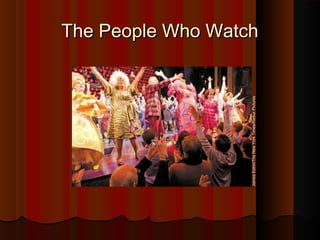
The People Who WatchThe People Who Watch
JamesEstrin/TheNewYorkTimes/ReduxPictures
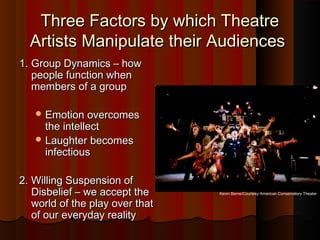
Three Factors by which TheatreThree Factors by which Theatre
Artists Manipulate their AudiencesArtists Manipulate their Audiences
1.1. Group Dynamics – howGroup Dynamics – how
people function whenpeople function when
members of a groupmembers of a group
 Emotion overcomesEmotion overcomes
the intellectthe intellect
 Laughter becomesLaughter becomes
infectiousinfectious
2.2. Willing Suspension ofWilling Suspension of
Disbelief – we accept theDisbelief – we accept the
world of the play over thatworld of the play over that
of our everyday realityof our everyday reality
Kevin Berne/Courtesy American Conservatory Theater
Three Factors by which TheatreThree Factors by which Theatre
Artists Manipulate their AudiencesArtists Manipulate their Audiences
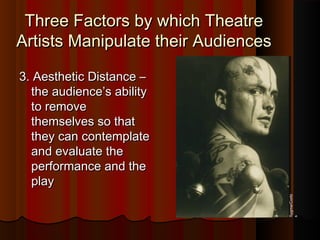
3. Aesthetic Distance –3. Aesthetic Distance –
the audience’s abilitythe audience’s ability
to removeto remove
themselves so thatthemselves so that
they can contemplatethey can contemplate
and evaluate theand evaluate the
performance and theperformance and the
playplay
Sygma/Corbi
s
Levels of ParticipationLevels of Participation
Presentational Theatre
is self-consciously
theatrical and will often
acknowledge the
audience and may even
invite them to participate
Example –
The Rocky Horror Picture
Show
Representational Theatre
is based on the idea of
the “fourth wall,” in which
the actors never
acknowledge the
presence of the audience
Example –
A Doll’s House
Etiquette in the TheatreEtiquette in the Theatre
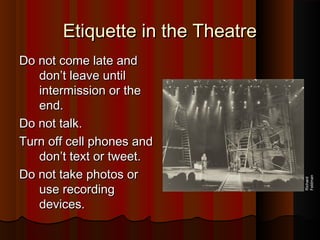
Do not come late andDo not come late and
don’t leave untildon’t leave until
intermission or theintermission or the
end.end.
Do not talk.Do not talk.
Turn off cell phones andTurn off cell phones and
don’t text or tweet.don’t text or tweet.
Do not take photos orDo not take photos or
use recordinguse recording
devices.devices.
Richard
Feldman
Going to the TheatreGoing to the Theatre
Check your local paper, TV, or websitesCheck your local paper, TV, or websites
for play listings.for play listings.
Reserve your nonrefundable tickets.Reserve your nonrefundable tickets.
To save money, attend previewTo save money, attend preview
performances or check for student rates.performances or check for student rates.
Observe the dress code for that theatre.Observe the dress code for that theatre.
Read the program to be better informed.Read the program to be better informed.
Analyze and discuss the performanceAnalyze and discuss the performance
after the show.after the show.
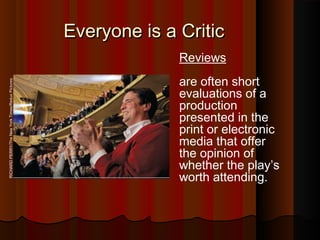
Everyone is a CriticEveryone is a Critic
Reviews
are often short
evaluations of a
production
presented in the
print or electronic
media that offer
the opinion of
whether the play’s
worth attending.
RICHARDPERRY/TheNewYorkTimes/ReduxPictures
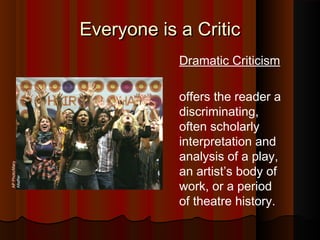
Everyone is a CriticEveryone is a Critic
Dramatic Criticism
offers the reader a
discriminating,
often scholarly
interpretation and
analysis of a play,
an artist’s body of
work, or a period
of theatre history.
APPhoto/Mary
Altaffer
GoetheGoethe
Three Essential Questions DramaticThree Essential Questions Dramatic
Criticism Should AddressCriticism Should Address
1. What is the artist trying to do?1. What is the artist trying to do?
2. How well has the artist done it?2. How well has the artist done it?
3. Is it worth doing?3. Is it worth doing?
Aristotle’s PoeticsAristotle’s Poetics
The Six Elements of DramaThe Six Elements of Drama
1. Plot – what is the story about?1. Plot – what is the story about?
2. Character – Who is doing the action?2. Character – Who is doing the action?
3. Thought – What do the actions in the play3. Thought – What do the actions in the play
mean?mean?
4. Diction – How is the dialogue used to reveal4. Diction – How is the dialogue used to reveal
character and set the environment?character and set the environment?
5. Spectacle – How do each of the visual and5. Spectacle – How do each of the visual and
auditory elements of the play contribute to theauditory elements of the play contribute to the
performance?performance?
6. Song – How do the musical elements of the6. Song – How do the musical elements of the
play move the plot to its conclusion?play move the plot to its conclusion?
Freedom of Speech and the ArtsFreedom of Speech and the Arts
Congress shall make no law respecting an
establishment of religion, or prohibiting the
free exercise thereof; or abridging the
freedom of speech, or of the press; or the
right of the people peaceably to assemble,
and to petition the Government for a redress
of grievances.
Exceptions to Freedom of SpeechExceptions to Freedom of Speech
• Defamation – can not state publicly or publishDefamation – can not state publicly or publish
alleged facts that are false and can harm thealleged facts that are false and can harm the
reputation of another.reputation of another.
• Sedition and Incitement to Crime – if one’s wordsSedition and Incitement to Crime – if one’s words
incite another to commit a crime, you may be inincite another to commit a crime, you may be in
violation of the First Amendment.violation of the First Amendment.
• Separation of Church and State.Separation of Church and State.
• Obscenity is not protected.Obscenity is not protected.
Exceptions to Freedom of SpeechExceptions to Freedom of Speech
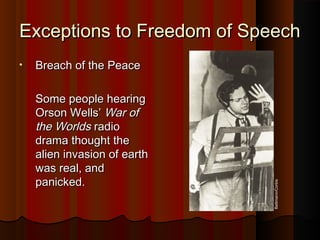
• Breach of the PeaceBreach of the Peace
Some people hearingSome people hearing
Orson Wells’Orson Wells’ War ofWar of
the Worldsthe Worlds radioradio
drama thought thedrama thought the
alien invasion of earthalien invasion of earth
was real, andwas real, and
panicked.panicked.
Bettmann/Corbis
You Can’t Say That!You Can’t Say That!
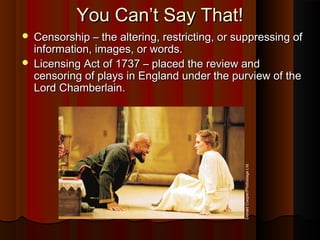
 Censorship – the altering, restricting, or suppressing ofCensorship – the altering, restricting, or suppressing of
information, images, or words.information, images, or words.
 Licensing Act of 1737 – placed the review andLicensing Act of 1737 – placed the review and
censoring of plays in England under the purview of thecensoring of plays in England under the purview of the
Lord Chamberlain.Lord Chamberlain.
DonaldCooper/PhotostageLtd.
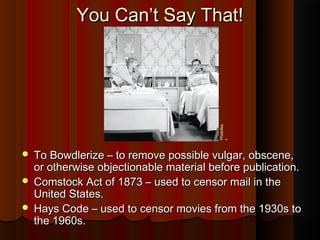
You Can’t Say That!You Can’t Say That!
 To Bowdlerize – to remove possible vulgar, obscene,To Bowdlerize – to remove possible vulgar, obscene,
or otherwise objectionable material before publication.or otherwise objectionable material before publication.
 Comstock Act of 1873 – used to censor mail in theComstock Act of 1873 – used to censor mail in the
United States.United States.
 Hays Code – used to censor movies from the 1930s toHays Code – used to censor movies from the 1930s to
the 1960s.the 1960s. Photofes
t
Curtain CallCurtain Call
“[I]f theatre is free conversation, free
dialogue, among free people about the
mysteries of the world, then it is precisely
what will show humankind the way toward
tolerance, mutual respect, and respect for
the miracle of Being.”
Vaclav Havel, playwright and formerVaclav Havel, playwright and former
President of CzechoslovakiaPresident of Czechoslovakia

Chapter 4: Experiencing and Analyzing Plays

  • 1.
    Chapter FourChapter Four Experiencingand Analyzing PlaysExperiencing and Analyzing Plays
  • 2.
    The People WhoWatchThe People Who Watch JamesEstrin/TheNewYorkTimes/ReduxPictures
  • 3.
    Three Factors bywhich TheatreThree Factors by which Theatre Artists Manipulate their AudiencesArtists Manipulate their Audiences 1.1. Group Dynamics – howGroup Dynamics – how people function whenpeople function when members of a groupmembers of a group  Emotion overcomesEmotion overcomes the intellectthe intellect  Laughter becomesLaughter becomes infectiousinfectious 2.2. Willing Suspension ofWilling Suspension of Disbelief – we accept theDisbelief – we accept the world of the play over thatworld of the play over that of our everyday realityof our everyday reality Kevin Berne/Courtesy American Conservatory Theater
  • 4.
    Three Factors bywhich TheatreThree Factors by which Theatre Artists Manipulate their AudiencesArtists Manipulate their Audiences 3. Aesthetic Distance –3. Aesthetic Distance – the audience’s abilitythe audience’s ability to removeto remove themselves so thatthemselves so that they can contemplatethey can contemplate and evaluate theand evaluate the performance and theperformance and the playplay Sygma/Corbi s
  • 5.
    Levels of ParticipationLevelsof Participation Presentational Theatre is self-consciously theatrical and will often acknowledge the audience and may even invite them to participate Example – The Rocky Horror Picture Show Representational Theatre is based on the idea of the “fourth wall,” in which the actors never acknowledge the presence of the audience Example – A Doll’s House
  • 6.
    Etiquette in theTheatreEtiquette in the Theatre Do not come late andDo not come late and don’t leave untildon’t leave until intermission or theintermission or the end.end. Do not talk.Do not talk. Turn off cell phones andTurn off cell phones and don’t text or tweet.don’t text or tweet. Do not take photos orDo not take photos or use recordinguse recording devices.devices. Richard Feldman
  • 7.
    Going to theTheatreGoing to the Theatre Check your local paper, TV, or websitesCheck your local paper, TV, or websites for play listings.for play listings. Reserve your nonrefundable tickets.Reserve your nonrefundable tickets. To save money, attend previewTo save money, attend preview performances or check for student rates.performances or check for student rates. Observe the dress code for that theatre.Observe the dress code for that theatre. Read the program to be better informed.Read the program to be better informed. Analyze and discuss the performanceAnalyze and discuss the performance after the show.after the show.
  • 8.
    Everyone is aCriticEveryone is a Critic Reviews are often short evaluations of a production presented in the print or electronic media that offer the opinion of whether the play’s worth attending. RICHARDPERRY/TheNewYorkTimes/ReduxPictures
  • 9.
    Everyone is aCriticEveryone is a Critic Dramatic Criticism offers the reader a discriminating, often scholarly interpretation and analysis of a play, an artist’s body of work, or a period of theatre history. APPhoto/Mary Altaffer
  • 10.
    GoetheGoethe Three Essential QuestionsDramaticThree Essential Questions Dramatic Criticism Should AddressCriticism Should Address 1. What is the artist trying to do?1. What is the artist trying to do? 2. How well has the artist done it?2. How well has the artist done it? 3. Is it worth doing?3. Is it worth doing?
  • 11.
    Aristotle’s PoeticsAristotle’s Poetics TheSix Elements of DramaThe Six Elements of Drama 1. Plot – what is the story about?1. Plot – what is the story about? 2. Character – Who is doing the action?2. Character – Who is doing the action? 3. Thought – What do the actions in the play3. Thought – What do the actions in the play mean?mean? 4. Diction – How is the dialogue used to reveal4. Diction – How is the dialogue used to reveal character and set the environment?character and set the environment? 5. Spectacle – How do each of the visual and5. Spectacle – How do each of the visual and auditory elements of the play contribute to theauditory elements of the play contribute to the performance?performance? 6. Song – How do the musical elements of the6. Song – How do the musical elements of the play move the plot to its conclusion?play move the plot to its conclusion?
  • 12.
    Freedom of Speechand the ArtsFreedom of Speech and the Arts Congress shall make no law respecting an establishment of religion, or prohibiting the free exercise thereof; or abridging the freedom of speech, or of the press; or the right of the people peaceably to assemble, and to petition the Government for a redress of grievances.
  • 13.
    Exceptions to Freedomof SpeechExceptions to Freedom of Speech • Defamation – can not state publicly or publishDefamation – can not state publicly or publish alleged facts that are false and can harm thealleged facts that are false and can harm the reputation of another.reputation of another. • Sedition and Incitement to Crime – if one’s wordsSedition and Incitement to Crime – if one’s words incite another to commit a crime, you may be inincite another to commit a crime, you may be in violation of the First Amendment.violation of the First Amendment. • Separation of Church and State.Separation of Church and State. • Obscenity is not protected.Obscenity is not protected.
  • 14.
    Exceptions to Freedomof SpeechExceptions to Freedom of Speech • Breach of the PeaceBreach of the Peace Some people hearingSome people hearing Orson Wells’Orson Wells’ War ofWar of the Worldsthe Worlds radioradio drama thought thedrama thought the alien invasion of earthalien invasion of earth was real, andwas real, and panicked.panicked. Bettmann/Corbis
  • 15.
    You Can’t SayThat!You Can’t Say That!  Censorship – the altering, restricting, or suppressing ofCensorship – the altering, restricting, or suppressing of information, images, or words.information, images, or words.  Licensing Act of 1737 – placed the review andLicensing Act of 1737 – placed the review and censoring of plays in England under the purview of thecensoring of plays in England under the purview of the Lord Chamberlain.Lord Chamberlain. DonaldCooper/PhotostageLtd.
  • 16.
    You Can’t SayThat!You Can’t Say That!  To Bowdlerize – to remove possible vulgar, obscene,To Bowdlerize – to remove possible vulgar, obscene, or otherwise objectionable material before publication.or otherwise objectionable material before publication.  Comstock Act of 1873 – used to censor mail in theComstock Act of 1873 – used to censor mail in the United States.United States.  Hays Code – used to censor movies from the 1930s toHays Code – used to censor movies from the 1930s to the 1960s.the 1960s. Photofes t
  • 17.
    Curtain CallCurtain Call “[I]ftheatre is free conversation, free dialogue, among free people about the mysteries of the world, then it is precisely what will show humankind the way toward tolerance, mutual respect, and respect for the miracle of Being.” Vaclav Havel, playwright and formerVaclav Havel, playwright and former President of CzechoslovakiaPresident of Czechoslovakia