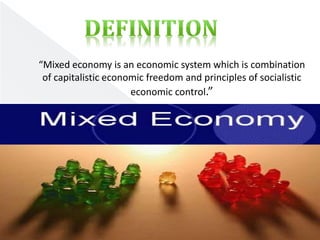
“Mixed economy is an economic system which is combination 
of capitalistic economic freedom and principles of socialistic 
economic control.”
 Mixed economy aroused when the two systems suffered failure 
and need of third system was felt. 
These failures are elaborated separately as: 
 Failure of capitalism 
 Failure of socialism
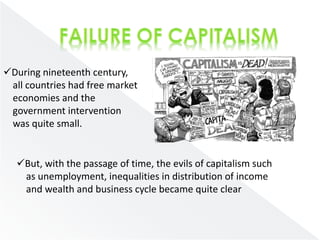
During nineteenth century, 
all countries had free market 
economies and the 
government intervention 
was quite small. 
But, with the passage of time, the evils of capitalism such 
as unemployment, inequalities in distribution of income 
and wealth and business cycle became quite clear
In the beginning of 20th century, 
some countries adopted socialism. 
But 
soon the drawbacks surfaced up. 
The rate of economic growth 
slowed down and people 
started resenting the loss of 
their personal freedom. 
Socialist economies failed to 
match the rapid progress in 
technology by capitalistic 
countries.
The term "mixed economy" arose in the 
context of political debate in the United 
Kingdom in the postwar period 
 Mixed economy is an economic 
system in which both the state and 
private sector direct the economy, 
reflecting characteristics of both 
market economies and planned 
economies.
 Supporters of the mixed economy : 
 R.H.Tawney 
 Anthony Crosland 
 Andrew Shonfield 
 Harold Macmillan. 
 Critics of British Mixed Economy: 
 Ludwig von Mises 
 Friedrich von Hayek
The making of mixed economy is divided into three different 
sections stated as follows: 
 Private Sector 
 Public Sector 
 Autonomous Bodies/Semi-Public Sector
 In economics the private sector is that part of the economy, 
sometimes referred to as the citizen sector, which is run by private 
individuals or groups, usually as a means of enterprise for profit, 
and is not controlled by the state.
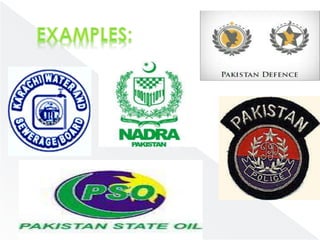
 The part of the economy concerned with providing basic 
government services to the public is called public sector. 
 The composition of the public sector varies by country, but in 
most countries the public sector includes such services as the 
police, military, public roads, public primary education and 
healthcare for the poor.
 Autonomous bodies are those in which public and private 
sector work together by merging their resources either to 
increase the efficiency or to supplement the deficiency of 
resources. 
 Still it does not mean that all autonomous bodies are 
efficient in their work. There is always possibility of lack of 
performance or inefficiency from public sector.
 The demerits of two economic systems acted as the 
initiative for the need of third economic system.
 Exploitation 
 Inequality of wealth distribution 
 Inappropriate use of productive 
resources 
 Emerging of monopolies 
 Unemployment
 Inefficiency 
 Consumers suffer 
 Economic inequality 
 Non existence of political and 
economic freedom 
 Non-existence of competition
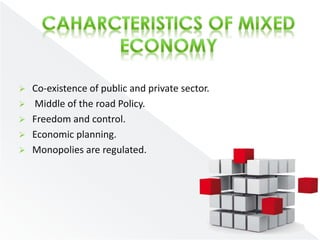
 Co-existence of public and private sector. 
 Middle of the road Policy. 
 Freedom and control. 
 Economic planning. 
 Monopolies are regulated.
 Efficient 
 Freedom of decision 
making of Consumer 
 Planned development 
 Increase in National 
Production
 Corruption 
 Fear of nationalization 
 Bureaucracy and red tapism 
 Conflict between public and 
private sector
Almost all the countries have mixed economy system. 
America is supposed to be the Capitalistic economy but role 
of government is also seen there. China is considered to be 
the Socialistic country but private sector also exists there. 
Pakistan 
India 
Scotland 
Australia 
Japan 
Germany 
UK
A mixed economy is a mix between socialism and 
capitalism. 
In this system the freedom in the economic activities are 
influenced by the Government's regulation and licensing 
policies.

Economic Systems - Mixed Economy

  • 2.
    “Mixed economy isan economic system which is combination of capitalistic economic freedom and principles of socialistic economic control.”
  • 3.
     Mixed economyaroused when the two systems suffered failure and need of third system was felt. These failures are elaborated separately as:  Failure of capitalism  Failure of socialism
  • 4.
    During nineteenth century, all countries had free market economies and the government intervention was quite small. But, with the passage of time, the evils of capitalism such as unemployment, inequalities in distribution of income and wealth and business cycle became quite clear
  • 5.
    In the beginningof 20th century, some countries adopted socialism. But soon the drawbacks surfaced up. The rate of economic growth slowed down and people started resenting the loss of their personal freedom. Socialist economies failed to match the rapid progress in technology by capitalistic countries.
  • 6.
    The term "mixedeconomy" arose in the context of political debate in the United Kingdom in the postwar period  Mixed economy is an economic system in which both the state and private sector direct the economy, reflecting characteristics of both market economies and planned economies.
  • 7.
     Supporters ofthe mixed economy :  R.H.Tawney  Anthony Crosland  Andrew Shonfield  Harold Macmillan.  Critics of British Mixed Economy:  Ludwig von Mises  Friedrich von Hayek
  • 8.
    The making ofmixed economy is divided into three different sections stated as follows:  Private Sector  Public Sector  Autonomous Bodies/Semi-Public Sector
  • 9.
     In economicsthe private sector is that part of the economy, sometimes referred to as the citizen sector, which is run by private individuals or groups, usually as a means of enterprise for profit, and is not controlled by the state.
  • 11.
     The partof the economy concerned with providing basic government services to the public is called public sector.  The composition of the public sector varies by country, but in most countries the public sector includes such services as the police, military, public roads, public primary education and healthcare for the poor.
  • 13.
     Autonomous bodiesare those in which public and private sector work together by merging their resources either to increase the efficiency or to supplement the deficiency of resources.  Still it does not mean that all autonomous bodies are efficient in their work. There is always possibility of lack of performance or inefficiency from public sector.
  • 15.
     The demeritsof two economic systems acted as the initiative for the need of third economic system.
  • 16.
     Exploitation Inequality of wealth distribution  Inappropriate use of productive resources  Emerging of monopolies  Unemployment
  • 17.
     Inefficiency Consumers suffer  Economic inequality  Non existence of political and economic freedom  Non-existence of competition
  • 18.
     Co-existence ofpublic and private sector.  Middle of the road Policy.  Freedom and control.  Economic planning.  Monopolies are regulated.
  • 19.
     Efficient Freedom of decision making of Consumer  Planned development  Increase in National Production
  • 20.
     Corruption Fear of nationalization  Bureaucracy and red tapism  Conflict between public and private sector
  • 21.
    Almost all thecountries have mixed economy system. America is supposed to be the Capitalistic economy but role of government is also seen there. China is considered to be the Socialistic country but private sector also exists there. Pakistan India Scotland Australia Japan Germany UK
  • 22.
    A mixed economyis a mix between socialism and capitalism. In this system the freedom in the economic activities are influenced by the Government's regulation and licensing policies.