ECNM 1115 CRN: 50878 G01
CRN: 51322 G03
Instructor: Dr Jean-Pierre Mulumba
1
Principles of Macroeconomics
Prof Jean-Pierre Mulumba Ph. D.
Principles of Macroeconomics
Agenda for today class
2
 Greeting
 Discussion of syllabus
 Introductions
 Limits, Alternatives, and Choices
Prof Jean-Pierre Mulumba Ph. D.
Syllabus Discussion
3 Prof Jean-Pierre Mulumba Ph. D.
Principles of Macroeconomics
Instructor:
4
 Jean-Pierre Mulumba, Ph.D.
 EMAIL: jp.mulumba@neu.edu
 PHONE #: 857 888 6490 (week days and working
hours)
 OFFICE HOURS: By appointment
Prof Jean-Pierre Mulumba Ph. D.
Principles of Macroeconomics
Schedule
5
 Class Meeting Times:
 Group 01: M and W: 13:30-15:10
 Location: Snell Library 002
 Group 03: M and W : 13:30-15:10
 Location: Ell Hall 411
Prof Jean-Pierre Mulumba Ph. D.
Principles of Macroeconomics
6
COURSE TEXT:
Required: Campbell McConnell, Stanley Brue, and Sean
Flynn, Macroeconomics, 20th Edition, McGraw-Hill, 2014,
ISBN 978-0-07-766062-8
Prof Jean-Pierre Mulumba Ph. D.
Principles of Macroeconomics
7
COURSE DESCRIPTION
 This course introduces macroeconomic analysis.
 It will study
 Flow of national income,
 Economic growth and fluctuations,
 Money and banking,
 Monetary and fiscal policies.
 It emphasizes on conceptual tools to analyze
economic problems
Prof Jean-Pierre Mulumba Ph. D.
Principles of Macroeconomics
Course Objectives
Prof Jean-Pierre Mulumba Ph. D.8
 Economics is the study of
 How to make choices
 How to reach decisions.
 This way of thinking involves the following
three objectives:
 To learn and remember the economics perspective:
 there are substitutes for everything
 every choice has costs and benefits: there’s no such thing
as a free lunch
 value is a function of scarcity
Principles of Macroeconomics
Course Objectives (continued
1)
Prof Jean-Pierre Mulumba Ph. D.9
 To become familiar with the economic tools:
 Market analysis
 Marginal analysis
 Costs
 To understand the economic objective:
 The efficient allocation of scarce resources
Principles of Macroeconomics
10
COURSE METHODOLOGY
 Class delivery format is lectures and discussions
 All students are expected to participate.
 Assessments:
 Three quizzes
 One midterm exam,
 Group project presentation,
 Final exam.
 Short assignment for every chapter.
 Included in student’s grade
Prof Jean-Pierre Mulumba Ph. D.
Principles of Macroeconomics
11
COURSE METHODOLOGY
(continued 1)
 During the semester, students are expected
to complete these duties:
• All readings assigned
• Participation in class discussions
• Preparation of papers/summaries
• Presentation of materials individually or in teams as
assigned
Prof Jean-Pierre Mulumba Ph. D.
Principles of Macroeconomics
12
COURSE METHODOLOGY
(continued 2)
 Group Presentation:
 Groups are constructed during the semester. group will be
required to select a research topic on a list of topics
presented by the instructor (suggestion: Current Issues in
Macroeconomics, Chapter 19). The group is constituted
during the second week of the semester. The group will
research articles from any source, NU databases, and
library resources to do a PowerPoint presentation on the
topic. The presentation should be about 20-25 minutes
followed by questions and answers. More information will
be forthcoming.
Prof Jean-Pierre Mulumba Ph. D.
Principles of Macroeconomics
Assignments Policy
13
• Assignments are due when specified.
• Assignments are due in writing form
emailed to me
• Please contact me as soon as possible if
any circumstance prevent you to achieve
the assignment.
Prof Jean-Pierre Mulumba Ph. D.
Principles of Macroeconomics
14
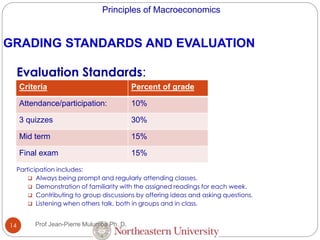
GRADING STANDARDS AND EVALUATION
Evaluation Standards:
http://www.youtube.com/watch?v=WVvKnq5XT-g
Participation includes:
 Always being prompt and regularly attending classes.
 Demonstration of familiarity with the assigned readings for each week.
 Contributing to group discussions by offering ideas and asking questions.
 Listening when others talk, both in groups and in class.
Criteria Percent of grade
Attendance/participation: 10%
3 quizzes 30%
Mid term 15%
Final exam 15%
Prof Jean-Pierre Mulumba Ph. D.
Principles of Macroeconomics
15
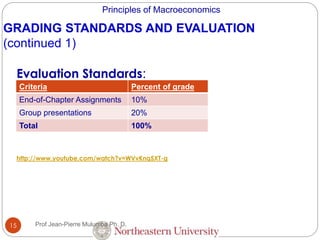
GRADING STANDARDS AND EVALUATION
(continued 1)
Evaluation Standards:
http://www.youtube.com/watch?v=WVvKnq5XT-g
Criteria Percent of grade
End-of-Chapter Assignments 10%
Group presentations 20%
Total 100%
Prof Jean-Pierre Mulumba Ph. D.
Principles of Macroeconomics
CLASSROOM POLICY
16
• Laptops, mobile phones and translation
machines are NOT allowed on your desk
during class.
• I will not tolerate any student not paying
attention, chatting with classmates, or
working on other assignments in class.
Prof Jean-Pierre Mulumba Ph. D.
Principles of Macroeconomics
Behavioral Expectations
17
 We require respecting each other
 We require being polite to each other
 Side personal conversations will not be accepted
 Speaking your native language in class is not
accepted
Prof Jean-Pierre Mulumba Ph. D.
Principles of Macroeconomics
Attendance and Tardiness Policies
18
 Class attendance is mandatory.
 Regular attendance is required to maintain legal
immigration status in the US.
 Regular attendance is essential to achieving a
passing grade in a course.
 Attendance is taken at the beginning of each
class.
 Arriving late in class by 5 minutes or more will be marked
absent for that day, unless the tardiness is excusable.
 It is the responsibility of the student to contact the
course Instructor in advance, in the event of an
excused absence.
Prof Jean-Pierre Mulumba Ph. D.
Principles of Macroeconomics
Attendance and Tardiness Policies
19
 Absence from class does not relieve a
student of responsibility for assignments.
 Class absences require documentation
where possible.
 Two unexcused absences will be flagged
with the Program Manager.
 Every subsequent absence will cause the
student’s final grade in the course to be
decreased one grade increment (i.e. B- to
C+).
Prof Jean-Pierre Mulumba Ph. D.
Principles of Macroeconomics
Course Guidelines-Absence for
Inclement Weather
Prof Jean-Pierre Mulumba, PH D.20
 What you have to do:
 Continue readings
 Complete all assignments as listed in the course outline
Principles of Macroeconomics
ACADEMIC HONESTY AND INTEGRITY
STATEMENT
 Academic dishonesty violates the most fundamental values of an
intellectual community and undermines your achievements.
 If you witness a violation of this policy you should report it to the
appropriate faculty member or the Office of Student Conduct &
Conflict Resolution (204 Ell Hall (617) 373-4390).
 Violations of this policy can lead to course failure, suspension
and even expulsion from the University.
 If a student feels that he or she has been wrongly accused he has
the right to appeal the charge to the body that first issued the
sanction
21 Prof Jean-Pierre Mulumba Ph. D.
Principles of Macroeconomics
ACADEMIC HONESTY AND INTEGRITY
STATEMENT (continued 1)
 Examples of academic dishonesty
 Cheating – intentionally using or attempting to use unauthorized materials,
information or study aids in an academic exercise. This includes unauthorized
use of notes, text, the Internet, or other aids during an exam or copying from
another student’s academic work for any assignment.
 Fabrication – intentional and unauthorized falsification, misrepresentation, or
invention of any data, or citation in an academic exercise. Examples may
include making up data for a research paper, altering the results of a lab
experiment or survey, listing a citation for a source not used, or stating an
opinion as a scientifically proven fact.
 Plagiarism – intentionally representing the words or ideas of another as one’s
own in any academic exercise without providing proper documentation.
22 Prof Jean-Pierre Mulumba Ph. D.
Principles of Macroeconomics
ACADEMIC HONESTY AND INTEGRITY
STATEMENT (Examples)
 Unauthorized collaboration – sharing analysis, interpretations, or reports for
individual academic work on take-home exams, case write-ups, lab reports,
and peer-related tasks.
 Participation in academically dishonest activities – Examples include stealing
an exam or using a pre-written paper; selling, loaning or otherwise
distributing materials for the purpose of cheating, plagiarism, or other
academically dishonest acts; destroying, altering, stealing, or forging another
student’s work, academic materials, or course grades.
 Facilitating academic dishonesty – intentional violation of any of these
provisions, which also includes making your work available for another to
resubmit for credit.
For a more detailed explanation of what constitutes a violation of academic
integrity, go to http://www.northeastern.edu/osccr/academichonesty.html
23 Prof Jean-Pierre Mulumba Ph. D.
Principles of Macroeconomics
COURSE OUTLINE
24 Prof Jean-Pierre Mulumba Ph. D.
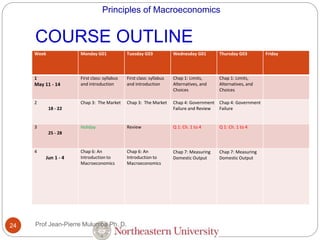
Week Monday G01 Tuesday G03 Wednesday G01 Thursday G03 Friday
1
May 11 - 14
First class: syllabus
and introduction
First class: syllabus
and introduction
Chap 1: Limits,
Alternatives, and
Choices
Chap 1: Limits,
Alternatives, and
Choices
2
18 - 22
Chap 3: The Market Chap 3: The Market Chap 4: Government
Failure and Review
Chap 4: Government
Failure
3
25 - 28
Holiday Review Q 1: Ch. 1 to 4 Q 1: Ch. 1 to 4
4
Jun 1 - 4
Chap 6: An
Introduction to
Macroeconomics
Chap 6: An
Introduction to
Macroeconomics
Chap 7: Measuring
Domestic Output
Chap 7: Measuring
Domestic Output
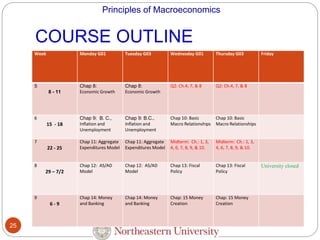
Principles of Macroeconomics
COURSE OUTLINE
25 Prof Jean-Pierre Mulumba Ph. D.
Week Monday G01 Tuesday G03 Wednesday G01 Thursday G03 Friday
5
8 - 11
Chap 8:
Economic Growth
Chap 8:
Economic Growth
Q2: Ch.4, 7, & 8 Q2: Ch.4, 7, & 8
6
15 - 18
Chap 9: B. C.,
Inflation and
Unemployment
Chap 9: B.C.,
Inflation and
Unemployment
Chap 10: Basic
Macro Relationships
Chap 10: Basic
Macro Relationships
7
22 - 25
Chap 11: Aggregate
Expenditures Model
Chap 11: Aggregate
Expenditures Model
Midterm: Ch.: 1, 3,
4, 6, 7, 8, 9, & 10.
Midterm: Ch.: 1, 3,
4, 6, 7, 8, 9, & 10.
8
29 – 7/2
Chap 12: AS/AD
Model
Chap 12: AS/AD
Model
Chap 13: Fiscal
Policy
Chap 13: Fiscal
Policy
University closed
9
6 - 9
Chap 14: Money
and Banking
Chap 14: Money
and Banking
Chap: 15 Money
Creation
Chap: 15 Money
Creation
Principles of Macroeconomics
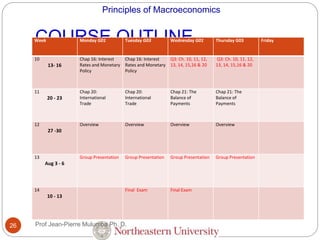
COURSE OUTLINE
26 Prof Jean-Pierre Mulumba Ph. D.
Week Monday G01 Tuesday G03 Wednesday G01 Thursday G03 Friday
10
13- 16
Chap 16: Interest
Rates and Monetary
Policy
Chap 16: Interest
Rates and Monetary
Policy
Q3: Ch. 10, 11, 12,
13, 14, 15,16 & 20
Q3: Ch. 10, 11, 12,
13, 14, 15,16 & 20
11
20 - 23
Chap 20:
International
Trade
Chap 20:
International
Trade
Chap 21: The
Balance of
Payments
Chap 21: The
Balance of
Payments
12
27 -30
Overview Overview Overview Overview
13
Aug 3 - 6
Group Presentation Group Presentation Group Presentation Group Presentation
14
10 - 13
Final Exam Final Exam
Principles of Macroeconomics
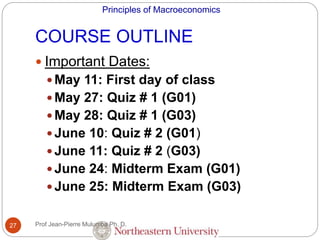
COURSE OUTLINE
27
 Important Dates:
 May 11: First day of class
 May 27: Quiz # 1 (G01)
 May 28: Quiz # 1 (G03)
 June 10: Quiz # 2 (G01)
 June 11: Quiz # 2 (G03)
 June 24: Midterm Exam (G01)
 June 25: Midterm Exam (G03)
Prof Jean-Pierre Mulumba Ph. D.
Principles of Macroeconomics
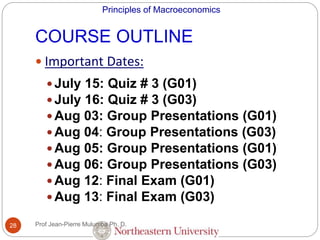
COURSE OUTLINE
28
 Important Dates:
 July 15: Quiz # 3 (G01)
 July 16: Quiz # 3 (G03)
 Aug 03: Group Presentations (G01)
 Aug 04: Group Presentations (G03)
 Aug 05: Group Presentations (G01)
 Aug 06: Group Presentations (G03)
 Aug 12: Final Exam (G01)
 Aug 13: Final Exam (G03)
Prof Jean-Pierre Mulumba Ph. D.
Self-Introduction
29 Prof Jean-Pierre Mulumba Ph. D.
Principles of Macroeconomics
Tell us --
30
• Your name
• Where you are from
• Where you have studied
• What you hope to study in the future
• What you have done in Boston,
• What you hope to do while you are here
• What you do for fun.
Prof Jean-Pierre Mulumba Ph. D.

Macro first day class

  • 1.
    ECNM 1115 CRN:50878 G01 CRN: 51322 G03 Instructor: Dr Jean-Pierre Mulumba 1 Principles of Macroeconomics Prof Jean-Pierre Mulumba Ph. D.
  • 2.
    Principles of Macroeconomics Agendafor today class 2  Greeting  Discussion of syllabus  Introductions  Limits, Alternatives, and Choices Prof Jean-Pierre Mulumba Ph. D.
  • 3.
    Syllabus Discussion 3 ProfJean-Pierre Mulumba Ph. D.
  • 4.
    Principles of Macroeconomics Instructor: 4 Jean-Pierre Mulumba, Ph.D.  EMAIL: jp.mulumba@neu.edu  PHONE #: 857 888 6490 (week days and working hours)  OFFICE HOURS: By appointment Prof Jean-Pierre Mulumba Ph. D.
  • 5.
    Principles of Macroeconomics Schedule 5 Class Meeting Times:  Group 01: M and W: 13:30-15:10  Location: Snell Library 002  Group 03: M and W : 13:30-15:10  Location: Ell Hall 411 Prof Jean-Pierre Mulumba Ph. D.
  • 6.
    Principles of Macroeconomics 6 COURSETEXT: Required: Campbell McConnell, Stanley Brue, and Sean Flynn, Macroeconomics, 20th Edition, McGraw-Hill, 2014, ISBN 978-0-07-766062-8 Prof Jean-Pierre Mulumba Ph. D.
  • 7.
    Principles of Macroeconomics 7 COURSEDESCRIPTION  This course introduces macroeconomic analysis.  It will study  Flow of national income,  Economic growth and fluctuations,  Money and banking,  Monetary and fiscal policies.  It emphasizes on conceptual tools to analyze economic problems Prof Jean-Pierre Mulumba Ph. D.
  • 8.
    Principles of Macroeconomics CourseObjectives Prof Jean-Pierre Mulumba Ph. D.8  Economics is the study of  How to make choices  How to reach decisions.  This way of thinking involves the following three objectives:  To learn and remember the economics perspective:  there are substitutes for everything  every choice has costs and benefits: there’s no such thing as a free lunch  value is a function of scarcity
  • 9.
    Principles of Macroeconomics CourseObjectives (continued 1) Prof Jean-Pierre Mulumba Ph. D.9  To become familiar with the economic tools:  Market analysis  Marginal analysis  Costs  To understand the economic objective:  The efficient allocation of scarce resources
  • 10.
    Principles of Macroeconomics 10 COURSEMETHODOLOGY  Class delivery format is lectures and discussions  All students are expected to participate.  Assessments:  Three quizzes  One midterm exam,  Group project presentation,  Final exam.  Short assignment for every chapter.  Included in student’s grade Prof Jean-Pierre Mulumba Ph. D.
  • 11.
    Principles of Macroeconomics 11 COURSEMETHODOLOGY (continued 1)  During the semester, students are expected to complete these duties: • All readings assigned • Participation in class discussions • Preparation of papers/summaries • Presentation of materials individually or in teams as assigned Prof Jean-Pierre Mulumba Ph. D.
  • 12.
    Principles of Macroeconomics 12 COURSEMETHODOLOGY (continued 2)  Group Presentation:  Groups are constructed during the semester. group will be required to select a research topic on a list of topics presented by the instructor (suggestion: Current Issues in Macroeconomics, Chapter 19). The group is constituted during the second week of the semester. The group will research articles from any source, NU databases, and library resources to do a PowerPoint presentation on the topic. The presentation should be about 20-25 minutes followed by questions and answers. More information will be forthcoming. Prof Jean-Pierre Mulumba Ph. D.
  • 13.
    Principles of Macroeconomics AssignmentsPolicy 13 • Assignments are due when specified. • Assignments are due in writing form emailed to me • Please contact me as soon as possible if any circumstance prevent you to achieve the assignment. Prof Jean-Pierre Mulumba Ph. D.
  • 14.
    Principles of Macroeconomics 14 GRADINGSTANDARDS AND EVALUATION Evaluation Standards: http://www.youtube.com/watch?v=WVvKnq5XT-g Participation includes:  Always being prompt and regularly attending classes.  Demonstration of familiarity with the assigned readings for each week.  Contributing to group discussions by offering ideas and asking questions.  Listening when others talk, both in groups and in class. Criteria Percent of grade Attendance/participation: 10% 3 quizzes 30% Mid term 15% Final exam 15% Prof Jean-Pierre Mulumba Ph. D.
  • 15.
    Principles of Macroeconomics 15 GRADINGSTANDARDS AND EVALUATION (continued 1) Evaluation Standards: http://www.youtube.com/watch?v=WVvKnq5XT-g Criteria Percent of grade End-of-Chapter Assignments 10% Group presentations 20% Total 100% Prof Jean-Pierre Mulumba Ph. D.
  • 16.
    Principles of Macroeconomics CLASSROOMPOLICY 16 • Laptops, mobile phones and translation machines are NOT allowed on your desk during class. • I will not tolerate any student not paying attention, chatting with classmates, or working on other assignments in class. Prof Jean-Pierre Mulumba Ph. D.
  • 17.
    Principles of Macroeconomics BehavioralExpectations 17  We require respecting each other  We require being polite to each other  Side personal conversations will not be accepted  Speaking your native language in class is not accepted Prof Jean-Pierre Mulumba Ph. D.
  • 18.
    Principles of Macroeconomics Attendanceand Tardiness Policies 18  Class attendance is mandatory.  Regular attendance is required to maintain legal immigration status in the US.  Regular attendance is essential to achieving a passing grade in a course.  Attendance is taken at the beginning of each class.  Arriving late in class by 5 minutes or more will be marked absent for that day, unless the tardiness is excusable.  It is the responsibility of the student to contact the course Instructor in advance, in the event of an excused absence. Prof Jean-Pierre Mulumba Ph. D.
  • 19.
    Principles of Macroeconomics Attendanceand Tardiness Policies 19  Absence from class does not relieve a student of responsibility for assignments.  Class absences require documentation where possible.  Two unexcused absences will be flagged with the Program Manager.  Every subsequent absence will cause the student’s final grade in the course to be decreased one grade increment (i.e. B- to C+). Prof Jean-Pierre Mulumba Ph. D.
  • 20.
    Principles of Macroeconomics CourseGuidelines-Absence for Inclement Weather Prof Jean-Pierre Mulumba, PH D.20  What you have to do:  Continue readings  Complete all assignments as listed in the course outline
  • 21.
    Principles of Macroeconomics ACADEMICHONESTY AND INTEGRITY STATEMENT  Academic dishonesty violates the most fundamental values of an intellectual community and undermines your achievements.  If you witness a violation of this policy you should report it to the appropriate faculty member or the Office of Student Conduct & Conflict Resolution (204 Ell Hall (617) 373-4390).  Violations of this policy can lead to course failure, suspension and even expulsion from the University.  If a student feels that he or she has been wrongly accused he has the right to appeal the charge to the body that first issued the sanction 21 Prof Jean-Pierre Mulumba Ph. D.
  • 22.
    Principles of Macroeconomics ACADEMICHONESTY AND INTEGRITY STATEMENT (continued 1)  Examples of academic dishonesty  Cheating – intentionally using or attempting to use unauthorized materials, information or study aids in an academic exercise. This includes unauthorized use of notes, text, the Internet, or other aids during an exam or copying from another student’s academic work for any assignment.  Fabrication – intentional and unauthorized falsification, misrepresentation, or invention of any data, or citation in an academic exercise. Examples may include making up data for a research paper, altering the results of a lab experiment or survey, listing a citation for a source not used, or stating an opinion as a scientifically proven fact.  Plagiarism – intentionally representing the words or ideas of another as one’s own in any academic exercise without providing proper documentation. 22 Prof Jean-Pierre Mulumba Ph. D.
  • 23.
    Principles of Macroeconomics ACADEMICHONESTY AND INTEGRITY STATEMENT (Examples)  Unauthorized collaboration – sharing analysis, interpretations, or reports for individual academic work on take-home exams, case write-ups, lab reports, and peer-related tasks.  Participation in academically dishonest activities – Examples include stealing an exam or using a pre-written paper; selling, loaning or otherwise distributing materials for the purpose of cheating, plagiarism, or other academically dishonest acts; destroying, altering, stealing, or forging another student’s work, academic materials, or course grades.  Facilitating academic dishonesty – intentional violation of any of these provisions, which also includes making your work available for another to resubmit for credit. For a more detailed explanation of what constitutes a violation of academic integrity, go to http://www.northeastern.edu/osccr/academichonesty.html 23 Prof Jean-Pierre Mulumba Ph. D.
  • 24.
    Principles of Macroeconomics COURSEOUTLINE 24 Prof Jean-Pierre Mulumba Ph. D. Week Monday G01 Tuesday G03 Wednesday G01 Thursday G03 Friday 1 May 11 - 14 First class: syllabus and introduction First class: syllabus and introduction Chap 1: Limits, Alternatives, and Choices Chap 1: Limits, Alternatives, and Choices 2 18 - 22 Chap 3: The Market Chap 3: The Market Chap 4: Government Failure and Review Chap 4: Government Failure 3 25 - 28 Holiday Review Q 1: Ch. 1 to 4 Q 1: Ch. 1 to 4 4 Jun 1 - 4 Chap 6: An Introduction to Macroeconomics Chap 6: An Introduction to Macroeconomics Chap 7: Measuring Domestic Output Chap 7: Measuring Domestic Output
  • 25.
    Principles of Macroeconomics COURSEOUTLINE 25 Prof Jean-Pierre Mulumba Ph. D. Week Monday G01 Tuesday G03 Wednesday G01 Thursday G03 Friday 5 8 - 11 Chap 8: Economic Growth Chap 8: Economic Growth Q2: Ch.4, 7, & 8 Q2: Ch.4, 7, & 8 6 15 - 18 Chap 9: B. C., Inflation and Unemployment Chap 9: B.C., Inflation and Unemployment Chap 10: Basic Macro Relationships Chap 10: Basic Macro Relationships 7 22 - 25 Chap 11: Aggregate Expenditures Model Chap 11: Aggregate Expenditures Model Midterm: Ch.: 1, 3, 4, 6, 7, 8, 9, & 10. Midterm: Ch.: 1, 3, 4, 6, 7, 8, 9, & 10. 8 29 – 7/2 Chap 12: AS/AD Model Chap 12: AS/AD Model Chap 13: Fiscal Policy Chap 13: Fiscal Policy University closed 9 6 - 9 Chap 14: Money and Banking Chap 14: Money and Banking Chap: 15 Money Creation Chap: 15 Money Creation
  • 26.
    Principles of Macroeconomics COURSEOUTLINE 26 Prof Jean-Pierre Mulumba Ph. D. Week Monday G01 Tuesday G03 Wednesday G01 Thursday G03 Friday 10 13- 16 Chap 16: Interest Rates and Monetary Policy Chap 16: Interest Rates and Monetary Policy Q3: Ch. 10, 11, 12, 13, 14, 15,16 & 20 Q3: Ch. 10, 11, 12, 13, 14, 15,16 & 20 11 20 - 23 Chap 20: International Trade Chap 20: International Trade Chap 21: The Balance of Payments Chap 21: The Balance of Payments 12 27 -30 Overview Overview Overview Overview 13 Aug 3 - 6 Group Presentation Group Presentation Group Presentation Group Presentation 14 10 - 13 Final Exam Final Exam
  • 27.
    Principles of Macroeconomics COURSEOUTLINE 27  Important Dates:  May 11: First day of class  May 27: Quiz # 1 (G01)  May 28: Quiz # 1 (G03)  June 10: Quiz # 2 (G01)  June 11: Quiz # 2 (G03)  June 24: Midterm Exam (G01)  June 25: Midterm Exam (G03) Prof Jean-Pierre Mulumba Ph. D.
  • 28.
    Principles of Macroeconomics COURSEOUTLINE 28  Important Dates:  July 15: Quiz # 3 (G01)  July 16: Quiz # 3 (G03)  Aug 03: Group Presentations (G01)  Aug 04: Group Presentations (G03)  Aug 05: Group Presentations (G01)  Aug 06: Group Presentations (G03)  Aug 12: Final Exam (G01)  Aug 13: Final Exam (G03) Prof Jean-Pierre Mulumba Ph. D.
  • 29.
  • 30.
    Principles of Macroeconomics Tellus -- 30 • Your name • Where you are from • Where you have studied • What you hope to study in the future • What you have done in Boston, • What you hope to do while you are here • What you do for fun. Prof Jean-Pierre Mulumba Ph. D.

Editor's Notes

  • #14 Note that we are required to send and receive all information and updates about NU Global through Husky Mail accounts. It is your responsibility to check this account daily to make sure you receive the new information and updates. Instructions for adding Husky Mail to mobile devices are given in the syllabus.
  • #17 You are expected to follow the following policies about the laptop, pagers, cell phones, food and beverages. Pagers, laptops should be turned off, and the cell phones should be set to vibrate mode during class. The use of electronic devices, like electronic dictionaries, is proscribed during this class, unless authorized by the instructor. No sleeping during the class.
  • #18 No use of your native language. Negative behavior and side personal conversations will not be accepted. In case of negative behavior, the student will get zero class participation points.
  • #19 You are expected to attend 100% of your classes for, at least two reasons: visa obligation, and achieving a passing grade. Attendance is taken at the beginning of each class. Coming late by 5 minutes or more will be marked absent for the day, unless if you have an excuse. Occasionally you may need to be absent, for example if you are sick or if you need to observe a religious holiday. It is the responsibility of the student to contact the course instructor in advance in the event of an excused absence.
  • #20 Absence from class does not relieve a student of responsibility for assignments. In the case of absence, the Program Management has a bunch of penalties' that you can find in the syllabus.
  • #22 For a more detailed explanation of what constitutes a violation of academic integrity, go to (http://www.northeastern.edu/osccr/academic-integrity-policy/).