ECONOMICS
It can explain everything
Overview
   Introduction            Public Goods
   Margins                 Fiscal Stimulus
   The Australian          International
    Economy                  Economics
     Basic   Concepts        Free  Trade
   Markets                   Institutions

     Outline                 Fair trade

     Failureand
     intervention
Introduction
   Economics is the study of choice
   At its heart, it seeks to answer what to do with
    scarce resources – what to produce, how to
    produce, and who gets the results
   Economics in debating is often more about a
    way of thinking than about bringing a particular
    argument
   Economics in debating often involves looking
    at the affects on individuals or groups in terms
    of changing their incentives to engage in
    certain activities
Margins
   Economics is all about the margins, or what
    happens to people who are “on the edge”
     Eg,   Baby Bonus
   Policies are rarely going to affect everyone;
    worth thinking about who specifically they
    affect
   This applies not only in economics but in all
    debates
     Eg   Death Penalty debates
The Australian Economy
   Unusual, in that a large part is primary
    products
     Major trading partners include China, Japan, US,
      South Korea, New Zealand, India
   Significant services sector
   Generally deregulated
   Independent Monetary Policy (interest rates)
   Moderate Welfare State
   Governments are willing to be interventionist
     Active   fiscal stimulus
Australian Economy: Basic
Concepts
   Inflation: Rise in average prices
     Badbecause it erodes wealth, but needed to
     ensure a moderate level of activity
   Unemployment: People without jobs, who
    want one
   Interest Rates (monetary policy): “Cost” of
    money
     Used   to moderate economic activity
   Economic Activity: stuff being produced and
    consumed – “trickle down”
   Fiscal Policy: Government spending and
Markets
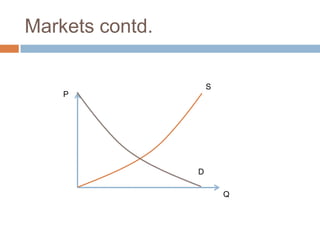
   Basic capitalist theory is that producers supply
    more as price increases, and consumers
    demand more as price decreases
   These two effects work together to come up
    with some price that equates the number of
    buyers and sellers in a market
   Often referred to as the “efficient outcome”, or
    “perfectly competitive market”
Markets contd.
   Price is particularly important
   It acts as a signal to buyers and sellers about
    how they should react
   It’s important not only within markets, but
    between them as well
          Investment in renewable energy – or not
     E.g.:
      needed?
   Competition is meant to spur innovation and
    lead to low prices
Markets contd.

                     S
    P


                 D

                         Q
Markets contd.
   Since markets lead to the “right” amount of
    production, people are often loathe to interfere
    with them
   Anything that leads to an outcome other than
    the market outcome is traditionally seen as
    inefficient
     Thisis because there are transactions that would
      have taken place that aren’t happening
   Examples – tariffs, quotas, price restrictions
Market Failure and Intervention
   However, markets don’t actually work like that
   Markets fail for a variety of reasons (usually
    because one of the assumptions underlying
    them doesn’t hold up):
     Perfect  information
     Infinite buyers/sellers
     Perfect mobility of capital
     Perfect rationality
     No external effects

   The extent to which they fail is usually the
    extent to which one of the assumptions breaks
    down
Market Failure and Intervention
   Intervention is designed to fix one of the
    problems above – though in some cases it
    may not be the best way to resolve the
    problem
   Debates are commonly about whether to
    intervene in a market to imperfectly solve a
    problem, or whether a problem is best left to
    the market to come up with its own imperfect
    solution
Information Asymmetry
   Fancy way of saying some people know stuff
    and other people don’t
     E.g.,   Insider Trading
   Solution: Regulation
   Two other interesting types:
     Adverse    Selection: People offering themselves
      for selection are the ones you don’t want to select
      (eg: cars)
     Moral Hazard: People act differently when
      insured against risk (eg: bailouts)
   Solution: ??
Monopolies/Duopoly/Cartels
   Exactly like the game
   One seller, charges a higher price than
    otherwise
   Eg Telstra
   Can be natural or otherwise
   Eg, OPEC
   Solutions: Government Regulation
   Other examples
Externalities
   Occur when a third party is affected by some
    economic transaction, and their welfare is not
    taken into account – may be positive or
    negative
   Means that market outcomes may not be
    efficient
   Eg, pollution
   Solution: Regulate/ban/subsidise/make
    mandatory
   However, these may also present
    opportunities for “market based” solutions
     Taxes
Self-Correction?
   Most solutions are imperfect, in some way or
    another
     Eg   Taxes on Pollution
   Markets may come up with their own solution
     Eg   Job Market
   Just because the Government can intervene,
    doesn’t mean it will be better or that it should
   Other examples
Public Goods
   A public good is a good that is non-excludable
    and non-rivalrous in consumption
     That  is, people cannot be excluded from its
      benefits
     Further, it means that once it is provided, it is
      provided whether one person consumes the good
      or a thousand people consume the good
   Examples include national defence, free-to-air
    TV, disease control, levees, lighthouses, and
    education (to a certain extent)
   Because of the effects, people have an
Public Goods contd.
   Public goods are an important concept – they
    describe how goods that people value may not
    get created, because everybody wants
    somebody else to do the hard work
   Also, they describe how a good’s cost may not
    be accurately reflected, as the benefits are
    wide-reaching
   Other examples
Fiscal Stimulus
   Involves trying to get money moving
   Monetary is better, but most people agree in
    the absence of this fiscal policy should take
    place
   Criteria is generally:
     Credible role for Government
     Timely – works quickly

     Targeted – gets spent, and spent effectively

     Temporary – not locking in the Government

   Often trade-offs involved
     Eg   Infrastructure
Free Trade
   Free trade works on the same basic economic
    principles – transactions that occur are
    mutually beneficial, and that these
    transactions can occur across national borders
   Often these transactions allow for new
    possibilities as different countries have
    different capabilities
     Comparativeadvantage – should David Beckham
     mow his own lawn?
   The notion is that free trade allows for
    economic growth as well, which leads to
Free Trade
   However, Governments don’t always do this
   Arguments against pure free trade generally
    focus on less economic concerns, though not
    always
     Infant Industries
     Political considerations

   Protectionism generally benefits a few people
    a lot, and costs most people a little bit
   Important to think about who wins/loses, and
    how
International Economics -
Institutions
   Governed largely by the WTO, IMF, World
    Bank
   Seen to be from the neo-classical school
   Have come under fire for policies that are seen
    to disregard social issues
   Generally focused on liberalisation (reducing
    barriers to markets functioning)
   This sometimes has negative outcomes – for
    example, IMF structural adjustment programs
Fair Trade
   A reaction to the free trade movement
   Looks to pay a “living wage”
     Paying   people sufficiently to allow them to live
     well
   Does this by setting a minimum price for
    commodities, which tend to fluctuate
   Leads to higher prices for products
   Seen as socially responsible
   However, has its own market distorting effects
    – effectively a price floor

Economics

  • 1.
  • 2.
    Overview  Introduction  Public Goods  Margins  Fiscal Stimulus  The Australian  International Economy Economics  Basic Concepts  Free Trade  Markets  Institutions  Outline  Fair trade  Failureand intervention
  • 3.
    Introduction  Economics is the study of choice  At its heart, it seeks to answer what to do with scarce resources – what to produce, how to produce, and who gets the results  Economics in debating is often more about a way of thinking than about bringing a particular argument  Economics in debating often involves looking at the affects on individuals or groups in terms of changing their incentives to engage in certain activities
  • 4.
    Margins  Economics is all about the margins, or what happens to people who are “on the edge”  Eg, Baby Bonus  Policies are rarely going to affect everyone; worth thinking about who specifically they affect  This applies not only in economics but in all debates  Eg Death Penalty debates
  • 5.
    The Australian Economy  Unusual, in that a large part is primary products  Major trading partners include China, Japan, US, South Korea, New Zealand, India  Significant services sector  Generally deregulated  Independent Monetary Policy (interest rates)  Moderate Welfare State  Governments are willing to be interventionist  Active fiscal stimulus
  • 6.
    Australian Economy: Basic Concepts  Inflation: Rise in average prices  Badbecause it erodes wealth, but needed to ensure a moderate level of activity  Unemployment: People without jobs, who want one  Interest Rates (monetary policy): “Cost” of money  Used to moderate economic activity  Economic Activity: stuff being produced and consumed – “trickle down”  Fiscal Policy: Government spending and
  • 7.
    Markets  Basic capitalist theory is that producers supply more as price increases, and consumers demand more as price decreases  These two effects work together to come up with some price that equates the number of buyers and sellers in a market  Often referred to as the “efficient outcome”, or “perfectly competitive market”
  • 8.
    Markets contd.  Price is particularly important  It acts as a signal to buyers and sellers about how they should react  It’s important not only within markets, but between them as well Investment in renewable energy – or not  E.g.: needed?  Competition is meant to spur innovation and lead to low prices
  • 9.
  • 10.
    Markets contd.  Since markets lead to the “right” amount of production, people are often loathe to interfere with them  Anything that leads to an outcome other than the market outcome is traditionally seen as inefficient  Thisis because there are transactions that would have taken place that aren’t happening  Examples – tariffs, quotas, price restrictions
  • 11.
    Market Failure andIntervention  However, markets don’t actually work like that  Markets fail for a variety of reasons (usually because one of the assumptions underlying them doesn’t hold up):  Perfect information  Infinite buyers/sellers  Perfect mobility of capital  Perfect rationality  No external effects  The extent to which they fail is usually the extent to which one of the assumptions breaks down
  • 12.
    Market Failure andIntervention  Intervention is designed to fix one of the problems above – though in some cases it may not be the best way to resolve the problem  Debates are commonly about whether to intervene in a market to imperfectly solve a problem, or whether a problem is best left to the market to come up with its own imperfect solution
  • 13.
    Information Asymmetry  Fancy way of saying some people know stuff and other people don’t  E.g., Insider Trading  Solution: Regulation  Two other interesting types:  Adverse Selection: People offering themselves for selection are the ones you don’t want to select (eg: cars)  Moral Hazard: People act differently when insured against risk (eg: bailouts)  Solution: ??
  • 14.
    Monopolies/Duopoly/Cartels  Exactly like the game  One seller, charges a higher price than otherwise  Eg Telstra  Can be natural or otherwise  Eg, OPEC  Solutions: Government Regulation  Other examples
  • 15.
    Externalities  Occur when a third party is affected by some economic transaction, and their welfare is not taken into account – may be positive or negative  Means that market outcomes may not be efficient  Eg, pollution  Solution: Regulate/ban/subsidise/make mandatory  However, these may also present opportunities for “market based” solutions  Taxes
  • 16.
    Self-Correction?  Most solutions are imperfect, in some way or another  Eg Taxes on Pollution  Markets may come up with their own solution  Eg Job Market  Just because the Government can intervene, doesn’t mean it will be better or that it should  Other examples
  • 17.
    Public Goods  A public good is a good that is non-excludable and non-rivalrous in consumption  That is, people cannot be excluded from its benefits  Further, it means that once it is provided, it is provided whether one person consumes the good or a thousand people consume the good  Examples include national defence, free-to-air TV, disease control, levees, lighthouses, and education (to a certain extent)  Because of the effects, people have an
  • 18.
    Public Goods contd.  Public goods are an important concept – they describe how goods that people value may not get created, because everybody wants somebody else to do the hard work  Also, they describe how a good’s cost may not be accurately reflected, as the benefits are wide-reaching  Other examples
  • 19.
    Fiscal Stimulus  Involves trying to get money moving  Monetary is better, but most people agree in the absence of this fiscal policy should take place  Criteria is generally:  Credible role for Government  Timely – works quickly  Targeted – gets spent, and spent effectively  Temporary – not locking in the Government  Often trade-offs involved  Eg Infrastructure
  • 20.
    Free Trade  Free trade works on the same basic economic principles – transactions that occur are mutually beneficial, and that these transactions can occur across national borders  Often these transactions allow for new possibilities as different countries have different capabilities  Comparativeadvantage – should David Beckham mow his own lawn?  The notion is that free trade allows for economic growth as well, which leads to
  • 21.
    Free Trade  However, Governments don’t always do this  Arguments against pure free trade generally focus on less economic concerns, though not always  Infant Industries  Political considerations  Protectionism generally benefits a few people a lot, and costs most people a little bit  Important to think about who wins/loses, and how
  • 22.
    International Economics - Institutions  Governed largely by the WTO, IMF, World Bank  Seen to be from the neo-classical school  Have come under fire for policies that are seen to disregard social issues  Generally focused on liberalisation (reducing barriers to markets functioning)  This sometimes has negative outcomes – for example, IMF structural adjustment programs
  • 23.
    Fair Trade  A reaction to the free trade movement  Looks to pay a “living wage”  Paying people sufficiently to allow them to live well  Does this by setting a minimum price for commodities, which tend to fluctuate  Leads to higher prices for products  Seen as socially responsible  However, has its own market distorting effects – effectively a price floor