Environment.
• The Sumof total of all biotic (Connected with living beings
and abiotic (connected with nonliving) factors, substance
and conditions that surround and Potentially influence
organisms without be coming their constituent Part.
• Ecology: Subject which studies the Interactions among
organisms between the organism and its Physical (abiotic)
environment. Term ecology Coined Combining two Greek
words, oikos ('house' or dwelling Places) and logos (study)
3.
• Biosphere! BiologicalComponent (Supporting life) of earth
which includes the lithosphere hydrosphere and
atmosphere.
• ECOSYSTEM:
Structural and functional Unit of biosphere Consisting
of Community of living being and Physical environment both
interacting and exchanging material between them.
4.
Bio sphere (lifecan possible
• Lithosphere –land
• Hydrosphere-water
• Atmosphere -Air
5.
Habitats
• The placewhere an organism likes where one would go to
find the particular organism is known as the habitat of that
organism. The habitat of an organism actually represents a
Particular set of environmental Conditions suitable for its
successful growth. (All habitats are environments, but all
environments are not habitats.
6.
• Ecological Niche:The term niche was first time used by
GrinnelHabitat(1917) to explain the microhabitats. Ecological
niche of an organisms include the physical space occupied
by it its functional role in the community that is trophic
position and its position in environment gradient or
temperature moisture pH soil etc. and the conditions of
resistance
• no two species of agent identical Niche.
7.
• Ecotone:A transitionalarea of vegetation between two
different Plant Communities, such as forest and
grasslands.
• It has some of the Characteristics of each bordering
biological community and often Contains Species that not
found in the overlapping Communities- Eg. Mangroves
represent ecosystem. an ecosystem between marine and
terrestrial ecosystems .
8.
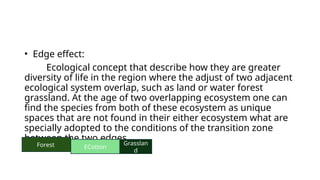
• Edge effect:
Ecologicalconcept that describe how they are greater
diversity of life in the region where the adjust of two adjacent
ecological system overlap, such as land or water forest
grassland. At the age of two overlapping ecosystem one can
find the species from both of these ecosystem as unique
spaces that are not found in their either ecosystem what are
specially adopted to the conditions of the transition zone
between the two edges.
Forest ECotton
Grasslan
d
9.
ECAD
• An Ecardof a plant species is a population of the individuals
which all the belong to the same genetic stock but differ
markedly lay in vegetive characters such as size shape
number of leaves etc.
• These vareatiare reversible as one type of ecard may change
into another with the change in its habitat changes are
reversible irreversible.
10.
Ecotype
• A populationin individuals a species which are genetically
different since different ecotypes are interfertile these are
kept under the same taxonomic spaces .They are variation
are permanently and irreversible as these are genetically
fixed.
11.
Deep ecology
• Deepecology that an environmental philosophy that prove
that promotes the Ethernet worth of all living beings
regardless of their instrumental utility to human needs and
the restricting of a modern societies in according of modern
human societies in accordance with such as ideas tree
planting and the man made forest are example of Deep
ecology
12.
Ecological equivalents
• Organismsthat occupy the same or similar ecological list in
the different geographical region are known as ecological
equivalents example kangaroos of Australia ecologically
equivalent to the bision of North American
13.
Character displacement
• Theterm used to describe
an evolutionary change that
occurs when two similar
species inhabit the same
environment under the such
condition natural selection
favours a divergence in the
character morphology
ecology behaviour or
physiology of the
organisms.
14.
• Population agroup of individual
organisms of the same species
in a given area.
• Spaces uniform interbreeding
population spread over the time
and space.
• community a group of a
population of different species in
a given area has includes all the
population in that area all plants
animals and microorganisms
15.
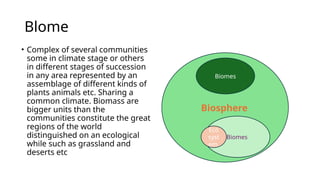
Blome
• Complex ofseveral communities
some in climate stage or others
in different stages of succession
in any area represented by an
assemblage of different kinds of
plants animals etc. Sharing a
common climate. Biomass are
bigger units than the
communities constitute the great
regions of the world
distinguished on an ecological
while such as grassland and
deserts etc
Biosphere
Biomes
Eco
syst
em
Biomes
16.
Biological spectrum
• Therelative numbers of a
plant species for biological
type aetophytes,
hydrophytes phanerophytes
etc occurring in a particular
ecosystem is expressed as a
percentage of total.
17.
Ecological efficiency
• Ecologicalefficiency
describe the efficiency with
energy is transferred from
one tropic levels in the
grazing food chain easy
restricted as the transfer of
the energy follows 10% low
only 10% of the energy is
transferred to each trophic
level from the lower tropic
level.
18.
Keystone species
• Speciesthat place on
essential role in the
structure functioning or
produced productivity of a
habitat or the ecosystem.
Disappearance of such
species may lead to the
significant and
disproportionate effect on
the ecosystem as compared
to the other species.
19.
Indicator species
• Speciesor the group of
species chosen as an
indicator of or the proxy for
the state of an ecosystem or
an certain process within
that ecosystem.
20.
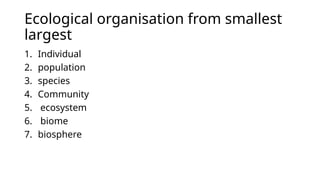
Ecological organisation fromsmallest
largest
1. Individual
2. population
3. species
4. Community
5. ecosystem
6. biome
7. biosphere
21.
Difference between floraand
vegetation
• Flora it is the species
content the region
irrespective of the numerical
strength of each species
• Vegetation
the collective and
continuous growth of a plants
in space region
22.
Major abiotic factors
•I am waiting factor is non
living part of an ecosystem
that’s saves its environment.
• In a terrestrial ecosystem it
included temperature light
and water .
• In a Marine ecosystem
ability factors would include
salinity and ocean currents.
23.
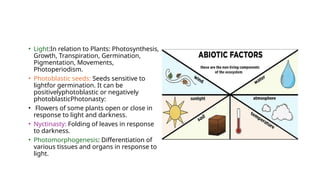
Abiotic factors
• Theseare non living
component of the
ecosystem.
• Wind sunlight soil water
atmosphere and
temperature.
24.
Water
• Hydrophytes
The plantsof the aquatic
habitats are called hydrophytes
they are possesses parenchyma
to support themselves in water .
• Mesophytes
Terrestrial plans which are
neither adapted to particularly
dry nor particular weight
environment.
25.
• Xerophytes:
the plantof dry aerial areas
are called xerophytes they
developed modification to
increase the water
observation to reduce the
transpiration etc.
26.
• Halophytes:
salt tolerantplants that
grow on soil or waters of an
high salinity such as
mangroves swamps marshes
sea source and saline semi
deserts.
27.
• Pneumatophores:
Lateral rootsthat extend
out of the surface of the water
and facilitate the exchange of
Oxygen and carbon dioxide
for the roots submerged in
water they are specialised
aerial root structure present in
the plants where the oxygen
required for the normal
respiration rules in adequate.
28.
RESPONSE TO ABIOTICFACTORS
• Resistance
RESPONSE TO ABIOTIC
FACTORSDormancy: Dormancy is a
widelyrecognized behavioral and
physiological state of both animals and
plants generally involve inactivity and
reduced metabolic rate
Hibernation: Way animals conserve energy
to survive adverse weather conditions or lack
of food. It involves physiological changes
such as a drop-in body temperature and
slowed metabolism. Hibernation is a type of
dormancy, but not all dormant animals
hibernate. That's because hibernation is a
really specific kind of dormancy.
29.
• Biosphere: biological
component(supporting life) of
earth which includes the
lithosphere, hydrosphere and
atmosphere
• Ecosystem: Structural and
functional unit of biosphere
consisting of community of
living beings and the physical
environment, both interacting
and exchanging materials
between them.BIOSPHERE 小
30.
• Habitat: Theplace where an
organism livesor the place
where one would go to find the
particular organism is known
as the habitat of that organism.
The habitat of an organism
actually represents a particular
set of environmental conditions
suitable for its successful
growth. (All habitats are
environments, but all
environments are not habitats.)
31.
• Ecological Niche:term niche was
first time used by Grinnel (1917)
to explain microhabitats.
Geological niche of an organism
includes the physical space
occupied by it, its functional role
in the community i.e. trophic
position, and its position in
environment gradients of
temperature, moisture, pH, soil
etc. and the conditions of
existence. No two species have
exact identical niche.
32.
• Ecotype: Apopulation of individuals of a
species, which are genetically different.
Since different ecotypes are interfertile,
these are kept under the same
taxonomic species. Their variations are
permanent and irreversible as these are
genetically fixed.
• Deep ecology: an environmental
philosophy that promotes the inherent
worth of all living beings regardless of
their instrumental utility to human
needs, and the restructuring of modern
human societies in accordance with such
ideas. Tree planting and man-made
forests are examples of deep ecology.
33.
• Light:In relationto Plants: Photosynthesis,
Growth, Transpiration, Germination,
Pigmentation, Movements,
Photoperiodism.
• Photoblastic seeds: Seeds sensitive to
lightfor germination. It can be
positivelyphotoblastic or negatively
photoblasticPhotonasty:
• Flowers of some plants open or close in
response to light and darkness.
• Nyctinasty: Folding of leaves in response
to darkness.
• Photomorphogenesis: Differentiation of
various tissues and organs in response to
light.
34.
• Light:0.Heliophytes: Plants
whichare adapted tolive under
plenty of sunlight are called
heliophytes. e.g. banyan.
Heliophytes form the roof of a
forest.
• Sciophytes: Plants which are
adapted to liveunder low light
conditions are called
sciophytes, e.g herbs.
Sciophytes form the understory
of a forest.