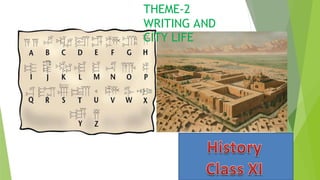
THEME-2
WRITING AND
CITY LIFE
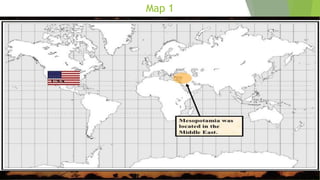
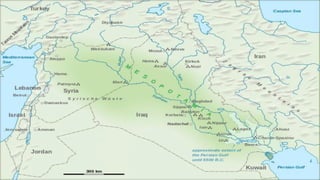
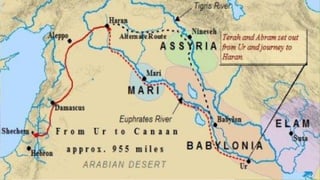
Map 1
2.WRITING AND CITY LIFE
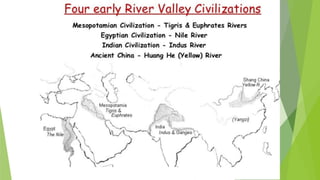
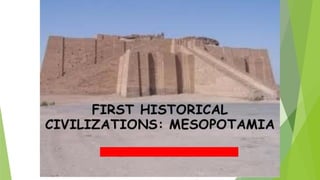
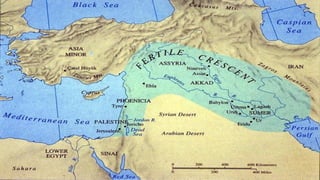
• City life began in Mesopotamia, the land
between the Euphrates and the Tigris rivers
that is now part of the Republic of Iraq.
• The name Mesopotamia is derived from the
Greek words mesos, meaning middle, and
potamas, meaning river.
• In the beginning of recorded history, the land,
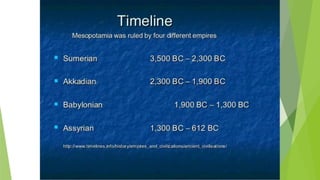
mainly the urbanized south, was called Sumer
and Akkad. After 2000 BC, when Babylon
became an important city, the term Babylonia
was used for the southern region.
Writing and city life
 From about 1100 BC, when the Assyrians established
their kingdom in the north, the region became known
as Assyria.
 The first known language of the land was Sumerian.
Writing and city life
 Archaeology began in Mesopotamia in the 1840s.
At one or two sites, including Urukk and Mari,
excavations continued for decades. Not only can
we study hundreds of Mesopotamian buildings,
statues, ornaments, graves, tools and seals as
sources, there are thousands of written
documents.
 Mesopotamia was important to Europeans because
of references to it in the Old Testament, the first
part of the Bible.
Mesopotamia and its Geography
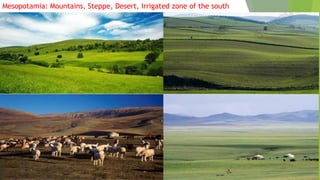
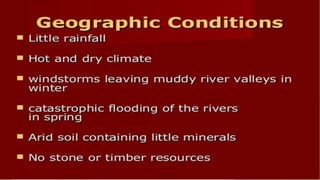
 Iraq is a land of diverse environments.
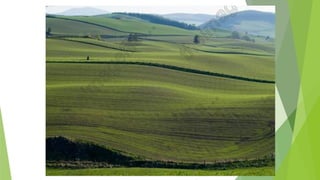
 North-east : green, tree covered mountain ranges with clear
streams and wild flowers, with enough rainfall to grow crops.
Here agriculture began between 7000 and 6000 BC.
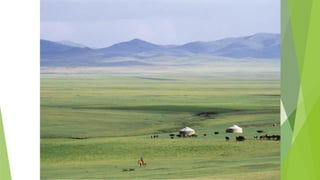
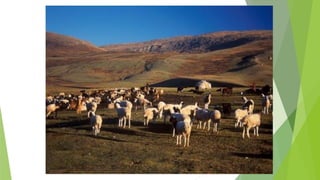
 North : stretch of upland called steppe, where animal herding
offers people a better livelihood than agriculture.
 East : tributaries of the Tigris provide routes of
communication in to the mountains of Iran.
 South : Desert-land this is where the first cities and writing
emerged. This desert could support cities because the rivers
Euphrates and Tigris, which rise in the northern mountains,
carry loads of silt (fine mud). When they flood or when their
water is let out on the fields, fertile silt is deposited.
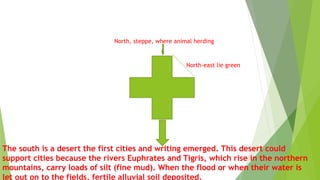
North, steppe, where animal herding
North-east lie green
The south is a desert the first cities and writing emerged. This desert could
support cities because the rivers Euphrates and Tigris, which rise in the northern
mountains, carry loads of silt (fine mud). When the flood or when their water is
let out on to the fields, fertile alluvial soil deposited.
Mesopotamia: Mountains, Steppe, Desert, Irrigated zone of the south
Mesopotamia and its Geography
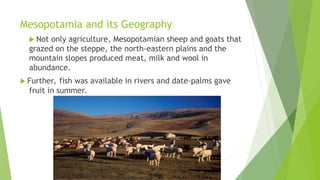
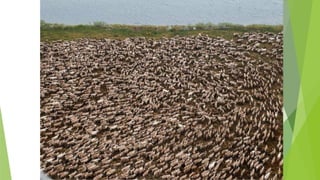
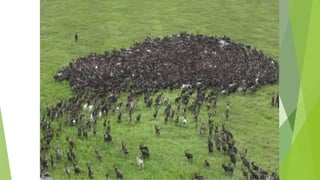
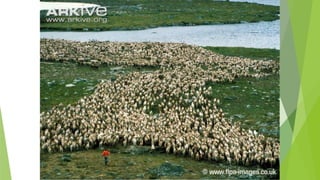
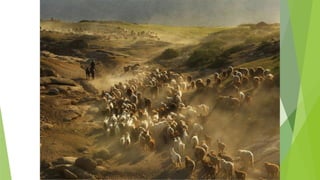
 Not only agriculture, Mesopotamian sheep and goats that
grazed on the steppe, the north-eastern plains and the
mountain slopes produced meat, milk and wool in
abundance.
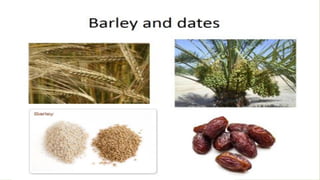
 Further, fish was available in rivers and date-palms gave
fruit in summer.
The significance of Urbanism
 The earliest cities in Mesopotamia date back to the Bronze age
(3000 BC).Bronze is an alloy of copper and tin.
 Cities and towns are not just places with large populations. It is
when an economy develops in spheres other than food
production that it becomes an advantage for people to cluster
in towns.
 Urban economies comprise besides food production, trade,
manufactures and service.
 City people were not self sufficient. The carver of stone seal
requires bronze tools, coloured stones.
 The bronze tool maker needs metals, charcoal. So they depend
on the products or services of other people.
 The division of labour is a mark of urban life.
The Significance of Urbanisation
There must be a social organisation in cities.
Fuel, metal, various stones, wood etc. come
from many places for city manufacturers
There are deliveries of grain and other food
items from the village to the city.
Thus organized trade and storage is needed.
In such a system some people commands and
those others obey.
Urban economies often require the keeping of
written records .
Movement of Goods into cities
 Food resources were abundant in Mesopotamia but
lacked stones, wood, metal.
 So they imported wood, copper, tin, silver, gold,
shell, stones from Turkey and Iran.
 They exported their textiles and food resources.
 Transport is also important for urban development.
 The canals and natural channels were routes for
goods transport.
 Euphrates became a world route.
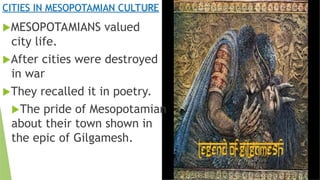
CITIES IN MESOPOTAMIAN CULTURE
MESOPOTAMIANS valued
city life.
After cities were destroyed
in war
They recalled it in poetry.
The pride of Mesopotamian
about their town shown in
the epic of Gilgamesh.
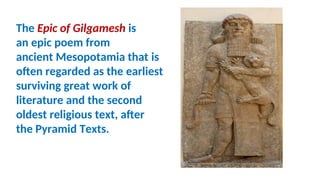
The Epic of Gilgamesh is
an epic poem from
ancient Mesopotamia that is
often regarded as the earliest
surviving great work of
literature and the second
oldest religious text, after
the Pyramid Texts.
The Development of Writing
A script, we mean that
spoken sounds are
represented in visible signs.
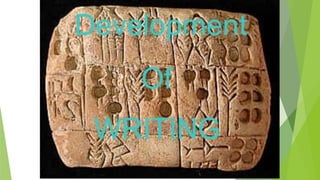
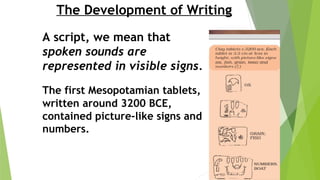
The first Mesopotamian tablets,
written around 3200 BCE,
contained picture-like signs and
numbers.
The Development of Writing
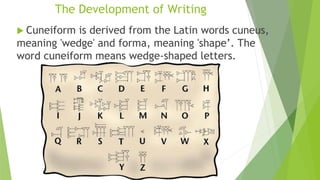
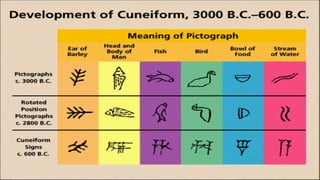
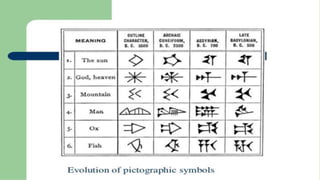
 Cuneiform is derived from the Latin words cuneus,
meaning 'wedge' and forma, meaning 'shape’. The
word cuneiform means wedge-shaped letters.
The Development of Writing
The Mesopotamian tablets
contained picture like signs and
numbers.
Writing began in Mesopotamia in 3200
BCE.
Writing began when society needed to
keep record of transactions.
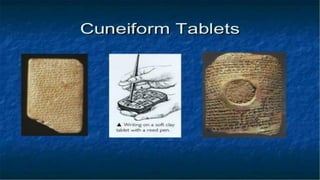
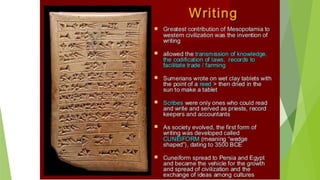
Mesopotamians wrote on tablets of clay.
Scribe would impress wedge shaped signs
on wet clay with the sharp end of a reed.
The Development of Writing
Once written, tablets were dried hard in the
sun and it would be almost indestructible(long lasting).
Once it dried, signs could not be pressed on
to a tablet.
So each transaction required a separate
written tablet.
This is why tablets occur by the hundreds at
Mesopotamian sites.
By 2600 BCE the letters became cuneiform
and language was Sumerian.
Writing was used for,
1.keeping records.
2.making dictionaries.
3.giving legal validity to land transfers.
4.narrating the deeds of kings.
5.announcing the changes a king had
made in the customary laws of the land
6. Storing information and of sending
messages
The System of Writing
The sound that a cuneiform sign represented
was not a single consonant or vowel but
syllables.
Thus the scribe had to learn hundreds of signs.
He had to handle a wet tablet and get it written
before it dried.
So writing was a skilled craft It conveys visual
form of system of sounds of a particular
language.
Literacy
King and Very few could read and write.
There were hundreds of signs to learn and
many of these were complex.
If a king could read, that was recorded in
his boastful(exhibitting self importance) inscriptions.
Writing reflected the mode of speaking.
It was kingship that organised trade and
writing
Urbanisation in Southern Mesopotamia:
Temples and Kings
By 5000 BCE, Settlements began in
Mesopotamia. The earliest cities emerged
from some of these settlements.
There were three kinds of cities
1. Cities that developed around temples
2. Cities that developed as centres of trade
3. Imperial cities
Construction and Maintenance of Temples in
Mesopotamia
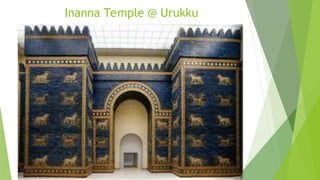
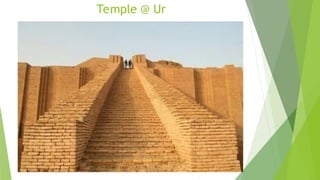
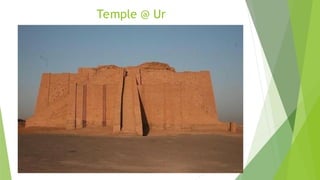
 The earliest known temple was a small shrine
made of unbaked bricks.
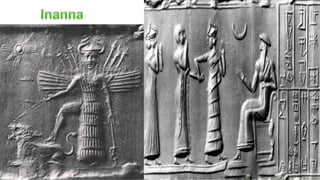
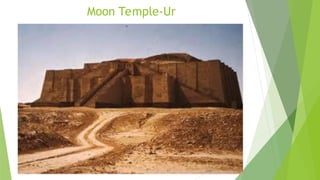
• Temples were the residence of various gods:
Moon God of Ur and for Inanna the Goddess of
Love and Wa r.
• Temples became larger over time with several
rooms around open courtyards.
Temples always had their outer walls going in
and out at regular intervals.
• The god was the focus of worship.
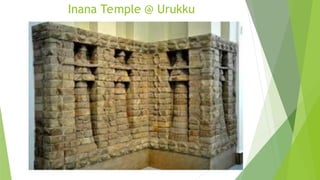
Inana Temple @ Urukku
Inanna Temple @ Urukku
Temple @ Ur
Temple @ Ur
Moon Temple-Ur
Construction and Maintenance of Temples in
Mesopotamia
 The god was the theoretical owner of the
agricultural fields, the fisheries, and the herds of
the local community
 Production process such as oil pressing, grain
grinding, spinning and weaving of woollen cloth
done in the temple.
 Thus temple became the main urban institution
by organizing production, employing merchants
and keeping records of distribution and
allotments of grain, plough animals, bread,
beer, fish etc.
Role of Kings in Construction and
Maintenance of Temples in Mesopotamia
 Archaeological records show that villages were periodically
relocated in Mesopotamian history because of flood in the
river
and change in the course of the rivers.
 There were man made problems as well. Those who lived on
the upstream stretches of a channel could divert so much
water in to their fields that villages of downstream were left
without water.
 There was continuous war fare in Mesopotamian villages for
land and water.
 The victorious chiefs distributed the loot among their followers
and took prisoners from the defeated groups.
Role of Kings in Construction and
Maintenance of Temples in Mesopotamia
 They were employed as their guards or servants.
 The chiefs also offer precious booty to the gods to
beautify temples.
 He organise the distribution of temple wealth by keeping
records.
 This gave the king high status and authority.
 War captives and local people had to work for the
temple, or for the ruler.
 Those who were put to work were paid rations.
 Hundreds of people were put to work at making and
baking of clay cones for temples
Life in the City of Ur
 In Mesopotamian society the nuclear
family system was the norm.
 The father was the head of the family
Marriage
 We know little about the procedures of marriage.
 A declaration was made about the willingness to marry by the
bride's parents.
 when the wedding took place gifts were exchanged by both
parties who ate together and made offerings in a temple.
 The bride was given her share of inheritance by her father.
 The father's house, herds, fields etc. were inherited by the sons.
Ur was a town and one of the earliest cities excavated in the 1930s
Narrow winding streets indicate the wheeled carts could
not have reached many of the houses.
 Sacks of grain and firewood would have reached on
donkey back.
Town planning and street drains were absent at Ur.
Instead of drains clay pipes were found in the inner
courtyards of houses.
House roofs sloped inwards and rainwater was
channelled via the drain pipes in to sumps in the inner
courtyards.
 People had swept their house hold refuse in to the streets. This
made street level rise, and overtime the thresholds(entrance) of hou
had to be raised. So that no mud would flow inside after rains.
 Light came into the rooms not from windows but from doorways
opening in to courtyards.
Superstitions about houses-As recorded in omen tablets at Ur:
 A raised threshold brought wealth;
 A front door that did not open towards another house was lucky;
 If the main door of a house open outwards, the wife would be a
Torment(intolerent) to her husband.
Town cemetery at Ur
The graves of royalty and commoners have been found there. Very
few individuals were found buried under the floors of ordinary house
A Trading Town in a Pastoral Zone
(Life in the city of Mari)
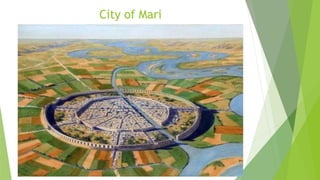
After 2000 BCE the royal city of Mari flourished.
• Mari was located on the upstream of Euphrates.
• Agriculture and animal rearing were carried out in
this region.
• Most of the region was used for pasturing sheep and
goats.
• Herders exchanged animals, cheese, leather and
meat in return for, metal tools etc. with the farmers.
• Nomadic groups of the western desert filtered into
the prosperous agricultural land.
 Such groups would come as herders, harvest labourers
or hired soldiers and settled down
 These included the Akkadians, Amorites, Assyrians and
Armaneans.
 The kings of Mari were Amorites and raised a temple at
Mari for Dagan, god of steppe.
 Mesopotamian society and culture were open to
different cultures
 Thus the vitality of the civilization was of course an
inter mixture culture
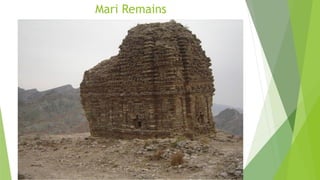
 Mari is a good example of an urban centre prospering on trade.
City of Mari
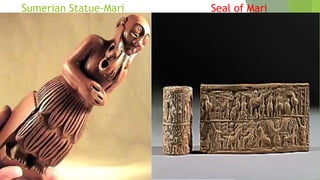
Sumerian Statue-Mari Seal of Mari
Mari Remains
A Trading Town in a Pastoral Zone
(Life in the city of Mari)
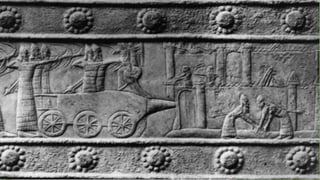
 Wood, copper, wine, tin, oil etc. were carried in
boats along the Euphrates between the south
and Turkey, Syria and Lebanon.
 Boats carrying grinding stones, wood, and wine
and oil jars, would stop at Mari on their way to
southern cities.
 Officers of this town would go abroad, inspect
the cargo and levy a charge of about one-tenth
the value of the goods. Thus, although the
kingdom of Mari was not militarily strong but it
was exceptionally prosperous.
Cities in Mesopotamian culture
 Mesopotamians valued city life .Many communities and
cultures lived side by side. After cities were destroyed in
war, they recalled them in poetry.
 The Epic of Gilgamesh remind us the pride of the
Mesopotamians who took in their cities.
 Gilgamesh was the ruler of Uruk and a great hero who
subdued people far and wide.
 He got a shock when his heroic friend died .He then set out
to find the secret of immortality.
 After a heroic attempt, Gilgamesh failed, and returned to
Uruk. There he consoled himself walking along the city wall,
back and forth.
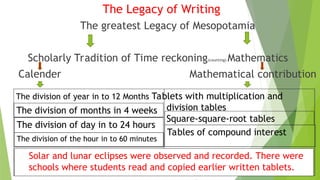
The Legacy of Writing
The greatest Legacy of Mesopotamia
Scholarly Tradition of Time reckoning(counting) Mathematics
Calender Mathematical contribution
The division of year in to 12 Months Tablets with multiplication and
division tables
Square-square-root tables
The division of months in 4 weeks
The division of day in to 24 hours
Tables of compound interest
The division of the hour in to 60 minutes
Solar and lunar eclipses were observed and recorded. There were
schools where students read and copied earlier written tablets.
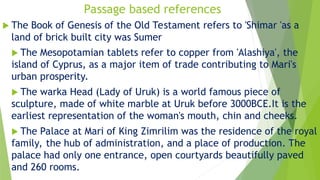
Passage based references
 The Book of Genesis of the Old Testament refers to 'Shimar 'as a
land of brick built city was Sumer
 The Mesopotamian tablets refer to copper from 'Alashiya', the
island of Cyprus, as a major item of trade contributing to Mari's
urban prosperity.
 The warka Head (Lady of Uruk) is a world famous piece of
sculpture, made of white marble at Uruk before 3000BCE.It is the
earliest representation of the woman's mouth, chin and cheeks.
 The Palace at Mari of King Zimrilim was the residence of the royal
family, the hub of administration, and a place of production. The
palace had only one entrance, open courtyards beautifully paved
and 260 rooms.
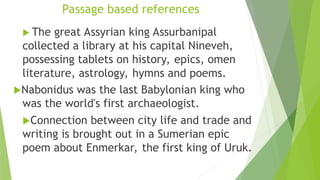
Passage based references
 The great Assyrian king Assurbanipal
collected a library at his capital Nineveh,
possessing tablets on history, epics, omen
literature, astrology, hymns and poems.
Nabonidus was the last Babylonian king who
was the world's first archaeologist.
Connection between city life and trade and
writing is brought out in a Sumerian epic
poem about Enmerkar, the first king of Uruk.
Chapter 2  Writing and City life-signed.ppt

Chapter 2 Writing and City life-signed.ppt

  • 2.
  • 5.
  • 6.
    2.WRITING AND CITYLIFE • City life began in Mesopotamia, the land between the Euphrates and the Tigris rivers that is now part of the Republic of Iraq. • The name Mesopotamia is derived from the Greek words mesos, meaning middle, and potamas, meaning river. • In the beginning of recorded history, the land, mainly the urbanized south, was called Sumer and Akkad. After 2000 BC, when Babylon became an important city, the term Babylonia was used for the southern region.
  • 7.
    Writing and citylife  From about 1100 BC, when the Assyrians established their kingdom in the north, the region became known as Assyria.  The first known language of the land was Sumerian.
  • 9.
    Writing and citylife  Archaeology began in Mesopotamia in the 1840s. At one or two sites, including Urukk and Mari, excavations continued for decades. Not only can we study hundreds of Mesopotamian buildings, statues, ornaments, graves, tools and seals as sources, there are thousands of written documents.  Mesopotamia was important to Europeans because of references to it in the Old Testament, the first part of the Bible.
  • 10.
    Mesopotamia and itsGeography  Iraq is a land of diverse environments.  North-east : green, tree covered mountain ranges with clear streams and wild flowers, with enough rainfall to grow crops. Here agriculture began between 7000 and 6000 BC.  North : stretch of upland called steppe, where animal herding offers people a better livelihood than agriculture.  East : tributaries of the Tigris provide routes of communication in to the mountains of Iran.  South : Desert-land this is where the first cities and writing emerged. This desert could support cities because the rivers Euphrates and Tigris, which rise in the northern mountains, carry loads of silt (fine mud). When they flood or when their water is let out on the fields, fertile silt is deposited.
  • 11.
    North, steppe, whereanimal herding North-east lie green The south is a desert the first cities and writing emerged. This desert could support cities because the rivers Euphrates and Tigris, which rise in the northern mountains, carry loads of silt (fine mud). When the flood or when their water is let out on to the fields, fertile alluvial soil deposited.
  • 12.
    Mesopotamia: Mountains, Steppe,Desert, Irrigated zone of the south
  • 17.
    Mesopotamia and itsGeography  Not only agriculture, Mesopotamian sheep and goats that grazed on the steppe, the north-eastern plains and the mountain slopes produced meat, milk and wool in abundance.  Further, fish was available in rivers and date-palms gave fruit in summer.
  • 23.
    The significance ofUrbanism  The earliest cities in Mesopotamia date back to the Bronze age (3000 BC).Bronze is an alloy of copper and tin.  Cities and towns are not just places with large populations. It is when an economy develops in spheres other than food production that it becomes an advantage for people to cluster in towns.  Urban economies comprise besides food production, trade, manufactures and service.  City people were not self sufficient. The carver of stone seal requires bronze tools, coloured stones.  The bronze tool maker needs metals, charcoal. So they depend on the products or services of other people.  The division of labour is a mark of urban life.
  • 24.
    The Significance ofUrbanisation There must be a social organisation in cities. Fuel, metal, various stones, wood etc. come from many places for city manufacturers There are deliveries of grain and other food items from the village to the city. Thus organized trade and storage is needed. In such a system some people commands and those others obey. Urban economies often require the keeping of written records .
  • 25.
    Movement of Goodsinto cities  Food resources were abundant in Mesopotamia but lacked stones, wood, metal.  So they imported wood, copper, tin, silver, gold, shell, stones from Turkey and Iran.  They exported their textiles and food resources.  Transport is also important for urban development.  The canals and natural channels were routes for goods transport.  Euphrates became a world route.
  • 28.
    CITIES IN MESOPOTAMIANCULTURE MESOPOTAMIANS valued city life. After cities were destroyed in war They recalled it in poetry. The pride of Mesopotamian about their town shown in the epic of Gilgamesh.
  • 29.
    The Epic ofGilgamesh is an epic poem from ancient Mesopotamia that is often regarded as the earliest surviving great work of literature and the second oldest religious text, after the Pyramid Texts.
  • 31.
    The Development ofWriting A script, we mean that spoken sounds are represented in visible signs. The first Mesopotamian tablets, written around 3200 BCE, contained picture-like signs and numbers.
  • 32.
    The Development ofWriting  Cuneiform is derived from the Latin words cuneus, meaning 'wedge' and forma, meaning 'shape’. The word cuneiform means wedge-shaped letters.
  • 35.
    The Development ofWriting The Mesopotamian tablets contained picture like signs and numbers. Writing began in Mesopotamia in 3200 BCE. Writing began when society needed to keep record of transactions. Mesopotamians wrote on tablets of clay. Scribe would impress wedge shaped signs on wet clay with the sharp end of a reed.
  • 37.
    The Development ofWriting Once written, tablets were dried hard in the sun and it would be almost indestructible(long lasting). Once it dried, signs could not be pressed on to a tablet. So each transaction required a separate written tablet. This is why tablets occur by the hundreds at Mesopotamian sites. By 2600 BCE the letters became cuneiform and language was Sumerian.
  • 38.
    Writing was usedfor, 1.keeping records. 2.making dictionaries. 3.giving legal validity to land transfers. 4.narrating the deeds of kings. 5.announcing the changes a king had made in the customary laws of the land 6. Storing information and of sending messages
  • 39.
    The System ofWriting The sound that a cuneiform sign represented was not a single consonant or vowel but syllables. Thus the scribe had to learn hundreds of signs. He had to handle a wet tablet and get it written before it dried. So writing was a skilled craft It conveys visual form of system of sounds of a particular language.
  • 40.
    Literacy King and Veryfew could read and write. There were hundreds of signs to learn and many of these were complex. If a king could read, that was recorded in his boastful(exhibitting self importance) inscriptions. Writing reflected the mode of speaking. It was kingship that organised trade and writing
  • 42.
    Urbanisation in SouthernMesopotamia: Temples and Kings By 5000 BCE, Settlements began in Mesopotamia. The earliest cities emerged from some of these settlements. There were three kinds of cities 1. Cities that developed around temples 2. Cities that developed as centres of trade 3. Imperial cities
  • 44.
    Construction and Maintenanceof Temples in Mesopotamia  The earliest known temple was a small shrine made of unbaked bricks. • Temples were the residence of various gods: Moon God of Ur and for Inanna the Goddess of Love and Wa r. • Temples became larger over time with several rooms around open courtyards. Temples always had their outer walls going in and out at regular intervals. • The god was the focus of worship.
  • 45.
  • 48.
  • 50.
  • 51.
  • 52.
  • 53.
    Construction and Maintenanceof Temples in Mesopotamia  The god was the theoretical owner of the agricultural fields, the fisheries, and the herds of the local community  Production process such as oil pressing, grain grinding, spinning and weaving of woollen cloth done in the temple.  Thus temple became the main urban institution by organizing production, employing merchants and keeping records of distribution and allotments of grain, plough animals, bread, beer, fish etc.
  • 54.
    Role of Kingsin Construction and Maintenance of Temples in Mesopotamia  Archaeological records show that villages were periodically relocated in Mesopotamian history because of flood in the river and change in the course of the rivers.  There were man made problems as well. Those who lived on the upstream stretches of a channel could divert so much water in to their fields that villages of downstream were left without water.  There was continuous war fare in Mesopotamian villages for land and water.  The victorious chiefs distributed the loot among their followers and took prisoners from the defeated groups.
  • 55.
    Role of Kingsin Construction and Maintenance of Temples in Mesopotamia  They were employed as their guards or servants.  The chiefs also offer precious booty to the gods to beautify temples.  He organise the distribution of temple wealth by keeping records.  This gave the king high status and authority.  War captives and local people had to work for the temple, or for the ruler.  Those who were put to work were paid rations.  Hundreds of people were put to work at making and baking of clay cones for temples
  • 56.
    Life in theCity of Ur  In Mesopotamian society the nuclear family system was the norm.  The father was the head of the family Marriage  We know little about the procedures of marriage.  A declaration was made about the willingness to marry by the bride's parents.  when the wedding took place gifts were exchanged by both parties who ate together and made offerings in a temple.  The bride was given her share of inheritance by her father.  The father's house, herds, fields etc. were inherited by the sons.
  • 57.
    Ur was atown and one of the earliest cities excavated in the 1930s Narrow winding streets indicate the wheeled carts could not have reached many of the houses.  Sacks of grain and firewood would have reached on donkey back. Town planning and street drains were absent at Ur. Instead of drains clay pipes were found in the inner courtyards of houses. House roofs sloped inwards and rainwater was channelled via the drain pipes in to sumps in the inner courtyards.
  • 58.
     People hadswept their house hold refuse in to the streets. This made street level rise, and overtime the thresholds(entrance) of hou had to be raised. So that no mud would flow inside after rains.  Light came into the rooms not from windows but from doorways opening in to courtyards. Superstitions about houses-As recorded in omen tablets at Ur:  A raised threshold brought wealth;  A front door that did not open towards another house was lucky;  If the main door of a house open outwards, the wife would be a Torment(intolerent) to her husband. Town cemetery at Ur The graves of royalty and commoners have been found there. Very few individuals were found buried under the floors of ordinary house
  • 59.
    A Trading Townin a Pastoral Zone (Life in the city of Mari) After 2000 BCE the royal city of Mari flourished. • Mari was located on the upstream of Euphrates. • Agriculture and animal rearing were carried out in this region. • Most of the region was used for pasturing sheep and goats. • Herders exchanged animals, cheese, leather and meat in return for, metal tools etc. with the farmers. • Nomadic groups of the western desert filtered into the prosperous agricultural land.
  • 60.
     Such groupswould come as herders, harvest labourers or hired soldiers and settled down  These included the Akkadians, Amorites, Assyrians and Armaneans.  The kings of Mari were Amorites and raised a temple at Mari for Dagan, god of steppe.  Mesopotamian society and culture were open to different cultures  Thus the vitality of the civilization was of course an inter mixture culture  Mari is a good example of an urban centre prospering on trade.
  • 61.
  • 62.
  • 63.
  • 65.
    A Trading Townin a Pastoral Zone (Life in the city of Mari)  Wood, copper, wine, tin, oil etc. were carried in boats along the Euphrates between the south and Turkey, Syria and Lebanon.  Boats carrying grinding stones, wood, and wine and oil jars, would stop at Mari on their way to southern cities.  Officers of this town would go abroad, inspect the cargo and levy a charge of about one-tenth the value of the goods. Thus, although the kingdom of Mari was not militarily strong but it was exceptionally prosperous.
  • 66.
    Cities in Mesopotamianculture  Mesopotamians valued city life .Many communities and cultures lived side by side. After cities were destroyed in war, they recalled them in poetry.  The Epic of Gilgamesh remind us the pride of the Mesopotamians who took in their cities.  Gilgamesh was the ruler of Uruk and a great hero who subdued people far and wide.  He got a shock when his heroic friend died .He then set out to find the secret of immortality.  After a heroic attempt, Gilgamesh failed, and returned to Uruk. There he consoled himself walking along the city wall, back and forth.
  • 67.
    The Legacy ofWriting The greatest Legacy of Mesopotamia Scholarly Tradition of Time reckoning(counting) Mathematics Calender Mathematical contribution The division of year in to 12 Months Tablets with multiplication and division tables Square-square-root tables The division of months in 4 weeks The division of day in to 24 hours Tables of compound interest The division of the hour in to 60 minutes Solar and lunar eclipses were observed and recorded. There were schools where students read and copied earlier written tablets.
  • 68.
    Passage based references The Book of Genesis of the Old Testament refers to 'Shimar 'as a land of brick built city was Sumer  The Mesopotamian tablets refer to copper from 'Alashiya', the island of Cyprus, as a major item of trade contributing to Mari's urban prosperity.  The warka Head (Lady of Uruk) is a world famous piece of sculpture, made of white marble at Uruk before 3000BCE.It is the earliest representation of the woman's mouth, chin and cheeks.  The Palace at Mari of King Zimrilim was the residence of the royal family, the hub of administration, and a place of production. The palace had only one entrance, open courtyards beautifully paved and 260 rooms.
  • 69.
    Passage based references The great Assyrian king Assurbanipal collected a library at his capital Nineveh, possessing tablets on history, epics, omen literature, astrology, hymns and poems. Nabonidus was the last Babylonian king who was the world's first archaeologist. Connection between city life and trade and writing is brought out in a Sumerian epic poem about Enmerkar, the first king of Uruk.