Introductio
n
1. There cannotbe a country without people and there is no kingdom without a country.
2. What is an empire?
3. How did empires rise and shape Indian civilisation?
4. What factors facilitated the transition from kingdoms to empires?
5. What was life like from the 6th to the 2nd century BCE?
3.
What is an
Empire?
1.The word ‘empire’ comes from the Latin ‘imperium’, which means
‘supreme power’.
2. Simply put, an empire is a collection of smaller kingdoms or territories
over which a powerful ruler exerts power.
3. The smaller territories still had their own rulers but were all tributaries
to the emperor.
4.
Features of anEmpire
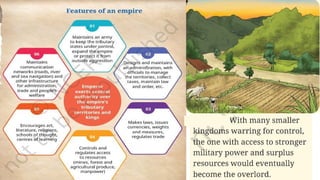
● Empires extended over vast areas and had diverse people.
● Emperors allowed regional kings or chiefs to govern their areas.
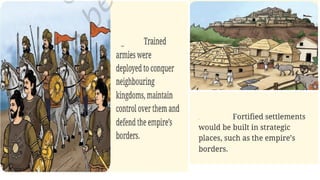
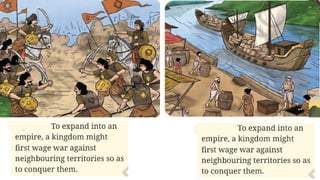
● They maintained an army to expand and protect the empire.
● They had a well-developed administration to collect taxes and maintain
order.
● Emperors issued laws, regulated trade, and maintained infrastructure.
● They encouraged arts, literature, and education.
● They controlled access to resources.
Trade, Trade Routesand Guilds
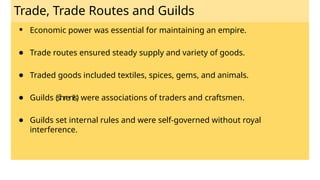
● Economic power was essential for maintaining an empire.
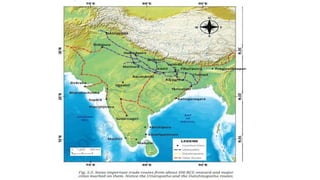
● Trade routes ensured steady supply and variety of goods.
● Traded goods included textiles, spices, gems, and animals.
● Guilds (śhrenīs) were associations of traders and craftsmen.
● Guilds set internal rules and were self-governed without royal
interference.
The Rise ofMagadha
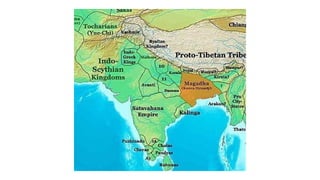
1. Magadha rose in importance among the sixteen
mahājanapadas.
2. Located in the Ganga plains, it had fertile soil and resources.
3. Iron ore and forests supported agriculture and military
strength.
4. Surplus food enabled development of arts and crafts.
5. Ganga and Son rivers aided trade and transport.
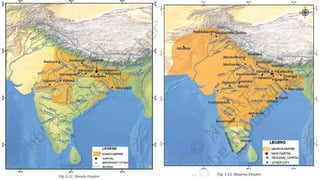
6. Mahāpadma Nanda unified smaller kingdoms into an empire.
7. He issued coins and maintained a large army.
8. Dhana Nanda’s unpopularity paved the way for Mauryan
The Arrival ofthe Greeks
1. The northwest had small kingdoms like the Pauravas.
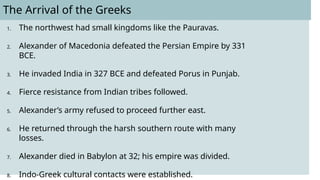
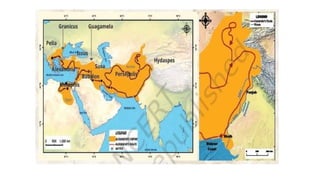
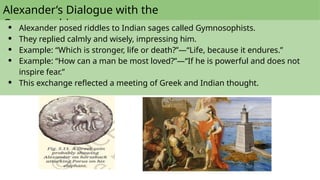
2. Alexander of Macedonia defeated the Persian Empire by 331
BCE.
3. He invaded India in 327 BCE and defeated Porus in Punjab.
4. Fierce resistance from Indian tribes followed.
5. Alexander’s army refused to proceed further east.
6. He returned through the harsh southern route with many
losses.
7. Alexander died in Babylon at 32; his empire was divided.
8. Indo-Greek cultural contacts were established.
Alexander’s Dialogue withthe
Gymnosophists
● Alexander posed riddles to Indian sages called Gymnosophists.
● They replied calmly and wisely, impressing him.
● Example: “Which is stronger, life or death?”—“Life, because it endures.”
● Example: “How can a man be most loved?”—“If he is powerful and does not
inspire fear.”
● This exchange reflected a meeting of Greek and Indian thought.
15.
The Mighty Mauryas
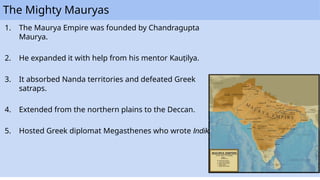
1.The Maurya Empire was founded by Chandragupta
Maurya.
2. He expanded it with help from his mentor Kauṭilya.
3. It absorbed Nanda territories and defeated Greek
satraps.
4. Extended from the northern plains to the Deccan.
5. Hosted Greek diplomat Megasthenes who wrote Indika.
16.
The Story ofKauṭ
ilya
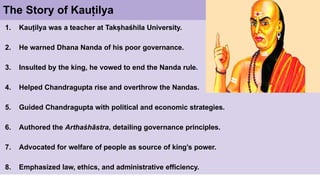
1. Kauṭ
ilya was a teacher at Takṣhaśhila University.
2. He warned Dhana Nanda of his poor governance.
3. Insulted by the king, he vowed to end the Nanda rule.
4. Helped Chandragupta rise and overthrow the Nandas.
5. Guided Chandragupta with political and economic strategies.
6. Authored the Arthaśhāstra, detailing governance principles.
7. Advocated for welfare of people as source of king’s power.
8. Emphasized law, ethics, and administrative efficiency.
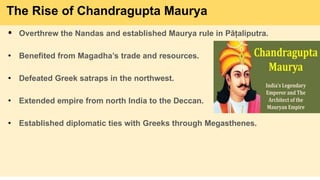
The Rise ofChandragupta Maurya
● Overthrew the Nandas and established Maurya rule in Pāṭ
aliputra.
● Benefited from Magadha’s trade and resources.
● Defeated Greek satraps in the northwest.
● Extended empire from north India to the Deccan.
● Established diplomatic ties with Greeks through Megasthenes.
19.
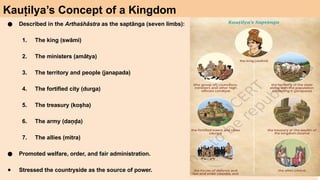
Kauṭilya’s Concept ofa Kingdom
● Described in the Arthaśhāstra as the saptānga (seven limbs):
1. The king (swāmi)
2. The ministers (amātya)
3. The territory and people (janapada)
4. The fortified city (durga)
5. The treasury (koṣha)
6. The army (daṇḍa)
7. The allies (mitra)
● Promoted welfare, order, and fair administration.
● Stressed the countryside as the source of power.
20.
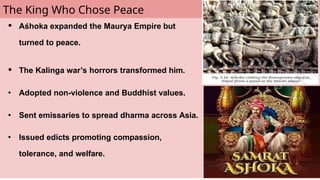
The King WhoChose Peace
● Aśhoka expanded the Maurya Empire but
turned to peace.
● The Kalinga war’s horrors transformed him.
● Adopted non-violence and Buddhist values.
● Sent emissaries to spread dharma across Asia.
● Issued edicts promoting compassion,
tolerance, and welfare.
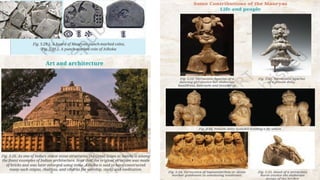
Life in theMauryan Period
● Cities had planned streets, palaces, and public buildings.
● Officials, artisans, and merchants were central to urban life.
● Agriculture was well protected and productive.
● Artisans included blacksmiths, carpenters, jewellers.
● People wore cotton garments and ornate shoes
23.
The Fragile Natureof Empires
● Empires often break when local rulers resist tribute.
● Natural calamities and weak rulers lead to fragmentation.
● Far-off regions are hardest to control.
● Though empires bring unity and prosperity, they are built on war.
● Their size and dependence on power make them unstable.