Gray Morris
Unit One: Chapter 3
Read decimals Write decimals Compare the size of decimals to one another Convert fractions to decimals Convert decimals to fractions Add decimals Subtract decimals Multiply decimals Divide decimals Round decimals to nearest tenth Round decimals to nearest hundredth After reviewing this chapter, you should be able to:
Dosages and other measurements in health care Understanding is crucial Decimal points—major source of medication errors Write with great care! Examples: Digoxin 0.125 mg Coreg 3.125 mg
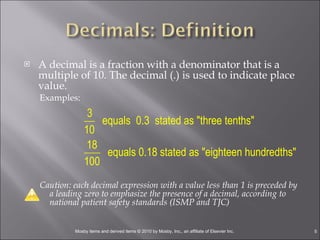
A decimal is a fraction with a denominator that is a multiple of 10. The decimal (.) is used to indicate place value. Examples:  Caution: each decimal expression with a value less than 1 is preceded by a leading zero to emphasize the presence of a decimal, according to national patient safety standards (ISMP and TJC)
 
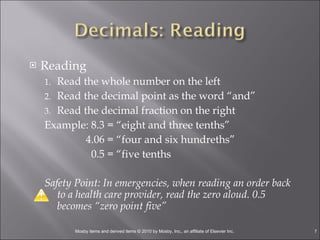
Reading Read the whole number on the left Read the decimal point as the word “and” Read the decimal fraction on the right Example: 8.3 = “eight and three tenths”   4.06 = “four and six hundreths”   0.5 = “five tenths Safety Point: In emergencies, when reading an order back to a health care provider, read the zero aloud. 0.5 becomes “zero point five”
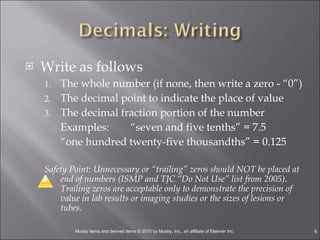
Write as follows The whole number (if none, then write a zero - “0”) The decimal point to indicate the place of value The decimal fraction portion of the number Examples:  “seven and five tenths” = 7.5 “ one hundred twenty-five thousandths” = 0.125  Safety Point: Unnecessary or “trailing” zeros should NOT be placed at end of numbers (ISMP and TJC “Do Not Use” list from 2005). Trailing zeros are acceptable only to demonstrate the precision of value in lab results or imaging studies or the sizes of lesions or tubes.
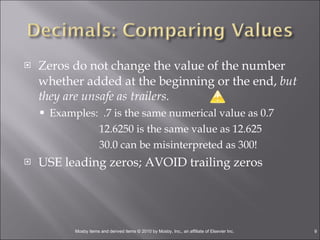
Zeros do not change the value of the number whether added at the beginning or the end,  but they are unsafe as trailers. Examples:  .7 is the same numerical value as 0.7   12.6250 is the same value as 12.625   30.0 can be misinterpreted as 300! USE leading zeros; AVOID trailing zeros
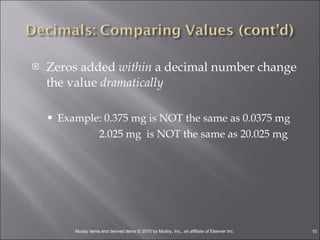
Zeros added  within  a decimal number change the value  dramatically Example: 0.375 mg is NOT the same as 0.0375 mg   2.025 mg  is NOT the same as 20.025 mg
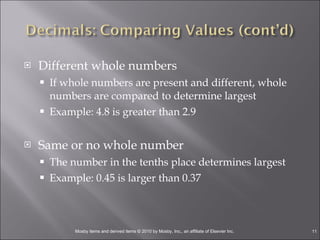
Different whole numbers If whole numbers are present and different, whole numbers are compared to determine largest  Example: 4.8 is greater than 2.9 Same or no whole number The number in the tenths place determines largest Example: 0.45 is larger than 0.37
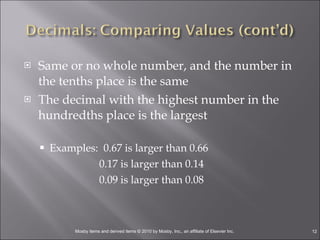
Same or no whole number, and the number in the tenths place is the same The decimal with the highest number in the hundredths place is the largest Examples:  0.67 is larger than 0.66   0.17 is larger than 0.14   0.09 is larger than 0.08
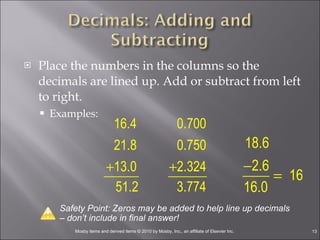
Place the numbers in the columns so the decimals are lined up. Add or subtract from left to right. Examples:  Safety Point: Zeros may be added to help line up decimals – don’t include in final answer!
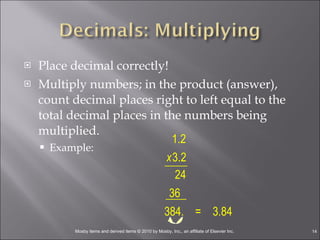
Place decimal correctly! Multiply numbers; in the product (answer), count decimal places right to left equal to the total decimal places in the numbers being multiplied. Example:
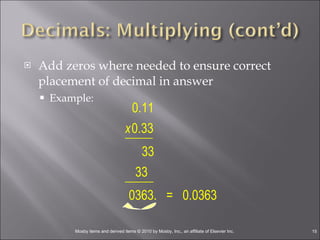
Add zeros where needed to ensure correct placement of decimal in answer Example:
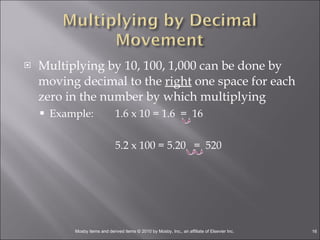
Multiplying by 10, 100, 1,000 can be done by moving decimal to the  right  one space for each zero in the number by which multiplying Example:  1.6 x 10 = 1.6  =  16 5.2 x 100 = 5.20  =  520
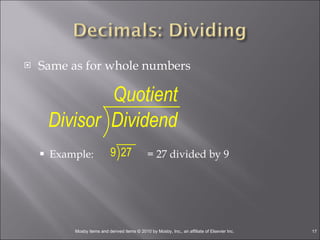
Same as for whole numbers Example:  = 27 divided by 9
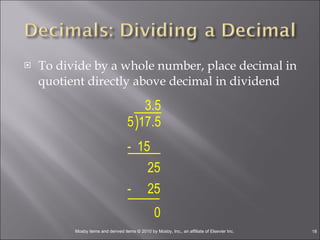
To divide by a whole number, place decimal in quotient directly above decimal in dividend
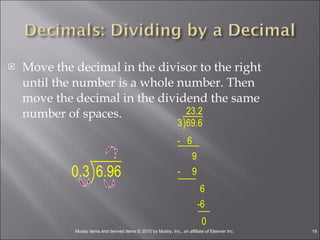
Move the decimal in the divisor to the right until the number is a whole number. Then move the decimal in the dividend the same number of spaces.
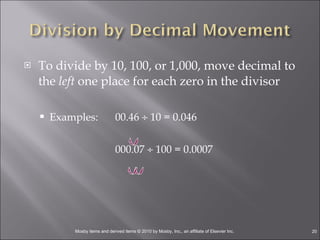
To divide by 10, 100, or 1,000, move decimal to the  left  one place for each zero in the divisor Examples: 00.46    10 = 0.046 000.07    100 = 0.0007
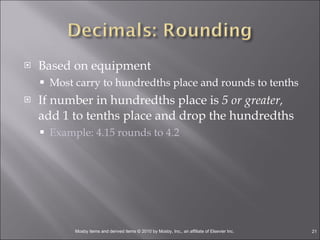
Based on equipment Most carry to hundredths place and rounds to tenths If number in hundredths place is  5 or greater,  add 1 to tenths place and drop the hundredths Example: 4.15 rounds to 4.2
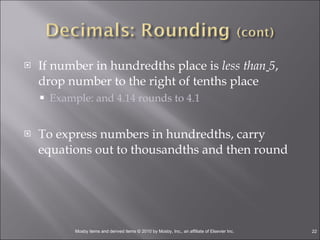
If number in hundredths place is  less than   5 , drop number to the right of tenths place Example: and 4.14 rounds to 4.1 To express numbers in hundredths, carry equations out to thousandths and then round
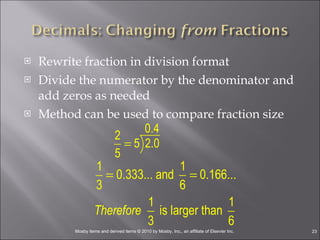
Rewrite fraction in division format Divide the numerator by the denominator and add zeros as needed Method can be used to compare fraction size
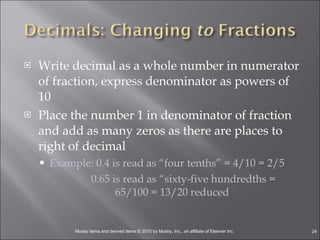
Write decimal as a whole number in numerator of fraction, express denominator as powers of 10 Place the number 1 in denominator of fraction and add as many zeros as there are places to right of decimal Example: 0.4 is read as “four tenths” = 4/10 = 2/5   0.65 is read as “sixty-five hundredths = 65/100 = 13/20 reduced

Decimals

  • 1.
  • 2.
  • 3.
    Read decimals Writedecimals Compare the size of decimals to one another Convert fractions to decimals Convert decimals to fractions Add decimals Subtract decimals Multiply decimals Divide decimals Round decimals to nearest tenth Round decimals to nearest hundredth After reviewing this chapter, you should be able to:
  • 4.
    Dosages and othermeasurements in health care Understanding is crucial Decimal points—major source of medication errors Write with great care! Examples: Digoxin 0.125 mg Coreg 3.125 mg
  • 5.
    A decimal isa fraction with a denominator that is a multiple of 10. The decimal (.) is used to indicate place value. Examples: Caution: each decimal expression with a value less than 1 is preceded by a leading zero to emphasize the presence of a decimal, according to national patient safety standards (ISMP and TJC)
  • 6.
  • 7.
    Reading Read thewhole number on the left Read the decimal point as the word “and” Read the decimal fraction on the right Example: 8.3 = “eight and three tenths” 4.06 = “four and six hundreths” 0.5 = “five tenths Safety Point: In emergencies, when reading an order back to a health care provider, read the zero aloud. 0.5 becomes “zero point five”
  • 8.
    Write as followsThe whole number (if none, then write a zero - “0”) The decimal point to indicate the place of value The decimal fraction portion of the number Examples: “seven and five tenths” = 7.5 “ one hundred twenty-five thousandths” = 0.125 Safety Point: Unnecessary or “trailing” zeros should NOT be placed at end of numbers (ISMP and TJC “Do Not Use” list from 2005). Trailing zeros are acceptable only to demonstrate the precision of value in lab results or imaging studies or the sizes of lesions or tubes.
  • 9.
    Zeros do notchange the value of the number whether added at the beginning or the end, but they are unsafe as trailers. Examples: .7 is the same numerical value as 0.7 12.6250 is the same value as 12.625 30.0 can be misinterpreted as 300! USE leading zeros; AVOID trailing zeros
  • 10.
    Zeros added within a decimal number change the value dramatically Example: 0.375 mg is NOT the same as 0.0375 mg 2.025 mg is NOT the same as 20.025 mg
  • 11.
    Different whole numbersIf whole numbers are present and different, whole numbers are compared to determine largest Example: 4.8 is greater than 2.9 Same or no whole number The number in the tenths place determines largest Example: 0.45 is larger than 0.37
  • 12.
    Same or nowhole number, and the number in the tenths place is the same The decimal with the highest number in the hundredths place is the largest Examples: 0.67 is larger than 0.66 0.17 is larger than 0.14 0.09 is larger than 0.08
  • 13.
    Place the numbersin the columns so the decimals are lined up. Add or subtract from left to right. Examples: Safety Point: Zeros may be added to help line up decimals – don’t include in final answer!
  • 14.
    Place decimal correctly!Multiply numbers; in the product (answer), count decimal places right to left equal to the total decimal places in the numbers being multiplied. Example:
  • 15.
    Add zeros whereneeded to ensure correct placement of decimal in answer Example:
  • 16.
    Multiplying by 10,100, 1,000 can be done by moving decimal to the right one space for each zero in the number by which multiplying Example: 1.6 x 10 = 1.6 = 16 5.2 x 100 = 5.20 = 520
  • 17.
    Same as forwhole numbers Example: = 27 divided by 9
  • 18.
    To divide bya whole number, place decimal in quotient directly above decimal in dividend
  • 19.
    Move the decimalin the divisor to the right until the number is a whole number. Then move the decimal in the dividend the same number of spaces.
  • 20.
    To divide by10, 100, or 1,000, move decimal to the left one place for each zero in the divisor Examples: 00.46  10 = 0.046 000.07  100 = 0.0007
  • 21.
    Based on equipmentMost carry to hundredths place and rounds to tenths If number in hundredths place is 5 or greater, add 1 to tenths place and drop the hundredths Example: 4.15 rounds to 4.2
  • 22.
    If number inhundredths place is less than 5 , drop number to the right of tenths place Example: and 4.14 rounds to 4.1 To express numbers in hundredths, carry equations out to thousandths and then round
  • 23.
    Rewrite fraction indivision format Divide the numerator by the denominator and add zeros as needed Method can be used to compare fraction size
  • 24.
    Write decimal asa whole number in numerator of fraction, express denominator as powers of 10 Place the number 1 in denominator of fraction and add as many zeros as there are places to right of decimal Example: 0.4 is read as “four tenths” = 4/10 = 2/5 0.65 is read as “sixty-five hundredths = 65/100 = 13/20 reduced