Some Basic Relationships
Between Pixels
• Definitions:
– f(x,y): digital image
– Pixels: q, p
– Subset of pixels of f(x,y): S
Neighbors of a Pixel
• A pixel p at (x,y) has 2 horizontal and 2
vertical neighbors:
– (x+1,y), (x-1,y), (x,y+1), (x,y-1)
– This set of pixels is called the 4-neighbors
of p: N4(p)
Neighbors of a Pixel
• The 4 diagonal neighbors of p are: (ND(p))
– (x+1,y+1), (x+1,y-1), (x-1,y+1), (x-1,y-1)
• N4(p) + ND(p)  N8(p): the 8-neighbors of p
Connectivity
• Connectivity between pixels is important:
– Because it is used in establishing boundaries of
objects and components of regions in an image
Connectivity
• Two pixels are connected if:
– They are neighbors (i.e. adjacent in some sense -
- e.g. N4(p), N8(p), …)
– Their gray levels satisfy a specified criterion of
similarity (e.g. equality, …)
• V is the set of gray-level values used to
define adjacency (e.g. V={1} for adjacency
of pixels of value 1)
Adjacency
• We consider three types of adjacency:
– 4-adjacency: two pixels p and q with values from
V are 4-adjacent if q is in the set N4(p)
– 8-adjacency : p & q are 8- adjacent if q is in the
set N8(p)
Adjacency
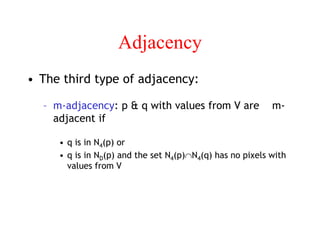
• The third type of adjacency:
– m-adjacency: p & q with values from V are m-
adjacent if
• q is in N4(p) or
• q is in ND(p) and the set N4(p)N4(q) has no pixels with
values from V
Adjacency
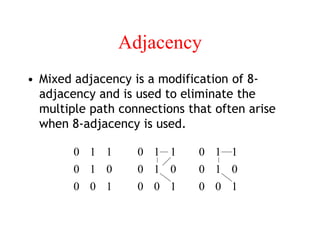
• Mixed adjacency is a modification of 8-
adjacency and is used to eliminate the
multiple path connections that often arise
when 8-adjacency is used.
1
0
0
0
1
0
1
1
0
1
0
0
0
1
0
1
1
0
1
0
0
0
1
0
1
1
0
Adjacency
• Two image subsets S1 and S2 are adjacent if some
pixel in S1 is adjacent to some pixel in S2.
Path
• A path (curve) from pixel p with coordinates
(x,y) to pixel q with coordinates (s,t) is a
sequence of distinct pixels:
– (x0,y0), (x1,y1), …, (xn,yn)
– where (x0,y0)=(x,y), (xn,yn)=(s,t), and
(xi,yi) is adjacent to (xi-1,yi-1), for
1≤i ≤n ; n is the length of the path.
• If (xo, yo) = (xn, yn): a closed path
Paths
• 4-, 8-, m-paths can be defined depending on
the type of adjacency specified.
• If p,q  S, then q is connected to p in S if
there is a path from p to q consisting
entirely of pixels in S.
Connectivity
• For any pixel p in S, the set of pixels in S
that are connected to p is a connected
component of S.
• If S has only one connected component then
S is called a connected set.
Boundary
• R a subset of pixels: R is a region if R is a
connected set.
• Its boundary (border, contour) is the set of
pixels in R that have at least one neighbor
not in R
• Edge can be the region boundary (in binary
images)
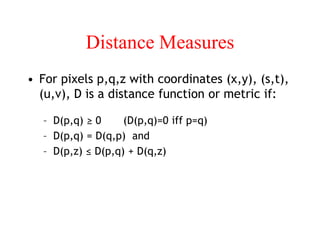
Distance Measures
• For pixels p,q,z with coordinates (x,y), (s,t),
(u,v), D is a distance function or metric if:
– D(p,q) ≥ 0 (D(p,q)=0 iff p=q)
– D(p,q) = D(q,p) and
– D(p,z) ≤ D(p,q) + D(q,z)
Distance Measures
• Euclidean distance:
– De(p,q) = [(x-s)2 + (y-t)2]1/2
– Points (pixels) having a distance less than or
equal to r from (x,y) are contained in a disk of
radius r centered at (x,y).
Distance Measures
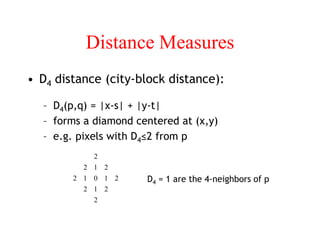
• D4 distance (city-block distance):
– D4(p,q) = |x-s| + |y-t|
– forms a diamond centered at (x,y)
– e.g. pixels with D4≤2 from p
2
2
1
2
2
1
0
1
2
2
1
2
2
D4 = 1 are the 4-neighbors of p
Distance Measures
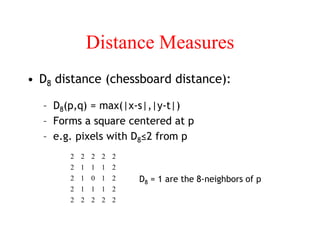
• D8 distance (chessboard distance):
– D8(p,q) = max(|x-s|,|y-t|)
– Forms a square centered at p
– e.g. pixels with D8≤2 from p
2
2
2
2
2
2
1
1
1
2
2
1
0
1
2
2
1
1
1
2
2
2
2
2
2
D8 = 1 are the 8-neighbors of p
Distance Measures
• D4 and D8 distances between p and q are
independent of any paths that exist between
the points because these distances involve
only the coordinates of the points
(regardless of whether a connected path
exists between them).
Distance Measures
• However, for m-connectivity the value of the
distance (length of path) between two pixels
depends on the values of the pixels along the
path and those of their neighbors.
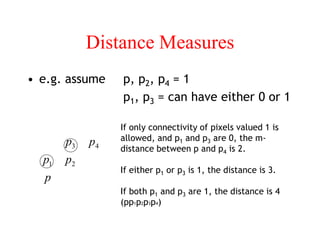
Distance Measures
• e.g. assume p, p2, p4 = 1
p1, p3 = can have either 0 or 1
p
p
p
p
p
2
1
4
3
If only connectivity of pixels valued 1 is
allowed, and p1 and p3 are 0, the m-
distance between p and p4 is 2.
If either p1 or p3 is 1, the distance is 3.
If both p1 and p3 are 1, the distance is 4
(pp1p2p3p4)

Lecture4.ppt

  • 1.
    Some Basic Relationships BetweenPixels • Definitions: – f(x,y): digital image – Pixels: q, p – Subset of pixels of f(x,y): S
  • 2.
    Neighbors of aPixel • A pixel p at (x,y) has 2 horizontal and 2 vertical neighbors: – (x+1,y), (x-1,y), (x,y+1), (x,y-1) – This set of pixels is called the 4-neighbors of p: N4(p)
  • 3.
    Neighbors of aPixel • The 4 diagonal neighbors of p are: (ND(p)) – (x+1,y+1), (x+1,y-1), (x-1,y+1), (x-1,y-1) • N4(p) + ND(p)  N8(p): the 8-neighbors of p
  • 4.
    Connectivity • Connectivity betweenpixels is important: – Because it is used in establishing boundaries of objects and components of regions in an image
  • 5.
    Connectivity • Two pixelsare connected if: – They are neighbors (i.e. adjacent in some sense - - e.g. N4(p), N8(p), …) – Their gray levels satisfy a specified criterion of similarity (e.g. equality, …) • V is the set of gray-level values used to define adjacency (e.g. V={1} for adjacency of pixels of value 1)
  • 6.
    Adjacency • We considerthree types of adjacency: – 4-adjacency: two pixels p and q with values from V are 4-adjacent if q is in the set N4(p) – 8-adjacency : p & q are 8- adjacent if q is in the set N8(p)
  • 7.
    Adjacency • The thirdtype of adjacency: – m-adjacency: p & q with values from V are m- adjacent if • q is in N4(p) or • q is in ND(p) and the set N4(p)N4(q) has no pixels with values from V
  • 8.
    Adjacency • Mixed adjacencyis a modification of 8- adjacency and is used to eliminate the multiple path connections that often arise when 8-adjacency is used. 1 0 0 0 1 0 1 1 0 1 0 0 0 1 0 1 1 0 1 0 0 0 1 0 1 1 0
  • 9.
    Adjacency • Two imagesubsets S1 and S2 are adjacent if some pixel in S1 is adjacent to some pixel in S2.
  • 10.
    Path • A path(curve) from pixel p with coordinates (x,y) to pixel q with coordinates (s,t) is a sequence of distinct pixels: – (x0,y0), (x1,y1), …, (xn,yn) – where (x0,y0)=(x,y), (xn,yn)=(s,t), and (xi,yi) is adjacent to (xi-1,yi-1), for 1≤i ≤n ; n is the length of the path. • If (xo, yo) = (xn, yn): a closed path
  • 11.
    Paths • 4-, 8-,m-paths can be defined depending on the type of adjacency specified. • If p,q  S, then q is connected to p in S if there is a path from p to q consisting entirely of pixels in S.
  • 12.
    Connectivity • For anypixel p in S, the set of pixels in S that are connected to p is a connected component of S. • If S has only one connected component then S is called a connected set.
  • 13.
    Boundary • R asubset of pixels: R is a region if R is a connected set. • Its boundary (border, contour) is the set of pixels in R that have at least one neighbor not in R • Edge can be the region boundary (in binary images)
  • 14.
    Distance Measures • Forpixels p,q,z with coordinates (x,y), (s,t), (u,v), D is a distance function or metric if: – D(p,q) ≥ 0 (D(p,q)=0 iff p=q) – D(p,q) = D(q,p) and – D(p,z) ≤ D(p,q) + D(q,z)
  • 15.
    Distance Measures • Euclideandistance: – De(p,q) = [(x-s)2 + (y-t)2]1/2 – Points (pixels) having a distance less than or equal to r from (x,y) are contained in a disk of radius r centered at (x,y).
  • 16.
    Distance Measures • D4distance (city-block distance): – D4(p,q) = |x-s| + |y-t| – forms a diamond centered at (x,y) – e.g. pixels with D4≤2 from p 2 2 1 2 2 1 0 1 2 2 1 2 2 D4 = 1 are the 4-neighbors of p
  • 17.
    Distance Measures • D8distance (chessboard distance): – D8(p,q) = max(|x-s|,|y-t|) – Forms a square centered at p – e.g. pixels with D8≤2 from p 2 2 2 2 2 2 1 1 1 2 2 1 0 1 2 2 1 1 1 2 2 2 2 2 2 D8 = 1 are the 8-neighbors of p
  • 18.
    Distance Measures • D4and D8 distances between p and q are independent of any paths that exist between the points because these distances involve only the coordinates of the points (regardless of whether a connected path exists between them).
  • 19.
    Distance Measures • However,for m-connectivity the value of the distance (length of path) between two pixels depends on the values of the pixels along the path and those of their neighbors.
  • 20.
    Distance Measures • e.g.assume p, p2, p4 = 1 p1, p3 = can have either 0 or 1 p p p p p 2 1 4 3 If only connectivity of pixels valued 1 is allowed, and p1 and p3 are 0, the m- distance between p and p4 is 2. If either p1 or p3 is 1, the distance is 3. If both p1 and p3 are 1, the distance is 4 (pp1p2p3p4)