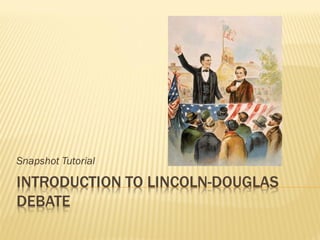
Snapshot Tutorial
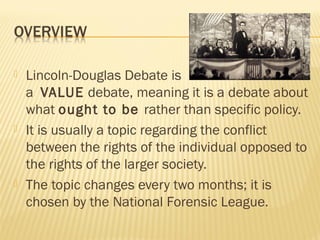
 Lincoln-Douglas Debate is 
a VALUE debate, meaning it is a debate about 
what ought to be rather than specific policy. 
 It is usually a topic regarding the conflict 
between the rights of the individual opposed to 
the rights of the larger society. 
 The topic changes every two months; it is 
chosen by the National Forensic League.
 A round of Lincoln-Douglas Debate is the 
debate of one person from one school 
arguing against a person from a dif ferent 
school. 
 At a debate tournament, each student will 
debate at least 3-4 times. The larger the 
tournament, the more rounds will be 
guaranteed.
 During a typical tournament, debaters will 
argue both sides of the topic. 
 Usually, each debater will be assigned the 
affirmative side for two rounds and the 
negative side on two other rounds. 
 A Lincoln-Douglas debate round lasts about 45 
minutes. The times for the various 
speeches are very structured, as are the 
purposes of the speeches.
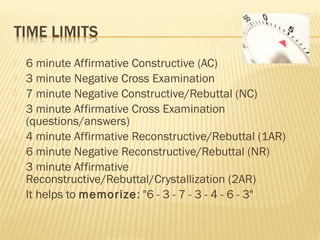
 6 minute Affirmative Constructive (AC) 
 3 minute Negative Cross Examination 
 7 minute Negative Constructive/Rebuttal (NC) 
 3 minute Affirmative Cross Examination 
(questions/answers) 
 4 minute Affirmative Reconstructive/Rebuttal (1AR) 
 6 minute Negative Reconstructive/Rebuttal (NR) 
 3 minute Affirmative 
Reconstructive/Rebuttal/Crystallization (2AR) 
 It helps to memorize: "6 - 3 - 7 - 3 - 4 - 6 - 3"
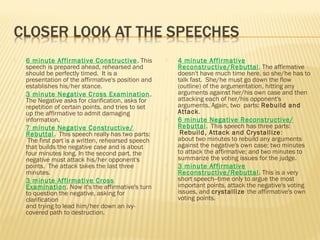
 6 minute Affirmative Constructive. This 
speech is prepared ahead, rehearsed and 
should be perfectly timed. It is a 
presentation of the affirmative's position and 
establishes his/her stance. 
 3 minute Negative Cross Examination. 
The Negative asks for clarification, asks for 
repetition of certain points, and tries to set 
up the affirmative to admit damaging 
information. 
 7 minute Negative Constructive/ 
Rebuttal. This speech really has two parts: 
The first part is a written, rehearsed speech 
that builds the negative case and is about 
four minutes long. In the second part, the 
negative must attack his/her opponent's 
points. The attack takes the last three 
minutes. 
 3 minute Affirmative Cross 
Examination. Now it's the affirmative's turn 
to question the negative, asking for 
clarification 
and trying to lead him/her down an ivy-covered 
path to destruction. 
 4 minute Affirmative 
Reconstructive/Rebuttal. The affirmative 
doesn't have much time here, so she/he has to 
talk fast. She/he must go down the flow 
(outline) of the argumentation, hitting any 
arguments against her/his own case and then 
attacking each of her/his opponent's 
arguments. Again, two parts: Rebuild and 
Attack. 
 6 minute Negative Reconstructive/ 
Rebuttal. This speech has three parts: 
Rebuild, Attack and Crystallize: 
about two minutes to rebuild any arguments 
against the negative's own case; two minutes 
to attack the affirmative; and two minutes to 
summarize the voting issues for the judge. 
 3 minute Affirmative 
Reconstructive/Rebuttal. This is a very 
short speech--time only to argue the most 
important points, attack the negative's voting 
issues, and crystallize the affirmative's own 
voting points.
 Our Team subscribes to publishers who create 
DEBATE BRIEFS 
 A Brief is a collection of evidence, arguments, 
current topic analysis, definitions, etc. 
 Briefs are helpful, but remember that other 
teams may also have these collections 
 Evidence can also be found on the internet, but 
only use CREDIBLE sources (NY Times, WA 
Post, etc.)
 You will need to write TWO speeches: the 
affirmative (6 min.) that says that the 
resolution is true and the negative (3-4 min) 
that says that the resolution is false. 
 You will use your affirmative speech in two of 
your debates and your negative speech in the 
other two debates.
 Step One: The Resolution. 
The resolution is a statement 
of the topic of the debate. The 
entire debate is a test of the 
validity of this statement. 
Therefore, wording and 
semantics are crucial. 
Each important word must be 
defined from different 
angles. 
 After a brief opening 
paragraph using the resolution 
as the thesis statement, 
or in the case of the negative, 
its antithesis, you will state 
your definitions. 
 Step Two: The Value 
Premise. 
 Remember that we said that 
Lincoln-Douglas Debate is a 
VALUE debate about what 
ought to be, right? 
 Each debate speech will center 
on a value that you choose as 
the cornerstone of your position. 
I know this seems very, very 
vague. 
 Let’s clarify using a simple 
analogy:
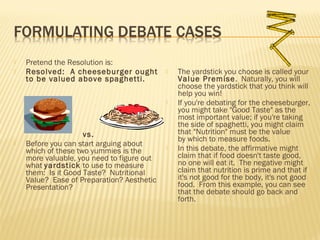
 Pretend the Resolution is: 
 Resolved: A cheeseburger ought 
to be valued above spaghetti. 
vs. 
 Before you can start arguing about 
which of these two yummies is the 
more valuable, you need to figure out 
what yardstick to use to measure 
them: Is it Good Taste? Nutritional 
Value? Ease of Preparation? Aesthetic 
Presentation? 
 The yardstick you choose is called your 
Value Premise. Naturally, you will 
choose the yardstick that you think will 
help you win! 
 If you're debating for the cheeseburger, 
you might take "Good Taste" as the 
most important value; if you're taking 
the side of spaghetti, you might claim 
that "Nutrition" must be the value 
by which to measure foods. 
 In this debate, the affirmative might 
claim that if food doesn't taste good, 
no one will eat it. The negative might 
claim that nutrition is prime and that if 
it's not good for the body, it's not good 
food. From this example, you can see 
that the debate should go back and 
forth.
 The value is achieved through certain 
Criteria. 
 After you state your value premise, 
you will name the 
criterion or criteria that you will use to 
achieve the value. 
 For example, for the value of 
Nutrition, your criterion might be the 
Four Food Groups, as set up by the 
U.S. Dept of Health, 
Education and Welfare. 
 Step Three: State arguments as main 
points. You will need two or three 
main points. The cheeseburger 
affirmative might be: 
 Value: Common Good 
 Criterion: Quality of Life 
 Contention One: The cheeseburger 
provides one of the basic needs of 
mankind, according to Maslow's 
hierarchy of basic needs. 
 Contention Two: The cheeseburger 
provides nutrition from all four food 
groups. 
 Contention Three: The 
cheeseburger provides advantages 
that the negative cannot provide, 
including portability and ease of use.
 The spaghetti negative 
might be: 
 Value: Life 
 Criterion: Nutrition 
 Contention One: 
Spaghetti provides a high 
standard of nutrition 
needed for life. 
 Contention Two: A 
cheeseburger is fat-filled 
and therefore fails to 
provide nutrition. 
 Step Four: Use evidence to 
back up each point. 
Evidence can consist of 
quotes, reasoning, or 
analogy. 
 Step Five: Find a good 
opening for the speech. 
This can be an apt quote, 
startling statistics, or 
interesting example. 
 Step Six: Time the speech. 
(Six minutes for the 
affirmative exactly. About 
three to four minutes for 
negative.)
 At the beginning of a round, they will 
post a listing of the debate rounds. 
This is called the Pairings. It will 
show your name, your opponent's 
name, your judge, the room number, 
and what side you are--aff or neg. 
 Write down your side and the room 
number. If you forget, you'll have to 
walk all the way back to the pairings. 
 Your audience is usually only one 
person--the JUDGE. If you don't make 
the judge respect you, you don't win 
the round. 
 Try to figure out what the judge will 
respect, and give it to her/him. Most 
judges like friendly, helpful kids who 
act as if they enjoy debating. Judges 
can be coaches, teachers, former 
debaters, community leaders, or 
parents. 
 Judging is hard. A judge has to listen 
carefully, take good notes, and 
sometimes give time signals all at the 
same time. 
 Just like students in a classroom , 
judges have other things on their minds 
that sometimes cause their attention to 
waiver. Therefore, plan to repeat 
yourself. Just because you said 
something once does not mean that 
the judge heard it. 
 The judge will fill out a BALLOT 
explaining the debate and why she/he 
made the decision about who won.
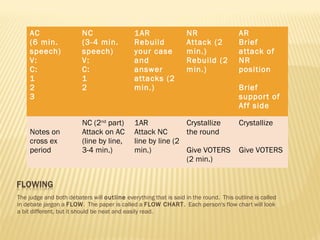
AC 
(6 min. 
speech) 
V: 
C: 
123 
NC 
(3-4 min. 
speech) 
V: 
C: 
12 
1AR 
Rebuild 
your case 
and 
answer 
attacks (2 
min.) 
NR 
Attack (2 
min.) 
Rebuild (2 
min.) 
AR 
Brief 
attack of 
NR 
position 
Brief 
support of 
Aff side 
Notes on 
cross ex 
period 
NC (2nd part) 
Attack on AC 
(line by line, 
3-4 min.) 
1AR 
Attack NC 
line by line (2 
min.) 
Crystallize 
the round 
Give VOTERS 
(2 min.) 
Crystallize 
Give VOTERS 
The judge and both debaters will outline everything that is said in the round. This outline is called 
in debate jargon a FLOW. The paper is called a FLOW CHART. Each person's flow chart will look 
a bit different, but it should be neat and easily read.
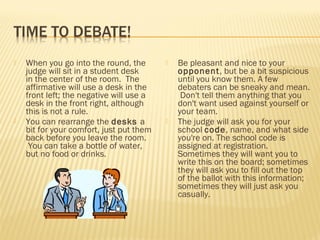
 When you go into the round, the 
judge will sit in a student desk 
in the center of the room. The 
affirmative will use a desk in the 
front left; the negative will use a 
desk in the front right, although 
this is not a rule. 
 You can rearrange the desks a 
bit for your comfort, just put them 
back before you leave the room. 
You can take a bottle of water, 
but no food or drinks. 
 Be pleasant and nice to your 
opponent, but be a bit suspicious 
until you know them. A few 
debaters can be sneaky and mean. 
Don't tell them anything that you 
don't want used against yourself or 
your team. 
 The judge will ask you for your 
school code, name, and what side 
you're on. The school code is 
assigned at registration. 
Sometimes they will want you to 
write this on the board; sometimes 
they will ask you to fill out the top 
of the ballot with this information; 
sometimes they will just ask you 
casually.
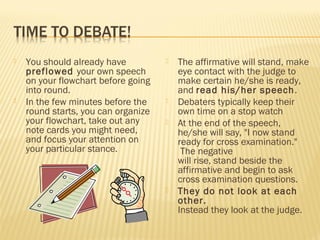
 You should already have 
preflowed your own speech 
on your flowchart before going 
into round. 
 In the few minutes before the 
round starts, you can organize 
your flowchart, take out any 
note cards you might need, 
and focus your attention on 
your particular stance. 
 The affirmative will stand, make 
eye contact with the judge to 
make certain he/she is ready, 
and read his/her speech. 
 Debaters typically keep their 
own time on a stop watch 
 At the end of the speech, 
he/she will say, "I now stand 
ready for cross examination." 
The negative 
will rise, stand beside the 
affirmative and begin to ask 
cross examination questions. 
 They do not look at each 
other. 
Instead they look at the judge.
 Each debater will have 4 minutes 
of Preparation Time that they can 
take whenever they like. 
 Usually the negative takes 2 minutes 
his/her cross-ex and then another 2 
minutes his second speech. 
 Usually the affirmative takes 2 
minutes before each of his/her 
rebuttal speeches. 
 The negative will then ROAD MAP 
for the judge what he/she intends to 
do. He/she will say, "I will first read 
the negative case and then attack 
my opponent's ridiculous position." 
(Not really-- don't really say 
"ridiculous"--just think it.) 
 Then he/she will read the four minute 
speech. Next he/she will say, "I will 
now turn to my opponent's case." 
Turning to the flow pad, he/she will 
attack all the points made by the 
affirmative, showing why his case is 
better. 
 Any points he fails to attack are 
considered dropped and are given to 
the other side. 
 MOST COMMON NOVICE ERROR: 
Failing to attack your opponent's case!
 Now the debate goes back and forth in the same manner. 
When it's over, shake hands with your opponent, thank 
the judge for judging and leave the room. 
 Both opponents should go out together. It is considered bad 
form for one to leave before the other. 
 The judge stays behind to make his decision (or s/he may 
give oral critiques). Be careful of what you say when you 
leave the room. If the judge hears you say that you think you 
lost, it might persuade him that you did. 
 Now you can go purchase some really 
“good” food at the snack bar!

Lincoln douglas debate intro

  • 1.
  • 2.
     Lincoln-Douglas Debateis a VALUE debate, meaning it is a debate about what ought to be rather than specific policy.  It is usually a topic regarding the conflict between the rights of the individual opposed to the rights of the larger society.  The topic changes every two months; it is chosen by the National Forensic League.
  • 3.
     A roundof Lincoln-Douglas Debate is the debate of one person from one school arguing against a person from a dif ferent school.  At a debate tournament, each student will debate at least 3-4 times. The larger the tournament, the more rounds will be guaranteed.
  • 4.
     During atypical tournament, debaters will argue both sides of the topic.  Usually, each debater will be assigned the affirmative side for two rounds and the negative side on two other rounds.  A Lincoln-Douglas debate round lasts about 45 minutes. The times for the various speeches are very structured, as are the purposes of the speeches.
  • 5.
     6 minuteAffirmative Constructive (AC)  3 minute Negative Cross Examination  7 minute Negative Constructive/Rebuttal (NC)  3 minute Affirmative Cross Examination (questions/answers)  4 minute Affirmative Reconstructive/Rebuttal (1AR)  6 minute Negative Reconstructive/Rebuttal (NR)  3 minute Affirmative Reconstructive/Rebuttal/Crystallization (2AR)  It helps to memorize: "6 - 3 - 7 - 3 - 4 - 6 - 3"
  • 6.
     6 minuteAffirmative Constructive. This speech is prepared ahead, rehearsed and should be perfectly timed. It is a presentation of the affirmative's position and establishes his/her stance.  3 minute Negative Cross Examination. The Negative asks for clarification, asks for repetition of certain points, and tries to set up the affirmative to admit damaging information.  7 minute Negative Constructive/ Rebuttal. This speech really has two parts: The first part is a written, rehearsed speech that builds the negative case and is about four minutes long. In the second part, the negative must attack his/her opponent's points. The attack takes the last three minutes.  3 minute Affirmative Cross Examination. Now it's the affirmative's turn to question the negative, asking for clarification and trying to lead him/her down an ivy-covered path to destruction.  4 minute Affirmative Reconstructive/Rebuttal. The affirmative doesn't have much time here, so she/he has to talk fast. She/he must go down the flow (outline) of the argumentation, hitting any arguments against her/his own case and then attacking each of her/his opponent's arguments. Again, two parts: Rebuild and Attack.  6 minute Negative Reconstructive/ Rebuttal. This speech has three parts: Rebuild, Attack and Crystallize: about two minutes to rebuild any arguments against the negative's own case; two minutes to attack the affirmative; and two minutes to summarize the voting issues for the judge.  3 minute Affirmative Reconstructive/Rebuttal. This is a very short speech--time only to argue the most important points, attack the negative's voting issues, and crystallize the affirmative's own voting points.
  • 7.
     Our Teamsubscribes to publishers who create DEBATE BRIEFS  A Brief is a collection of evidence, arguments, current topic analysis, definitions, etc.  Briefs are helpful, but remember that other teams may also have these collections  Evidence can also be found on the internet, but only use CREDIBLE sources (NY Times, WA Post, etc.)
  • 8.
     You willneed to write TWO speeches: the affirmative (6 min.) that says that the resolution is true and the negative (3-4 min) that says that the resolution is false.  You will use your affirmative speech in two of your debates and your negative speech in the other two debates.
  • 9.
     Step One:The Resolution. The resolution is a statement of the topic of the debate. The entire debate is a test of the validity of this statement. Therefore, wording and semantics are crucial. Each important word must be defined from different angles.  After a brief opening paragraph using the resolution as the thesis statement, or in the case of the negative, its antithesis, you will state your definitions.  Step Two: The Value Premise.  Remember that we said that Lincoln-Douglas Debate is a VALUE debate about what ought to be, right?  Each debate speech will center on a value that you choose as the cornerstone of your position. I know this seems very, very vague.  Let’s clarify using a simple analogy:
  • 10.
     Pretend theResolution is:  Resolved: A cheeseburger ought to be valued above spaghetti. vs.  Before you can start arguing about which of these two yummies is the more valuable, you need to figure out what yardstick to use to measure them: Is it Good Taste? Nutritional Value? Ease of Preparation? Aesthetic Presentation?  The yardstick you choose is called your Value Premise. Naturally, you will choose the yardstick that you think will help you win!  If you're debating for the cheeseburger, you might take "Good Taste" as the most important value; if you're taking the side of spaghetti, you might claim that "Nutrition" must be the value by which to measure foods.  In this debate, the affirmative might claim that if food doesn't taste good, no one will eat it. The negative might claim that nutrition is prime and that if it's not good for the body, it's not good food. From this example, you can see that the debate should go back and forth.
  • 11.
     The valueis achieved through certain Criteria.  After you state your value premise, you will name the criterion or criteria that you will use to achieve the value.  For example, for the value of Nutrition, your criterion might be the Four Food Groups, as set up by the U.S. Dept of Health, Education and Welfare.  Step Three: State arguments as main points. You will need two or three main points. The cheeseburger affirmative might be:  Value: Common Good  Criterion: Quality of Life  Contention One: The cheeseburger provides one of the basic needs of mankind, according to Maslow's hierarchy of basic needs.  Contention Two: The cheeseburger provides nutrition from all four food groups.  Contention Three: The cheeseburger provides advantages that the negative cannot provide, including portability and ease of use.
  • 12.
     The spaghettinegative might be:  Value: Life  Criterion: Nutrition  Contention One: Spaghetti provides a high standard of nutrition needed for life.  Contention Two: A cheeseburger is fat-filled and therefore fails to provide nutrition.  Step Four: Use evidence to back up each point. Evidence can consist of quotes, reasoning, or analogy.  Step Five: Find a good opening for the speech. This can be an apt quote, startling statistics, or interesting example.  Step Six: Time the speech. (Six minutes for the affirmative exactly. About three to four minutes for negative.)
  • 13.
     At thebeginning of a round, they will post a listing of the debate rounds. This is called the Pairings. It will show your name, your opponent's name, your judge, the room number, and what side you are--aff or neg.  Write down your side and the room number. If you forget, you'll have to walk all the way back to the pairings.  Your audience is usually only one person--the JUDGE. If you don't make the judge respect you, you don't win the round.  Try to figure out what the judge will respect, and give it to her/him. Most judges like friendly, helpful kids who act as if they enjoy debating. Judges can be coaches, teachers, former debaters, community leaders, or parents.  Judging is hard. A judge has to listen carefully, take good notes, and sometimes give time signals all at the same time.  Just like students in a classroom , judges have other things on their minds that sometimes cause their attention to waiver. Therefore, plan to repeat yourself. Just because you said something once does not mean that the judge heard it.  The judge will fill out a BALLOT explaining the debate and why she/he made the decision about who won.
  • 14.
    AC (6 min. speech) V: C: 123 NC (3-4 min. speech) V: C: 12 1AR Rebuild your case and answer attacks (2 min.) NR Attack (2 min.) Rebuild (2 min.) AR Brief attack of NR position Brief support of Aff side Notes on cross ex period NC (2nd part) Attack on AC (line by line, 3-4 min.) 1AR Attack NC line by line (2 min.) Crystallize the round Give VOTERS (2 min.) Crystallize Give VOTERS The judge and both debaters will outline everything that is said in the round. This outline is called in debate jargon a FLOW. The paper is called a FLOW CHART. Each person's flow chart will look a bit different, but it should be neat and easily read.
  • 15.
     When yougo into the round, the judge will sit in a student desk in the center of the room. The affirmative will use a desk in the front left; the negative will use a desk in the front right, although this is not a rule.  You can rearrange the desks a bit for your comfort, just put them back before you leave the room. You can take a bottle of water, but no food or drinks.  Be pleasant and nice to your opponent, but be a bit suspicious until you know them. A few debaters can be sneaky and mean. Don't tell them anything that you don't want used against yourself or your team.  The judge will ask you for your school code, name, and what side you're on. The school code is assigned at registration. Sometimes they will want you to write this on the board; sometimes they will ask you to fill out the top of the ballot with this information; sometimes they will just ask you casually.
  • 16.
     You shouldalready have preflowed your own speech on your flowchart before going into round.  In the few minutes before the round starts, you can organize your flowchart, take out any note cards you might need, and focus your attention on your particular stance.  The affirmative will stand, make eye contact with the judge to make certain he/she is ready, and read his/her speech.  Debaters typically keep their own time on a stop watch  At the end of the speech, he/she will say, "I now stand ready for cross examination." The negative will rise, stand beside the affirmative and begin to ask cross examination questions.  They do not look at each other. Instead they look at the judge.
  • 17.
     Each debaterwill have 4 minutes of Preparation Time that they can take whenever they like.  Usually the negative takes 2 minutes his/her cross-ex and then another 2 minutes his second speech.  Usually the affirmative takes 2 minutes before each of his/her rebuttal speeches.  The negative will then ROAD MAP for the judge what he/she intends to do. He/she will say, "I will first read the negative case and then attack my opponent's ridiculous position." (Not really-- don't really say "ridiculous"--just think it.)  Then he/she will read the four minute speech. Next he/she will say, "I will now turn to my opponent's case." Turning to the flow pad, he/she will attack all the points made by the affirmative, showing why his case is better.  Any points he fails to attack are considered dropped and are given to the other side.  MOST COMMON NOVICE ERROR: Failing to attack your opponent's case!
  • 18.
     Now thedebate goes back and forth in the same manner. When it's over, shake hands with your opponent, thank the judge for judging and leave the room.  Both opponents should go out together. It is considered bad form for one to leave before the other.  The judge stays behind to make his decision (or s/he may give oral critiques). Be careful of what you say when you leave the room. If the judge hears you say that you think you lost, it might persuade him that you did.  Now you can go purchase some really “good” food at the snack bar!