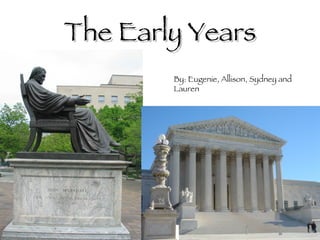
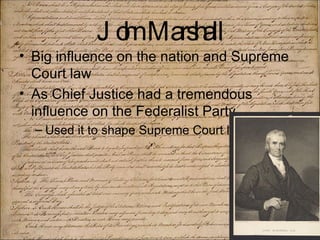
John Marshall had a significant influence on the Supreme Court and federalism through key cases during his tenure as Chief Justice from 1801 to 1835. In McCulloch v. Maryland, Marshall established the doctrine of implied powers, finding the federal government had implied powers beyond those explicitly enumerated. In Gibbons v. Ogden, Marshall broadened Congress's power to regulate interstate commerce. His rulings strengthened the power of the federal government and limited the power of the states, representing the Federalist view of a stronger national government over state governments.