   A computer system is defined as
    combination of components designed to
    process data and store files. A
    computer system consists of four major
    hardware components; input devices,
    output devices, processor and storage
    devices. A computer system requires
    hardware, software and a user to fully
    function.
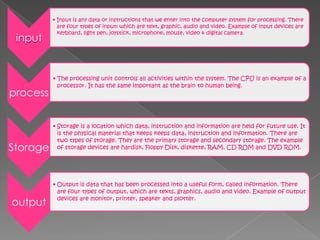
• Input is any data or instructions that we enter into the computer system for processing. There
            are four types of input: which are text, graphic, audio and video. Example of input devices are
            keyboard, light pen, joystick, microphone, mouse, video & digital camera.
 input


          • The processing unit controls all activities within the system. The CPU is an example of a
            processor. It has the same important as the brain to human being.
process

          • Storage is a location which data, instruction and information are held for future use. It
            is the physical material that keeps keeps data, instruction and information. There are
            two types of storage. They are the primary storage and secondary storage. The example
Storage     of storage devices are hardisk, Floppy Disk, diskette, RAM, CD ROM and DVD ROM.


          • Output is data that has been processed into a useful form, called information. There
            are four types of output, which are texts, graphics, audio and video. Example of output
            devices are monitor, printer, speaker and plotter.
output
input                               process                                storage

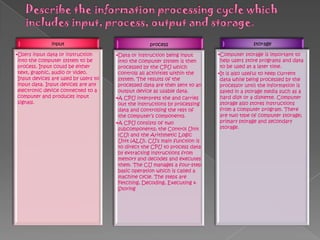
•Users input data or instruction      •Data or instruction being input      •Computer storage is important to
 into the computer system to be        into the computer system is then      help users store programs and data
 process. Input could be either        processed by the CPU which            to be used at a later time.
 text, graphic, audio or video.        controls all activities within the   •It is also useful to keep current
 Input devices are used by users to    system. The results of the            data while being processed by the
 input data. Input devices are any     processed data are then sent to an    processor until the information is
 electronic device connected to a      output device as usable data.         saved in a storage media such as a
 computer and produces input          •A CPU interprets the and carries      hard disk or a diskette. Computer
 signals.                              out the instructions by processing    storage also stores instructions
                                       data and controlling the rest of      from a computer program. There
                                       the computer’s components.            are two type of computer storage;
                                      •A CPU consists of two                 primary storage and secondary
                                       subcomponents; the Control Unit       storage.
                                       (CU) and the Arithmetic Logic
                                       Unit (ALU). CU’s main function is
                                       to direct the CPU to process data
                                       by extracting instructions from
                                       memory and decodes and executes
                                       them. The CU manages a four-step
                                       basic operation which is called a
                                       machine cycle. The steps are
                                       Fetching, Decoding, Executing &
                                       Storing
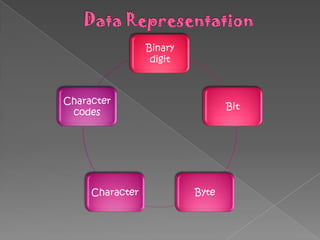
Binary
                  digit


Character
                                 Bit
 codes


     Character            Byte
BINARY DIGIT

     Computers recognize only two discrete states: on and off. These states can be
      represented by two digits, 0 and 1. Each 0 or 1 is called a bit in the binary system.

     Bit is the smallest unit of data a computer can process. Bit is a short for binary digit.
      The binary system has a base of 2 with the two digits (0 and 1). Combinations of 0s and 1s
      represent larger numbers.


BIT

     A bit is the smallest unit of data that the computer can process. Bit is a short for binary
      digit. A bit is represented by the numbers 1 and 0. These numbers represent the binary
      system. They correspond to the states of on and off, true and false, or yes and no.

     All digital data use the binary system to process the information. This information
      include letters, digits or special character.

BYTE

           Byte is a unit of information built from bits. One byte is equals to 8 bits. Eight bits
            that are grouped together as a unit. A byte provides enough different
            combinations of 0s and 1s to represent 256 individual characters.

           One byte represents a single character such as the number 3, letter b or a $
            symbol. Bits and bytes are the basis for representing all meaningful information and
            programs on computers.
CHARACTER

   8 bits = 1 byte

   One byte represents one character such as A, 7, 9 and +.Eight bits that are grouped
    together as a unit. A byte provides enough different combinations of 0s and 1s to
    represent 256 individual characters.

   For example, the capital letter F is represented by the binary code 01000110 that can
    be understood by the computer system. Eight bits grouped together as a unit are
    called a byte. A byte represents a single character in the computer.


CHARACTER CODES

   There are three character codes to represent characters which are ASCII, EBCDIC
    and Unicode. Each byte contains eight bits. A byte provides enough different
    combination of 0s and 1s to represent 256 characters.

   The combinations of 0s and 1s are defined by patterns. These patterns are called
    coding scheme. The 256-character capability of ASCII and EBCDIC is too small to
    handle the characters that are used by other languages such as Arabic, Japanese and
    Chinese.

   The Unicode coding scheme is designed to solve this problem. It uses two bytes (16
    bits) to represent one character. Unicode will have more than 65,000 different
    characters. This can cover all the world’s languages.
ASCII code
   ASCII pronounced as "ask-key" stands for the American
    Standard Code for Information Interchange and was
    proposed by ASA (American Standard Association) in 963
    and was finalised in 1968.ASCII is a standard of 7-bit code
    used to represent characters, which include letters,
    numbers and punctuation marks.
   7 bits allow the computer to encode a total of 128
    characters for the numbers 0-9, uppercase and lowercase
    letters A-Z and a few punctuation symbols. However this 128
    bit code only suitable for english language speaking users.

   IBM and Apple expanded the amount of space reserved for
    the character codes to 8-bits, equivalent to 1 byte.
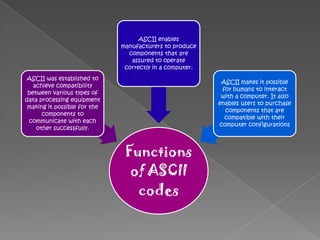
ASCII enables
                              manufacturers to produce
                                components that are
                                 assured to operate
                               correctly in a computer.
 ASCII was established to
                                                           ASCII makes it possible
   achieve compatibility
                                                           for humans to interact
 between various types of
                                                           with a computer. It also
data processing equipment
                                                          enables users to purchase
 making it possible for the
                                                            components that are
      components to
                                                            compatible with their
 communicate with each
                                                          computer configurations
    other successfully.


                               Functions
                                of ASCII
                                 codes
When you press a
                         key, for example the
                           letter D on your
                             keyboard, the
                          electronic signal is
                         sent to the CPU for
                           the computer to
                         process and store in
                                memory.


In this example,                                       Every character is
 the letter D is                                        converted to its
  converted to                                           corresponding
   01000100.                                              binary form.


              When the
             computer is
               finished                     The computer the
           processing the                      processes the
         byte, the software                      letter as a
           installed in the                     byte., which
           system convert                   actually a series of
            the byte back                      on and off of
            which is then                    electrical states.
          displayed in the
               screen.
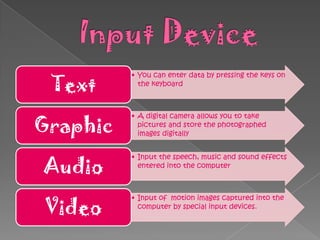
Text
          • You can enter data by pressing the keys on
            the keyboard


Graphic
          • A digital camera allows you to take
            pictures and store the photographed
            images digitally


Audio
          • Input the speech, music and sound effects
            entered into the computer


Video
          • Input of motion images captured into the
            computer by special input devices.
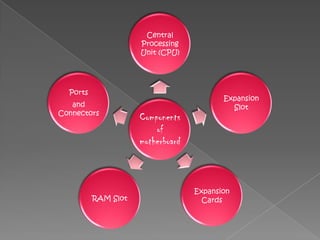
Central
                     Processing
                     Unit (CPU)


  Ports
                                          Expansion
   and                                      Slot
Connectors
                     Components
                         of
                     motherboard


                                   Expansion
          RAM Slot                   Cards
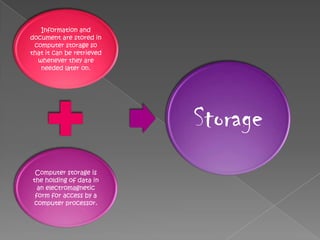
Information and
document are stored in
 computer storage so
that it can be retrieved
  whenever they are
   needed later on.


                           Storage
 Computer storage is
the holding of data in
  an electromagnetic
 form for access by a
 computer processor.
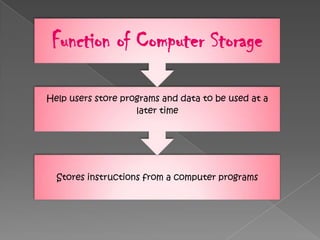
Function of Computer Storage

Help users store programs and data to be used at a
                    later time


  Stores instructions from a computer programs
Definition of operating system
 Set of programs that schedule
  tasks, allowcates storage and presents a
  default interface to the user between
  applications.

Function of the operating system are :
 Starting a computer
 Providing a user interface
 Managing data and programs
 Managing memory
 Configuring devices
Chapter 2 computer system

Chapter 2 computer system

  • 2.
    A computer system is defined as combination of components designed to process data and store files. A computer system consists of four major hardware components; input devices, output devices, processor and storage devices. A computer system requires hardware, software and a user to fully function.
  • 3.
    • Input isany data or instructions that we enter into the computer system for processing. There are four types of input: which are text, graphic, audio and video. Example of input devices are keyboard, light pen, joystick, microphone, mouse, video & digital camera. input • The processing unit controls all activities within the system. The CPU is an example of a processor. It has the same important as the brain to human being. process • Storage is a location which data, instruction and information are held for future use. It is the physical material that keeps keeps data, instruction and information. There are two types of storage. They are the primary storage and secondary storage. The example Storage of storage devices are hardisk, Floppy Disk, diskette, RAM, CD ROM and DVD ROM. • Output is data that has been processed into a useful form, called information. There are four types of output, which are texts, graphics, audio and video. Example of output devices are monitor, printer, speaker and plotter. output
  • 4.
    input process storage •Users input data or instruction •Data or instruction being input •Computer storage is important to into the computer system to be into the computer system is then help users store programs and data process. Input could be either processed by the CPU which to be used at a later time. text, graphic, audio or video. controls all activities within the •It is also useful to keep current Input devices are used by users to system. The results of the data while being processed by the input data. Input devices are any processed data are then sent to an processor until the information is electronic device connected to a output device as usable data. saved in a storage media such as a computer and produces input •A CPU interprets the and carries hard disk or a diskette. Computer signals. out the instructions by processing storage also stores instructions data and controlling the rest of from a computer program. There the computer’s components. are two type of computer storage; •A CPU consists of two primary storage and secondary subcomponents; the Control Unit storage. (CU) and the Arithmetic Logic Unit (ALU). CU’s main function is to direct the CPU to process data by extracting instructions from memory and decodes and executes them. The CU manages a four-step basic operation which is called a machine cycle. The steps are Fetching, Decoding, Executing & Storing
  • 5.
    Binary digit Character Bit codes Character Byte
  • 6.
    BINARY DIGIT  Computers recognize only two discrete states: on and off. These states can be represented by two digits, 0 and 1. Each 0 or 1 is called a bit in the binary system.  Bit is the smallest unit of data a computer can process. Bit is a short for binary digit. The binary system has a base of 2 with the two digits (0 and 1). Combinations of 0s and 1s represent larger numbers. BIT  A bit is the smallest unit of data that the computer can process. Bit is a short for binary digit. A bit is represented by the numbers 1 and 0. These numbers represent the binary system. They correspond to the states of on and off, true and false, or yes and no.  All digital data use the binary system to process the information. This information include letters, digits or special character. BYTE  Byte is a unit of information built from bits. One byte is equals to 8 bits. Eight bits that are grouped together as a unit. A byte provides enough different combinations of 0s and 1s to represent 256 individual characters.  One byte represents a single character such as the number 3, letter b or a $ symbol. Bits and bytes are the basis for representing all meaningful information and programs on computers.
  • 7.
    CHARACTER  8 bits = 1 byte  One byte represents one character such as A, 7, 9 and +.Eight bits that are grouped together as a unit. A byte provides enough different combinations of 0s and 1s to represent 256 individual characters.  For example, the capital letter F is represented by the binary code 01000110 that can be understood by the computer system. Eight bits grouped together as a unit are called a byte. A byte represents a single character in the computer. CHARACTER CODES  There are three character codes to represent characters which are ASCII, EBCDIC and Unicode. Each byte contains eight bits. A byte provides enough different combination of 0s and 1s to represent 256 characters.  The combinations of 0s and 1s are defined by patterns. These patterns are called coding scheme. The 256-character capability of ASCII and EBCDIC is too small to handle the characters that are used by other languages such as Arabic, Japanese and Chinese.  The Unicode coding scheme is designed to solve this problem. It uses two bytes (16 bits) to represent one character. Unicode will have more than 65,000 different characters. This can cover all the world’s languages.
  • 8.
    ASCII code  ASCII pronounced as "ask-key" stands for the American Standard Code for Information Interchange and was proposed by ASA (American Standard Association) in 963 and was finalised in 1968.ASCII is a standard of 7-bit code used to represent characters, which include letters, numbers and punctuation marks.  7 bits allow the computer to encode a total of 128 characters for the numbers 0-9, uppercase and lowercase letters A-Z and a few punctuation symbols. However this 128 bit code only suitable for english language speaking users.  IBM and Apple expanded the amount of space reserved for the character codes to 8-bits, equivalent to 1 byte.
  • 9.
    ASCII enables manufacturers to produce components that are assured to operate correctly in a computer. ASCII was established to ASCII makes it possible achieve compatibility for humans to interact between various types of with a computer. It also data processing equipment enables users to purchase making it possible for the components that are components to compatible with their communicate with each computer configurations other successfully. Functions of ASCII codes
  • 10.
    When you pressa key, for example the letter D on your keyboard, the electronic signal is sent to the CPU for the computer to process and store in memory. In this example, Every character is the letter D is converted to its converted to corresponding 01000100. binary form. When the computer is finished The computer the processing the processes the byte, the software letter as a installed in the byte., which system convert actually a series of the byte back on and off of which is then electrical states. displayed in the screen.
  • 11.
    Text • You can enter data by pressing the keys on the keyboard Graphic • A digital camera allows you to take pictures and store the photographed images digitally Audio • Input the speech, music and sound effects entered into the computer Video • Input of motion images captured into the computer by special input devices.
  • 12.
    Central Processing Unit (CPU) Ports Expansion and Slot Connectors Components of motherboard Expansion RAM Slot Cards
  • 13.
    Information and document arestored in computer storage so that it can be retrieved whenever they are needed later on. Storage Computer storage is the holding of data in an electromagnetic form for access by a computer processor.
  • 14.
    Function of ComputerStorage Help users store programs and data to be used at a later time Stores instructions from a computer programs
  • 15.
    Definition of operatingsystem  Set of programs that schedule tasks, allowcates storage and presents a default interface to the user between applications. Function of the operating system are :  Starting a computer  Providing a user interface  Managing data and programs  Managing memory  Configuring devices