Chapter 2
DEFINING CULTURE AND SSOCIETY
FROM THEE PERSPECTIVES OF
ANTHROPOLOGY AND SOCIOLOGY
I.Defining Culture
andSocietyfrom
theperspectives
ofAnthropology
andSociology
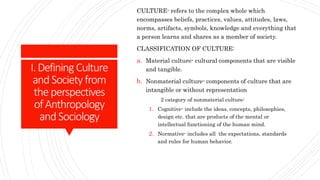
CULTURE- refers to the complex whole which
encompasses beliefs, practices, values, attitudes, laws,
norms, artifacts, symbols, knowledge and everything that
a person learns and shares as a member of society.
CLASSIFICATION OF CULTURE:
a. Material culture- cultural components that are visible
and tangible.
b. Nonmaterial culture- components of culture that are
intangible or without representation
2 category of nonmaterial culture:
1. Cognitive- include the ideas, concepts, philosophies,
design etc. that are products of the mental or
intellectual functioning of the human mind.
2. Normative- includes all the expectations, standards
and rules for human behavior.
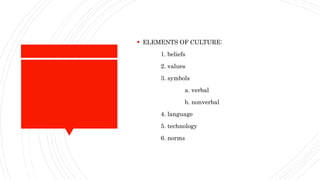
 ELEMENTS OF CULTURE:
1. beliefs
2. values
3. symbols
a. verbal
b. nonverbal
4. language
5. technology
6. norms
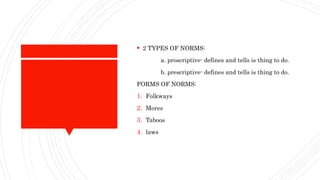
 2 TYPES OF NORMS:
a. proscriptive- defines and tells is thing to do.
b. prescriptive- defines and tells is thing to do.
FORMS OF NORMS:
1. Folkways
2. Mores
3. Taboos
4. laws
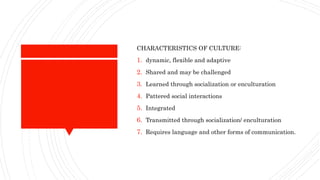
CHARACTERISTICS OF CULTURE:
1. dynamic, flexible and adaptive
2. Shared and may be challenged
3. Learned through socialization or enculturation
4. Pattered social interactions
5. Integrated
6. Transmitted through socialization/ enculturation
7. Requires language and other forms of communication.
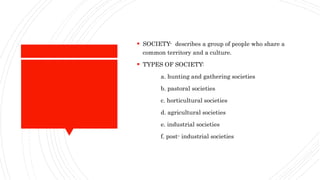
 SOCIETY- describes a group of people who share a
common territory and a culture.
 TYPES OF SOCIETY:
a. hunting and gathering societies
b. pastoral societies
c. horticultural societies
d. agricultural societies
e. industrial societies
f. post- industrial societies
ETHNOCENTRISM/
XENOCENTRISMAND
CULTURALRELATIVISM
ASORIENTATIONSIN
VIEWINGOTHER
CULTURE
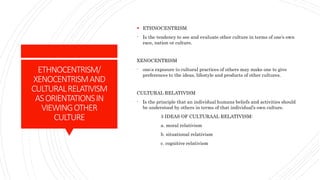
 ETHNOCENTRISM
- Is the tendency to see and evaluate other culture in terms of one’s own
race, nation or culture.
XENOCENTRISM
- one;s exposure to cultural practices of others may make one to give
preferences to the ideas, lifestyle and products of other cultures.
CULTURAL RELATIVISM
- Is the principle that an individual humans beliefs and activities should
be understood by others in terms of that individual’s own culture.
3 IDEAS OF CULTURAAL RELATIVISM:
a. moral relativism
b. situational relativism
c. cognitive relativism
 Reference:
 Understanding, Culture, Society and Politics. 2016. Myla M. Arcinas Ph. D. pp 1-13.

Chapter 2: DEFINING CULTURE AND SOCIETY FROM THE PERSPECTIVE OF ANTHROPOLOGY AND SOCIOLOGY

  • 1.
    Chapter 2 DEFINING CULTUREAND SSOCIETY FROM THEE PERSPECTIVES OF ANTHROPOLOGY AND SOCIOLOGY
  • 2.
    I.Defining Culture andSocietyfrom theperspectives ofAnthropology andSociology CULTURE- refersto the complex whole which encompasses beliefs, practices, values, attitudes, laws, norms, artifacts, symbols, knowledge and everything that a person learns and shares as a member of society. CLASSIFICATION OF CULTURE: a. Material culture- cultural components that are visible and tangible. b. Nonmaterial culture- components of culture that are intangible or without representation 2 category of nonmaterial culture: 1. Cognitive- include the ideas, concepts, philosophies, design etc. that are products of the mental or intellectual functioning of the human mind. 2. Normative- includes all the expectations, standards and rules for human behavior.
  • 3.
     ELEMENTS OFCULTURE: 1. beliefs 2. values 3. symbols a. verbal b. nonverbal 4. language 5. technology 6. norms
  • 4.
     2 TYPESOF NORMS: a. proscriptive- defines and tells is thing to do. b. prescriptive- defines and tells is thing to do. FORMS OF NORMS: 1. Folkways 2. Mores 3. Taboos 4. laws
  • 5.
    CHARACTERISTICS OF CULTURE: 1.dynamic, flexible and adaptive 2. Shared and may be challenged 3. Learned through socialization or enculturation 4. Pattered social interactions 5. Integrated 6. Transmitted through socialization/ enculturation 7. Requires language and other forms of communication.
  • 6.
     SOCIETY- describesa group of people who share a common territory and a culture.  TYPES OF SOCIETY: a. hunting and gathering societies b. pastoral societies c. horticultural societies d. agricultural societies e. industrial societies f. post- industrial societies
  • 7.
    ETHNOCENTRISM/ XENOCENTRISMAND CULTURALRELATIVISM ASORIENTATIONSIN VIEWINGOTHER CULTURE  ETHNOCENTRISM - Isthe tendency to see and evaluate other culture in terms of one’s own race, nation or culture. XENOCENTRISM - one;s exposure to cultural practices of others may make one to give preferences to the ideas, lifestyle and products of other cultures. CULTURAL RELATIVISM - Is the principle that an individual humans beliefs and activities should be understood by others in terms of that individual’s own culture. 3 IDEAS OF CULTURAAL RELATIVISM: a. moral relativism b. situational relativism c. cognitive relativism
  • 8.
     Reference:  Understanding,Culture, Society and Politics. 2016. Myla M. Arcinas Ph. D. pp 1-13.