GOOD MORNING 😇
“ARRANGE ME”
OSTYCIE
_ _ _ _ _ _ _
LARUTLUC
MSIVITALALER
_ _ _ _ _ _ _ _ _ _ _ _ _ _ _ _ _ _
NOITAZILAICOS
_ _ _ _ _ _ _ _ _ _ _ _ _
MSIRTNECOHTE
_ _ _ _ _ _ _ _ _ _ _ _
TURECUL
_ _ _ _ _ _ _
LESSON 2:
DEFINING CULTURE AND SOCIETY
FROM THE PERSPECTIVES OF
ANTHROPOLOGY AND SOCIOLOGY
•A. Definition of Society
Society -is a group of individuals sharing a
common culture, geographical location, and
government.
Human beings are considered to be naturally inclined to
establish societies, since it is in interacting with others that
they are able to ensure their survival by establishing
mutually beneficial relationships with one another.
It enables individuals to acquire necessary survival skills,
maximize their potential, and share resources.
The classic definition of society is based on E.B.
Taylor's concept which states that society is "that
complex whole which encompasses beliefs,
practices, values, attitudes, laws, norms, artifacts,
symbols, knowledge, and everything that a person
learns and shares as a member of society."
A society is characterized by the presence of the
following elements:
a) social solidarity, whereby members of the
community live together for mutual benefit
b) shared identity and culture among members that
serve as basis for their patterns of action and
behavior
c) a common language;
d) definite geographical area
e) political, economic, and social organization.
B. DEFINITION OF CULTURE
Culture is one of the important bases that define
and influence society.
It refers to the set of beliefs, ideas, values,
practices, knowledge, history and shared
experiences, attitudes, as well as material objects
and possessions accumulated over time and shared
by the members of society.
Components of Culture
1. Technology- The combination of objects and rules
2. Symbols- Anything that represents something
else; the very basis of human culture
3. Language- The organization of written or spoken
symbols into a standardized system.
4. Values- Are shared beliefs about what is good or bad; the
type of values held by a group determines their character
5. Norms- shared rules of conduct.
* Folkways
* Mores
• Folkways are norms that describe socially acceptable
behavior but do not have great moral significance
attached to them.
• Mores are norms that have great moral significance
attached to them that when violated endangers society.
(e.g. dishonesty, fraud, killings)
• Culture helps to explain human social behavior.
• Culture may be material or non-material.
• Material culture consists of tangible things. (technology,
architecture, fashion, food)
• Non-material culture consists of intangible things.
(values, language, beliefs, traditions/practices, political
system, etc.)
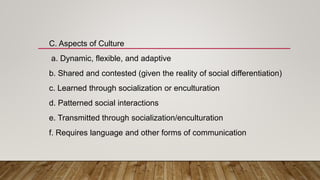
C. Aspects of Culture
a. Dynamic, flexible, and adaptive
b. Shared and contested (given the reality of social differentiation)
c. Learned through socialization or enculturation
d. Patterned social interactions
e. Transmitted through socialization/enculturation
f. Requires language and other forms of communication
Subculture is a part of the dominant group but differs from it
in some important aspects.(e.g. China town, youth groups,
Circus people, military, police, lawyers, etc.)
Counterculture is a subculture deliberately and consciously
opposed to certain central beliefs of the dominant culture.
(e.g. goth, punk, prison counterculture, gangs)
D. ETHNOCENTRISM AND CULTURAL RELATIVISM AS
ORIENTATIONS IN VIEWING OTHER CULTURES (RESPONSE TO
VARIATIONS)
Ethnocentrism- diminishes or invalidates "other" ways of life and
creates a distorted view of one's own. As a result, this could affect
individual behavior and relationships with other cultures.
Extreme forms of ethnocentrism have led to wars or colonization.
William Howard Taft, for example, once referred to the Filipinos as the
Americans' "little brown brothers" who needed to be supervised by
the United States of America in establishing a society and
government that approximates "Anglo American standards."
Cultural Relativism- recognizes and accepts the cultural
differences between societies.
Interaction between members of different societies is more
likely to succeed if everybody is aware and is respectful of
cultural diversity.
ENRICHMENT ACTIVITY
“ Appreciate me
as your Culture”
RECAPITULATION
• Why do we need to understand Culture ?
• Why Society and Culture is important ?
• How Culture affects the behavior of Society ?
QUIZ :
5 MINUTES
Identification:
_____ 1. a group of individuals sharing a common culture, geographical location, and government.
_____ 2. one of the important bases that define and influence society.
_____ 3. Are shared beliefs about what is good or bad
_____ 4. It refers to the set of beliefs, ideas, values, practices, knowledge, history and shared
experiences, attitudes, as well as material objects and possessions accumulated over time and shared
by the members of society.
_____ 5. diminishes or invalidates “other” ways of life and creates a distorted view of one’s own.
ASSIGNMENT
Have an advance reading to our next topic
“ Family and Household”

UCSP.pptx

  • 1.
  • 2.
  • 3.
  • 4.
    LARUTLUC MSIVITALALER _ _ __ _ _ _ _ _ _ _ _ _ _ _ _ _ _
  • 5.
    NOITAZILAICOS _ _ __ _ _ _ _ _ _ _ _ _
  • 6.
    MSIRTNECOHTE _ _ __ _ _ _ _ _ _ _ _
  • 7.
  • 8.
    LESSON 2: DEFINING CULTUREAND SOCIETY FROM THE PERSPECTIVES OF ANTHROPOLOGY AND SOCIOLOGY
  • 9.
    •A. Definition ofSociety Society -is a group of individuals sharing a common culture, geographical location, and government.
  • 10.
    Human beings areconsidered to be naturally inclined to establish societies, since it is in interacting with others that they are able to ensure their survival by establishing mutually beneficial relationships with one another. It enables individuals to acquire necessary survival skills, maximize their potential, and share resources.
  • 11.
    The classic definitionof society is based on E.B. Taylor's concept which states that society is "that complex whole which encompasses beliefs, practices, values, attitudes, laws, norms, artifacts, symbols, knowledge, and everything that a person learns and shares as a member of society."
  • 12.
    A society ischaracterized by the presence of the following elements: a) social solidarity, whereby members of the community live together for mutual benefit b) shared identity and culture among members that serve as basis for their patterns of action and behavior
  • 13.
    c) a commonlanguage; d) definite geographical area e) political, economic, and social organization.
  • 14.
    B. DEFINITION OFCULTURE Culture is one of the important bases that define and influence society. It refers to the set of beliefs, ideas, values, practices, knowledge, history and shared experiences, attitudes, as well as material objects and possessions accumulated over time and shared by the members of society.
  • 15.
    Components of Culture 1.Technology- The combination of objects and rules 2. Symbols- Anything that represents something else; the very basis of human culture 3. Language- The organization of written or spoken symbols into a standardized system.
  • 16.
    4. Values- Areshared beliefs about what is good or bad; the type of values held by a group determines their character 5. Norms- shared rules of conduct. * Folkways * Mores
  • 17.
    • Folkways arenorms that describe socially acceptable behavior but do not have great moral significance attached to them. • Mores are norms that have great moral significance attached to them that when violated endangers society. (e.g. dishonesty, fraud, killings) • Culture helps to explain human social behavior.
  • 18.
    • Culture maybe material or non-material. • Material culture consists of tangible things. (technology, architecture, fashion, food) • Non-material culture consists of intangible things. (values, language, beliefs, traditions/practices, political system, etc.)
  • 19.
    C. Aspects ofCulture a. Dynamic, flexible, and adaptive b. Shared and contested (given the reality of social differentiation) c. Learned through socialization or enculturation d. Patterned social interactions e. Transmitted through socialization/enculturation f. Requires language and other forms of communication
  • 20.
    Subculture is apart of the dominant group but differs from it in some important aspects.(e.g. China town, youth groups, Circus people, military, police, lawyers, etc.) Counterculture is a subculture deliberately and consciously opposed to certain central beliefs of the dominant culture. (e.g. goth, punk, prison counterculture, gangs)
  • 21.
    D. ETHNOCENTRISM ANDCULTURAL RELATIVISM AS ORIENTATIONS IN VIEWING OTHER CULTURES (RESPONSE TO VARIATIONS) Ethnocentrism- diminishes or invalidates "other" ways of life and creates a distorted view of one's own. As a result, this could affect individual behavior and relationships with other cultures. Extreme forms of ethnocentrism have led to wars or colonization. William Howard Taft, for example, once referred to the Filipinos as the Americans' "little brown brothers" who needed to be supervised by the United States of America in establishing a society and government that approximates "Anglo American standards."
  • 22.
    Cultural Relativism- recognizesand accepts the cultural differences between societies. Interaction between members of different societies is more likely to succeed if everybody is aware and is respectful of cultural diversity.
  • 23.
  • 24.
    RECAPITULATION • Why dowe need to understand Culture ? • Why Society and Culture is important ? • How Culture affects the behavior of Society ?
  • 25.
    QUIZ : 5 MINUTES Identification: _____1. a group of individuals sharing a common culture, geographical location, and government. _____ 2. one of the important bases that define and influence society. _____ 3. Are shared beliefs about what is good or bad _____ 4. It refers to the set of beliefs, ideas, values, practices, knowledge, history and shared experiences, attitudes, as well as material objects and possessions accumulated over time and shared by the members of society. _____ 5. diminishes or invalidates “other” ways of life and creates a distorted view of one’s own.
  • 26.
    ASSIGNMENT Have an advancereading to our next topic “ Family and Household”