Chapter 19 Section 2
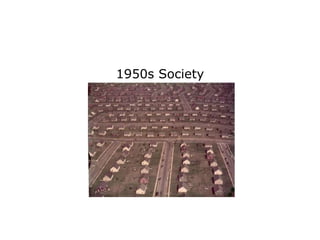
1950s Society
Objectives
• Examine the rise of the suburbs and the
growth of the Sunbelt.
• Describe changes in the U.S. economy and
education in the postwar period.
Terms and People

• Interstate Highway Act – 1956 law that

authorized the spending of $32 billion to
build 41,000 miles of highway
• Sunbelt – name given to the region of

states in the South and the Southwest
• service sector – businesses that provide

services rather than manufactured goods
Terms and People (continued)

• information industry – businesses that

provide informational services
• franchise business – companies that

distribute products or services through
businesses owned by independent
operators [ex Subway, Dunkin Donuts]
• multinational corporation – companies

that produce and sell their goods and
services all over the world
Terms and People

(continued)

• AFL-CIO –Two labor unions that united to

form one more powerful union
• California Master Plan – called for three

tiers of higher education: research
universities, state colleges, and community
colleges, all of which were to be accessible
to all of the state’s citizens
What social and economic factors changed American
life during the 1950s?
After World War II, many Americans migrated to the Sunbelt states and to
newly built suburbs.

White-collar jobs began to replace blue-collar jobs in the U.S. economy,
more women joined the workforce, and franchise businesses and
multinational corporations were on the rise.
Between 1940 and 1960, 40 million
Americans moved to the suburbs, one of
the largest mass migrations in history.

• Because few houses were built during the war,
the United States had a severe shortage of
urban housing.
• Newly married veterans who needed housing
looked to the suburbs.
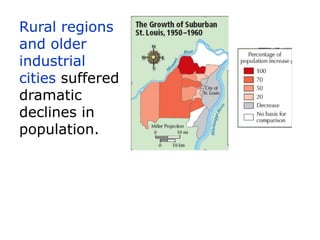
Rural regions
and older
industrial
cities suffered
dramatic
declines in
population.
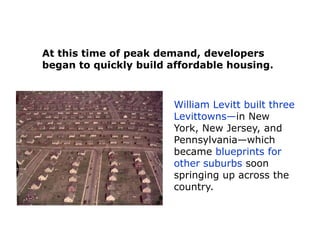
At this time of peak demand, developers
began to quickly build affordable housing.

William Levitt built three
Levittowns—in New
York, New Jersey, and
Pennsylvania—which
became blueprints for
other suburbs soon
springing up across the
country.
New home buyers received low-interest home
loans courtesy of the GI Bill of Rights and the
Federal Housing Administration (FHA).

As populations
increased, subur
bs became selfcontained
communities with
shops, schools, a
nd police
departments.

Some suburbanites used
public
transportation, but
many needed cars to
commute to work and to
shop at suburban
shopping malls.
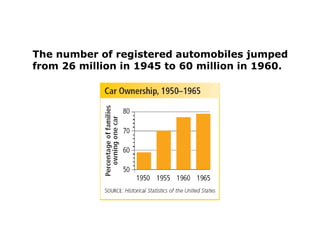
The number of registered automobiles jumped
from 26 million in 1945 to 60 million in 1960.
To support the growing “car culture,” in 1953
President Eisenhower authorized funding to
build the interstate highway system.

• In 1956, Congress passed the Interstate
Highway Act, the biggest expenditure on public
works in history.
• Fast-food restaurants, drive-in movie
theaters, and the travel and vacation industries
all benefited from the new roads.
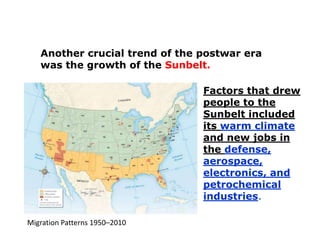
Another crucial trend of the postwar era
was the growth of the Sunbelt.
Factors that drew
people to the
Sunbelt included
its warm climate
and new jobs in
the defense,
aerospace,
electronics, and
petrochemical
industries.
Migration Patterns 1950–2010
As Americans moved to the suburbs and the
Sunbelt, these areas

•

gained political power with increased
congressional representation

•

faced more environmental concerns such as
air pollution and water shortages
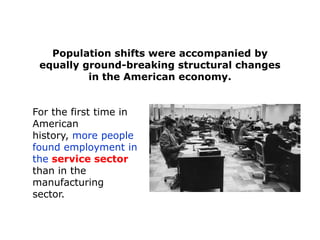
Population shifts were accompanied by
equally ground-breaking structural changes
in the American economy.
For the first time in
American
history, more people
found employment in
the service sector
than in the
manufacturing
sector.
The new white-collar workforce included many
who worked in information industries.

• The information industries often used computers.
• By the 1960s, the government and private
industry had found many uses for the computer.
Other Changes in the Economy
•

Women in
the
Workforce

The Decline
of Family
Farms and
the Rise of
Technology

The number of women in the
workforce doubled between 1940 and
1960.

•

Many worked part-time and were
underpaid, but their jobs helped keep
their families in the middle class.

•

Both the number and percentage of
Americans who made a living farming
continued to decline.

•

At the same time, improvements in
technology made farming more
productive with fewer workers.
The postwar period saw changes in types of
businesses and in the labor movement.

•

Franchise businesses were attractive to
consumers craving quality and consistency.

•

Multinational corporations expanded.

•

Although many new white-collar workers did not
join unions and labor’s image was tarnished by a
corruption scandal, the AFL-CIO still had a great
deal of political clout.
After the war, more people were able to
complete high school and attend college. A
more educated workforce boosted productivity.
•

Local and state governments provided most of
the funding for education.

•

But after the Soviets launched Sputnik 1 in
1957, Congress approved the $1 billion
National Defense Education Act, aimed at
producing more scientists and science
teachers.

Chapter 19 section 2 Post-war America

  • 1.
  • 2.
  • 3.
    Objectives • Examine therise of the suburbs and the growth of the Sunbelt. • Describe changes in the U.S. economy and education in the postwar period.
  • 4.
    Terms and People •Interstate Highway Act – 1956 law that authorized the spending of $32 billion to build 41,000 miles of highway • Sunbelt – name given to the region of states in the South and the Southwest • service sector – businesses that provide services rather than manufactured goods
  • 5.
    Terms and People(continued) • information industry – businesses that provide informational services • franchise business – companies that distribute products or services through businesses owned by independent operators [ex Subway, Dunkin Donuts] • multinational corporation – companies that produce and sell their goods and services all over the world
  • 6.
    Terms and People (continued) •AFL-CIO –Two labor unions that united to form one more powerful union • California Master Plan – called for three tiers of higher education: research universities, state colleges, and community colleges, all of which were to be accessible to all of the state’s citizens
  • 7.
    What social andeconomic factors changed American life during the 1950s? After World War II, many Americans migrated to the Sunbelt states and to newly built suburbs. White-collar jobs began to replace blue-collar jobs in the U.S. economy, more women joined the workforce, and franchise businesses and multinational corporations were on the rise.
  • 8.
    Between 1940 and1960, 40 million Americans moved to the suburbs, one of the largest mass migrations in history. • Because few houses were built during the war, the United States had a severe shortage of urban housing. • Newly married veterans who needed housing looked to the suburbs.
  • 9.
    Rural regions and older industrial citiessuffered dramatic declines in population.
  • 10.
    At this timeof peak demand, developers began to quickly build affordable housing. William Levitt built three Levittowns—in New York, New Jersey, and Pennsylvania—which became blueprints for other suburbs soon springing up across the country.
  • 11.
    New home buyersreceived low-interest home loans courtesy of the GI Bill of Rights and the Federal Housing Administration (FHA). As populations increased, subur bs became selfcontained communities with shops, schools, a nd police departments. Some suburbanites used public transportation, but many needed cars to commute to work and to shop at suburban shopping malls.
  • 12.
    The number ofregistered automobiles jumped from 26 million in 1945 to 60 million in 1960.
  • 13.
    To support thegrowing “car culture,” in 1953 President Eisenhower authorized funding to build the interstate highway system. • In 1956, Congress passed the Interstate Highway Act, the biggest expenditure on public works in history. • Fast-food restaurants, drive-in movie theaters, and the travel and vacation industries all benefited from the new roads.
  • 14.
    Another crucial trendof the postwar era was the growth of the Sunbelt. Factors that drew people to the Sunbelt included its warm climate and new jobs in the defense, aerospace, electronics, and petrochemical industries. Migration Patterns 1950–2010
  • 15.
    As Americans movedto the suburbs and the Sunbelt, these areas • gained political power with increased congressional representation • faced more environmental concerns such as air pollution and water shortages
  • 16.
    Population shifts wereaccompanied by equally ground-breaking structural changes in the American economy. For the first time in American history, more people found employment in the service sector than in the manufacturing sector.
  • 17.
    The new white-collarworkforce included many who worked in information industries. • The information industries often used computers. • By the 1960s, the government and private industry had found many uses for the computer.
  • 18.
    Other Changes inthe Economy • Women in the Workforce The Decline of Family Farms and the Rise of Technology The number of women in the workforce doubled between 1940 and 1960. • Many worked part-time and were underpaid, but their jobs helped keep their families in the middle class. • Both the number and percentage of Americans who made a living farming continued to decline. • At the same time, improvements in technology made farming more productive with fewer workers.
  • 19.
    The postwar periodsaw changes in types of businesses and in the labor movement. • Franchise businesses were attractive to consumers craving quality and consistency. • Multinational corporations expanded. • Although many new white-collar workers did not join unions and labor’s image was tarnished by a corruption scandal, the AFL-CIO still had a great deal of political clout.
  • 20.
    After the war,more people were able to complete high school and attend college. A more educated workforce boosted productivity. • Local and state governments provided most of the funding for education. • But after the Soviets launched Sputnik 1 in 1957, Congress approved the $1 billion National Defense Education Act, aimed at producing more scientists and science teachers.