Chapter 30The Affluent Society
Economic Miracle
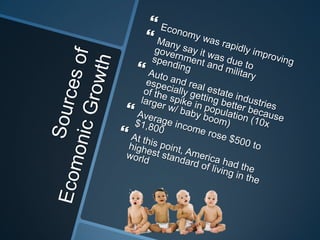
Sources of Ecomonic GrowthEconomy was rapidly improvingMany say it was due to government and military spendingAuto and real estate industries especially getting better because of the spike in population (10x larger w/ baby boom)Average income rose $500 to $1,800At this point, America had the highest standard of living in the world
The Rise of the Modern WestUp until this point, the West was the East’s provider, never really an economic power.Population increased because of the addition of dams, power stations, and highways to fulfill population’s needs.Many Military contracts flowed to factories in CA and TXPetroleum and Oil industry bloomed, giving more jobsGood weatherThe UC and UT schools became the best and largest schools in the countryPopulation rose over 50% between 1940 and 1960
The New EconomicsThe American economic system was getting cockyThe US’s implementation of Kynesian economics was a contributing factor.Lack of limits for economic growth led to constant economic growth.
The Explosion of Science and Technology
Medical BreakthroughAntibacterial drugs Based on discoveries by Louis Pasteur and Jules Francois JoubertProduced evidence that harmful bacteria could be defeated by more ordinary by ordinary bacteria1930, antibiotics used to treat blood infectioinsPenicilin Discovered in 1928 by Alexander FlemingAfter finding a method that could make large,  usable quantities of it, it became widely available in 1948
Medical Breakthrough (2)Immunization also improvedSmallpoc vaccine invented in 18th centuryTetanus shots used in ww2Virus shots didnst start coming out until 1930’sYellow fever, Polio, Influenza
Pesticides	Kept Plants free of bugs and bug infectionsUsually used DDTSaved american solders from insect-carried diseaseApparently DDT had long lasting harmful effects on people
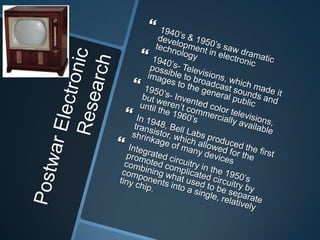
Postwar Electronic Research1940’s & 1950’s saw dramatic development in electronic technology1940’s- Televisions, which made it possible to broadcast sounds and images to the general public 1950’s- Invented color televisions, but weren’t commercially available until the 1960’sIn 1948, Bell Labs produced the first transistor, which allowed for the shrinkage of many devicesIntegrated circuitry in the 1950’s promoted complicated circuitry by combining what used to be separate components into a single, relatively tiny chip.
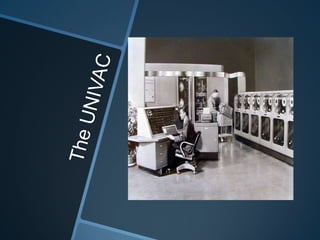
Postwar Computer TechnologyUp until the 1950’s, computers were used only to perform complicated mathematical tasks, like breaking military codes.In 1950, the UNIVAC (Universal Automatic Computer) was born and designed for the US bureau of the cencusIt was able to handle alphabetically and numerically organized information better than its predecessorsIn order to inform the Public of the UNIAC, they decided to have it predict the outcome of the upcoming elevtion (Eisenhower vs Stevenson) on national television.The public now knew computers existed.Later, in the mid 1950’s, IBM introduced the first data processing computers that it successfully sold to businesses in the US, making it the leader for years afterwards.
The UNIVAC
Bombs, Rockets, and MissilesAfter the development of the hydrogen bomb, which was unlike any other bomb at the time, US and Soviet Union were re-inspired to find a way to send an unmanned explosive from point “a” to a distant point “b”.In 1958, the first ICBM (inter continental ballistic missiles) were successful because of alternate fuel supplies and new generation guidance systems. These were dubbed “Minute Men”Also developed nuclear missiles that could be fired by a submarine underwater in 1960
The Space ProgramWas originally developed to outdo the Soviet Union, who released Sputnik into the Earth’s orbit Launched the Explorer I soon afterwards in January of 1958In 1958, NASA proposed manned space explorationMay 5 1961, Alan Shepard- first American to almost orbit the world.Soviet Cosmonaut Yuri Gagarin had already orbited the earth.Ebruary 2, 162- John Genn: 1st American to orbit the earth. Became a senator for a while, then came back at the age of 77 to go on a space shuttle mission.Soon afterwards, Gemini program started, to carry 2 men at once in a shuttle.
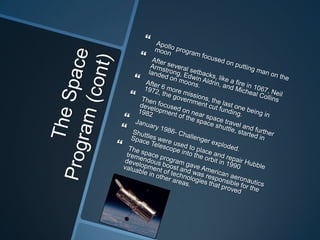
The Space Program (cont)Apollo program focused on putting man on the moonAfter several setbacks, like a fire in 1067, Neil Armstrong, Edwin Aldrin, and Micheal Collins landed on moons.After 6 more missions, the last one being in 1972, the government cut funding.Then focused on near space travel and further development of the space shuttle, started in 1982January 1986- Challenger exploded.Shuttles were used to place and repair Hubble Space Telescope into the orbit in 1990 The space program gave American aeronautics tremendous boost and was responsible for the development of technologies that proved valuable in other areas.
People of Plenty
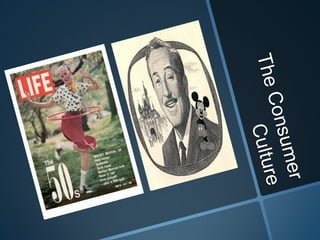
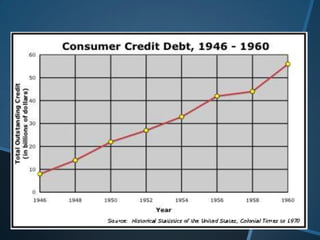
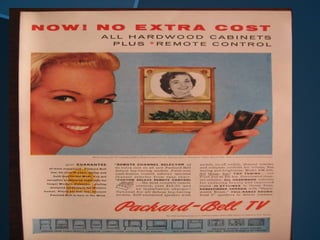
The Consumer CultureAt the center of middle-class culture in the 1950s, as it had been for many decades before, was a growing absorption with consumer goods. That was a result of increased prosperity, of the increasing variety and availability of products, and of advertisers’ adeptness in creating a demand for those products.Consumers also responded eagerly to the development of such new products as dishwashers, garbage disposals, televisions, hi-fis, stereos, and automobiles. To a striking degree, the prosperity of the 1950s and 1960s was consumer driven (as opposed to investment driven).
The Consumer Culture
The Suburban NationBy 1960 a third of the nation’s population was living in suburbs—part of a demographic shift almost without precedent in American history.People moved from the cities to the suburbs for many reasons: to escape crowding, crime, pollution, and high costs; to find better schools for their children; and sometimes to escape racial and ethnic diversity—to find a more homogeneous community in which to live.
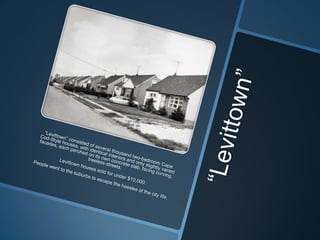
“Levittown” “Levittown” consisted of several thousand two-bedroom Cape Cod-Style houses, with identical interiors and only slightly varied facades, each perched on its own concrete slab, facing curving, treeless streets. Levittown houses sold for under $10,000.People went to the suburbs to escape the hassles of the city life.
The Suburban Family
The Suburban FamilyFor professional men suburban life generally meant a rigid division between their working and personal worlds.For many middle-class, married women, it meant an increased isolation from the workplace. One of the most influential books in postwar American life was a famous guide to child rearing: Dr. Benjamin Spock’s Baby and Child Care. (1946).The purpose of motherhood he taught, was to help children learn and grow and realize their potential. Feminism Weakened.
The Birth of the Television The growth of televisions developed rapidly shortly after World War II.In 1946 there were only 17,000 sets in the country; by 1956, there were 40 million television sets in use.  T.V.  >  Refrigerators. T.V. > newspapers

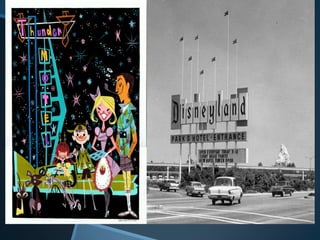
Travel, Outdoor Recreation, and Environmentalism It was not until the post years that vacation travel became truly widespread among middle-income Americans. Nowhere was this surge in travel and recreation more visible than in the nation’s national parks, which experienced the beginnings of what became a permanent surge in attendance in the 1950s.
Organized Society and Its DetractorsWhite collar workers came to outnumber blue-collar laborers for the first time, and an increasing proportion of them worked in corporate settings with rigid hierarchical structures. The American educational system responded to the demands of this increasingly organized society by experimenting with changes in curriculum and philosophy.
The Beats and the Restless Culture of YouthThe most caustic critics of bureaucracy were a group of young poets, writers, and artists generally known as the “beats.”Generally wrote harsh critiques of American life. The beats were the most visible evidence of a widespread restlessness among young Americans in the 1950s. Also what was disturbing was the style to what the youth culture were developing.
Slicked-Back hair
Rock ‘n’ RollOne of the most powerful signs of the restiveness of American youth was the enormous popularity of rock ’n’ roll. One of the greatest early rock star was Elvis Presley. The rise of such white rock musicians as Presley was a result in part of the limited willingness of white audiences to accept black musicians.
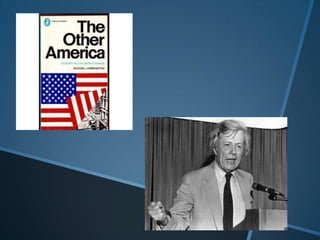
Poverty in America 1960, 30 million americans living below poverty line80% of poverty were temporarily or recently20% were Blacks, Hispanics, and most significantly, Native AmericansFarmer’s national income decreases“The Other America” by Michael Harringtonhighlighted the existence of poverty in America
Poverty cont.Significant growth of inner-city neighborhoodsWhy did they remain continually impoverished?Urban RenewalJuvenile crime
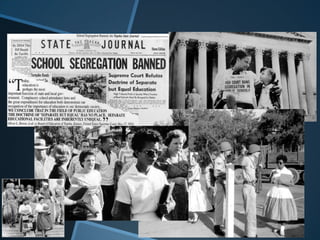
Brown v. Board of Education of TopekaDecision of the supreme court made May 17, 1954“Separate but equal” no longer validCombined effortThurgood Marshall, William Hastie, and James NarbitBrown decision helps spark a growing number of popular challenges to segregation
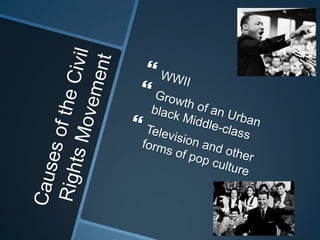
Causes of the Civil Rights MovementWWIIGrowth of an Urban black Middle-classTelevision and other forms of pop culture
EisenhowerFirst Republican administration in 20 years“What was good for our country was good for General Motors, and vice versa.”-Charles WilsonAppointed wealthy corporate lawyers and business executivesLimited Federal power and encouraged private enterprise
Eisenhower cont.Sustained welfare policies of the New DealFederal Highway Act of 1956$25 billion for a 25 year project400,000 miles of interstate highways.
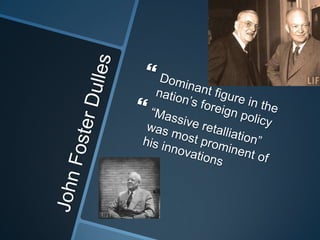
John Foster DullesDominant figure in the nation’s foreign policy“Massive retalliation” was most prominent of his innovations
France, America, and VietnamThe war in Korea and EisenhowerJuly 27, 1953 negotiators at Panmunjom sign an agreement to end hostilitiesFrance had been attempting to re-obtain VietnamVietnam hopes to gain help from U.S.France ends it’s commitment to Vietnam at an international conference in Geneva
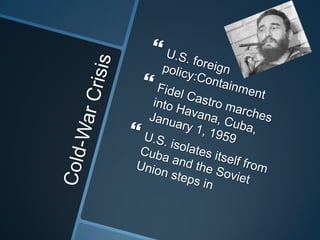
Cold-War CrisisU.S. foreign policy:ContainmentFidel Castro marches into Havana, Cuba, January 1, 1959U.S. isolates itself from Cuba and the Soviet Union steps in
The U-2 CrisisKruschev renews the demands of his predecessorsU.S. welcomes him cool and polite
Eisenhower’s Farewell Adressleaves caution with both international and domestic affairs

Chapter 30 Period 3

  • 1.
  • 2.
  • 3.
    Sources of EcomonicGrowthEconomy was rapidly improvingMany say it was due to government and military spendingAuto and real estate industries especially getting better because of the spike in population (10x larger w/ baby boom)Average income rose $500 to $1,800At this point, America had the highest standard of living in the world
  • 4.
    The Rise ofthe Modern WestUp until this point, the West was the East’s provider, never really an economic power.Population increased because of the addition of dams, power stations, and highways to fulfill population’s needs.Many Military contracts flowed to factories in CA and TXPetroleum and Oil industry bloomed, giving more jobsGood weatherThe UC and UT schools became the best and largest schools in the countryPopulation rose over 50% between 1940 and 1960
  • 5.
    The New EconomicsTheAmerican economic system was getting cockyThe US’s implementation of Kynesian economics was a contributing factor.Lack of limits for economic growth led to constant economic growth.
  • 6.
    The Explosion ofScience and Technology
  • 7.
    Medical BreakthroughAntibacterial drugsBased on discoveries by Louis Pasteur and Jules Francois JoubertProduced evidence that harmful bacteria could be defeated by more ordinary by ordinary bacteria1930, antibiotics used to treat blood infectioinsPenicilin Discovered in 1928 by Alexander FlemingAfter finding a method that could make large, usable quantities of it, it became widely available in 1948
  • 8.
    Medical Breakthrough (2)Immunizationalso improvedSmallpoc vaccine invented in 18th centuryTetanus shots used in ww2Virus shots didnst start coming out until 1930’sYellow fever, Polio, Influenza
  • 9.
    Pesticides Kept Plants freeof bugs and bug infectionsUsually used DDTSaved american solders from insect-carried diseaseApparently DDT had long lasting harmful effects on people
  • 10.
    Postwar Electronic Research1940’s& 1950’s saw dramatic development in electronic technology1940’s- Televisions, which made it possible to broadcast sounds and images to the general public 1950’s- Invented color televisions, but weren’t commercially available until the 1960’sIn 1948, Bell Labs produced the first transistor, which allowed for the shrinkage of many devicesIntegrated circuitry in the 1950’s promoted complicated circuitry by combining what used to be separate components into a single, relatively tiny chip.
  • 11.
    Postwar Computer TechnologyUpuntil the 1950’s, computers were used only to perform complicated mathematical tasks, like breaking military codes.In 1950, the UNIVAC (Universal Automatic Computer) was born and designed for the US bureau of the cencusIt was able to handle alphabetically and numerically organized information better than its predecessorsIn order to inform the Public of the UNIAC, they decided to have it predict the outcome of the upcoming elevtion (Eisenhower vs Stevenson) on national television.The public now knew computers existed.Later, in the mid 1950’s, IBM introduced the first data processing computers that it successfully sold to businesses in the US, making it the leader for years afterwards.
  • 12.
  • 13.
    Bombs, Rockets, andMissilesAfter the development of the hydrogen bomb, which was unlike any other bomb at the time, US and Soviet Union were re-inspired to find a way to send an unmanned explosive from point “a” to a distant point “b”.In 1958, the first ICBM (inter continental ballistic missiles) were successful because of alternate fuel supplies and new generation guidance systems. These were dubbed “Minute Men”Also developed nuclear missiles that could be fired by a submarine underwater in 1960
  • 14.
    The Space ProgramWasoriginally developed to outdo the Soviet Union, who released Sputnik into the Earth’s orbit Launched the Explorer I soon afterwards in January of 1958In 1958, NASA proposed manned space explorationMay 5 1961, Alan Shepard- first American to almost orbit the world.Soviet Cosmonaut Yuri Gagarin had already orbited the earth.Ebruary 2, 162- John Genn: 1st American to orbit the earth. Became a senator for a while, then came back at the age of 77 to go on a space shuttle mission.Soon afterwards, Gemini program started, to carry 2 men at once in a shuttle.
  • 15.
    The Space Program(cont)Apollo program focused on putting man on the moonAfter several setbacks, like a fire in 1067, Neil Armstrong, Edwin Aldrin, and Micheal Collins landed on moons.After 6 more missions, the last one being in 1972, the government cut funding.Then focused on near space travel and further development of the space shuttle, started in 1982January 1986- Challenger exploded.Shuttles were used to place and repair Hubble Space Telescope into the orbit in 1990 The space program gave American aeronautics tremendous boost and was responsible for the development of technologies that proved valuable in other areas.
  • 16.
  • 17.
    The Consumer CultureAtthe center of middle-class culture in the 1950s, as it had been for many decades before, was a growing absorption with consumer goods. That was a result of increased prosperity, of the increasing variety and availability of products, and of advertisers’ adeptness in creating a demand for those products.Consumers also responded eagerly to the development of such new products as dishwashers, garbage disposals, televisions, hi-fis, stereos, and automobiles. To a striking degree, the prosperity of the 1950s and 1960s was consumer driven (as opposed to investment driven).
  • 18.
  • 20.
    The Suburban NationBy1960 a third of the nation’s population was living in suburbs—part of a demographic shift almost without precedent in American history.People moved from the cities to the suburbs for many reasons: to escape crowding, crime, pollution, and high costs; to find better schools for their children; and sometimes to escape racial and ethnic diversity—to find a more homogeneous community in which to live.
  • 21.
    “Levittown” “Levittown” consistedof several thousand two-bedroom Cape Cod-Style houses, with identical interiors and only slightly varied facades, each perched on its own concrete slab, facing curving, treeless streets. Levittown houses sold for under $10,000.People went to the suburbs to escape the hassles of the city life.
  • 22.
  • 23.
    The Suburban FamilyForprofessional men suburban life generally meant a rigid division between their working and personal worlds.For many middle-class, married women, it meant an increased isolation from the workplace. One of the most influential books in postwar American life was a famous guide to child rearing: Dr. Benjamin Spock’s Baby and Child Care. (1946).The purpose of motherhood he taught, was to help children learn and grow and realize their potential. Feminism Weakened.
  • 26.
    The Birth ofthe Television The growth of televisions developed rapidly shortly after World War II.In 1946 there were only 17,000 sets in the country; by 1956, there were 40 million television sets in use. T.V. > Refrigerators. T.V. > newspapers
  • 27.
    Travel, Outdoor Recreation,and Environmentalism It was not until the post years that vacation travel became truly widespread among middle-income Americans. Nowhere was this surge in travel and recreation more visible than in the nation’s national parks, which experienced the beginnings of what became a permanent surge in attendance in the 1950s.
  • 29.
    Organized Society andIts DetractorsWhite collar workers came to outnumber blue-collar laborers for the first time, and an increasing proportion of them worked in corporate settings with rigid hierarchical structures. The American educational system responded to the demands of this increasingly organized society by experimenting with changes in curriculum and philosophy.
  • 30.
    The Beats andthe Restless Culture of YouthThe most caustic critics of bureaucracy were a group of young poets, writers, and artists generally known as the “beats.”Generally wrote harsh critiques of American life. The beats were the most visible evidence of a widespread restlessness among young Americans in the 1950s. Also what was disturbing was the style to what the youth culture were developing.
  • 31.
  • 32.
    Rock ‘n’ RollOneof the most powerful signs of the restiveness of American youth was the enormous popularity of rock ’n’ roll. One of the greatest early rock star was Elvis Presley. The rise of such white rock musicians as Presley was a result in part of the limited willingness of white audiences to accept black musicians.
  • 33.
    Poverty in America1960, 30 million americans living below poverty line80% of poverty were temporarily or recently20% were Blacks, Hispanics, and most significantly, Native AmericansFarmer’s national income decreases“The Other America” by Michael Harringtonhighlighted the existence of poverty in America
  • 35.
    Poverty cont.Significant growthof inner-city neighborhoodsWhy did they remain continually impoverished?Urban RenewalJuvenile crime
  • 36.
    Brown v. Boardof Education of TopekaDecision of the supreme court made May 17, 1954“Separate but equal” no longer validCombined effortThurgood Marshall, William Hastie, and James NarbitBrown decision helps spark a growing number of popular challenges to segregation
  • 38.
    Causes of theCivil Rights MovementWWIIGrowth of an Urban black Middle-classTelevision and other forms of pop culture
  • 39.
    EisenhowerFirst Republican administrationin 20 years“What was good for our country was good for General Motors, and vice versa.”-Charles WilsonAppointed wealthy corporate lawyers and business executivesLimited Federal power and encouraged private enterprise
  • 40.
    Eisenhower cont.Sustained welfarepolicies of the New DealFederal Highway Act of 1956$25 billion for a 25 year project400,000 miles of interstate highways.
  • 41.
    John Foster DullesDominantfigure in the nation’s foreign policy“Massive retalliation” was most prominent of his innovations
  • 42.
    France, America, andVietnamThe war in Korea and EisenhowerJuly 27, 1953 negotiators at Panmunjom sign an agreement to end hostilitiesFrance had been attempting to re-obtain VietnamVietnam hopes to gain help from U.S.France ends it’s commitment to Vietnam at an international conference in Geneva
  • 43.
    Cold-War CrisisU.S. foreignpolicy:ContainmentFidel Castro marches into Havana, Cuba, January 1, 1959U.S. isolates itself from Cuba and the Soviet Union steps in
  • 44.
    The U-2 CrisisKruschevrenews the demands of his predecessorsU.S. welcomes him cool and polite
  • 45.
    Eisenhower’s Farewell Adressleavescaution with both international and domestic affairs