Chapter 19 Section 1
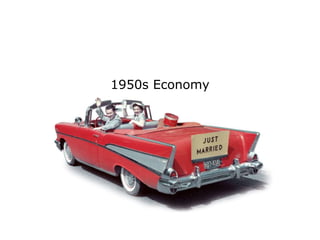
1950s Economy
Objectives
•

Describe how the United States made the
transformation to a peacetime economy.

•

Discuss the accomplishments of Presidents
Harry Truman and Dwight Eisenhower.

•

Analyze the 1950s economic boom.
Terms and People
•

demobilization – sending home members of the army

•

GI Bill of Rights – eased the return of World War II veterans by providing
education and employment aid

•

baby boom – increase in births between 1945 and 1964
Terms and People

(continued)

•

productivity – the rate at which goods are produced or services performed

•

Taft-Hartley Act – a law that restricted the power of labor unions; outlawed
the closed shop,
a workplace in which only union members can be hired

•

Fair Deal – President Truman’s program to expand New Deal reforms
How did the nation experience recovery and economic
prosperity after World War II?
The GI Bill of Rights and a strong demand for consumer goods – coupled
with defense spending on the Korean War and increased foreign demand for
U.S. goods – greatly improved the U.S. economy after World War II.

The U.S became the richest country in the world.
After World War II, many citizens and
economists feared the country would
fall into a widespread depression.
• Truman started demobilization, and
millions of soldiers came home and searched
for work.
• Contracts to produce military goods were
cancelled and millions of defense workers
lost their jobs.
• An end to rationing and price controls – plus
a demand for goods – fueled inflation.
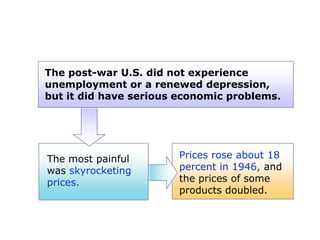
The post-war U.S. did not experience
unemployment or a renewed depression,
but it did have serious economic problems.

The most painful
was skyrocketing
prices.

Prices rose about 18
percent in 1946, and
the prices of some
products doubled.
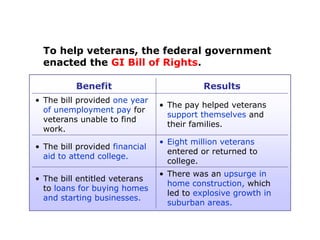
To help veterans, the federal government
enacted the GI Bill of Rights.
Benefit

Results

• The bill provided one year
of unemployment pay for
veterans unable to find
work.

• The pay helped veterans
support themselves and
their families.

• The bill provided financial
aid to attend college.

• Eight million veterans
entered or returned to
college.

• The bill entitled veterans
to loans for buying homes
and starting businesses.

• There was an upsurge in
home construction, which
led to explosive growth in
suburban areas.
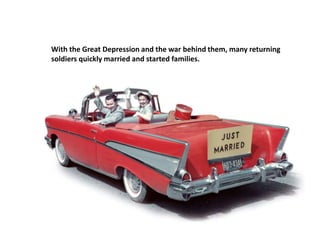
With the Great Depression and the war behind them, many returning
soldiers quickly married and started families.
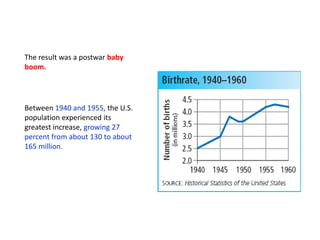
The result was a postwar baby
boom.

Between 1940 and 1955, the U.S.
population experienced its
greatest increase, growing 27
percent from about 130 to about
165 million.
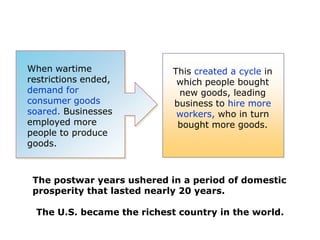
When wartime
restrictions ended,
demand for
consumer goods
soared. Businesses
employed more
people to produce
goods.

This created a cycle in
which people bought
new goods, leading
business to hire more
workers, who in turn
bought more goods.

The postwar years ushered in a period of domestic
prosperity that lasted nearly 20 years.
The U.S. became the richest country in the world.
During the postwar period, the U.S. economy
also benefitted from technological advances,
such as atomic power, computers, and plastics.

Worker
productivity
continued to
improve, largely
because of new
technology.

The economy also got
a boost from federal
defense spending for
the Korean War and
from foreign demand
for U.S. goods caused
by the Marshall Plan.
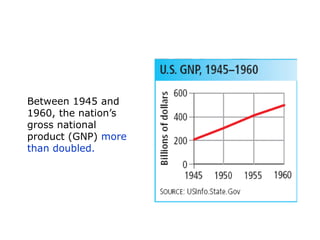
Between 1945 and
1960, the nation’s
gross national
product (GNP) more
than doubled.
Despite the economic growth, the U.S.
faced challenges during after World
War II. President Harry Truman faced
the following issues.

• The Cold War was beginning and there were
communist takeovers in Europe and Asia.
• The U.S. faced inflation and labor unrest at
home.
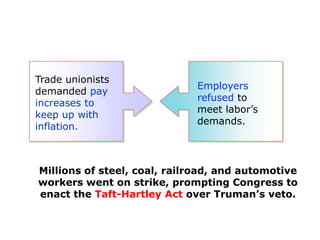
Trade unionists
demanded pay
increases to
keep up with
inflation.

Employers
refused to
meet labor’s
demands.

Millions of steel, coal, railroad, and automotive
workers went on strike, prompting Congress to
enact the Taft-Hartley Act over Truman’s veto.
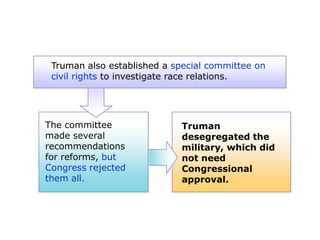
Truman also established a special committee on
civil rights to investigate race relations.

The committee
made several
recommendations
for reforms, but
Congress rejected
them all.

Truman
desegregated the
military, which did
not need
Congressional
approval.
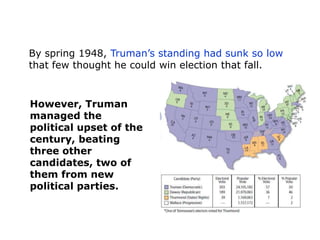
By spring 1948, Truman’s standing had sunk so low
that few thought he could win election that fall.

However, Truman
managed the
political upset of the
century, beating
three other
candidates, two of
them from new
political parties.
Shortly after the election, Truman
announced a far-ranging legislative
program he called the Fair Deal.

• The Fair Deal was meant to strengthen existing
New Deal reforms and establish new programs,
such as national health insurance.

• But Congress rejected most of Truman’s Fair
Deal proposals.
Legislative failure and a stalled war in Korea
contributed to Truman’s loss of popularity, and
he did not seek reelection in 1952.
Popular, charming
Republican
candidate Dwight D.
Eisenhower won the
presidency that year,
beating Democrat
Adlai Stevenson.

The public believed
that Eisenhower would
walk the line between
liberal and
conservative political
positions, and he did
not disappoint.
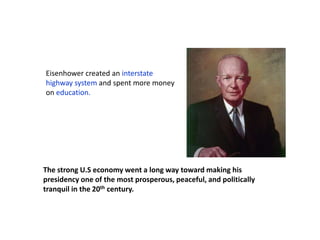
Eisenhower created an interstate
highway system and spent more money
on education.

The strong U.S economy went a long way toward making his
presidency one of the most prosperous, peaceful, and politically
tranquil in the 20th century.

Chapter 19 section 1

  • 1.
  • 2.
  • 3.
    Objectives • Describe how theUnited States made the transformation to a peacetime economy. • Discuss the accomplishments of Presidents Harry Truman and Dwight Eisenhower. • Analyze the 1950s economic boom.
  • 4.
    Terms and People • demobilization– sending home members of the army • GI Bill of Rights – eased the return of World War II veterans by providing education and employment aid • baby boom – increase in births between 1945 and 1964
  • 5.
    Terms and People (continued) • productivity– the rate at which goods are produced or services performed • Taft-Hartley Act – a law that restricted the power of labor unions; outlawed the closed shop, a workplace in which only union members can be hired • Fair Deal – President Truman’s program to expand New Deal reforms
  • 6.
    How did thenation experience recovery and economic prosperity after World War II? The GI Bill of Rights and a strong demand for consumer goods – coupled with defense spending on the Korean War and increased foreign demand for U.S. goods – greatly improved the U.S. economy after World War II. The U.S became the richest country in the world.
  • 7.
    After World WarII, many citizens and economists feared the country would fall into a widespread depression. • Truman started demobilization, and millions of soldiers came home and searched for work. • Contracts to produce military goods were cancelled and millions of defense workers lost their jobs. • An end to rationing and price controls – plus a demand for goods – fueled inflation.
  • 8.
    The post-war U.S.did not experience unemployment or a renewed depression, but it did have serious economic problems. The most painful was skyrocketing prices. Prices rose about 18 percent in 1946, and the prices of some products doubled.
  • 9.
    To help veterans,the federal government enacted the GI Bill of Rights. Benefit Results • The bill provided one year of unemployment pay for veterans unable to find work. • The pay helped veterans support themselves and their families. • The bill provided financial aid to attend college. • Eight million veterans entered or returned to college. • The bill entitled veterans to loans for buying homes and starting businesses. • There was an upsurge in home construction, which led to explosive growth in suburban areas.
  • 10.
    With the GreatDepression and the war behind them, many returning soldiers quickly married and started families.
  • 11.
    The result wasa postwar baby boom. Between 1940 and 1955, the U.S. population experienced its greatest increase, growing 27 percent from about 130 to about 165 million.
  • 12.
    When wartime restrictions ended, demandfor consumer goods soared. Businesses employed more people to produce goods. This created a cycle in which people bought new goods, leading business to hire more workers, who in turn bought more goods. The postwar years ushered in a period of domestic prosperity that lasted nearly 20 years. The U.S. became the richest country in the world.
  • 13.
    During the postwarperiod, the U.S. economy also benefitted from technological advances, such as atomic power, computers, and plastics. Worker productivity continued to improve, largely because of new technology. The economy also got a boost from federal defense spending for the Korean War and from foreign demand for U.S. goods caused by the Marshall Plan.
  • 14.
    Between 1945 and 1960,the nation’s gross national product (GNP) more than doubled.
  • 15.
    Despite the economicgrowth, the U.S. faced challenges during after World War II. President Harry Truman faced the following issues. • The Cold War was beginning and there were communist takeovers in Europe and Asia. • The U.S. faced inflation and labor unrest at home.
  • 16.
    Trade unionists demanded pay increasesto keep up with inflation. Employers refused to meet labor’s demands. Millions of steel, coal, railroad, and automotive workers went on strike, prompting Congress to enact the Taft-Hartley Act over Truman’s veto.
  • 17.
    Truman also establisheda special committee on civil rights to investigate race relations. The committee made several recommendations for reforms, but Congress rejected them all. Truman desegregated the military, which did not need Congressional approval.
  • 18.
    By spring 1948,Truman’s standing had sunk so low that few thought he could win election that fall. However, Truman managed the political upset of the century, beating three other candidates, two of them from new political parties.
  • 19.
    Shortly after theelection, Truman announced a far-ranging legislative program he called the Fair Deal. • The Fair Deal was meant to strengthen existing New Deal reforms and establish new programs, such as national health insurance. • But Congress rejected most of Truman’s Fair Deal proposals.
  • 20.
    Legislative failure anda stalled war in Korea contributed to Truman’s loss of popularity, and he did not seek reelection in 1952. Popular, charming Republican candidate Dwight D. Eisenhower won the presidency that year, beating Democrat Adlai Stevenson. The public believed that Eisenhower would walk the line between liberal and conservative political positions, and he did not disappoint.
  • 21.
    Eisenhower created aninterstate highway system and spent more money on education. The strong U.S economy went a long way toward making his presidency one of the most prosperous, peaceful, and politically tranquil in the 20th century.