Management: Arab World Edition
Robbins, Coulter, Sidani, Jamali
Chapter 16: Managers As Leaders
Lecturer: : [Insert your name here]
Learning Outcomes

Follow this Learning Outline as you read and study this chapter.
16.1 Who Are Leaders and What Is Leadership
• Define

leaders and leadership.

• Explain

why managers should be leaders.

16.2 Historical Leadership In The Middle East
• Ibn-Khaldun

Conception of Leadership

• The

role of Asabiya (Group-bond in fostering leadership)
• The

Prophetic-Caliphal Model of Leadership

16-3

Copyright © 2011 Pearson Education
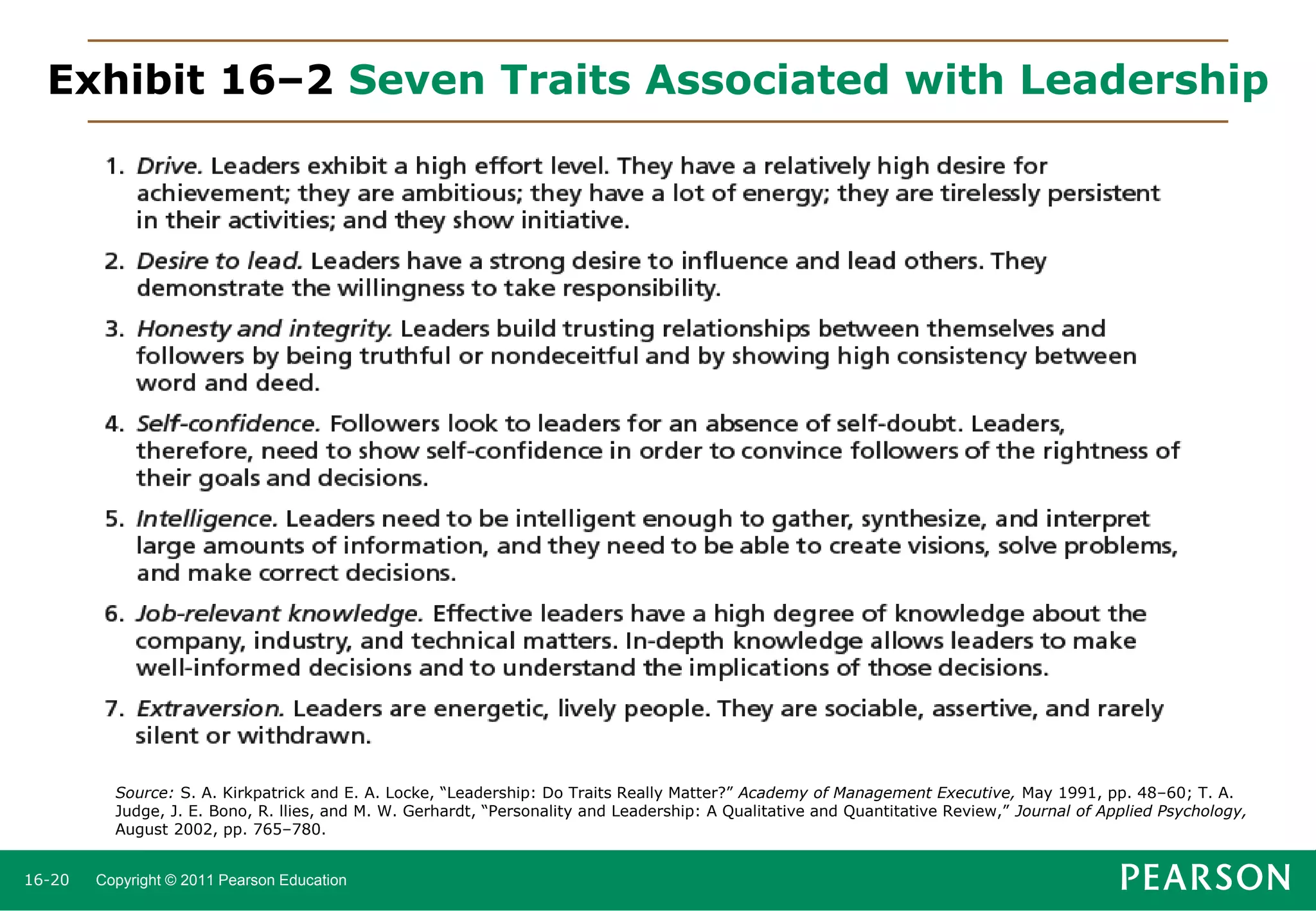
Learning Outcomes
16.3 Early Leadership Theories
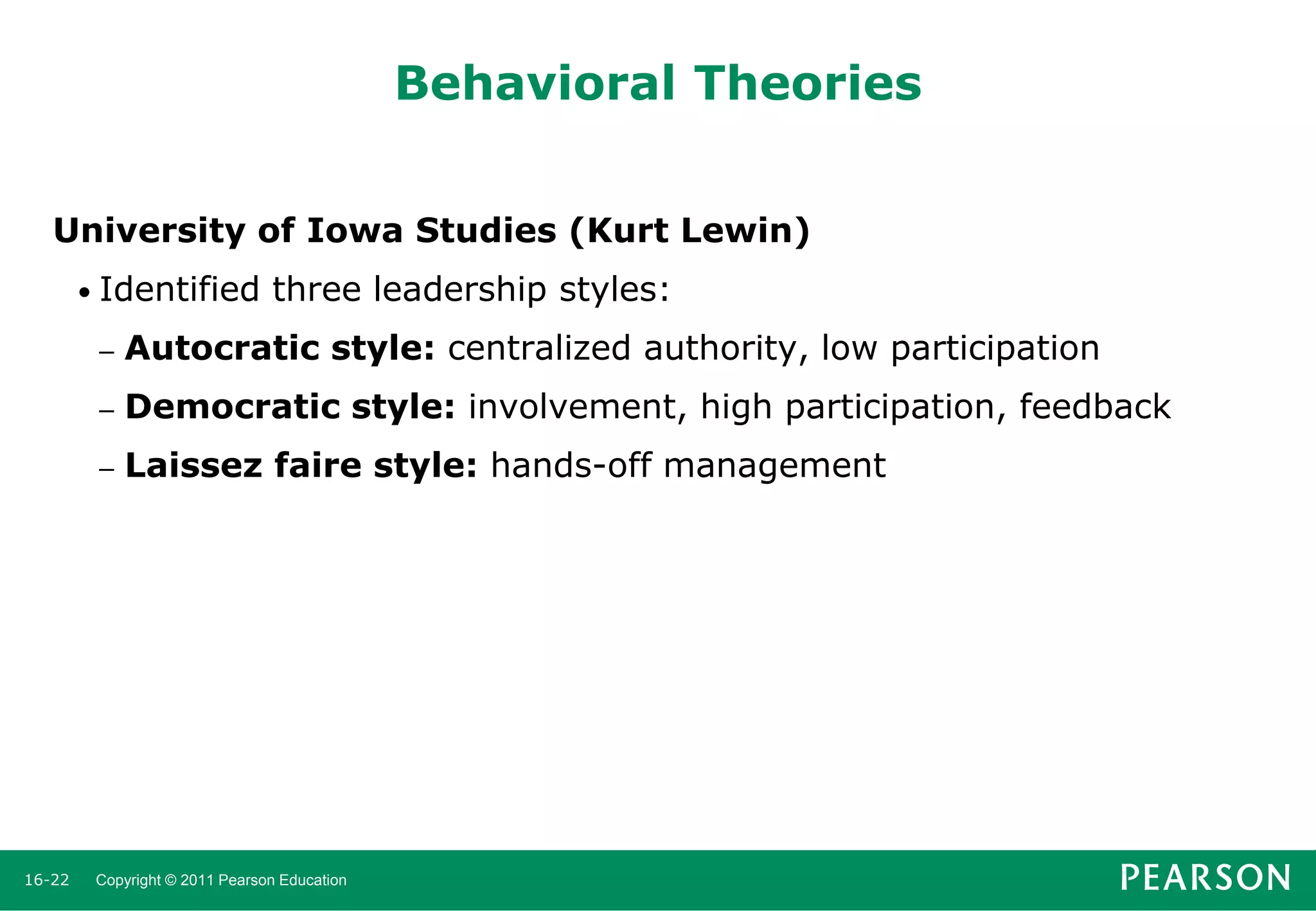
• Discuss

what research has shown about leadership traits.

• Contrast
• Explain

the findings of the four behavioral leadership theories.

the dual nature of a leader’s behavior.

16.4 Contingency Theories of Leadership
• Explain

Fiedler’s contingency model of leadership.

• Describe
• Discuss

16-4

situational leadership theory.

how path–goal theory explains leadership.

Copyright © 2011 Pearson Education
Learning Outcomes
16.5 Contemporary Views of Leadership
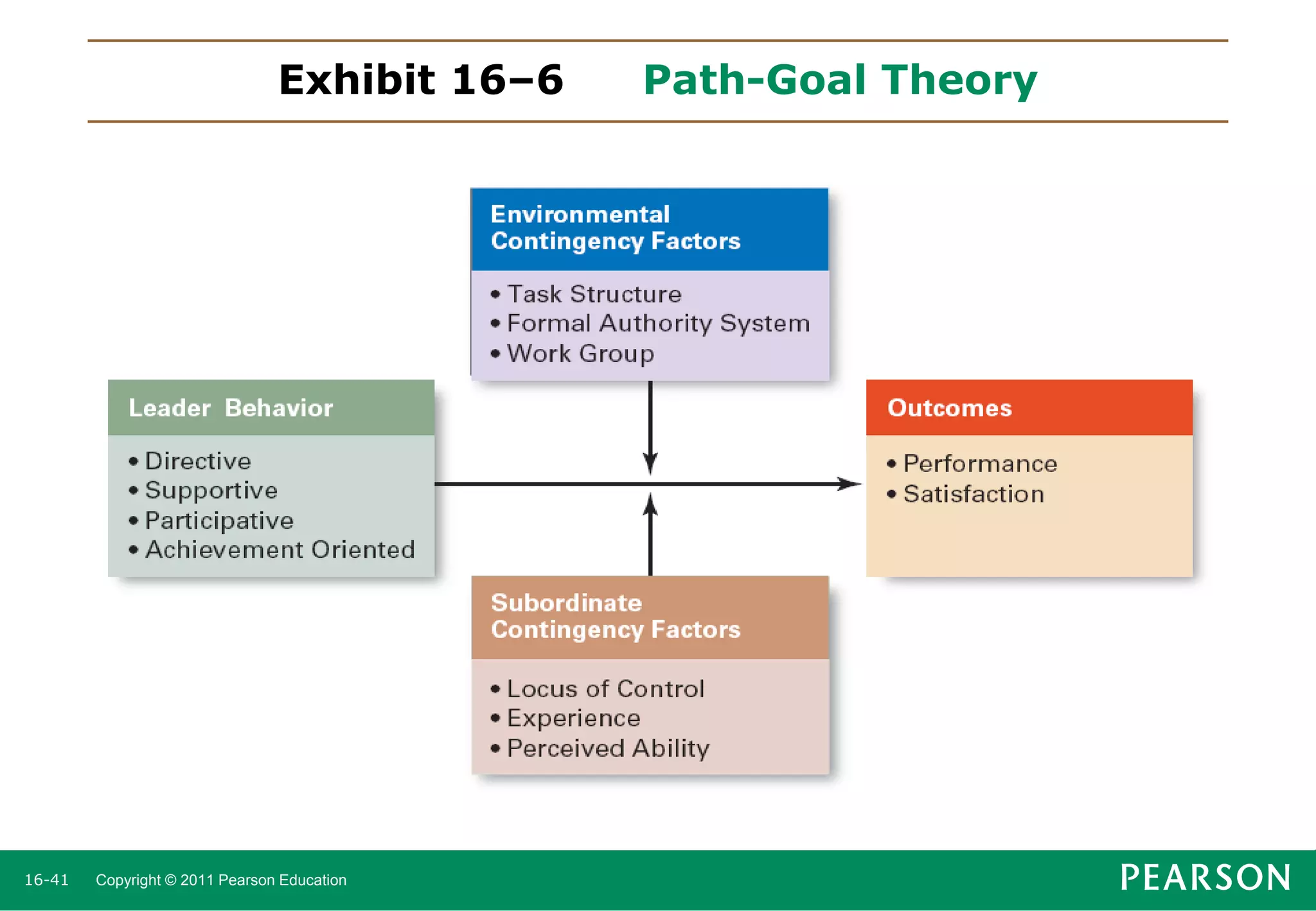
• Differentiate

between transactional and transformational

leaders.
• Describe
• Discuss

charismatic and visionary leadership.

what team leadership involves.

16.6 Leadership Issues in the Twenty-First Century
• Describe
• Discuss

16-5

the five sources of a leader’s power.

the issues today’s leaders face.

Copyright © 2011 Pearson Education
Who Are Leaders and
What Is Leadership
1. Define leaders and leadership.
2. Explain why managers should be leaders.

16-6

Copyright © 2011 Pearson Education
Who Are Leaders and
What Is Leadership
Leader
 Someone

who can influence others and who has
managerial authority

Leadership
 What

leaders do; the process of influencing a group
to achieve goals

16-7

Copyright © 2011 Pearson Education
Who Are Leaders and What Is Leadership
Although groups may have informal leaders who emerge, those are
not the leaders we’re studying.
Leadership research has tried to answer:
What is an effective leader?

16-8

Copyright © 2011 Pearson Education
Historical Leadership In
The Middle East
1. Ibn-Khaldun Conception of Leadership
2. The role of Asabiya (Group-bond in fostering
leadership)
3. The Prophetic-Caliphal Model of Leadership

16-9

Copyright © 2011 Pearson Education
Ibn-Khaldun Conception of Leadership
He was born in Tunis in the year 1332.
 He was mainly interested in political leadership, but his
conceptualization is important for understanding leadership in any
context, business or non-business.
 Ibn Khaldun emphasizes the personal qualities of the leader. He calls
those qualities “perfecting details”.


16-10

Copyright © 2011 Pearson Education
Perfecting Details Include:
1. Generosity
2. Forgiveness of error
3. Patience and perseverance
4. Hospitality toward guests
5. Maintenance of the indigent
6. Execution of commitments
7. Respect for the religious law

16-11

Copyright © 2011 Pearson Education
Perfecting Details Include:
8. Reverence for old men and teachers
9. Fairness
10. Meekness
11. Consideration to the needs of followers
12. Avoidance of deception and fraud
13. Kindness to, and protection of, subjects.

16-12

Copyright © 2011 Pearson Education
The role of Asabiya


Asabiya (“group feeling” or “group bond”).

Asabiya

stems from blood ties and alliances, with the former having
the most weight in fostering the leadership bond.
Blood

ties may be an unimportant factor in the West as a source of
leadership, but they are important in the Arab region.

16-13

Copyright © 2011 Pearson Education
The Prophetic-Caliphal Model of Leadership
Four elements of the model:
(1) Personalism

(2) Individualism
(3) Lack of institutionalization
(4) The importance of the great man

16-14

Copyright © 2011 Pearson Education
The Prophetic-Caliphal Model of Leadership
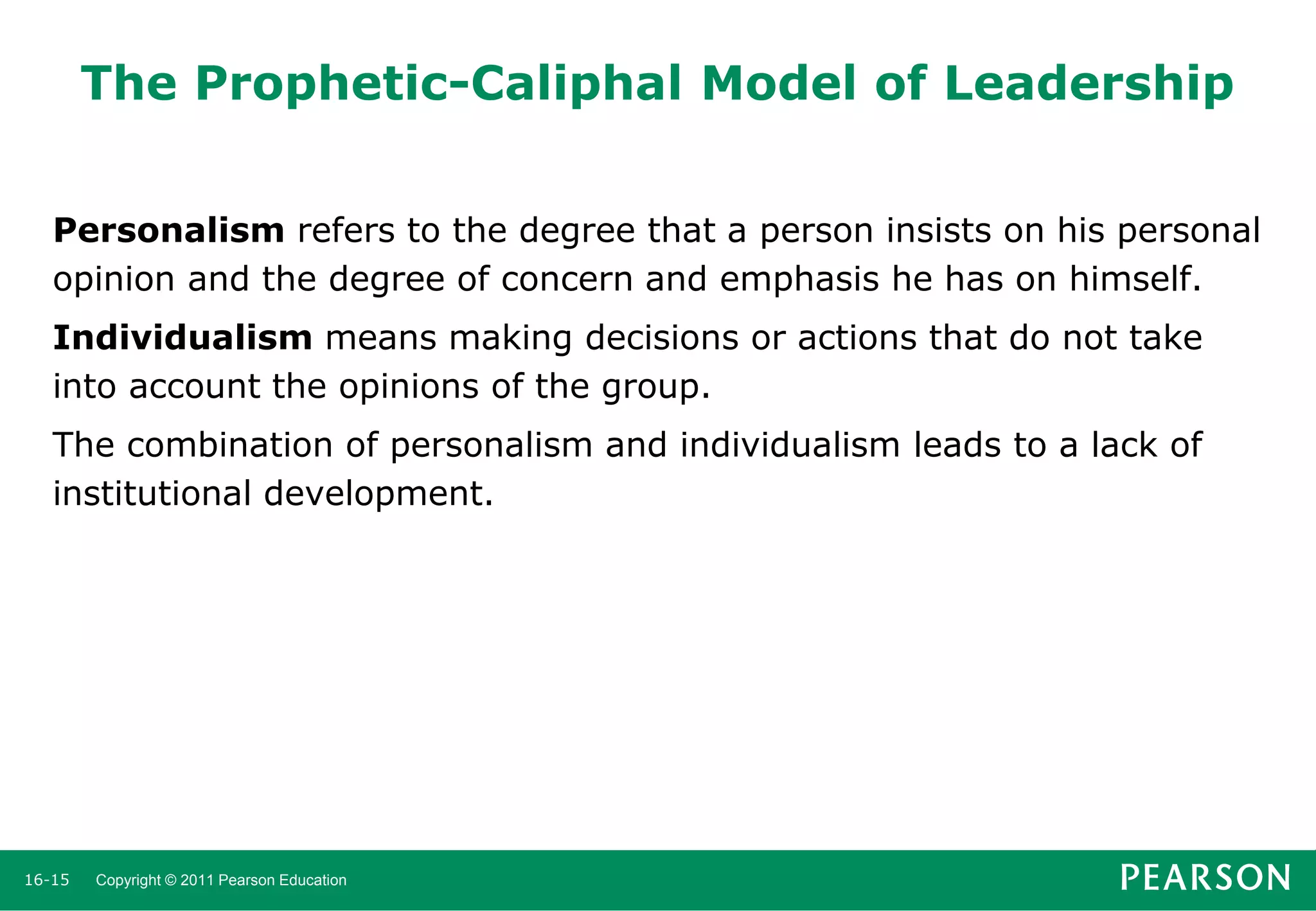
Personalism refers to the degree that a person insists on his personal
opinion and the degree of concern and emphasis he has on himself.

Individualism means making decisions or actions that do not take
into account the opinions of the group.
The combination of personalism and individualism leads to a lack of
institutional development.

16-15

Copyright © 2011 Pearson Education
The Prophetic-Caliphal Model of Leadership


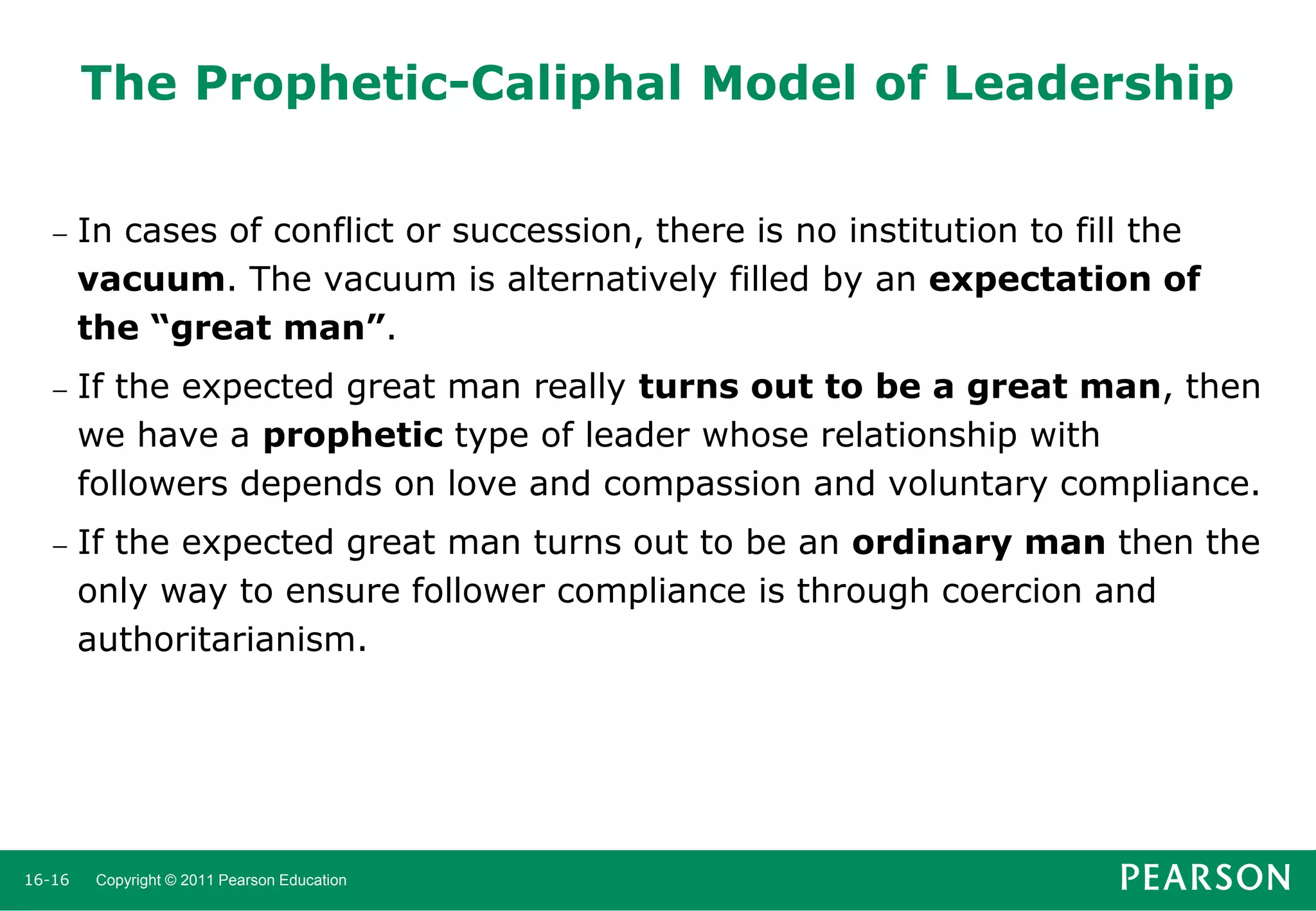
In cases of conflict or succession, there is no institution to fill the
vacuum. The vacuum is alternatively filled by an expectation of
the “great man”.



If the expected great man really turns out to be a great man, then
we have a prophetic type of leader whose relationship with
followers depends on love and compassion and voluntary compliance.



If the expected great man turns out to be an ordinary man then the
only way to ensure follower compliance is through coercion and
authoritarianism.

16-16

Copyright © 2011 Pearson Education
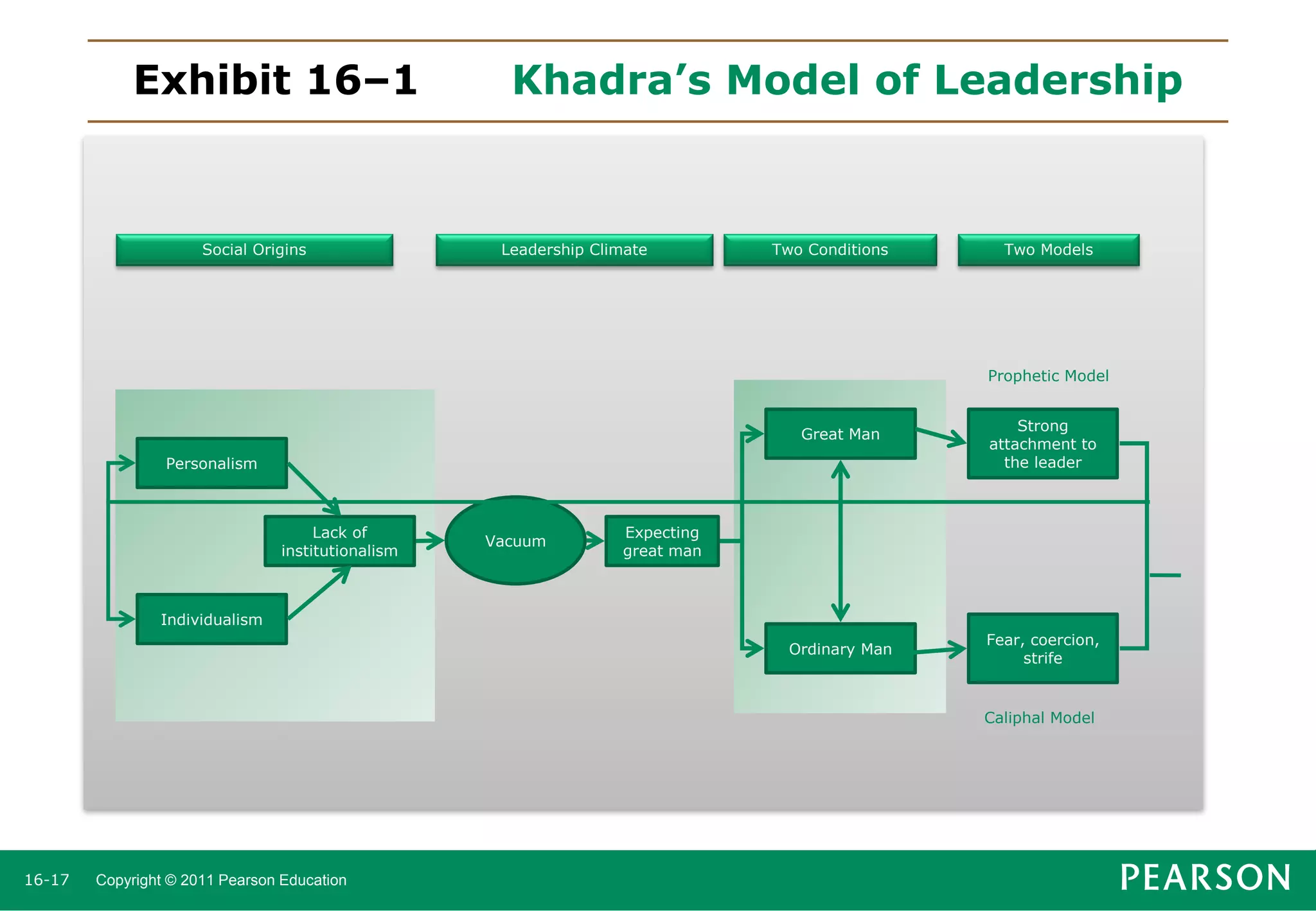
Exhibit 16–1

Social Origins

Khadra’s Model of Leadership

Leadership Climate

Two Conditions

Two Models

Prophetic Model

Great Man
Personalism

Lack of
institutionalism

Vacuum

Strong
attachment to
the leader

Expecting
great man

Individualism

Ordinary Man

Fear, coercion,
strife

Caliphal Model

16-17

Copyright © 2011 Pearson Education
Early Leadership Theories

1. Discuss what research has shown about leadership
traits.
2. Contrast the findings of the four behavioral leadership
theories.
3. Explain the dual nature of a leader’s behavior.

16-18

Copyright © 2011 Pearson Education
Early Leadership Theories

Trait Theories (1920s–1930s)
• Research

focused on identifying personal characteristics that
differentiated leaders from non-leaders was unsuccessful.

• Later

research on the leadership process identified seven traits
associated with successful leadership:

• Drive,

the desire to lead, honesty and integrity, selfconfidence, intelligence, job-relevant knowledge, and
extraversion.

16-19

Copyright © 2011 Pearson Education
Exhibit 16–2 Seven Traits Associated with Leadership

Source: S. A. Kirkpatrick and E. A. Locke, “Leadership: Do Traits Really Matter?” Academy of Management Executive, May 1991, pp. 48–60; T. A.
Judge, J. E. Bono, R. llies, and M. W. Gerhardt, “Personality and Leadership: A Qualitative and Quantitative Review,” Journal of Applied Psychology,
August 2002, pp. 765–780.
16-20

Copyright © 2011 Pearson Education
Behavioral Theories
1. University of Iowa Studies
2. Ohio State Studies

3. University of Michigan Studies
4. The Managerial Grid

16-21

Copyright © 2011 Pearson Education
Behavioral Theories
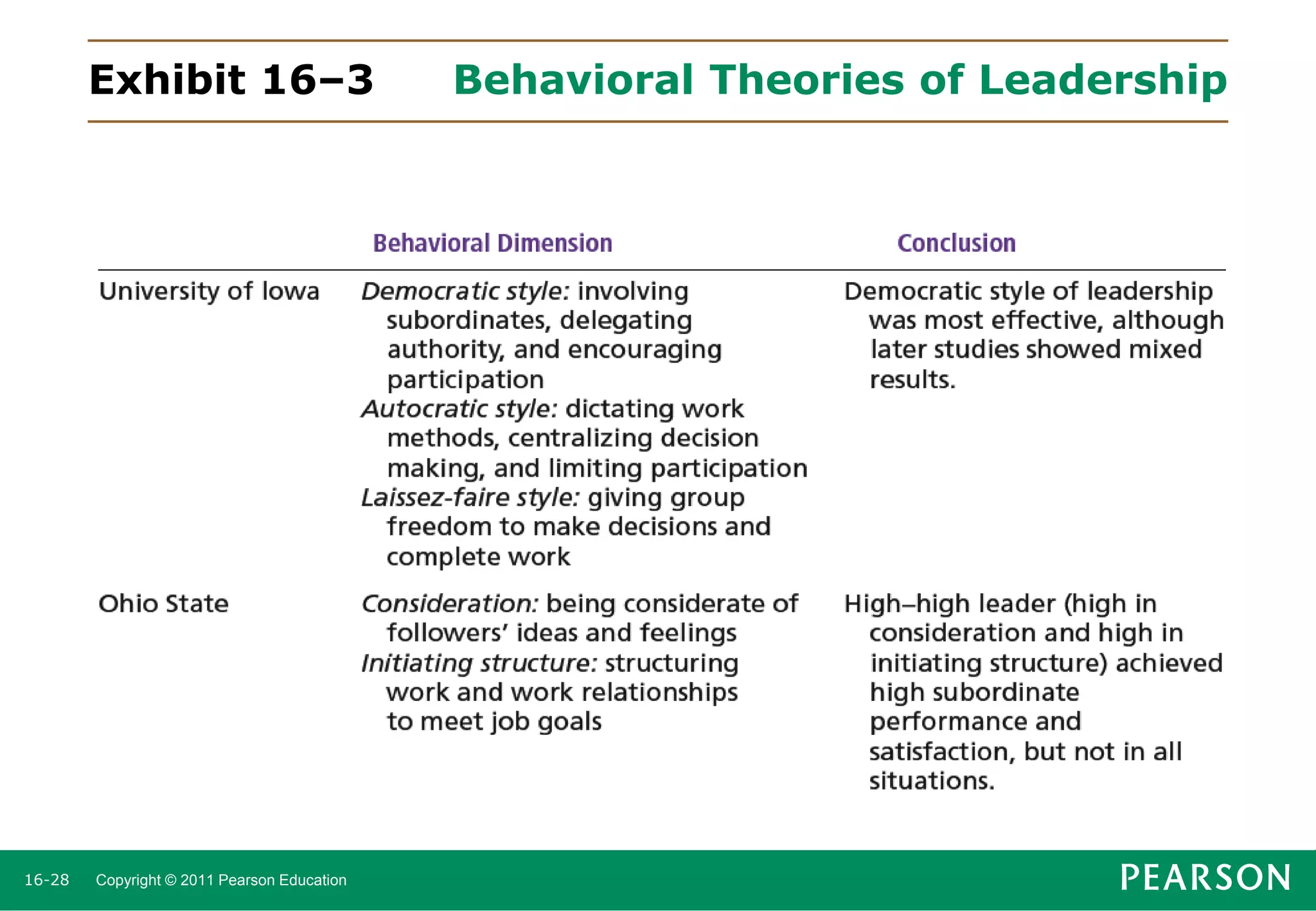
University of Iowa Studies (Kurt Lewin)
• Identified

three leadership styles:

–
–

Democratic style: involvement, high participation, feedback

–

16-22

Autocratic style: centralized authority, low participation
Laissez faire style: hands-off management

Copyright © 2011 Pearson Education
Behavioral Theories
University of Iowa Studies (Kurt Lewin)
•

Research findings: mixed results
–

–

16-23

No specific style was consistently better for producing better
performance.
Employees were more satisfied under a democratic leader
than an autocratic leader.

Copyright © 2011 Pearson Education
Behavioral Theories (cont’d)
Ohio State Studies
• Identified

two dimensions of leader behavior:

–

–

16-24

Initiating structure: the role of the leader in defining his or
her role and the roles of group members.
Consideration: the leader’s mutual trust and respect for group
members’ ideas and feelings.

Copyright © 2011 Pearson Education
Behavioral Theories (cont’d)
Ohio State Studies
• Research

findings: mixed results

–

–

16-25

High-high leaders generally, but not always, achieved high
group task performance and satisfaction.
Evidence indicated that situational factors appeared to strongly
influence leadership effectiveness.

Copyright © 2011 Pearson Education
Behavioral Theories (cont’d)
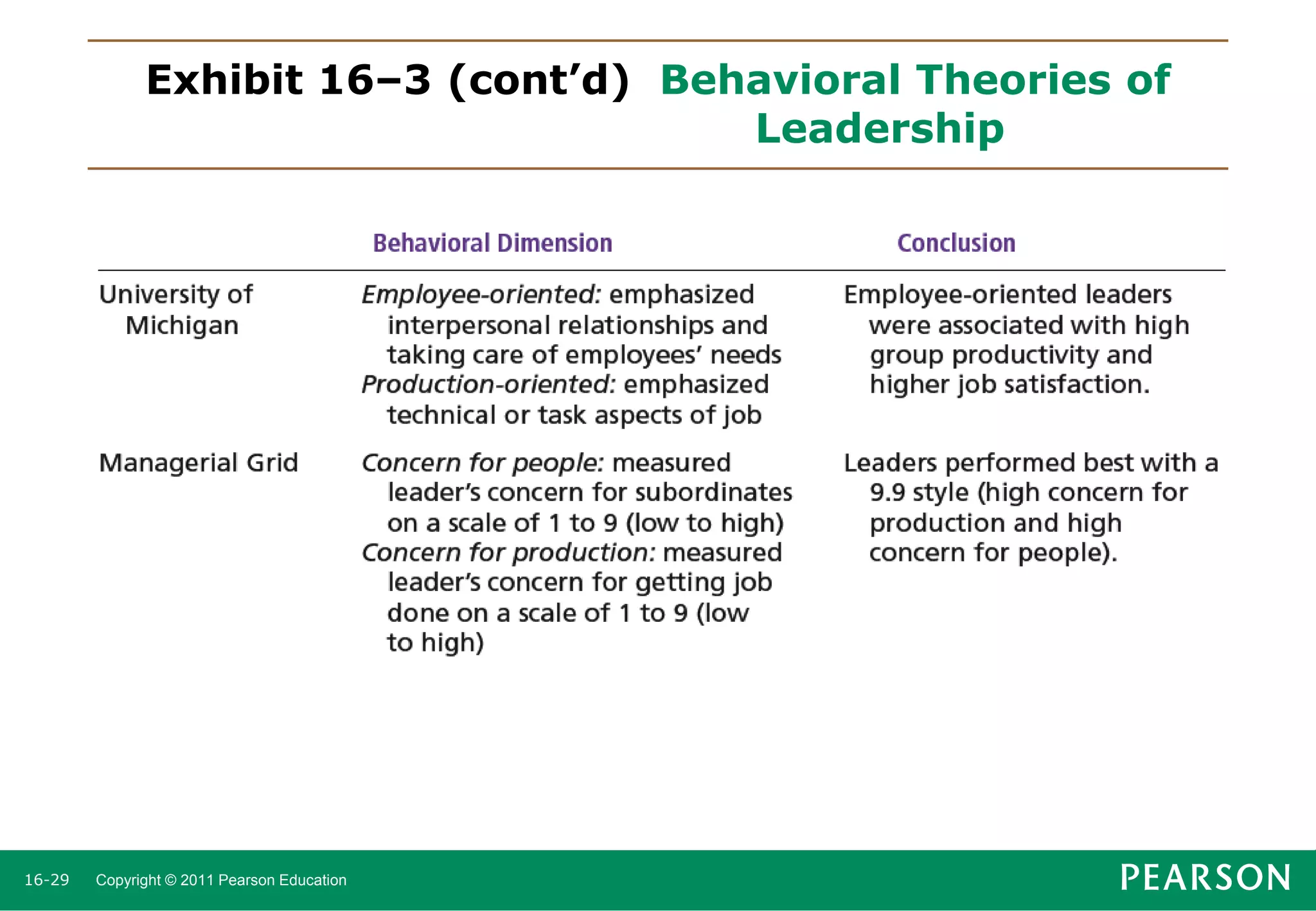
University of Michigan Studies
•

Identified two dimensions of leader behavior:
–
–

•

16-26

Employee oriented: emphasizing personal relationships
Production oriented: emphasizing task accomplishment

Research findings: Leaders who are employee oriented are strongly
associated with high group productivity and high job satisfaction.

Copyright © 2011 Pearson Education
Behavioral Theories (cont’d)
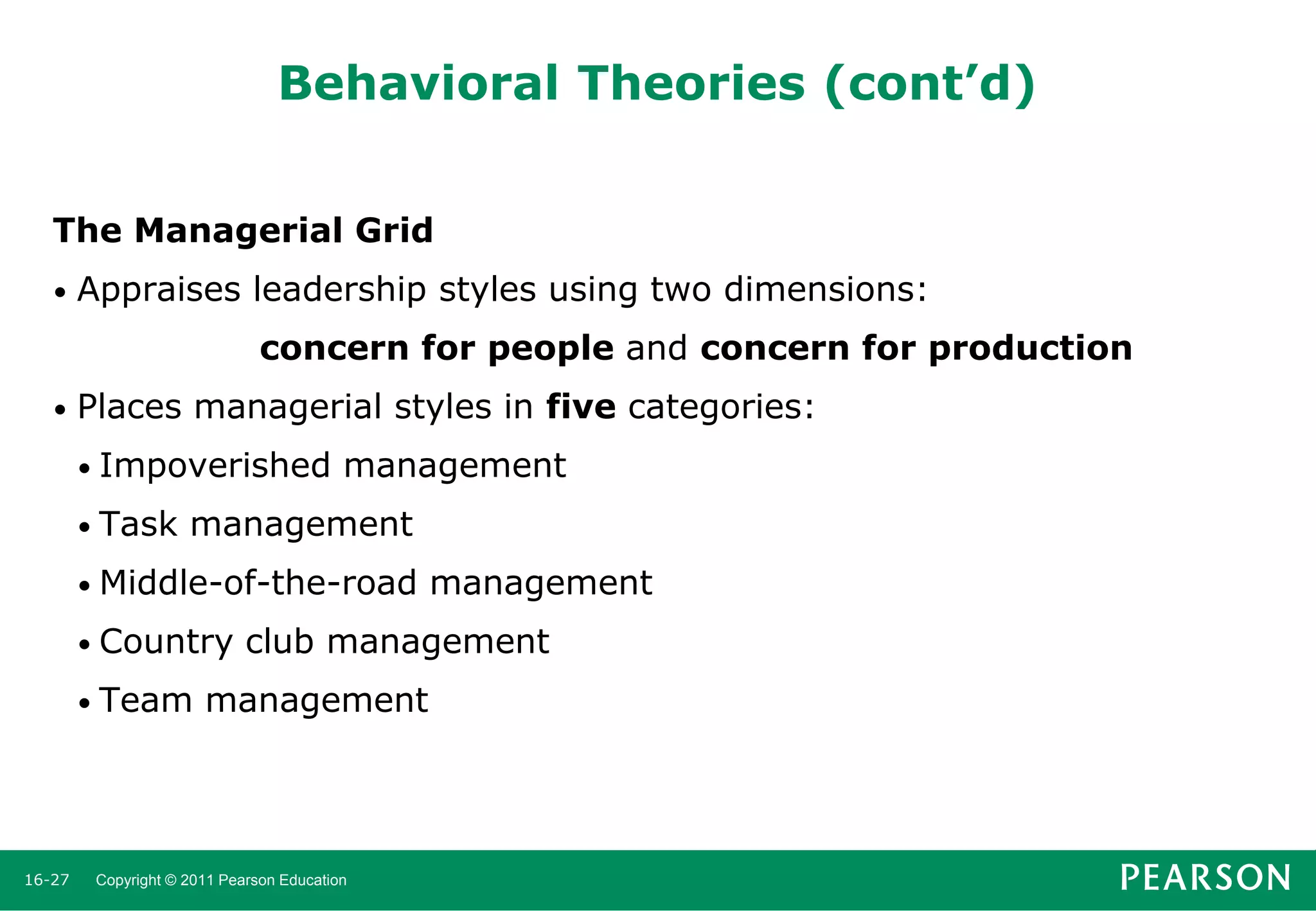
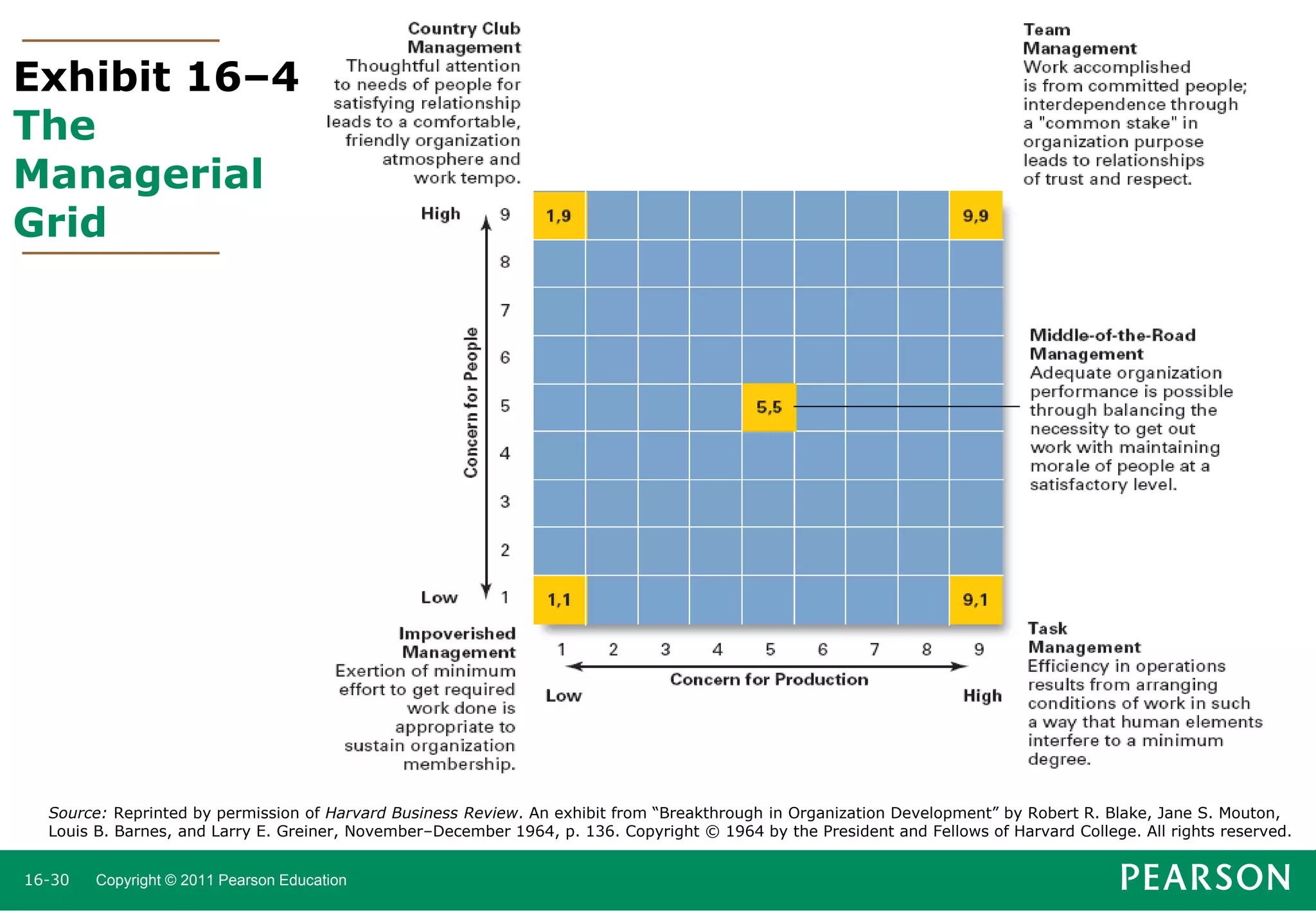
The Managerial Grid
•

Appraises leadership styles using two dimensions:
concern for people and concern for production

•

Places managerial styles in five categories:
• Impoverished
• Task

management

management

• Middle-of-the-road
• Country

• Team

16-27

management

club management

management

Copyright © 2011 Pearson Education
Exhibit 16–3

16-28

Copyright © 2011 Pearson Education

Behavioral Theories of Leadership
Exhibit 16–3 (cont’d) Behavioral Theories of
Leadership

16-29

Copyright © 2011 Pearson Education
Exhibit 16–4
The
Managerial
Grid

Source: Reprinted by permission of Harvard Business Review. An exhibit from “Breakthrough in Organization Development” by Robert R. Blake, Jane S. Mouton,
Louis B. Barnes, and Larry E. Greiner, November–December 1964, p. 136. Copyright © 1964 by the President and Fellows of Harvard College. All rights reserved.
16-30

Copyright © 2011 Pearson Education
Contingency Theories of
Leadership
1. Explain Fiedler’s contingency model of leadership.
2. Describe situational leadership theory.

3. Discuss how path–goal theory explains leadership.

16-31

Copyright © 2011 Pearson Education
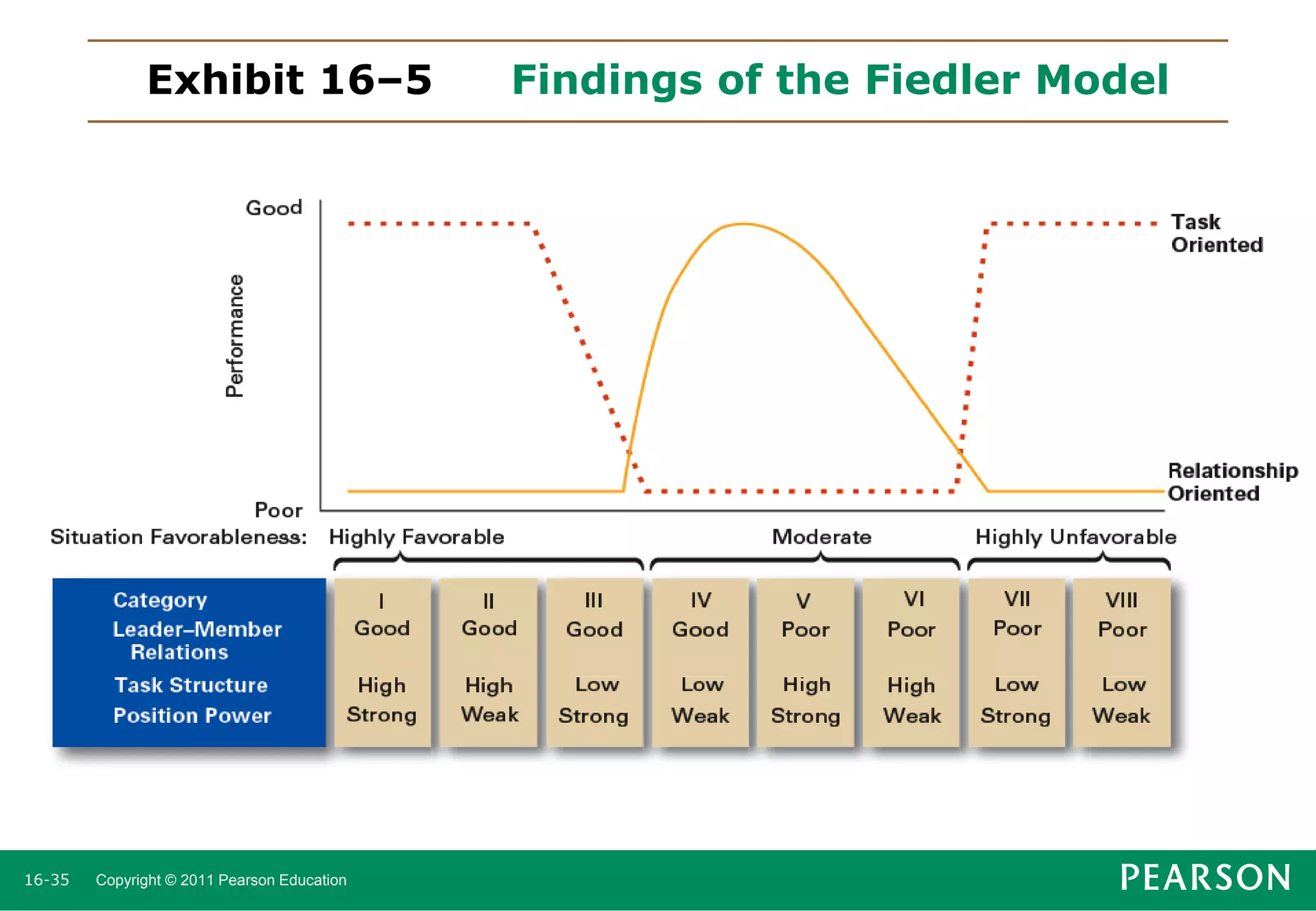
The Fiedler Model


16-32

Proposes that effective group performance depends upon the proper
match between the leader’s style of interacting with followers and
the degree to which the situation allows the leader to control and
influence.

Copyright © 2011 Pearson Education
The Fiedler Model
Assumptions:


A certain leadership style should be most effective in different types
of situations.



Leaders do not readily change leadership styles.



Matching the leader to the situation or changing the situation
to make it favorable to the leader is required.

16-33

Copyright © 2011 Pearson Education
The Fiedler Model
•

Situational factors in matching leader to the situation:
• Leader–member
• Task

structure

• Position

16-34

power

Copyright © 2011 Pearson Education

relations
Exhibit 16–5

16-35

Copyright © 2011 Pearson Education

Findings of the Fiedler Model
Hersey and Blanchard’s Situational
Leadership Theory (SLT)
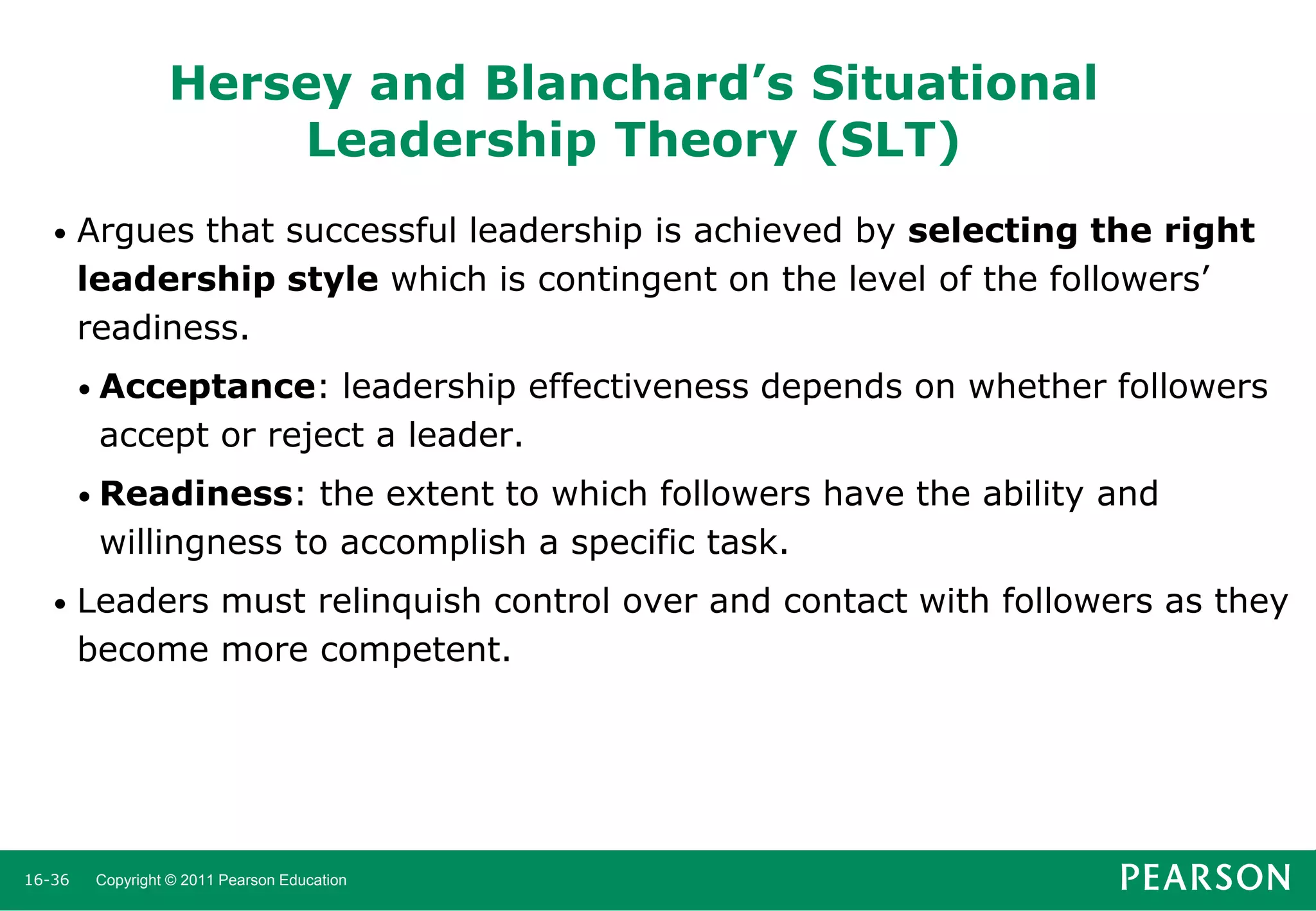
•

Argues that successful leadership is achieved by selecting the right
leadership style which is contingent on the level of the followers’
readiness.
• Acceptance:

leadership effectiveness depends on whether followers
accept or reject a leader.

• Readiness:

the extent to which followers have the ability and
willingness to accomplish a specific task.

•

16-36

Leaders must relinquish control over and contact with followers as they
become more competent.

Copyright © 2011 Pearson Education
Hersey and Blanchard’s Situational
Leadership Theory (SLT)
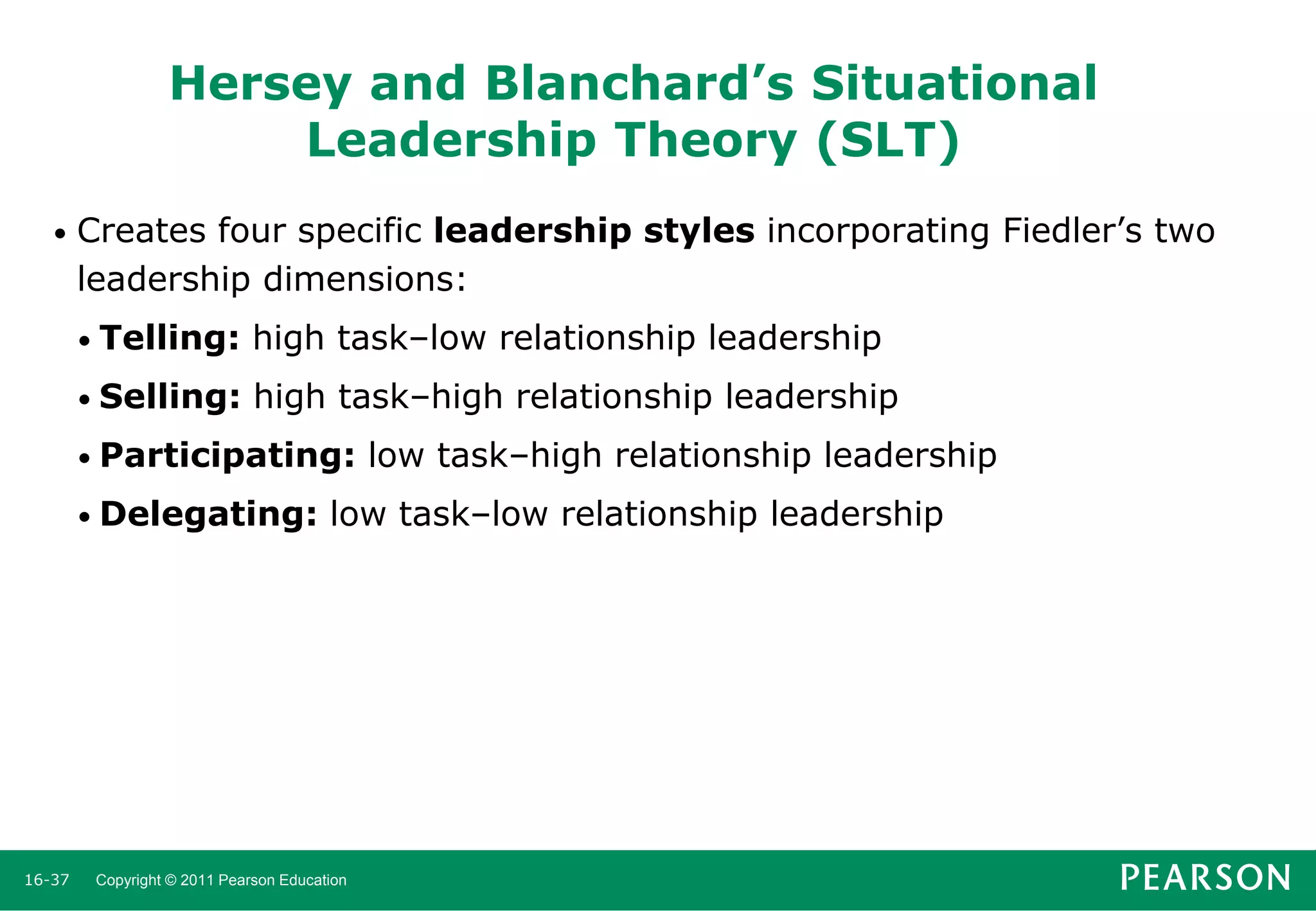
•

Creates four specific leadership styles incorporating Fiedler’s two
leadership dimensions:
• Telling:

high task–low relationship leadership

• Selling:

high task–high relationship leadership

• Participating:

• Delegating:

16-37

low task–high relationship leadership

low task–low relationship leadership

Copyright © 2011 Pearson Education
Hersey and Blanchard’s Situational
Leadership Theory (SLT)
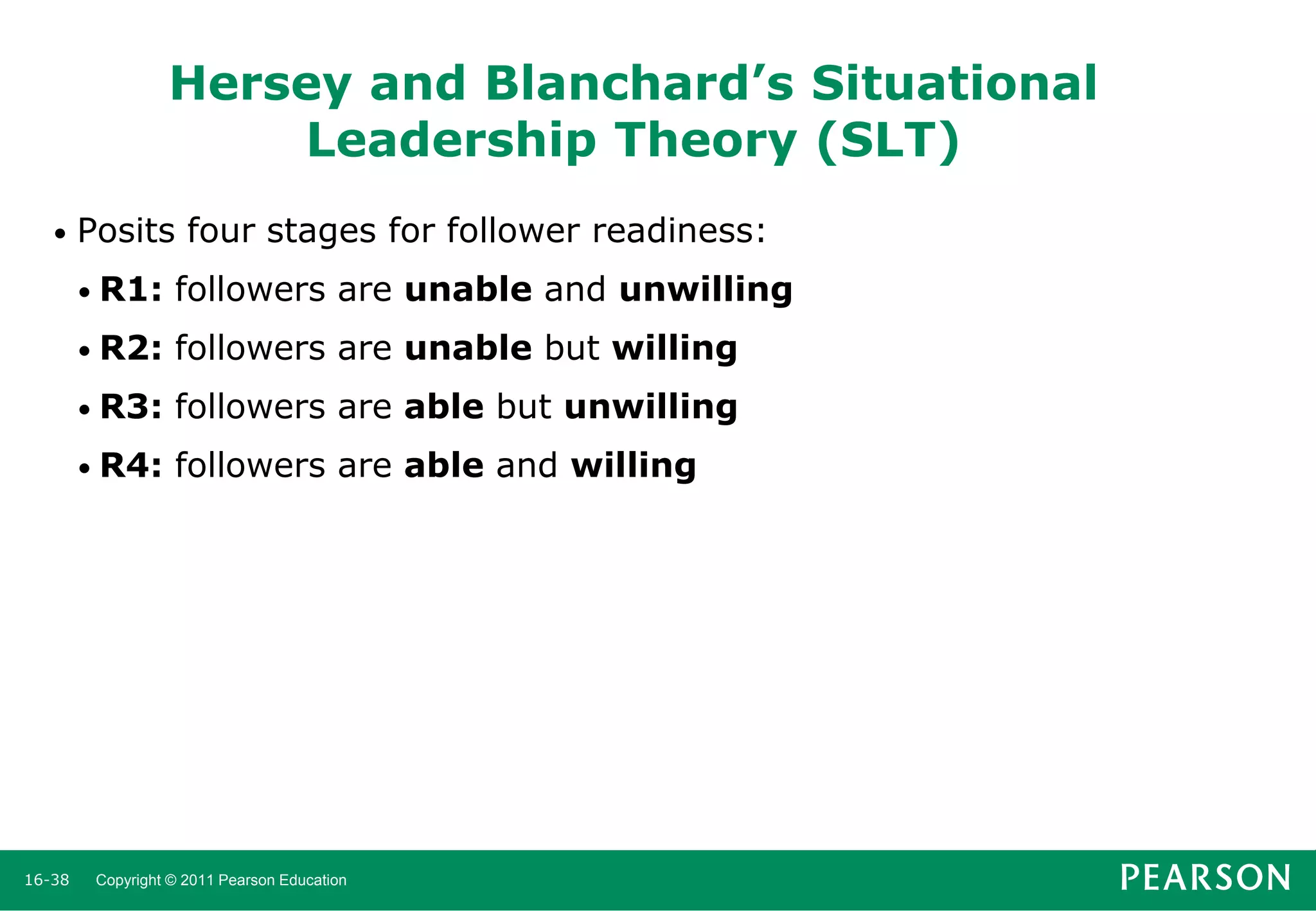
•

Posits four stages for follower readiness:
• R1:
• R2:

followers are unable but willing

• R3:

followers are able but unwilling

• R4:

16-38

followers are unable and unwilling

followers are able and willing

Copyright © 2011 Pearson Education
Path-Goal Model
•

16-39

States that the leader’s job is to assist his or her followers in
attaining their goals and to provide direction or support to ensure
their goals are compatible with organizational goals.

Copyright © 2011 Pearson Education
Path-Goal Model
•

Leaders assume different leadership styles at different times
depending on the situation:
• Directive

leader

• Supportive

leader

• Participative
• Achievement

16-40

leader
oriented leader

Copyright © 2011 Pearson Education
Exhibit 16–6

16-41

Copyright © 2011 Pearson Education

Path-Goal Theory
Contemporary Views of
Leadership
1. Differentiate between transactional and
transformational leaders.
2. Describe charismatic and visionary leadership.
3. Discuss what team leadership involves.

16-42

Copyright © 2011 Pearson Education
Transactional-Transformational Leadership
Transactional Leadership
•

Leaders who guide or motivate their followers in the direction of
established goals by clarifying role and task requirements.

Transformational Leadership
•

16-43

Leaders who inspire followers to transcend their own self-interests
for the good of the organization by clarifying role and task
requirements.

Copyright © 2011 Pearson Education
Team leadership
•

Having patience to share information

•

Being able to trust others and to give up authority

•

Understanding when to intervene

•

Managing the team’s external boundary

•

Facilitating the team process

•

Coaching, facilitating, handling disciplinary problems , reviewing
team and individual performance, training, and communication

16-44

Copyright © 2011 Pearson Education
Leadership Issues in the
Twenty-First Century
1. Managing Power
2. Developing Trust
3. Empowering Employees
4. Leading across Cultures
5. Understanding Gender Differences
6. Gender differences in the Arab World
7. Becoming an Effective Leader

16-45

Copyright © 2011 Pearson Education
Managing Power
Legitimate power
• The power a leader has as a
result of his or her position.
• Coercive power
• The power a leader has to
punish or control.
• Reward power
• The power to give positive
benefits or rewards.
•

16-46

Copyright © 2011 Pearson Education

Expert power
• The influence a leader can exert
as a result of his or her
expertise, skills, or knowledge.
• Referent power
• The power of a leader that
arises because of a person’s
desirable resources or admired
personal traits.
•
Developing Trust
Credibility (of a Leader)
 The assessment of a leader’s honesty, competence, and ability to
inspire by his or her followers.
Trust
 Is the belief of followers and others in the integrity, character, and
ability of a leader.
 Is related to increases in job performance, organizational citizenship
behaviors, job satisfaction, and organization commitment.

16-47

Copyright © 2011 Pearson Education
Dimensions of Trust
Integrity: Honesty and truthfulness

Competence: Technical and interpersonal knowledge and skills
Consistency: Reliability, predictability, and good judgment in
handling situations
Loyalty: Willingness to protect a person, physically and
emotionally
Openness: Willingness to share ideas and information freely

16-48

Copyright © 2011 Pearson Education
Empowering Employees
Empowerment involves increasing the decision-making discretion of
workers such that teams can make key operating decisions that
directly affect their work.
•

Why empower employees?
• Quicker

responses to problems and faster decisions

• Addresses

the problem of increased spans of control in relieving
managers to work on other problems

16-49

Copyright © 2011 Pearson Education
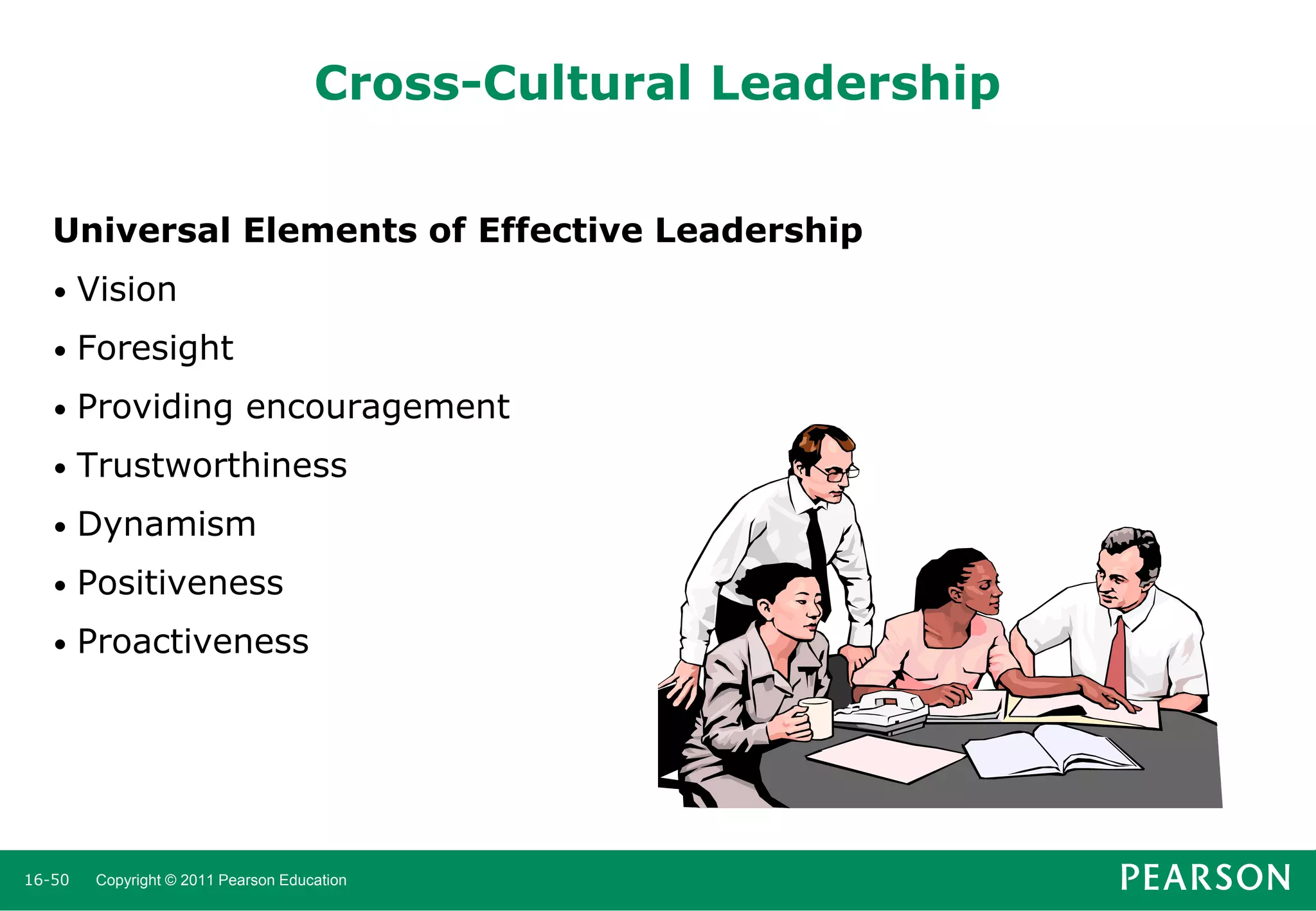
Cross-Cultural Leadership
Universal Elements of Effective Leadership
•

Vision

•

Foresight

•

Providing encouragement

•

Trustworthiness

•

Dynamism

•

Positiveness

•

Proactiveness

16-50

Copyright © 2011 Pearson Education
Exhibit 16–7
Selected Cross-Cultural Leadership Findings
• Korean leaders are expected to be paternalistic toward
employees.
• Arab leaders who show kindness or generosity without
being asked to do so are seen by other Arabs as weak.
• Japanese leaders are expected to be humble and speak
frequently.
• Scandinavian and Dutch leaders who single out individuals
with public praise are likely to embarrass, not energize,
those individuals.

Source: Based on J. C. Kennedy, “Leadership in Malaysia: Traditional Values, International Outlook,” Academy of Management Executive, August 2002, pp.
15–16; F.C. Brodbeck, M. Frese, and M. Javidan, “Leadership Made in Germany: Low on Compassion, High on Performance,” Academy of Management
Executive, February 2002, pp. 16–29; M. F. Peterson and J. G. Hunt, “International Perspectives on International Leadership,” Leadership Quarterly, Fall 1997,
pp. 203–31; R. J. House and R. N. Aditya, “The Social Scientific Study of Leadership: Quo Vadis?” Journal of Management, vol. 23, no. 3, (1997), p. 463; and
R. J. House, “Leadership in the Twenty-First Century,” in A. Howard (ed.), The Changing Nature of Work (San Francisco: Jossey-Bass, 1995), p. 442.
16-51

Copyright © 2011 Pearson Education
Exhibit 16–7 (cont’d)
Selected Cross-Cultural Leadership Findings
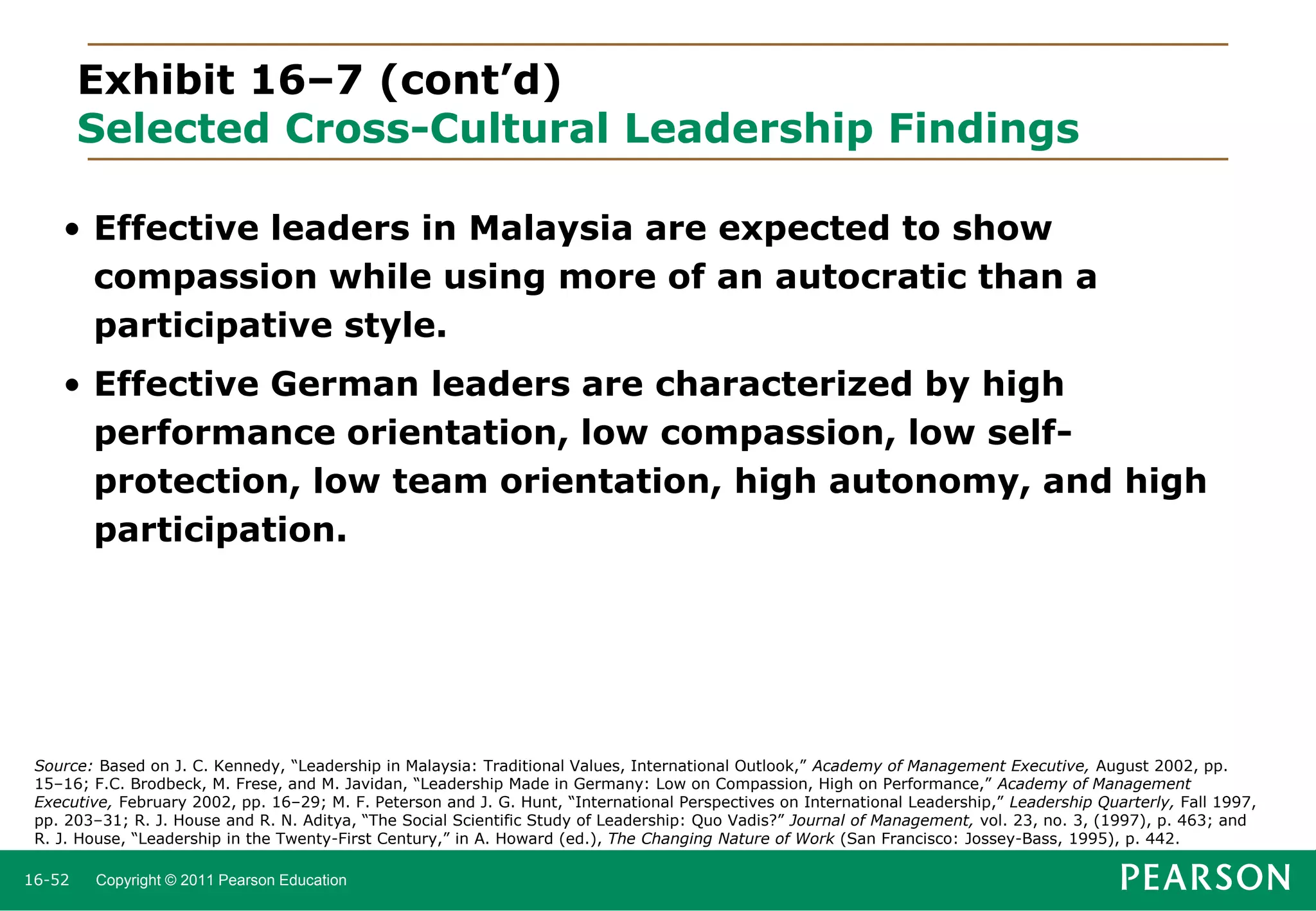
• Effective leaders in Malaysia are expected to show
compassion while using more of an autocratic than a
participative style.
• Effective German leaders are characterized by high
performance orientation, low compassion, low selfprotection, low team orientation, high autonomy, and high
participation.

Source: Based on J. C. Kennedy, “Leadership in Malaysia: Traditional Values, International Outlook,” Academy of Management Executive, August 2002, pp.
15–16; F.C. Brodbeck, M. Frese, and M. Javidan, “Leadership Made in Germany: Low on Compassion, High on Performance,” Academy of Management
Executive, February 2002, pp. 16–29; M. F. Peterson and J. G. Hunt, “International Perspectives on International Leadership,” Leadership Quarterly, Fall 1997,
pp. 203–31; R. J. House and R. N. Aditya, “The Social Scientific Study of Leadership: Quo Vadis?” Journal of Management, vol. 23, no. 3, (1997), p. 463; and
R. J. House, “Leadership in the Twenty-First Century,” in A. Howard (ed.), The Changing Nature of Work (San Francisco: Jossey-Bass, 1995), p. 442.
16-52

Copyright © 2011 Pearson Education
Gender Differences and Leadership:
Research findings


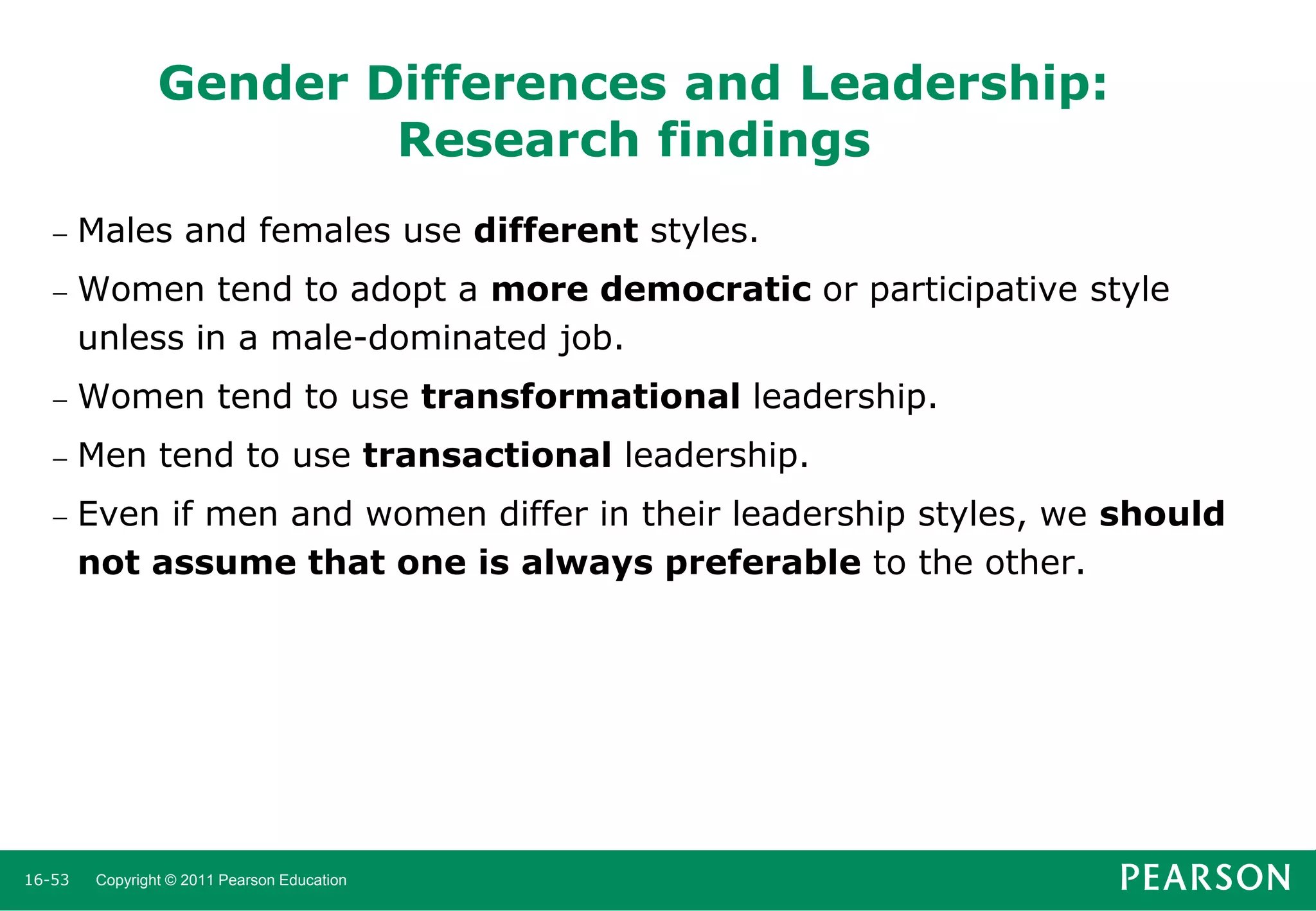
Males and females use different styles.



Women tend to adopt a more democratic or participative style
unless in a male-dominated job.



Women tend to use transformational leadership.



Men tend to use transactional leadership.



Even if men and women differ in their leadership styles, we should
not assume that one is always preferable to the other.

16-53

Copyright © 2011 Pearson Education
Gender Differences In Leadership In The
Arab World
•

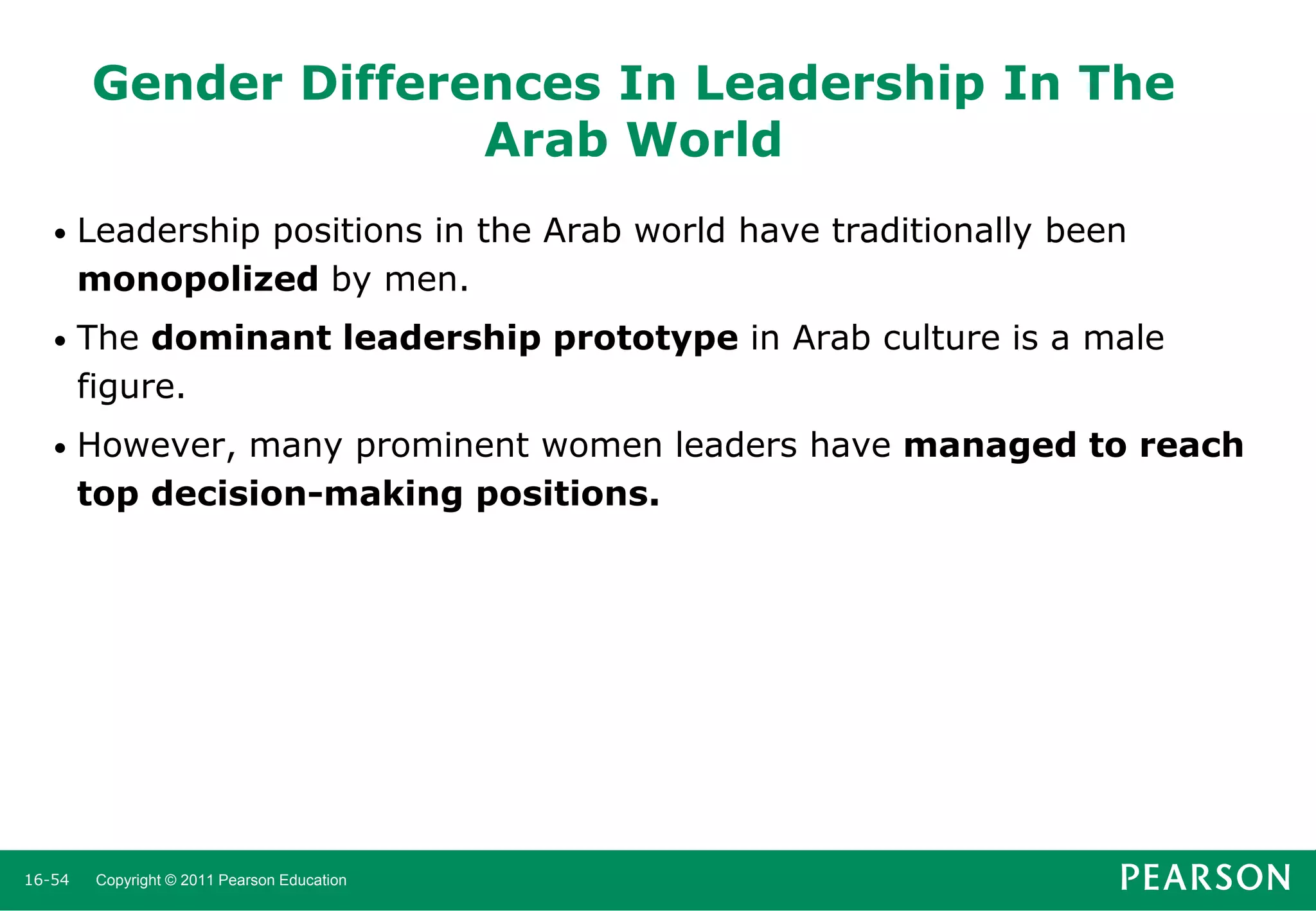
Leadership positions in the Arab world have traditionally been
monopolized by men.

•

The dominant leadership prototype in Arab culture is a male
figure.

•

However, many prominent women leaders have managed to reach
top decision-making positions.

16-54

Copyright © 2011 Pearson Education
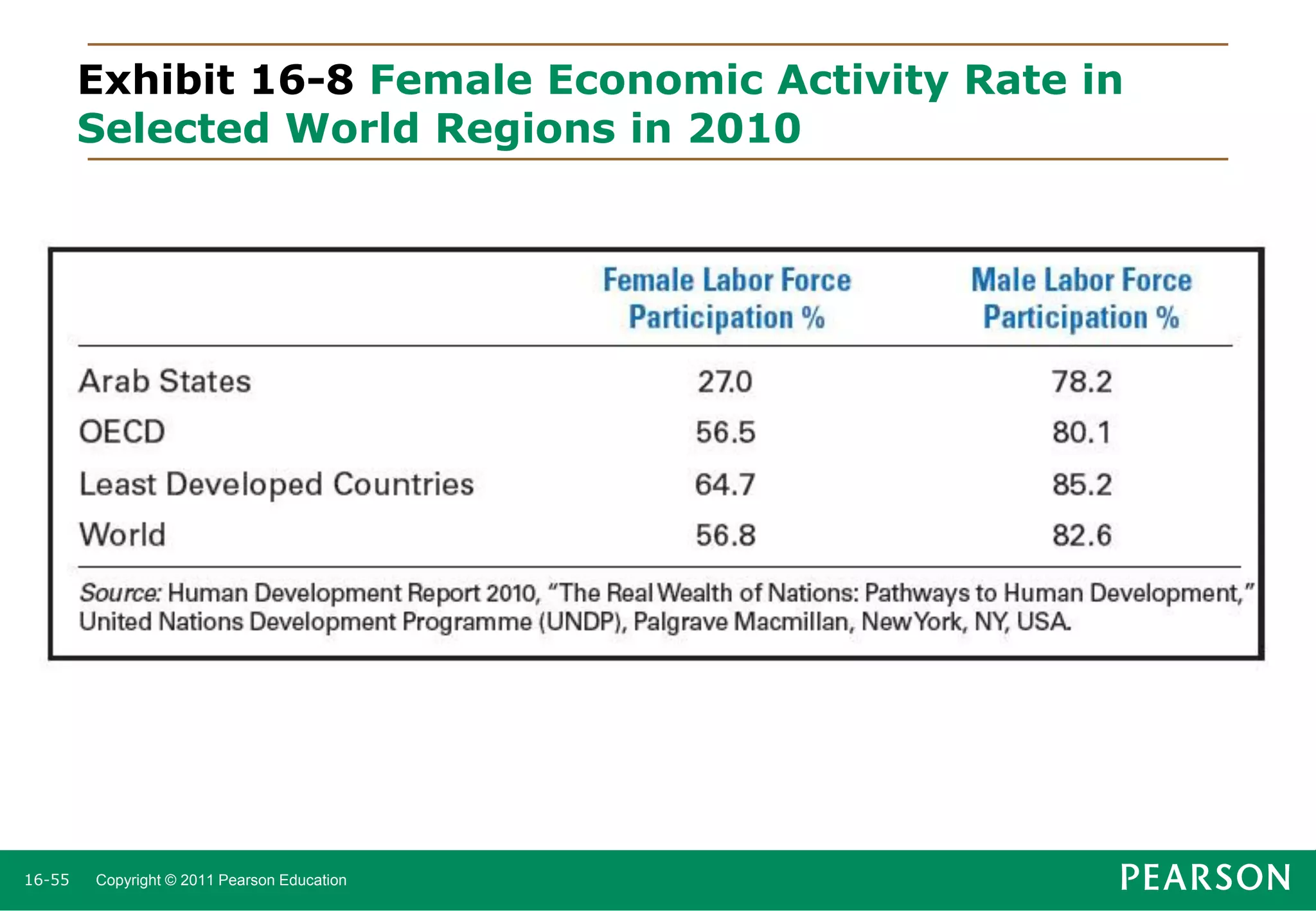
Exhibit 16-8 Female Economic Activity Rate in
Selected World Regions in 2010

16-55

Copyright © 2011 Pearson Education
Becoming an Effective Leader:
Leader Training
•

More likely to be successful with individuals who are high selfmonitors than with low self-monitors.

•

Individuals with higher levels of motivation to lead are more
receptive to leadership development opportunities

What can be taught:
–
–

Trust-building

–

Mentoring

–

16-56

Implementation skills

Situational analysis

Copyright © 2011 Pearson Education
Becoming an Effective Leader:
Substitutes for Leadership
Sometimes, leadership may not be important!

Follower characteristics


Experience, training, professional orientation, or the need for
independence

Job characteristics


Routine, unambiguous, and satisfying jobs

Organizational characteristics


16-57

Explicit formalized goals, rigid rules and procedures, or cohesive work
groups

Copyright © 2011 Pearson Education
Terms to Know
leader
leadership
behavioral theories
autocratic style
democratic style
laissez-faire style
initiating structure
consideration
high-high leader
managerial grid
Fiedler contingency model

16-58

Copyright © 2011 Pearson Education

leader-member relations
task structure
position power
situational leadership theory (SLT)
readiness
leader participation model
path–goal theory
transactional leaders
transformational leaders
Terms to Know
legitimate power
coercive power
reward power
expert power
referent power
credibility
trust
empowerment

16-59

Copyright © 2011 Pearson Education
16-60

Copyright © 2011 Pearson Education

Chapter 16

  • 2.
    Management: Arab WorldEdition Robbins, Coulter, Sidani, Jamali Chapter 16: Managers As Leaders Lecturer: : [Insert your name here]
  • 3.
    Learning Outcomes Follow thisLearning Outline as you read and study this chapter. 16.1 Who Are Leaders and What Is Leadership • Define leaders and leadership. • Explain why managers should be leaders. 16.2 Historical Leadership In The Middle East • Ibn-Khaldun Conception of Leadership • The role of Asabiya (Group-bond in fostering leadership) • The Prophetic-Caliphal Model of Leadership 16-3 Copyright © 2011 Pearson Education
  • 4.
    Learning Outcomes 16.3 EarlyLeadership Theories • Discuss what research has shown about leadership traits. • Contrast • Explain the findings of the four behavioral leadership theories. the dual nature of a leader’s behavior. 16.4 Contingency Theories of Leadership • Explain Fiedler’s contingency model of leadership. • Describe • Discuss 16-4 situational leadership theory. how path–goal theory explains leadership. Copyright © 2011 Pearson Education
  • 5.
    Learning Outcomes 16.5 ContemporaryViews of Leadership • Differentiate between transactional and transformational leaders. • Describe • Discuss charismatic and visionary leadership. what team leadership involves. 16.6 Leadership Issues in the Twenty-First Century • Describe • Discuss 16-5 the five sources of a leader’s power. the issues today’s leaders face. Copyright © 2011 Pearson Education
  • 6.
    Who Are Leadersand What Is Leadership 1. Define leaders and leadership. 2. Explain why managers should be leaders. 16-6 Copyright © 2011 Pearson Education
  • 7.
    Who Are Leadersand What Is Leadership Leader  Someone who can influence others and who has managerial authority Leadership  What leaders do; the process of influencing a group to achieve goals 16-7 Copyright © 2011 Pearson Education
  • 8.
    Who Are Leadersand What Is Leadership Although groups may have informal leaders who emerge, those are not the leaders we’re studying. Leadership research has tried to answer: What is an effective leader? 16-8 Copyright © 2011 Pearson Education
  • 9.
    Historical Leadership In TheMiddle East 1. Ibn-Khaldun Conception of Leadership 2. The role of Asabiya (Group-bond in fostering leadership) 3. The Prophetic-Caliphal Model of Leadership 16-9 Copyright © 2011 Pearson Education
  • 10.
    Ibn-Khaldun Conception ofLeadership He was born in Tunis in the year 1332.  He was mainly interested in political leadership, but his conceptualization is important for understanding leadership in any context, business or non-business.  Ibn Khaldun emphasizes the personal qualities of the leader. He calls those qualities “perfecting details”.  16-10 Copyright © 2011 Pearson Education
  • 11.
    Perfecting Details Include: 1.Generosity 2. Forgiveness of error 3. Patience and perseverance 4. Hospitality toward guests 5. Maintenance of the indigent 6. Execution of commitments 7. Respect for the religious law 16-11 Copyright © 2011 Pearson Education
  • 12.
    Perfecting Details Include: 8.Reverence for old men and teachers 9. Fairness 10. Meekness 11. Consideration to the needs of followers 12. Avoidance of deception and fraud 13. Kindness to, and protection of, subjects. 16-12 Copyright © 2011 Pearson Education
  • 13.
    The role ofAsabiya  Asabiya (“group feeling” or “group bond”). Asabiya stems from blood ties and alliances, with the former having the most weight in fostering the leadership bond. Blood ties may be an unimportant factor in the West as a source of leadership, but they are important in the Arab region. 16-13 Copyright © 2011 Pearson Education
  • 14.
    The Prophetic-Caliphal Modelof Leadership Four elements of the model: (1) Personalism (2) Individualism (3) Lack of institutionalization (4) The importance of the great man 16-14 Copyright © 2011 Pearson Education
  • 15.
    The Prophetic-Caliphal Modelof Leadership Personalism refers to the degree that a person insists on his personal opinion and the degree of concern and emphasis he has on himself. Individualism means making decisions or actions that do not take into account the opinions of the group. The combination of personalism and individualism leads to a lack of institutional development. 16-15 Copyright © 2011 Pearson Education
  • 16.
    The Prophetic-Caliphal Modelof Leadership  In cases of conflict or succession, there is no institution to fill the vacuum. The vacuum is alternatively filled by an expectation of the “great man”.  If the expected great man really turns out to be a great man, then we have a prophetic type of leader whose relationship with followers depends on love and compassion and voluntary compliance.  If the expected great man turns out to be an ordinary man then the only way to ensure follower compliance is through coercion and authoritarianism. 16-16 Copyright © 2011 Pearson Education
  • 17.
    Exhibit 16–1 Social Origins Khadra’sModel of Leadership Leadership Climate Two Conditions Two Models Prophetic Model Great Man Personalism Lack of institutionalism Vacuum Strong attachment to the leader Expecting great man Individualism Ordinary Man Fear, coercion, strife Caliphal Model 16-17 Copyright © 2011 Pearson Education
  • 18.
    Early Leadership Theories 1.Discuss what research has shown about leadership traits. 2. Contrast the findings of the four behavioral leadership theories. 3. Explain the dual nature of a leader’s behavior. 16-18 Copyright © 2011 Pearson Education
  • 19.
    Early Leadership Theories TraitTheories (1920s–1930s) • Research focused on identifying personal characteristics that differentiated leaders from non-leaders was unsuccessful. • Later research on the leadership process identified seven traits associated with successful leadership: • Drive, the desire to lead, honesty and integrity, selfconfidence, intelligence, job-relevant knowledge, and extraversion. 16-19 Copyright © 2011 Pearson Education
  • 20.
    Exhibit 16–2 SevenTraits Associated with Leadership Source: S. A. Kirkpatrick and E. A. Locke, “Leadership: Do Traits Really Matter?” Academy of Management Executive, May 1991, pp. 48–60; T. A. Judge, J. E. Bono, R. llies, and M. W. Gerhardt, “Personality and Leadership: A Qualitative and Quantitative Review,” Journal of Applied Psychology, August 2002, pp. 765–780. 16-20 Copyright © 2011 Pearson Education
  • 21.
    Behavioral Theories 1. Universityof Iowa Studies 2. Ohio State Studies 3. University of Michigan Studies 4. The Managerial Grid 16-21 Copyright © 2011 Pearson Education
  • 22.
    Behavioral Theories University ofIowa Studies (Kurt Lewin) • Identified three leadership styles: – – Democratic style: involvement, high participation, feedback – 16-22 Autocratic style: centralized authority, low participation Laissez faire style: hands-off management Copyright © 2011 Pearson Education
  • 23.
    Behavioral Theories University ofIowa Studies (Kurt Lewin) • Research findings: mixed results – – 16-23 No specific style was consistently better for producing better performance. Employees were more satisfied under a democratic leader than an autocratic leader. Copyright © 2011 Pearson Education
  • 24.
    Behavioral Theories (cont’d) OhioState Studies • Identified two dimensions of leader behavior: – – 16-24 Initiating structure: the role of the leader in defining his or her role and the roles of group members. Consideration: the leader’s mutual trust and respect for group members’ ideas and feelings. Copyright © 2011 Pearson Education
  • 25.
    Behavioral Theories (cont’d) OhioState Studies • Research findings: mixed results – – 16-25 High-high leaders generally, but not always, achieved high group task performance and satisfaction. Evidence indicated that situational factors appeared to strongly influence leadership effectiveness. Copyright © 2011 Pearson Education
  • 26.
    Behavioral Theories (cont’d) Universityof Michigan Studies • Identified two dimensions of leader behavior: – – • 16-26 Employee oriented: emphasizing personal relationships Production oriented: emphasizing task accomplishment Research findings: Leaders who are employee oriented are strongly associated with high group productivity and high job satisfaction. Copyright © 2011 Pearson Education
  • 27.
    Behavioral Theories (cont’d) TheManagerial Grid • Appraises leadership styles using two dimensions: concern for people and concern for production • Places managerial styles in five categories: • Impoverished • Task management management • Middle-of-the-road • Country • Team 16-27 management club management management Copyright © 2011 Pearson Education
  • 28.
    Exhibit 16–3 16-28 Copyright ©2011 Pearson Education Behavioral Theories of Leadership
  • 29.
    Exhibit 16–3 (cont’d)Behavioral Theories of Leadership 16-29 Copyright © 2011 Pearson Education
  • 30.
    Exhibit 16–4 The Managerial Grid Source: Reprintedby permission of Harvard Business Review. An exhibit from “Breakthrough in Organization Development” by Robert R. Blake, Jane S. Mouton, Louis B. Barnes, and Larry E. Greiner, November–December 1964, p. 136. Copyright © 1964 by the President and Fellows of Harvard College. All rights reserved. 16-30 Copyright © 2011 Pearson Education
  • 31.
    Contingency Theories of Leadership 1.Explain Fiedler’s contingency model of leadership. 2. Describe situational leadership theory. 3. Discuss how path–goal theory explains leadership. 16-31 Copyright © 2011 Pearson Education
  • 32.
    The Fiedler Model  16-32 Proposesthat effective group performance depends upon the proper match between the leader’s style of interacting with followers and the degree to which the situation allows the leader to control and influence. Copyright © 2011 Pearson Education
  • 33.
    The Fiedler Model Assumptions:  Acertain leadership style should be most effective in different types of situations.  Leaders do not readily change leadership styles.  Matching the leader to the situation or changing the situation to make it favorable to the leader is required. 16-33 Copyright © 2011 Pearson Education
  • 34.
    The Fiedler Model • Situationalfactors in matching leader to the situation: • Leader–member • Task structure • Position 16-34 power Copyright © 2011 Pearson Education relations
  • 35.
    Exhibit 16–5 16-35 Copyright ©2011 Pearson Education Findings of the Fiedler Model
  • 36.
    Hersey and Blanchard’sSituational Leadership Theory (SLT) • Argues that successful leadership is achieved by selecting the right leadership style which is contingent on the level of the followers’ readiness. • Acceptance: leadership effectiveness depends on whether followers accept or reject a leader. • Readiness: the extent to which followers have the ability and willingness to accomplish a specific task. • 16-36 Leaders must relinquish control over and contact with followers as they become more competent. Copyright © 2011 Pearson Education
  • 37.
    Hersey and Blanchard’sSituational Leadership Theory (SLT) • Creates four specific leadership styles incorporating Fiedler’s two leadership dimensions: • Telling: high task–low relationship leadership • Selling: high task–high relationship leadership • Participating: • Delegating: 16-37 low task–high relationship leadership low task–low relationship leadership Copyright © 2011 Pearson Education
  • 38.
    Hersey and Blanchard’sSituational Leadership Theory (SLT) • Posits four stages for follower readiness: • R1: • R2: followers are unable but willing • R3: followers are able but unwilling • R4: 16-38 followers are unable and unwilling followers are able and willing Copyright © 2011 Pearson Education
  • 39.
    Path-Goal Model • 16-39 States thatthe leader’s job is to assist his or her followers in attaining their goals and to provide direction or support to ensure their goals are compatible with organizational goals. Copyright © 2011 Pearson Education
  • 40.
    Path-Goal Model • Leaders assumedifferent leadership styles at different times depending on the situation: • Directive leader • Supportive leader • Participative • Achievement 16-40 leader oriented leader Copyright © 2011 Pearson Education
  • 41.
    Exhibit 16–6 16-41 Copyright ©2011 Pearson Education Path-Goal Theory
  • 42.
    Contemporary Views of Leadership 1.Differentiate between transactional and transformational leaders. 2. Describe charismatic and visionary leadership. 3. Discuss what team leadership involves. 16-42 Copyright © 2011 Pearson Education
  • 43.
    Transactional-Transformational Leadership Transactional Leadership • Leaderswho guide or motivate their followers in the direction of established goals by clarifying role and task requirements. Transformational Leadership • 16-43 Leaders who inspire followers to transcend their own self-interests for the good of the organization by clarifying role and task requirements. Copyright © 2011 Pearson Education
  • 44.
    Team leadership • Having patienceto share information • Being able to trust others and to give up authority • Understanding when to intervene • Managing the team’s external boundary • Facilitating the team process • Coaching, facilitating, handling disciplinary problems , reviewing team and individual performance, training, and communication 16-44 Copyright © 2011 Pearson Education
  • 45.
    Leadership Issues inthe Twenty-First Century 1. Managing Power 2. Developing Trust 3. Empowering Employees 4. Leading across Cultures 5. Understanding Gender Differences 6. Gender differences in the Arab World 7. Becoming an Effective Leader 16-45 Copyright © 2011 Pearson Education
  • 46.
    Managing Power Legitimate power •The power a leader has as a result of his or her position. • Coercive power • The power a leader has to punish or control. • Reward power • The power to give positive benefits or rewards. • 16-46 Copyright © 2011 Pearson Education Expert power • The influence a leader can exert as a result of his or her expertise, skills, or knowledge. • Referent power • The power of a leader that arises because of a person’s desirable resources or admired personal traits. •
  • 47.
    Developing Trust Credibility (ofa Leader)  The assessment of a leader’s honesty, competence, and ability to inspire by his or her followers. Trust  Is the belief of followers and others in the integrity, character, and ability of a leader.  Is related to increases in job performance, organizational citizenship behaviors, job satisfaction, and organization commitment. 16-47 Copyright © 2011 Pearson Education
  • 48.
    Dimensions of Trust Integrity:Honesty and truthfulness Competence: Technical and interpersonal knowledge and skills Consistency: Reliability, predictability, and good judgment in handling situations Loyalty: Willingness to protect a person, physically and emotionally Openness: Willingness to share ideas and information freely 16-48 Copyright © 2011 Pearson Education
  • 49.
    Empowering Employees Empowerment involvesincreasing the decision-making discretion of workers such that teams can make key operating decisions that directly affect their work. • Why empower employees? • Quicker responses to problems and faster decisions • Addresses the problem of increased spans of control in relieving managers to work on other problems 16-49 Copyright © 2011 Pearson Education
  • 50.
    Cross-Cultural Leadership Universal Elementsof Effective Leadership • Vision • Foresight • Providing encouragement • Trustworthiness • Dynamism • Positiveness • Proactiveness 16-50 Copyright © 2011 Pearson Education
  • 51.
    Exhibit 16–7 Selected Cross-CulturalLeadership Findings • Korean leaders are expected to be paternalistic toward employees. • Arab leaders who show kindness or generosity without being asked to do so are seen by other Arabs as weak. • Japanese leaders are expected to be humble and speak frequently. • Scandinavian and Dutch leaders who single out individuals with public praise are likely to embarrass, not energize, those individuals. Source: Based on J. C. Kennedy, “Leadership in Malaysia: Traditional Values, International Outlook,” Academy of Management Executive, August 2002, pp. 15–16; F.C. Brodbeck, M. Frese, and M. Javidan, “Leadership Made in Germany: Low on Compassion, High on Performance,” Academy of Management Executive, February 2002, pp. 16–29; M. F. Peterson and J. G. Hunt, “International Perspectives on International Leadership,” Leadership Quarterly, Fall 1997, pp. 203–31; R. J. House and R. N. Aditya, “The Social Scientific Study of Leadership: Quo Vadis?” Journal of Management, vol. 23, no. 3, (1997), p. 463; and R. J. House, “Leadership in the Twenty-First Century,” in A. Howard (ed.), The Changing Nature of Work (San Francisco: Jossey-Bass, 1995), p. 442. 16-51 Copyright © 2011 Pearson Education
  • 52.
    Exhibit 16–7 (cont’d) SelectedCross-Cultural Leadership Findings • Effective leaders in Malaysia are expected to show compassion while using more of an autocratic than a participative style. • Effective German leaders are characterized by high performance orientation, low compassion, low selfprotection, low team orientation, high autonomy, and high participation. Source: Based on J. C. Kennedy, “Leadership in Malaysia: Traditional Values, International Outlook,” Academy of Management Executive, August 2002, pp. 15–16; F.C. Brodbeck, M. Frese, and M. Javidan, “Leadership Made in Germany: Low on Compassion, High on Performance,” Academy of Management Executive, February 2002, pp. 16–29; M. F. Peterson and J. G. Hunt, “International Perspectives on International Leadership,” Leadership Quarterly, Fall 1997, pp. 203–31; R. J. House and R. N. Aditya, “The Social Scientific Study of Leadership: Quo Vadis?” Journal of Management, vol. 23, no. 3, (1997), p. 463; and R. J. House, “Leadership in the Twenty-First Century,” in A. Howard (ed.), The Changing Nature of Work (San Francisco: Jossey-Bass, 1995), p. 442. 16-52 Copyright © 2011 Pearson Education
  • 53.
    Gender Differences andLeadership: Research findings  Males and females use different styles.  Women tend to adopt a more democratic or participative style unless in a male-dominated job.  Women tend to use transformational leadership.  Men tend to use transactional leadership.  Even if men and women differ in their leadership styles, we should not assume that one is always preferable to the other. 16-53 Copyright © 2011 Pearson Education
  • 54.
    Gender Differences InLeadership In The Arab World • Leadership positions in the Arab world have traditionally been monopolized by men. • The dominant leadership prototype in Arab culture is a male figure. • However, many prominent women leaders have managed to reach top decision-making positions. 16-54 Copyright © 2011 Pearson Education
  • 55.
    Exhibit 16-8 FemaleEconomic Activity Rate in Selected World Regions in 2010 16-55 Copyright © 2011 Pearson Education
  • 56.
    Becoming an EffectiveLeader: Leader Training • More likely to be successful with individuals who are high selfmonitors than with low self-monitors. • Individuals with higher levels of motivation to lead are more receptive to leadership development opportunities What can be taught: – – Trust-building – Mentoring – 16-56 Implementation skills Situational analysis Copyright © 2011 Pearson Education
  • 57.
    Becoming an EffectiveLeader: Substitutes for Leadership Sometimes, leadership may not be important! Follower characteristics  Experience, training, professional orientation, or the need for independence Job characteristics  Routine, unambiguous, and satisfying jobs Organizational characteristics  16-57 Explicit formalized goals, rigid rules and procedures, or cohesive work groups Copyright © 2011 Pearson Education
  • 58.
    Terms to Know leader leadership behavioraltheories autocratic style democratic style laissez-faire style initiating structure consideration high-high leader managerial grid Fiedler contingency model 16-58 Copyright © 2011 Pearson Education leader-member relations task structure position power situational leadership theory (SLT) readiness leader participation model path–goal theory transactional leaders transformational leaders
  • 59.
    Terms to Know legitimatepower coercive power reward power expert power referent power credibility trust empowerment 16-59 Copyright © 2011 Pearson Education
  • 60.
    16-60 Copyright © 2011Pearson Education