8-1
Chapter 8
The Procurement of
Equipment
8-2
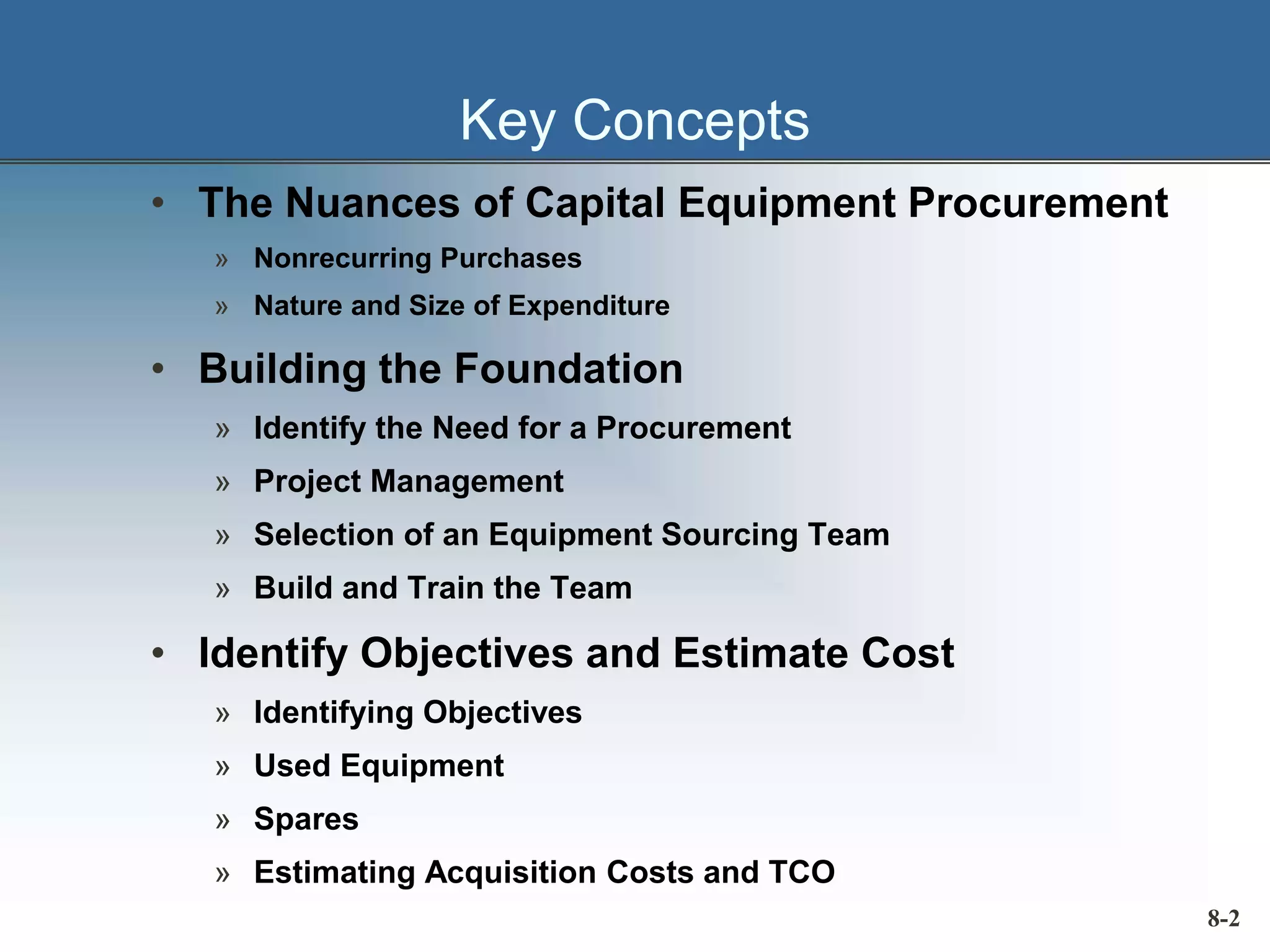
Key Concepts
• The Nuances of Capital Equipment Procurement
» Nonrecurring Purchases
» Nature and Size of Expenditure
• Building the Foundation
» Identify the Need for a Procurement
» Project Management
» Selection of an Equipment Sourcing Team
» Build and Train the Team
• Identify Objectives and Estimate Cost
» Identifying Objectives
» Used Equipment
» Spares
» Estimating Acquisition Costs and TCO
8-3
Key Concepts
• Develop Specifications and Initiate
Sourcing, Pricing & TCO Analysis
» Develop Specifications
» Sourcing
» Develop Updated Acquisition Cost and TCO
Estimates
» Updated Cost Estimates
» Meet Budget and TCO Objectives
» Top Management Approval
» Negotiation
8-4
Key Concepts
• Leased Equipment
» Types of Leases
» Factors Favoring Leasing
» Factors Weighing Against Leasing
» To Lease or to Buy?
• Initiate Lease or Contract
• Post Award Activities
8-5
The Nuances of Capital Equipment Procurement
• Nonrecurring Purchases
• Nature and Size of Expenditure
• Price vs. total life cost (TCO)
• Single-purpose vs. multi-purpose
• New, Used, Lease?
• Who should be involved in the process
8-6
Supply Management’s Role
• Distinctly different
role than in
acquisition of
materials
• Gatherer of
Information
• Source of information
• Process coordinator
• Consultant to
management
• Contract
administration
• Facilitator of unbiased
specifications
• Liaison service
provider
• Negotiator
8-7
Identify
Need
Identify
Need
Assign
Project
Manager
Assign
Project
Manager
Form
Task
Team
Form
Task
Team
Build &
Train
Task team
Build &
Train
Task team
To Phase IIB
Phase I: Build the Foundation
• Identify the Need for
a Procurement
• Project Management
• Selection of an
Equipment Sourcing
Team
• Build and Train the
Team
Figure 8-1
8-8
Figure 8-2
Phase II: Identify Objectives and Estimate Costs
• Identifying
Objectives
• Used Equipment
• Spares
• Estimating
Acquisition Costs
and the Total Cost
of Ownership
B
Identify
Objectives
Identify
Objectives
Estimate
Total
Cost of
Ownership
Estimate
Total
Cost of
Ownership
NO TCO
Analysis
C
Estimate
Acquisition
Cost
Estimate
Acquisition
Cost
Capital
Budget
Analysis
NO
YESYES
Consider Used EquipmentConsider Used Equipment
Address Need for SparesAddress Need for Spares
To Phase III
From Phase I
8-9
Used Equipment
• Reasons for Purchasing Used Equipment
» Cost
» Availability
» Used equipment may satisfy the purchasing
need
• The Used Equipment Market
» Used equipment dealers
» Sale by owner
» Brokers
» Auctions
8-10
Used Equipment
• Cautions in Purchasing Used Equipment
» Difficult to determine the true condition
» Check the reputation of the supplier
» Inspect the equipment
» Observe the equipment under power
» Determine the age
8-11
Estimating Acquisition Costs and the Total Cost
of Ownership
• A team should develop both acquisition
cost and TCO cost estimates
• In the development of the estimates the
life cycle costs should be considered
8-12
Life Cycle Cost Analysis
• Usage of the
equipment
• Number of years it will
be in service
• Various economic
inflation factors
• Original delivered cost
• Installation
• Ongoing adjustment
• Calibration
• Energy and labor for
operation
• Routine maintenance
• Major overhauls
• Downtime
• Disposal of the
machine
8-13
Total Cost of Ownership for Equipment
n
TCO = (A) + (NPV  Ci) - NPV Sn
i = 1
A = delivered acquisition cost
NPV = net present value
Ci = total operating costs incurred in year i
Sn = salvage value in year n
8-14
Develop Specifications and Initiate Sourcing,
Pricing and TCO Analysis
• Develop Specifications
• Sourcing
• Develop Updated Acquisition Cost and
TCO Estimates
• Updated Cost Estimates
• Meet Budget and TCO Objectives
• Top Management Approval
• Negotiation
8-15
Top Management ApprovalTop Management Approval
Develop SpecificationDevelop Specification
Develop Updated Acquisition
Cost & TCO Estimates
Develop Updated Acquisition
Cost & TCO Estimates
NegotiationNegotiation
From Phase IIC
YES
Identify
Objectives
Initiate Sourcing TasksInitiate Sourcing Tasks
Meet Budget &
TCO Objectives?
NO
YES
D
To Phase IV
Figure 8-3
Phase III: Develop Specifications and Initiate
Sourcing, Pricing and TCO Analysis
8-16
Develop Updated Acquisition Cost and TCO
Estimates
• Meet Budget and TCO Objectives?
• Top Management Approval
• Negotiation
8-17
Develop Updated Acquisition Cost and TCO
Estimates
$2,500,000$3,000,000
$1,300,000$2,000,000PV future cost
$1,200,000$1,000,000Acquisition cost
YX
Table 8-1
TCO
8-18
Post
Award
Activities
Post
Award
Activities
Lease or
Buy
D From Phase III
Initiate LeaseInitiate Lease Initiate ContractInitiate Contract
Figure 8-4
Phase IV: Sourcing Lease/Buy Analysis
and Post Award Activities
8-19
Leased Equipment
• Operating Lease
» Used by most firms to facilitate business operations
» Focus is on operating convenience and flexibility
» Firm is usually not interested in ownership
» Most operating leases are short term
» Most often used when firm wants freedom/flexibility
• Financial Lease
» Primary motivation is to obtain financial benefits
» Usually they are long-term
» Length is usually shorter than the life of the equipment
» Many financial leases are non-cancelable
» Some argue financial leases distort the financial reports
8-20
Leased Equipment
• Factors favoring
» Operating and
Managerial
Convenience
» Operating Flexibility
» Obsolescence
Protection
» Financial Leverage
» Income Tax
Considerations
– difference between
lease payments and
allowable depreciation
can be written off
• Factors against
» Cost
» Control
8-21
To Lease or to Buy?
• Cost Comparison
• The Decision
» Determine the operating advantages and
disadvantages
» From an operating point of view, is leasing the
preferred alternative?
» If leasing is preferable, calculate and compare
the present value costs of the two alternatives.
» Make the decision
8-22
Initiate Lease or Contract
• Responsibility of both parties
• Acceptance testing and inspection
• Acceptance timing
• Machine specifications
• Performance standards
• Guarantee conditions
• Penalties, if any
• Length of agreement
8-23
Post-Award Activities
• Work closely with the users of the
equipment to ensure that performance
expectations are fulfilled
» Collect and interpret performance data
» Use techniques from the chapter on
Relationship and Contract Management where
applicable
8-24
Concluding Remarks
• Supply management personnel function
as facilitators, coordinators, contract
administrators, and consultants in
procurement of equipment
• Specifications must be precise and
complete
• Economic analyses must be thorough and
accurate
• Total cost of ownership analysis must be
used
• Responsibilities of both the supplying and
buying firms should be established

Chapter 8 The Procurement of Equipment

  • 1.
  • 2.
    8-2 Key Concepts • TheNuances of Capital Equipment Procurement » Nonrecurring Purchases » Nature and Size of Expenditure • Building the Foundation » Identify the Need for a Procurement » Project Management » Selection of an Equipment Sourcing Team » Build and Train the Team • Identify Objectives and Estimate Cost » Identifying Objectives » Used Equipment » Spares » Estimating Acquisition Costs and TCO
  • 3.
    8-3 Key Concepts • DevelopSpecifications and Initiate Sourcing, Pricing & TCO Analysis » Develop Specifications » Sourcing » Develop Updated Acquisition Cost and TCO Estimates » Updated Cost Estimates » Meet Budget and TCO Objectives » Top Management Approval » Negotiation
  • 4.
    8-4 Key Concepts • LeasedEquipment » Types of Leases » Factors Favoring Leasing » Factors Weighing Against Leasing » To Lease or to Buy? • Initiate Lease or Contract • Post Award Activities
  • 5.
    8-5 The Nuances ofCapital Equipment Procurement • Nonrecurring Purchases • Nature and Size of Expenditure • Price vs. total life cost (TCO) • Single-purpose vs. multi-purpose • New, Used, Lease? • Who should be involved in the process
  • 6.
    8-6 Supply Management’s Role •Distinctly different role than in acquisition of materials • Gatherer of Information • Source of information • Process coordinator • Consultant to management • Contract administration • Facilitator of unbiased specifications • Liaison service provider • Negotiator
  • 7.
    8-7 Identify Need Identify Need Assign Project Manager Assign Project Manager Form Task Team Form Task Team Build & Train Task team Build& Train Task team To Phase IIB Phase I: Build the Foundation • Identify the Need for a Procurement • Project Management • Selection of an Equipment Sourcing Team • Build and Train the Team Figure 8-1
  • 8.
    8-8 Figure 8-2 Phase II:Identify Objectives and Estimate Costs • Identifying Objectives • Used Equipment • Spares • Estimating Acquisition Costs and the Total Cost of Ownership B Identify Objectives Identify Objectives Estimate Total Cost of Ownership Estimate Total Cost of Ownership NO TCO Analysis C Estimate Acquisition Cost Estimate Acquisition Cost Capital Budget Analysis NO YESYES Consider Used EquipmentConsider Used Equipment Address Need for SparesAddress Need for Spares To Phase III From Phase I
  • 9.
    8-9 Used Equipment • Reasonsfor Purchasing Used Equipment » Cost » Availability » Used equipment may satisfy the purchasing need • The Used Equipment Market » Used equipment dealers » Sale by owner » Brokers » Auctions
  • 10.
    8-10 Used Equipment • Cautionsin Purchasing Used Equipment » Difficult to determine the true condition » Check the reputation of the supplier » Inspect the equipment » Observe the equipment under power » Determine the age
  • 11.
    8-11 Estimating Acquisition Costsand the Total Cost of Ownership • A team should develop both acquisition cost and TCO cost estimates • In the development of the estimates the life cycle costs should be considered
  • 12.
    8-12 Life Cycle CostAnalysis • Usage of the equipment • Number of years it will be in service • Various economic inflation factors • Original delivered cost • Installation • Ongoing adjustment • Calibration • Energy and labor for operation • Routine maintenance • Major overhauls • Downtime • Disposal of the machine
  • 13.
    8-13 Total Cost ofOwnership for Equipment n TCO = (A) + (NPV  Ci) - NPV Sn i = 1 A = delivered acquisition cost NPV = net present value Ci = total operating costs incurred in year i Sn = salvage value in year n
  • 14.
    8-14 Develop Specifications andInitiate Sourcing, Pricing and TCO Analysis • Develop Specifications • Sourcing • Develop Updated Acquisition Cost and TCO Estimates • Updated Cost Estimates • Meet Budget and TCO Objectives • Top Management Approval • Negotiation
  • 15.
    8-15 Top Management ApprovalTopManagement Approval Develop SpecificationDevelop Specification Develop Updated Acquisition Cost & TCO Estimates Develop Updated Acquisition Cost & TCO Estimates NegotiationNegotiation From Phase IIC YES Identify Objectives Initiate Sourcing TasksInitiate Sourcing Tasks Meet Budget & TCO Objectives? NO YES D To Phase IV Figure 8-3 Phase III: Develop Specifications and Initiate Sourcing, Pricing and TCO Analysis
  • 16.
    8-16 Develop Updated AcquisitionCost and TCO Estimates • Meet Budget and TCO Objectives? • Top Management Approval • Negotiation
  • 17.
    8-17 Develop Updated AcquisitionCost and TCO Estimates $2,500,000$3,000,000 $1,300,000$2,000,000PV future cost $1,200,000$1,000,000Acquisition cost YX Table 8-1 TCO
  • 18.
    8-18 Post Award Activities Post Award Activities Lease or Buy D FromPhase III Initiate LeaseInitiate Lease Initiate ContractInitiate Contract Figure 8-4 Phase IV: Sourcing Lease/Buy Analysis and Post Award Activities
  • 19.
    8-19 Leased Equipment • OperatingLease » Used by most firms to facilitate business operations » Focus is on operating convenience and flexibility » Firm is usually not interested in ownership » Most operating leases are short term » Most often used when firm wants freedom/flexibility • Financial Lease » Primary motivation is to obtain financial benefits » Usually they are long-term » Length is usually shorter than the life of the equipment » Many financial leases are non-cancelable » Some argue financial leases distort the financial reports
  • 20.
    8-20 Leased Equipment • Factorsfavoring » Operating and Managerial Convenience » Operating Flexibility » Obsolescence Protection » Financial Leverage » Income Tax Considerations – difference between lease payments and allowable depreciation can be written off • Factors against » Cost » Control
  • 21.
    8-21 To Lease orto Buy? • Cost Comparison • The Decision » Determine the operating advantages and disadvantages » From an operating point of view, is leasing the preferred alternative? » If leasing is preferable, calculate and compare the present value costs of the two alternatives. » Make the decision
  • 22.
    8-22 Initiate Lease orContract • Responsibility of both parties • Acceptance testing and inspection • Acceptance timing • Machine specifications • Performance standards • Guarantee conditions • Penalties, if any • Length of agreement
  • 23.
    8-23 Post-Award Activities • Workclosely with the users of the equipment to ensure that performance expectations are fulfilled » Collect and interpret performance data » Use techniques from the chapter on Relationship and Contract Management where applicable
  • 24.
    8-24 Concluding Remarks • Supplymanagement personnel function as facilitators, coordinators, contract administrators, and consultants in procurement of equipment • Specifications must be precise and complete • Economic analyses must be thorough and accurate • Total cost of ownership analysis must be used • Responsibilities of both the supplying and buying firms should be established