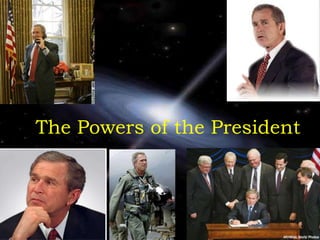
The Powers of the President
First, some background…
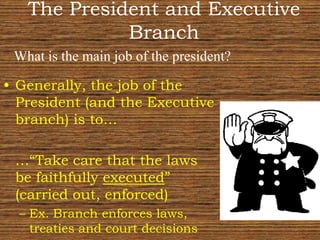
The President and Executive BranchWhat is the main job of the president?Generally, the job of the President (and the Executive branch) is to…	…“Take care that the laws be faithfully executed” (carried out, enforced)Ex. Branch enforces laws, treaties and court decisions
Powers of the PresidentThe president is given several powers in Article II of the Constitution to help him perform these duties.
Presidential Powers can be grouped into 5 categories…Executivepowers Diplomatic powersLegislative powersMilitary powersJudicial powers
Additionally, Presidential powers can be one of two types:“Expressed”:Directly stated in the Constitution“Implied”Not directly stated, but “created” by the president to help him do his job“Uphold Constitution, preserve and defend United States”Based on vague language in Article II…
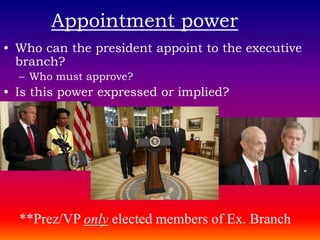
Appointment powerWho can the president appoint to the executive branch?Who must approve?Is this power expressed or implied?**Prez/VP only elected members of Ex. Branch
Executive Orders“Presidential rules that have the force of law”Must be constitutional and agree with current law“Implied” PowerExample: President Bush used an executive order to set up a wiretapping program to catch terrorists after September 11th, 2001.
Executive Privilege“Right of the President to withhold information from the courts, Congress or the public”Most often used when secrecy is needed (wartime, national security, etc.)“Implied”power that has been limited by judicial review**One well-known example deals with President Nixon
Treaties/Executive agreementsPresidents can negotiate treaties and executiveagreementsOn issues such as peace, disarmament, trade, or  immigrationTreaties = “agreements with other nations that require Senate approval (2/3rds)” (EXPRESSED)Executive agreements = agreement between heads of state (does not require Senate approval) (IMPLIED)**Why would a president use an executive agreement instead of a treaty?
Appointing ambassadors/diplomatsPresidents have the power to appoint those who work in/with foreign nations“Expressed” powerSubject to Senate approval (2/3rds)**Why might the Senate, especially after the elections of 2006, be very picky in who it confirms to these positions?
Recall these pictures…What might they have in common?
Mahmud AbbasPalestinian AuthorityKim Jong-IlNorth KoreaFidel Castro – 	CubaKing Wangchuck – BhutanThe island of TaiwanWhat’s the connection?
Presidential Diplomatic Powers 400The common connection between the leaders/nations of Bhutan, Cuba, North Korea, Taiwan and the Palestinian territories…A: What is these are 5 “nations” whose governments are not currently recognized by the United States?S2C13 Jeopardy Review
RecognitionWhat is recognition**Can be used to express approval or disapproval of a nation’s actions
SanctionsIn addition to refusing to recognize a country’s government, the president may choose to place sanctions on a nation…Sanctions: Rules or actions that restrict trade, finances, or travel with another country as a punishment for its actions…“Implied” power…The new US sanctions against Iran are a good example of the use of this power.
State of the Union AddressWhen does it take place?Who watches the speech?What is the purpose?
State of the Union AddressThis is how the president can have an effect on laws at the beginning of the lawmaking process…He can also have an even larger impact on laws at the end of the process by using…
The “Veto”   (“I object”)The President not only makes suggestions for laws, but also has the (almost) final say in whether a bill passes…All bills which pass Congress end up on his desk…He has 3 options…He can sign it (becomes law), do nothing, or veto it…A veto means the bill is sent back to Congress with the president’s objections.What option does Congress have when a president vetoes their bill?
Military PowersWhat does it mean to be cic?“Directs the armed forces” What does it mean to..?Should we stay in Afgh?
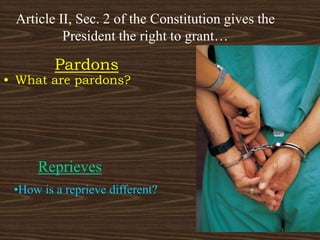
Article II, Sec. 2 of the Constitution gives the President the right to grant…PardonsWhat are pardons?ReprievesHow is a reprieve different?
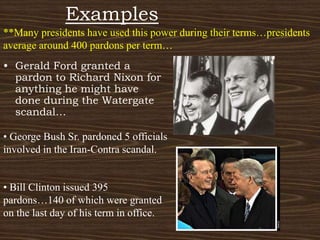
Examples**Many presidents have used this power during their terms…presidents average around 400 pardons per term…Gerald Ford granted a pardon to Richard Nixon for anything he might have done during the Watergate scandal… George Bush Sr. pardoned 5 officials involved in the Iran-Contra scandal. Bill Clinton issued 395 pardons…140 of which were granted on the last day of his term in office.
Amnesty“What is amnesty?Should amnesty be given to illegal immigrants?  What about people who owe taxes if they agree to pay?
Review1) What is executive privilege?2) What is the difference between a treaty and an executive agreement?3) When a president accepts or approves another country’s government, it is called…4) What is a veto?5) What are the two parts of the War Powers Act?6) What is the difference between a pardon and a reprieve?
Choose a question and answer it on your FrontPage sheet…Should US soldiers be permitted to use forms of torture against prisoners of war?What is the most important need facing this country this year?Should the US invade Iran if that nation tries to make nuclear weapons, or should we try to deal with them diplomatically?Should there be a law that provides health insurance to all American children under the age of 18?Should the government be able to randomly listen in on your cell conversations or read your email?Should illegal aliens (immigrants) already in this country be allowed a path to become citizens?Should the president be given as much power as possible to fight the war on terrorism?

Presidential Powers Point

  • 1.
    The Powers ofthe President
  • 2.
  • 3.
    The President andExecutive BranchWhat is the main job of the president?Generally, the job of the President (and the Executive branch) is to… …“Take care that the laws be faithfully executed” (carried out, enforced)Ex. Branch enforces laws, treaties and court decisions
  • 4.
    Powers of thePresidentThe president is given several powers in Article II of the Constitution to help him perform these duties.
  • 5.
    Presidential Powers canbe grouped into 5 categories…Executivepowers Diplomatic powersLegislative powersMilitary powersJudicial powers
  • 6.
    Additionally, Presidential powerscan be one of two types:“Expressed”:Directly stated in the Constitution“Implied”Not directly stated, but “created” by the president to help him do his job“Uphold Constitution, preserve and defend United States”Based on vague language in Article II…
  • 7.
    Appointment powerWho canthe president appoint to the executive branch?Who must approve?Is this power expressed or implied?**Prez/VP only elected members of Ex. Branch
  • 8.
    Executive Orders“Presidential rulesthat have the force of law”Must be constitutional and agree with current law“Implied” PowerExample: President Bush used an executive order to set up a wiretapping program to catch terrorists after September 11th, 2001.
  • 9.
    Executive Privilege“Right ofthe President to withhold information from the courts, Congress or the public”Most often used when secrecy is needed (wartime, national security, etc.)“Implied”power that has been limited by judicial review**One well-known example deals with President Nixon
  • 10.
    Treaties/Executive agreementsPresidents cannegotiate treaties and executiveagreementsOn issues such as peace, disarmament, trade, or immigrationTreaties = “agreements with other nations that require Senate approval (2/3rds)” (EXPRESSED)Executive agreements = agreement between heads of state (does not require Senate approval) (IMPLIED)**Why would a president use an executive agreement instead of a treaty?
  • 11.
    Appointing ambassadors/diplomatsPresidents havethe power to appoint those who work in/with foreign nations“Expressed” powerSubject to Senate approval (2/3rds)**Why might the Senate, especially after the elections of 2006, be very picky in who it confirms to these positions?
  • 12.
    Recall these pictures…Whatmight they have in common?
  • 13.
    Mahmud AbbasPalestinian AuthorityKimJong-IlNorth KoreaFidel Castro – CubaKing Wangchuck – BhutanThe island of TaiwanWhat’s the connection?
  • 14.
    Presidential Diplomatic Powers400The common connection between the leaders/nations of Bhutan, Cuba, North Korea, Taiwan and the Palestinian territories…A: What is these are 5 “nations” whose governments are not currently recognized by the United States?S2C13 Jeopardy Review
  • 15.
    RecognitionWhat is recognition**Canbe used to express approval or disapproval of a nation’s actions
  • 16.
    SanctionsIn addition torefusing to recognize a country’s government, the president may choose to place sanctions on a nation…Sanctions: Rules or actions that restrict trade, finances, or travel with another country as a punishment for its actions…“Implied” power…The new US sanctions against Iran are a good example of the use of this power.
  • 17.
    State of theUnion AddressWhen does it take place?Who watches the speech?What is the purpose?
  • 18.
    State of theUnion AddressThis is how the president can have an effect on laws at the beginning of the lawmaking process…He can also have an even larger impact on laws at the end of the process by using…
  • 19.
    The “Veto” (“I object”)The President not only makes suggestions for laws, but also has the (almost) final say in whether a bill passes…All bills which pass Congress end up on his desk…He has 3 options…He can sign it (becomes law), do nothing, or veto it…A veto means the bill is sent back to Congress with the president’s objections.What option does Congress have when a president vetoes their bill?
  • 20.
    Military PowersWhat doesit mean to be cic?“Directs the armed forces” What does it mean to..?Should we stay in Afgh?
  • 21.
    Article II, Sec.2 of the Constitution gives the President the right to grant…PardonsWhat are pardons?ReprievesHow is a reprieve different?
  • 22.
    Examples**Many presidents haveused this power during their terms…presidents average around 400 pardons per term…Gerald Ford granted a pardon to Richard Nixon for anything he might have done during the Watergate scandal… George Bush Sr. pardoned 5 officials involved in the Iran-Contra scandal. Bill Clinton issued 395 pardons…140 of which were granted on the last day of his term in office.
  • 23.
    Amnesty“What is amnesty?Shouldamnesty be given to illegal immigrants? What about people who owe taxes if they agree to pay?
  • 24.
    Review1) What isexecutive privilege?2) What is the difference between a treaty and an executive agreement?3) When a president accepts or approves another country’s government, it is called…4) What is a veto?5) What are the two parts of the War Powers Act?6) What is the difference between a pardon and a reprieve?
  • 25.
    Choose a questionand answer it on your FrontPage sheet…Should US soldiers be permitted to use forms of torture against prisoners of war?What is the most important need facing this country this year?Should the US invade Iran if that nation tries to make nuclear weapons, or should we try to deal with them diplomatically?Should there be a law that provides health insurance to all American children under the age of 18?Should the government be able to randomly listen in on your cell conversations or read your email?Should illegal aliens (immigrants) already in this country be allowed a path to become citizens?Should the president be given as much power as possible to fight the war on terrorism?