Bellwork -State Changes
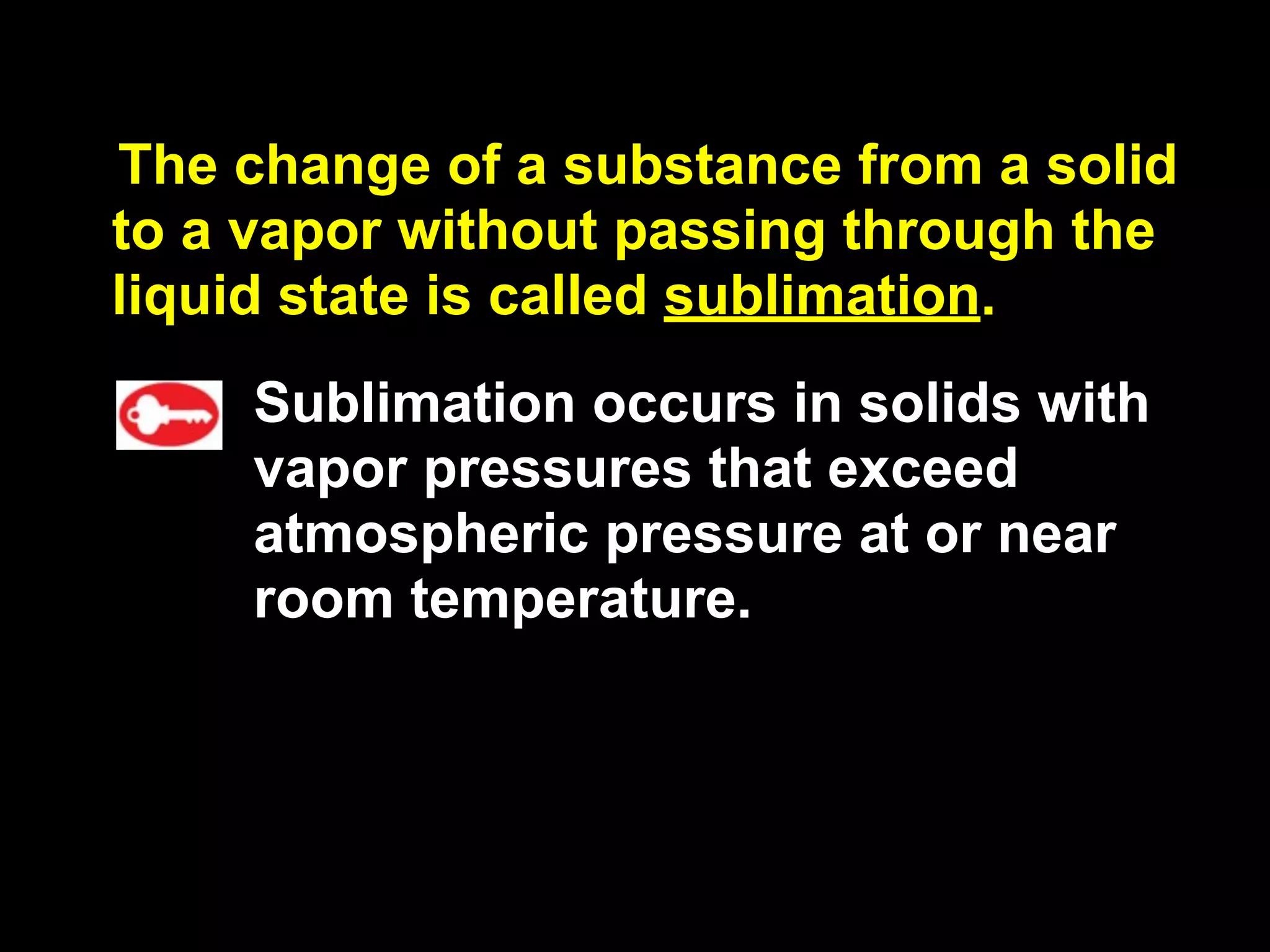
Water exists on Earth as a liquid, a solid, and a vapor.
As water cycles through the atmosphere, the oceans,
and Earth’s crust, it undergoes repeated changes of
state. You will learn what conditions can control the
state of a substance.


BELLWORK-name the
following phase changes:
a)Solid to liquid b) liquid to solid
c)Liquid to gas   d) gas to liquid
e) Solid to gas
Melting - solid to liquid
Freezing- liquid to solid
Vaporization- liquid to gas
Vapor- a gas that is usually a liquid at room temp
Condensation- changing from a gas to a liquid
Chapter 13- States of Matter
         Intro to Gases

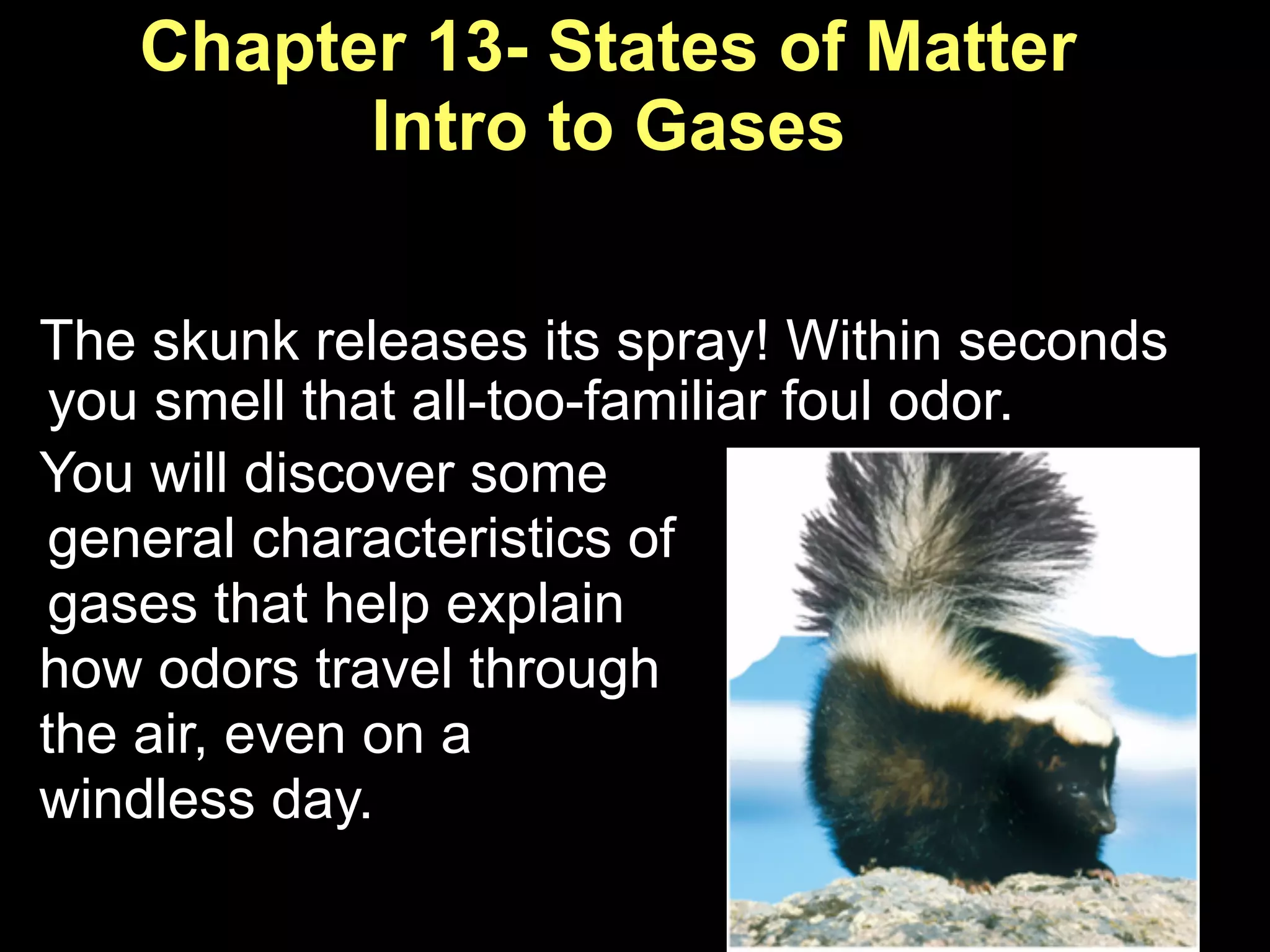
The skunk releases its spray! Within seconds
 you smell that all-too-familiar foul odor.
You will discover some
 general characteristics of
 gases that help explain
how odors travel through
the air, even on a
windless day.
13.1
The Kinetic Molecular Theory explains
       the behavior of gases.
The word kinetic refers to motion.

•The energy an object has
  because of its motion is called
  kinetic energy.
The word kinetic refers to motion.

•The energy an object has
  because of its motion is called
  kinetic energy.
• According to the
  kinetic theory,
  all matter consists
  of tiny particles that
  are in constant
  motion.
Kinetic Molecular Theory: GASES
• The particles in a gas are small,
 hard spheres with an
 insignificant volume.
Kinetic Molecular Theory: GASES
• The particles in a gas are small,
 hard spheres with an
 insignificant volume.
• The motion of gas particles is
 rapid, constant, and random.
Kinetic Molecular Theory: GASES
• The particles in a gas are small,
 hard spheres with an
 insignificant volume.
• The motion of gas particles is
 rapid, constant, and random.
• All collisions between gas
 particles are perfectly elastic
 (no energy lost).
13.1


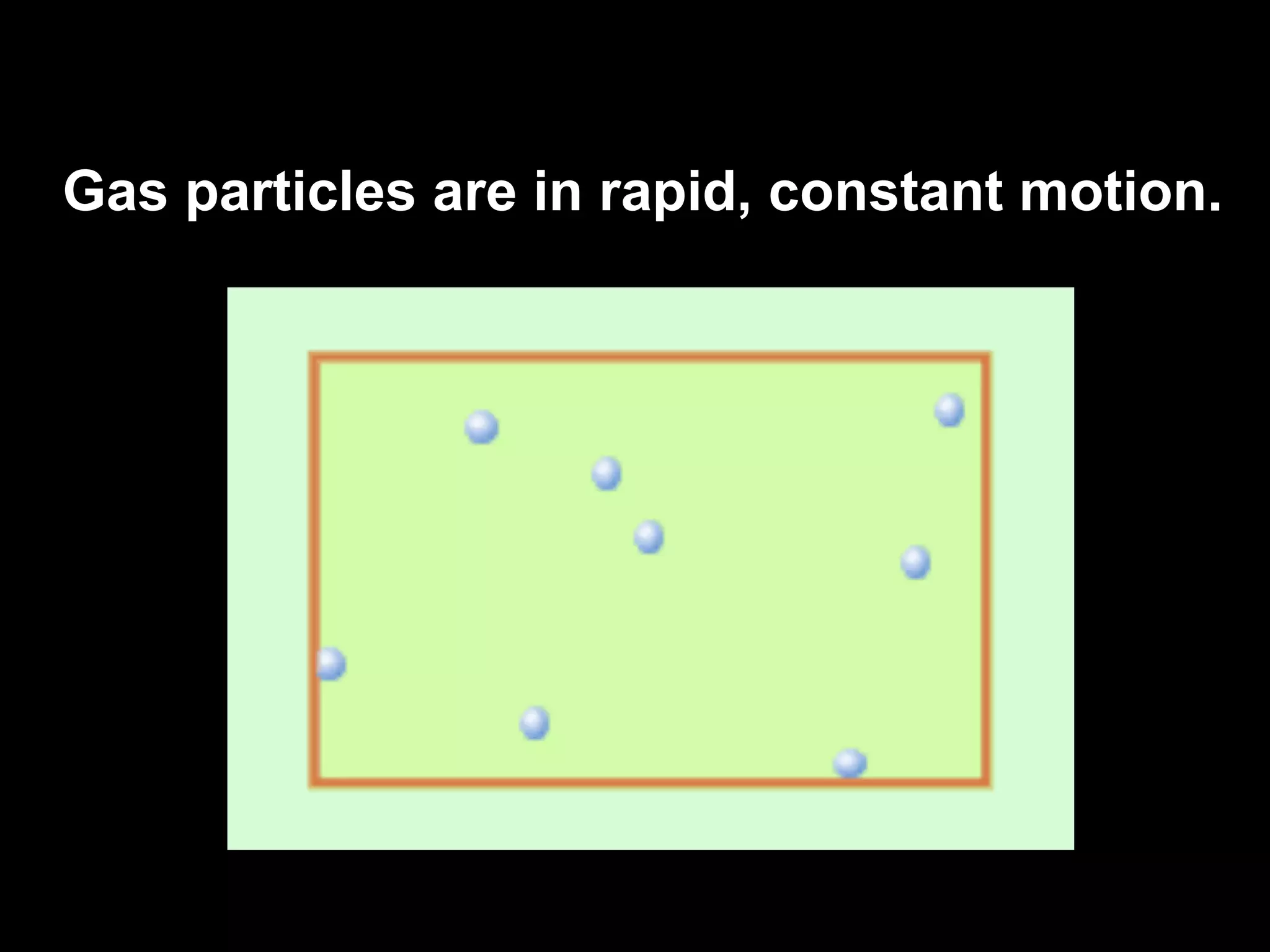
Gas particles are in rapid, constant motion.
13.1
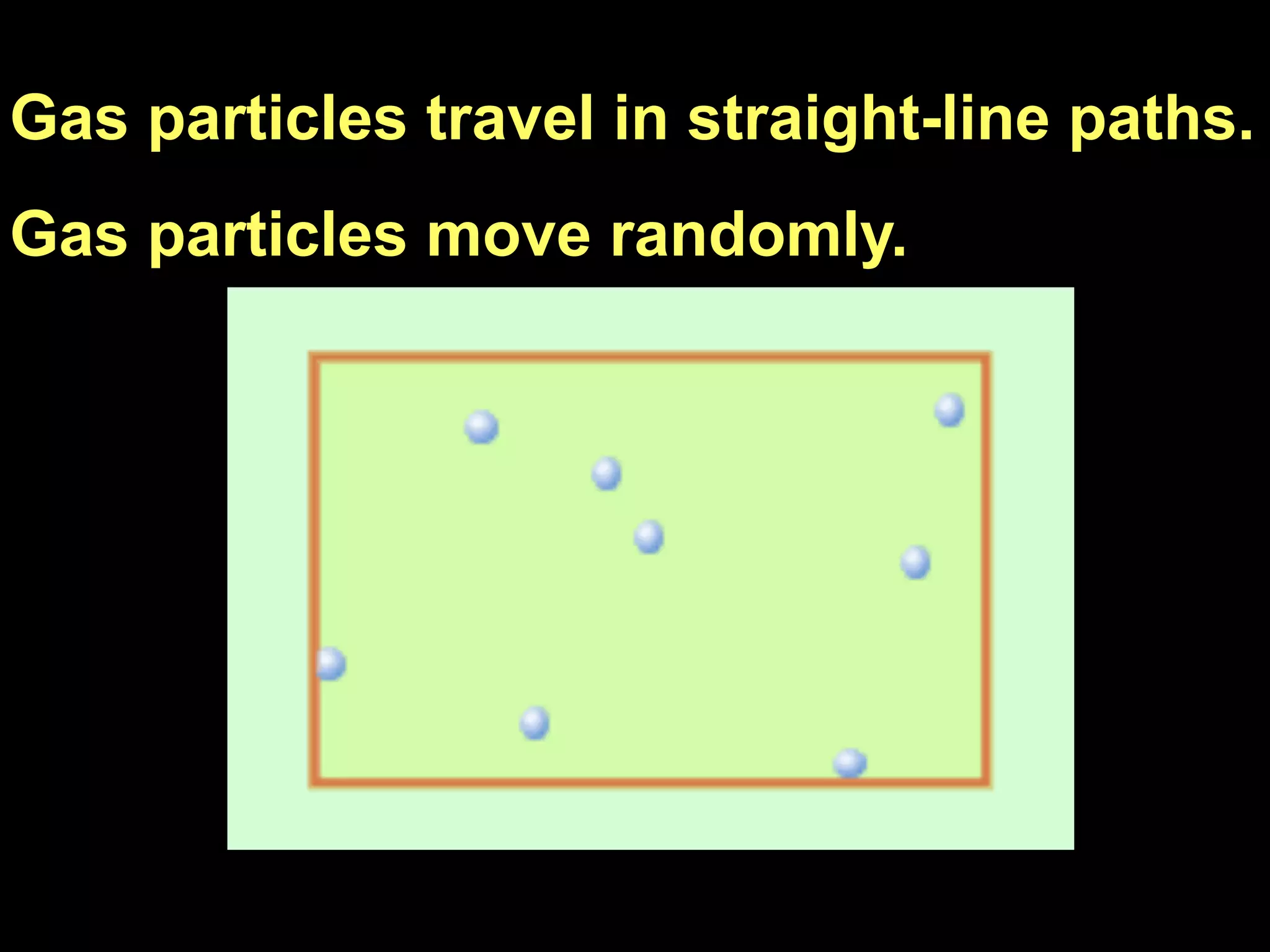
Gas particles travel in straight-line paths.
Gas particles move randomly.
13.1


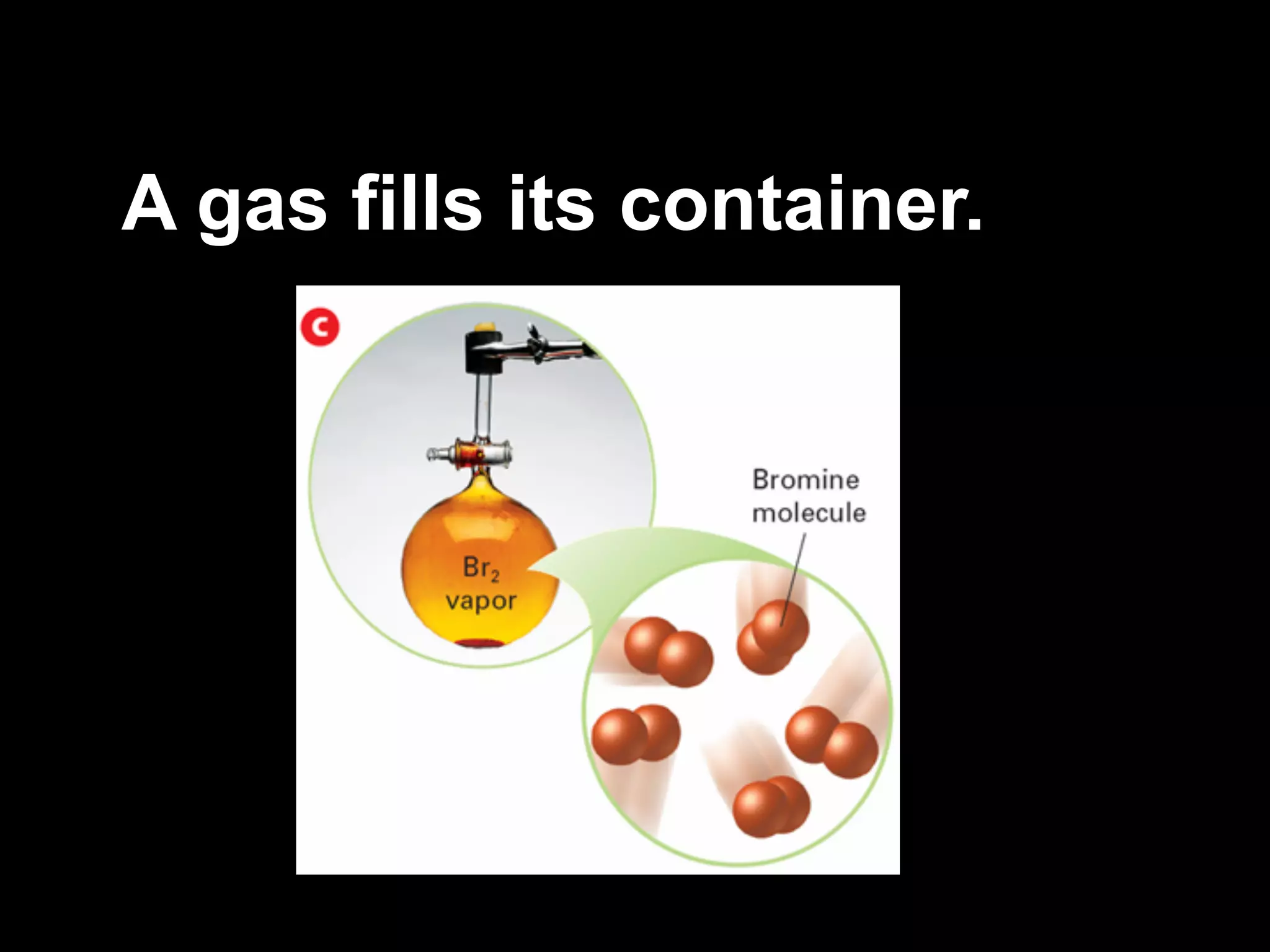
A gas fills its container.
13.1
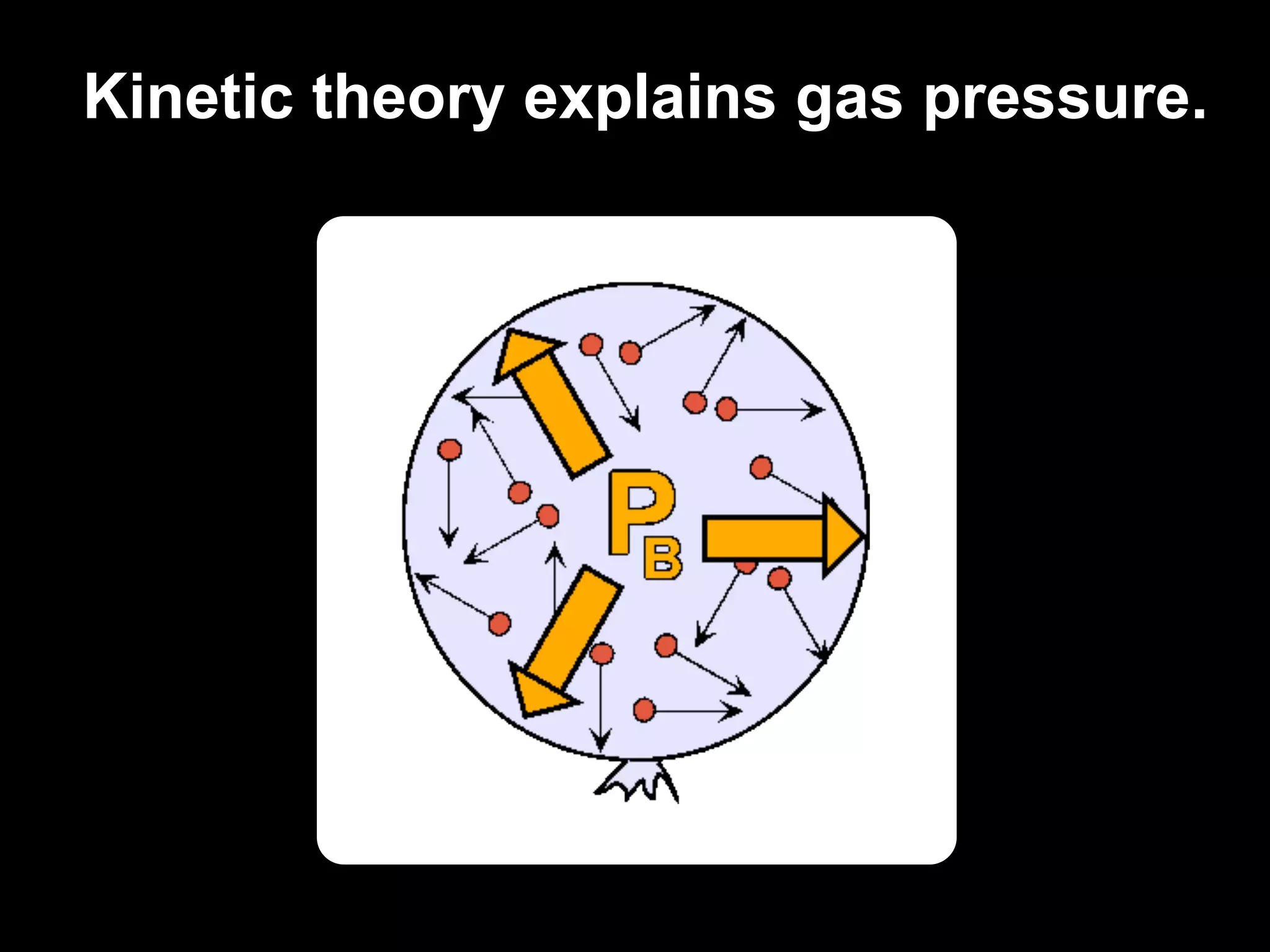
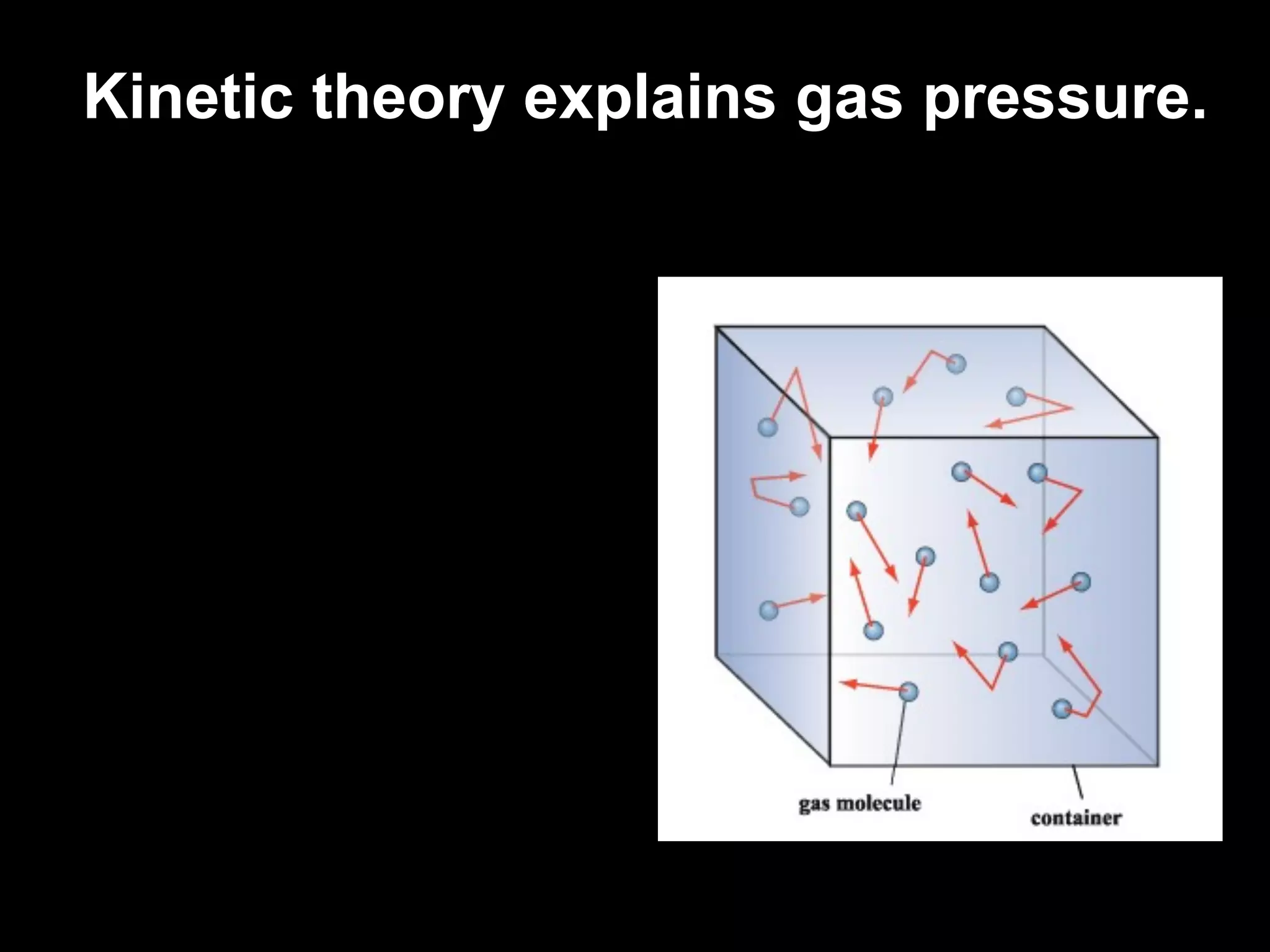
Kinetic theory explains gas pressure.
13.1
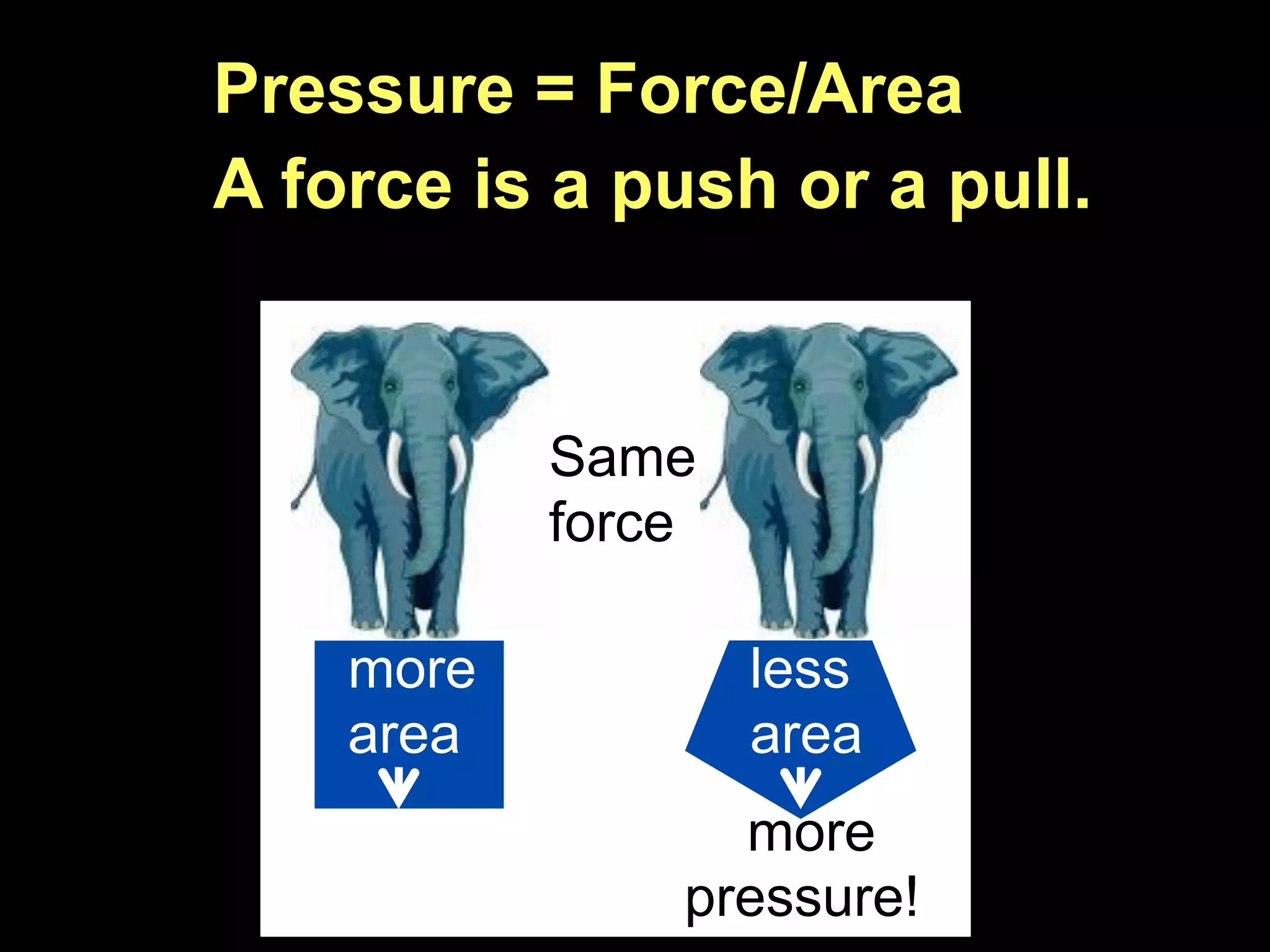
       Pressure = Force/Area
       A force is a push or a pull.


                  Same
                  force

           more           less
           area           area
                        more
                      pressure!
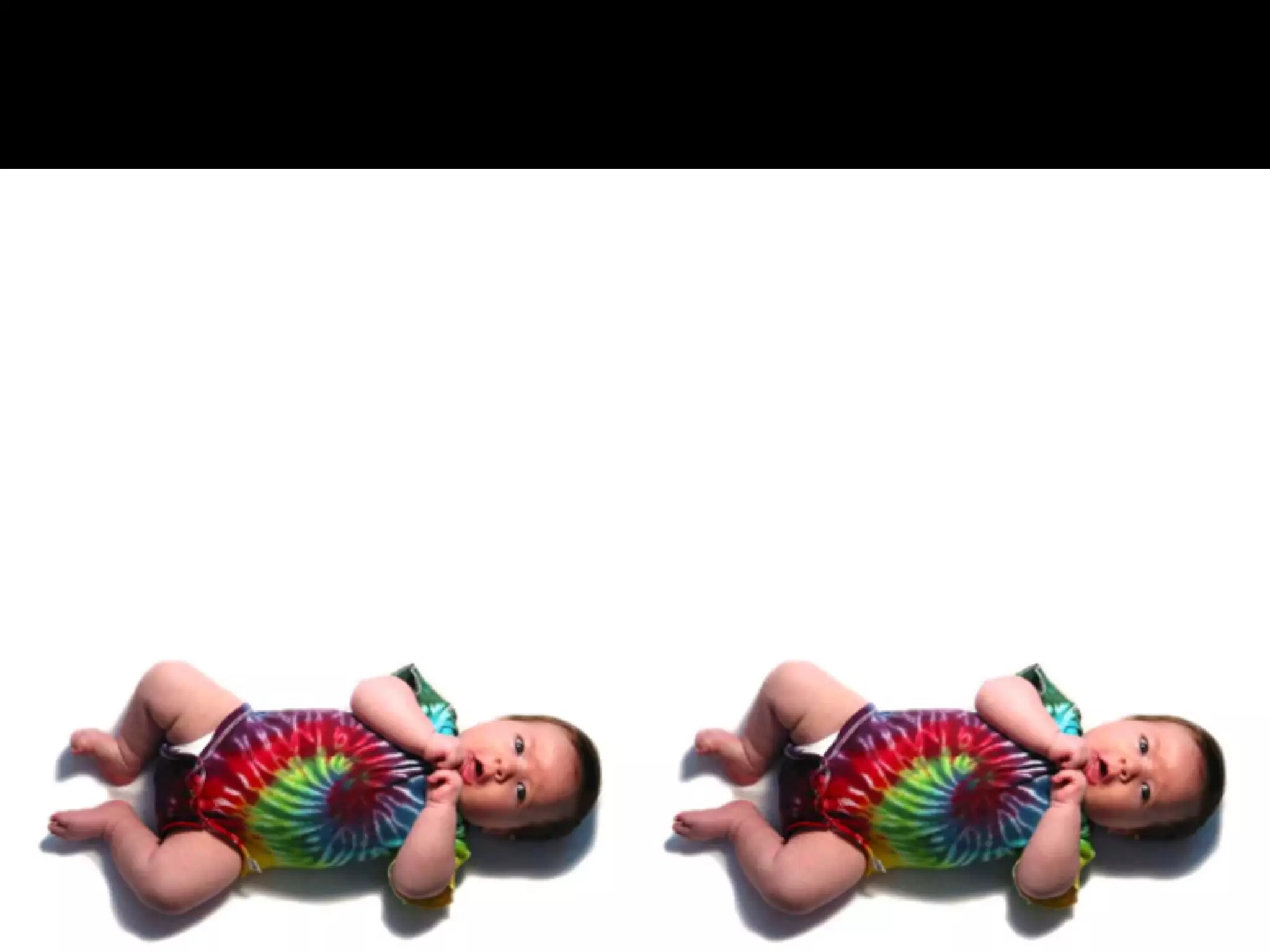
Which would you prefer? Why?
13.1
Kinetic theory explains gas pressure.
13.1
Kinetic theory explains gas pressure.


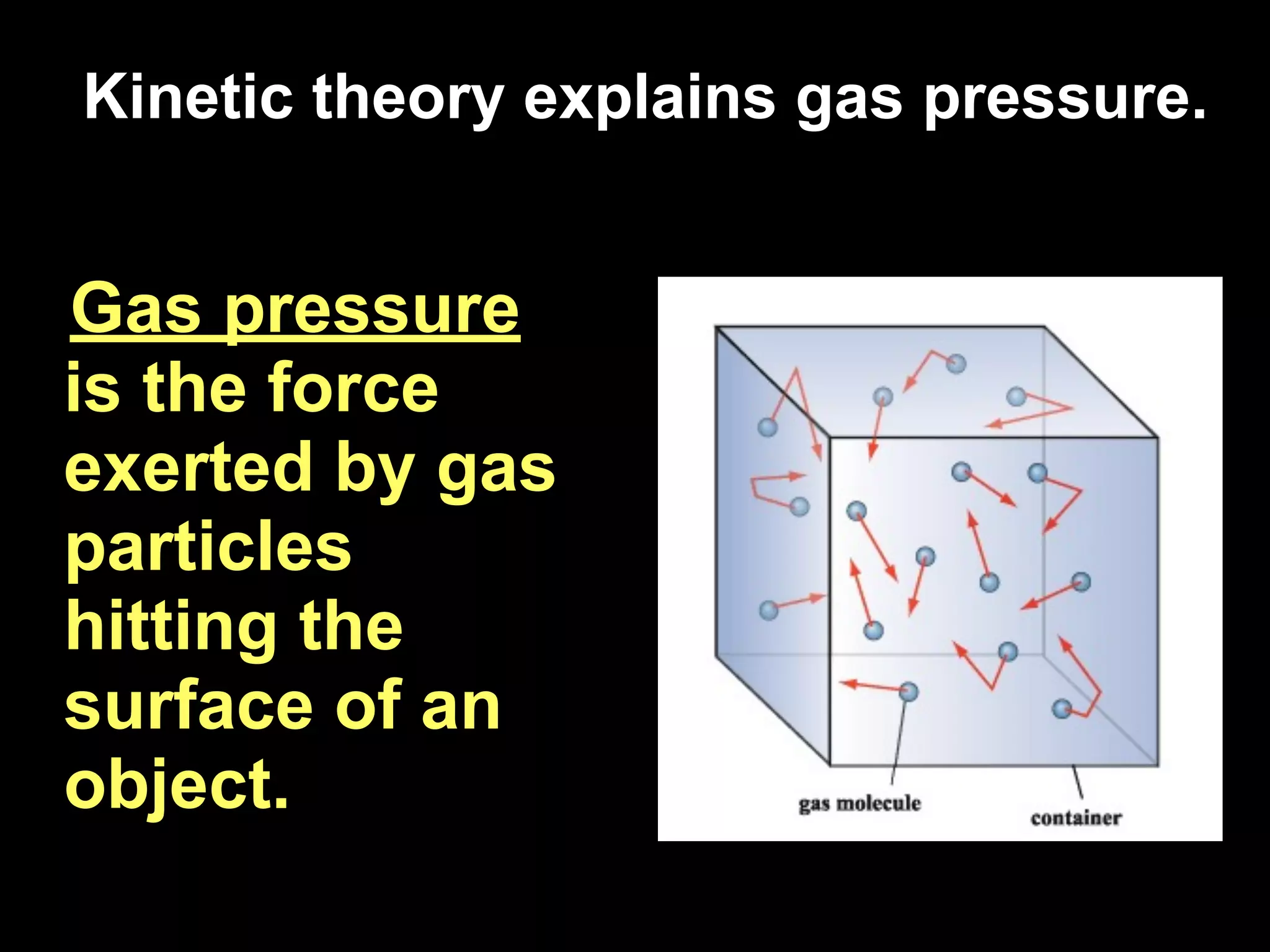
Gas pressure
is the force
exerted by gas
particles
hitting the
surface of an
object.
13.1
 Kinetic theory explains gas pressure.


Gas pressure can KILL!
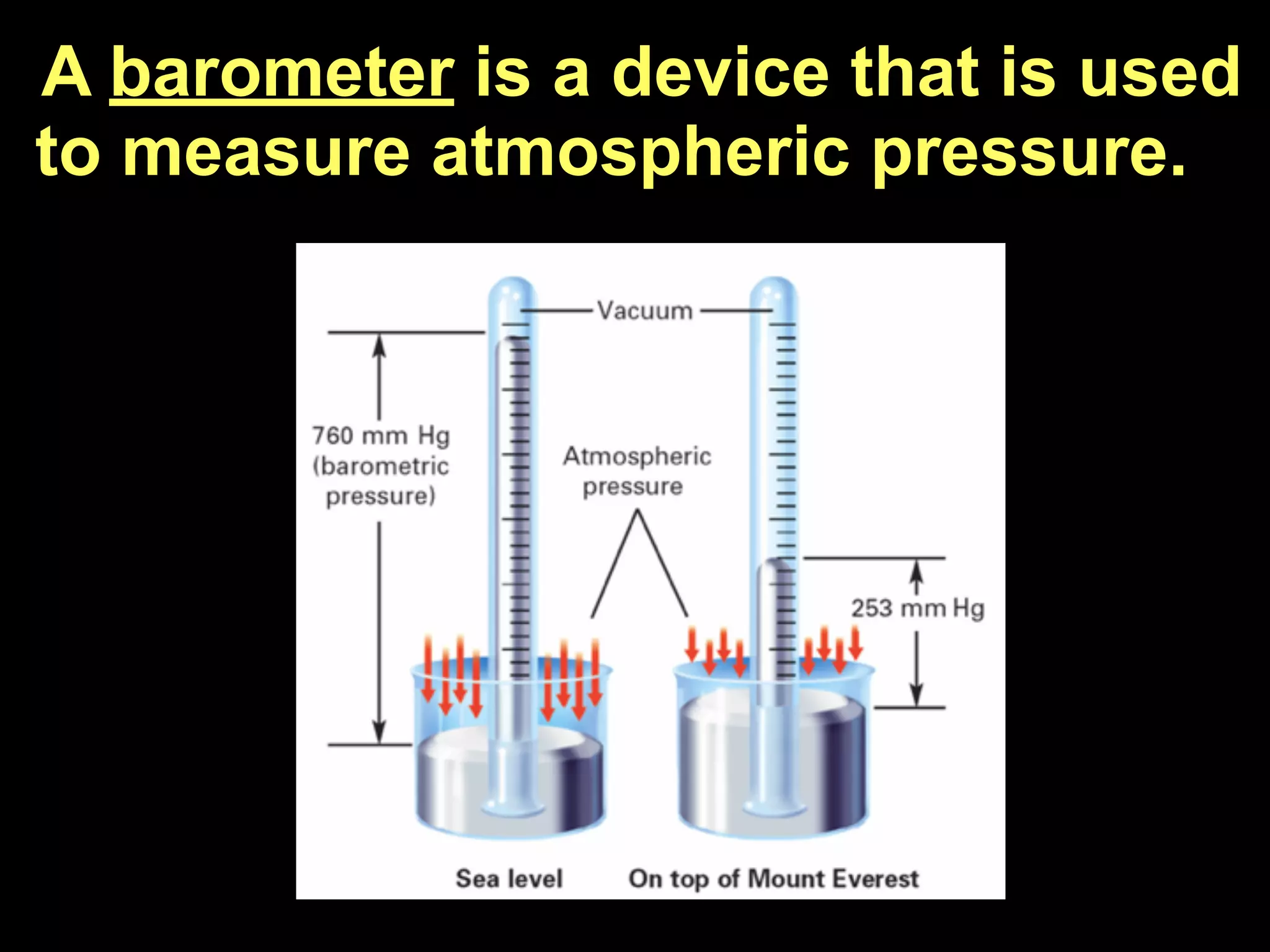
An empty space with no particles
and no pressure is called a vacuum.
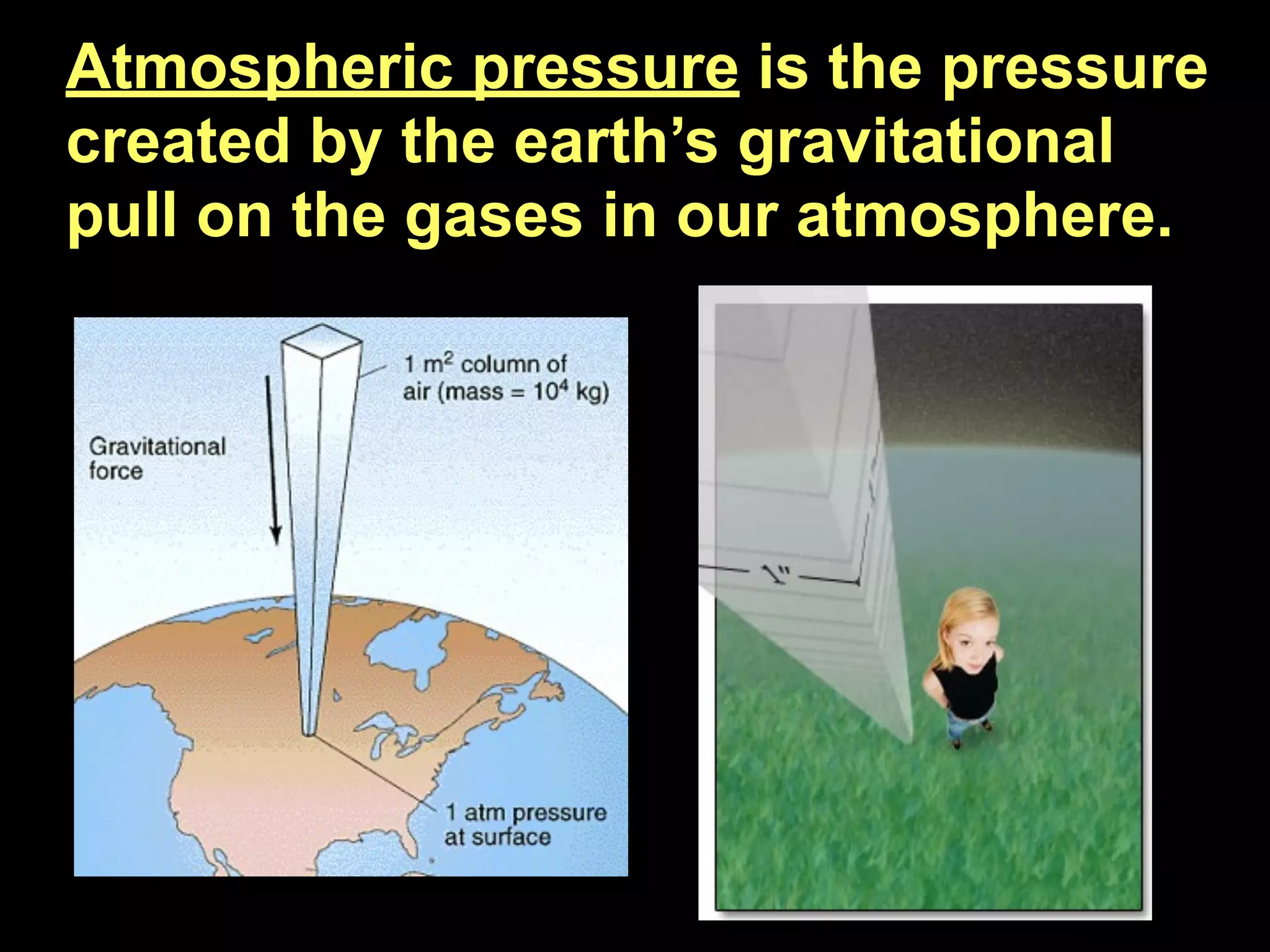
Atmospheric pressure is the pressure
created by the earth’s gravitational
pull on the gases in our atmosphere.
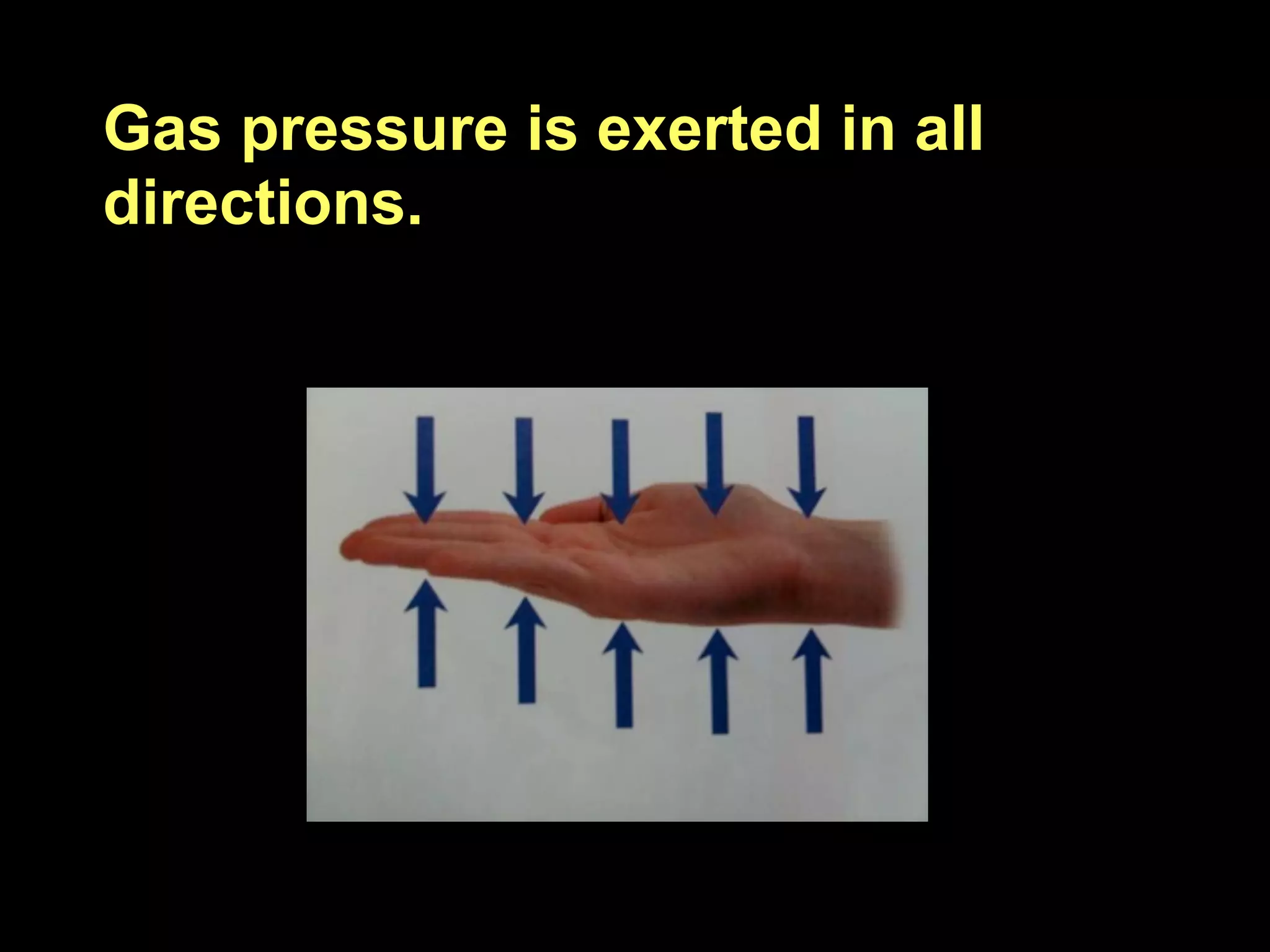
Gas pressure is exerted in all
directions.
A barometer is a device that is used
to measure atmospheric pressure.
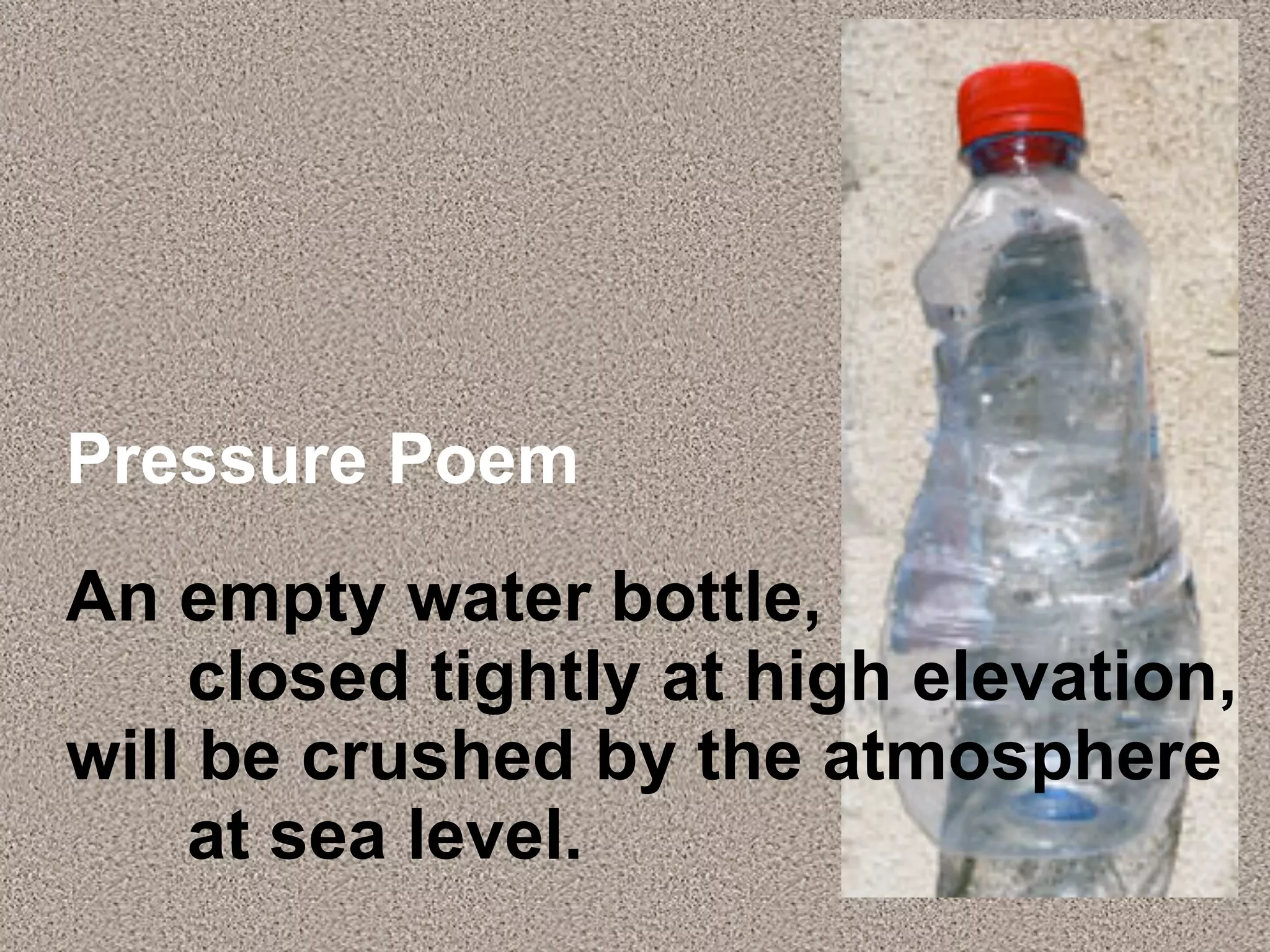
Pressure Poem
An empty water bottle,
    closed tightly at high elevation,
will be crushed by the atmosphere
    at sea level.
13.1

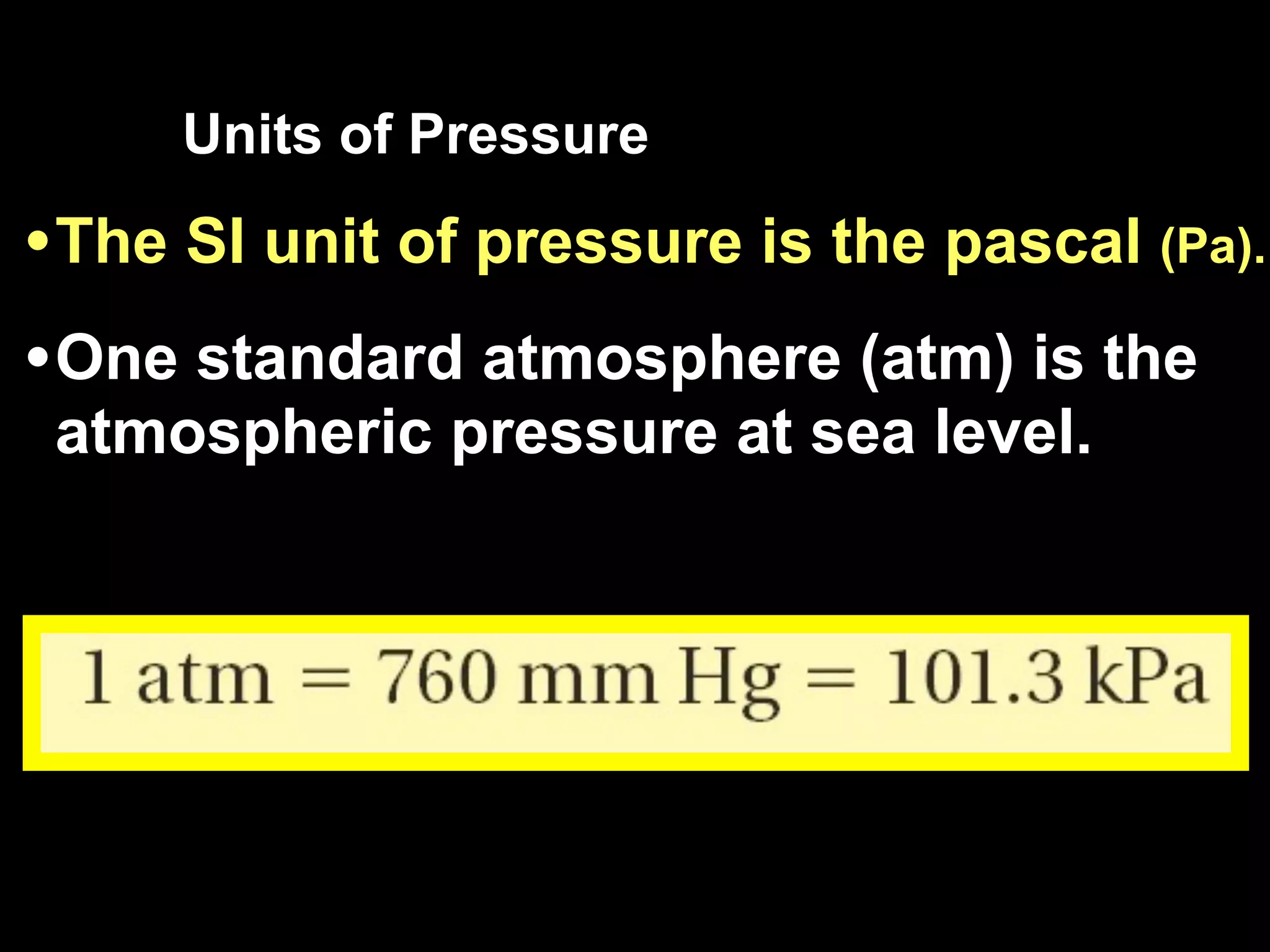
     Units of Pressure

• The SI unit of pressure is the pascal (Pa).
• One standard atmosphere (atm) is the
 atmospheric pressure at sea level.
13.1
13.1


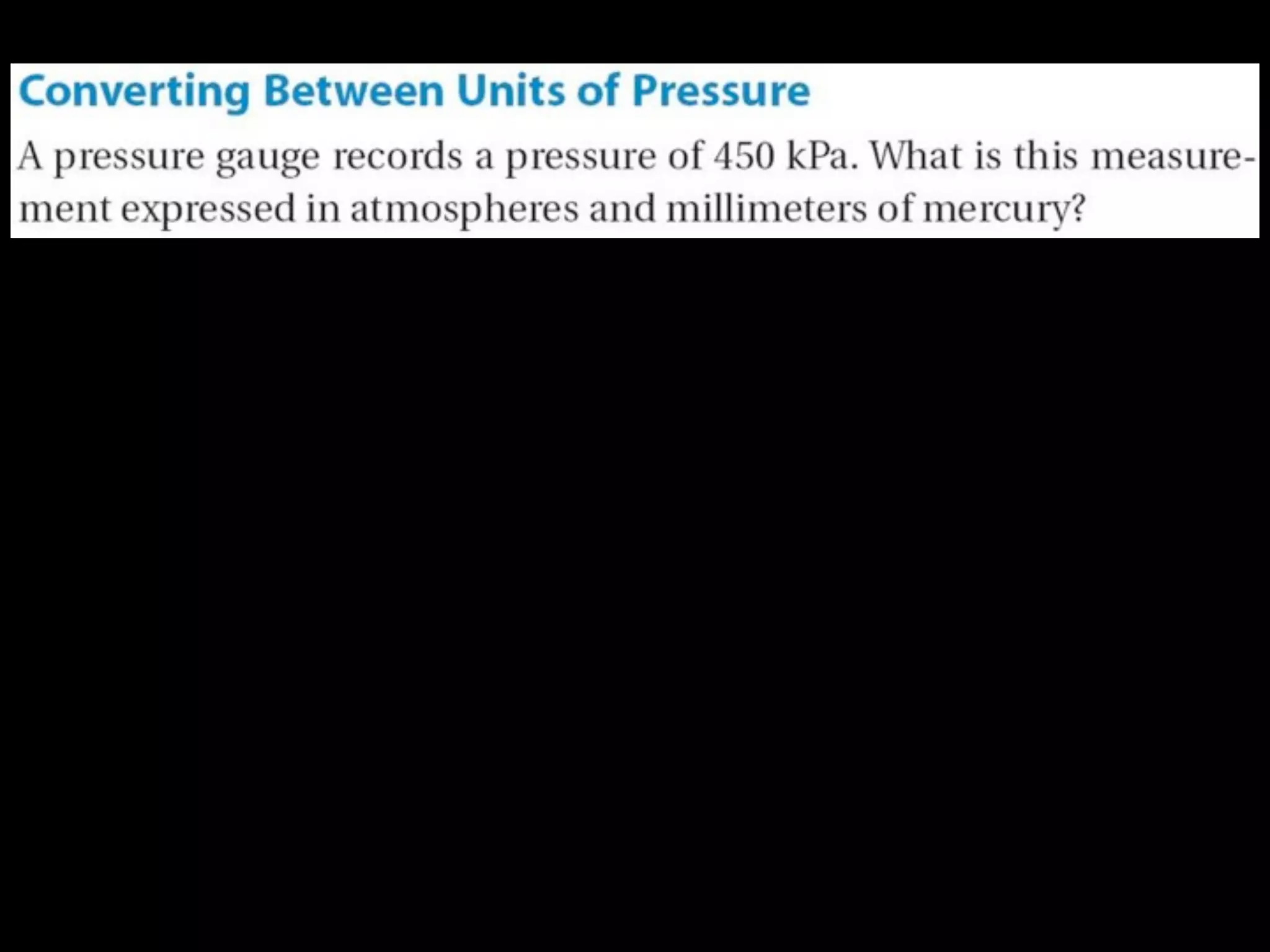
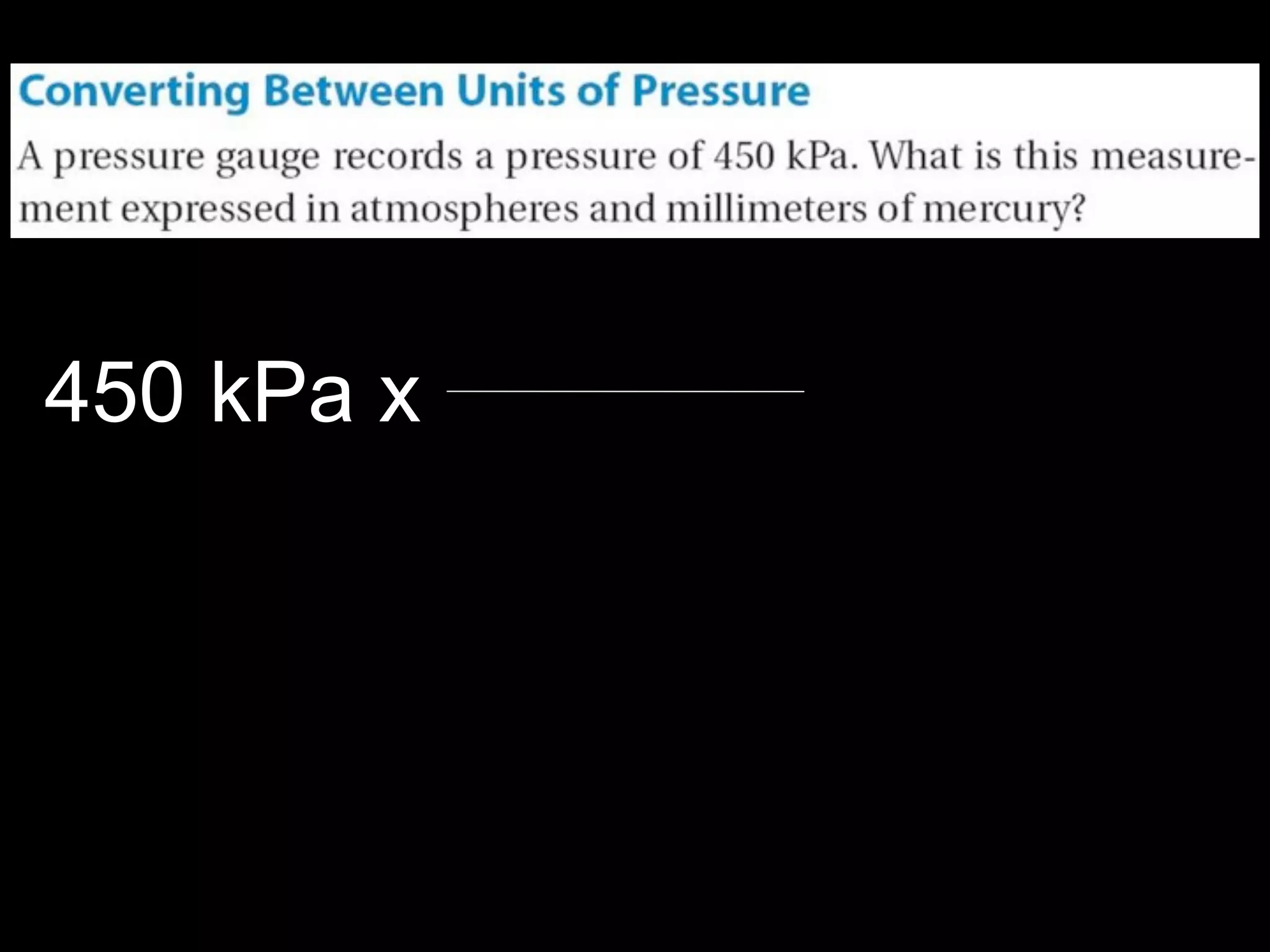
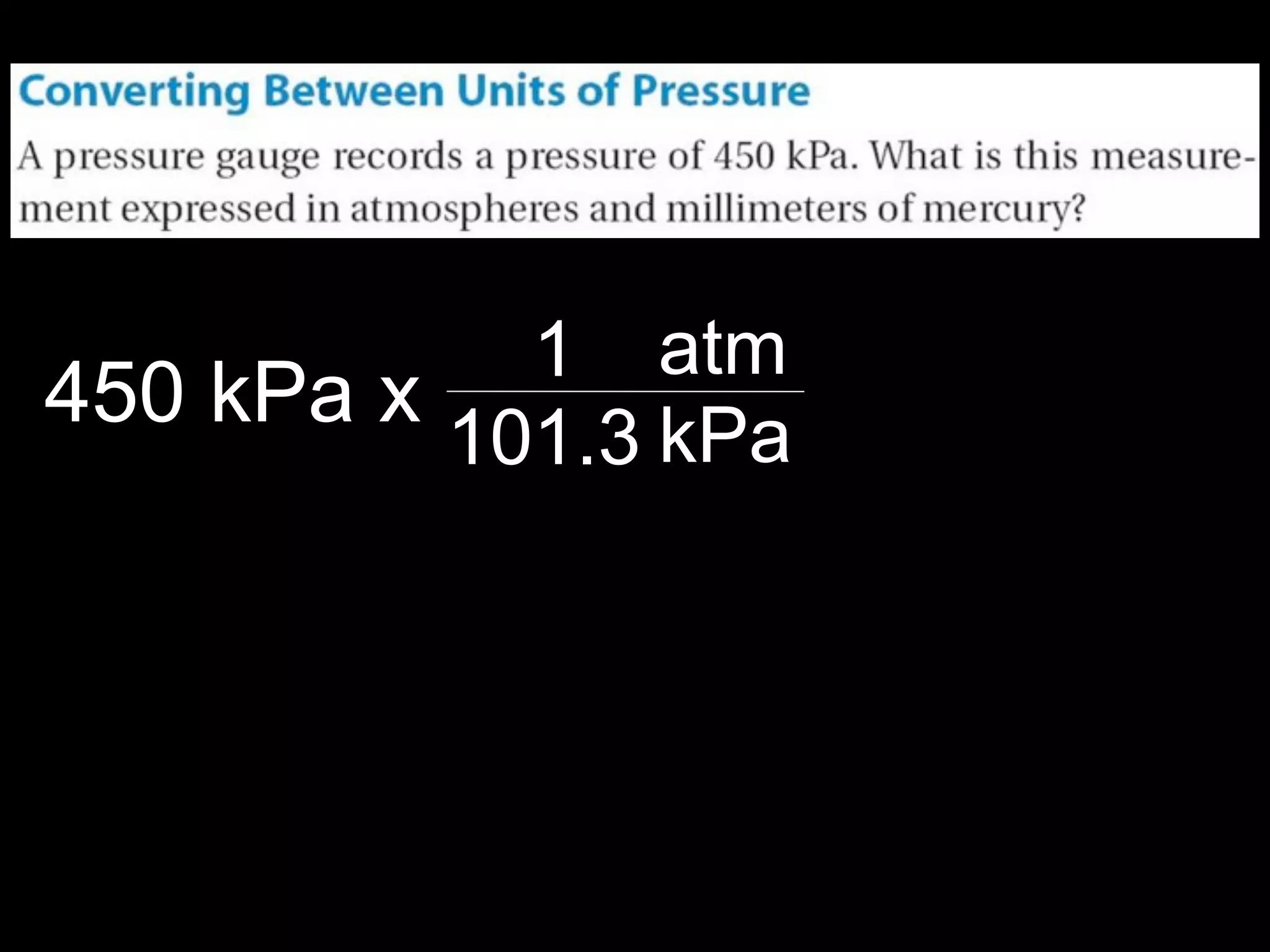
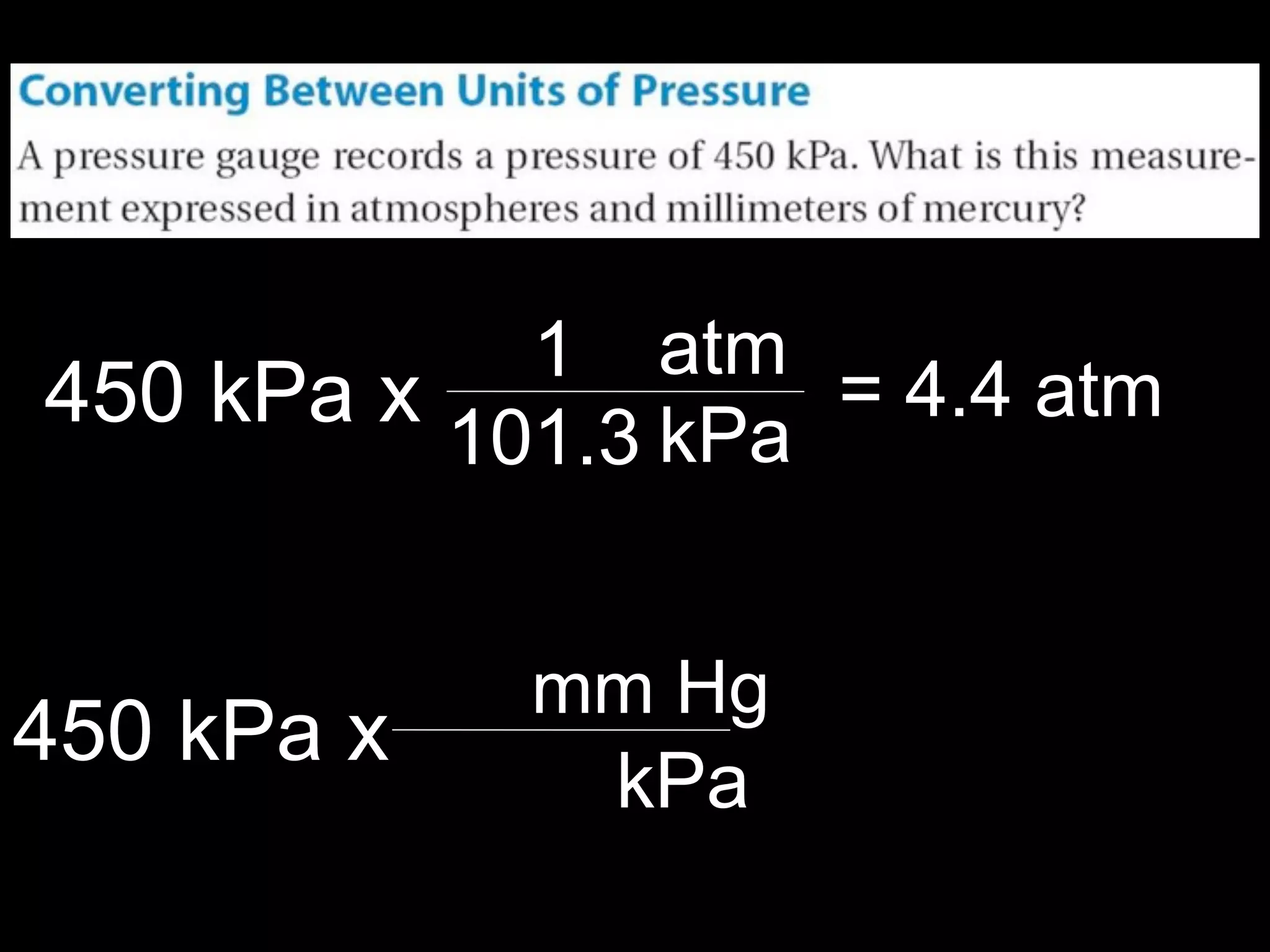
450 kPa x
13.1


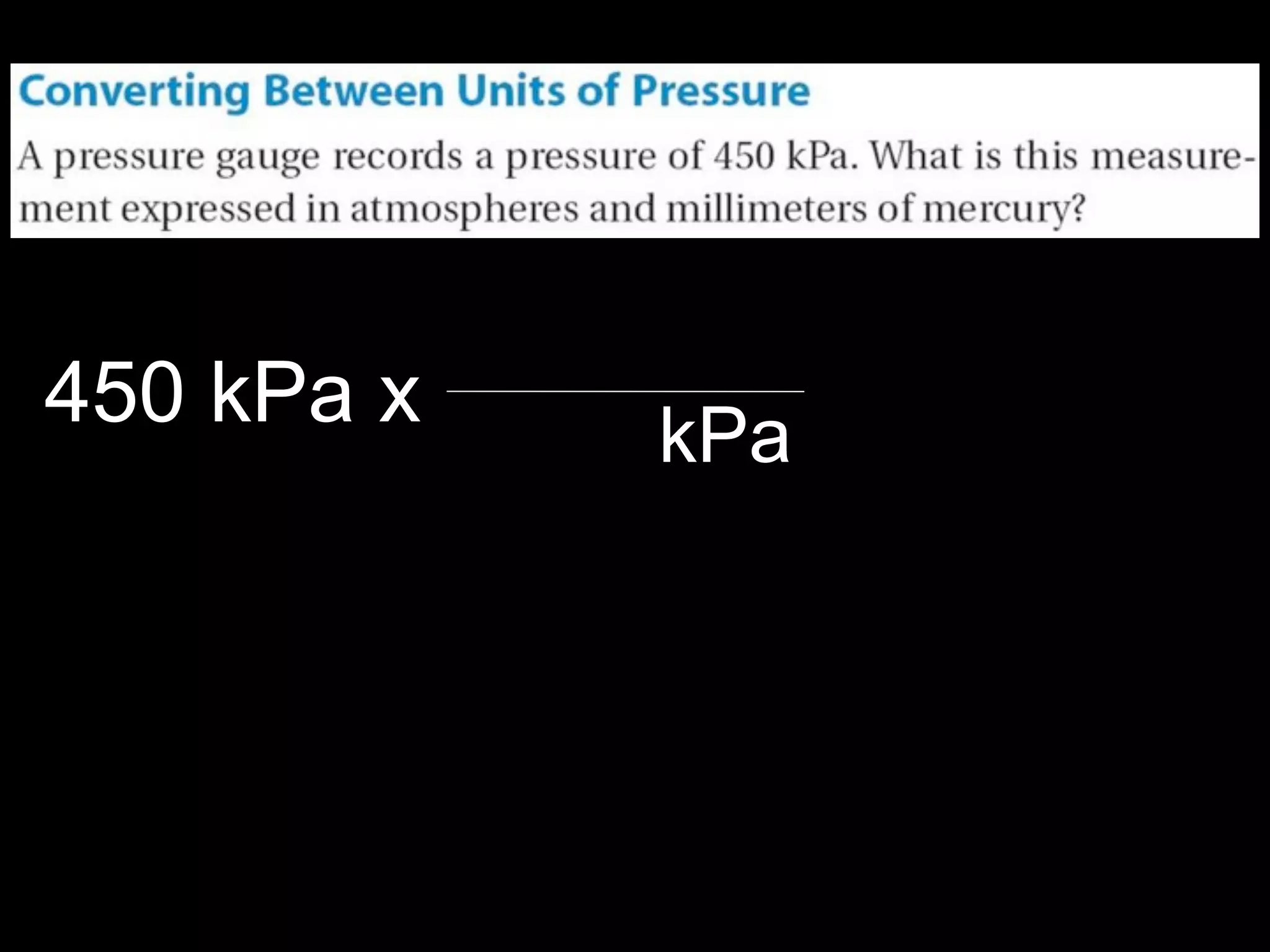
450 kPa x          kPa
13.1


                   atm
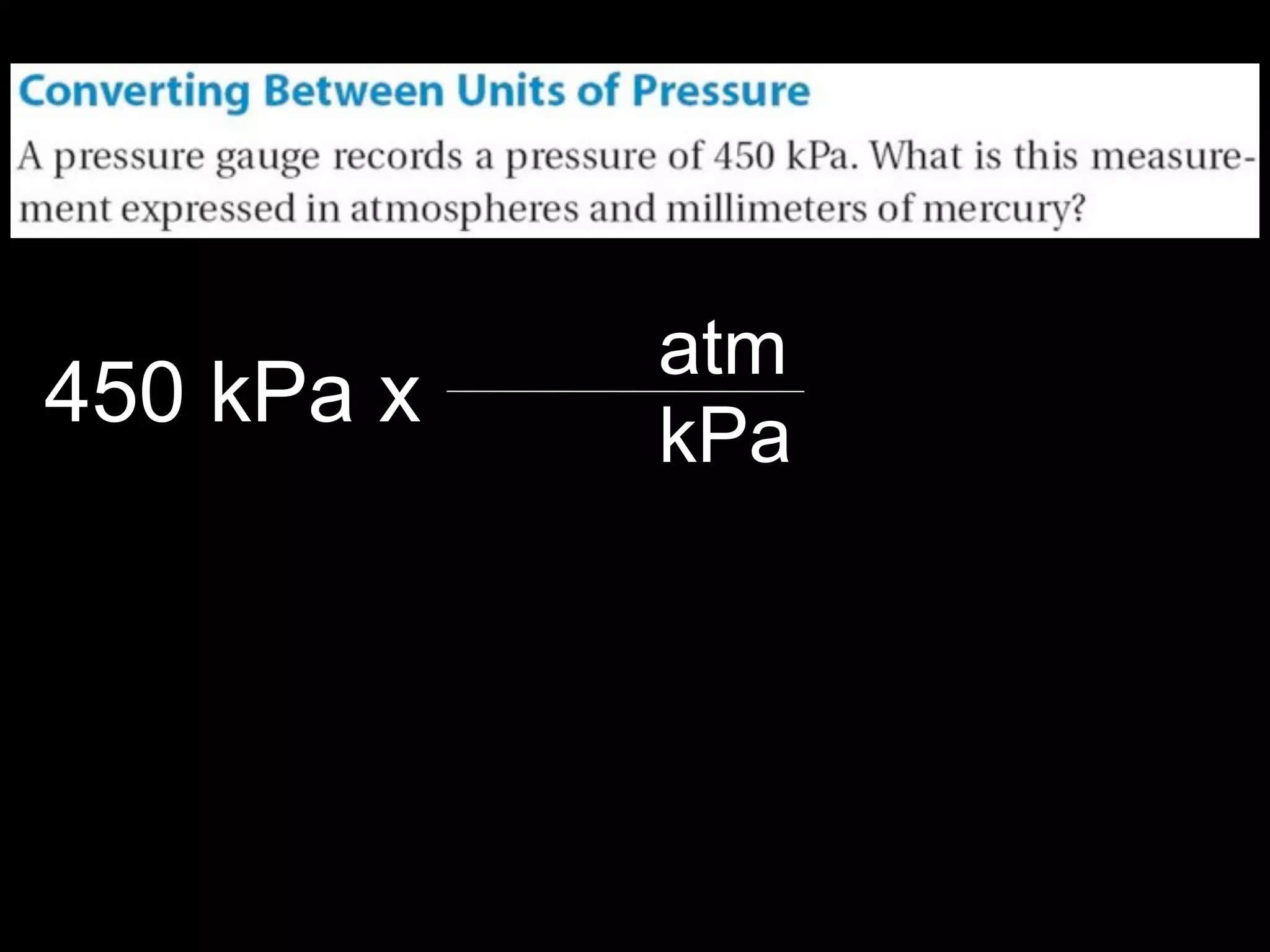
450 kPa x          kPa
13.1


            1 atm
450 kPa x
          101.3 kPa
13.1


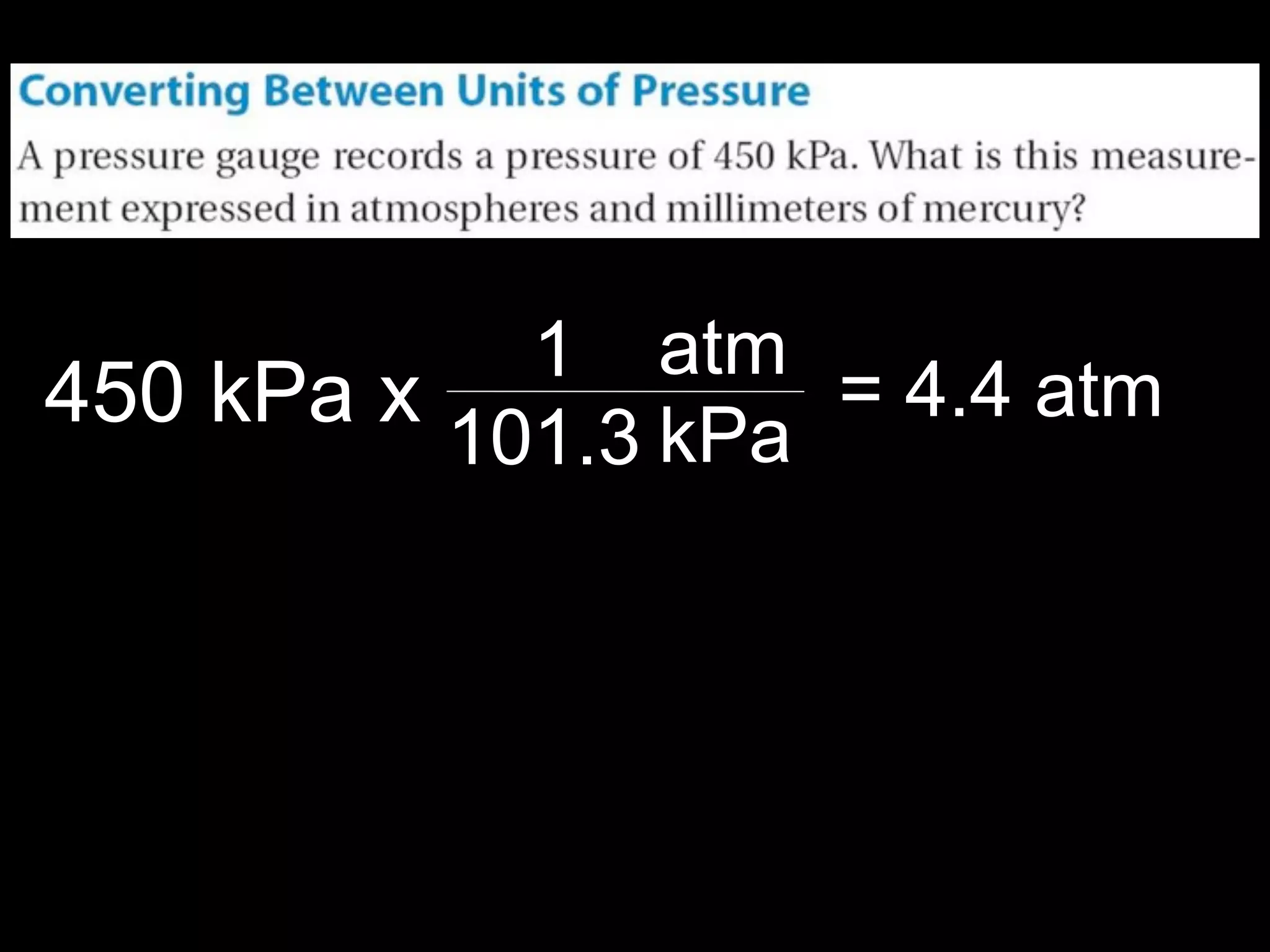
            1 atm
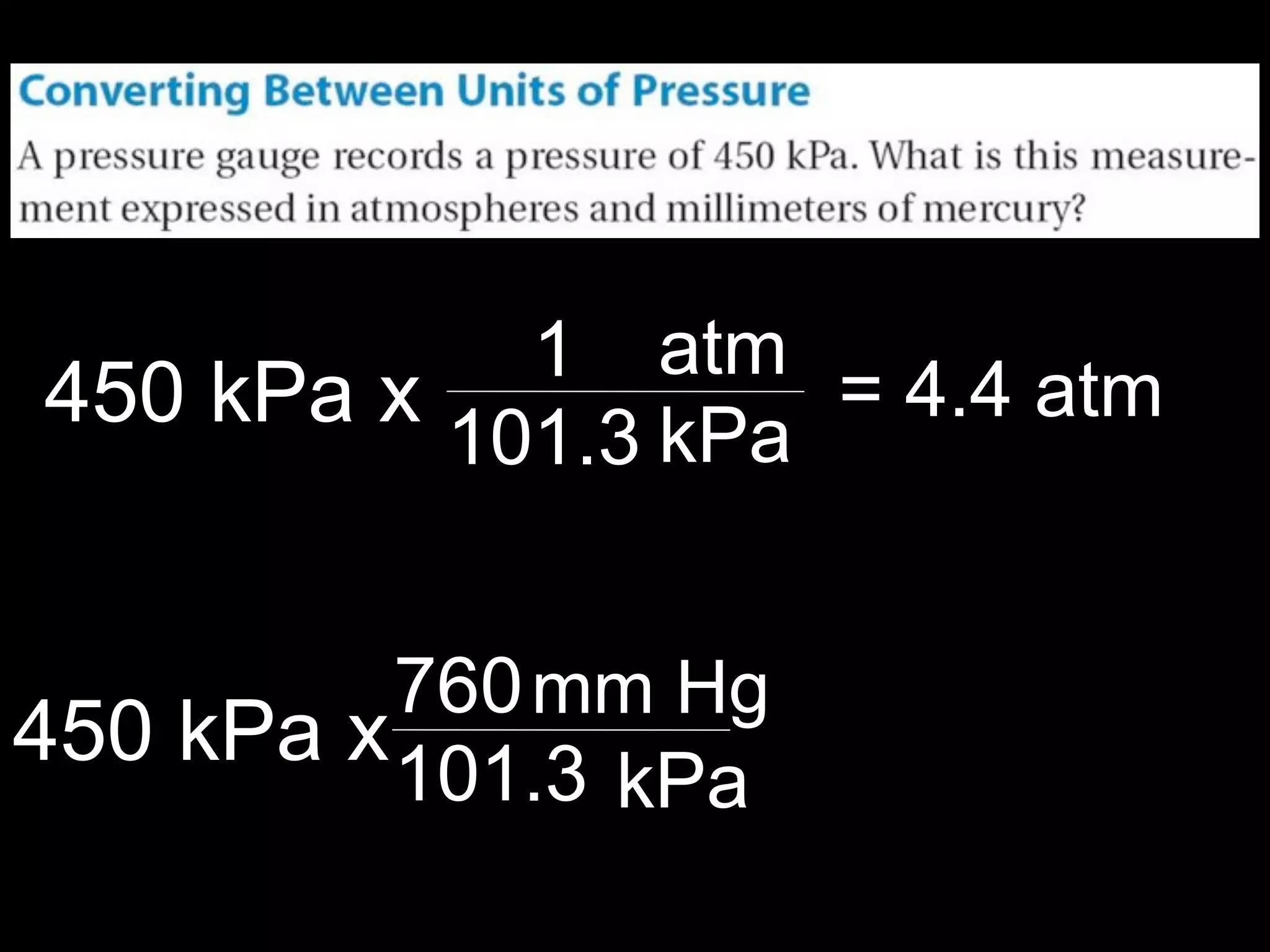
450 kPa x           = 4.4 atm
          101.3 kPa
13.1


            1 atm
450 kPa x           = 4.4 atm
          101.3 kPa


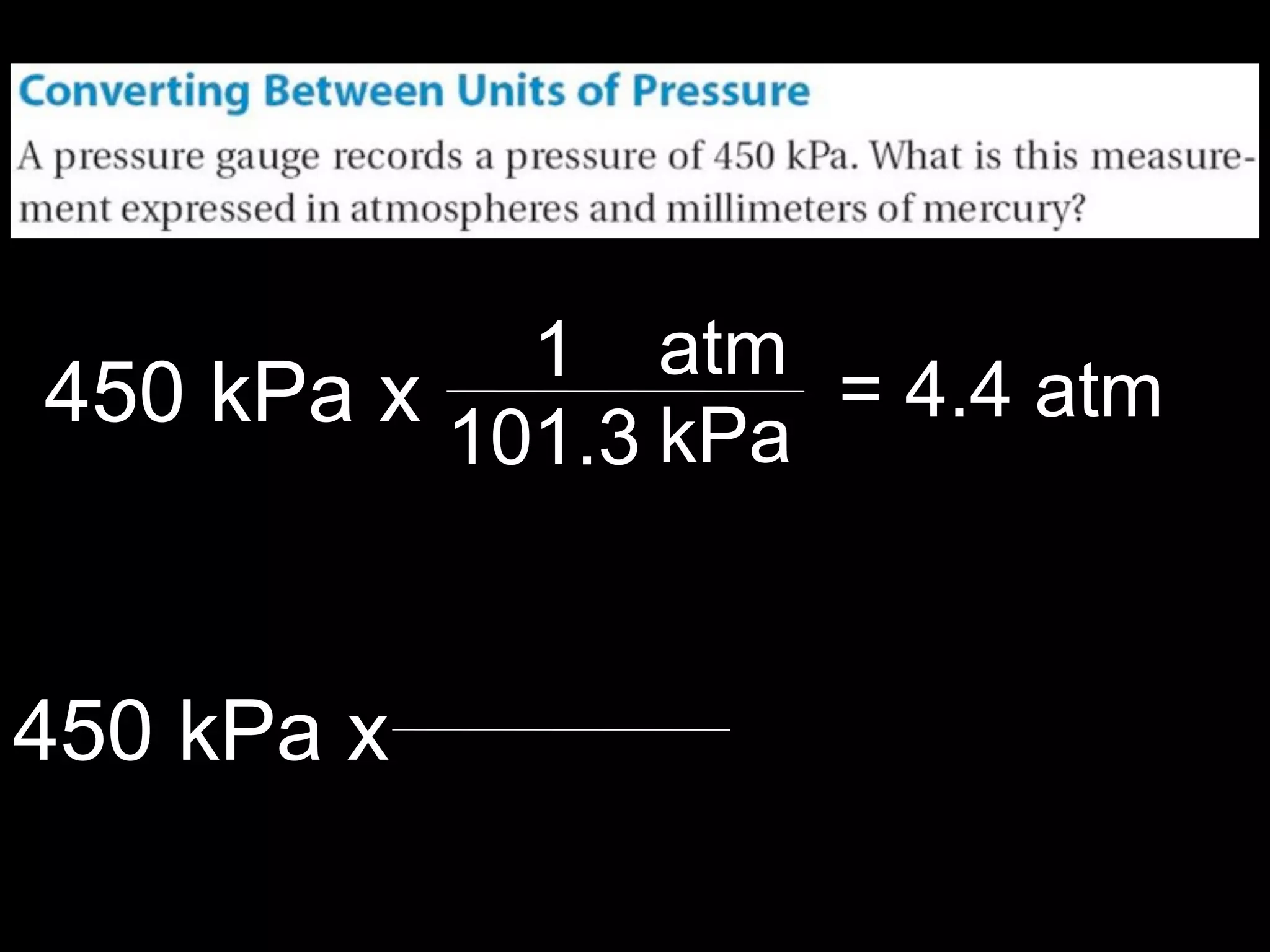
450 kPa x
13.1


            1 atm
450 kPa x           = 4.4 atm
          101.3 kPa


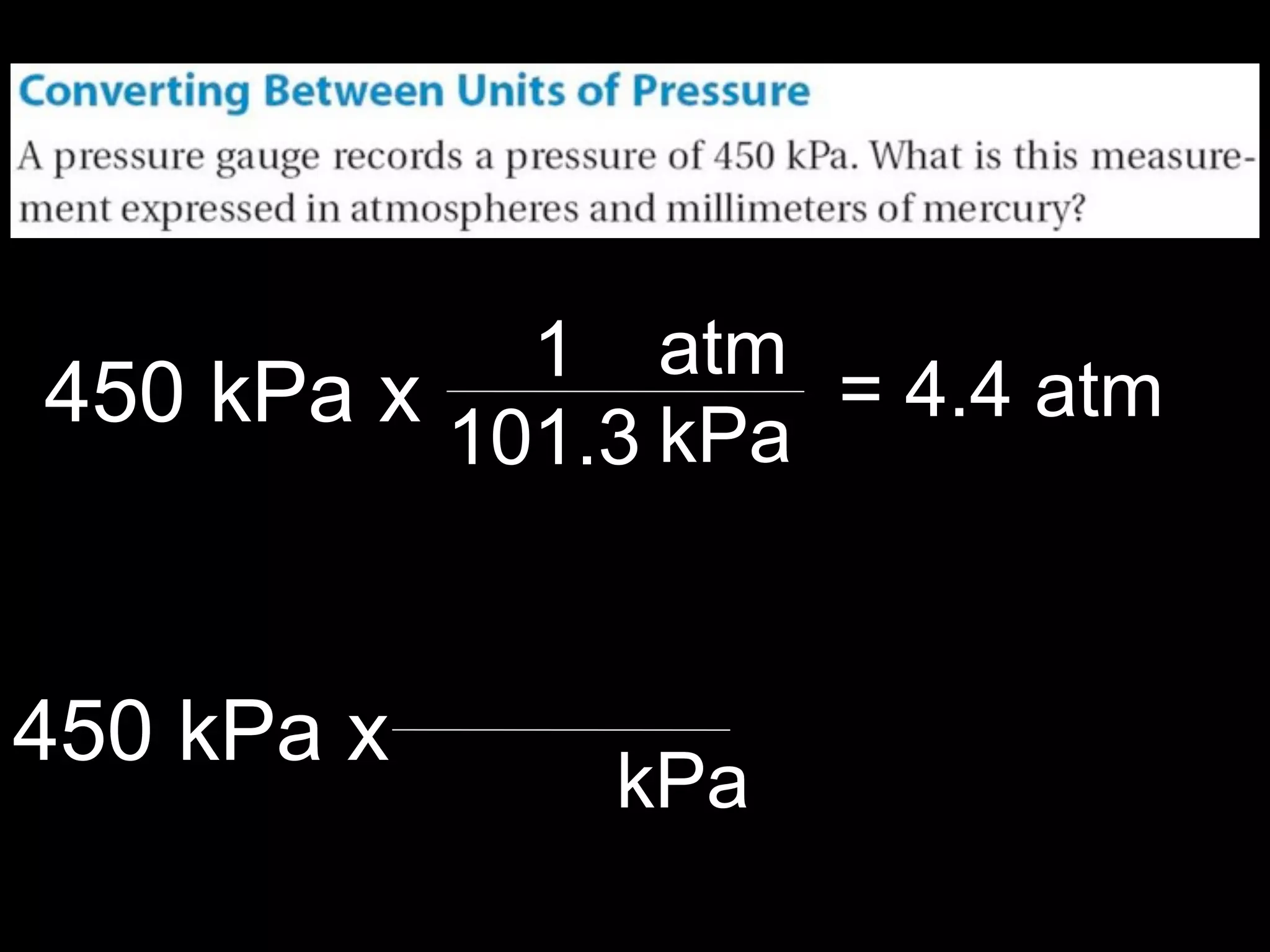
450 kPa x
               kPa
13.1


            1 atm
450 kPa x           = 4.4 atm
          101.3 kPa


             mm Hg
450 kPa x
              kPa
13.1


            1 atm
450 kPa x           = 4.4 atm
          101.3 kPa


          760 mm Hg
450 kPa x 101.3
                kPa
13.1


            1 atm
450 kPa x           = 4.4 atm
          101.3 kPa


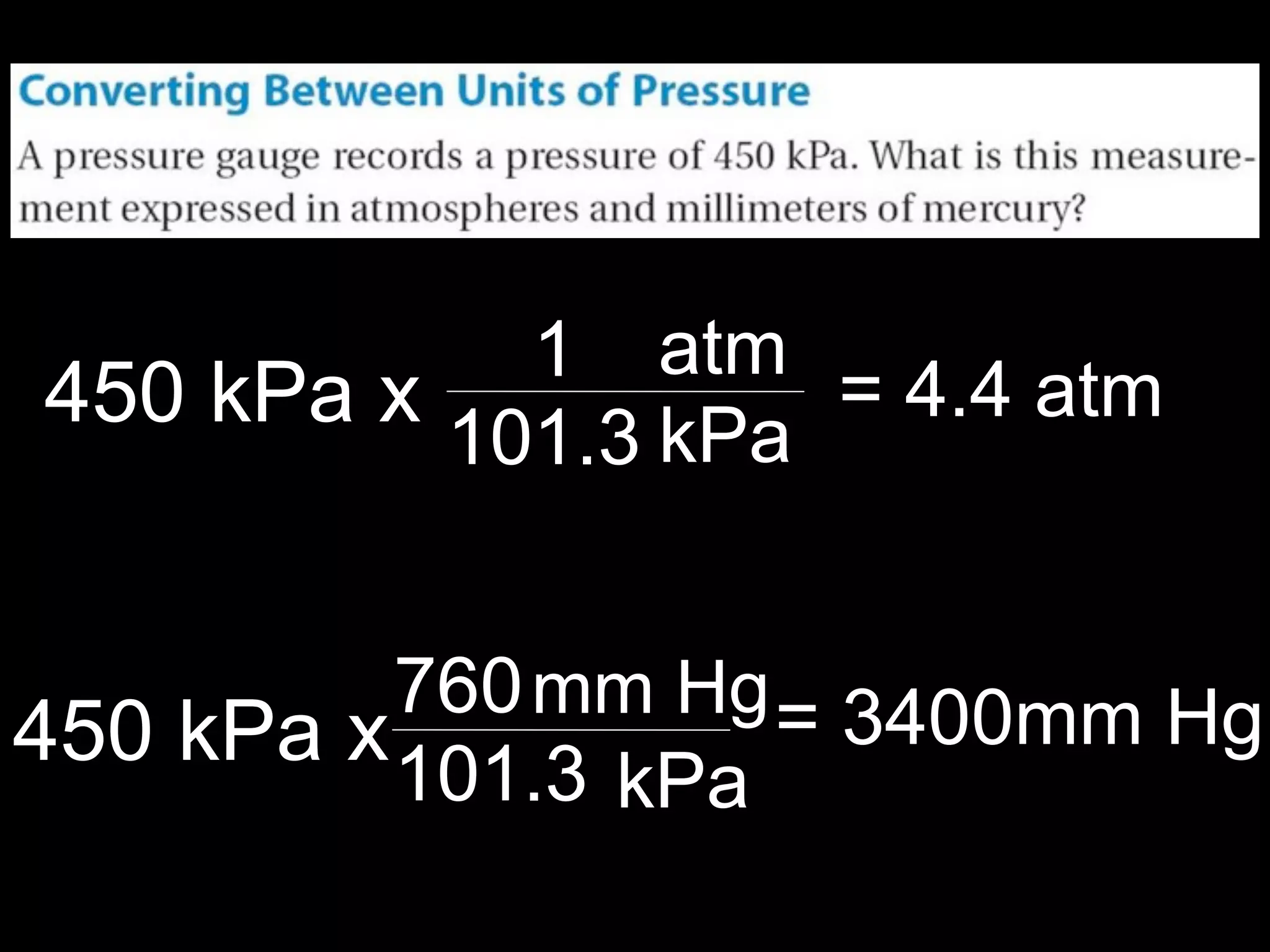
          760 mm Hg = 3400mm Hg
450 kPa x 101.3
                kPa
for Sample Problem 13.1
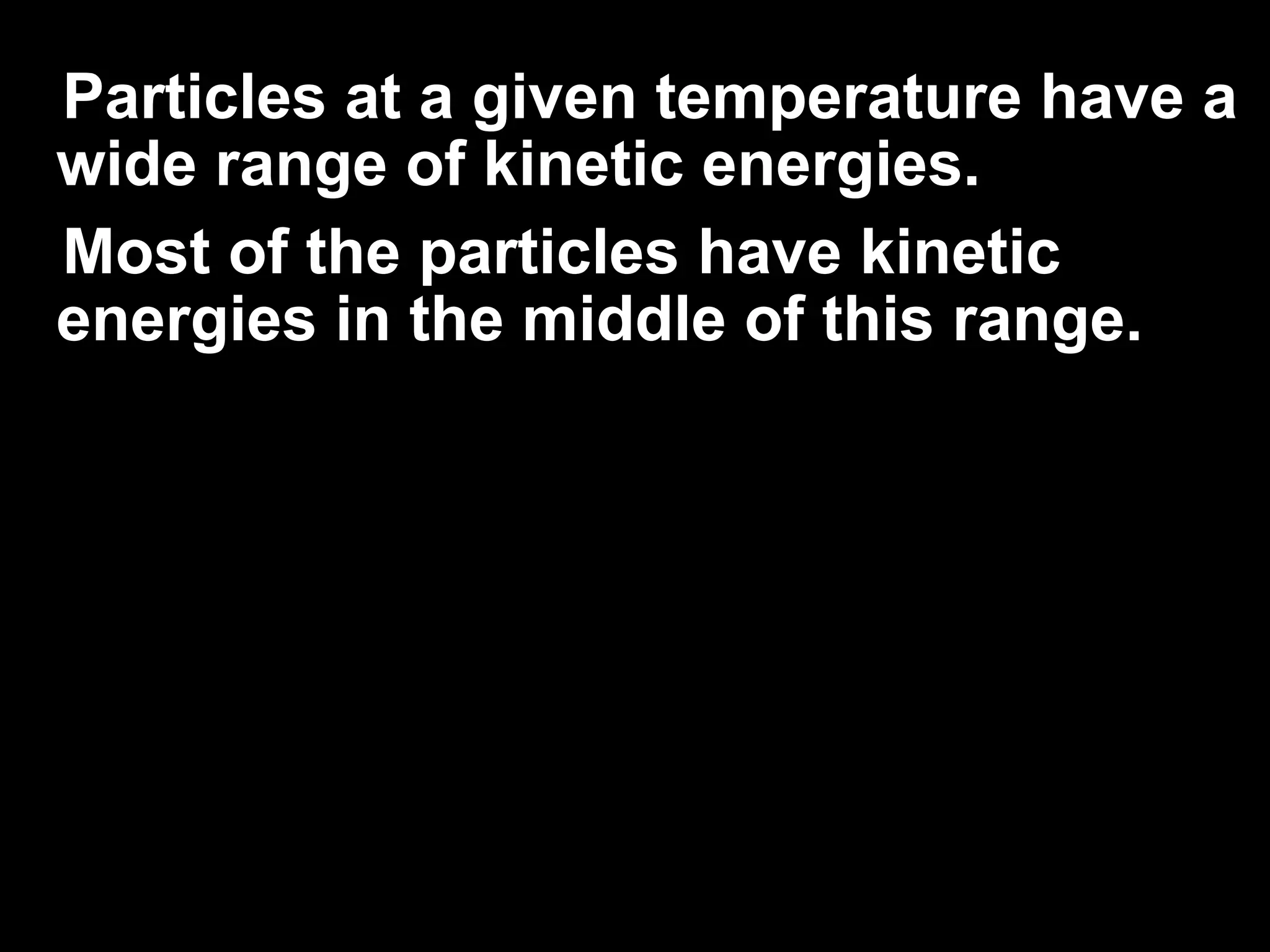
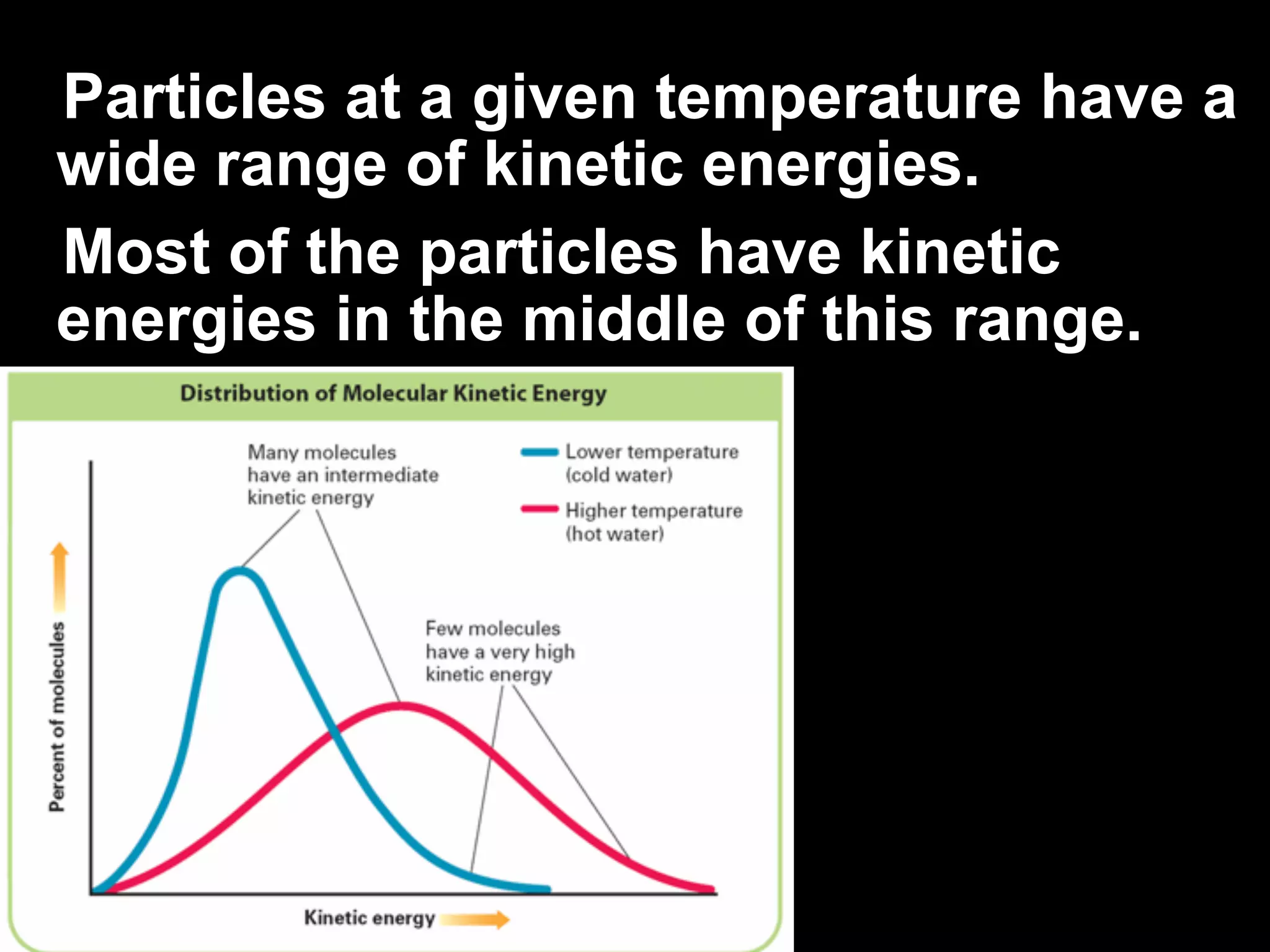
Particles at a given temperature have a
wide range of kinetic energies.
Most of the particles have kinetic
energies in the middle of this range.
Particles at a given temperature have a
wide range of kinetic energies.
Most of the particles have kinetic
energies in the middle of this range.
Particles at a given temperature have a
wide range of kinetic energies.
Most of the particles have kinetic
energies in the middle of this range.

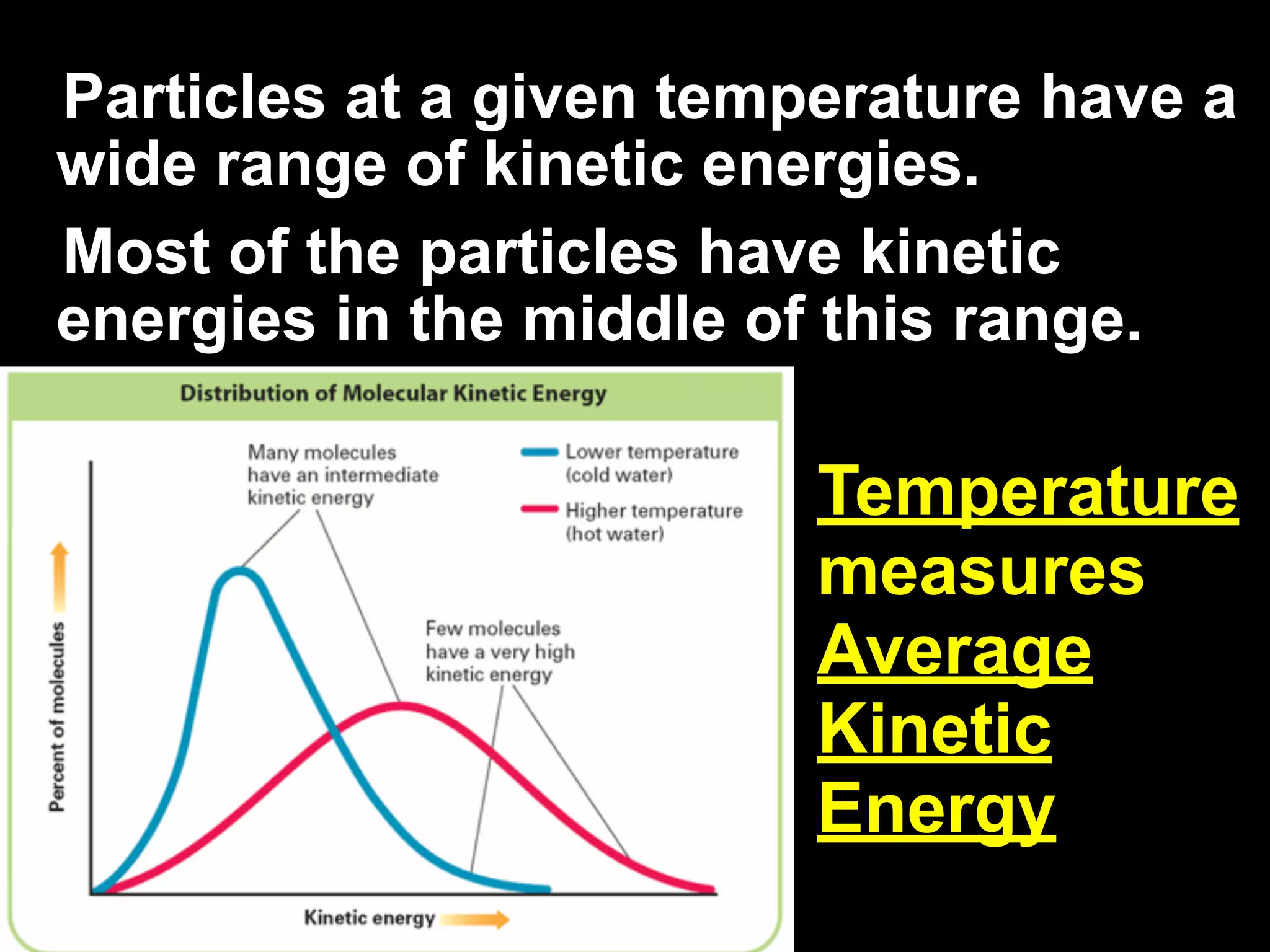
                         Temperature
                         measures
                         Average
                         Kinetic
                         Energy
13.1


The Kelvin temperature of a
substance is directly proportional
to average kinetic energy.
13.1


The Kelvin temperature of a
substance is directly proportional
to average kinetic energy.


The higher the kinetic energy, the higher
the temperature.
13.1

Two substances with the same average
kinetic energy are at the same
temperature.

Two substances at the same
temperature have the same
average kinetic energy.
13.1
Absolute zero (0 K, or –273.15°C)
is the temperature at which the
motion of particles theoretically
stops.
13.1
Absolute zero (0 K, or –273.15°C)
is the temperature at which the
motion of particles theoretically
stops.
•Particles would have no kinetic
 energy at absolute zero.
13.1
Absolute zero (0 K, or –273.15°C)
is the temperature at which the
motion of particles theoretically
stops.
•Particles would have no kinetic
 energy at absolute zero.
• Absolute zero has never been produced
 in the laboratory (and not for lack of
 trying!).
Bellwork- Kinetic Energy

•What is kinetic energy?
•How is average kinetic energy
related to temperature?
•Which has higher kinetic energy,
an olympic size pool of water or a
cup of hot coffee?
13.2


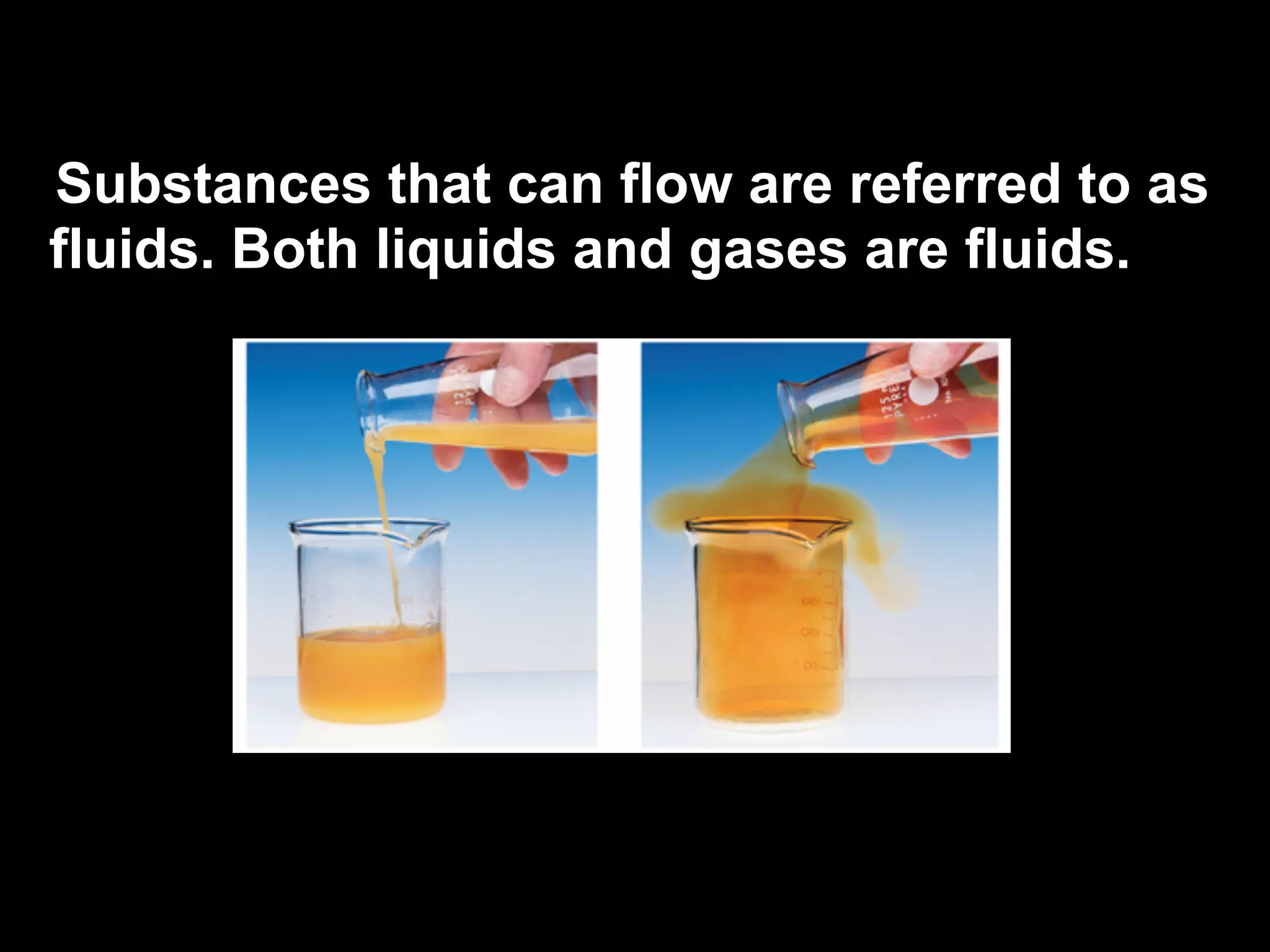
Substances that can flow are referred to as
fluids. Both liquids and gases are fluids.
13.2


The intermolecular attractions
(IMFs) are counteracted by
motion of molecules.
Together they determine the physical
properties of liquids.
High IMFs promote a solid state
High temps (motion) promote a gas state.
13.2


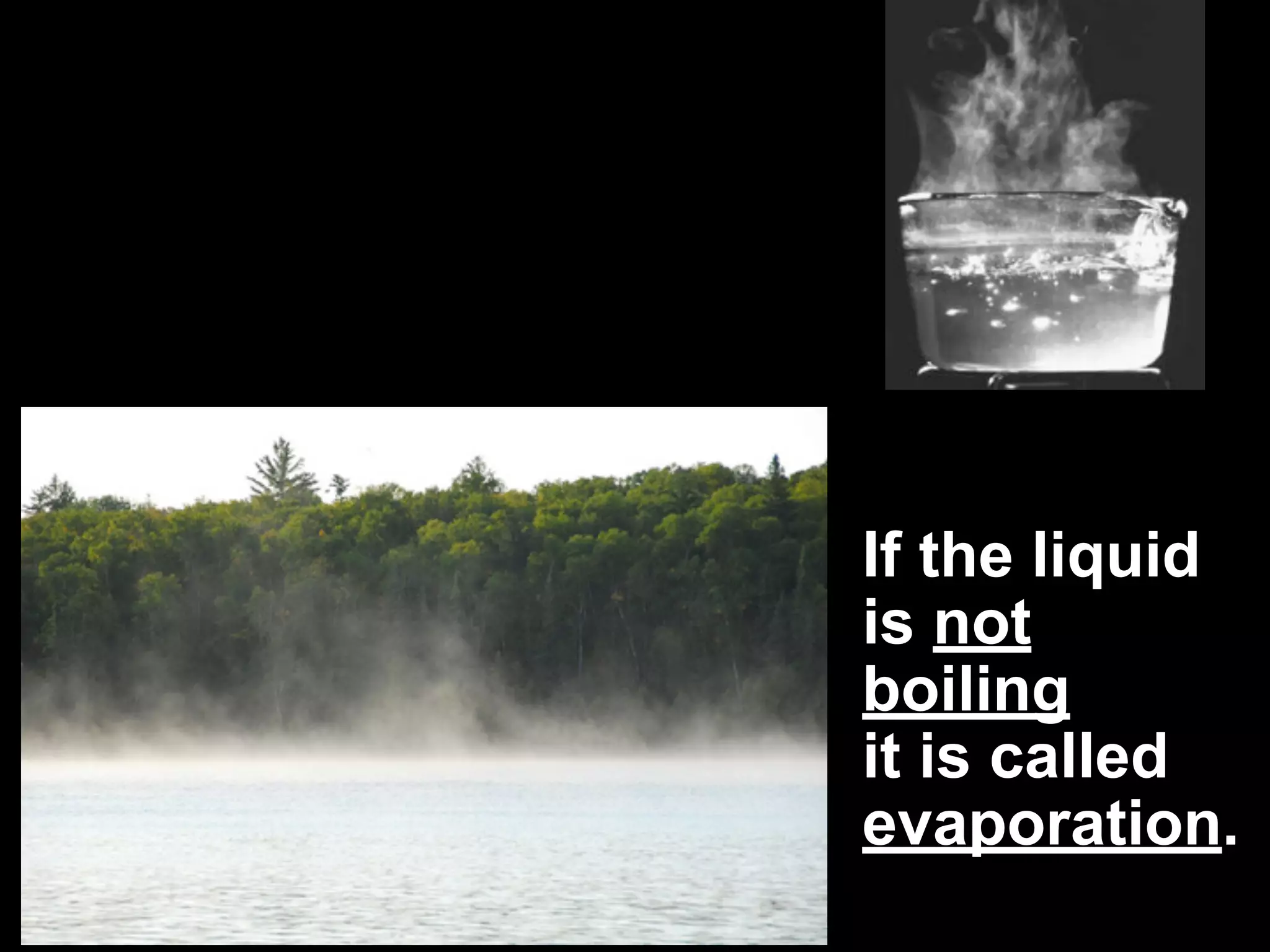
       If the liquid
       is not
       boiling
       it is called
       evaporation.
13.2
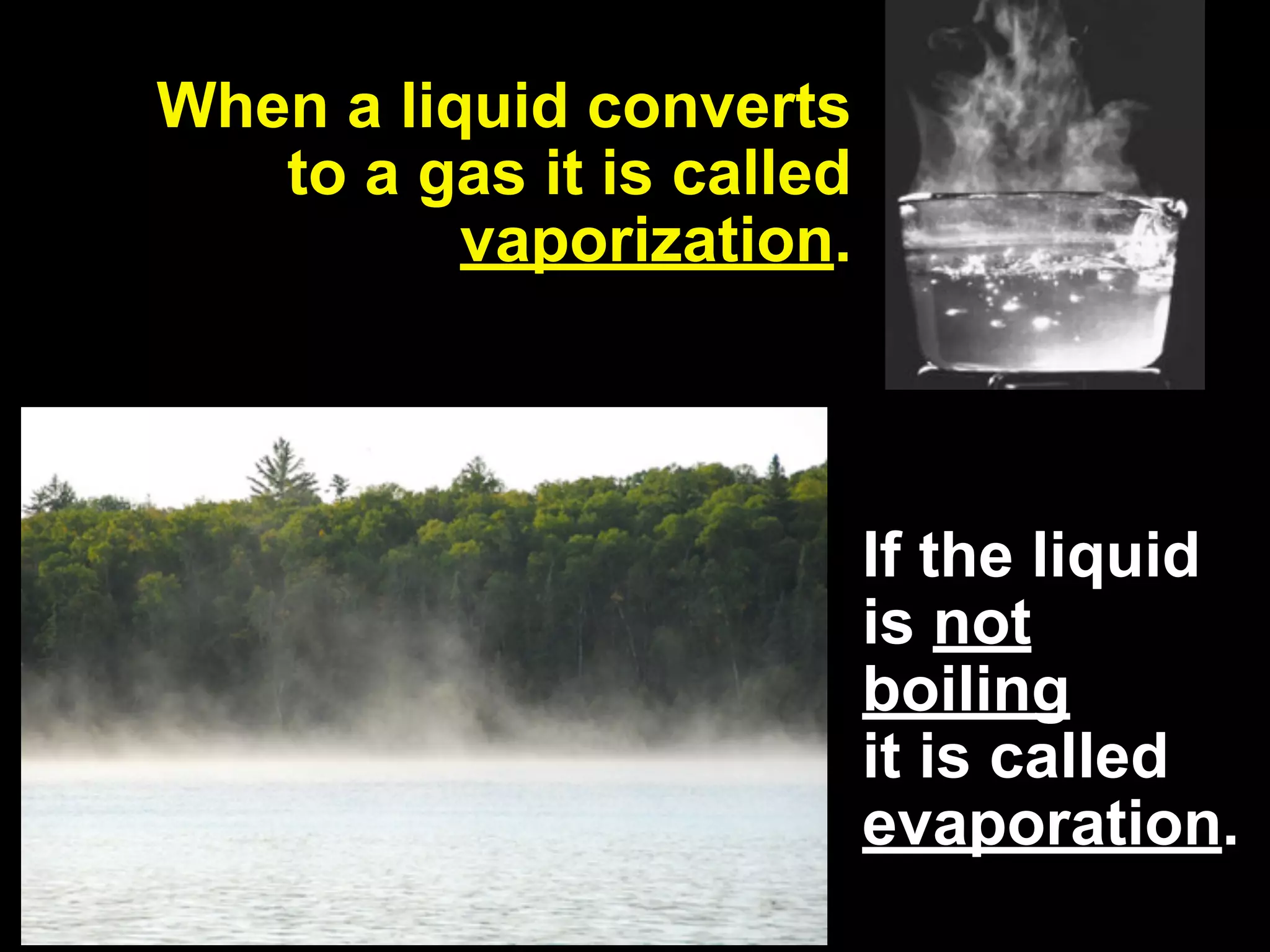
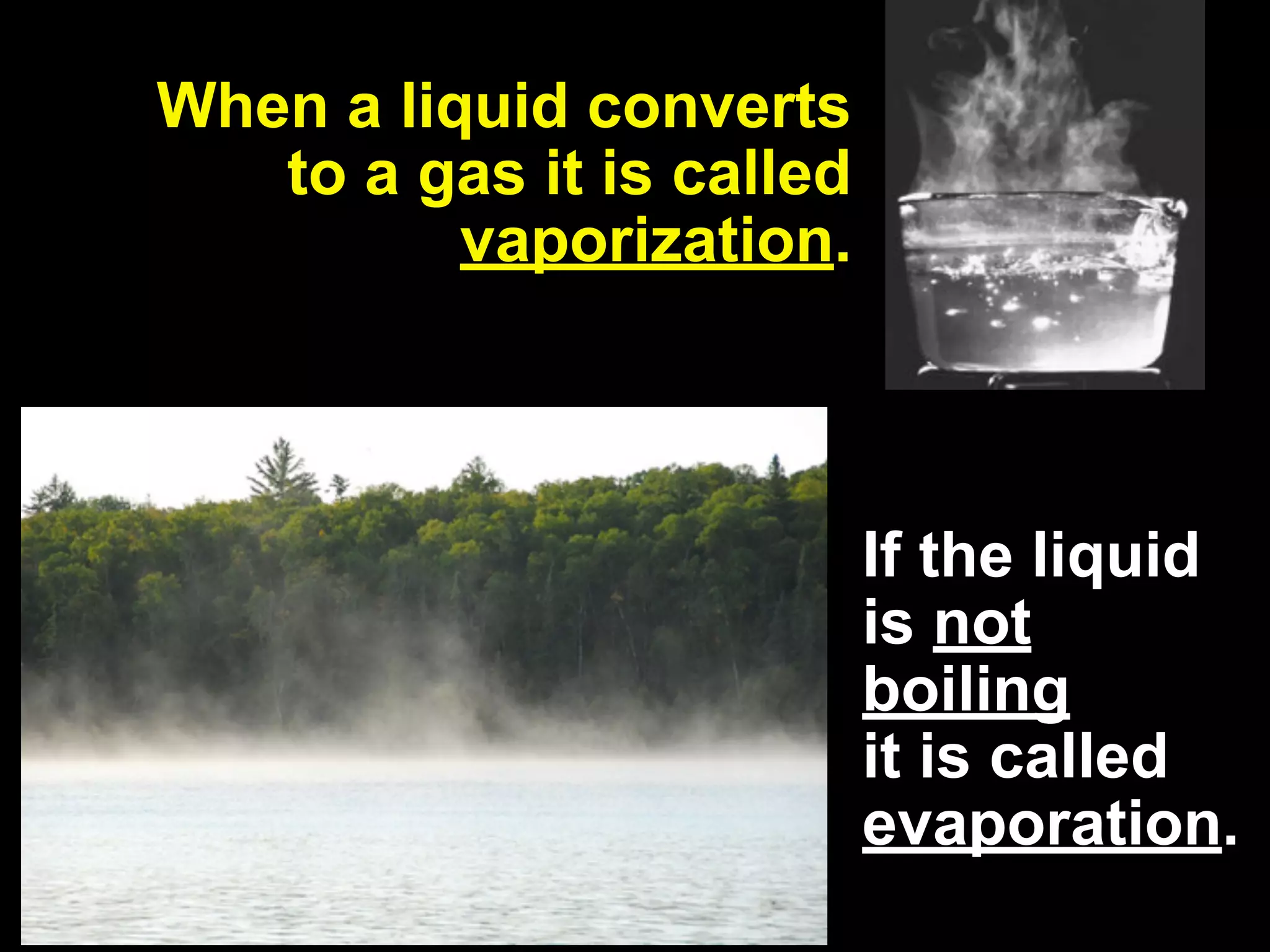
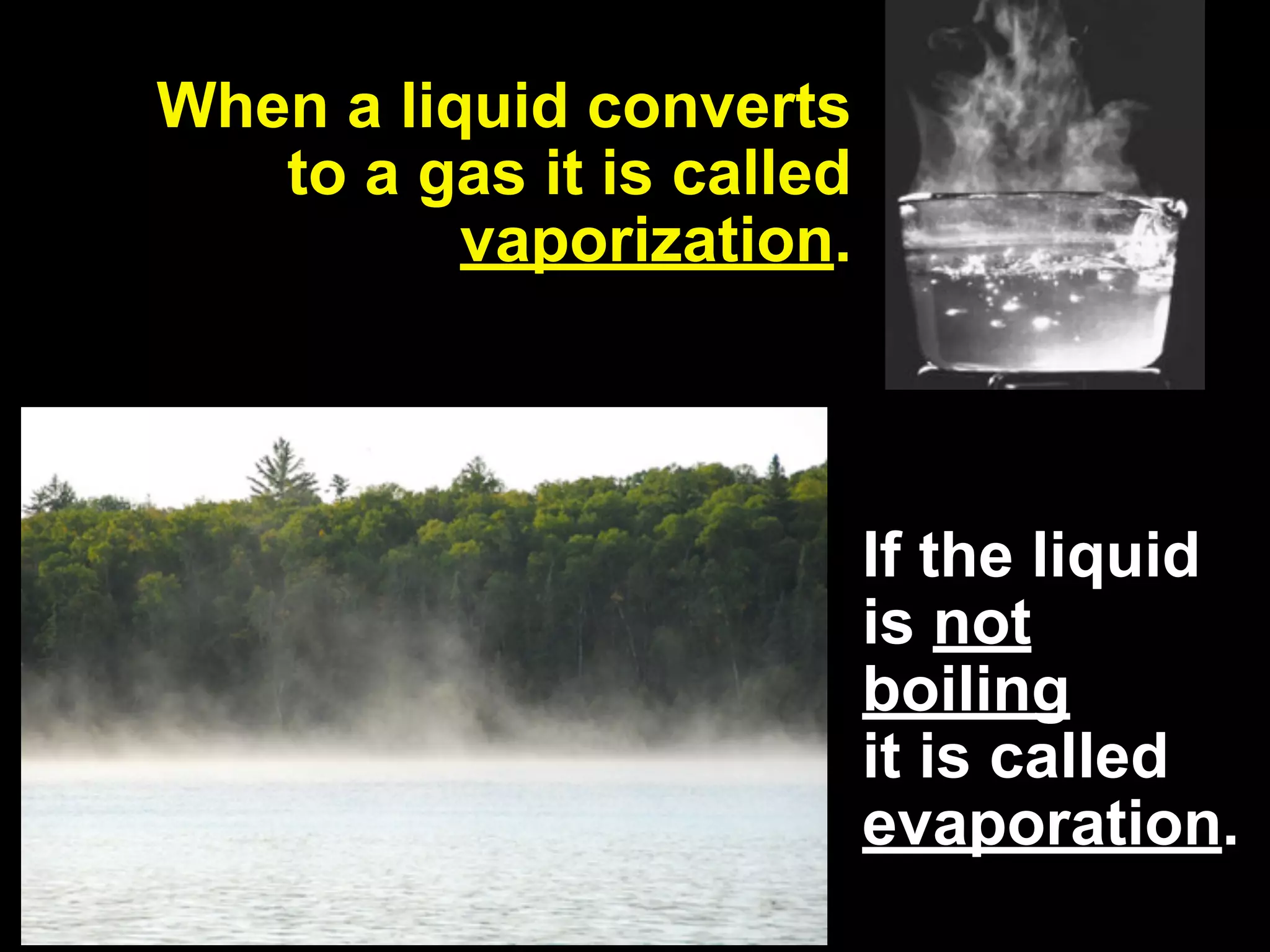
 When a liquid converts
    to a gas it is called
           vaporization.


                            If the liquid
                            is not
                            boiling
                            it is called
                            evaporation.
13.2
 When a liquid converts
    to a gas it is called
           vaporization.


                            If the liquid
                            is not
                            boiling
                            it is called
                            evaporation.
13.2
 When a liquid converts
    to a gas it is called
           vaporization.


                            If the liquid
                            is not
                            boiling
                            it is called
                            evaporation.
13.2
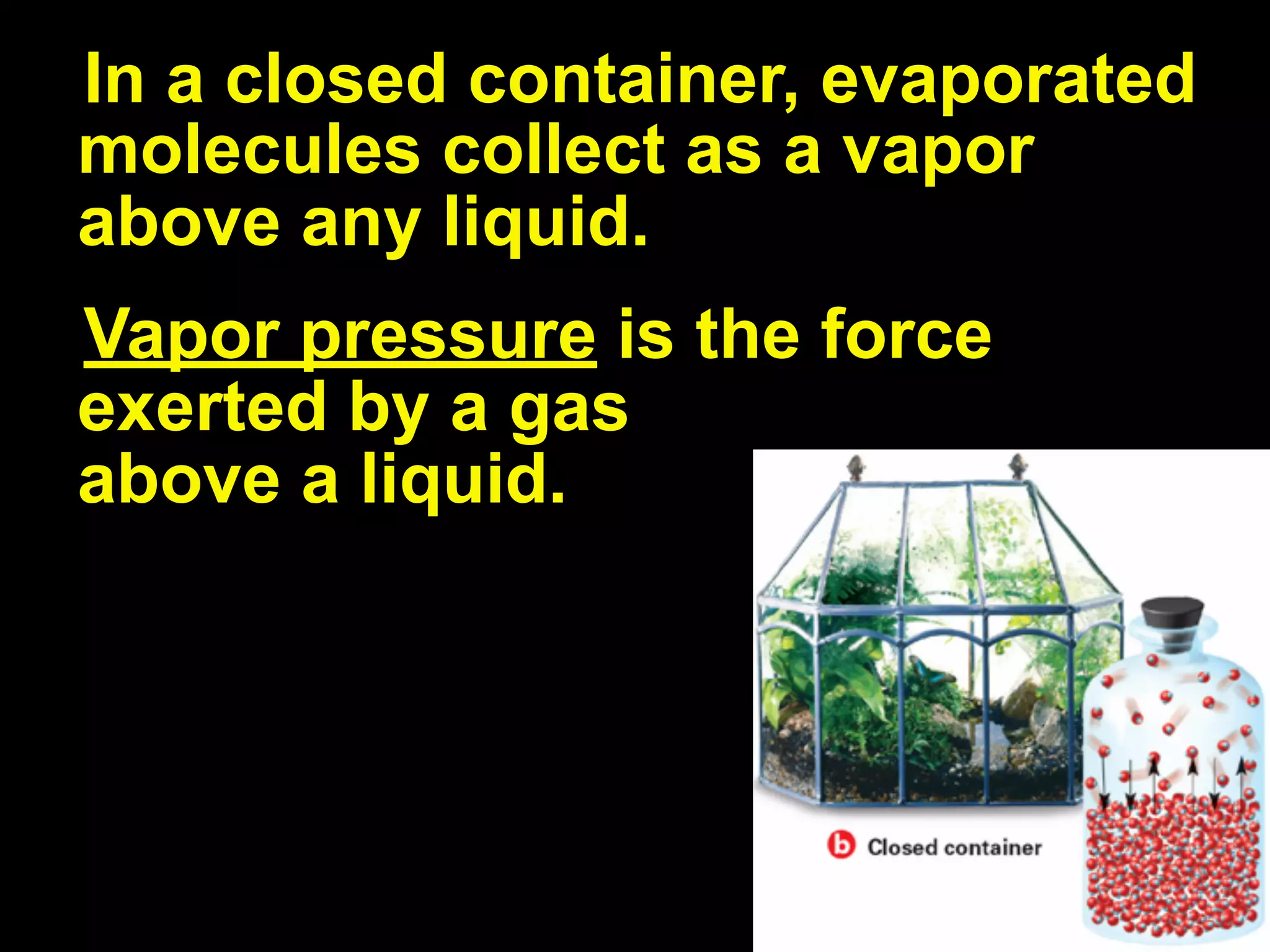
In a closed container, evaporated
molecules collect as a vapor
above any liquid.
Vapor pressure is the force
exerted by a gas
above a liquid.
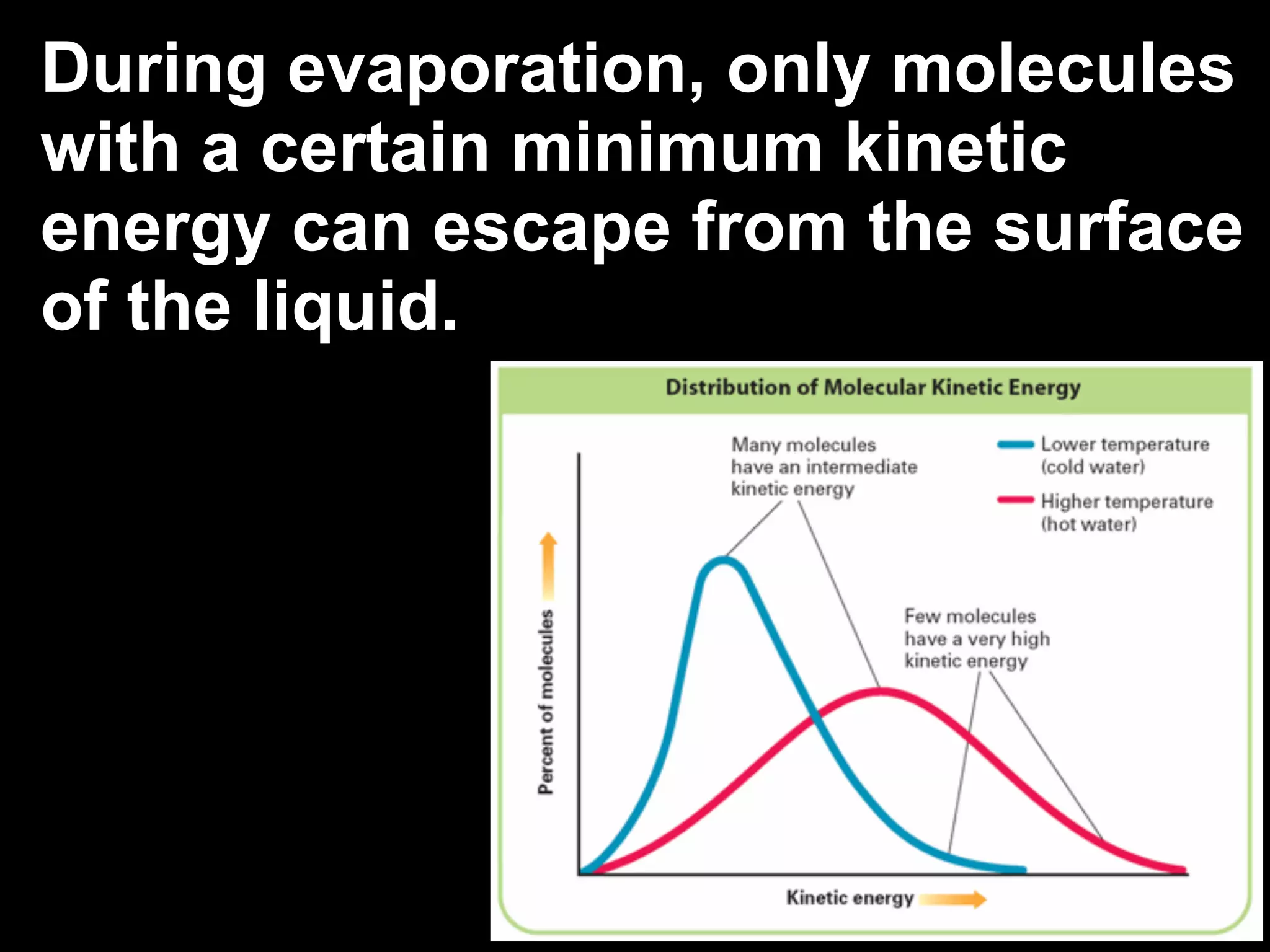
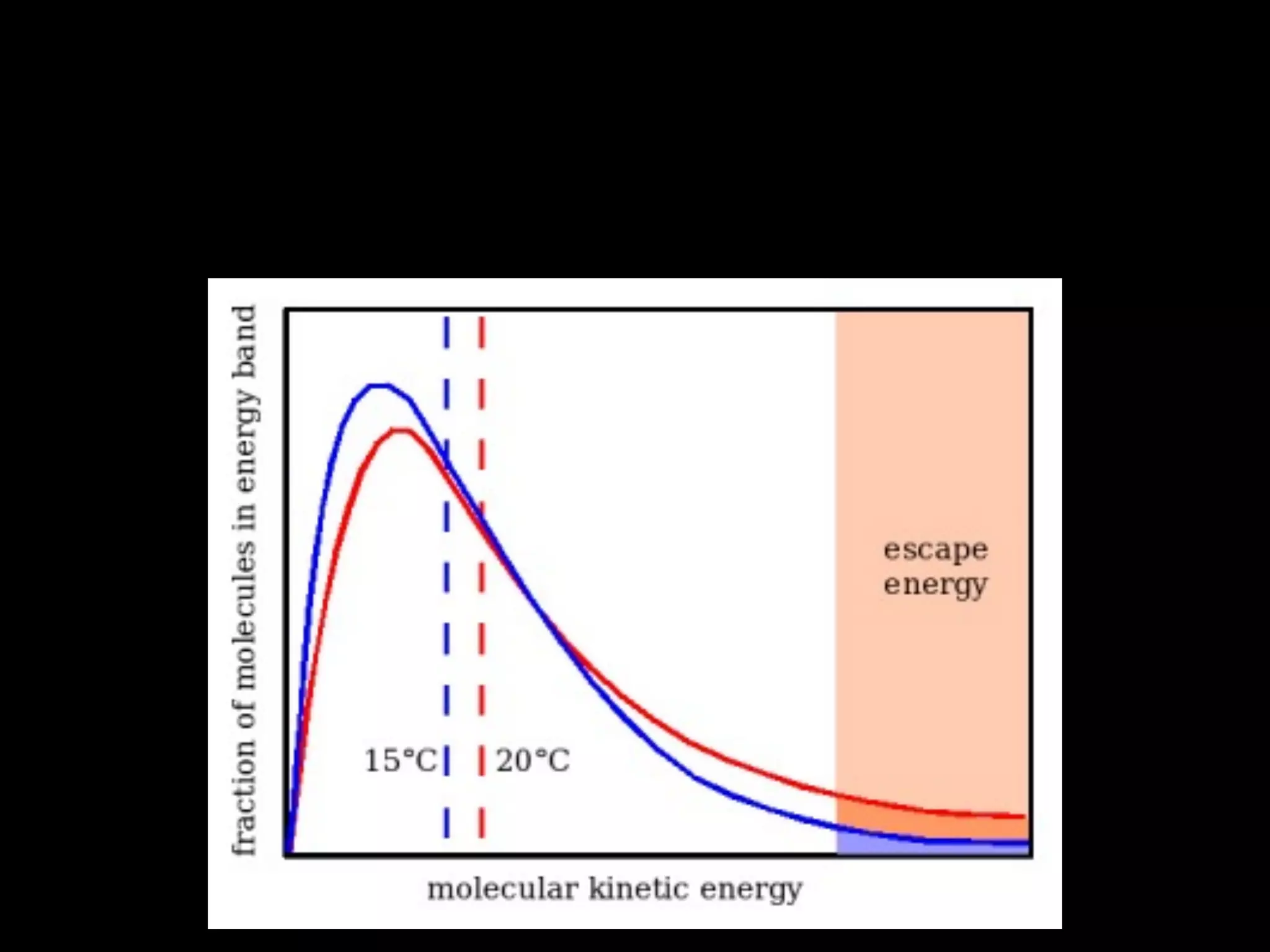
During evaporation, only molecules
with a certain minimum kinetic
energy can escape from the surface
of the liquid.
During evaporation, only molecules
with a certain minimum kinetic
energy can escape from the surface
of the liquid.
During evaporation, only molecules
with a certain minimum kinetic
energy can escape from the surface
of the liquid.
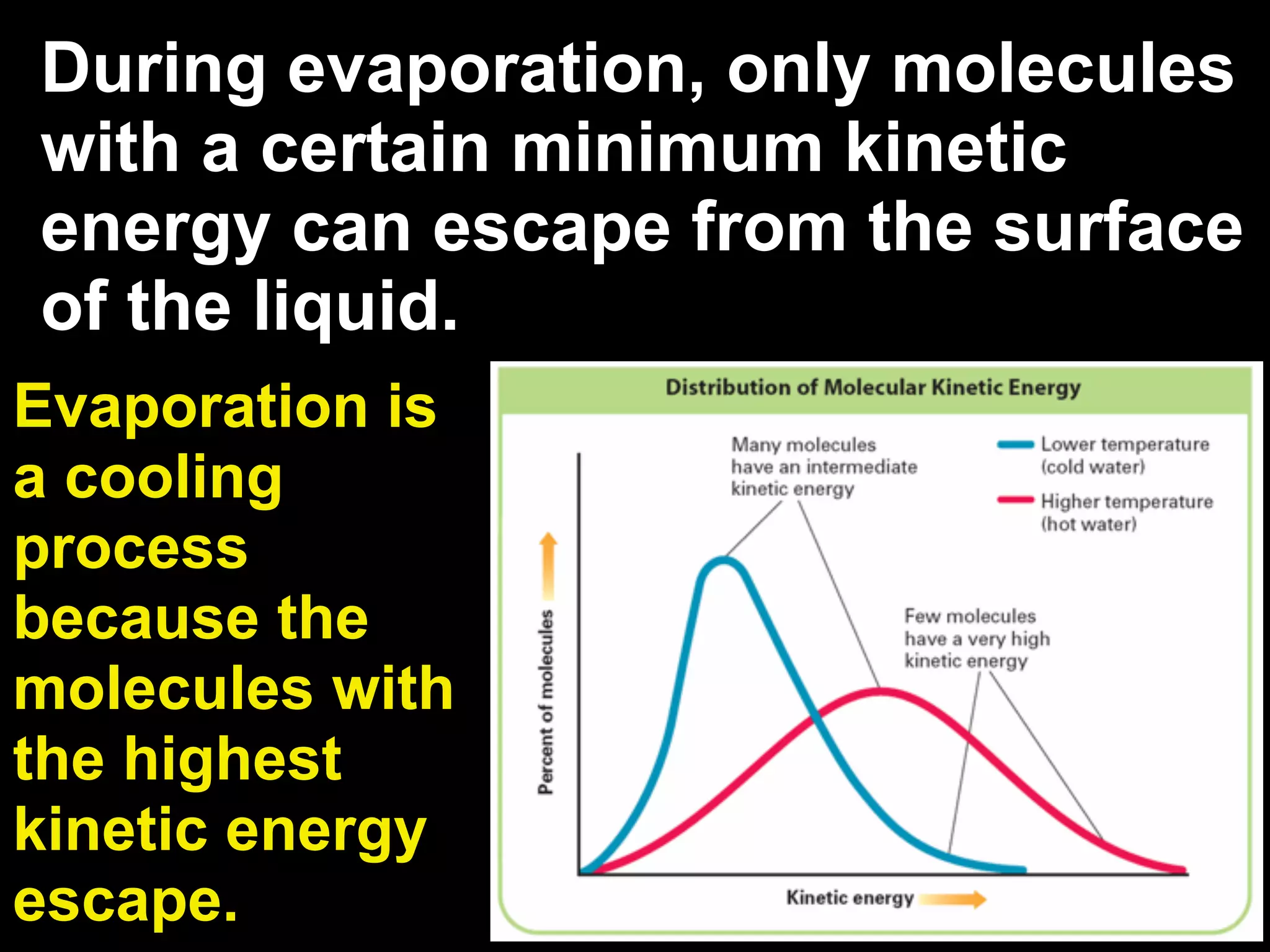
Evaporation is
a cooling
process
because the
molecules with
the highest
kinetic energy
escape.
13.2
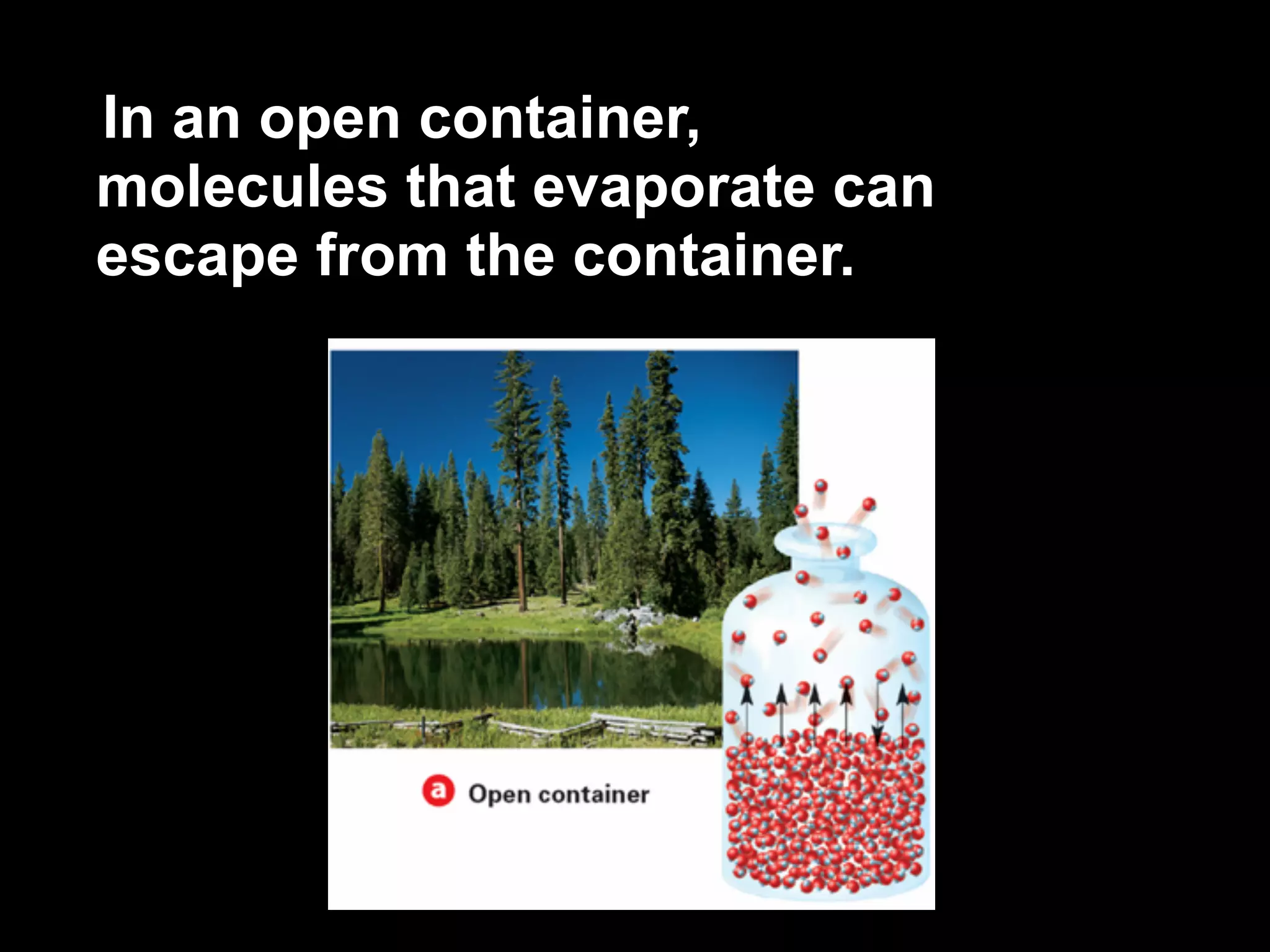
In an open container,
molecules that evaporate can
escape from the container.
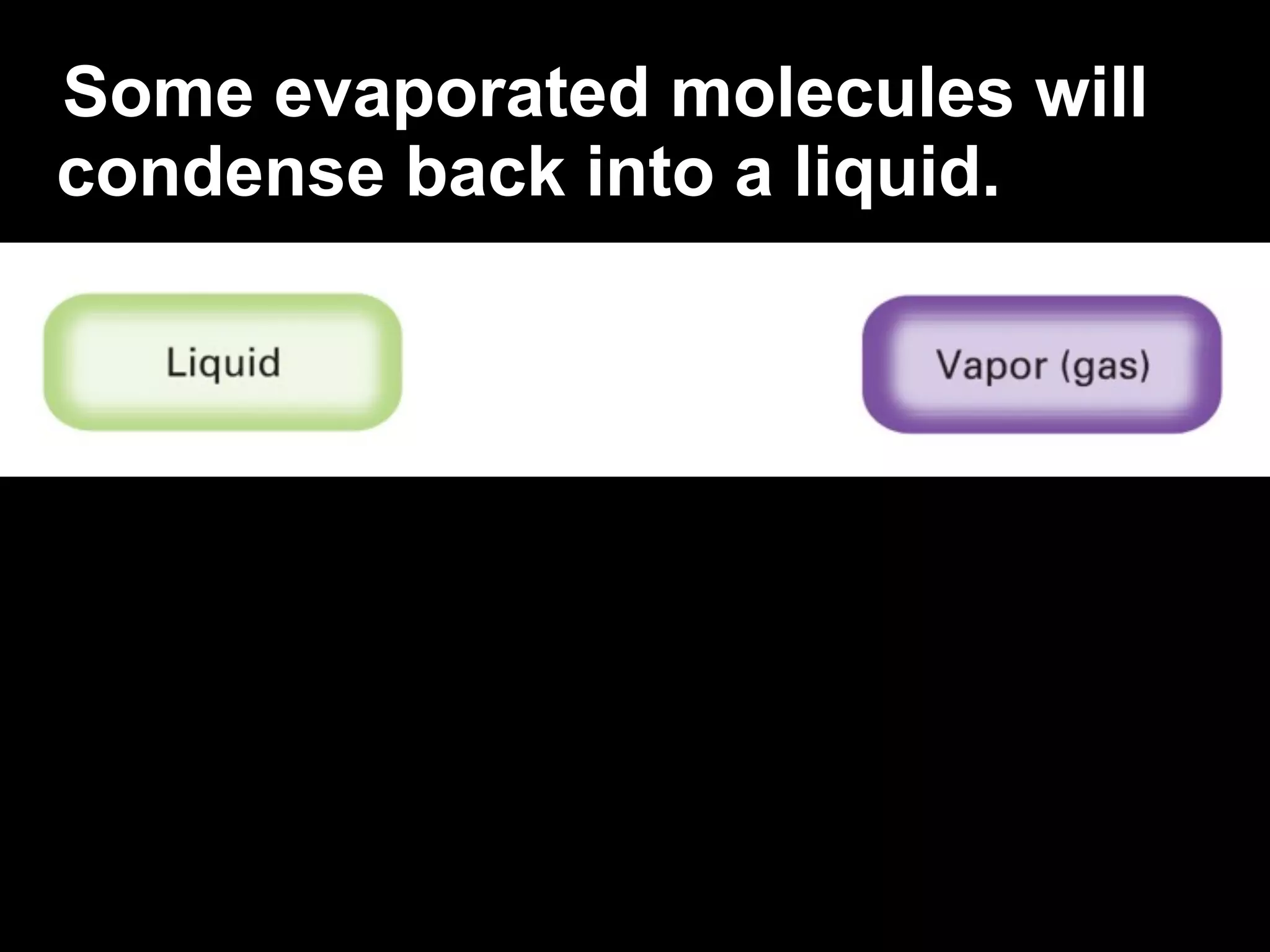
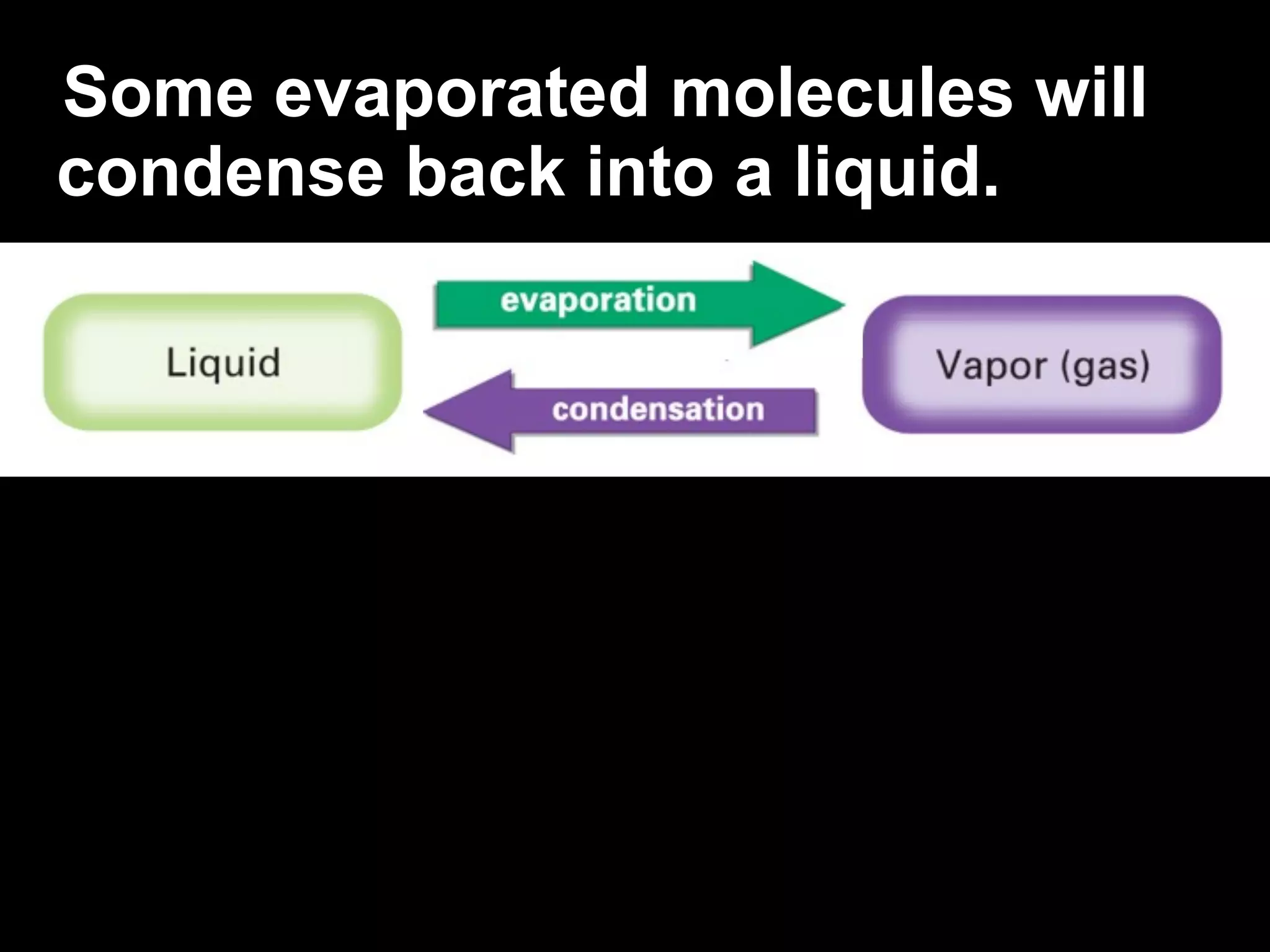
Some evaporated molecules will
condense back into a liquid.
Some evaporated molecules will
condense back into a liquid.
Some evaporated molecules will
condense back into a liquid.


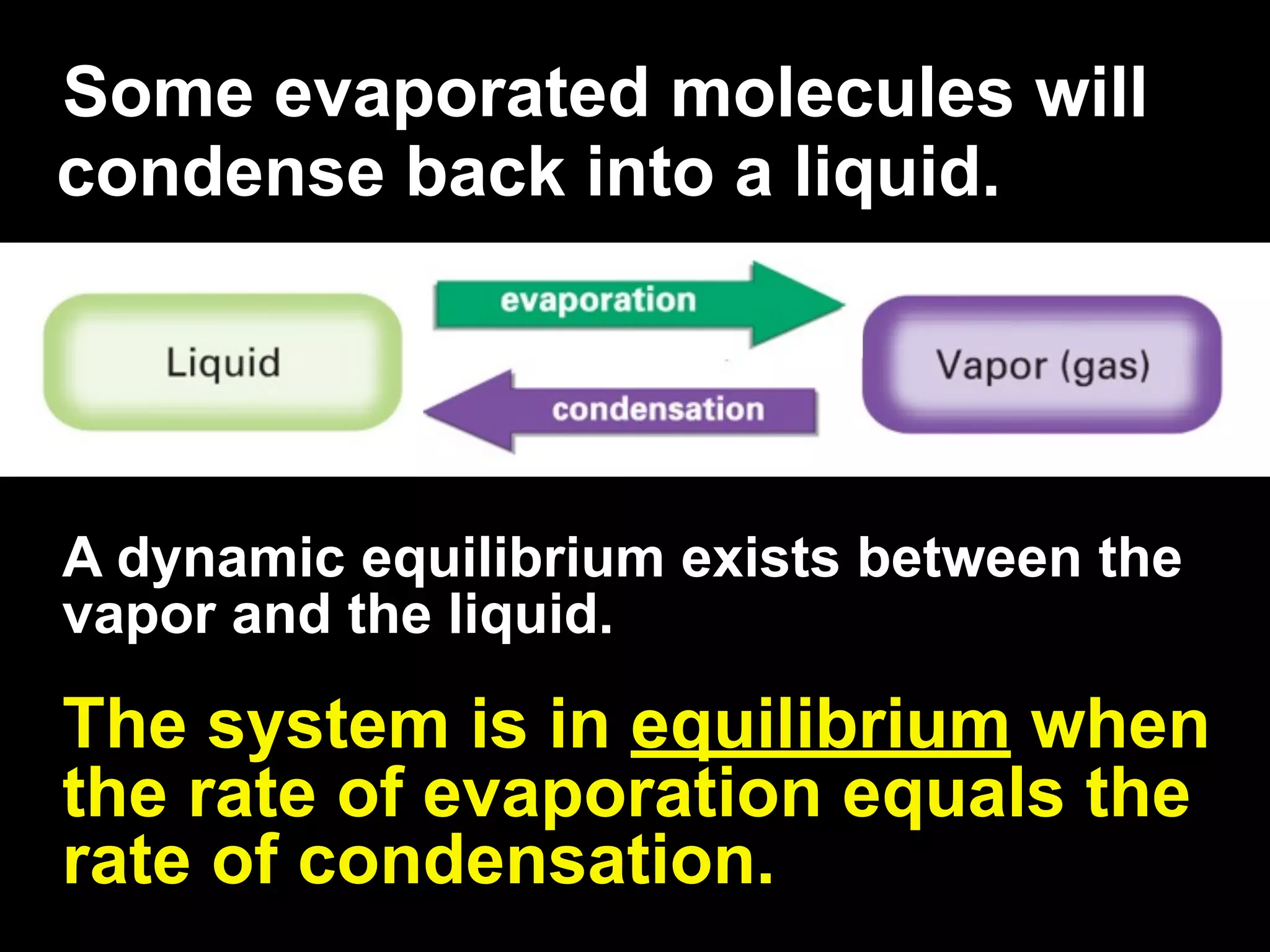
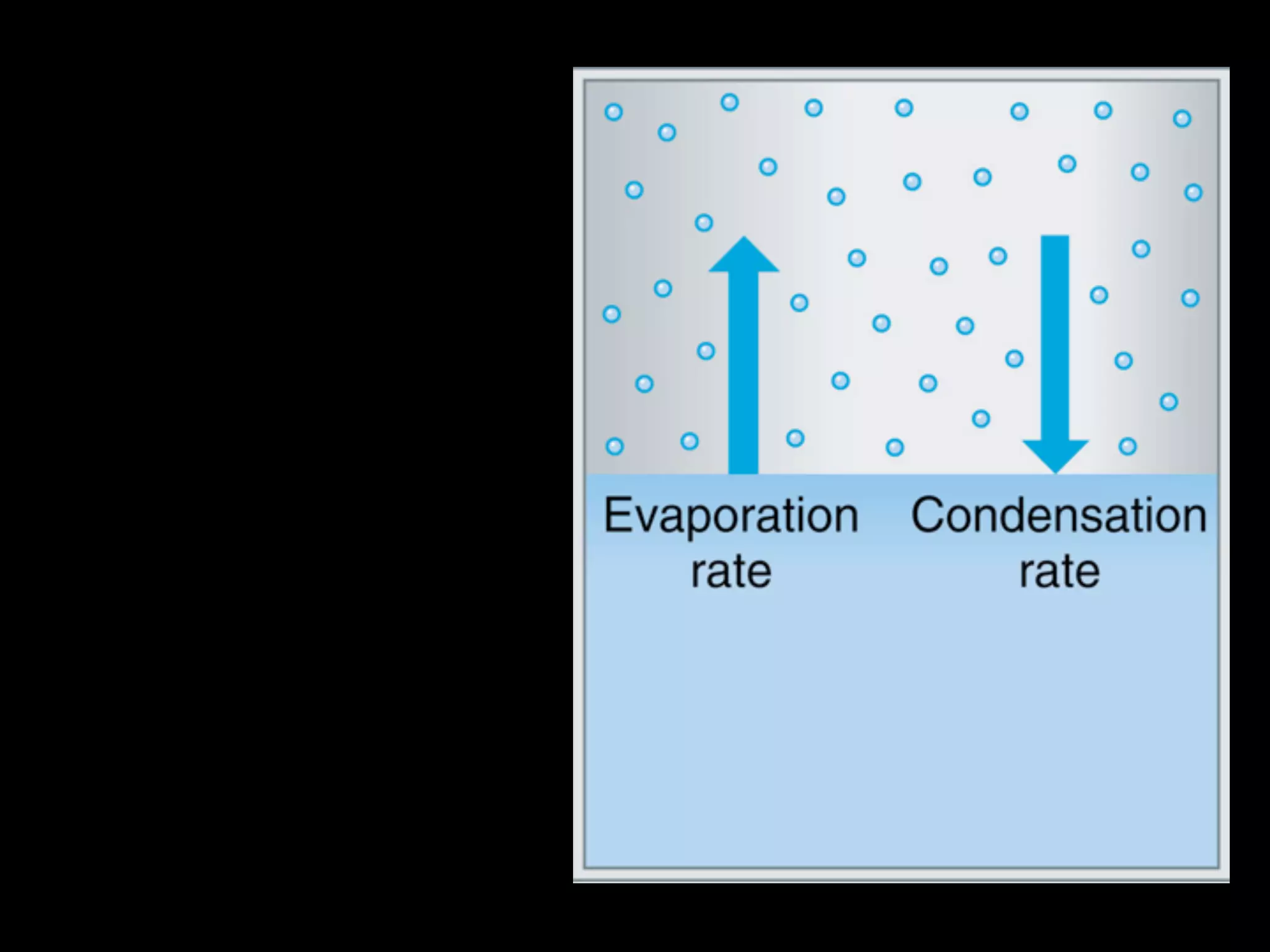
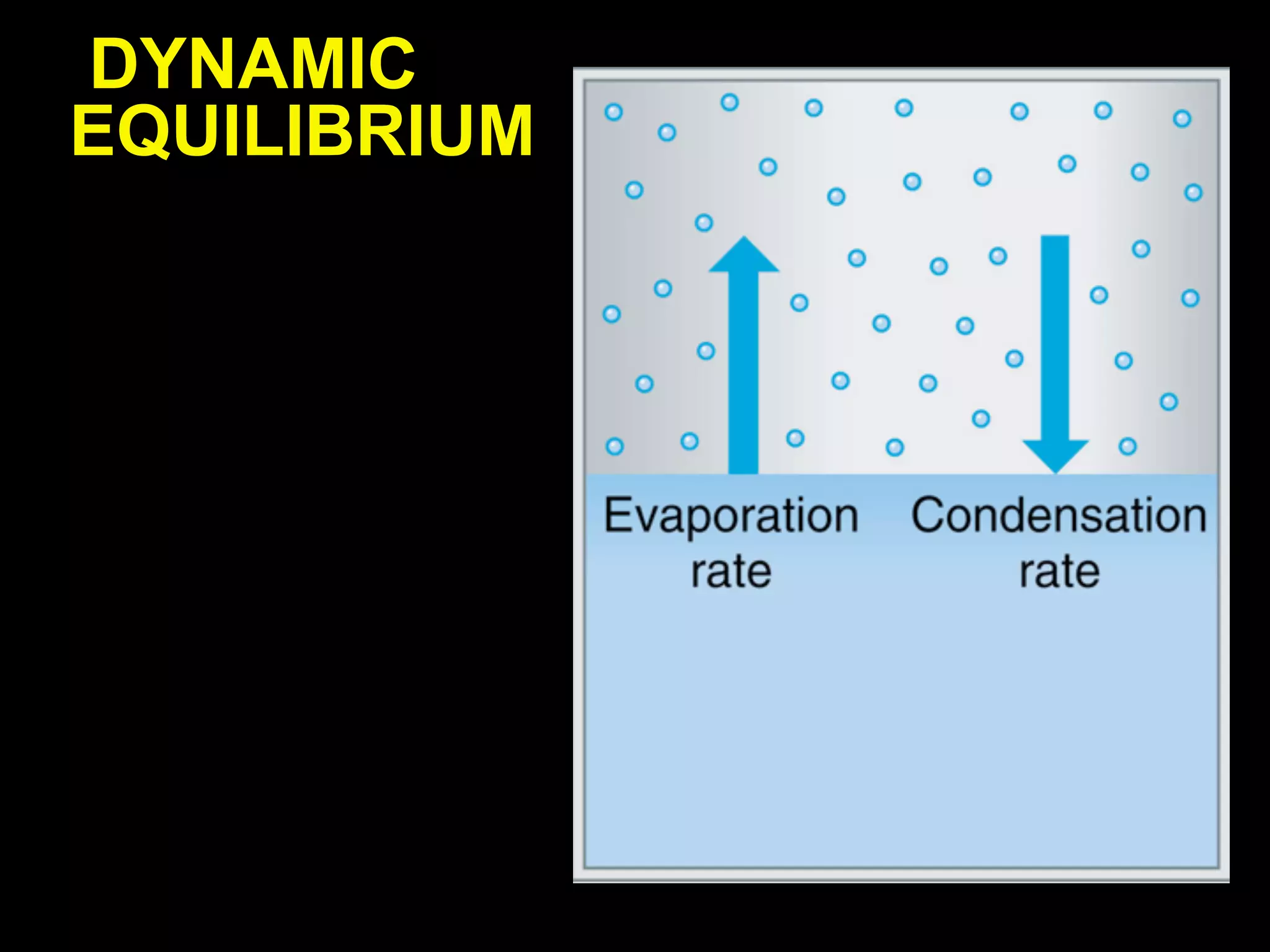
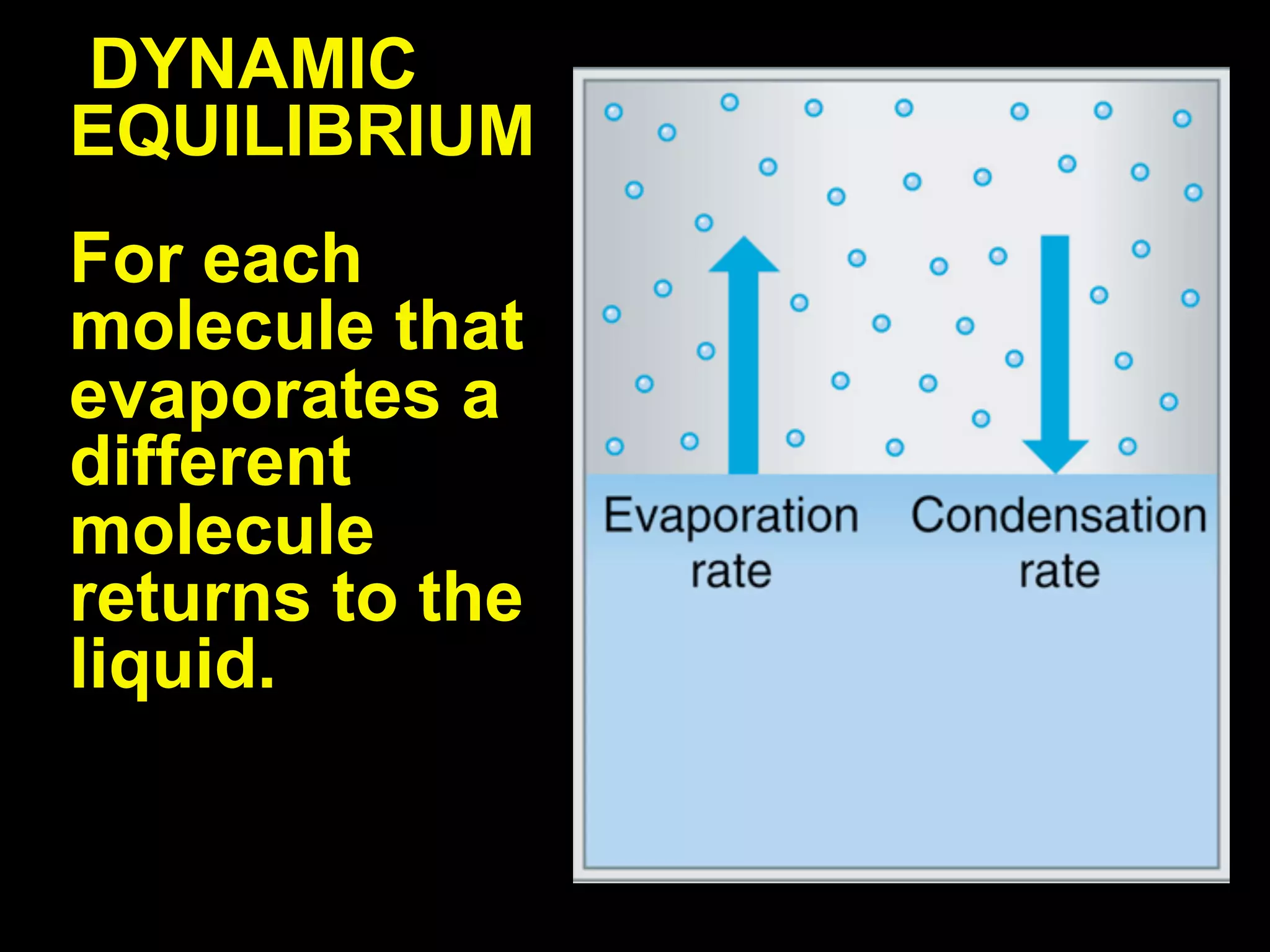
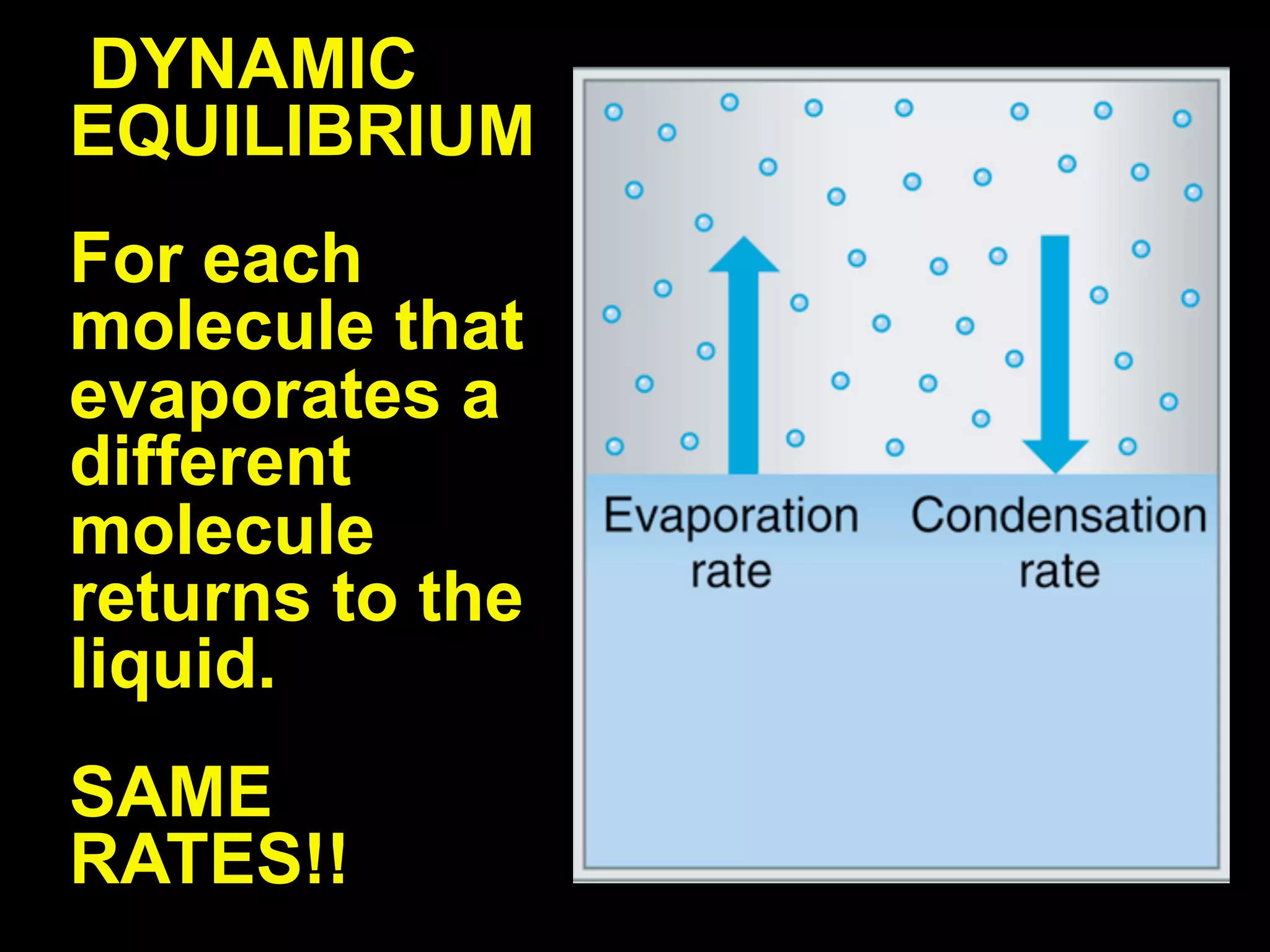
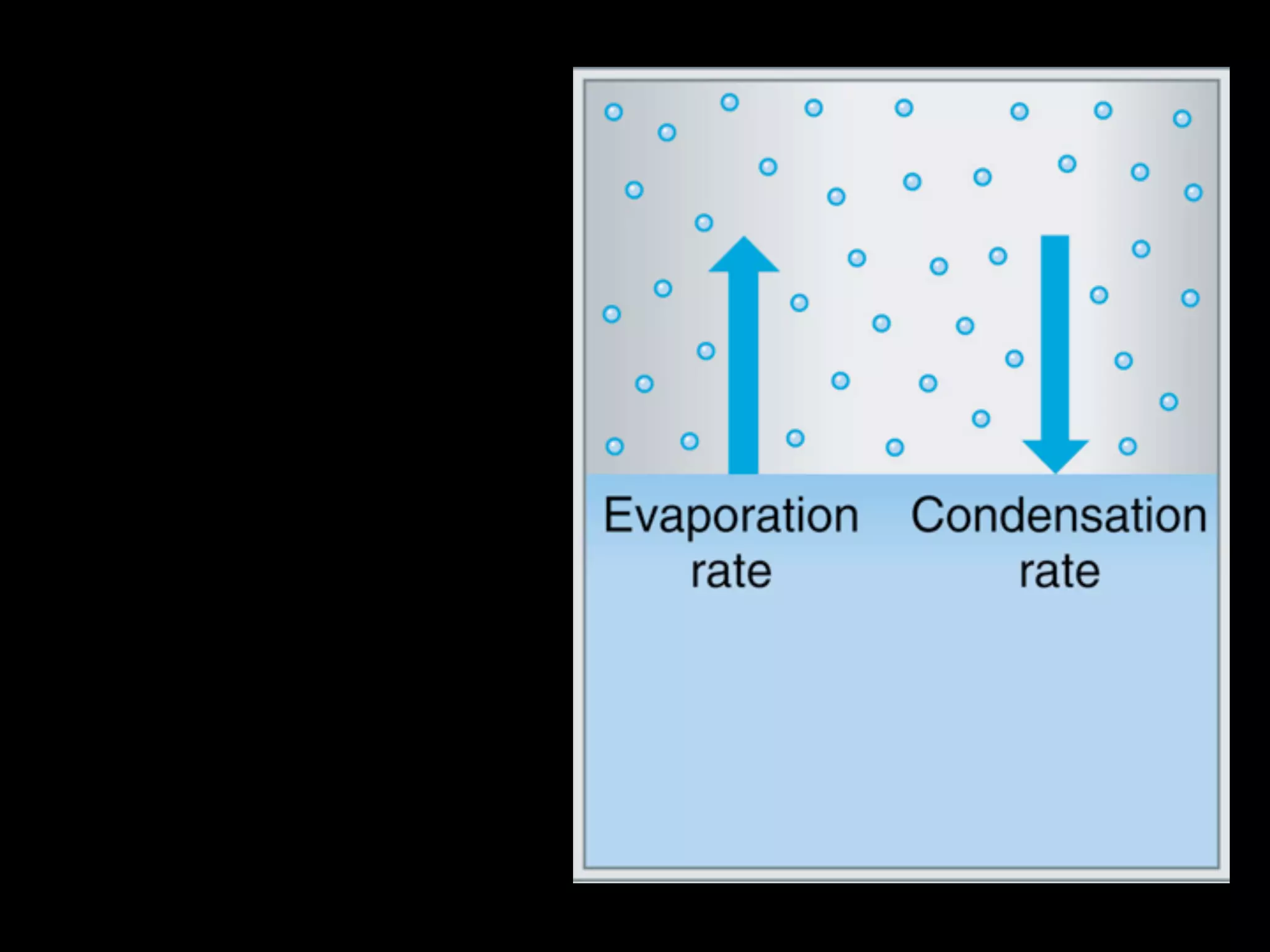
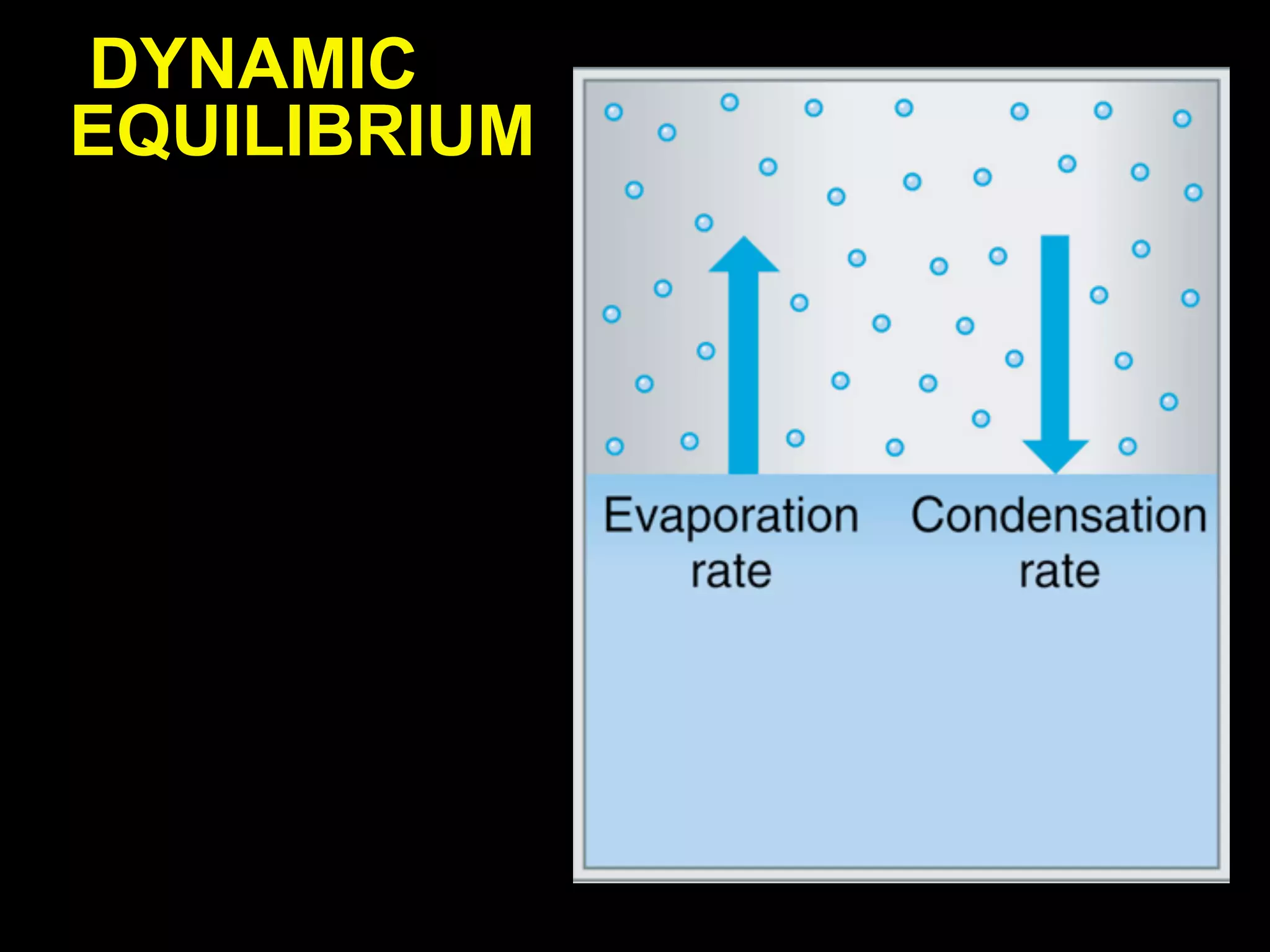
A dynamic equilibrium exists between the
vapor and the liquid.

The system is in equilibrium when
the rate of evaporation equals the
rate of condensation.
DYNAMIC
EQUILIBRIUM
DYNAMIC
EQUILIBRIUM
For each
molecule that
evaporates a
different
molecule
returns to the
liquid.
DYNAMIC
EQUILIBRIUM
For each
molecule that
evaporates a
different
molecule
returns to the
liquid.
SAME
RATES!!
DYNAMIC
EQUILIBRIUM
DYNAMIC
EQUILIBRIUM
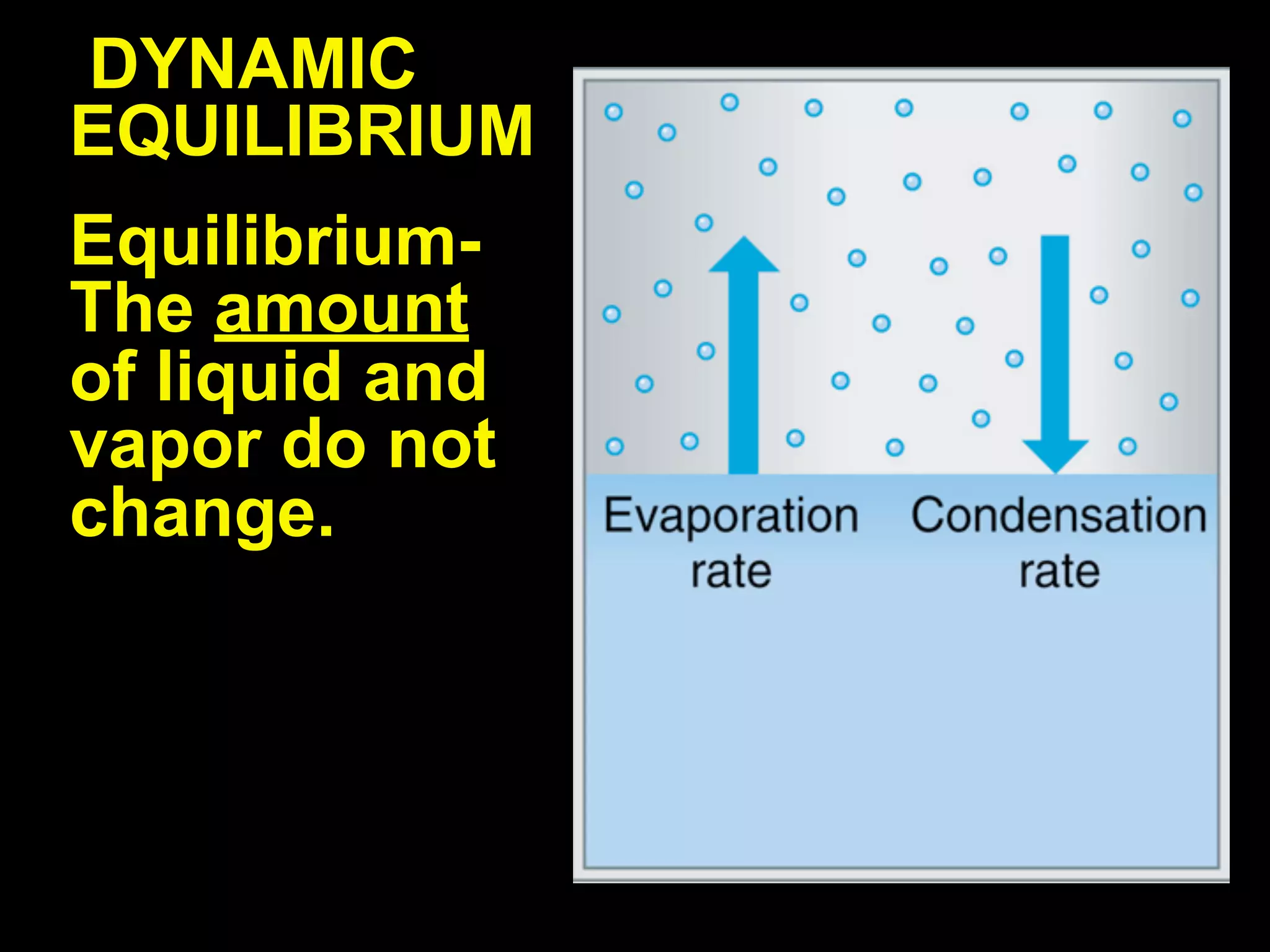
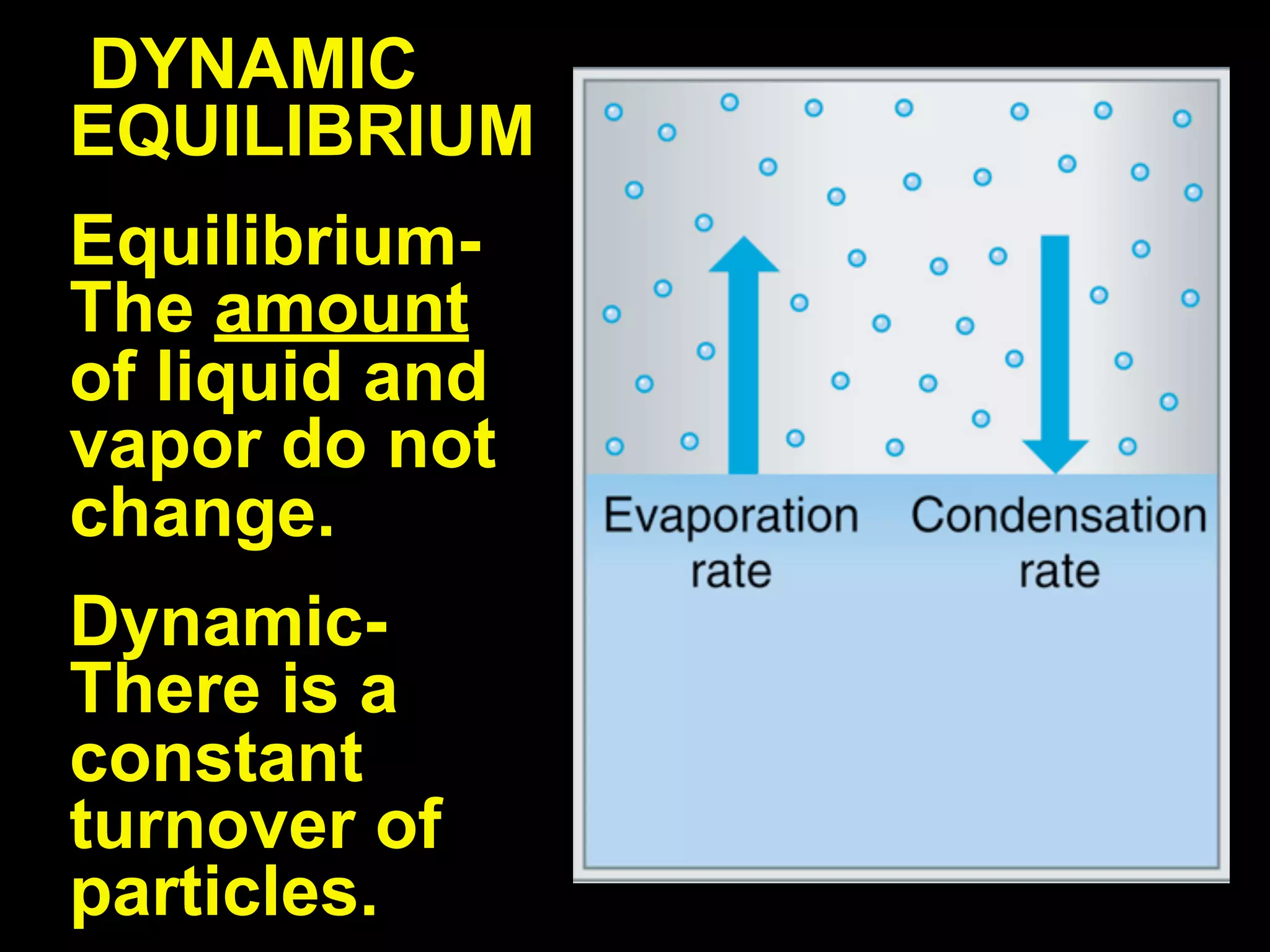
Equilibrium-
The amount
of liquid and
vapor do not
change.
DYNAMIC
EQUILIBRIUM
Equilibrium-
The amount
of liquid and
vapor do not
change.
Dynamic-
There is a
constant
turnover of
particles.
13.2


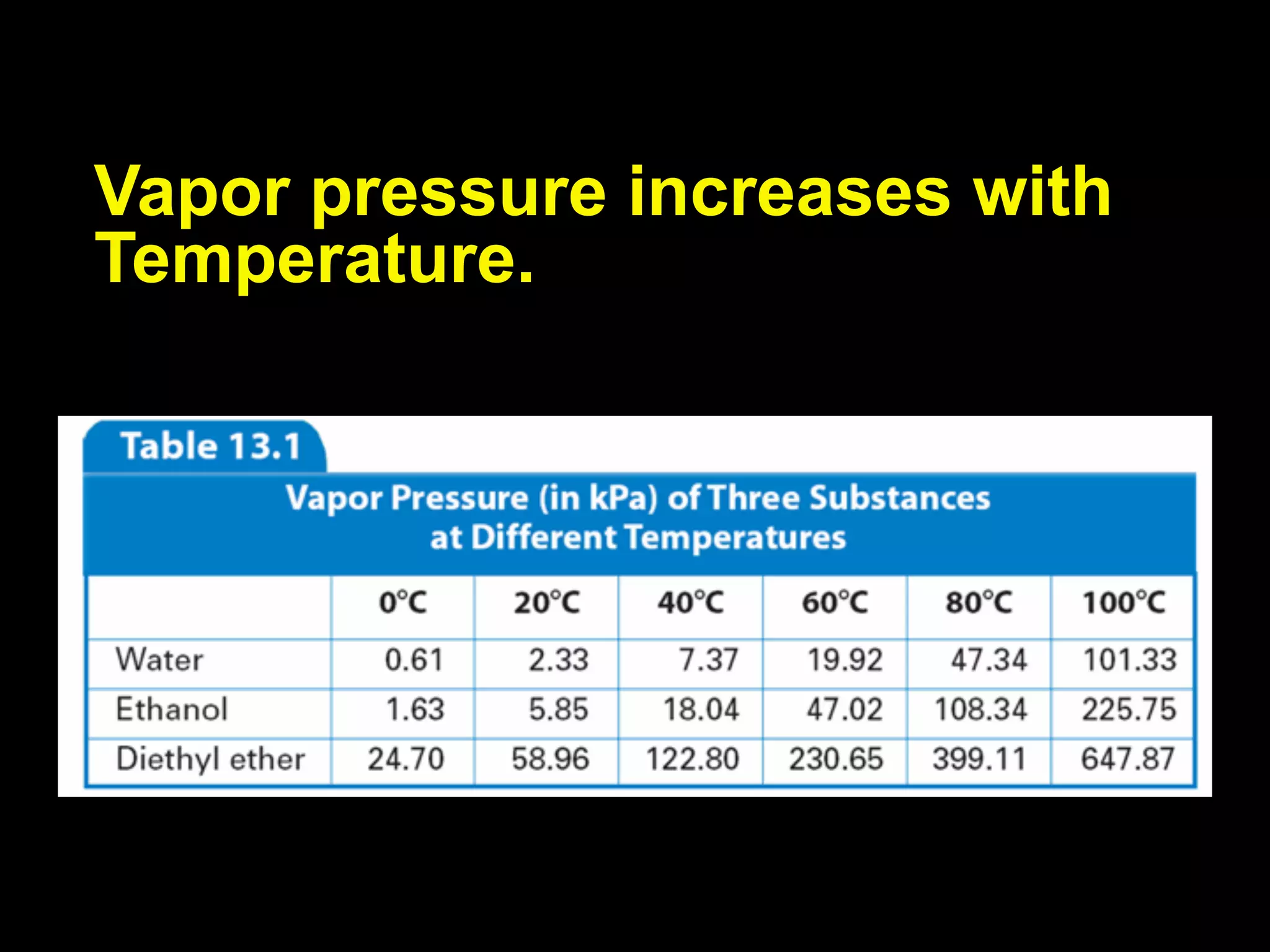
Vapor pressure increases with
Temperature.
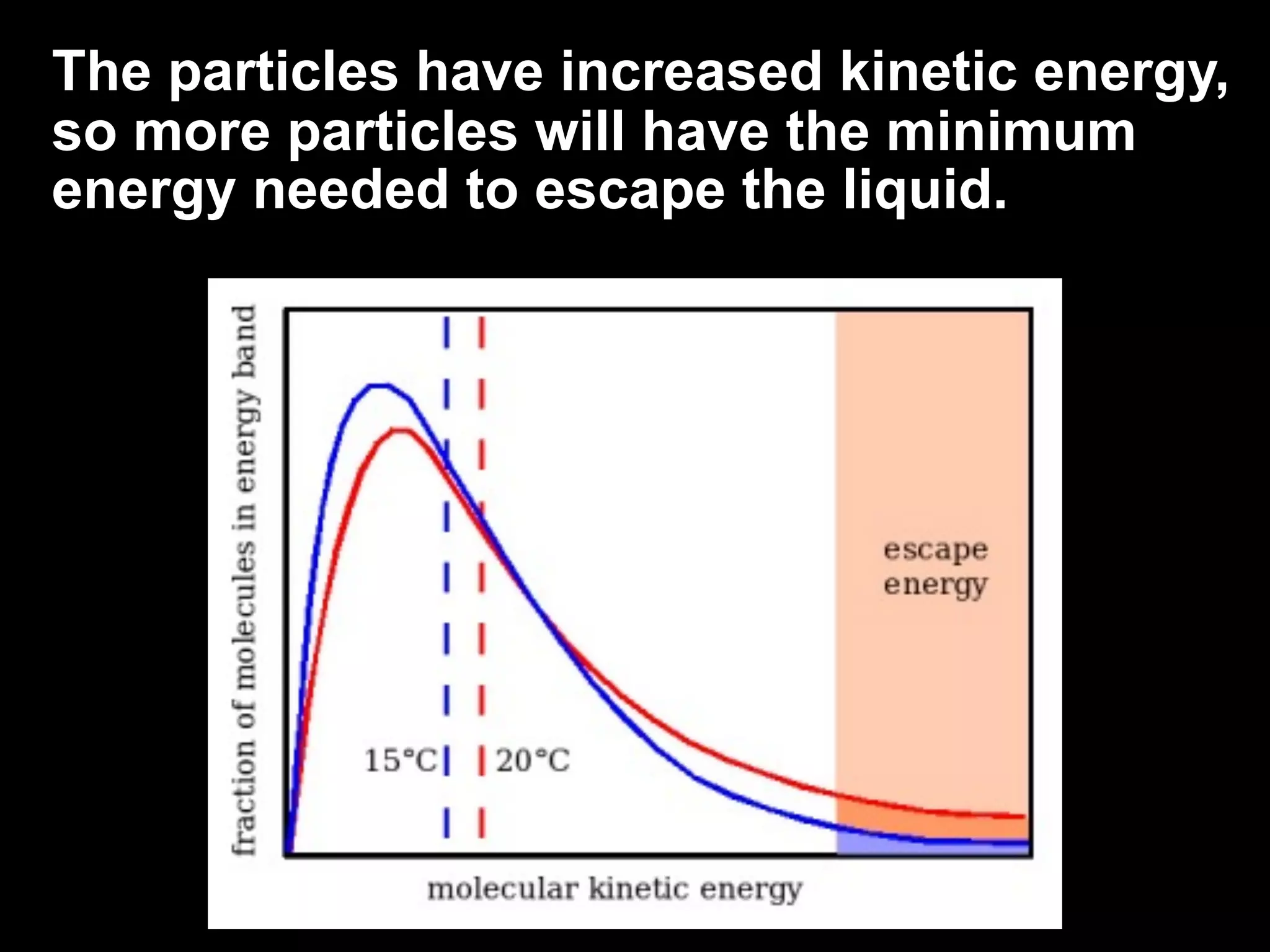
The particles have increased kinetic energy,
so more particles will have the minimum
energy needed to escape the liquid.
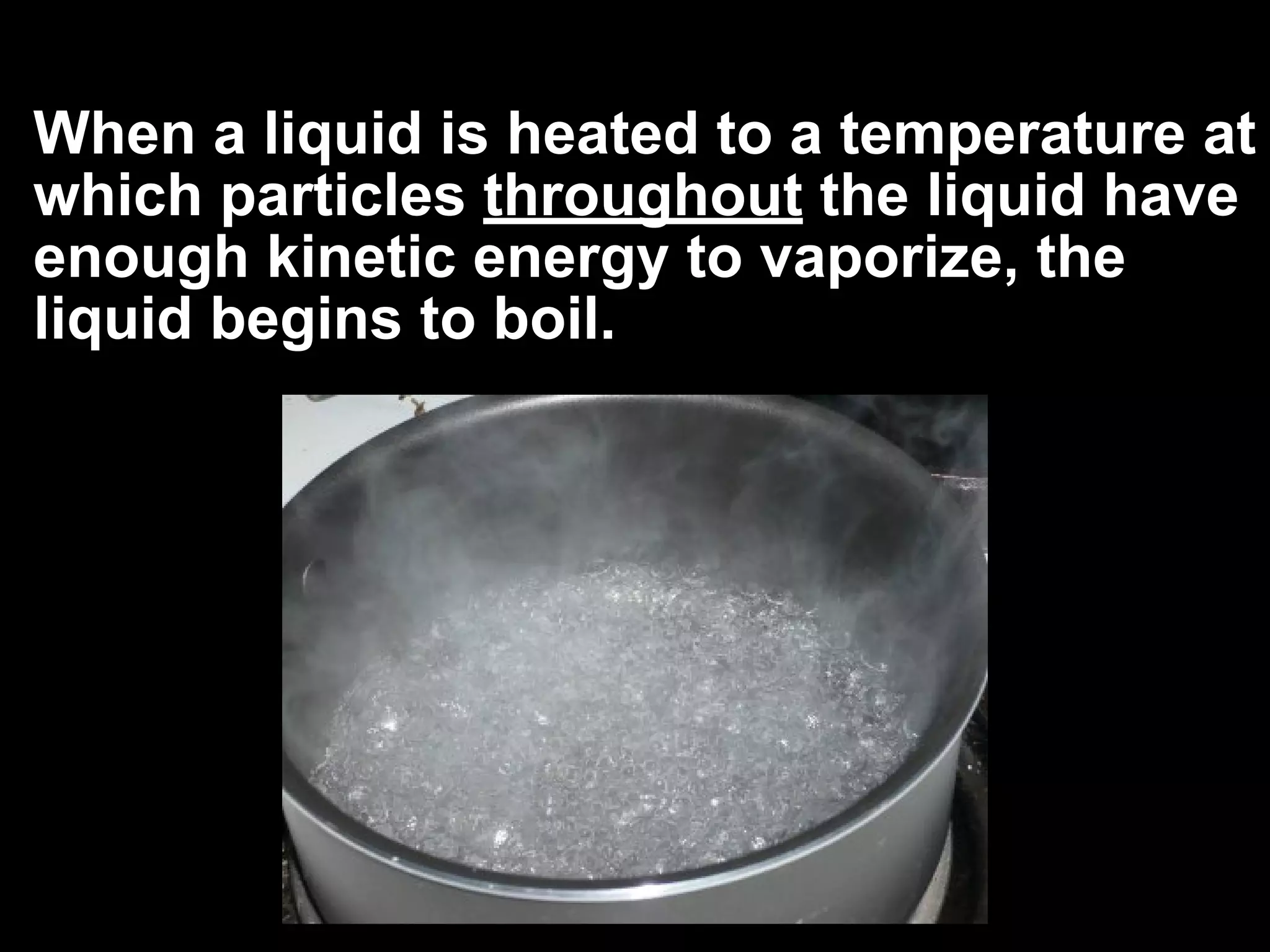
When a liquid is heated to a temperature at
which particles throughout the liquid have
enough kinetic energy to vaporize, the
liquid begins to boil.
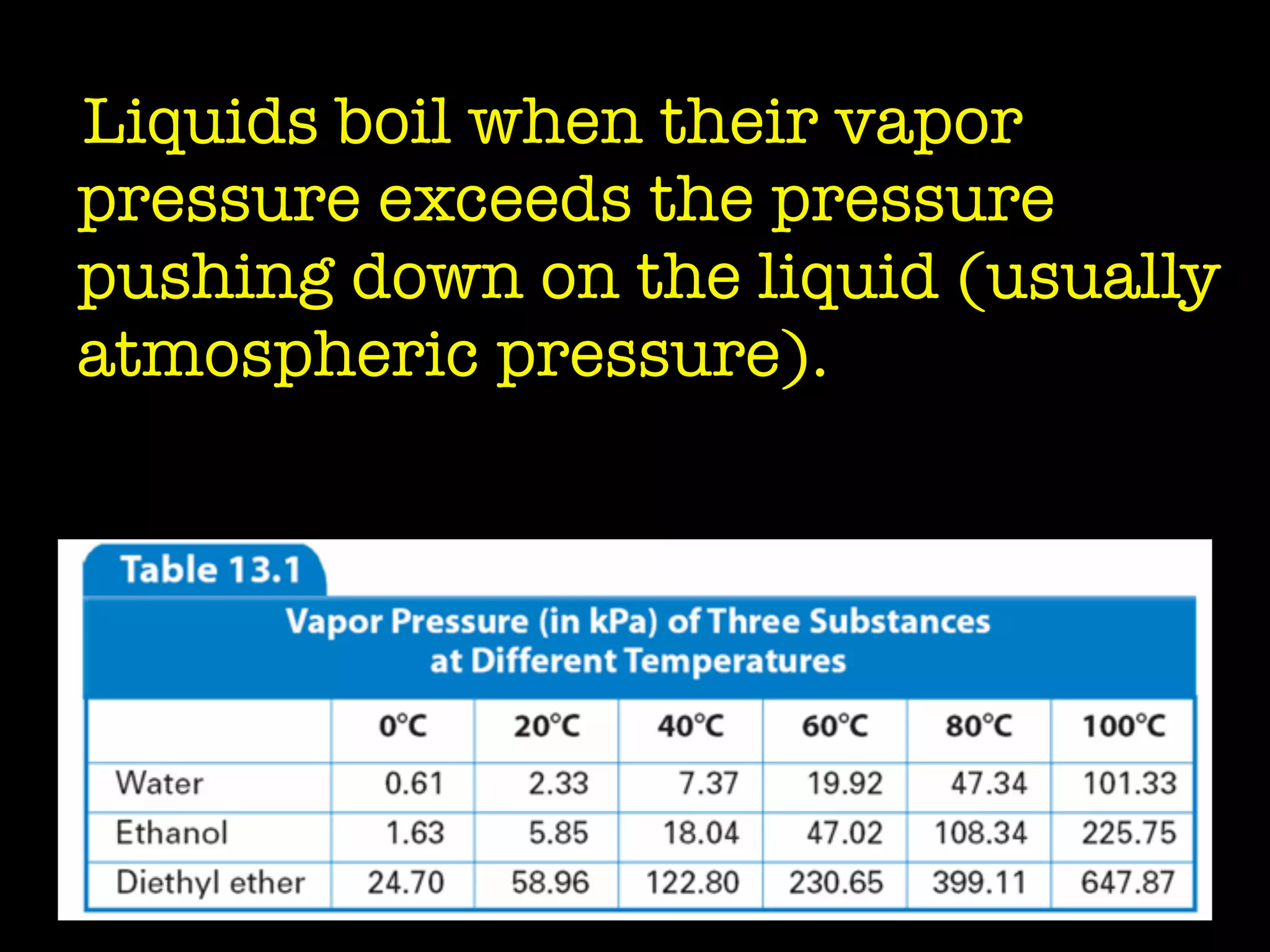
Liquids boil when their vapor
pressure exceeds the pressure
pushing down on the liquid (usually
atmospheric pressure).
13.2
Boiling Point and Pressure Changes
Because a liquid boils when its vapor
pressure is equal to the external pressure,
liquids don’t always boil at the same
temperature.
Boiling Point and Pressure Changes
Because a liquid boils when its vapor
pressure is equal to the external pressure,
liquids don’t always boil at the same
temperature.

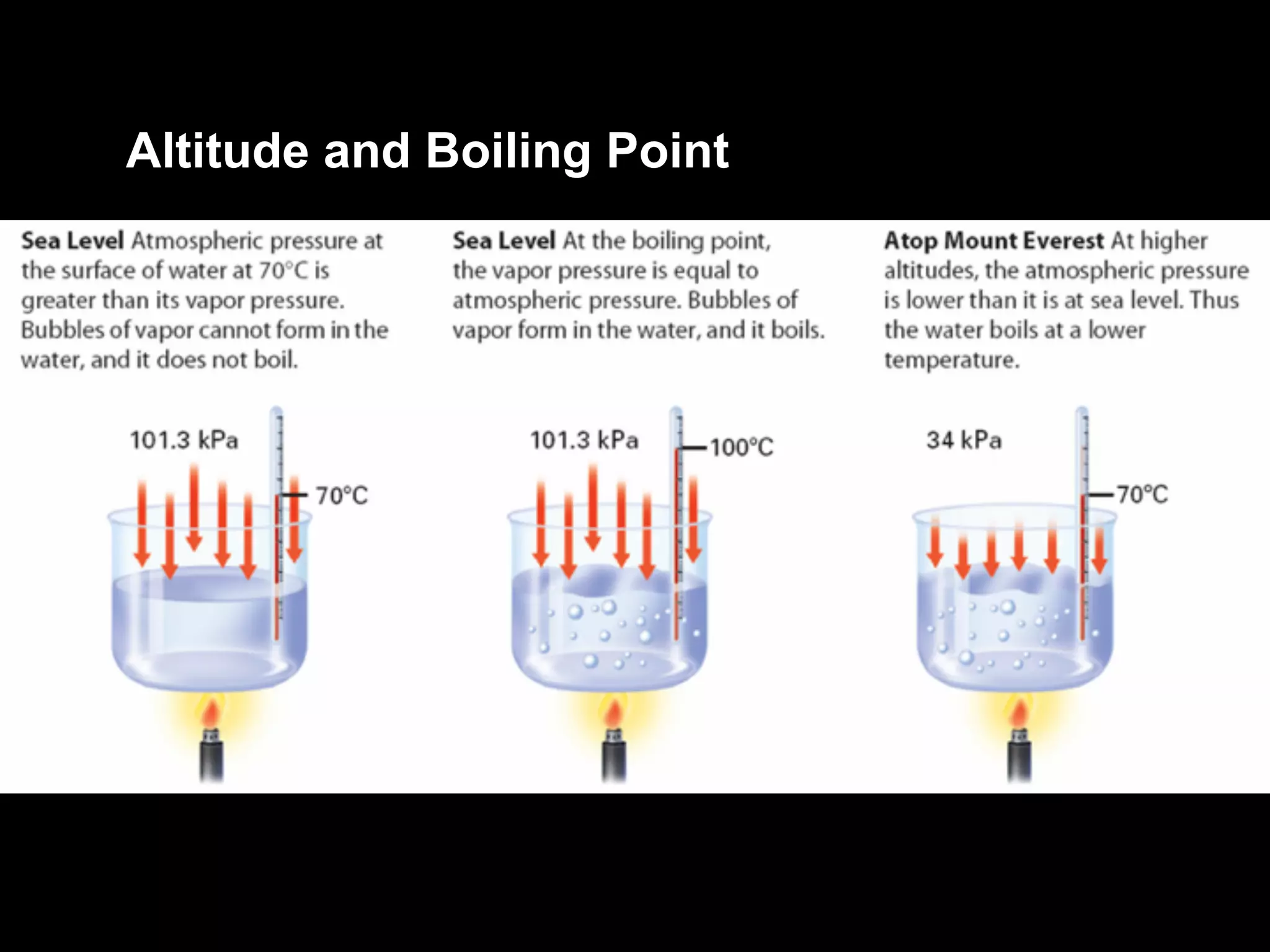
 • At high altitudes, atmospheric
  pressure is low, so water boils cooler
  and food needs longer to cook.
Boiling Point and Pressure Changes
Because a liquid boils when its vapor
pressure is equal to the external pressure,
liquids don’t always boil at the same
temperature.

 • At high altitudes, atmospheric
  pressure is low, so water boils cooler
  and food needs longer to cook.

 • A pressure cooker increases the
  boiling point so food cooks fast.
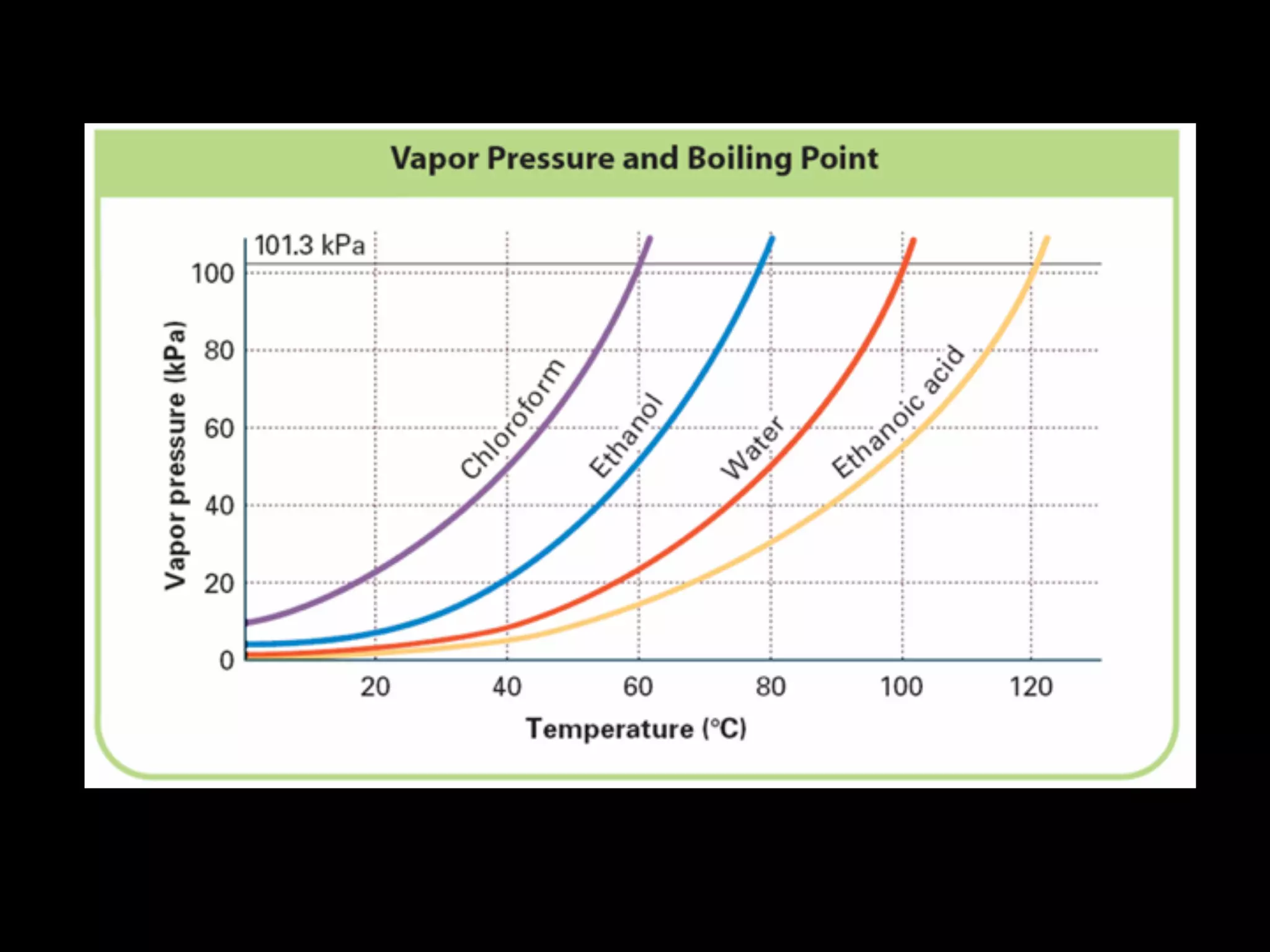
Altitude and Boiling Point
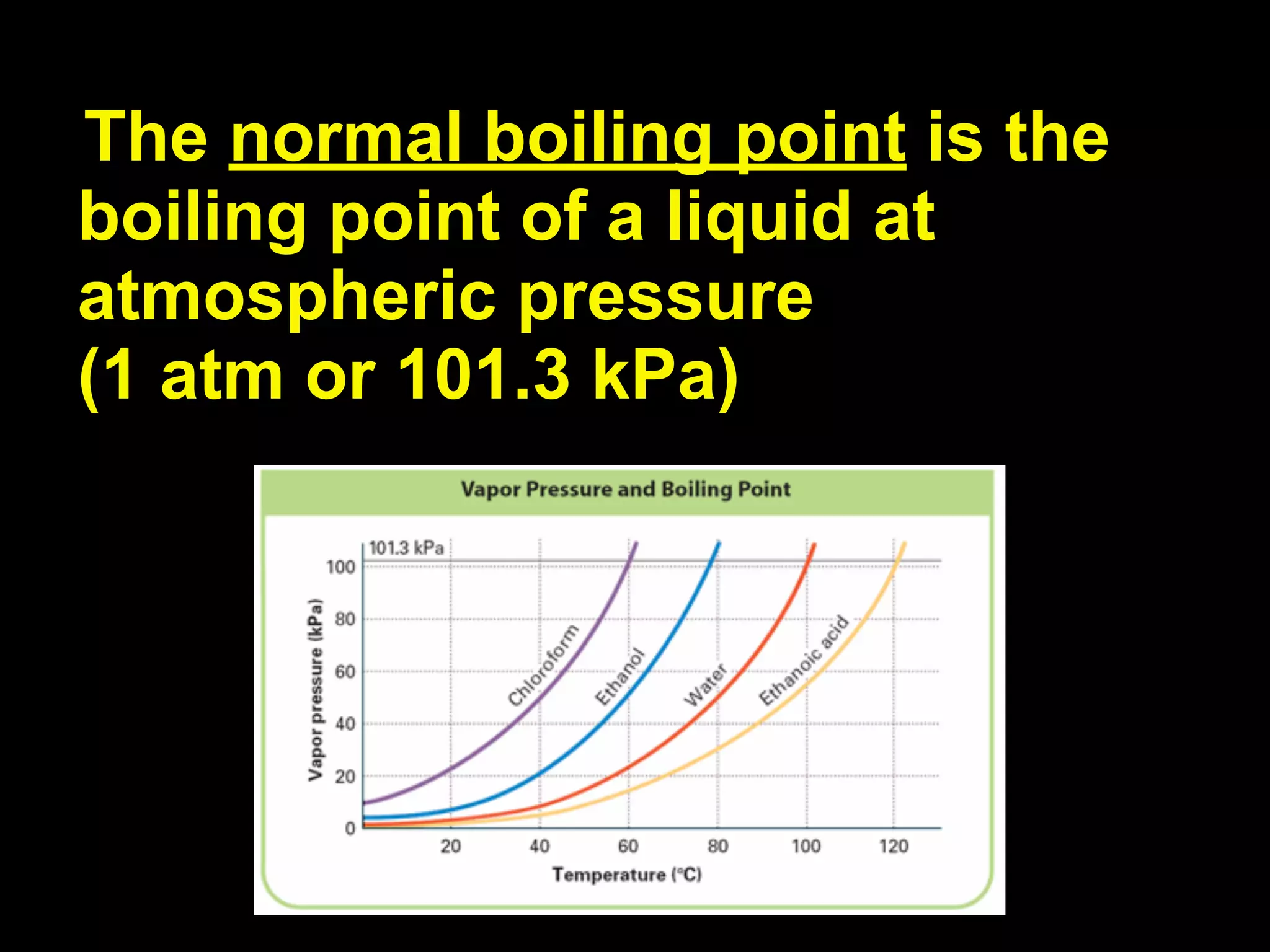
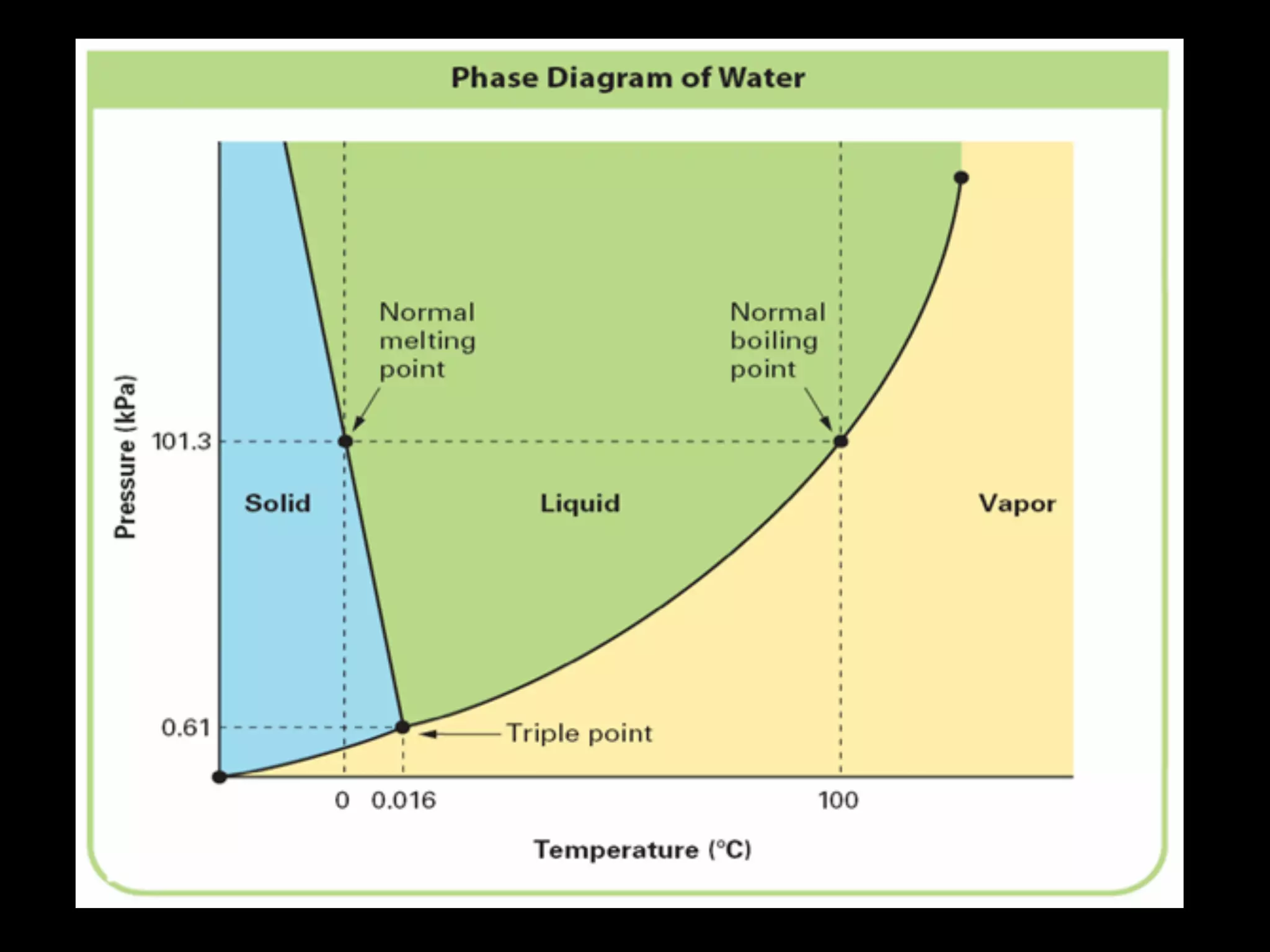
The normal boiling point is the
boiling point of a liquid at
atmospheric pressure
(1 atm or 101.3 kPa)
Section 13.3- Solids
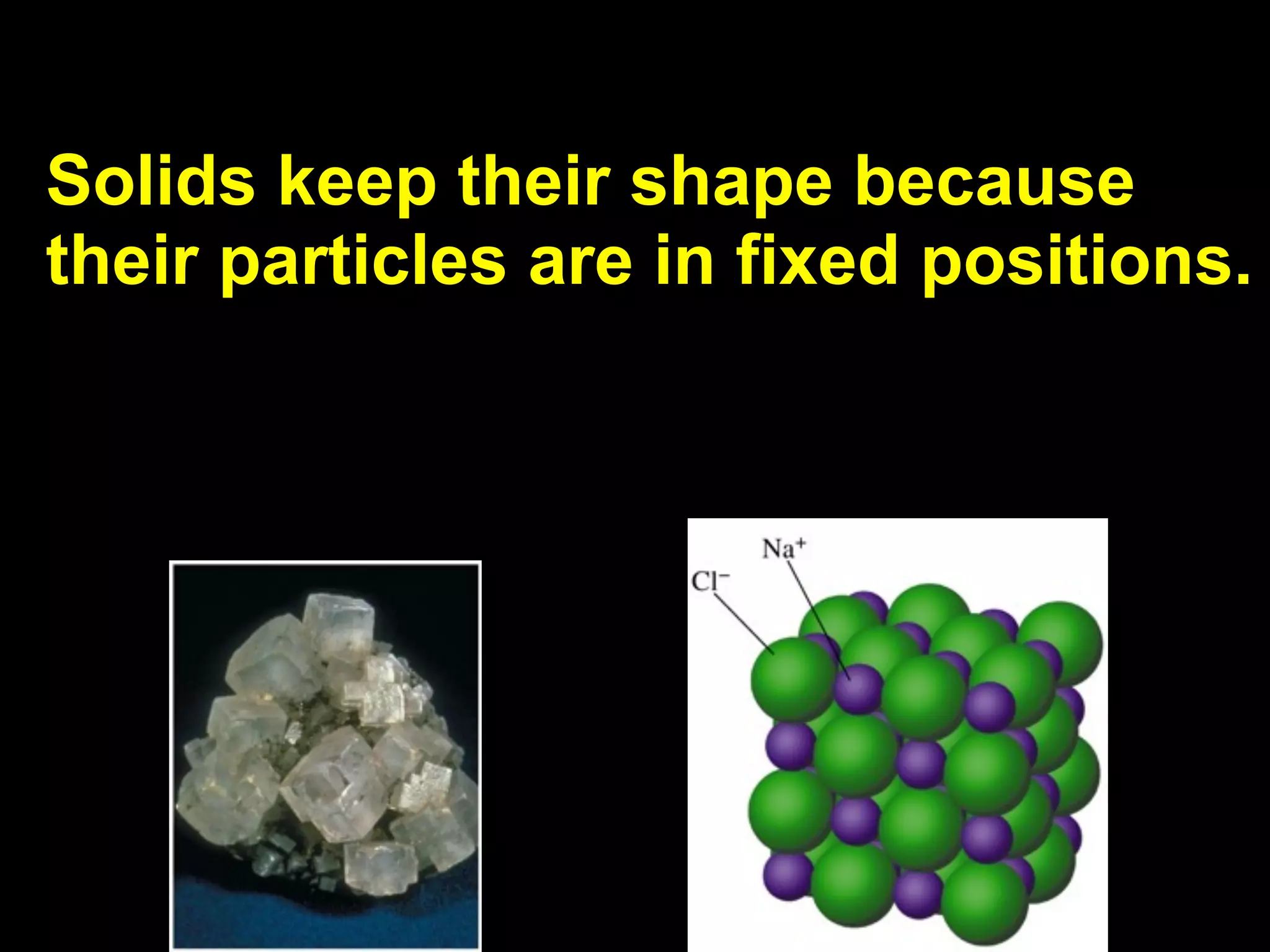
Solids keep their shape because
their particles are in fixed positions.
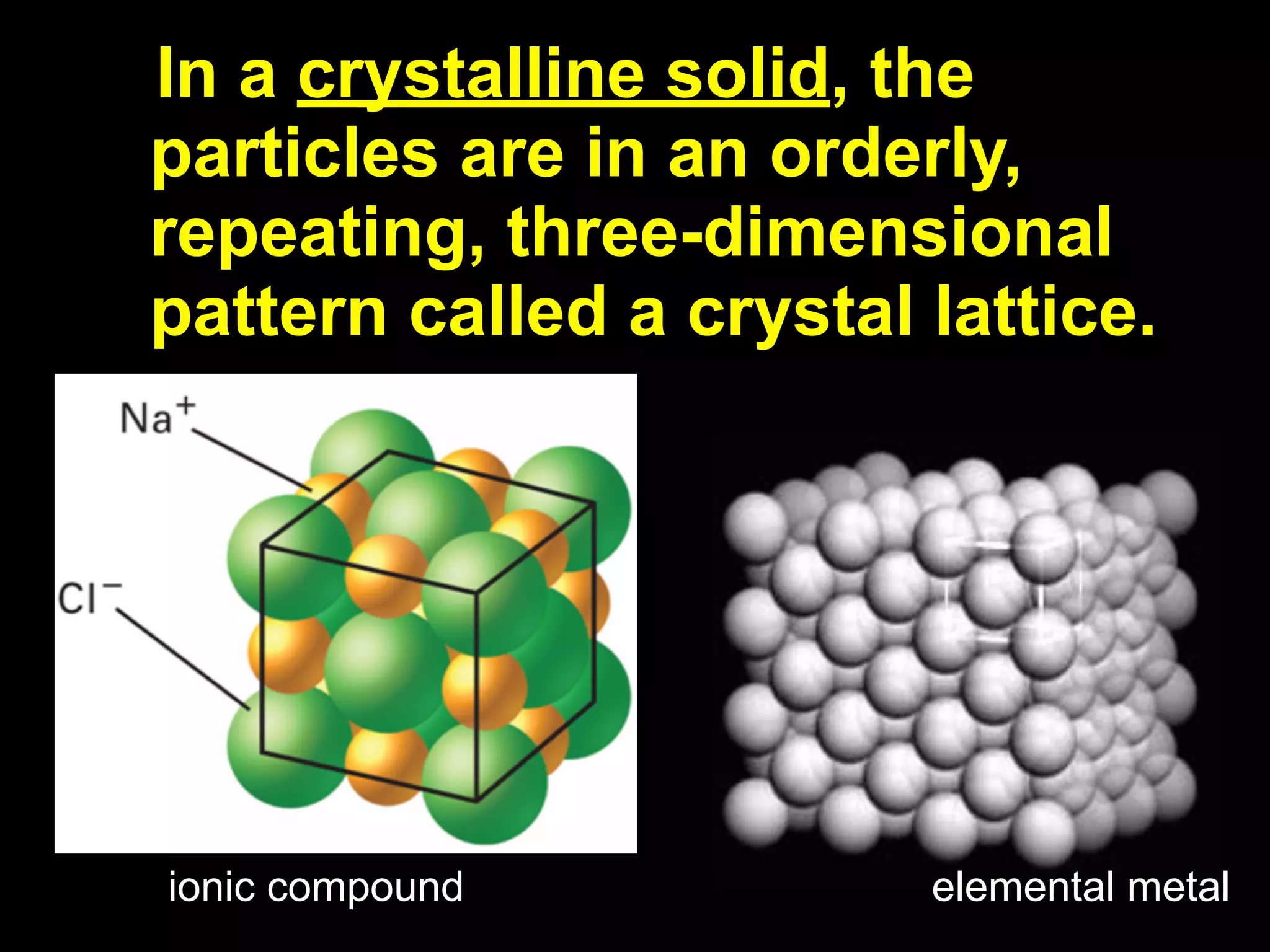
In a crystalline solid, the
particles are in an orderly,
repeating, three-dimensional
pattern called a crystal lattice.


ionic compound           elemental metal
13.3

When an element can make more
than one structure, the different
forms are called allotropes.
13.3

When an element can make more
than one structure, the different
forms are called allotropes.
•Allotropes have different properties
 because their structures are
 different.
13.3

When an element can make more
than one structure, the different
forms are called allotropes.
•Allotropes have different properties
 because their structures are
 different.
• Only a few elements have allotropes.
13.3


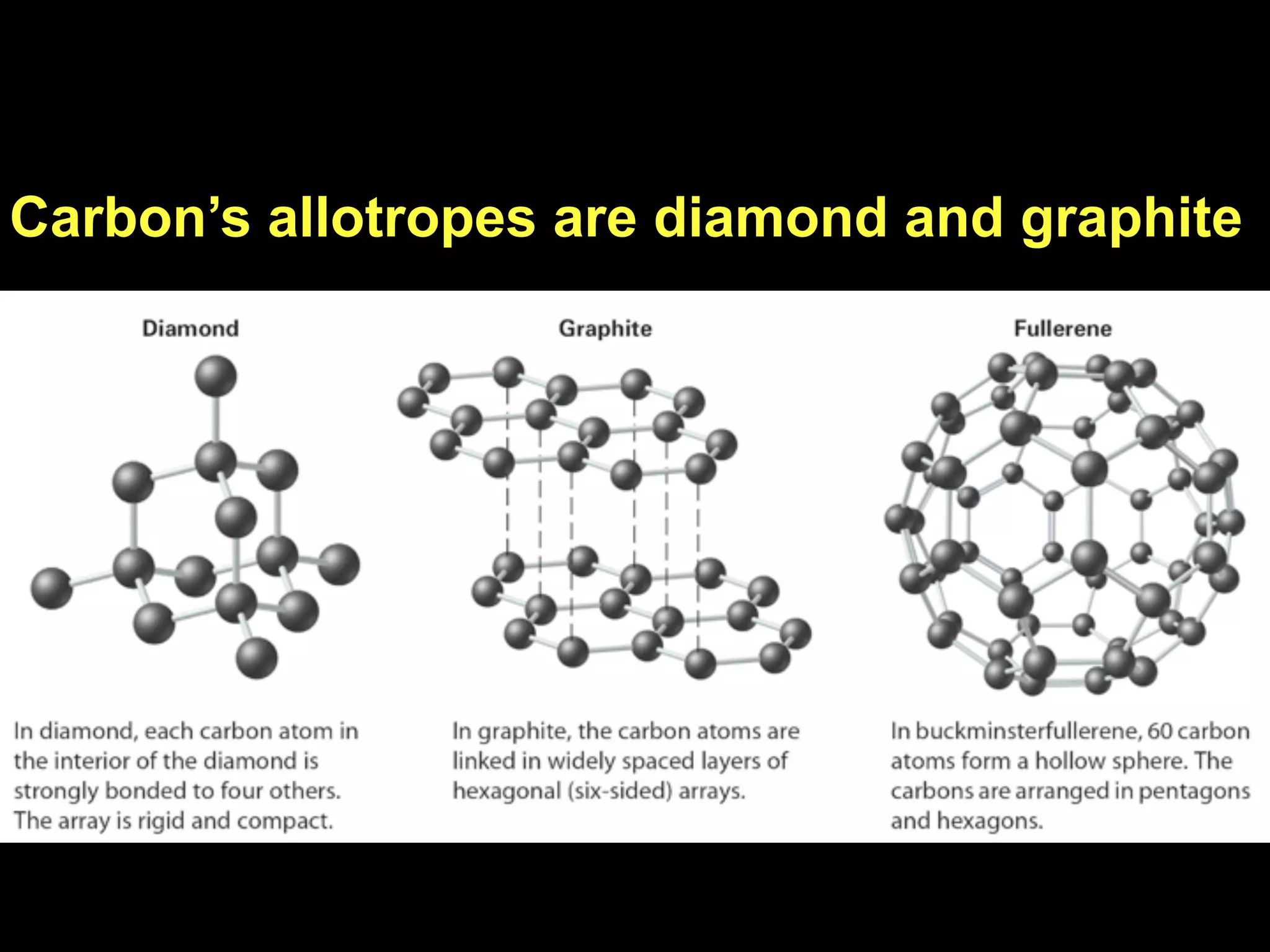
Carbon’s allotropes are diamond and graphite
Non-Crystalline Solids
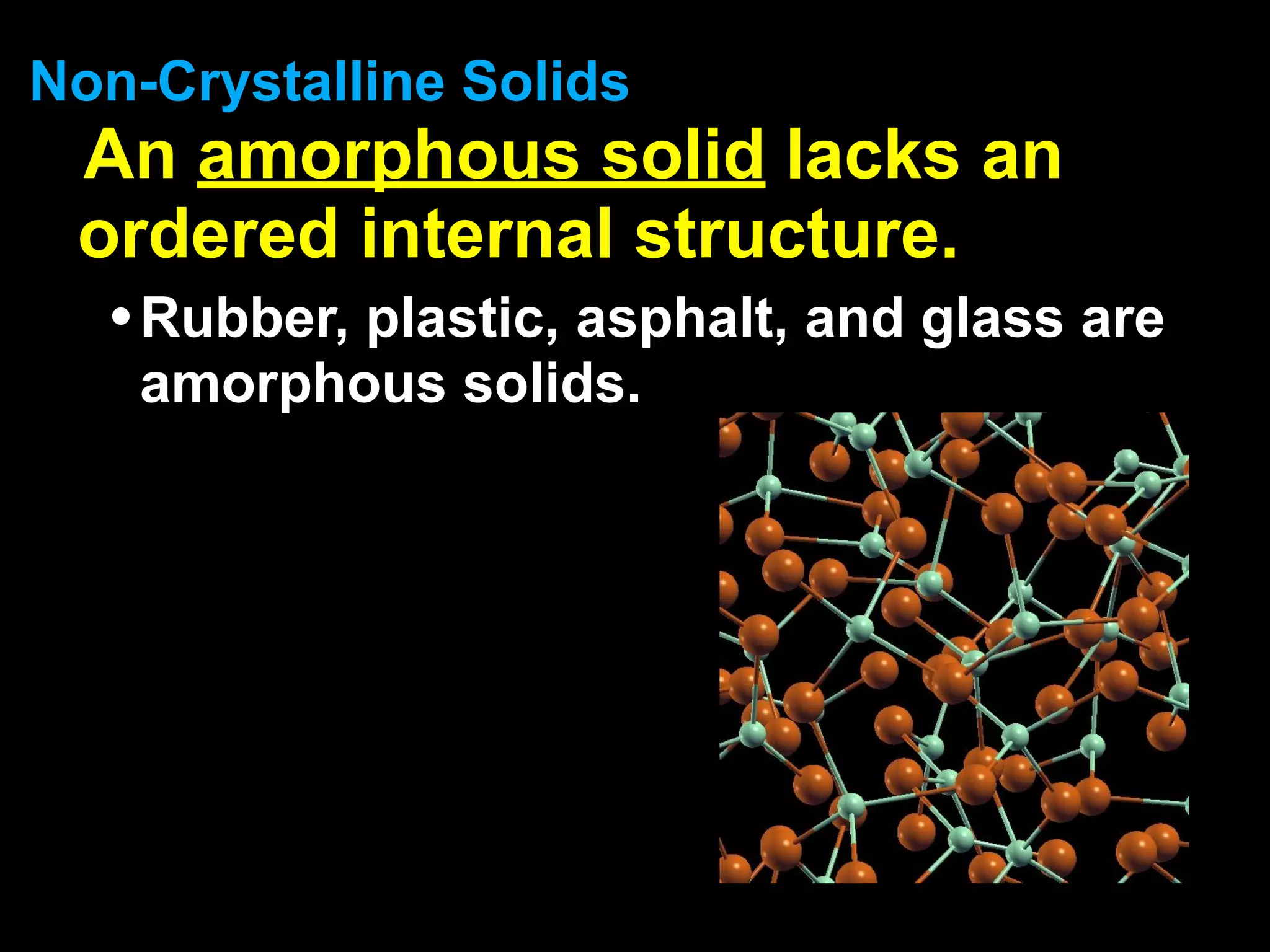
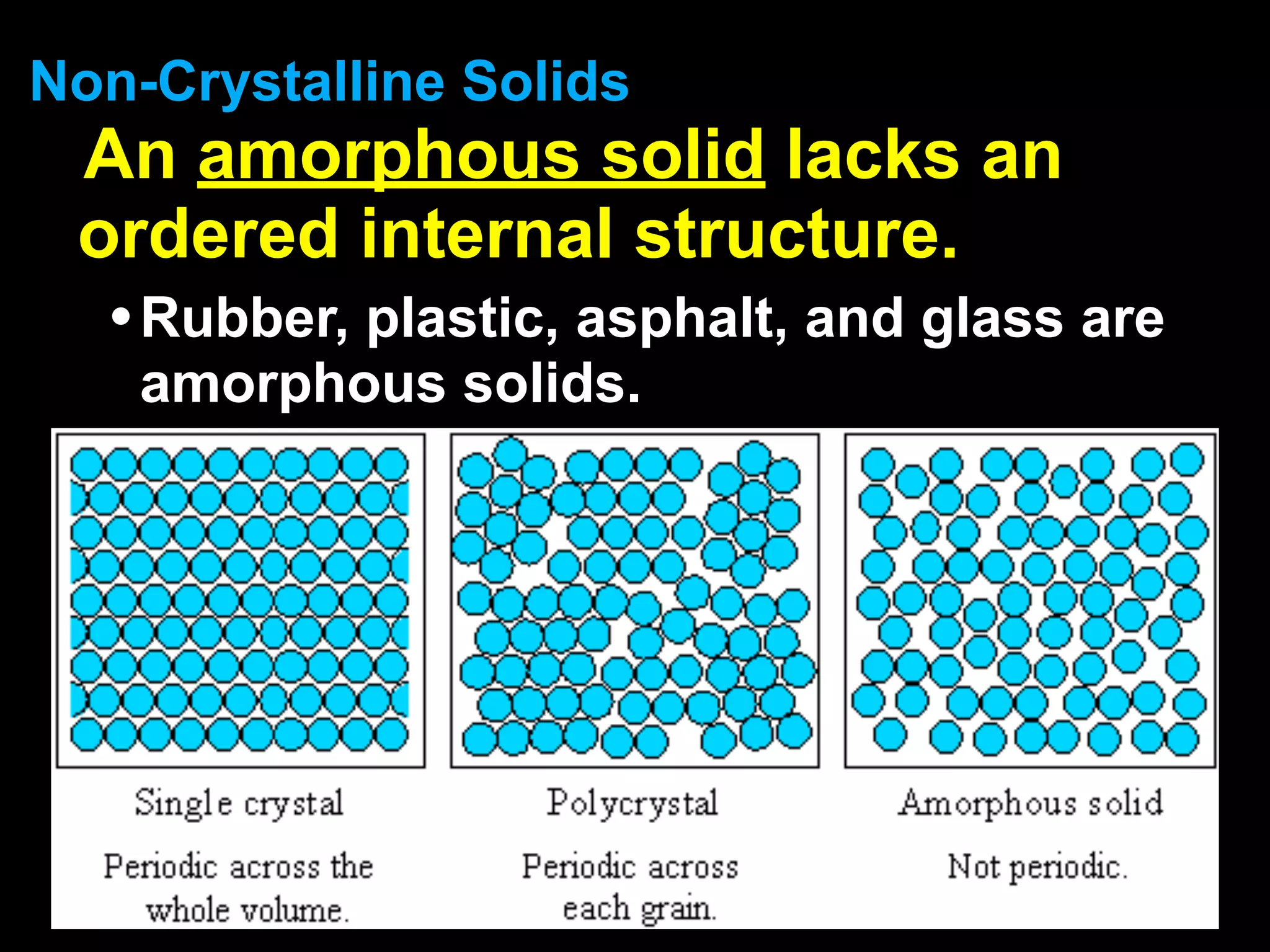
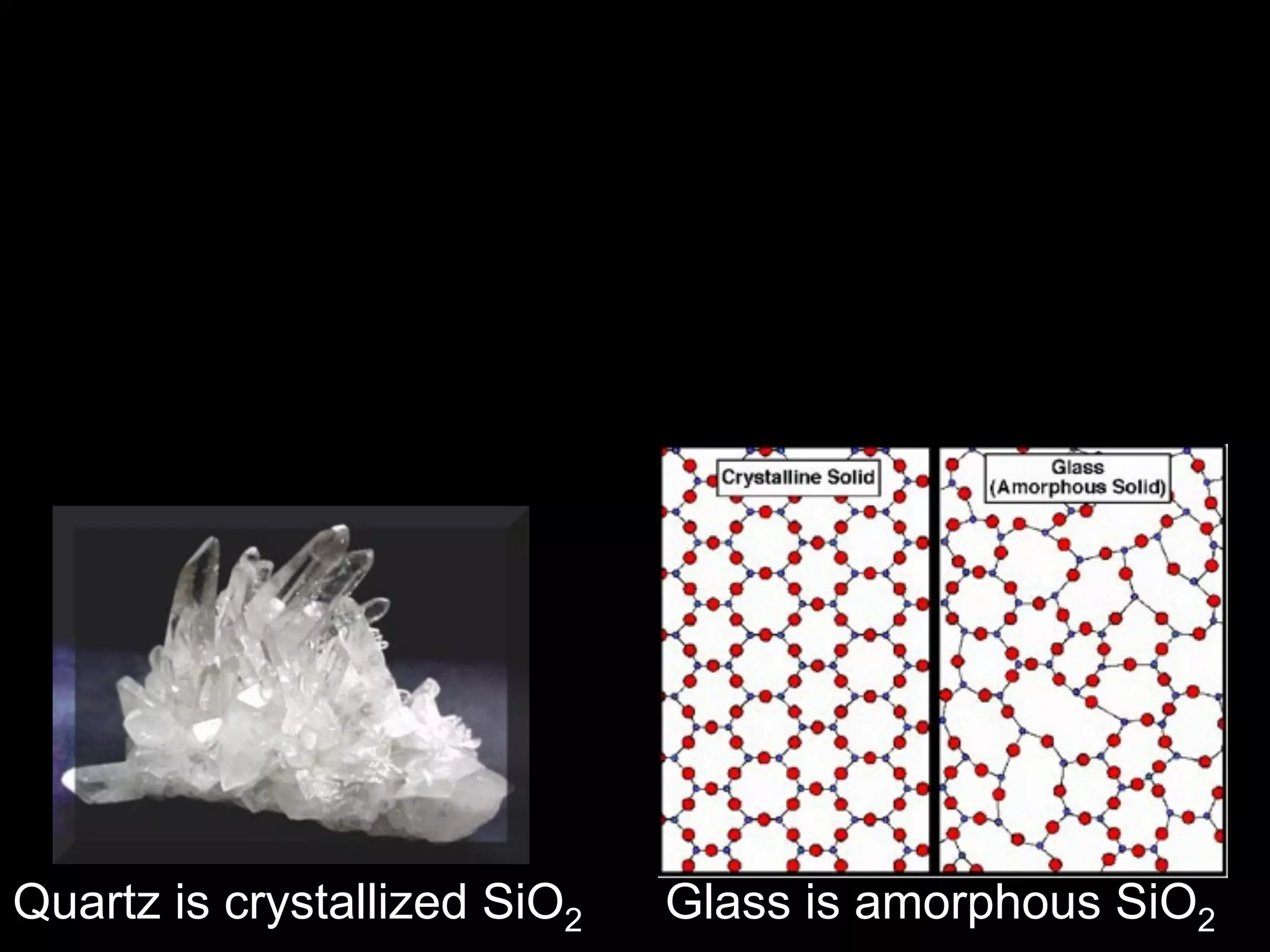
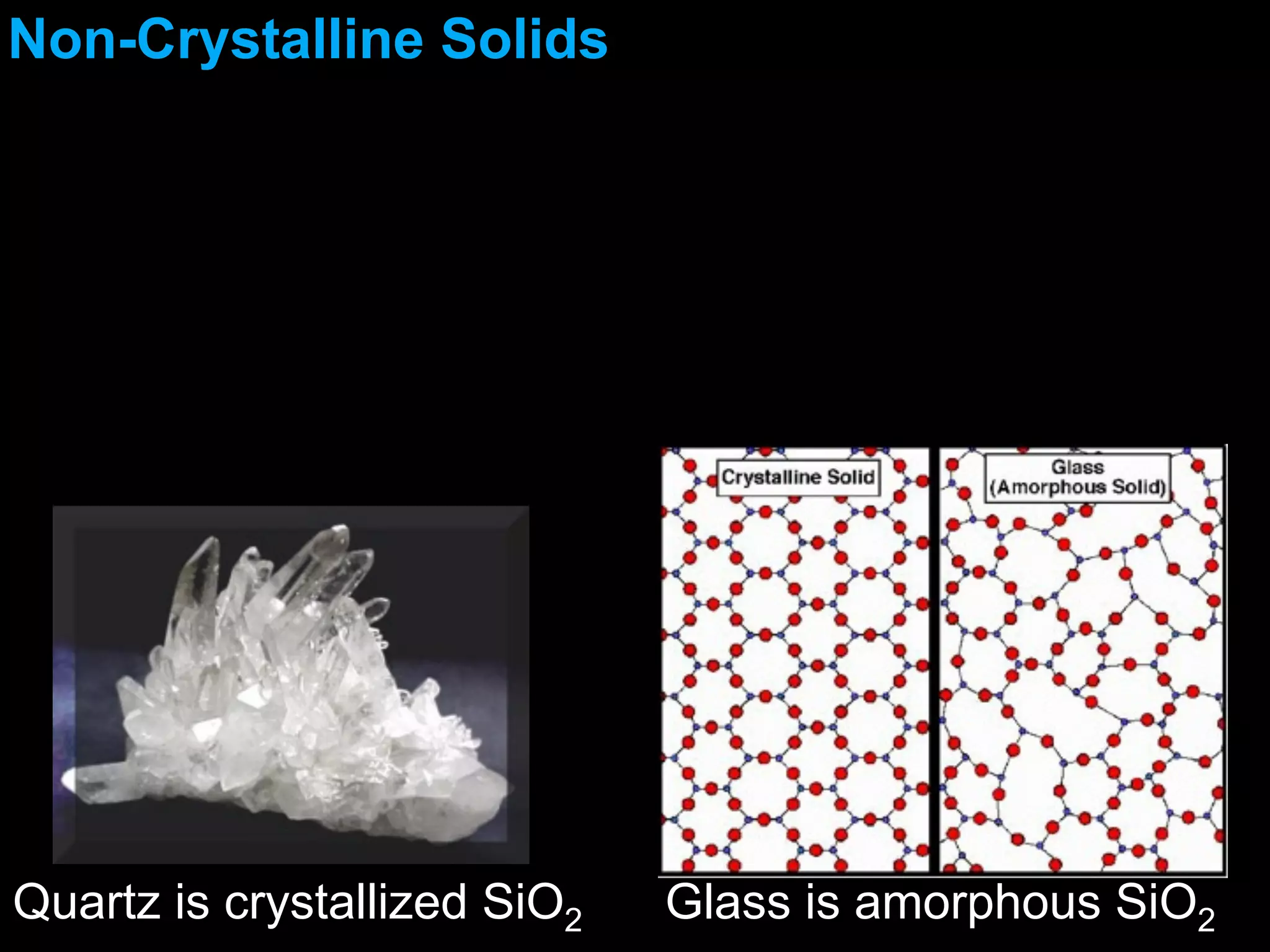
 An amorphous solid lacks an
 ordered internal structure.
  • Rubber, plastic, asphalt, and glass are
    amorphous solids.
Non-Crystalline Solids
 An amorphous solid lacks an
 ordered internal structure.
  • Rubber, plastic, asphalt, and glass are
    amorphous solids.
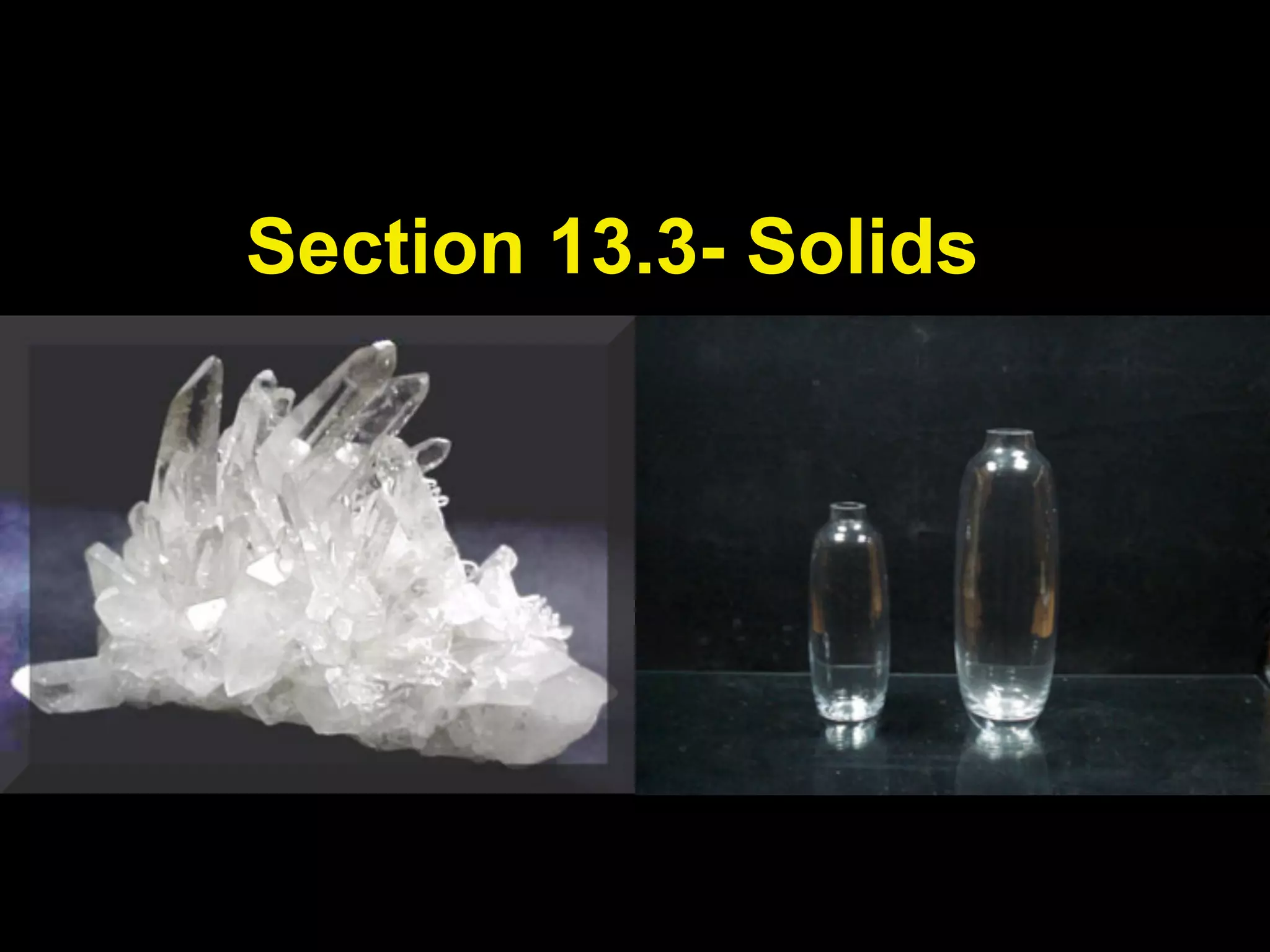
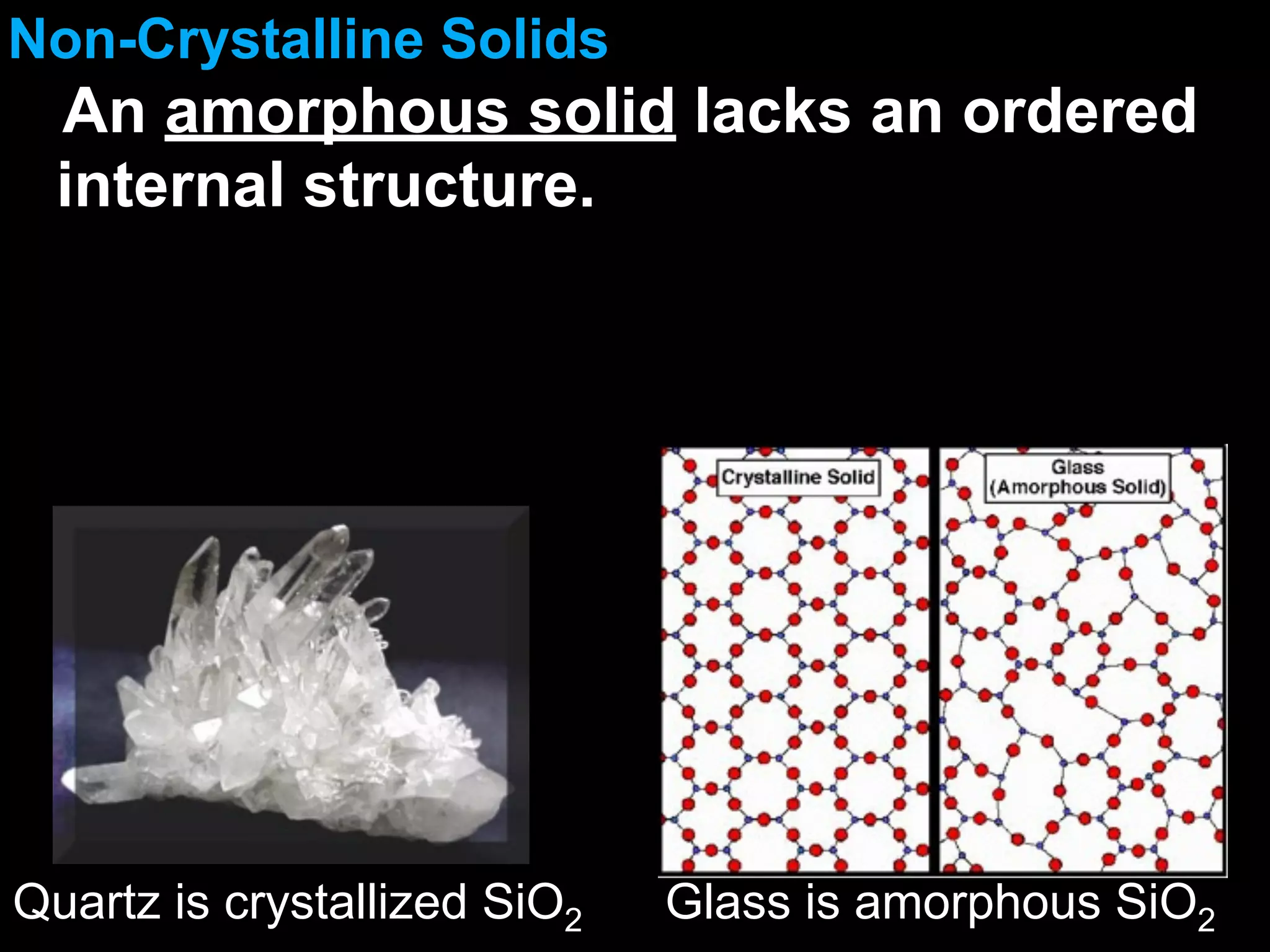
Quartz is crystallized SiO2   Glass is amorphous SiO2
Non-Crystalline Solids


Quartz is crystallized SiO2   Glass is amorphous SiO2
Non-Crystalline Solids
  An amorphous solid lacks an ordered
  internal structure.


Quartz is crystallized SiO2   Glass is amorphous SiO2
Non-Crystalline Solids
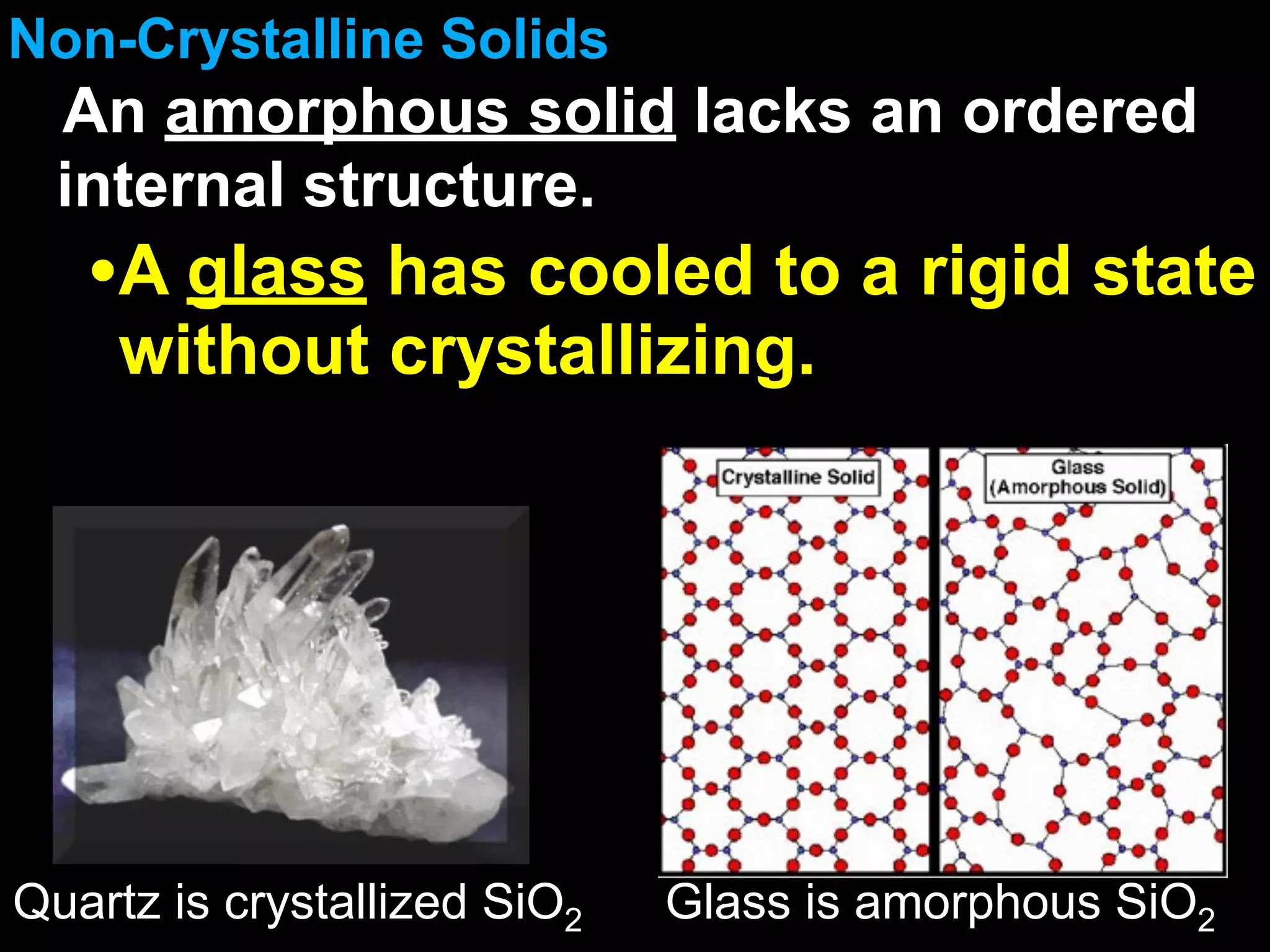
  An amorphous solid lacks an ordered
  internal structure.
   •A glass has cooled to a rigid state
     without crystallizing.


Quartz is crystallized SiO2   Glass is amorphous SiO2
13.4
13.4


The change of a substance from a solid
to a vapor without passing through the
liquid state is called sublimation.
       Sublimation occurs in solids with
       vapor pressures that exceed
       atmospheric pressure at or near
       room temperature.
13.4


The change of a substance from a solid
to a vapor without passing through the
liquid state is called sublimation.
       Sublimation occurs in solids with
       vapor pressures that exceed
       atmospheric pressure at or near
       room temperature.
Chapter 13 Lecture

  • 1.
    Bellwork -State Changes Waterexists on Earth as a liquid, a solid, and a vapor. As water cycles through the atmosphere, the oceans, and Earth’s crust, it undergoes repeated changes of state. You will learn what conditions can control the state of a substance. BELLWORK-name the following phase changes: a)Solid to liquid b) liquid to solid c)Liquid to gas d) gas to liquid e) Solid to gas
  • 2.
    Melting - solidto liquid Freezing- liquid to solid Vaporization- liquid to gas Vapor- a gas that is usually a liquid at room temp Condensation- changing from a gas to a liquid
  • 3.
    Chapter 13- Statesof Matter Intro to Gases The skunk releases its spray! Within seconds you smell that all-too-familiar foul odor. You will discover some general characteristics of gases that help explain how odors travel through the air, even on a windless day.
  • 4.
    13.1 The Kinetic MolecularTheory explains the behavior of gases.
  • 6.
    The word kineticrefers to motion.
  • 7.
    The word kineticrefers to motion. •The energy an object has because of its motion is called kinetic energy.
  • 8.
    The word kineticrefers to motion. •The energy an object has because of its motion is called kinetic energy. • According to the kinetic theory, all matter consists of tiny particles that are in constant motion.
  • 9.
  • 10.
    Kinetic Molecular Theory:GASES • The particles in a gas are small, hard spheres with an insignificant volume.
  • 11.
    Kinetic Molecular Theory:GASES • The particles in a gas are small, hard spheres with an insignificant volume. • The motion of gas particles is rapid, constant, and random.
  • 12.
    Kinetic Molecular Theory:GASES • The particles in a gas are small, hard spheres with an insignificant volume. • The motion of gas particles is rapid, constant, and random. • All collisions between gas particles are perfectly elastic (no energy lost).
  • 13.
    13.1 Gas particles arein rapid, constant motion.
  • 14.
    13.1 Gas particles travelin straight-line paths. Gas particles move randomly.
  • 15.
    13.1 A gas fillsits container.
  • 16.
  • 17.
    13.1 Pressure = Force/Area A force is a push or a pull. Same force more less area area more pressure!
  • 19.
    Which would youprefer? Why?
  • 20.
  • 21.
    13.1 Kinetic theory explainsgas pressure. Gas pressure is the force exerted by gas particles hitting the surface of an object.
  • 22.
    13.1 Kinetic theoryexplains gas pressure. Gas pressure can KILL!
  • 24.
    An empty spacewith no particles and no pressure is called a vacuum.
  • 25.
    Atmospheric pressure isthe pressure created by the earth’s gravitational pull on the gases in our atmosphere.
  • 26.
    Gas pressure isexerted in all directions.
  • 27.
    A barometer isa device that is used to measure atmospheric pressure.
  • 28.
    Pressure Poem An emptywater bottle, closed tightly at high elevation, will be crushed by the atmosphere at sea level.
  • 29.
    13.1 Units of Pressure • The SI unit of pressure is the pascal (Pa). • One standard atmosphere (atm) is the atmospheric pressure at sea level.
  • 30.
  • 31.
  • 32.
  • 33.
    13.1 atm 450 kPa x kPa
  • 34.
    13.1 1 atm 450 kPa x 101.3 kPa
  • 35.
    13.1 1 atm 450 kPa x = 4.4 atm 101.3 kPa
  • 36.
    13.1 1 atm 450 kPa x = 4.4 atm 101.3 kPa 450 kPa x
  • 37.
    13.1 1 atm 450 kPa x = 4.4 atm 101.3 kPa 450 kPa x kPa
  • 38.
    13.1 1 atm 450 kPa x = 4.4 atm 101.3 kPa mm Hg 450 kPa x kPa
  • 39.
    13.1 1 atm 450 kPa x = 4.4 atm 101.3 kPa 760 mm Hg 450 kPa x 101.3 kPa
  • 40.
    13.1 1 atm 450 kPa x = 4.4 atm 101.3 kPa 760 mm Hg = 3400mm Hg 450 kPa x 101.3 kPa
  • 41.
  • 42.
    Particles at agiven temperature have a wide range of kinetic energies. Most of the particles have kinetic energies in the middle of this range.
  • 43.
    Particles at agiven temperature have a wide range of kinetic energies. Most of the particles have kinetic energies in the middle of this range.
  • 44.
    Particles at agiven temperature have a wide range of kinetic energies. Most of the particles have kinetic energies in the middle of this range. Temperature measures Average Kinetic Energy
  • 45.
    13.1 The Kelvin temperatureof a substance is directly proportional to average kinetic energy.
  • 46.
    13.1 The Kelvin temperatureof a substance is directly proportional to average kinetic energy. The higher the kinetic energy, the higher the temperature.
  • 47.
    13.1 Two substances withthe same average kinetic energy are at the same temperature. Two substances at the same temperature have the same average kinetic energy.
  • 48.
    13.1 Absolute zero (0K, or –273.15°C) is the temperature at which the motion of particles theoretically stops.
  • 49.
    13.1 Absolute zero (0K, or –273.15°C) is the temperature at which the motion of particles theoretically stops. •Particles would have no kinetic energy at absolute zero.
  • 50.
    13.1 Absolute zero (0K, or –273.15°C) is the temperature at which the motion of particles theoretically stops. •Particles would have no kinetic energy at absolute zero. • Absolute zero has never been produced in the laboratory (and not for lack of trying!).
  • 51.
    Bellwork- Kinetic Energy •Whatis kinetic energy? •How is average kinetic energy related to temperature? •Which has higher kinetic energy, an olympic size pool of water or a cup of hot coffee?
  • 52.
    13.2 Substances that canflow are referred to as fluids. Both liquids and gases are fluids.
  • 53.
    13.2 The intermolecular attractions (IMFs)are counteracted by motion of molecules. Together they determine the physical properties of liquids. High IMFs promote a solid state High temps (motion) promote a gas state.
  • 54.
    13.2 If the liquid is not boiling it is called evaporation.
  • 55.
    13.2 When aliquid converts to a gas it is called vaporization. If the liquid is not boiling it is called evaporation.
  • 56.
    13.2 When aliquid converts to a gas it is called vaporization. If the liquid is not boiling it is called evaporation.
  • 57.
    13.2 When aliquid converts to a gas it is called vaporization. If the liquid is not boiling it is called evaporation.
  • 58.
    13.2 In a closedcontainer, evaporated molecules collect as a vapor above any liquid. Vapor pressure is the force exerted by a gas above a liquid.
  • 59.
    During evaporation, onlymolecules with a certain minimum kinetic energy can escape from the surface of the liquid.
  • 60.
    During evaporation, onlymolecules with a certain minimum kinetic energy can escape from the surface of the liquid.
  • 61.
    During evaporation, onlymolecules with a certain minimum kinetic energy can escape from the surface of the liquid. Evaporation is a cooling process because the molecules with the highest kinetic energy escape.
  • 62.
    13.2 In an opencontainer, molecules that evaporate can escape from the container.
  • 63.
    Some evaporated moleculeswill condense back into a liquid.
  • 64.
    Some evaporated moleculeswill condense back into a liquid.
  • 65.
    Some evaporated moleculeswill condense back into a liquid. A dynamic equilibrium exists between the vapor and the liquid. The system is in equilibrium when the rate of evaporation equals the rate of condensation.
  • 67.
  • 68.
    DYNAMIC EQUILIBRIUM For each molecule that evaporatesa different molecule returns to the liquid.
  • 69.
    DYNAMIC EQUILIBRIUM For each molecule that evaporatesa different molecule returns to the liquid. SAME RATES!!
  • 71.
  • 72.
  • 73.
    DYNAMIC EQUILIBRIUM Equilibrium- The amount of liquidand vapor do not change. Dynamic- There is a constant turnover of particles.
  • 74.
  • 76.
    The particles haveincreased kinetic energy, so more particles will have the minimum energy needed to escape the liquid.
  • 77.
    When a liquidis heated to a temperature at which particles throughout the liquid have enough kinetic energy to vaporize, the liquid begins to boil.
  • 78.
    Liquids boil whentheir vapor pressure exceeds the pressure pushing down on the liquid (usually atmospheric pressure).
  • 79.
  • 81.
    Boiling Point andPressure Changes
  • 82.
    Boiling Point andPressure Changes Because a liquid boils when its vapor pressure is equal to the external pressure, liquids don’t always boil at the same temperature.
  • 83.
    Boiling Point andPressure Changes Because a liquid boils when its vapor pressure is equal to the external pressure, liquids don’t always boil at the same temperature. • At high altitudes, atmospheric pressure is low, so water boils cooler and food needs longer to cook.
  • 84.
    Boiling Point andPressure Changes Because a liquid boils when its vapor pressure is equal to the external pressure, liquids don’t always boil at the same temperature. • At high altitudes, atmospheric pressure is low, so water boils cooler and food needs longer to cook. • A pressure cooker increases the boiling point so food cooks fast.
  • 85.
  • 86.
    The normal boilingpoint is the boiling point of a liquid at atmospheric pressure (1 atm or 101.3 kPa)
  • 88.
  • 89.
    Solids keep theirshape because their particles are in fixed positions.
  • 90.
    In a crystallinesolid, the particles are in an orderly, repeating, three-dimensional pattern called a crystal lattice. ionic compound elemental metal
  • 91.
    13.3 When an elementcan make more than one structure, the different forms are called allotropes.
  • 92.
    13.3 When an elementcan make more than one structure, the different forms are called allotropes. •Allotropes have different properties because their structures are different.
  • 93.
    13.3 When an elementcan make more than one structure, the different forms are called allotropes. •Allotropes have different properties because their structures are different. • Only a few elements have allotropes.
  • 94.
    13.3 Carbon’s allotropes arediamond and graphite
  • 95.
    Non-Crystalline Solids Anamorphous solid lacks an ordered internal structure. • Rubber, plastic, asphalt, and glass are amorphous solids.
  • 96.
    Non-Crystalline Solids Anamorphous solid lacks an ordered internal structure. • Rubber, plastic, asphalt, and glass are amorphous solids.
  • 97.
    Quartz is crystallizedSiO2 Glass is amorphous SiO2
  • 98.
    Non-Crystalline Solids Quartz iscrystallized SiO2 Glass is amorphous SiO2
  • 99.
    Non-Crystalline Solids An amorphous solid lacks an ordered internal structure. Quartz is crystallized SiO2 Glass is amorphous SiO2
  • 100.
    Non-Crystalline Solids An amorphous solid lacks an ordered internal structure. •A glass has cooled to a rigid state without crystallizing. Quartz is crystallized SiO2 Glass is amorphous SiO2
  • 101.
  • 102.
    13.4 The change ofa substance from a solid to a vapor without passing through the liquid state is called sublimation. Sublimation occurs in solids with vapor pressures that exceed atmospheric pressure at or near room temperature.
  • 103.
    13.4 The change ofa substance from a solid to a vapor without passing through the liquid state is called sublimation. Sublimation occurs in solids with vapor pressures that exceed atmospheric pressure at or near room temperature.