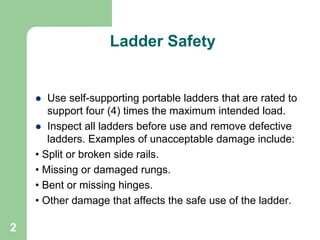
Ladder Safety
2
Ladder Safety
 Use self-supporting portable ladders that are rated to
support four (4) times the maximum intended load.
 Inspect all ladders before use and remove defective
ladders. Examples of unacceptable damage include:
• Split or broken side rails.
• Missing or damaged rungs.
• Bent or missing hinges.
• Other damage that affects the safe use of the ladder.
3
Ladder Safety
 Use self-supporting portable ladders that are rated to
support four (4) times the maximum intended load.
 Inspect all ladders before use and remove defective
ladders. Examples of unacceptable damage include:
• Split or broken side rails.
• Missing or damaged rungs.
• Bent or missing hinges.
• Other damage that affects the safe use of the ladder.
4
Ladder Safety
 Extend ladders a minimum of 1 m (3 ft)
above the top landing point.
 Set straight ladders and extension
ladders at a slope of 4:1. Place ladder
vertically only if both side rails are
secured to a supporting structure (e.g.,
scaffold).
5
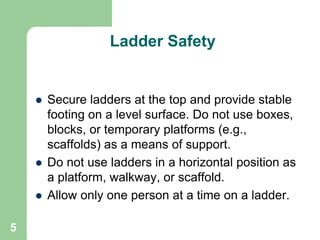
Ladder Safety
 Secure ladders at the top and provide stable
footing on a level surface. Do not use boxes,
blocks, or temporary platforms (e.g.,
scaffolds) as a means of support.
 Do not use ladders in a horizontal position as
a platform, walkway, or scaffold.
 Allow only one person at a time on a ladder.
6
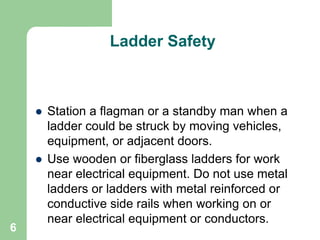
Ladder Safety
 Station a flagman or a standby man when a
ladder could be struck by moving vehicles,
equipment, or adjacent doors.
 Use wooden or fiberglass ladders for work
near electrical equipment. Do not use metal
ladders or ladders with metal reinforced or
conductive side rails when working on or
near electrical equipment or conductors.
7
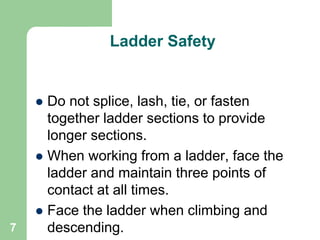
Ladder Safety
 Do not splice, lash, tie, or fasten
together ladder sections to provide
longer sections.
 When working from a ladder, face the
ladder and maintain three points of
contact at all times.
 Face the ladder when climbing and
descending.
8
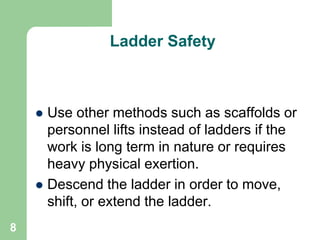
Ladder Safety
 Use other methods such as scaffolds or
personnel lifts instead of ladders if the
work is long term in nature or requires
heavy physical exertion.
 Descend the ladder in order to move,
shift, or extend the ladder.
9
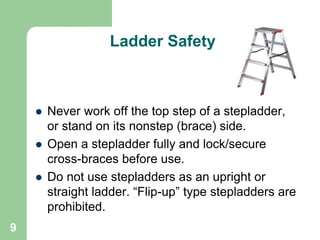
Ladder Safety
 Never work off the top step of a stepladder,
or stand on its nonstep (brace) side.
 Open a stepladder fully and lock/secure
cross-braces before use.
 Do not use stepladders as an upright or
straight ladder. “Flip-up” type stepladders are
prohibited.

Ladder Safety.ppt

  • 1.
  • 2.
    2 Ladder Safety  Useself-supporting portable ladders that are rated to support four (4) times the maximum intended load.  Inspect all ladders before use and remove defective ladders. Examples of unacceptable damage include: • Split or broken side rails. • Missing or damaged rungs. • Bent or missing hinges. • Other damage that affects the safe use of the ladder.
  • 3.
    3 Ladder Safety  Useself-supporting portable ladders that are rated to support four (4) times the maximum intended load.  Inspect all ladders before use and remove defective ladders. Examples of unacceptable damage include: • Split or broken side rails. • Missing or damaged rungs. • Bent or missing hinges. • Other damage that affects the safe use of the ladder.
  • 4.
    4 Ladder Safety  Extendladders a minimum of 1 m (3 ft) above the top landing point.  Set straight ladders and extension ladders at a slope of 4:1. Place ladder vertically only if both side rails are secured to a supporting structure (e.g., scaffold).
  • 5.
    5 Ladder Safety  Secureladders at the top and provide stable footing on a level surface. Do not use boxes, blocks, or temporary platforms (e.g., scaffolds) as a means of support.  Do not use ladders in a horizontal position as a platform, walkway, or scaffold.  Allow only one person at a time on a ladder.
  • 6.
    6 Ladder Safety  Stationa flagman or a standby man when a ladder could be struck by moving vehicles, equipment, or adjacent doors.  Use wooden or fiberglass ladders for work near electrical equipment. Do not use metal ladders or ladders with metal reinforced or conductive side rails when working on or near electrical equipment or conductors.
  • 7.
    7 Ladder Safety  Donot splice, lash, tie, or fasten together ladder sections to provide longer sections.  When working from a ladder, face the ladder and maintain three points of contact at all times.  Face the ladder when climbing and descending.
  • 8.
    8 Ladder Safety  Useother methods such as scaffolds or personnel lifts instead of ladders if the work is long term in nature or requires heavy physical exertion.  Descend the ladder in order to move, shift, or extend the ladder.
  • 9.
    9 Ladder Safety  Neverwork off the top step of a stepladder, or stand on its nonstep (brace) side.  Open a stepladder fully and lock/secure cross-braces before use.  Do not use stepladders as an upright or straight ladder. “Flip-up” type stepladders are prohibited.