Motivation: From Concepts to Applications 7- © 2009 Prentice-Hall Inc.  All rights reserved.
Chapter Learning Objectives After studying this chapter, you should be able to: Describe the Job Characteristics Model and evaluate the way it motivates by changing the work environment. Compare and contrast the three main ways jobs can be redesigned. Identify three alternative work arrangements and show how they might motive employees. Give examples of employee involvement measures and show how they can motivate employees. Demonstrate how the different types of variable-pay programs can increase employee motivation. Show how flexible benefits turn benefits into motivators. Identify the motivational benefits of intrinsic rewards. © 2009 Prentice-Hall Inc.  All rights reserved. 7-
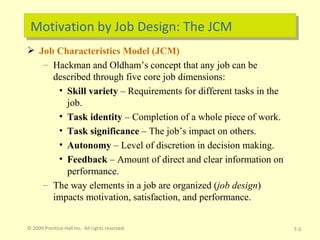
Motivation by Job Design: The JCM Job Characteristics Model (JCM) Hackman and Oldham’s concept that any job can be described through five core job dimensions: Skill variety  – Requirements for different tasks in the job. Task identity  – Completion of a whole piece of work. Task significance  – The job’s impact on others. Autonomy  – Level of discretion in decision making.  Feedback  – Amount of direct and clear information on performance. The way elements in a job are organized ( job design ) impacts motivation, satisfaction, and performance. © 2009 Prentice-Hall Inc.  All rights reserved. 7-
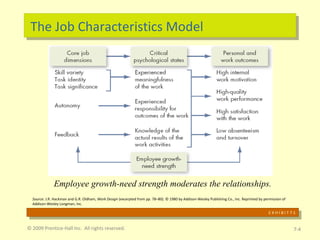
The Job Characteristics Model Employee growth-need strength moderates the relationships. © 2009 Prentice-Hall Inc.  All rights reserved. 7- E X H I B I T 7-1 Source:  J.R. Hackman and G.R. Oldham,  Work Design  (excerpted from pp. 78–80). © 1980 by Addison-Wesley Publishing Co., Inc. Reprinted by permission of Addison-Wesley Longman, Inc.
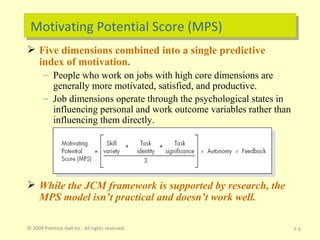
Motivating Potential Score (MPS) Five dimensions combined into a single predictive index of motivation. People who work on jobs with high core dimensions are generally more motivated, satisfied, and productive. Job dimensions operate through the psychological states in influencing personal and work outcome variables rather than influencing them directly. While the JCM framework is supported by research, the MPS model isn’t practical and doesn’t work well. © 2009 Prentice-Hall Inc.  All rights reserved. 7-
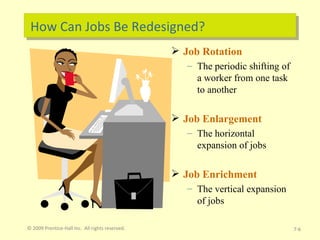
How Can Jobs Be Redesigned? Job Rotation The periodic shifting of a worker from one task to another Job Enlargement The horizontal expansion of jobs Job Enrichment The vertical expansion of jobs © 2009 Prentice-Hall Inc.  All rights reserved. 7-
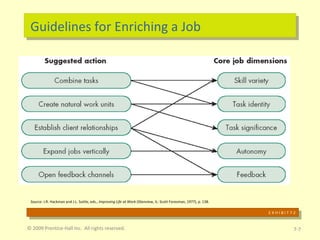
Guidelines for Enriching a Job © 2009 Prentice-Hall Inc.  All rights reserved. 7- E X H I B I T 7-2 Source:  J.R. Hackman and J.L. Suttle, eds.,  Improving Life at Work  (Glenview, IL: Scott Foresman, 1977), p. 138.
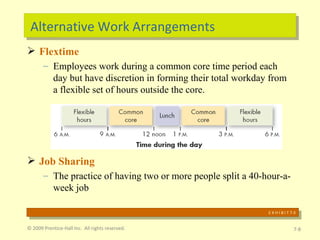
Alternative Work Arrangements Flextime Employees work during a common core time period each day but have discretion in forming their total workday from a flexible set of hours outside the core. Job Sharing The practice of having two or more people split a 40-hour-a-week job © 2009 Prentice-Hall Inc.  All rights reserved. 7- E X H I B I T 7-3
Another Alternative: Telecommuting Telecommuting Employees do their work at home at least two days a week on a computer that is linked to their office. The Virtual Office Employees work out of their home on a relatively permanent basis. Typical Telecommuting Jobs Professional and other knowledge-related tasks Routine information-handling tasks Mobile activities © 2009 Prentice-Hall Inc.  All rights reserved. 7-
Reasons for and against Telecommuting  Advantages Larger labor pool Higher productivity Less turnover Improved morale Reduced office-space costs Disadvantages Employer Less direct supervision of employees Difficult to coordinate teamwork Difficult to evaluate non-quantitative performance Employee May not be as noticed for his or her efforts © 2009 Prentice-Hall Inc.  All rights reserved. 7-
© 2009 Prentice-Hall Inc.  All rights reserved. 7- Please Visit Us At : http://wanbk.page.tl

Chapter 12

  • 1.
    Motivation: From Conceptsto Applications 7- © 2009 Prentice-Hall Inc. All rights reserved.
  • 2.
    Chapter Learning ObjectivesAfter studying this chapter, you should be able to: Describe the Job Characteristics Model and evaluate the way it motivates by changing the work environment. Compare and contrast the three main ways jobs can be redesigned. Identify three alternative work arrangements and show how they might motive employees. Give examples of employee involvement measures and show how they can motivate employees. Demonstrate how the different types of variable-pay programs can increase employee motivation. Show how flexible benefits turn benefits into motivators. Identify the motivational benefits of intrinsic rewards. © 2009 Prentice-Hall Inc. All rights reserved. 7-
  • 3.
    Motivation by JobDesign: The JCM Job Characteristics Model (JCM) Hackman and Oldham’s concept that any job can be described through five core job dimensions: Skill variety – Requirements for different tasks in the job. Task identity – Completion of a whole piece of work. Task significance – The job’s impact on others. Autonomy – Level of discretion in decision making. Feedback – Amount of direct and clear information on performance. The way elements in a job are organized ( job design ) impacts motivation, satisfaction, and performance. © 2009 Prentice-Hall Inc. All rights reserved. 7-
  • 4.
    The Job CharacteristicsModel Employee growth-need strength moderates the relationships. © 2009 Prentice-Hall Inc. All rights reserved. 7- E X H I B I T 7-1 Source: J.R. Hackman and G.R. Oldham, Work Design (excerpted from pp. 78–80). © 1980 by Addison-Wesley Publishing Co., Inc. Reprinted by permission of Addison-Wesley Longman, Inc.
  • 5.
    Motivating Potential Score(MPS) Five dimensions combined into a single predictive index of motivation. People who work on jobs with high core dimensions are generally more motivated, satisfied, and productive. Job dimensions operate through the psychological states in influencing personal and work outcome variables rather than influencing them directly. While the JCM framework is supported by research, the MPS model isn’t practical and doesn’t work well. © 2009 Prentice-Hall Inc. All rights reserved. 7-
  • 6.
    How Can JobsBe Redesigned? Job Rotation The periodic shifting of a worker from one task to another Job Enlargement The horizontal expansion of jobs Job Enrichment The vertical expansion of jobs © 2009 Prentice-Hall Inc. All rights reserved. 7-
  • 7.
    Guidelines for Enrichinga Job © 2009 Prentice-Hall Inc. All rights reserved. 7- E X H I B I T 7-2 Source: J.R. Hackman and J.L. Suttle, eds., Improving Life at Work (Glenview, IL: Scott Foresman, 1977), p. 138.
  • 8.
    Alternative Work ArrangementsFlextime Employees work during a common core time period each day but have discretion in forming their total workday from a flexible set of hours outside the core. Job Sharing The practice of having two or more people split a 40-hour-a-week job © 2009 Prentice-Hall Inc. All rights reserved. 7- E X H I B I T 7-3
  • 9.
    Another Alternative: TelecommutingTelecommuting Employees do their work at home at least two days a week on a computer that is linked to their office. The Virtual Office Employees work out of their home on a relatively permanent basis. Typical Telecommuting Jobs Professional and other knowledge-related tasks Routine information-handling tasks Mobile activities © 2009 Prentice-Hall Inc. All rights reserved. 7-
  • 10.
    Reasons for andagainst Telecommuting Advantages Larger labor pool Higher productivity Less turnover Improved morale Reduced office-space costs Disadvantages Employer Less direct supervision of employees Difficult to coordinate teamwork Difficult to evaluate non-quantitative performance Employee May not be as noticed for his or her efforts © 2009 Prentice-Hall Inc. All rights reserved. 7-
  • 11.
    © 2009 Prentice-HallInc. All rights reserved. 7- Please Visit Us At : http://wanbk.page.tl