Alternative Dispute Resolution Mechanism
By Dr. Deepa Praveen Patil
Asst. Prof. Ismailsaheb Mulla Law college, Satara
Dispute resolution system
 Court as a means of dispute resolution
Litigation has its own strength, weakness & limitations
Voltaire once said “ I was ruined twice in my life,
once when I lost a law suit and once when I won a
law suit !.”
Panchayat system at villages
Alternative dispute resolution creates win –win
situation
Formal dispute resolution system
Non-formal justice delivery system
Adversarial system
 Canada and most countries that derive their legal systems from the English
model use what is called the adversarial legal system.The two great
systems of law, the common law and the civil law systems, both have
differing procedures when a case goes to trial.The two approaches are
either adversarial or inquisitorial.
 The Adversarial System
 Our system of justice is based on the adversarial model.The adversarial
system implies that two parties assume opposite positions in debating the
guilt or innocence of an individual. In this scenario, the judge is required to
be neutral at the contest unfolding before him or her.The role of the judge
in this arrangement is to ensure the trial proceeds according to the
procedural rules of trial or due process of law and that evidence entered is
done so according to established rules and guidelines.
 The advantages of the adversarial system include.
 the judge reserves comment until all evidence from both parties are heard.
 this makes the judge appear more neutral since judgement must be
reserved until all the evidence is heard
 The disadvantages of the adversarial system include
 the finding of evidence rests on the resources of the two parties which
may be unequal
 parties only provide evidence favourable to their arguments
Inquisitorial Legal Systems
 The inquisitorial system is the common procedural approach in
most civil law jurisdictions.
 In an inquisitorial system, a judge is involved in the preparation of
evidence along with the police and in how the various parties are
to present their case at the trial.The judge questions witnesses in
depth and can even call witnesses to appear while prosecution and
defense parties can ask follow up questions.The judge plays the
central role in finding the truth and all the evidence that either
proves the innocence or guilt of the accused before the court.The
judge takes on the role of prosecutor and judge in the inquisitorial
system. Some other major distinctions is that there are no jury
trials in an inquisitorial system and a judge can compel an accused
to make statements and answer questions.This differs dramatically
from the common law and adversarial right not to take the stand in
one's own defence.
Alternative Dispute Resolution(ADR) System
 ADR is defined as any process or procedure other than
adjudication by a presiding judge in court – litigation, in
which a neutral third party participates to assist in the
resolution of issues in controversy.
 ADR is not a new concept it was in existence from the
ancient period in India what is new is the extensive
promotion & proliferation of ADR models
 Expansion of commercialization & Industrialization
 21st century era of Globalization, clogged court houses –
people inclined either to avoid litigation or to start resorting
to extra judicial remedies
 Presently ADR become sine quo non for justice delivery
system.
 ADR not as alternative dispute resolution, but
appropriate dispute resolution
CHARACTERISTICS OF ADR
PROCESSES
 1) Informality:- Most fundamentally ADR processes are less formal than judicial
processes.The rules of procedure are flexible, without formal pleadings, extensive written
documentation or rules of evidence. It is important for reducing the cost and delay in
dispute resolution.
 2) Application of equality:- ADR mechanisms are instruments for the
application of equity, rather than rule of law. Each case is decided by a third party or
negotiated between disputants themselves, based on principles &terms those seem
equitable in the particular case, rather than on uniformly applied legal standards.ADR
system tends to achieve efficient settlements at the expense of consistent & uniform
justice.
 3) Law is relevant in ADR:-Alternative to court redressal system do not deviate
completely from law & legal process. Legality is a necessary requirement, while the myriad
forms of solutions could be invented beyond the law & reach of enforcement regulators.
Thus the need to resort to alternatives has emerged from, the problems arising out of
litigation such as inordinate delay, escalating costs of litigation, mounting arrears, pervasive
corruption, and inequities in system.
 4) Direct participation and communication between disputants:- In ADR
systems, there is more direct participation by the disputants in the process and in
designing settlements, more direct dialogue & opportunity for reconciliation, between
disputants with higher level of confidentiality since public records are not typically kept,
also more flexibility in designing creative settlements.
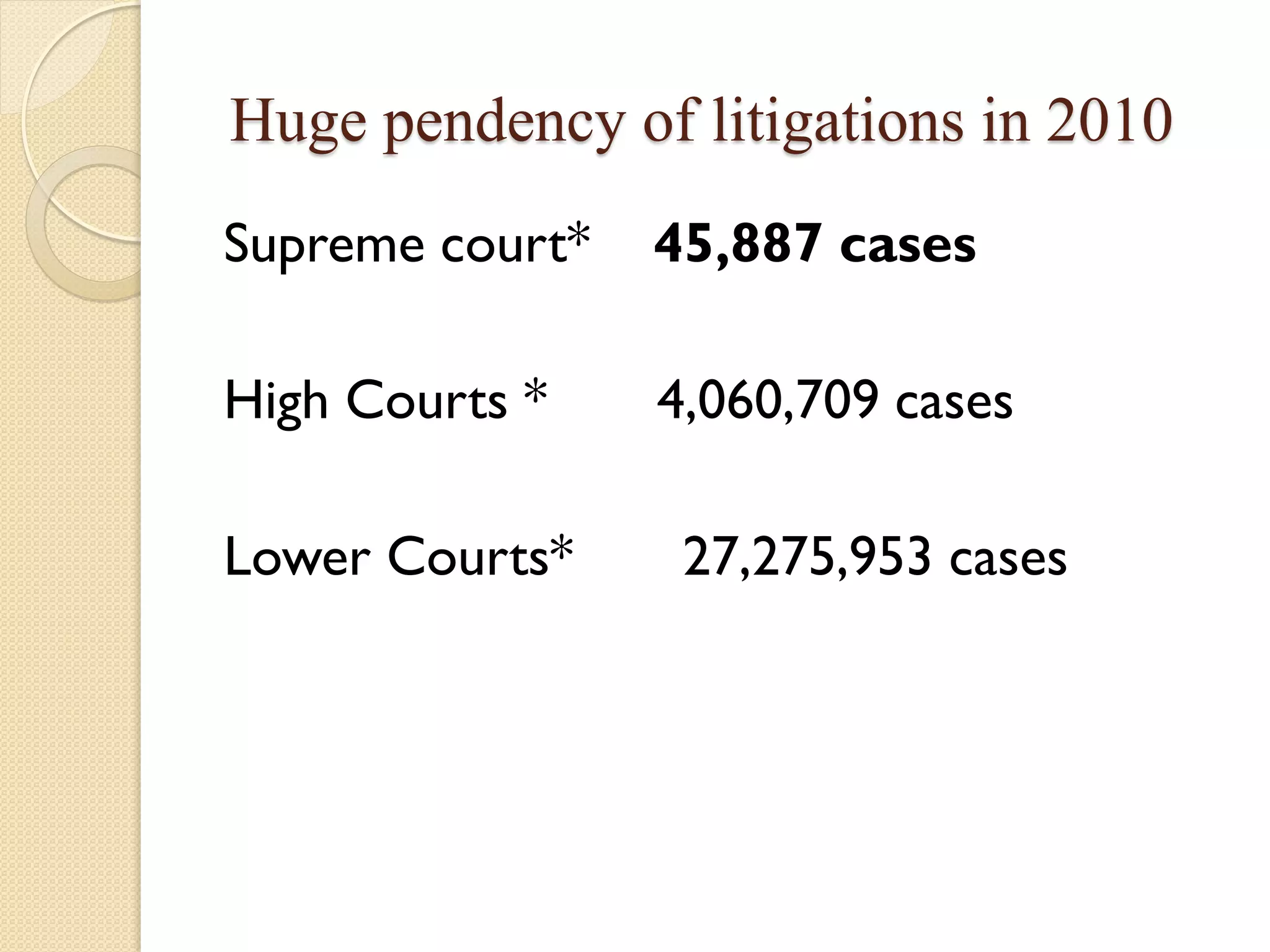
Huge pendency of litigations in 2010
Supreme court* 45,887 cases
High Courts * 4,060,709 cases
Lower Courts* 27,275,953 cases
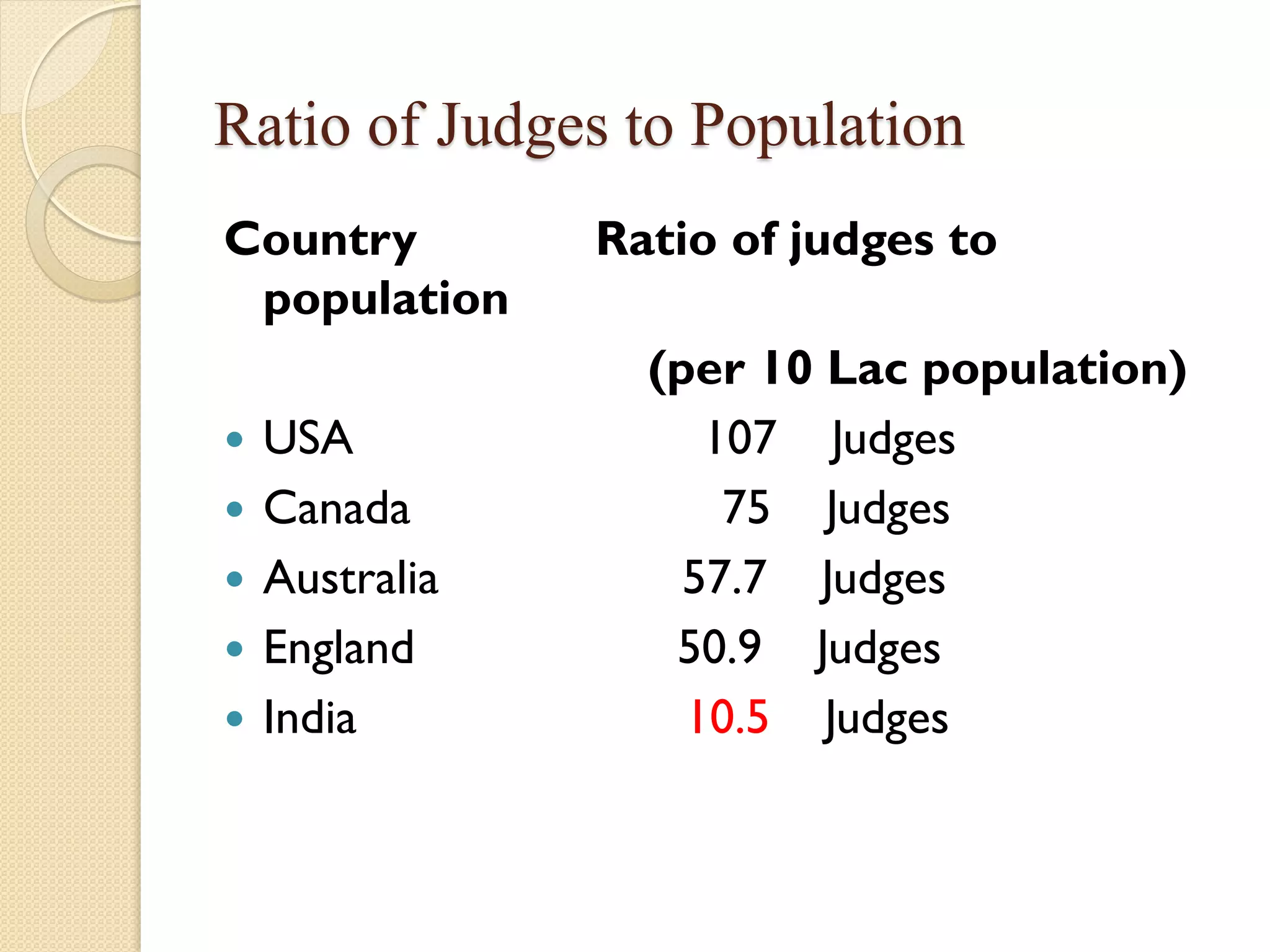
Ratio of Judges to Population
Country Ratio of judges to
population
(per 10 Lac population)
 USA 107 Judges
 Canada 75 Judges
 Australia 57.7 Judges
 England 50.9 Judges
 India 10.5 Judges
Government is the largest litigator
 According to rough estimate, 70% of all cases
are either agitated by the State or appealed by
it.
 The State fights cases against citizens at the
cost of citizens.
Ability of Courts to disposal off the Cases has
become doubtful
Complicated and burdensome procedural details
which are inherently very slow proving.
Filing of the plaint, serving the process filing the
written statements,
Time irresponsibly taken and given, the discovery
procedure, recording of depositions,
Ineffective court management,
Fragmented and discontinuous trial unattractive
alternatives to trial and
 Indifferent attitudes of legal actors, namely
lawyers, judges and litigants have resulted into
vicious cycles of backlogs and delays.
Choice of ADR Mechanisms
Arbitration is a legal techniques for the resolution of disputes outside the
courts, where in the parties to a dispute refer it to one or more persons
(the “arbitrators”, ”arbiters” or “arbitral tribunal”.) by whose decision
(the award) they agree to be bound.
(The Arbitration and Conciliation Act, 1996)
Conciliation is a non-binding procedure in which an
impartial third party, the conciliator, assists the
parties to a dispute in reaching a mutually agreed
Settlement of the disputes.(Industrial Disputes Act, 1947,
Hindu Marriage Act, 1955, )
Arbitration
Conciliation
Choice of ADR Mechanism
Mediation
Mediation a private informal dispute resolution process in which a
neutral third party, the mediator helps disputing parties to reach an
agreement the mediator has no power to impose a decision on the
parties.(Section 89 CPC and “Civil Procedure ADR and Mediation
Rules, 2006”)
Lok Adalat:
The word Lok Adalat means peoples court. If the pending suit is not
complicated and disputes in that suit is easily settled by applying
clear legal principles Lok Adalat will be a preferred choice.
(The Legal Services Authorities Act,1987)
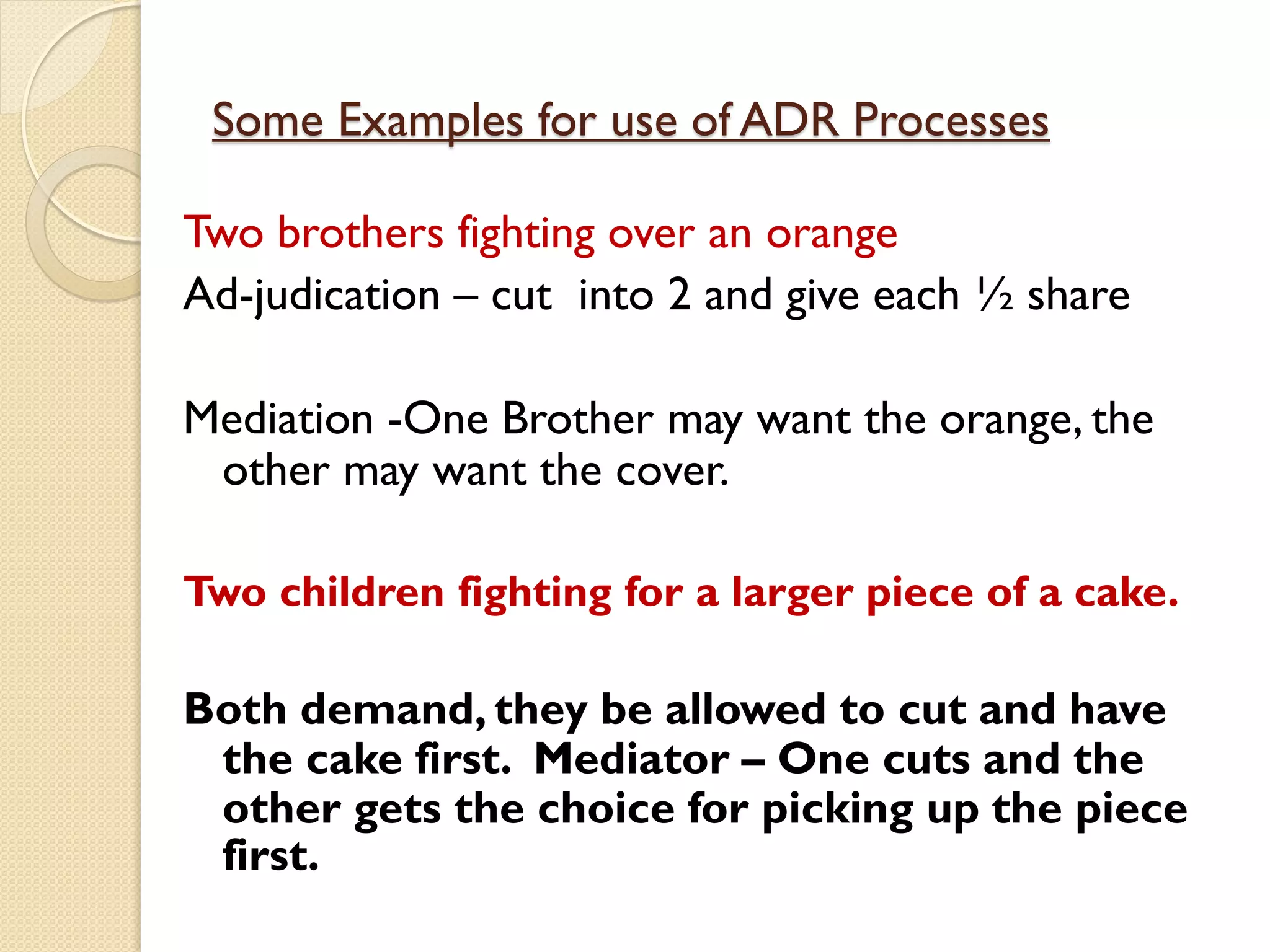
Some Examples for use of ADR Processes
Two brothers fighting over an orange
Ad-judication – cut into 2 and give each ½ share
Mediation -One Brother may want the orange, the
other may want the cover.
Two children fighting for a larger piece of a cake.
Both demand, they be allowed to cut and have
the cake first. Mediator – One cuts and the
other gets the choice for picking up the piece
first.
Disputes suitable for ADR processes :
(i) All cases relating to trade, commerce and contracts, including - disputes arising out of
contracts (including all money claims); - disputes relating to specific performance; disputes
between suppliers and customers; disputes between bankers and customers; disputes
between developers/builders and customers; - disputes between landlords and
tenants/licensor and licensees; - disputes between insurer and insured;
(ii) All cases arising from strained or soured relationships, including - disputes relating to
matrimonial causes, maintenance, custody of children; disputes relating to partition/division
among family members/co- parceners/co owners; and disputes relating to partnership among
partners.
(iii) All cases where there is a need for continuation of the pre-existing relationship in spite of
the disputes, including disputes between neighbors (relating to easementary rights,
encroachments, nuisance etc.) disputes between employers and employees; disputes among
members of societies/associations/Apartment owners Associations;
(iv)All cases relating to tortious liability including - claims for compensation in motor
accidents/other accidents; and
(v) All consumer disputes
(vi) Compoundable offences Plea bargaining
Cases not suitable for ADR process
(i) Representative suits under Order 1 Rule 8 CPC which involve
public interest or interest or numerous persons who are not
parties before the court (In fact, even a compromise in such a suit
is a difficult process requiring notice to the persons interested in
the suit, before its acceptance).
(ii) Disputes relating to election to public offices ( as contrasted
from disputes between two groups trying to get control over the
management of societies, clubs, association etc).
(iii) Cases involving grant of authority by the court after enquiry, as
for example, suits for grant of probate or letters of administration.
(iv) Cases involving serious and specific allegations of fraud,
fabrication of documents, forgery, impersonation, coercion etc.
(iii) Cases requiring protection of courts, as for example, claims
against minors, deities and mentally challenged and suits for
declaration of title against government.
(v) Cases involving prosecution for non-compunding criminal
offences.
Advantages of ADR mechanism
 ADR system can reduce delay in the resolution of
disputes
 Less Expensive
 ADR can increase satisfaction of disputants with
outcomes
 Participation of parties
 Win-Win situation
 No external control
 Informal procedure
 ADR system can increase access to justice for
disadvantaged groups
 Failed ADR proceeding is never a waste
 Finality of decision
Limitations of ADR mechanism
 ADR programs do not set precedent, refine legal norms or
establish broad community or national standards, nor do they
promote a consistent application of legal rules
 ADR programs cannot correct systematic injustice,
discrimination or violations of human rights
 ADR programs do not work well in the context of extreme
power imbalance between parties
 ADR settlements do not have any educational, punitive or
deterrent effect on the population
 ADR is inappropriate in disputes of multiparty cases in which
some of the parties of not participate
 ADR may undermine judicial reform efforts
 The settlement through ADR might not result in a binding
solution
 Consensus is the basis of jurisdiction of ADR program
 ADR programs can not resolve non-compoundable offences
A Famous quote by - Mahatma Gandhi
Mahatma Gandhi,An Autobiography:The Story of my experiments with
Truth, 134 (6th ed. 1965)
“I had learnt the practice of law. I had learnt
to find out the better side of human nature,
and to enter men’s hearts. I realized that the
true function of a lawyer was to unite parties
driven a sunder….. ..I lost nothing thereby-
not even money, certainty not my soul.”
Conclusion
 Indian Judiciary is overburdened with huge backlog of
cases.
 Globalization has also created a great stimulation in the
process of universalizing and simplifying the process of
dispute resolution in different countries across the globe.
 Indian judiciary has also played a substantial role in up
gradation of ADR mechanism.
 ADR aimed at settling disputes in peaceful manner and
cost effective, speedy, simple, convenient to both the
parties
 It aims at providing justice that not only resolves dispute
but also harmonizes the relation of the parties.
Thank
you

Alternative dispute resolution system

  • 1.
    Alternative Dispute ResolutionMechanism By Dr. Deepa Praveen Patil Asst. Prof. Ismailsaheb Mulla Law college, Satara
  • 2.
    Dispute resolution system Court as a means of dispute resolution Litigation has its own strength, weakness & limitations Voltaire once said “ I was ruined twice in my life, once when I lost a law suit and once when I won a law suit !.” Panchayat system at villages Alternative dispute resolution creates win –win situation Formal dispute resolution system Non-formal justice delivery system
  • 3.
    Adversarial system  Canadaand most countries that derive their legal systems from the English model use what is called the adversarial legal system.The two great systems of law, the common law and the civil law systems, both have differing procedures when a case goes to trial.The two approaches are either adversarial or inquisitorial.  The Adversarial System  Our system of justice is based on the adversarial model.The adversarial system implies that two parties assume opposite positions in debating the guilt or innocence of an individual. In this scenario, the judge is required to be neutral at the contest unfolding before him or her.The role of the judge in this arrangement is to ensure the trial proceeds according to the procedural rules of trial or due process of law and that evidence entered is done so according to established rules and guidelines.  The advantages of the adversarial system include.  the judge reserves comment until all evidence from both parties are heard.  this makes the judge appear more neutral since judgement must be reserved until all the evidence is heard  The disadvantages of the adversarial system include  the finding of evidence rests on the resources of the two parties which may be unequal  parties only provide evidence favourable to their arguments
  • 4.
    Inquisitorial Legal Systems The inquisitorial system is the common procedural approach in most civil law jurisdictions.  In an inquisitorial system, a judge is involved in the preparation of evidence along with the police and in how the various parties are to present their case at the trial.The judge questions witnesses in depth and can even call witnesses to appear while prosecution and defense parties can ask follow up questions.The judge plays the central role in finding the truth and all the evidence that either proves the innocence or guilt of the accused before the court.The judge takes on the role of prosecutor and judge in the inquisitorial system. Some other major distinctions is that there are no jury trials in an inquisitorial system and a judge can compel an accused to make statements and answer questions.This differs dramatically from the common law and adversarial right not to take the stand in one's own defence.
  • 5.
    Alternative Dispute Resolution(ADR)System  ADR is defined as any process or procedure other than adjudication by a presiding judge in court – litigation, in which a neutral third party participates to assist in the resolution of issues in controversy.  ADR is not a new concept it was in existence from the ancient period in India what is new is the extensive promotion & proliferation of ADR models  Expansion of commercialization & Industrialization  21st century era of Globalization, clogged court houses – people inclined either to avoid litigation or to start resorting to extra judicial remedies  Presently ADR become sine quo non for justice delivery system.  ADR not as alternative dispute resolution, but appropriate dispute resolution
  • 6.
    CHARACTERISTICS OF ADR PROCESSES 1) Informality:- Most fundamentally ADR processes are less formal than judicial processes.The rules of procedure are flexible, without formal pleadings, extensive written documentation or rules of evidence. It is important for reducing the cost and delay in dispute resolution.  2) Application of equality:- ADR mechanisms are instruments for the application of equity, rather than rule of law. Each case is decided by a third party or negotiated between disputants themselves, based on principles &terms those seem equitable in the particular case, rather than on uniformly applied legal standards.ADR system tends to achieve efficient settlements at the expense of consistent & uniform justice.  3) Law is relevant in ADR:-Alternative to court redressal system do not deviate completely from law & legal process. Legality is a necessary requirement, while the myriad forms of solutions could be invented beyond the law & reach of enforcement regulators. Thus the need to resort to alternatives has emerged from, the problems arising out of litigation such as inordinate delay, escalating costs of litigation, mounting arrears, pervasive corruption, and inequities in system.  4) Direct participation and communication between disputants:- In ADR systems, there is more direct participation by the disputants in the process and in designing settlements, more direct dialogue & opportunity for reconciliation, between disputants with higher level of confidentiality since public records are not typically kept, also more flexibility in designing creative settlements.
  • 7.
    Huge pendency oflitigations in 2010 Supreme court* 45,887 cases High Courts * 4,060,709 cases Lower Courts* 27,275,953 cases
  • 8.
    Ratio of Judgesto Population Country Ratio of judges to population (per 10 Lac population)  USA 107 Judges  Canada 75 Judges  Australia 57.7 Judges  England 50.9 Judges  India 10.5 Judges
  • 9.
    Government is thelargest litigator  According to rough estimate, 70% of all cases are either agitated by the State or appealed by it.  The State fights cases against citizens at the cost of citizens.
  • 10.
    Ability of Courtsto disposal off the Cases has become doubtful Complicated and burdensome procedural details which are inherently very slow proving. Filing of the plaint, serving the process filing the written statements, Time irresponsibly taken and given, the discovery procedure, recording of depositions, Ineffective court management, Fragmented and discontinuous trial unattractive alternatives to trial and  Indifferent attitudes of legal actors, namely lawyers, judges and litigants have resulted into vicious cycles of backlogs and delays.
  • 11.
    Choice of ADRMechanisms Arbitration is a legal techniques for the resolution of disputes outside the courts, where in the parties to a dispute refer it to one or more persons (the “arbitrators”, ”arbiters” or “arbitral tribunal”.) by whose decision (the award) they agree to be bound. (The Arbitration and Conciliation Act, 1996) Conciliation is a non-binding procedure in which an impartial third party, the conciliator, assists the parties to a dispute in reaching a mutually agreed Settlement of the disputes.(Industrial Disputes Act, 1947, Hindu Marriage Act, 1955, ) Arbitration Conciliation
  • 12.
    Choice of ADRMechanism Mediation Mediation a private informal dispute resolution process in which a neutral third party, the mediator helps disputing parties to reach an agreement the mediator has no power to impose a decision on the parties.(Section 89 CPC and “Civil Procedure ADR and Mediation Rules, 2006”) Lok Adalat: The word Lok Adalat means peoples court. If the pending suit is not complicated and disputes in that suit is easily settled by applying clear legal principles Lok Adalat will be a preferred choice. (The Legal Services Authorities Act,1987)
  • 13.
    Some Examples foruse of ADR Processes Two brothers fighting over an orange Ad-judication – cut into 2 and give each ½ share Mediation -One Brother may want the orange, the other may want the cover. Two children fighting for a larger piece of a cake. Both demand, they be allowed to cut and have the cake first. Mediator – One cuts and the other gets the choice for picking up the piece first.
  • 14.
    Disputes suitable forADR processes : (i) All cases relating to trade, commerce and contracts, including - disputes arising out of contracts (including all money claims); - disputes relating to specific performance; disputes between suppliers and customers; disputes between bankers and customers; disputes between developers/builders and customers; - disputes between landlords and tenants/licensor and licensees; - disputes between insurer and insured; (ii) All cases arising from strained or soured relationships, including - disputes relating to matrimonial causes, maintenance, custody of children; disputes relating to partition/division among family members/co- parceners/co owners; and disputes relating to partnership among partners. (iii) All cases where there is a need for continuation of the pre-existing relationship in spite of the disputes, including disputes between neighbors (relating to easementary rights, encroachments, nuisance etc.) disputes between employers and employees; disputes among members of societies/associations/Apartment owners Associations; (iv)All cases relating to tortious liability including - claims for compensation in motor accidents/other accidents; and (v) All consumer disputes (vi) Compoundable offences Plea bargaining
  • 15.
    Cases not suitablefor ADR process (i) Representative suits under Order 1 Rule 8 CPC which involve public interest or interest or numerous persons who are not parties before the court (In fact, even a compromise in such a suit is a difficult process requiring notice to the persons interested in the suit, before its acceptance). (ii) Disputes relating to election to public offices ( as contrasted from disputes between two groups trying to get control over the management of societies, clubs, association etc). (iii) Cases involving grant of authority by the court after enquiry, as for example, suits for grant of probate or letters of administration. (iv) Cases involving serious and specific allegations of fraud, fabrication of documents, forgery, impersonation, coercion etc. (iii) Cases requiring protection of courts, as for example, claims against minors, deities and mentally challenged and suits for declaration of title against government. (v) Cases involving prosecution for non-compunding criminal offences.
  • 16.
    Advantages of ADRmechanism  ADR system can reduce delay in the resolution of disputes  Less Expensive  ADR can increase satisfaction of disputants with outcomes  Participation of parties  Win-Win situation  No external control  Informal procedure  ADR system can increase access to justice for disadvantaged groups  Failed ADR proceeding is never a waste  Finality of decision
  • 17.
    Limitations of ADRmechanism  ADR programs do not set precedent, refine legal norms or establish broad community or national standards, nor do they promote a consistent application of legal rules  ADR programs cannot correct systematic injustice, discrimination or violations of human rights  ADR programs do not work well in the context of extreme power imbalance between parties  ADR settlements do not have any educational, punitive or deterrent effect on the population  ADR is inappropriate in disputes of multiparty cases in which some of the parties of not participate  ADR may undermine judicial reform efforts  The settlement through ADR might not result in a binding solution  Consensus is the basis of jurisdiction of ADR program  ADR programs can not resolve non-compoundable offences
  • 18.
    A Famous quoteby - Mahatma Gandhi Mahatma Gandhi,An Autobiography:The Story of my experiments with Truth, 134 (6th ed. 1965) “I had learnt the practice of law. I had learnt to find out the better side of human nature, and to enter men’s hearts. I realized that the true function of a lawyer was to unite parties driven a sunder….. ..I lost nothing thereby- not even money, certainty not my soul.”
  • 19.
    Conclusion  Indian Judiciaryis overburdened with huge backlog of cases.  Globalization has also created a great stimulation in the process of universalizing and simplifying the process of dispute resolution in different countries across the globe.  Indian judiciary has also played a substantial role in up gradation of ADR mechanism.  ADR aimed at settling disputes in peaceful manner and cost effective, speedy, simple, convenient to both the parties  It aims at providing justice that not only resolves dispute but also harmonizes the relation of the parties.
  • 20.