10-1
Trade Promotions
Chapter Overview
Discussion Slide
10
• Nature of trade promotions
• Types of trade promotions
• Objectives of trade
promotions
• Concerns in using trade
promotions
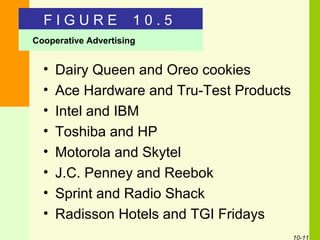
Prof. ( Dr.) Kao Kveng Hong, PhD., D.LittProf. ( Dr.) Kao Kveng Hong, PhD., D.Litt
10-2
Trade Promotions
• Expenditures or incentives used by
manufacturers and channel members to push
goods through the channel.
• 7% to 10% of sales revenue goes for trade
promotions.
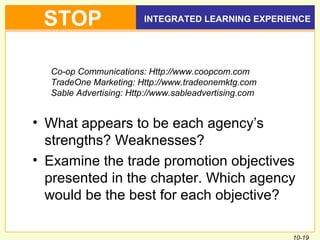
• Approximately 50% of total promotional
dollars spent.
• To be effective, must be integral part of IMC
program.
10-3
Marketing Budgets
Trade Promotions
50%
Consumer Promotions
24%
Advertising
26%
10-4
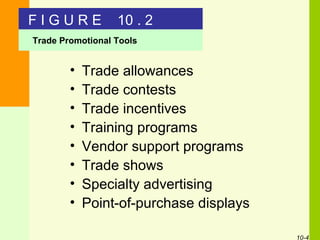
• Trade allowances
• Trade contests
• Trade incentives
• Training programs
• Vendor support programs
• Trade shows
• Specialty advertising
• Point-of-purchase displays
F I G U R E 10 . 2
Trade Promotional Tools
10-5
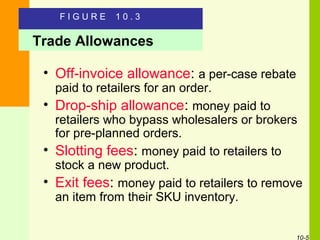
• Off-invoice allowance: a per-case rebate
paid to retailers for an order.
• Drop-ship allowance: money paid to
retailers who bypass wholesalers or brokers
for pre-planned orders.
• Slotting fees: money paid to retailers to
stock a new product.
• Exit fees: money paid to retailers to remove
an item from their SKU inventory.
F I G U R E 1 0 . 3
Trade Allowances
10-6
Disadvantages of Trade Allowances
• Failure to pass allowances on to retail
customers.
• Forward buying.
• Diversion.
10-7
Trade Contests
• Used to achieve sales targets.
• Funds known as “spiff money.”
• Rewards can be prizes or cash.
• Can be designed for various channel
members.
• Some organizations do not allow trade
contests because of possible conflict of
interests.
10-8
• Cooperative merchandising agreement
(CMA)
• Corporate sales program (CSP)
• Producing plant allowance (PPA)
• Back haul allowance (BHA)
• Cross-dock or Pedal runs
• Premium or bonus pack
F I G U R E 1 0 . 4
Trade Incentives
10-9
Training Programs
• Manufacturer provides training to
wholesalers’ or retailers’ salespeople.
10-10
Vendor Support Programs
• Billback programs
• Co-op advertising programs
10-11
• Dairy Queen and Oreo cookies
• Ace Hardware and Tru-Test Products
• Intel and IBM
• Toshiba and HP
• Motorola and Skytel
• J.C. Penney and Reebok
• Sprint and Radio Shack
• Radisson Hotels and TGI Fridays
F I G U R E 1 0 . 5
Cooperative Advertising
10-12
Trade Shows
• Ranks 3rd
in B-to-B marketing expenditures.
• Manufacturers spend $70,000-$100,000 per show.
• Retailers spend $600 per attendee.
• Average trade show had 701 exhibiting firms and 13,431
attendees.
• Average ratio of attendees to exhibitors was 19 to 1.
• Largest trade shows are:
• International CES
• The Super Show
• Miami International Boat Show & Strictly Sail
• International Housewares Show
• Mid-America Trucking Show
10-13
Trade Shows by Industry
Manufacturing (18.6%)
Computer (4.6%)
Consumer (11.0%)
Education (4.6%)
Communications (5.3%)
Retail/Distributors (15.8%)
Food (7.0%)
Engineering (7.7%)
General Business (8.3%)
Medical (10.3%)
Source: Danica Vasos, “Industry Profile,”Source: Danica Vasos, “Industry Profile,” ExpoExpo, January 2000, pp. 52-55, January 2000, pp. 52-55
10-14
Source: Alf Nucifora, "Simple Coffee Cups Packs Advertising Punch,"
Long Island Business News, (Jan. 22, 1999), Vol. 46, No. 4, p. 7C.
26
13
10 10 10
A
p
p
a
re
l
W
ritin
g
in
stru
m
e
n
ts
G
la
ssw
a
re
R
e
co
g
n
itio
n
a
w
a
rd
s
D
e
sk/o
ffice
a
cce
sso
rie
s
0
5
10
15
20
25
30
F I G U R E 1 0 . 7
Top Categories in Advertising SpecialtiesTop Categories in Advertising Specialties
10-15
• Integrate the brand’s image into the display.
• Integrate the display with current advertising and
promotions.
• Make the display dramatic to get attention.
• Keep the color of the display down so the product
and signage stand out.
• Make the display versatile so it can be easily adapted
by retailers.
• Make the display re-usable and easy to assemble.
• Make the display easy to stock.
• Customize the display to fit the retailer’s store.
F I G U R E 1 0 . 9
Effective POP Displays
10-16
Source: "Pop Peeves," Marketing Tools, (June 1997), p. 10.
3
6
11
17
19
24
Inappropriate
for
productN
o
custom
er
response
T
oo
seasonal
P
oorly
built
W
rong
size
Inappropriate
for
channel
0
5
10
15
20
25
30
F I G U R E 1 0 . 2
Top Weaknesses of Manufacturer-Supplied POP Displays
10-17
INTEGRATED LEARNING EXPERIENCESTOP
• Access the following firms that produce POP displays.
• Melrose Displays: Http://www.melrosedisplays.com
• Visy Displays: Http://www.visydisplays.com
• Display Design & Sales: Http://www.displays4pop.com
• Acrylic Designs: Http://www.acrylicdesigns.com
• Which firm’s Web site is the most attractive?
• Which site is the most informative?
• Which firm would be the best from the standpoint of the:
• Manufacturer?
• Retailer?
10-18
• Obtain initial distribution.
• Obtain prime retail location or shelf space.
• Maintain support for established brands.
• Counter competitive activities.
• Increase order size.
• Build retail inventories.
• Reduce excess inventories.
• Enhance channel relationships.
• Enhance the IMC program.
F I G U R E 1 0 . 1 0
Objectives of Trade Promotions
10-19
INTEGRATED LEARNING EXPERIENCESTOP
• What appears to be each agency’s
strengths? Weaknesses?
• Examine the trade promotion objectives
presented in the chapter. Which agency
would be the best for each objective?
Co-op Communications: Http://www.coopcom.com
TradeOne Marketing: Http://www.tradeonemktg.com
Sable Advertising: Http://www.sableadvertising.com
10-20
Concerns about Trade Promotions
• High cost
• Tend to be used outside of IMC Plan
• Over-reliance on trade promotions to
push merchandise
• Often used for short-term sales goals
• Potential erosion of brand image
• Impact on small manufacturers
10-21
• Decide on the objectives of the trade promotions.
• Develop trade promotions for
• Wholesalers or distributors
• Retailers
• Decide on which trade shows to attend.
• What type of POP display is necessary and how will
retailers be encouraged to use it?
• Decide on a co-op advertising program.
Building Your IMC Campaign

Chapter 10 trade-promotions

  • 1.
    10-1 Trade Promotions Chapter Overview DiscussionSlide 10 • Nature of trade promotions • Types of trade promotions • Objectives of trade promotions • Concerns in using trade promotions Prof. ( Dr.) Kao Kveng Hong, PhD., D.LittProf. ( Dr.) Kao Kveng Hong, PhD., D.Litt
  • 2.
    10-2 Trade Promotions • Expendituresor incentives used by manufacturers and channel members to push goods through the channel. • 7% to 10% of sales revenue goes for trade promotions. • Approximately 50% of total promotional dollars spent. • To be effective, must be integral part of IMC program.
  • 3.
  • 4.
    10-4 • Trade allowances •Trade contests • Trade incentives • Training programs • Vendor support programs • Trade shows • Specialty advertising • Point-of-purchase displays F I G U R E 10 . 2 Trade Promotional Tools
  • 5.
    10-5 • Off-invoice allowance:a per-case rebate paid to retailers for an order. • Drop-ship allowance: money paid to retailers who bypass wholesalers or brokers for pre-planned orders. • Slotting fees: money paid to retailers to stock a new product. • Exit fees: money paid to retailers to remove an item from their SKU inventory. F I G U R E 1 0 . 3 Trade Allowances
  • 6.
    10-6 Disadvantages of TradeAllowances • Failure to pass allowances on to retail customers. • Forward buying. • Diversion.
  • 7.
    10-7 Trade Contests • Usedto achieve sales targets. • Funds known as “spiff money.” • Rewards can be prizes or cash. • Can be designed for various channel members. • Some organizations do not allow trade contests because of possible conflict of interests.
  • 8.
    10-8 • Cooperative merchandisingagreement (CMA) • Corporate sales program (CSP) • Producing plant allowance (PPA) • Back haul allowance (BHA) • Cross-dock or Pedal runs • Premium or bonus pack F I G U R E 1 0 . 4 Trade Incentives
  • 9.
    10-9 Training Programs • Manufacturerprovides training to wholesalers’ or retailers’ salespeople.
  • 10.
    10-10 Vendor Support Programs •Billback programs • Co-op advertising programs
  • 11.
    10-11 • Dairy Queenand Oreo cookies • Ace Hardware and Tru-Test Products • Intel and IBM • Toshiba and HP • Motorola and Skytel • J.C. Penney and Reebok • Sprint and Radio Shack • Radisson Hotels and TGI Fridays F I G U R E 1 0 . 5 Cooperative Advertising
  • 12.
    10-12 Trade Shows • Ranks3rd in B-to-B marketing expenditures. • Manufacturers spend $70,000-$100,000 per show. • Retailers spend $600 per attendee. • Average trade show had 701 exhibiting firms and 13,431 attendees. • Average ratio of attendees to exhibitors was 19 to 1. • Largest trade shows are: • International CES • The Super Show • Miami International Boat Show & Strictly Sail • International Housewares Show • Mid-America Trucking Show
  • 13.
    10-13 Trade Shows byIndustry Manufacturing (18.6%) Computer (4.6%) Consumer (11.0%) Education (4.6%) Communications (5.3%) Retail/Distributors (15.8%) Food (7.0%) Engineering (7.7%) General Business (8.3%) Medical (10.3%) Source: Danica Vasos, “Industry Profile,”Source: Danica Vasos, “Industry Profile,” ExpoExpo, January 2000, pp. 52-55, January 2000, pp. 52-55
  • 14.
    10-14 Source: Alf Nucifora,"Simple Coffee Cups Packs Advertising Punch," Long Island Business News, (Jan. 22, 1999), Vol. 46, No. 4, p. 7C. 26 13 10 10 10 A p p a re l W ritin g in stru m e n ts G la ssw a re R e co g n itio n a w a rd s D e sk/o ffice a cce sso rie s 0 5 10 15 20 25 30 F I G U R E 1 0 . 7 Top Categories in Advertising SpecialtiesTop Categories in Advertising Specialties
  • 15.
    10-15 • Integrate thebrand’s image into the display. • Integrate the display with current advertising and promotions. • Make the display dramatic to get attention. • Keep the color of the display down so the product and signage stand out. • Make the display versatile so it can be easily adapted by retailers. • Make the display re-usable and easy to assemble. • Make the display easy to stock. • Customize the display to fit the retailer’s store. F I G U R E 1 0 . 9 Effective POP Displays
  • 16.
    10-16 Source: "Pop Peeves,"Marketing Tools, (June 1997), p. 10. 3 6 11 17 19 24 Inappropriate for productN o custom er response T oo seasonal P oorly built W rong size Inappropriate for channel 0 5 10 15 20 25 30 F I G U R E 1 0 . 2 Top Weaknesses of Manufacturer-Supplied POP Displays
  • 17.
    10-17 INTEGRATED LEARNING EXPERIENCESTOP •Access the following firms that produce POP displays. • Melrose Displays: Http://www.melrosedisplays.com • Visy Displays: Http://www.visydisplays.com • Display Design & Sales: Http://www.displays4pop.com • Acrylic Designs: Http://www.acrylicdesigns.com • Which firm’s Web site is the most attractive? • Which site is the most informative? • Which firm would be the best from the standpoint of the: • Manufacturer? • Retailer?
  • 18.
    10-18 • Obtain initialdistribution. • Obtain prime retail location or shelf space. • Maintain support for established brands. • Counter competitive activities. • Increase order size. • Build retail inventories. • Reduce excess inventories. • Enhance channel relationships. • Enhance the IMC program. F I G U R E 1 0 . 1 0 Objectives of Trade Promotions
  • 19.
    10-19 INTEGRATED LEARNING EXPERIENCESTOP •What appears to be each agency’s strengths? Weaknesses? • Examine the trade promotion objectives presented in the chapter. Which agency would be the best for each objective? Co-op Communications: Http://www.coopcom.com TradeOne Marketing: Http://www.tradeonemktg.com Sable Advertising: Http://www.sableadvertising.com
  • 20.
    10-20 Concerns about TradePromotions • High cost • Tend to be used outside of IMC Plan • Over-reliance on trade promotions to push merchandise • Often used for short-term sales goals • Potential erosion of brand image • Impact on small manufacturers
  • 21.
    10-21 • Decide onthe objectives of the trade promotions. • Develop trade promotions for • Wholesalers or distributors • Retailers • Decide on which trade shows to attend. • What type of POP display is necessary and how will retailers be encouraged to use it? • Decide on a co-op advertising program. Building Your IMC Campaign

Editor's Notes

  • #5 These are covered in the following OHs
  • #6 Slotting fees – Can be $25,000 per item to millions of dollars for a chain store Exit fees – introducing a new version of an existing brand
  • #7 Forward – retailer purchases excess inventory of product when it’s on deal (but retailer has carrying costs) Diversion – retailer purchases product on deal in one location and diverts inventory to another location
  • #9 Retailer gets something for performing a function. CMA – set up displays; cooperative advertising; etc. CSP – manuf ships products in ready to display pallets PPA – retailer purchases full or half truckload to get an allowance BHA – retailer pays cost of shipping Cross dock or pedal run – allowance for buying full truckload to be split amongst one’s regional stores Premium – retailer gets free merchandise; e.g., one carton for every 20 purchased over next 60 days.
  • #11 Billback – manuf repays retailer for special product displays, ads or price cuts
  • #13 Finding prospects – but buying is generally done in international trade shows
  • #15 Ad specialties – impress customers; constant reminder; should fit
  • #16 About 50% of purchases at supermarkets and mass merchandisers in unplanned – thus POP can really draw attention and prompt impulse buys.
  • #21 Brand image – taking away money from advertising