SMALL CELLS IN 5G
TECHNOLOGY
Presented by
G. VIJAY KUMAR
INTRODUCTION
Small cells are low powered cellular radio access nodes
that operate in licensed and unlicensed spectrum that have a range
of few kilometers. They are small when compared to a mobile
macro cell.
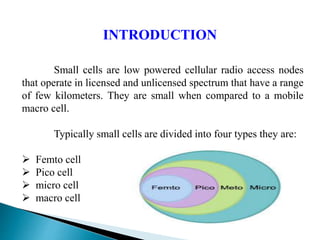
Typically small cells are divided into four types they are:
 Femto cell
 Pico cell
 micro cell
 macro cell
A small cell may transmit at only 50 mill watts,
depending on the particular environment.
Small cells are indeed small. The units themselves are
typically less than 6 cubic feet in volume and consume very
little power.
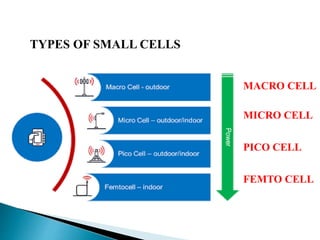
TYPES OF SMALL CELLS
MACRO CELL
MICRO CELL
PICO CELL
FEMTO CELL
FEMTO CELL
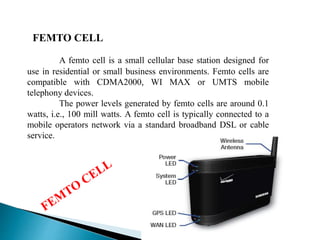
A femto cell is a small cellular base station designed for
use in residential or small business environments. Femto cells are
compatible with CDMA2000, WI MAX or UMTS mobile
telephony devices.
The power levels generated by femto cells are around 0.1
watts, i.e., 100 mill watts. A femto cell is typically connected to a
mobile operators network via a standard broadband DSL or cable
service.
PICO CELL
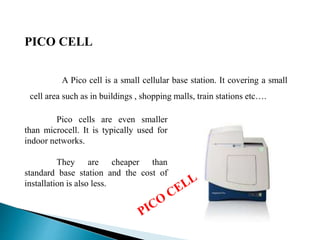
A Pico cell is a small cellular base station. It covering a small
cell area such as in buildings , shopping malls, train stations etc….
Pico cells are even smaller
than microcell. It is typically used for
indoor networks.
They are cheaper than
standard base station and the cost of
installation is also less.
MICROCELL
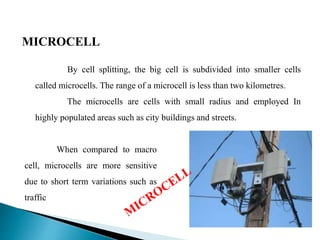
By cell splitting, the big cell is subdivided into smaller cells
called microcells. The range of a microcell is less than two kilometres.
The microcells are cells with small radius and employed In
highly populated areas such as city buildings and streets.
When compared to macro
cell, microcells are more sensitive
due to short term variations such as
traffic
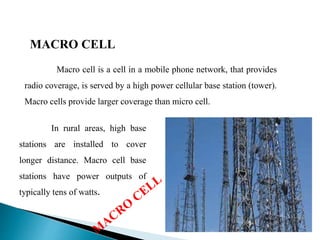
Macro cell is a cell in a mobile phone network, that provides
radio coverage, is served by a high power cellular base station (tower).
Macro cells provide larger coverage than micro cell.
MACRO CELL
In rural areas, high base
stations are installed to cover
longer distance. Macro cell base
stations have power outputs of
typically tens of watts.
Small Cell IN 5G TECHNOLOGY

Small Cell IN 5G TECHNOLOGY

  • 1.
    SMALL CELLS IN5G TECHNOLOGY Presented by G. VIJAY KUMAR
  • 2.
    INTRODUCTION Small cells arelow powered cellular radio access nodes that operate in licensed and unlicensed spectrum that have a range of few kilometers. They are small when compared to a mobile macro cell. Typically small cells are divided into four types they are:  Femto cell  Pico cell  micro cell  macro cell
  • 3.
    A small cellmay transmit at only 50 mill watts, depending on the particular environment. Small cells are indeed small. The units themselves are typically less than 6 cubic feet in volume and consume very little power.
  • 4.
    TYPES OF SMALLCELLS MACRO CELL MICRO CELL PICO CELL FEMTO CELL
  • 5.
    FEMTO CELL A femtocell is a small cellular base station designed for use in residential or small business environments. Femto cells are compatible with CDMA2000, WI MAX or UMTS mobile telephony devices. The power levels generated by femto cells are around 0.1 watts, i.e., 100 mill watts. A femto cell is typically connected to a mobile operators network via a standard broadband DSL or cable service.
  • 6.
    PICO CELL A Picocell is a small cellular base station. It covering a small cell area such as in buildings , shopping malls, train stations etc…. Pico cells are even smaller than microcell. It is typically used for indoor networks. They are cheaper than standard base station and the cost of installation is also less.
  • 7.
    MICROCELL By cell splitting,the big cell is subdivided into smaller cells called microcells. The range of a microcell is less than two kilometres. The microcells are cells with small radius and employed In highly populated areas such as city buildings and streets. When compared to macro cell, microcells are more sensitive due to short term variations such as traffic
  • 8.
    Macro cell isa cell in a mobile phone network, that provides radio coverage, is served by a high power cellular base station (tower). Macro cells provide larger coverage than micro cell. MACRO CELL In rural areas, high base stations are installed to cover longer distance. Macro cell base stations have power outputs of typically tens of watts.